Exam
Name___________________________________
MULTIPLE CHOICE. Choose the one alternative that best completes the statement or answers the question.
1)
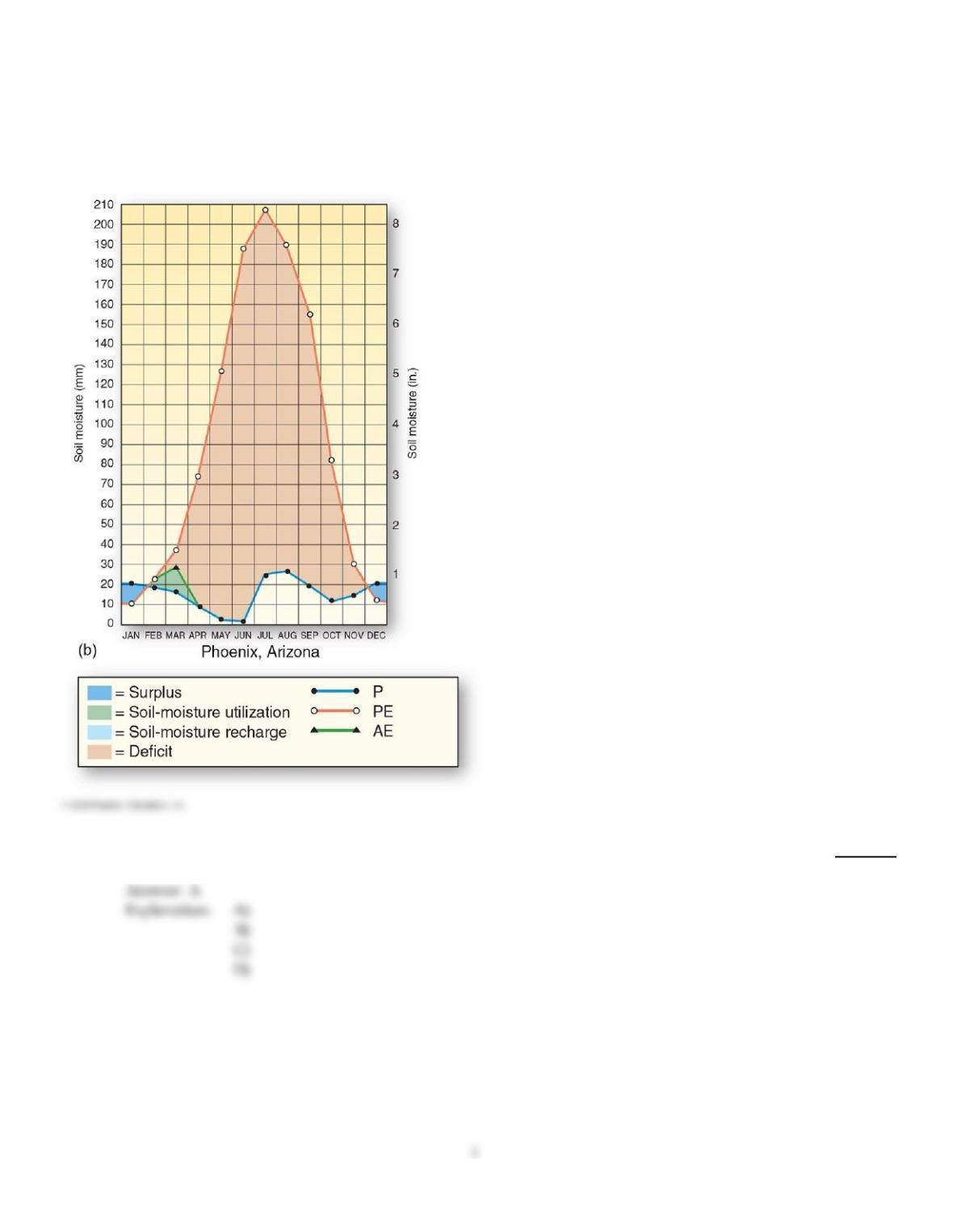
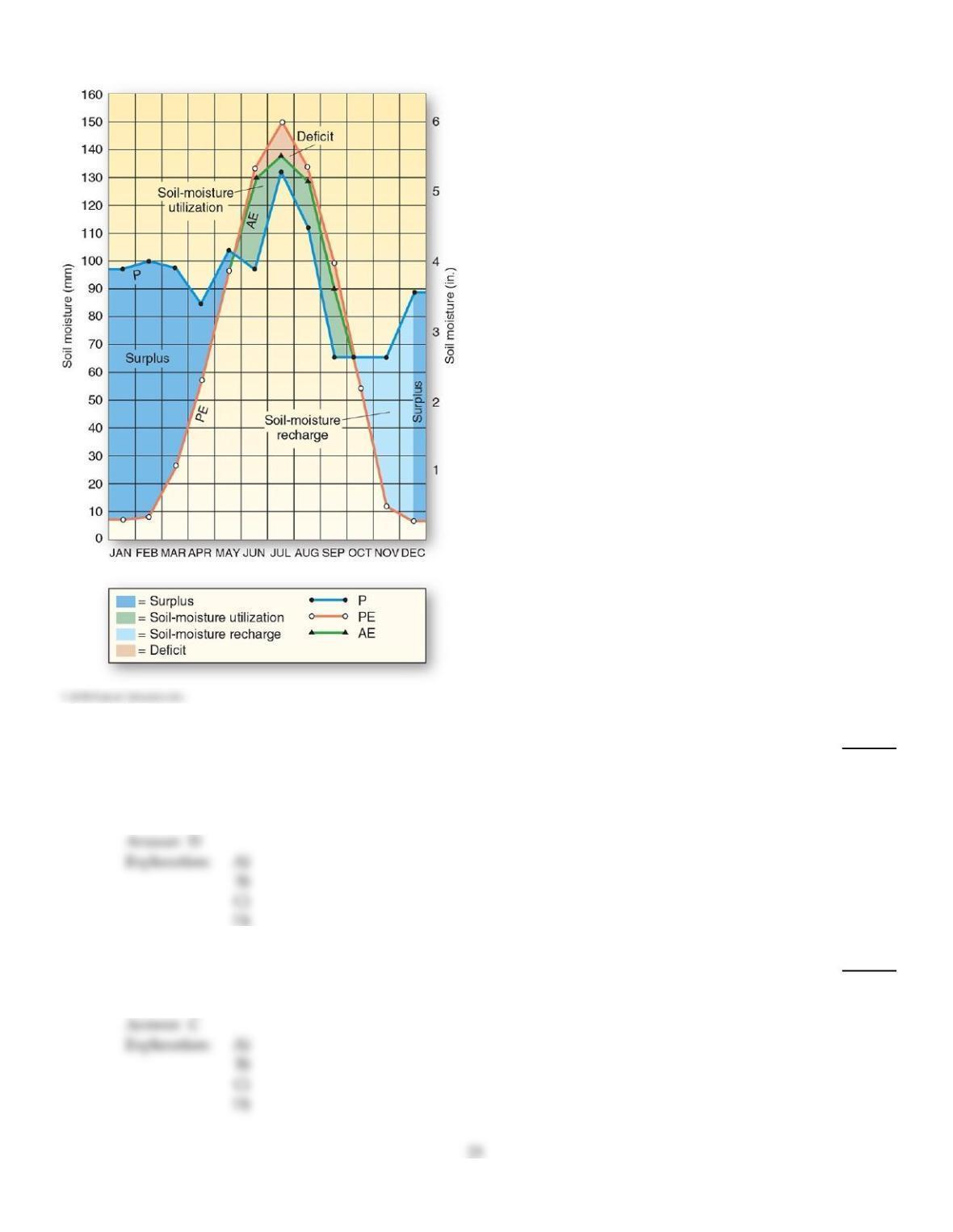
Actual evapotranspiration for Phoenix, Arizona is highest during
1)
A)
March.
B)
September.
C)
July.
D)
February.
2)
The largest practical potential source of fresh water in the world is
2)
A)
ice sheets and glaciers.
B)
soil moisture.
C)
stream discharge.
D)
groundwater.
3)
Which of the following is TRUE regarding the amount of water in rivers, streams, and the
atmosphere?
3)
A)
They contain 0.033 percent of the world’s fresh water supply.
B)
They contain 11.02% of the world’s fresh water supplies.
C)
The amount of the world’s fresh water in rivers and streams is greater than that in the
atmosphere.
D)
Combined, they contain the majority of the world’s freshwater.
4)
A drought defined based on decreases in streamflow, lowering of reservoir levels, and declines in
snowpacks is a(n)
4)
A)
meteorological drought.
B)
agricultural drought.
C)
hydrological drought.
D)
socioeconomic drought.
5)
A water surplus occurs when
5)
A)
potential evapotranspiration is greater than soil moisture.
B)
the additional inputs of water into a system are not enough to satisfy potential
evapotranspiration.
C)
additional water exists after potential evapotranspiration is satisfied by precipitation inputs.
D)
the potential evapotranspiration demand cannot be satisfied by precipitation inputs.
6)
Which condition may exist when the potentiometric surface is above ground level
6)
A)
a confined aquifer may become an unconfined aquifer.
B)
artesian water may rise to the surface.
C)
groundwater recharge of the aquifer.
D)
drawdown in the well.
7)
Intercepted water that drains across plant leaves and down their stems to the ground is known as
7)
A)
stem flow.
B)
infiltration.
C)
overland flow.
D)
throughfall.
8)
Some of Earth’s water supply originated from
8)
A)
gases expelled from the Sun; i.e., solar wind.
B)
photosynthesis.
C)
asteroids.
D)
icy comets.
9)
Drawdown refers to
9)
A)
the aquifer recharge area.
B)
effluent conditions where groundwater feed streamflow.
C)
the lowering of an aquifer from overuse.
D)
the potentiometric surface of an aquifer.
10)
The water in wetlands is
10)
A)
always freshwater.
B)
always saltwater.
C)
either freshwater or saltwater.
D)
too polluted to use as a water resource.
11)
Evapotranspiration from Earth’s land surface represents ________ percent of water entering the
atmosphere.
11)
A)
14
B)
44
C)
86
D)
78
12)
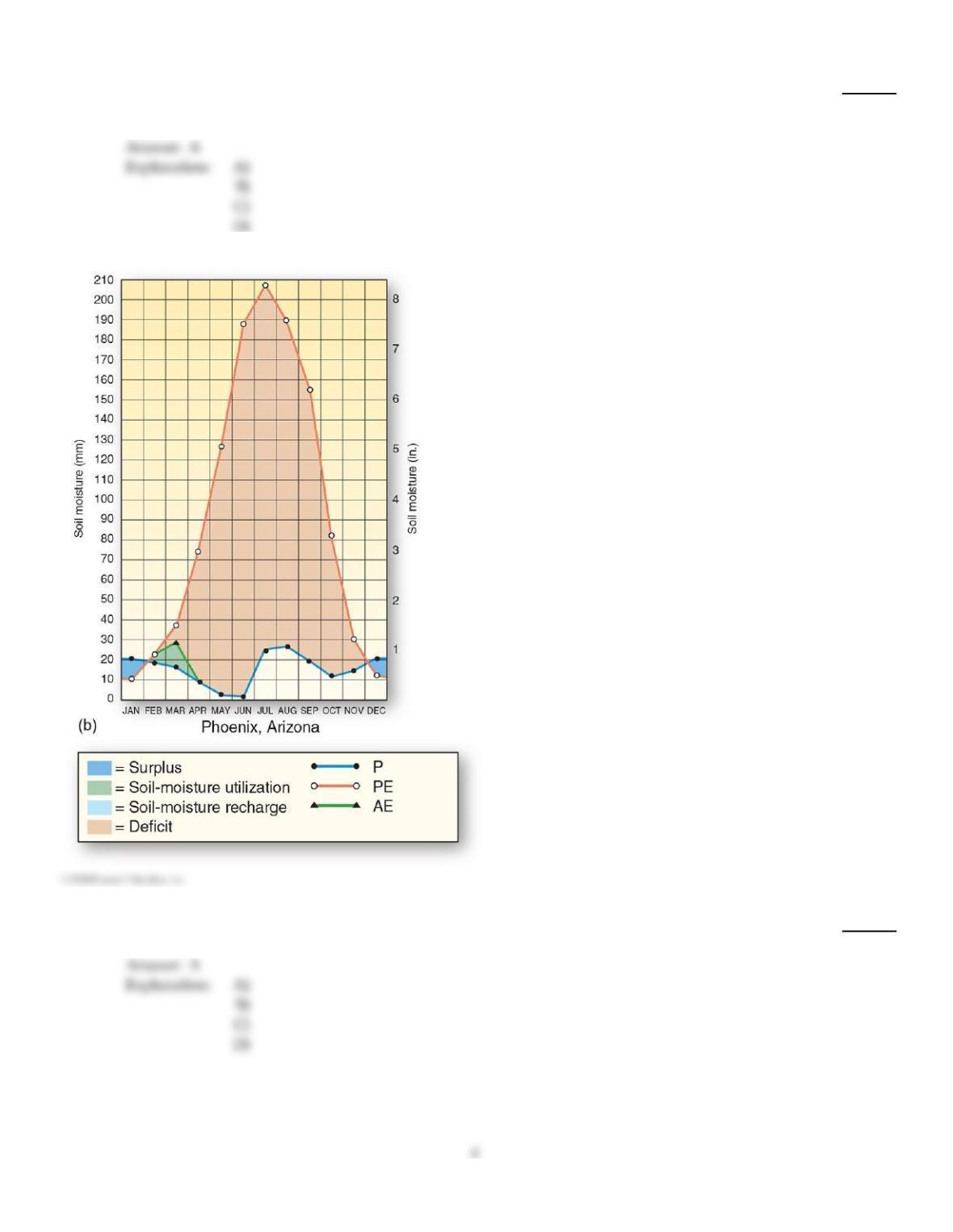
Potential evapotranspiration for Phoenix, Arizona is highest during
12)
A)
July.
B)
March.
C)
September.
D)
February.
13)
The California State Water Project is
13)
A)
a multi–year plan designed to harvest rainwater for agricultural purposes.
B)
a water conveyance system to distribute water resources throughout the state.
C)
an ambition goal to build a hydroelectric power station larger than China’s Three Gorges.
D)
a proposed dam of the Colorado River between the Parker and Palo Verde Dam.
14)
________ occurs when precipitation lands on vegetation or other land cover before reaching the
surface.
14)
A)
Interception
B)
Surface runoff
C)
Infiltration
D)
Overland flow
15)
The main source of groundwater is
15)
A)
the zone of aeration above the water table.
B)
precipitation that percolates downward as gravitational water.
C)
hygroscopic water in the soil.
D)
surface water where it intersects the zone of recharge.
16)
The downslope, unchannelized flow of water across the surface is known as
16)
A)
throughfall.
B)
infiltration.
C)
stem flow.
D)
overland flow.
17)
Glacio–eustatic factors refer to
17)
A)
changes in sea level related to the increase or decrease in quantities of ice.
B)
changes in sea level related to the melting of icebergs.
C)
changes in the total amount of water on Earth.
D)
a steady–state equilibrium in the water system.
18)
Hydropower power currently provides the world with approximately ________ of the world’s
electricity.
18)
A)
1/5th
B)
2/3rds
C)
1/2
D)
1/4th
19)
Precipitation that falls directly to the ground is known as
19)
A)
stem flow.
B)
infiltration.
C)
overland flow.
D)
throughfall.
20)
In the water budget, ________ is the major “receipt” and ________ is the major “expenditure.”
20)
A)
precipitation; evapotranspiration
B)
outgassing; dissociation
C)
evapotranspiration; precipitation
D)
insolation; radiative cooling
21)
Which of the following is an example of the consumptive use of water?
21)
A)
Using water for a bath
B)
Water which evaporates from an irrigated field
C)
Hydroelectric power production
D)
River navigation
22)
Which of the following is an example of the instream use of water?
22)
A)
Water for livestock production
B)
Hydroelectric power production
C)
Irrigating crops
D)
Water used in the manufacturing process
23)
The largest reservoir in the world by volume is
23)
A)
Lake Nasser.
B)
Lake Kariba.
C)
Lake Guri.
D)
Lake Votka.
24)
A drought defined by the degree of dryness as compared to a regional average and the duration of
dryness is a(n)
24)
A)
meteorological drought.
B)
agricultural drought.
C)
hydrological drought.
D)
socioeconomic drought.
A
25)
The High Plains aquifer
25)
A)
was not heavily mined until the 1960s.
B)
has little importance as a freshwater resource.
C)
is also known as the Garber–Wellington Aquifer.
D)
is North America’s largest known aquifer system.
D
B
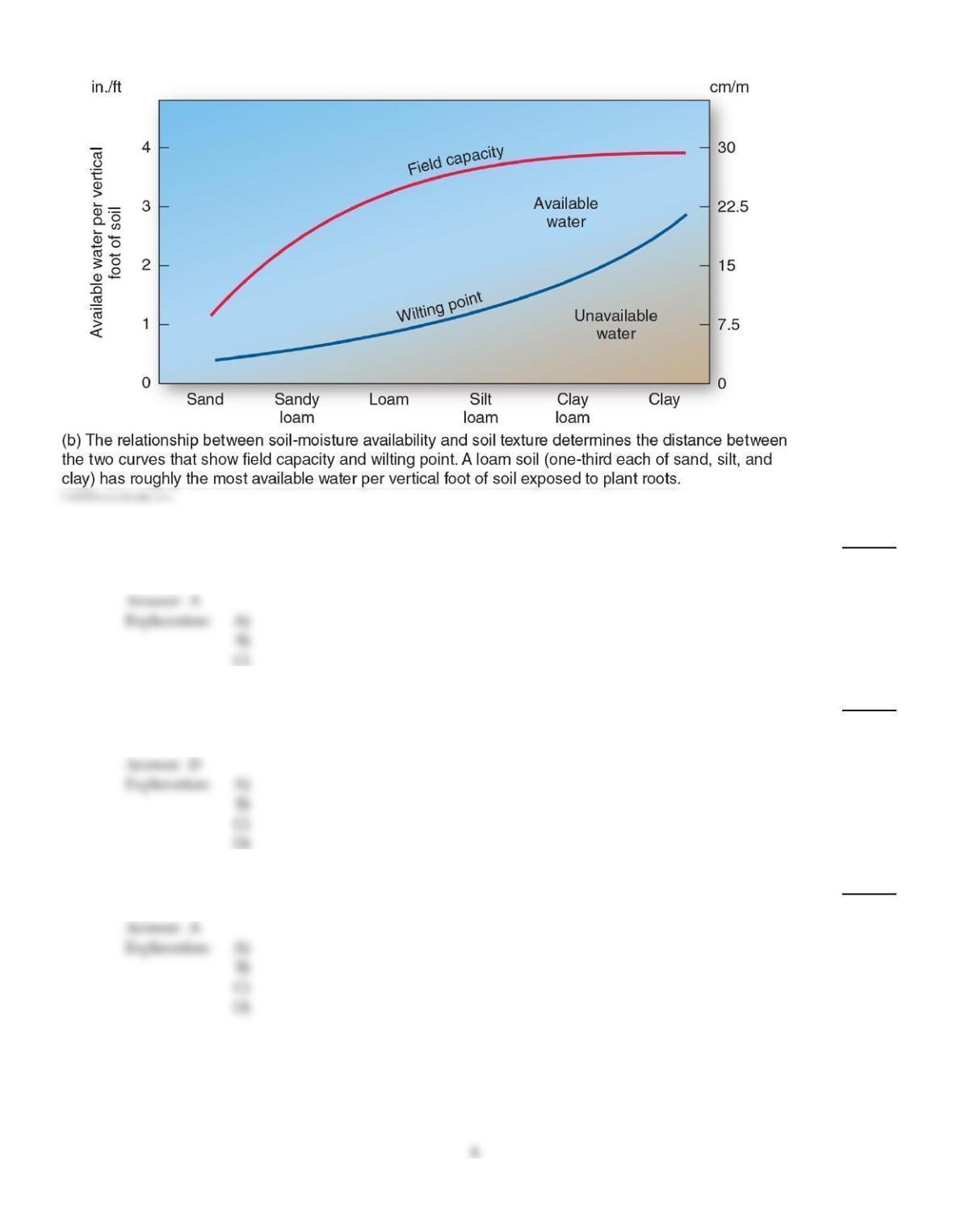
26)
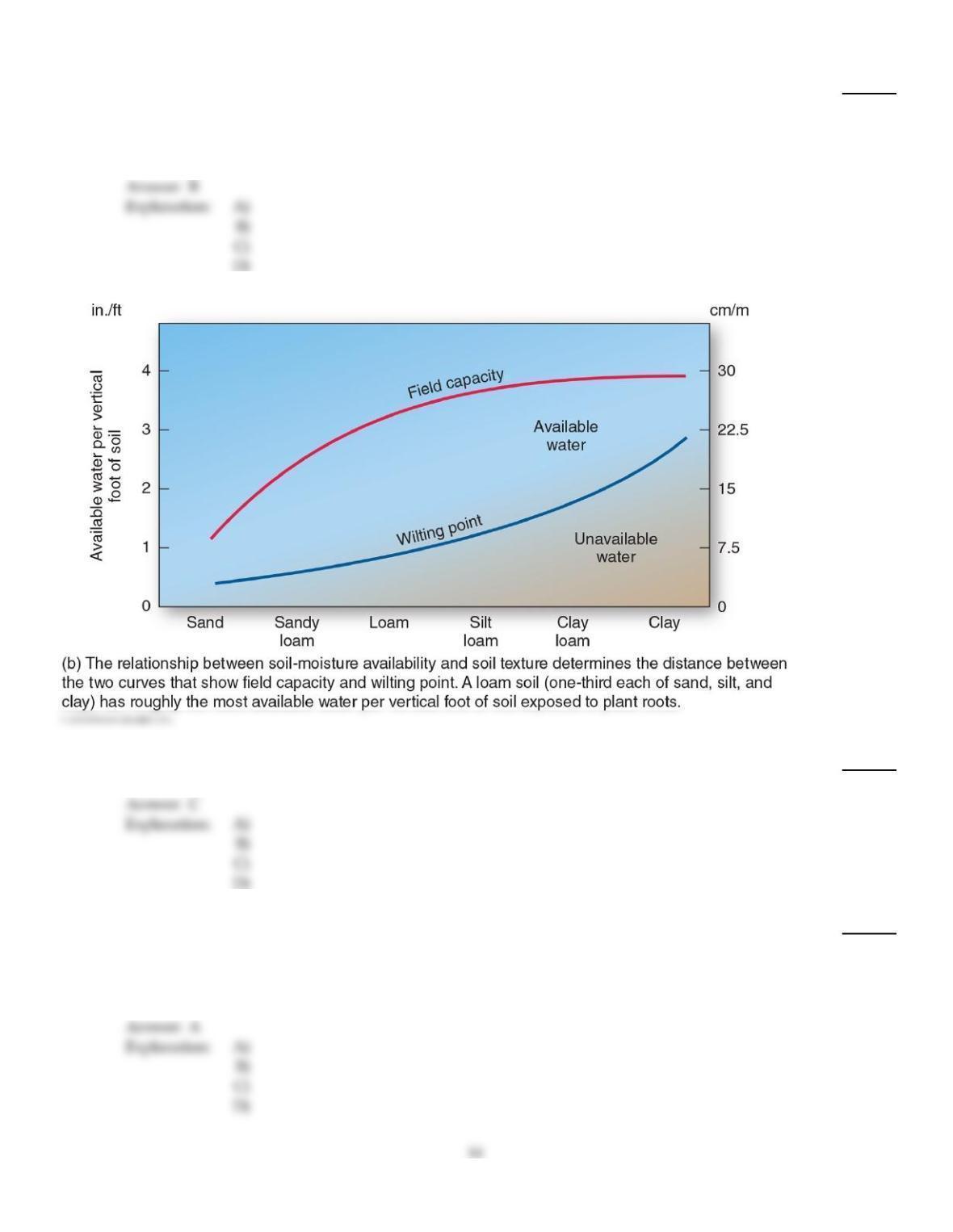
The amount of water associated with the wilting point in clay is ________ than that for sand and
silt.
26)
A)
greater
B)
less
C)
approximately the same
27)
The permanent removal of water from the immediate water environment is known as
27)
A)
nonconsumptive use.
B)
offstream.
C)
water withdrawal.
D)
consumptive use.
28)
An estimated ________ percent of Earth’s precipitation occurs over oceans.
28)
A)
78
B)
8
C)
22
D)
14
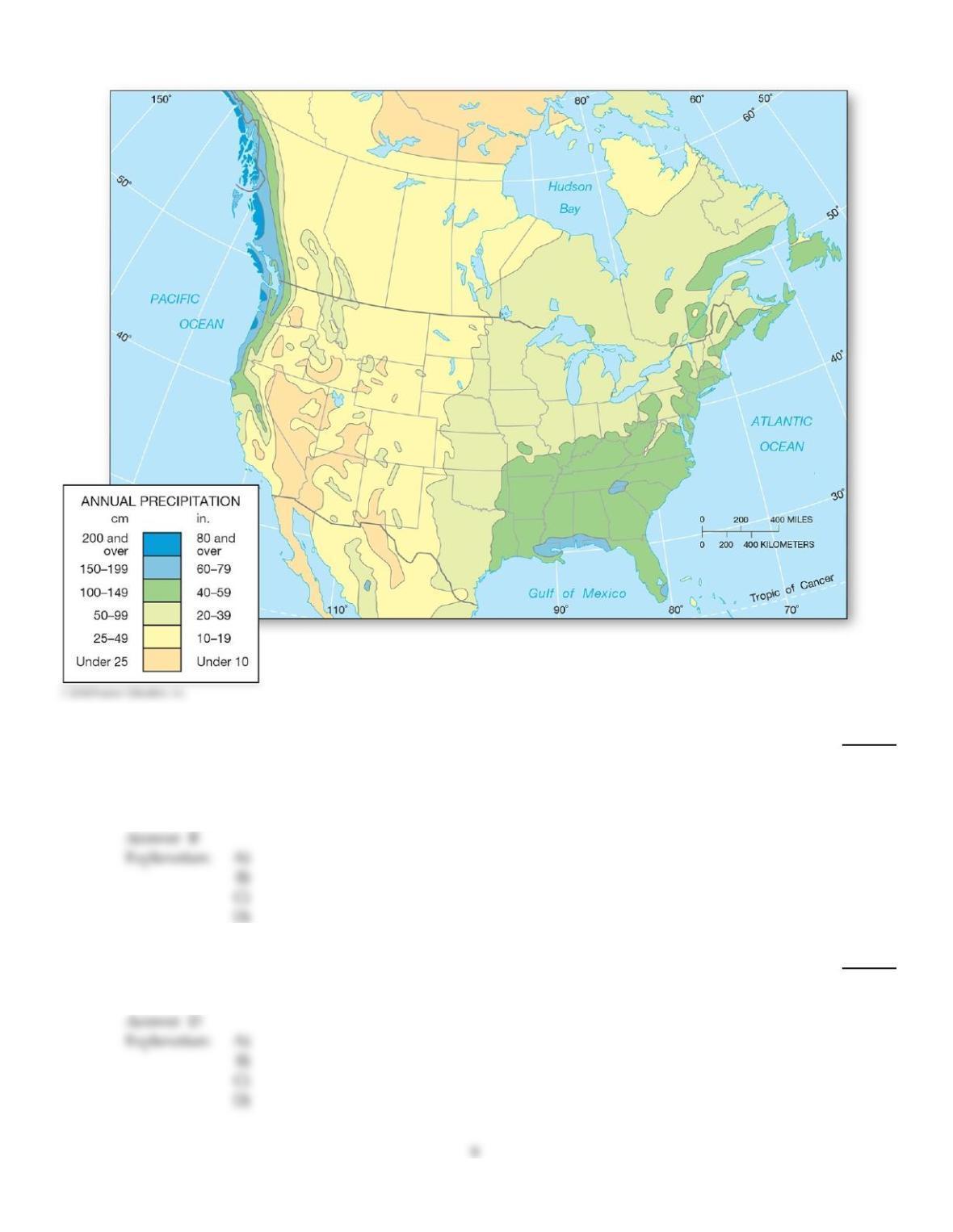
29)
Which of the following is TRUE of precipitation in North America?
29)
A)
The lowest amounts are received in the Midwest.
B)
The highest amounts occur in the Southeast and extreme South.
C)
The lowest amounts are received near Hudson Bay.
D)
The highest amounts occur in the Southwest and Midwest.
30)
The largest fresh water lake in the world by volume is
30)
A)
Lake Superior.
B)
Lake Michigan.
C)
Lake Tanganyika.
D)
Lake Baikal.
31)
The utilization of aquifers beyond their flow and recharge capacities is known as
31)
A)
groundwater mining.
B)
the contact surface.
C)
the potentiometric surface.
D)
influent conditions.
32)
If precipitation and soil moisture are inadequate to meet potential evapotranspiration demands, the
moisture condition is described as
32)
A)
a deficit.
B)
a surplus.
C)
actual evapotranspiration.
D)
soil moisture utilization.
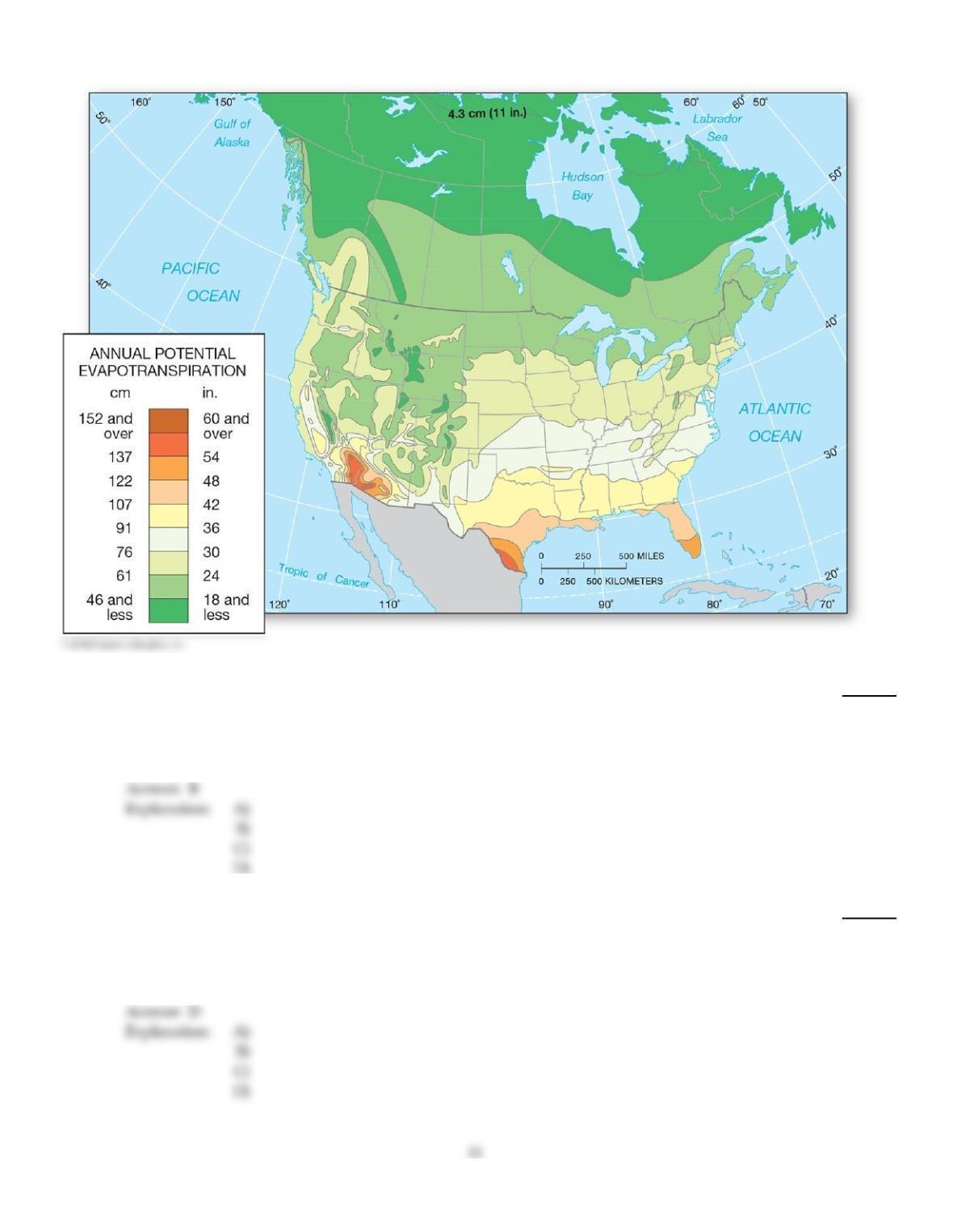
33)
Which of the following is TRUE of potential evapotranspiration in North America?
33)
A)
The highest amounts are received in the U.S. Pacific Northwest.
B)
The lowest amounts occur in northern Canada.
C)
The highest amounts are received in the Midwest.
D)
The lowest amounts occur in the Southwest and southern Texas.
34)
Which of the following is TRUE regarding groundwater?
34)
A)
In terms of total amount, it is second to streams in the United States.
B)
When polluted, it is actually easier to clean up than is surface water.
C)
It is unlimited when compared with the amount of surface water supplies.
D)
The total amount of groundwater has been reduced by the mining of water.
35)
Which of the following is NOT an example of a potential surface water resource?
35)
A)
Rivers
B)
Artificial lakes
C)
Aquifers
D)
Glaciers
36)
The hydrologic cycle doesn’t include water
36)
A)
in the atmosphere.
B)
at a depth of up to several kilometers below the surface.
C)
from the liquid outer core.
D)
at the surface of Earth and in the oceans.
37)
Other than ice sheets and glaciers, the largest repository of fresh water is located in
37)
A)
soil moisture storage.
B)
lakes and saline seas.
C)
groundwater.
D)
rivers and streams.
38)
Which of the following is NOT a main component of the hydrologic cycle?
38)
A)
Surface
B)
Subsurface
C)
Atmosphere
D)
Cryosphere
39)
Earth’s oceans possess
39)
A)
ninety–seven percent of Earth’s waters.
B)
fifty percent of Earth’s waters.
C)
about the same amount of water as is in the atmosphere.
D)
most of the fresh water on Earth.
40)
The hydrologic cycle
40)
A)
refers to the highly localized transfer of water from plants and soils to the atmosphere and
back.
B)
is the groundwater component of the global water cycle.
C)
involves the continuous movement of water in all its states throughout the lower atmosphere,
biosphere, lithosphere, and hydrosphere.
D)
is limited to freshwater circulation in the hydrosphere.
41)
The texture and structure of the soil dictate all of the following EXCEPT
41)
A)
available pore spaces (i.e., the soil’s porosity).
B)
flow of water through soil (i.e., the soil’s permeability).
C)
the field capacity.
D)
the wilting point.
E)
hygroscopic water.
42)
The net movement of free water molecules away from a wet surface into air that is less than
saturated is known as
42)
A)
evaporation.
B)
deposition.
C)
sublimation.
D)
precipitation.
43)
The term “ground water mining” refers to
43)
A)
the excavation of tunnels to reach ground water.
B)
the use of ground water to mine minerals.
C)
the removal of ground water at a rate faster than that at which it can be replaced.
D)
the removal of overlying rock to reach ground water.
44)
Transpiration refers to
44)
A)
the movement of free water molecules away from a wet surface.
B)
the outward movement of water from plant leaves.
C)
evaporation.
D)
an amount of moisture loss from the surface that cannot be measured.
45)
Of the following, which soil type has the highest field capacity?
45)
A)
Loam
B)
Silt loam
C)
Clay loam
D)
Sandy loam
C
46)
Potential evapotranspiration refers to
46)
A)
the amount of evapotranspiration that would occur if available water was not limited.
B)
the amount of evapotranspiration measured from an evaporation pan.
C)
the average amount of evapotranspiration over an area per unit time.
D)
a precise measurement of evapotranspiration using a lysimeter.
A
B
47)
________ occurs when soil soaks water into the subsurface
47)
A)
Stem flow
B)
Throughfall
C)
Infiltration
D)
Overland flow
48)
Which of the following is TRUE of the distribution of land and water on Earth?
48)
A)
The Southern Hemisphere is dominated by water.
B)
The Northern Hemisphere is dominated by water.
C)
They are evenly distributed in both hemispheres.
A
49)
Approximately what percent of the world’s irrigation water is from groundwater?
49)
A)
15 percent
B)
25 percent
C)
50 percent
D)
80 percent
D
50)
The Colorado River is an exotic stream. This means
50)
A)
it mostly flows through arid environments, though its headwaters are located in a region of
water surplus.
B)
it crosses multiple countries, as well as states, in its path to the sea.
C)
it contains a variety of exotic species, which it transports from its source to all regions through
which it flows.
D)
it is used for multiple purposes, including hydroelectricity generation, irrigation, water
supplies, and recreation.
A
51)
Which of the following is NOT a cited benefit of China’s Three Gorges Dam on the Yangtze River?
51)
A)
Flood control
B)
Pollution abatement
C)
Redistribution of water supplies
D)
Hydroelectric power
B
C
52)
Which of the following is NOT necessary for an aquifer to exist?
52)
A)
Hygroscopic water
B)
Porosity
C)
Permeability
D)
Zone of saturation
53)
Eustasy refers to
53)
A)
changes in the total amount of water on Earth.
B)
a steady–state equilibrium in the water system.
C)
worldwide changes in sea level.
D)
the amount of new water from outgassing volcanoes.
54)
Which of the following is TRUE when the soil is at field capacity?
54)
A)
The soil is holding the maximum amount of water that it can hold against the pull of gravity.
B)
A surplus definitely exists.
C)
No gravity drainage has occurred.
D)
The capillary force is not acting.
55)
Which of the following is a potential source of ground water pollution?
55)
A)
Dumps
B)
Septic tanks
C)
Pesticides and fertilizers
D)
Septic tanks, pesticides and fertilizers, and dumps
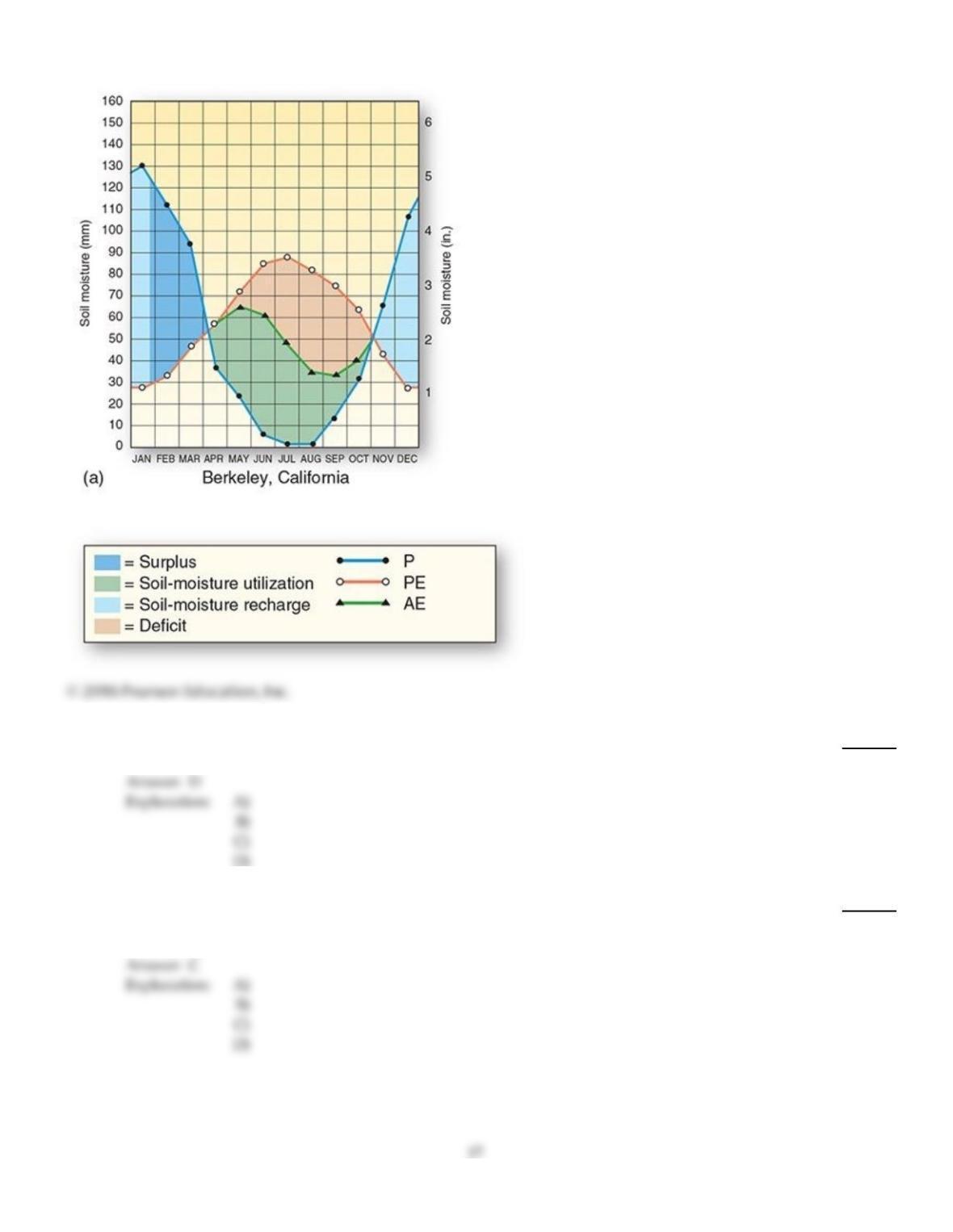
56)
Berkeley, CA has the highest amount of precipitation during the
56)
A)
summer.
B)
autumn.
C)
spring.
D)
winter.
57)
The largest portion of fresh water today is located in
57)
A)
clouds.
B)
the major rivers and lakes of the world.
C)
ice caps and glaciers.
D)
groundwater resources.
C
D
58)
The portion of streamflow that consists of groundwater is known as
58)
A)
saturated flow.
B)
base flow.
C)
surface runoff.
D)
overland flow.
59)
Which of the following is NOT considered an issue pertaining to water resources in the future?
59)
A)
Growing populations will continue to exploit water resources.
B)
Regional drought will increase pressure on groundwater resources.
C)
Pollution will limit the water–resource base.
D)
Desalination will exacerbate dwindling freshwater supplies.
60)
The term “cone of depression” refers to
60)
A)
a graphical representation of the decline in the rate of ground water flow as an aquifer dries
out.
B)
a depression in Earth’s surface formed by ground water withdrawal.
C)
a change in the level of the soil water zone.
D)
a depression in the water table formed by rapid ground water withdrawal.
61)
The subsurface are in which all pore spaces are completely fill with water is known as
61)
A)
water table.
B)
zone of saturation.
C)
base flow.
D)
gravitational zone.
62)
The line of contact between the zone of aeration and the zone of saturation is known as the
62)
A)
aquiclude.
B)
influent line.
C)
water table.
D)
saturation contact.
63)
Water covers approximately ________ of Earth’s surface.
63)
A)
50 percent
B)
71 percent
C)
25 percent
D)
90 percent
64)
If one were to map a vertical profile of groundwater resources, which of the following is CORRECT
order from top to bottom?
64)
A)
Zone of aerationwater tablezone of saturationimpermeable rock
B)
Zone of aerationzone of saturationwater tableimpermeable rock
C)
Zone of saturationwater tablezone of aerationimpermeable rock
D)
Water tablezone of aerationzone of saturationimpermeable rock
65)
Excess surface water percolates through the zone of ________ to reach the zone of ________ and the
water table.
65)
A)
porosity; permeability
B)
hydration; infiltration
C)
dehydration; hydration
D)
aeration; saturation
66)
Which of the following is TRUE regarding freshwater on Earth?
66)
A)
Most of it is frozen in glaciers and ice caps.
B)
Most of it is in freshwater lakes, rivers, and streams.
C)
Most of it is groundwater.
D)
Most of it is in large lakes.
67)
About 50 percent of the 125,000 km3 (30,000 mi3) of freshwater in lakes is
67)
A)
located in the 40 largest lakes.
B)
in the Great Lakes.
C)
saline.
D)
located in just seven lakes.
68)
Soil moisture tightly bound to each soil particle and unavailable for plant use is termed ________
water.
68)
A)
capillary
B)
available
C)
hygroscopic
D)
gravitational
69)
Approximately ________ countries are currently experiencing water shortages.
69)
A)
5
B)
10
C)
80
D)
165
70)
Which of the following would decrease the rate at which evapotranspiration occurs?
70)
A)
Increased water availability
B)
Increased temperatures
C)
Increased humidity
D)
Increased wind speed
71)
Which of the following types of water is accessible to plants?
71)
A)
Deficit water
B)
Transpired water
C)
Capillary
D)
Hygroscopic
72)
The ________ Ocean contains the largest volume of water.
72)
A)
Pacific
B)
Atlantic
C)
Arctic
D)
Indian
73)
Actual evapotranspiration is
73)
A)
Surplus subtracted from Precipitation total.
B)
Surplus subtracted from Potential Evaporation.
C)
an actual expenditure of the water to the atmosphere.
D)
when atmospheric demand exceeds water supplies.
74)
A water–bearing rock stratum is called a(n)
74)
A)
aquifer.
B)
aquiclude.
C)
zone of aeration.
D)
water table.
75)
Which of the following is an example of the nonconsumptive use of water?
75)
A)
River navigation
B)
Hydroelectric power production
C)
Water consumption by humans and livestock
D)
Municipal treatment of wastewater
76)
An estimated ________ percent of precipitation over land infiltrates the subsurface, of which
________ percent returns to the atmosphere via evapotranspiration.
76)
A)
75; 75
B)
44; 80
C)
76; 85
D)
35; 97
77)
Which of the following is TRUE regarding the hydrologic cycle?
77)
A)
Seventy–eight percent of all precipitation falls on the oceans.
B)
Very little moisture is evaporated from the sea to the land.
C)
Twenty–two percent of Earth’s precipitation falls over the oceans.
D)
The bulk of the precipitation occurs over land.
78)
Water enters the soil in a process called ________, and then moves downward through the soil in a
process called ________.
78)
A)
percolation; throughfall
B)
throughfall; percolation
C)
infiltration; percolation
D)
percolation; infiltration
79)
A drought defined by the shortage of precipitation and soil moisture effects on crop yield is a(n)
79)
A)
meteorological drought.
B)
agricultural drought.
C)
hydrological drought.
D)
socioeconomic drought.
80)
Soil moisture that plants are capable of accessing and using is called
80)
A)
free molecular water.
B)
capillary water.
C)
wilting point water.
D)
hygroscopic water.
81)
Outgassing refers to
81)
A)
process in which water and water vapor emerge from deep layers within and below Earth’s
crust.
B)
the dynamic equilibrium between surface and ocean water.
C)
a steady–state equilibrium in the water system caused by cycles of evaporation and
condensation.
D)
changes in the total amount of water on Earth through evapotranspiration.
82)
The movement of water into the atmosphere from plants is
82)
A)
evaporation.
B)
transpiration.
C)
sublimation.
D)
precipitation.
83)
The water balance for Kingsport, Tennessee exhibits
83)
A)
water deficits each month of the year.
B)
net demands for water for 10 months of the year.
C)
a net water surplus (SURPL) during each month of the year.
D)
water deficits in the summer months.
84)
Approximately what percent of the U.S. population derives a portion of its fresh water from
groundwater sources?
84)
A)
10 percent
B)
30 percent
C)
50 percent
D)
90 percent
85)
An estimated ________ percent of Earth’s evaporation occurs over oceans.
85)
A)
97
B)
16
C)
86
D)
71
86)
Which of the following accurately describes annual groundwater withdrawal in the United States
and Canada?
86)
A)
Withdrawals increased 150 percent between 1950 and 2000.
B)
The percentage of withdrawals in the United States and Canada are about the same.
C)
The amount withdrawn is equal to river discharges in the United States.
D)
Groundwater pumping is presently not exceeding water recharge rates.
TRUE/FALSE. Write ‘T’ if the statement is true and ‘F’ if the statement is false.
87)
An erupting geyser is an example of outgassing.
87)
88)
Potential evapotranspiration is a direct measurement of the amount of evapotranspiration that
occurs in a given area during a given period of time.
88)
89)
Meltwater from glaciers and snowpacks provide water for humans in many parts of the world.
89)
90)
Groundwater represents the largest potential freshwater source on Earth.
90)
91)
Desalination removes organic compounds, debris, and salinity from seawater and represents a
method to provide potable water for domestic use.
91)
92)
Center pivot agriculture which pumps water from an aquifer is an example of instream water use.
92)
93)
Water is a renewable resource, constantly cycling through the environment in the hydrologic cycle.
93)
94)
Warming temperatures can lead to both increases and decreases in lake levels.
94)
95)
Sea–level change caused by glacial activity is known as glacioeustasy.
95)
96)
Human made lakes are generally called reservoirs.
96)
97)
Nonconsumptive water use involves the return of water to its source after use.
97)
98)
Precipitation is the main source of groundwater, percolating downward as gravitational water
from the soil moisture zone.
98)
ESSAY. Write your answer in the space provided or on a separate sheet of paper.
99)
Briefly describe the various surface water resources. Which resources are available in your area? What are the
large water projects in your area, such as water transfer pr or dams?
100)
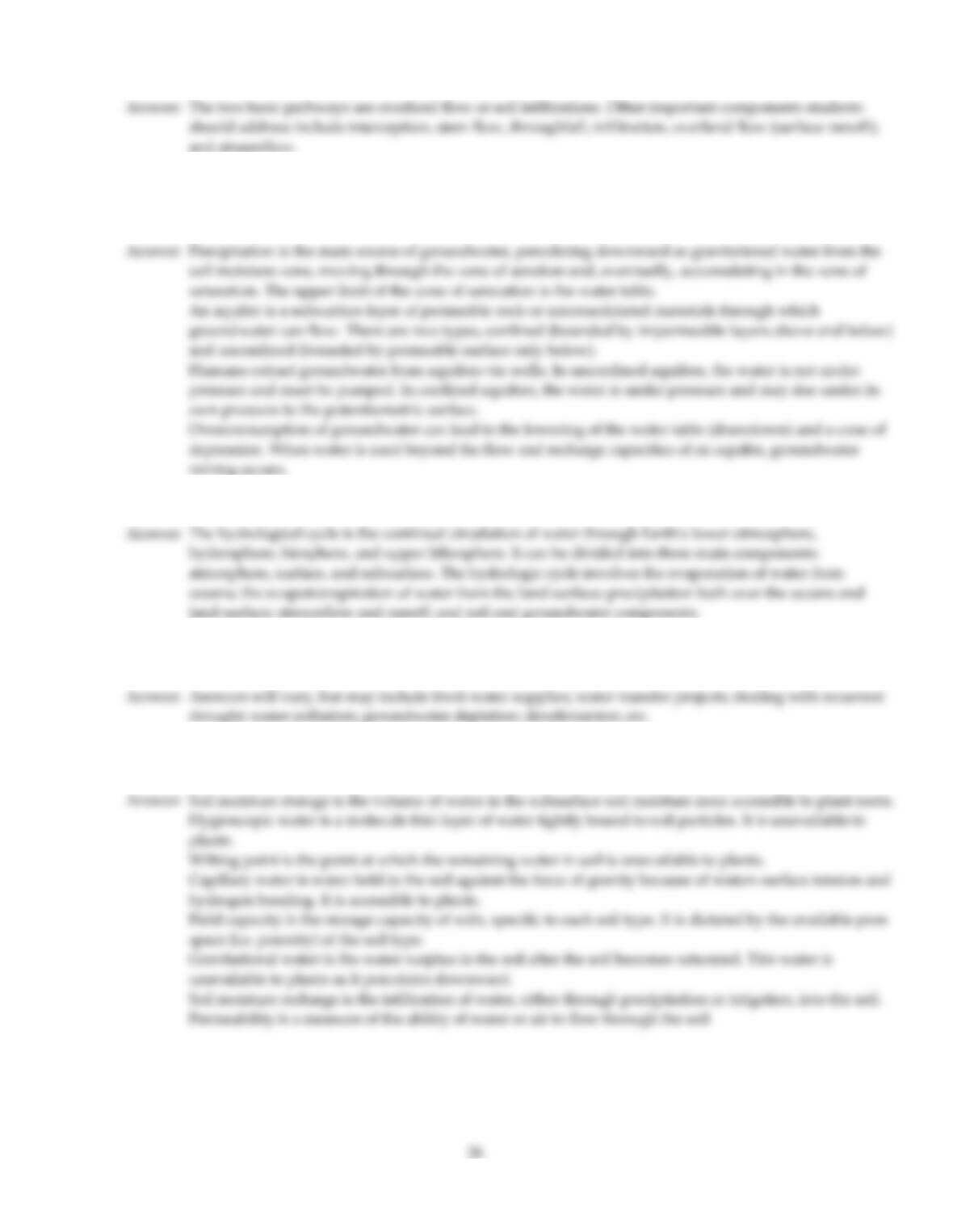
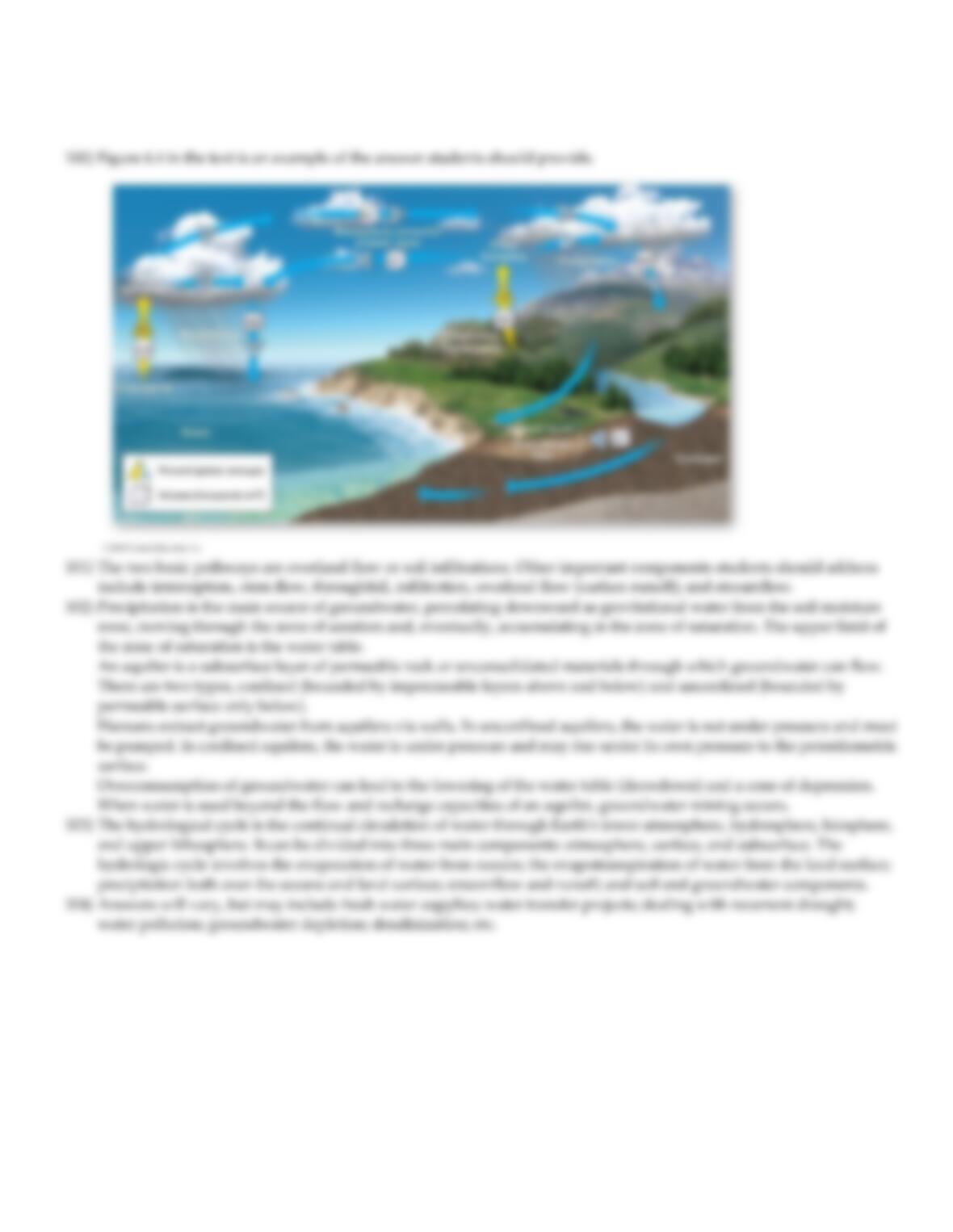
Draw and label a diagram of the hydrologic cycle.
101)
What are the two basic pathways precipitation can take once it reaches Earth’s surface?
102)
Discuss the different aspects of groundwater storage and movement below the surface. Include the ways in
which groundwater comes to the surface on its own, or is drawn to the surface by humans, along with the
consequences.
103)
Describe the hydrological cycle, including its different components.
104)
What are the water issues your community is currently facing? How will these issue likely be addressed in the
future?
105)
Define the following: soil–moisture storage, hygroscopic water, wilting point, capillary water, field capacity,
gravitational water, soil–moisture recharge, soil porosity, and soil permeability.
106)
Describe the location and percentage of all water on Earth. Where are the largest repositories; where are the
smallest repositories?
107)
Discuss nonconsumptive use, consumptive use, and instream use as it pertains to the area in which you live.
Answer Key
Testname: C6
Answer Key
Testname: C6
Answer Key
Testname: C6
30
Answer Key
Testname: C6
31