
52. Which of the following statements is false?
a.
About 1.2 million people are killed worldwide annually in motor vehicle accidents.
b.
Motor vehicles are the largest source of air pollution.
c.
More Americans have been killed by automobiles than on battlefields in all U.S. wars.
d.
In the United States, more than 40,000 people die annually in motor vehicle accidents.
e.
Motor vehicles are second only to industry as a source of air pollution in the U.S.
53. Full-cost pricing of gasoline refers to taxing gasoline by the gallon, as it is purchased, to cover the
estimated harmful costs of driving. This tax has been estimated to be:
a.
$2.90 per gallon
b.
$12.00 per gallon just for the tax
c.
$12.00 per gallon when combined with the cost of the gas itself
d.
$4.00 per gallon
e.
$4.00 per liter
54. Advantages of Mass Transit Rail systems include which of the following?
a.
Causes fewer injuries and deaths than cars.
b.
Inexpensive to build.
c.
Produces less air pollution than cars.
d.
All of these answers are correct.
e.
Two of these answers choices are correct
55. Smart growth or new urbanism tools include greenbelts around cities, high density cluster housing, and
a.
extensive freeway networks to provide efficient travel to and from work
b.
taxing buildings
c.
taxing land instead of buildings
d.
no construction of expensive mass transit systems
e.
use of only fuel efficient personal transportation
56. Which of the following statements about Vauban, a suburb of Freiberg, Germany,is false?
a.
A small minority of homeowner own cars
b.
Street parking is forbidden.
c.
Each home is within walking distance of trains going to and from surrounding areas.
d.
Most homes are single family homes.
e.
The town has a car-sharing club.

57. An ecocity is
a.
car oriented
b.
industry oriented
c.
profit oriented
d.
people oriented
e.
family oriented
58. In an ecocity, plants are utilized to provide shade and beauty. Typically, the plants are
a.
always fast-growing, broadleaf plants
b.
adapted to local climate and soils
c.
adapted so they do not use much water
d.
resistant to pests
e.
always endemic plants
59. If you visited Curitiba, Brazil, you would expect to find
a.
no recycling program
b.
a sophisticated bus system
c.
very polluted air
d.
residents who wish to relocate to other cities
e.
no high-rise apartments
60. Which of the following statements about Curitiba, Brazil, is false?
a.
Day care centers are free for low-income parents.
b.
Recycled old buses are used as health clinics and soup kitchens.
c.
95 percent of the citizens can read.
d.
70 percent of the paper used is recycled.
e.
Each household owns one very fuel-efficient car.
TRUE/FALSE
1. Family planning, economic opportunities for women, and schooling for girls generally produces a
higher birth rate.

2. Currently there are five hypercities in the world, one of which is Tokyo, Japan.
3. Urban areas are attracting more and more residents, partly because of the hope for employment.
4. The declining economic health of cities often reduces services to their residents: water, electricity,
open spaces, timely garbage collection, etc.
5. Birth and death rates generally decline as countries develop economically.
6. Death rates are very high during the preindustrial stage of demographic transitions.
7. Megacities have improved significantly over the last decade due to public water supplies and better
sanitation.
8. A major factor in human population increase in the last 200 years is the emergence of early and
modern agriculture.
9. Some analysts believe that because of our technological ingenuity, there are few, if any, limits to
human population growth and resource use per person,
10. Women are now having fewer babies but not few enough to stabilize the world’s population.

11. Women who live in rural areas have a lower total fertility rate than those in urban areas.
12. Because of the concentration of people, automobiles, business enterprises, and industries in cities, they
can never be sustainable.
13. The environmental limits that will control growth of the human population are precisely known by
scientists.
14. Based on resource use per person, the United States is more overpopulated than China.
15. The availability of, or lack of, private and public pension funds can influence the decision of some
couples on how many children to have.
16. Mexico City has recently improved its air quality.
17. Car sharing has been tried in Germany, but was not found to be effective or successful.
18. Most of the increase in the world’s population in the last 100 years took place because of a sharp
increase in birth rates.
19. One of the reasons for a lower life expectancy in the United States is the fact that it has one of the
world’s highest obesity rates.

COMPLETION
1. You live in an ecocity where the world’s best bus system transports about 72% of all commuters each
day. You may be living in_______________.
2. ____________________ refers to a process in which an increasing proportion of an entire population
lives in cities and the suburbs of cities.
3. An advantage of ____________________ is the decrease in birth rates and decrease in abortions.
4. Technological advances have allowed humans to avoid the pressure of ____________________.
5. In areas with a low ____________________, people usually have fewer children because of the
increased life expectancy.
6. You live in a country where married couples pledging to have no more than one child receive financial
incentives and benefits. You live in__________.

7. Urban areas with poor sanitation and numerous health risks will generally have a low
____________________.
8. You live in a village where street parking and driveways are forbidden and the community has no
single-family homes. You may be living in__________________.
9. A city that emphasizes prevention of pollution, reduction of waste, and effective use of resources is
called a(n) ____________________.
10. China’s family planning and birth control program was instituted because of a serious threat of
____________________.
11. Analysts vary as to their opinion of which factor is the more serious threat to the Earth’s life support
systems: ____________________ or ____________________.
12. If everyone on the planet reached the U.S. level of consumption of renewable resources by the year
2050, we would need ____________________ Earths to meet the demand.
130
13. As countries become more ____________________, their populations tend to grow more slowly.
14. In the United States, the percentage of married women working outside the home increased from
__________ to ________ between the years 1900 and 2000.
15. Most urban areas are ____________________ systems.
16. Inadequate health care for poor women during pregnancy is one of the reasons the United States has
such a high____________________.
MATCHING
Match the items listed below with the appropriate choice
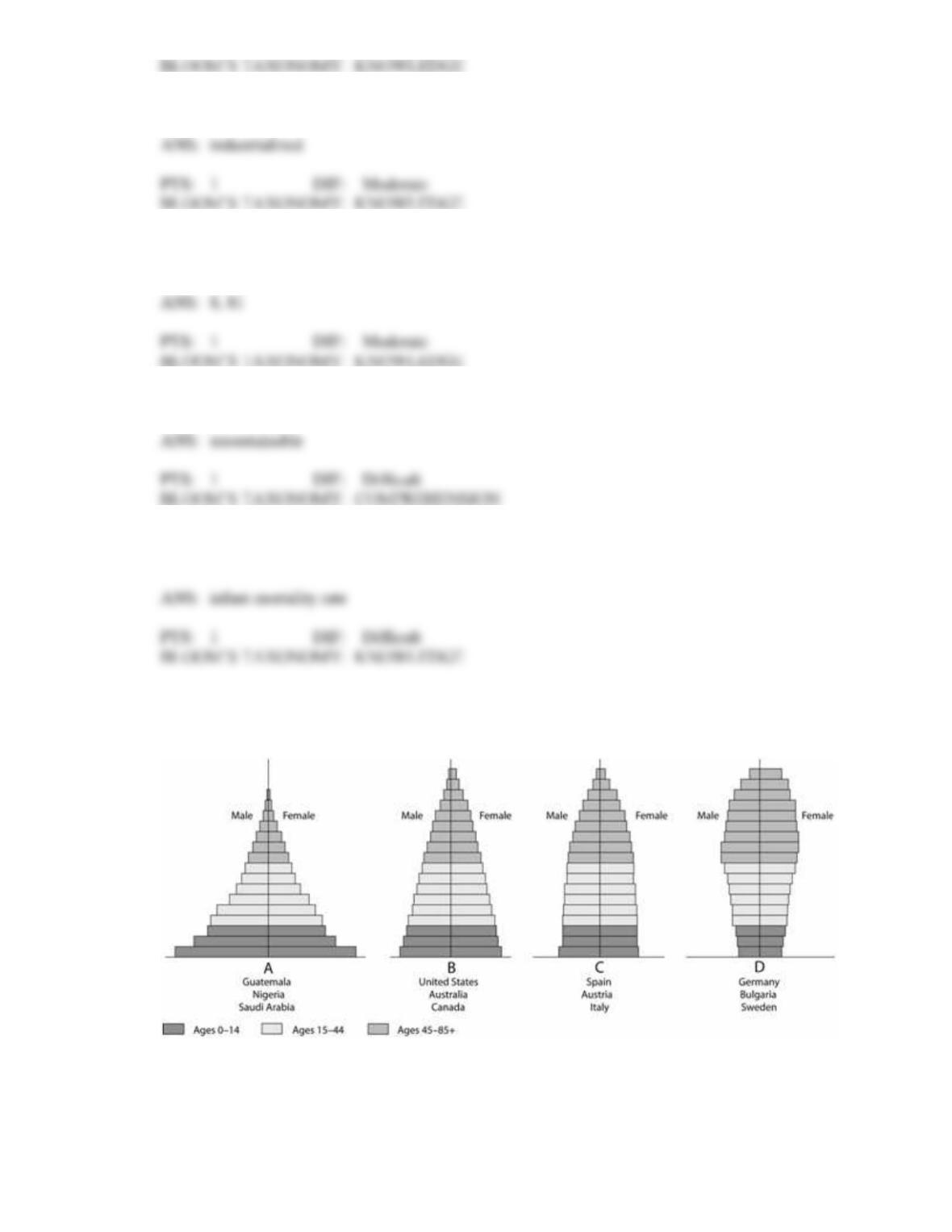
1. On the generalized population age structure figure, choose the diagram with similar numbers of males
and females in prereproductive and reproductive categories.
131
2. On the generalized population age structure figure, choose the diagram with demographic momentum.
3. On the generalized population age structure figure, choose the diagram that represents a population
that is increasing slowly.
4. On the generalized population age structure figure, choose the diagram that shows a declining
population.
Match the items listed below with the appropriate choice
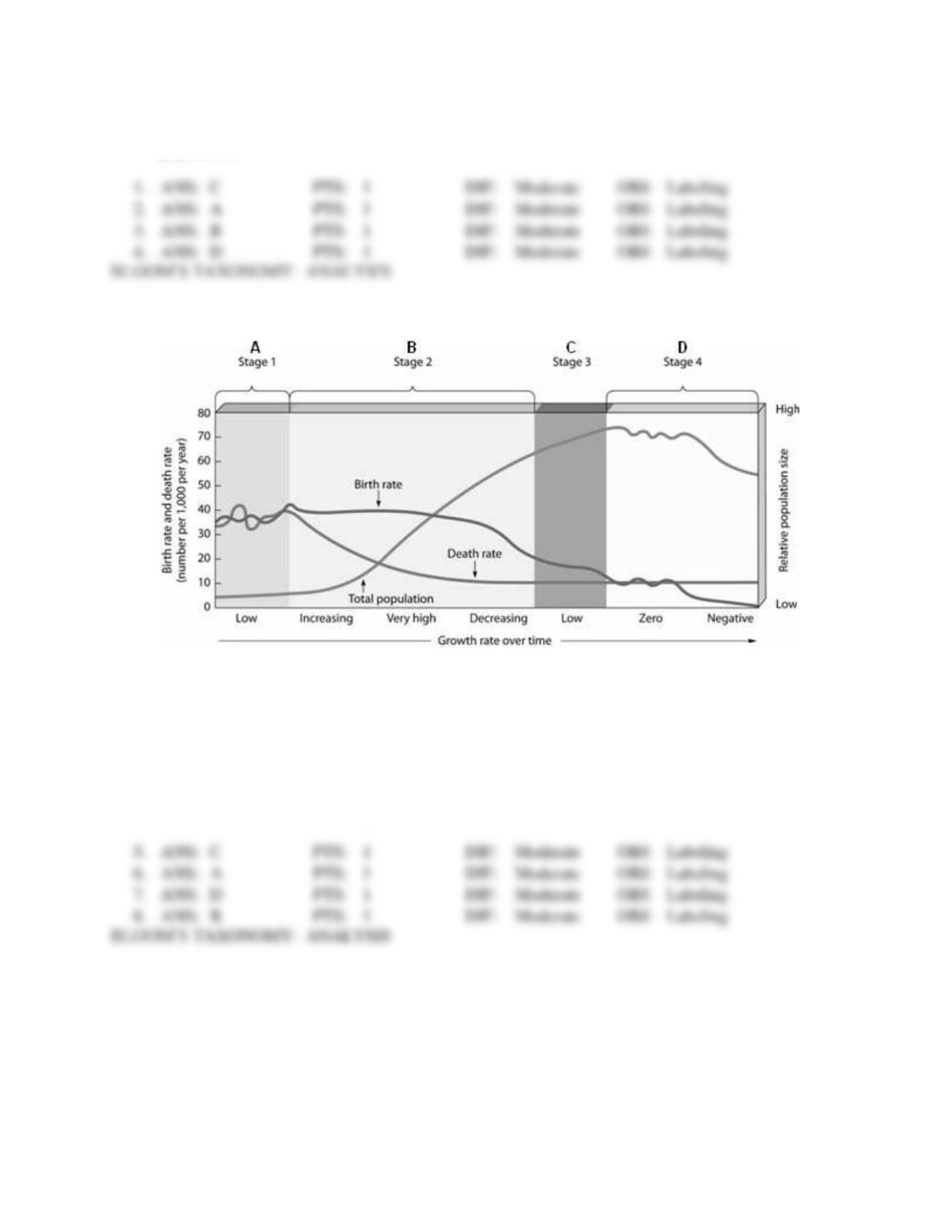
5. On the generalized model of the demographic transition, choose the stage in which population growth
continues but at a slower and rate.
6. On the generalized model of the demographic transition, choose the stage that has a high birth rate and
a high death rate.
7. On the generalized model of the demographic transition, choose the stage in which most countries
experience zero growth rate.
8. On the generalized model of the demographic transition, choose the stage in which death rates
decrease and birth rates are high.

Use the list of three sustainability principles below to categorize actions taken by the city of Curitiba,
Brazil, (or any city) in an effort to become more sustainable.
a.
reliance on solar energy
c.
chemical cycling
b.
Biodiversity
9. Flood-prone areas along the river banks have been converted to parks.
10. Volunteers have planted more than 1.5 million trees throughout the city.
11. Tax credits are available for installing solar panels on private homes.
12. 60% of metal, glass, and plastic is recycled.
13. Poor people who live in areas without garbage pick-up can exchange filled garbage bags for surplus
food and school supplies.
14. City government buildings have solar panels to help heat the buildings.
15. 70% of the paper used in the city is recycled.
16. For every tree that is cut down in the city, two have to be planted to replace it.
SHORT ANSWER
1. Can the city you now live in become an ecocity? Name four things your city could do to begin a
transition to ecocity status. Hint: Think of the processes now in place in Curitiba, Brazil.
2. Explain this statement: The world’s population growth has slowed, but the world’s population is still
growing. Include a comment about where the slowing has occurred.
3. Briefly explain the root cause of the increase in the world’s population during the last 100 years.
ESSAY
1. Briefly discuss the baby boomers and their effect on our population profile.
2. Explain the term demographic momentum and provide a real-life example.
3. List the four ways that urban sprawl affects natural capital degradation of water resources.
4. List and briefly describe the seven factors that affect a country’s average birth rate and total fertility
rate.
5. Explain why as incomes rise we draw more from nature’s ecological credit card, and what the
suspected consequences are
6. Briefly explain the bottom line for analysts who believe that adding more people to the planet is not a
problem.