Cost Accounting: A Managerial Emphasis, 6e
Chapter 6 – Master Budget and Responsibility Accounting
Use the information below to answer the following question(s).
Copper Corporation has the following sales budget for the last six months of 2012:
July
$200,000
October
$180,000
August
160,000
November
200,000
September
220,000
December
188,000
Historically, the cash collection of sales has been as follows:
65 percent of sales collected in month of sale,
25 percent of sales collected in month following sale,
8 percent of sales collected in second month following sale, and
2 percent of sales is uncollectable.
7) Cash collections for September are
A) $143,000.
B) $161,400.
C) $199,000.
D) $204,000.
E) $240,000.
8) What is the ending balance of accounts receivable at the end of September assuming uncollectible
balance is written off in the third month after the sale?
A) $199,000
B) $97,000
C) $89,800
D) $93,000
E) $88,000
Cost Accounting: A Managerial Emphasis, 6e
Chapter 6 – Master Budget and Responsibility Accounting
9) Cash collections for October are
A) $117,000.
B) $184,800.
C) $199,000.
D) $176,400.
E) $174,000.
10) The cash budget is a schedule of expected cash receipts and disbursements that
A) requires an aging of accounts receivable and accounts payable.
B) is a self-liquidating cycle.
C) is prepared immediately after the sales forecast.
D) predicts the effect on the cash position at given levels of operations.
E) is prepared by the organization’s bank.
Cost Accounting: A Managerial Emphasis, 6e
Chapter 6 – Master Budget and Responsibility Accounting
Use the information below to answer the following question(s).
Grinnell Manufacturing Company has the following information for 2012:
Month
Budgeted Sales
January
$76,000
February
85,000
March
92,000
April
79,000
Budget Expenses per Month
Wages
$15,000
Advertising
12,000
Depreciation
3,000
Other
4 percent of sales
Note: All cash expenses are paid as incurred; Collections from sales are 50% in the month of sale and 50%
in the month following the sale; December 2011 sales were $110,000.
11) What is the expected total cash disbursements for expenses in February?
A) $33,400
B) $30,000
C) $30,200
D) $30,400
E) $27,000
12) What are the expected total cash receipts for February?
A) $118,500
B) $89,000
C) $88,500
D) $85,000
E) $80,500
Cost Accounting: A Managerial Emphasis, 6e
Chapter 6 – Master Budget and Responsibility Accounting
13) What is the budgeted net operating income for the first quarter of 2012?
A) $132,640
B) $135,280
C) $172,160
D) $123,640
E) $140,560
Answer the following question(s) using the information below.
The following information pertains to Tiffany Company:
Month
Sales
Purchases
January
$30,000
$16,000
February
$40,000
$20,000
March
$50,000
$28,000
• Cash is collected from customers in the following manner:
Month of sale 30%
Month following the sale 70%
• 40% of purchases are paid for in cash in the month of purchase, and the balance is paid the following
month.
• Labour costs are 20% of sales. Other operating costs are $15,000 per month (including $4,000 of
depreciation). Both of these are paid in the month incurred.
• The cash balance on March 1 is $4,000. A minimum cash balance of $3,000 is required at the end of the
month. Money can be borrowed in multiples of $1,000.
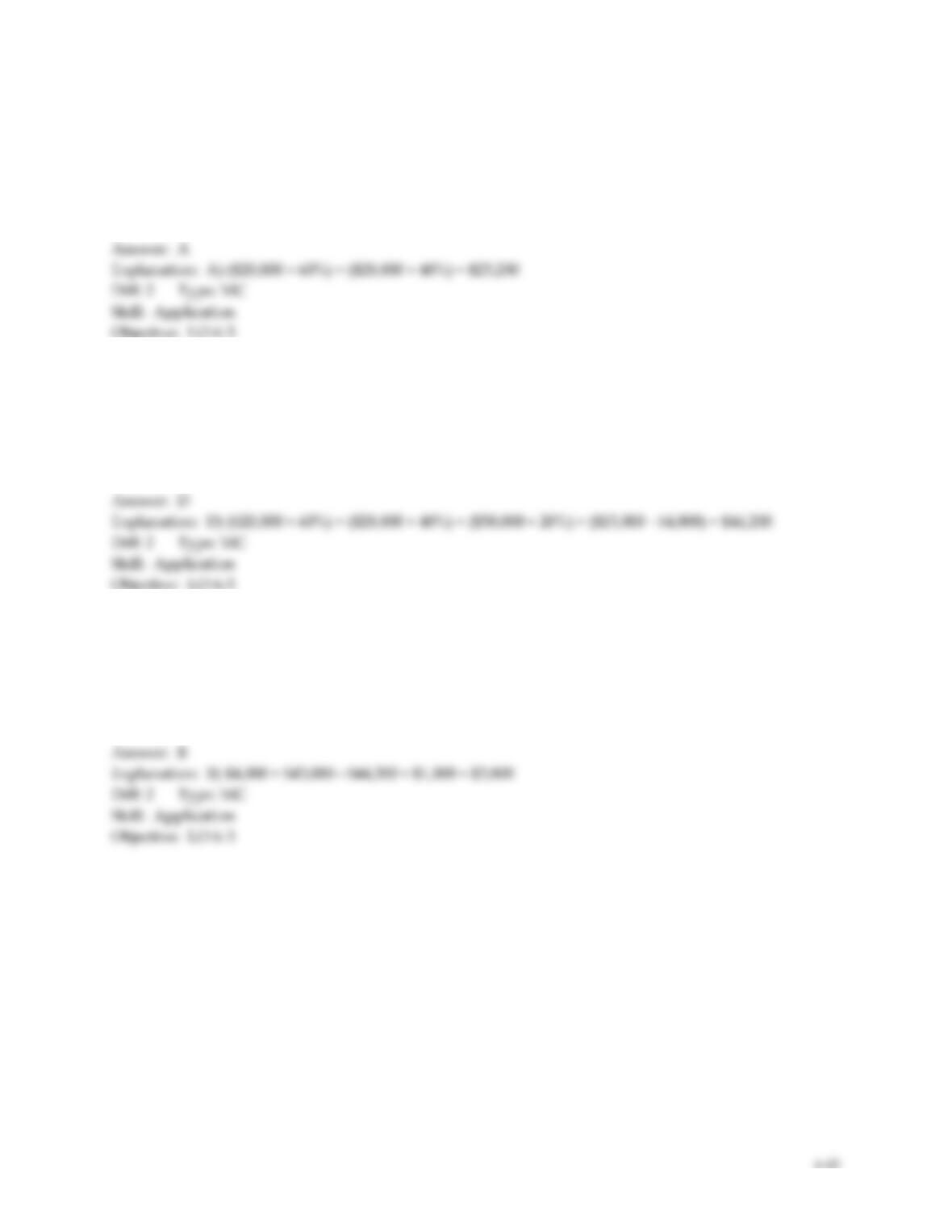
14) How much cash will be collected from customers in March?
A) $47,000
B) $45,000
C) $50,000
D) $33,000
E) $43,000
Cost Accounting: A Managerial Emphasis, 6e
Chapter 6 – Master Budget and Responsibility Accounting
15) How much cash will be paid to suppliers in March?
A) $23,200
B) $28,000
C) $44,000
D) $24,800
E) $17,600
16) How much cash will be disbursed in total in March?
A) $21,000
B) $25,000
C) $48,200
D) $44,200
E) $45,800
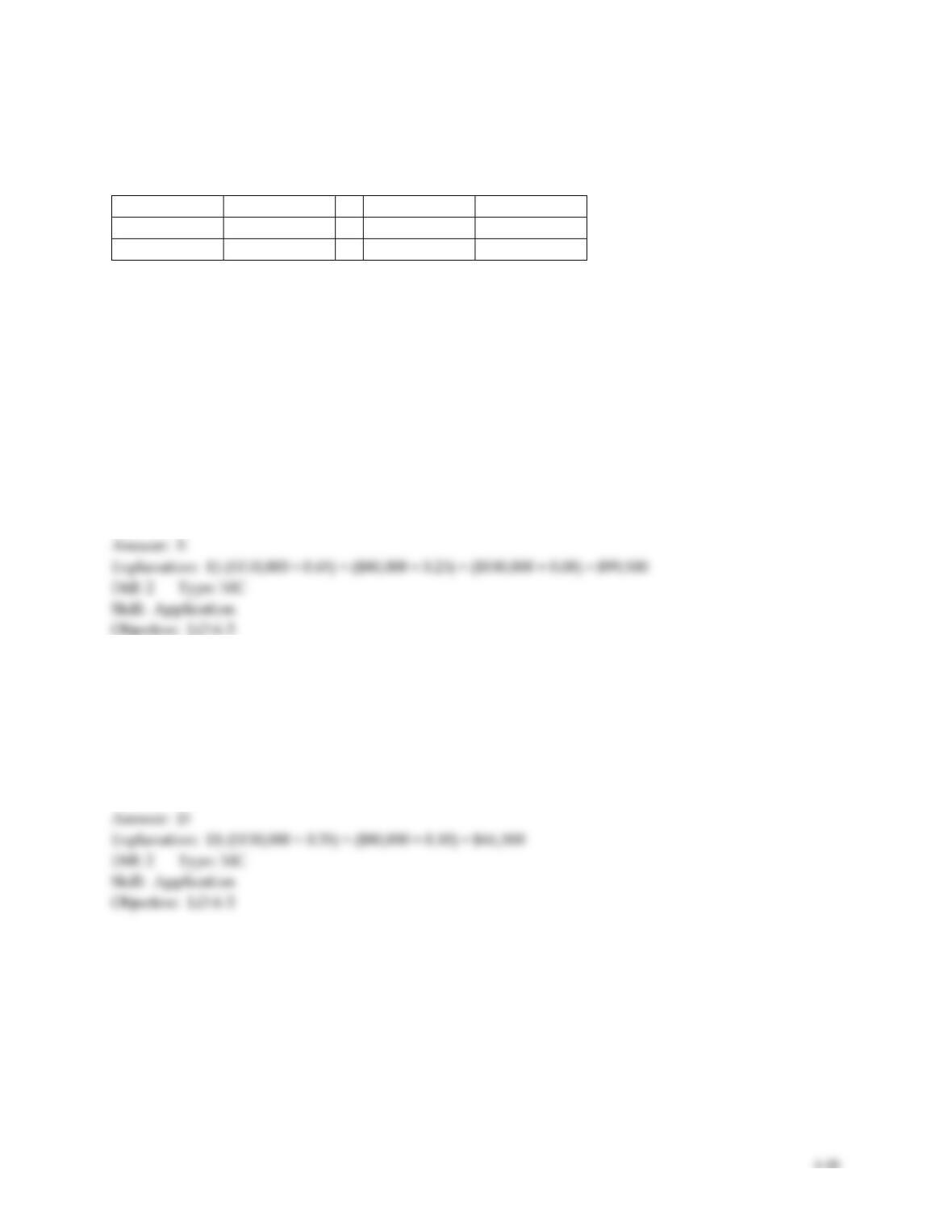
17) What is the ending cash balance for March after borrowing, if required?
A) $4,000
B) $3,800
C) $3,200
D) $2,800
E) $3,000
Cost Accounting: A Managerial Emphasis, 6e
Chapter 6 – Master Budget and Responsibility Accounting
Answer the following question(s) using the information below.
Fiscal Company has the following sales budget for the last six months of 2013:
July
$100,000
October
$90,000
August
80,000
November
100,000
September
110,000
December
94,000
Historically, the cash collection of sales has been as follows:
65% of sales collected in the month of sale,
25% of sales collected in the month following the sale,
8% of sales collected in the second month following the sale, and
2% of sales are uncollectible.
18) Cash collections for September are
A) $71,500
B) $86,700
C) $110,000
D) $102,000
E) $99,500
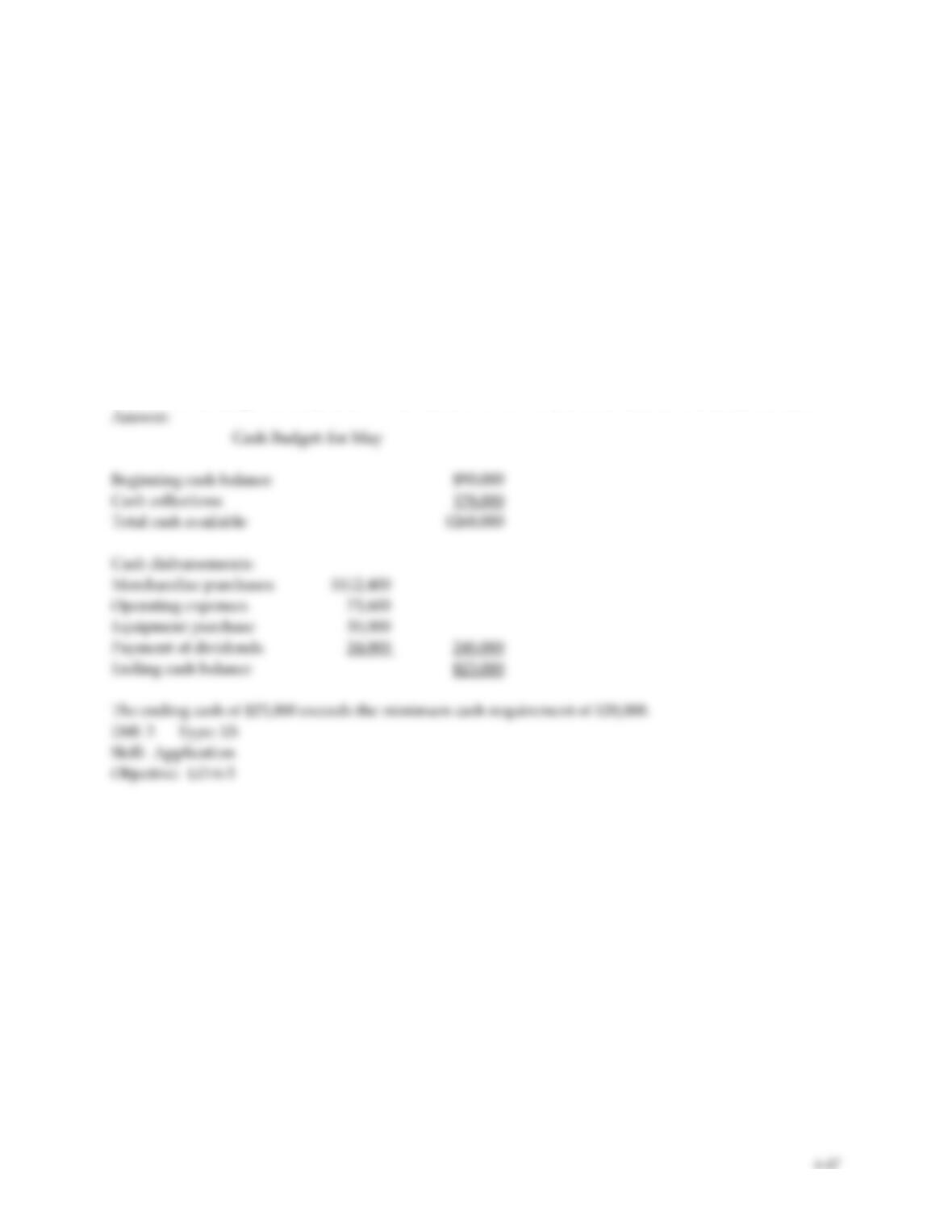
19) What is the ending balance of accounts receivable for September, assuming uncollectible balances are
written off during the second month following the sale?
A) $99,500
B) $48,500
C) $44,900
D) $46,500
E) $54,500
Cost Accounting: A Managerial Emphasis, 6e
Chapter 6 – Master Budget and Responsibility Accounting
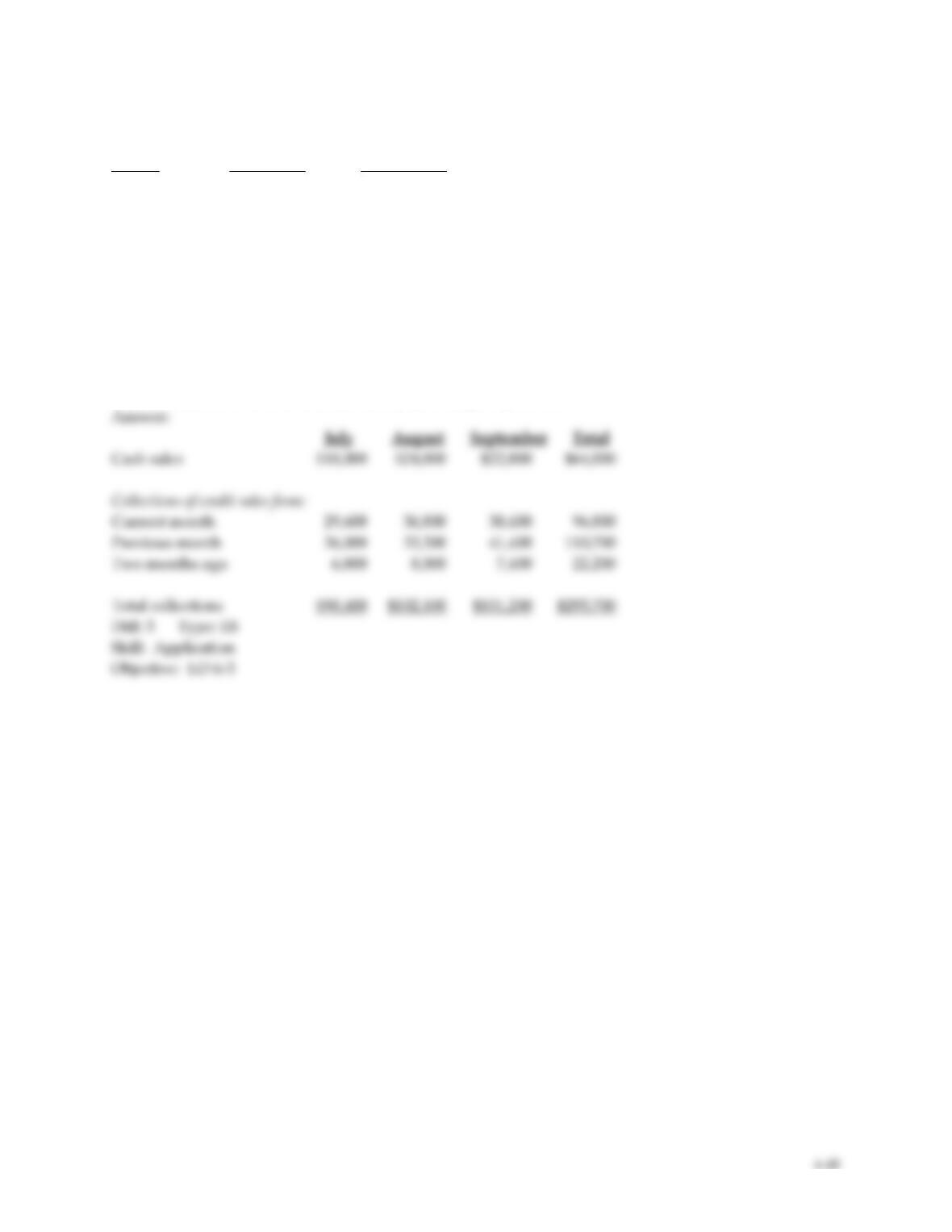
20) Perry Company has gathered the following information:
April 30, cash balance $90,000
Dividends paid in May $24,000
Cash expenditures in May for operating expenses $73,600
Amortization expense in May $9,000
Cash collections in May $178,000
Merchandise purchases paid in cash in May $112,400
Purchased equipment for cash in May $35,000
Perry desires to keep a minimum cash balance of $20,000.
Required:
Prepare a cash budget for May, and indicate whether or not Perry meets minimum cash requirements.
Cost Accounting: A Managerial Emphasis, 6e
Chapter 6 – Master Budget and Responsibility Accounting
21) Duffy Corporation has prepared the following sales budget:
Month Cash Sales Credit Sales
May $16,000 $68,000
June 20,000 80,000
July 18,000 74,000
August 24,000 92,000
September 22,000 76,000
Collections are 40% in the month of sale, 45% in the month following the sale, and 10% two months
following the sale. The remaining 5% is expected to be uncollectible.
Required:
Prepare a schedule of cash collections for July through September.
Cost Accounting: A Managerial Emphasis, 6e
Chapter 6 – Master Budget and Responsibility Accounting
22) The following information pertains to Amigo Corporation:
Month Sales Purchases
July $30,000 $10,000
August 34,000 12,000
September 38,000 14,000
October 42,000 16,000
November 48,000 18,000
December 60,000 20,000
Cash is collected from customers in the following manner:
Month of sale* 30%
Month following sale 50%
Two months following sale 15%
Amount uncollectible 5 %
* Customers paying in the month of sale receive a 2% cash discount.
40% of purchases are paid for in cash in the month of purchase, and the balance is paid the following
month.
Required:
a. Prepare a summary of cash collections for the 4th quarter.
b. Prepare a summary of cash disbursements for the 4th quarter.
Cost Accounting: A Managerial Emphasis, 6e
Chapter 6 – Master Budget and Responsibility Accounting
6.4 Distinguish among sensitivity analysis, Kaizen budgeting, and activity-based
budgeting.
1) Sensitivity analysis helps to evaluate outcomes from changes in data or assumptions.
2) Kaizen budgeting is a budgetary approach that explicitly incorporates continuous improvement during
the budget period into the resultant budget numbers.
3) The objective of activity-based budgeting is to refine the budgeting process by partitioning indirect
costs into different homogeneous activity cost pools.
4) The value of budgets to managers in their strategic analysis and planning is enhanced by
A) value based budgeting.
B) conducting sensitivity analysis.
C) the lines of responsibility in the value chain.
D) the current organizational structure.
E) the operating plan.
5) Kaizen budgeting, adapted from the Japanese, provides that
A) activity costs are budgeted based on current practices, methods, and costs.
B) continuous budgeting methods are employed.
C) target pricing is key to budget preparation.
D) continuous improvements are incorporated into the budget.
E) a rolling budget is employed to keep a handle on management.
Cost Accounting: A Managerial Emphasis, 6e
Chapter 6 – Master Budget and Responsibility Accounting
6) The objective of activity-based budgeting is
A) to allow multiple activities to be used as cost drivers rather than just one item such as direct labour
hours.
B) to compute the cost of performing activities.
C) to refine the budgeting process by assigning indirect costs into activity cost pools.
D) to classify costs by functional area and assign them to related activities.
E) to classify costs as to whether they are value added or non-value added.
7) Activity-based budgeting is a strategy
A) used to determine production targets.
B) that requires budgeting each functional organizational unit.
C) that requires determining the budgetary slack for the activity being measured.
D) that does not require an understanding of value added activities.
E) that focuses on the cost of activities necessary to produce and sell products and services.
8) Stark Company is developing its budgets for 2013 and for the first time will use the Kaizen approach.
The initial 2013 income statement, based on static data from 2012 is as follows:
Sales (300,000 units) $450,000
Less: cost of goods sold 300,000
Gross margin $150,000
Operating expenses (includes
$40,000 of amortization) 120,000
Net income $30,000
Selling prices for 2013 are expected to increase by 6 percent, and sales volume in units will decrease by 10
percent. The cost of goods sold as estimated by the Kaizen approach will decline by 10 percent per unit.
Other than amortization, all other operating costs are expected to decline by 5 percent.
Required:
Prepare a Kaizen-based budgeted income statement for 2013.