
Page 1
1.
Expand the following expression using rules of logarithms:
( )
32
ln m n
2.
Expand the following expression using rules of logarithms:
( )
3
ln m n
A)
ln(3m) ln(n)+
B)
( )
3
ln m n+
C)
3 ln(m) ln(n)+
D)
ln(3m n)+
3.
Contract the following expression using rules of logarithms. Express your answer as a
single logarithm.
6 ln(m) 2 ln(n)+
4.
Contract the following expression using rules of logarithms. Express your answer as a
single logarithm.
3 ln(x) 2 ln(y)+
A)
( )
ln 3x 2y+
B)
( )
32
ln x y+
C)
( )
ln 3x 2y
D)
( )
32
ln x y
5.
Expand the following expression using rules of logarithms:
3
5
m
ln n
6.
Expand the following expression using rules of logarithms:
3
5
A
ln B
A)
ln(3A) ln(5B)−
B)
( )
35
ln A B−
C)
ln(3A 5B)−
D)
3 ln(A) 5 ln(B)−

Page 2
7.
Contract the following expression using rules of logarithms. Express your answer as a
single logarithm.
3ln(A) 4 ln(B)−
8.
Contract the following expression using rules of logarithms. Express your answer as a
single logarithm.
3 ln(m) 6 ln(n)−
A)
3m
ln 6n
B)
( )
ln 3m 6n−
C)
3
6
m
ln n
D)
( )
36
ln m n−
9.
Expand the following expression using rules of logarithms:
43
5
ab
ln c
10.
Expand the following expression using rules of logarithms:
4
5
ab
ln c
A)
ln(a 4b 5c)+−
B)
ln(a) 4 ln(b) 5 ln(c)+−
C)
45
ln(a b c )+−
D)
ln(a) ln(4b) ln(5c)+−
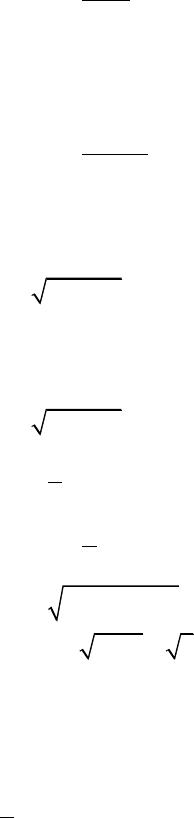
11.
Contract the following expression using rules of logarithms. Express your answer as a
single logarithm.
ln(a) 2 ln(b) 3 ln(c)+−
Page 3
12.
Contract the following expression using rules of logarithms. Express your answer as a
single logarithm.
4 ln(x) 5 ln(y) ln(z)+−
A)
45
xy
ln z
B)
( )
ln 4x 5y z+−
C)
( )
45
ln x y z+−
D)
4x 5y
ln z
13.
Expand the following expression using rules of logarithms:
( )
ln –4 m– 3
14.
Expand the following expression using rules of logarithms:
( )
ln –5 m– 3
A)
( )
1ln –5 m– 3
2
B)
( )
1
ln –5m– 3
2
C)
( )
ln –5m– 3
D)
( )
ln –5 m – 3
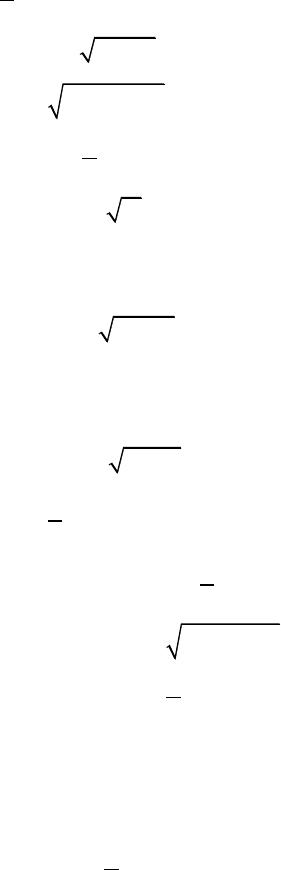
15.
Contract the following expression using rules of logarithms. Write your answer as a
single logarithm.
( )
1ln 2A+5
2
Page 4
16.
Contract the following expression using rules of logarithms. Write your answer as a
single logarithm.
( )
1ln –2 A+
2
A)
( )
ln –2 A+
B)
( )
ln –2 A+
C)
( )
1
ln –2A+
2
D)
–2 ln A +
17.
Expand the following expression using rules of logarithms:
( )
( )
ln A– 7 3A– 4
18.
Expand the following expression using rules of logarithms:
( )
( )
ln 2 x– 6 3 x+ 2
A)
( ) ( )
( )
1ln 2 x– 6 ln 3x+ 2
2+
B)
( ) ( )
1
ln 2 x– 6 ln 3x+ 2
2
+
C)
( ) ( )
ln 2 x– 6 ln 3 x+ 2+
D)
( ) ( )
1
ln 2 x– 6 ln 3 x+ 2
2
+
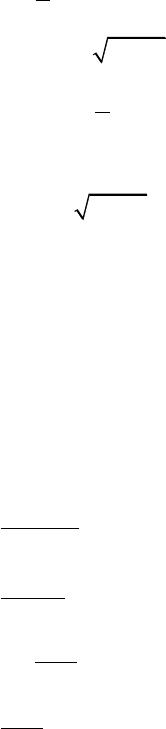
19.
Contract the following expression using rules of logarithms. Write your answer as a
single logarithm.
( ) ( )
1
ln x+2 ln x+6
2
+
Page 5
20.
Contract the following expression using rules of logarithms. Write your answer as a
single logarithm.
( ) ( )
1
ln 4 x+1 ln 5x+ 4
2
+
A)
( )
( )
ln 4x+1 5x+ 4+
B)
( ) ( )
1
ln 4x+1 5x+4
2
+
C)
( )
( )
ln 5 x– 8
D)
( )
( )
ln 4x+1 5x+ 4
21.
Solve the equation for t.
0.85 33
t
e=
Round your answer to 2 decimal places.
22.
Which of the following is the exact solution to the equation:
1.89 12
t
e=
A)
( )
ln 12
ln(1.89)
t=
B)
( )
ln 12
1.89
t=
C)
12
ln 1.89
t
=
D)
12
1.89
t=
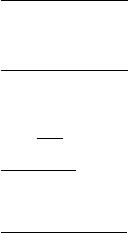
23.
Solve the equation for t.
1.99
90 1,885,700
t
e=
Round your answer to 2 decimal places.
Page 6
24.
Which of the following is the exact solution to the equation:
–0.45
74 9
t
e=
A)
( )
ln 9
ln(74 –0.45)
t=
B)
( )
ln 9
ln(74) –0.45
t=
C)
9
ln 74
–0.45
t
=
D)
9
74 ln(–0.45)
t=
25.
The function,
0.06
6,000 t
Ve=
, gives the value, V, of an investment t years after the
initial investment. How many years until the investment is worth $1,200?
Round your answer to the nearest year.
26.
The function,
0.11
8,000 t
Ve=
, gives the value, V, of an investment t years after the
initial investment. How many years until the worth of the investment doubles?
Round your answer to the nearest year.
27.
Upon her retirement, Mary begins to receive money from a retirement account. The
function,
–0.26
750,000 t
Me=
, gives the money remaining, M, in the account t years after
her retirement. How many years until the account balance is $360,000?
Round your answer to the nearest year.
28.
Upon her retirement, Mary begins to receive money from a retirement account. The
function,
–0.08
540,000 t
Me=
, gives the money remaining, M, in the account t years after
her retirement. How many years until Mary has received half of the money from the
account?
Round your answer to the nearest year.
29.
Radium-226 has a half-life of 1600 years.
A) Find the continuous decay rate. Write your answer as a percent rounded 4 decimal places.
B) Then find the age of a fossil that has 67% of it’s original Radium-226 left?
Round your answer to the nearest year.
Page 7
30.
Solve the equation for x.
ln( ) 0x=
Round your answer to 2 decimal places.
31.
Which of the following is the exact solution of the equation?
ln( ) –2x=
A)
–2
10x=
B)
–2
xe=
C)
–2x=
D)
ln(–2)x=
32.
Solve the equation for x.
ln( ) –1.5x=
Round your answer to 2 decimal places.
33.
Which of the following is the exact solution of the equation?
ln( ) 2.1x=
A)
2.1
xe=
B)
2.1
ln( )
xe
=
C)
ln(2.1)x=
D)
2.1
10x=
34.
Solve the equation for x.
ln( – 9) 3.4x=
Round your answer to 2 decimal places.
35.
Which of the following is the exact solution of the equation?
ln( – 6) 3.9x=
A)
3.9+6
xe=
B)
3.9 +6xe=
C)
ln(3.9)+6x=
D)
3.9
ln(6)
x=
Page 8
36.
Solve the equation for x.
ln( +3) ln(5) –0.6x+=
Round your answer to 2 decimal places.
37.
Which of the following is the exact solution of the equation?
ln( +2) ln(5) 2.5x+=
A)
2.5 –2
5
e
x=
B)
2.5 – 4.5xe=
C)
2.5 +7xe=
D)
2.5 –10
5
e
x=
38.
The population of a town grew from 10,000 in 1999 to 12,000 in 2003. Find A) the
annual growth rate and B) the continuou growth rate.
Write your answer as a percent rounded to 2 decimal places, like 13.45%.
39.
The population of a town grew from 9,000 in 1996 to 13,000 in 1999.
A) Find a function of the form,
kt
P C e=
, for the population, P, of the town as a
function of t, the number of years after 1996.
Round values to 2 decimal places.
B) Use this function to find the population in 2005.
Round your answer to the nearest person.
40.
Find k by converting a to
k
e
.
( )
48 0.91 48
tkt
e=
Round your answer to 2 decimal places.
41.
Find A) the continuous growth factor and B) the (annual) growth factor from the
function,
( )
( ) 4,700 1.89 t
ft=
Write your answers as percents rounded to 2 decimal places, like 23.75%.
42.
A growth rate of 14% of corresponds to what continuous growth rate?
Write your answer as a percent rounded to 2 decimal places.
Page 9
43.
A continuous growth rate of 49% of corresponds to what growth rate?
Write your answer as a percent rounded to 2 decimal places.
44.
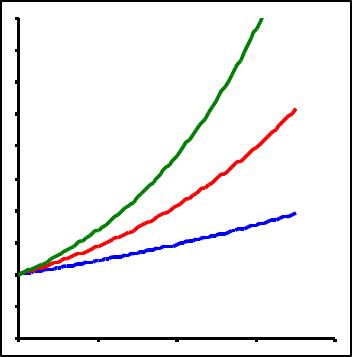
The graphs of the three functions,
( )
2 1.05 x
y=
,
( )
2 1.1 x
y=
, and
( )
2 1.25 x
y=
are
given. Which color is the graph of
2 1.1x
y=
?
A)
Blue
B)
Red
C)
Green
Page 10
45.
The graphs of the three functions,
0.05
2x
ye=
,
0.1
2x
ye=
, and
0.25
2x
ye=
are given.
Which color is the graph of
0.05
2x
ye=
?
A)
Green
B)
Blue
C)
Red
46.
If it took a radioactive substance 900 years to continuously decay from 2 grams to 0.8
grams, what is the half life of the substance?
Round the answer to the nearest year.
47.
If an investment earns interest at a rate of 7.5% compounded continuously, what is the
effective annual interest rate?
Round the answer to the nearest hundredth of a percent.
48.
Find the doubling time for the function
0.08
7,200 t
Ae=
Assume t is measured in years.
Round the answer to 2 decimal places.
49.
Solve for x.
( )
log 10 –2
x=
50.
Solve for x.
log( )
10 8
x=
Page 11
51.
Solve for x.
( )
ln –6
x
e=
52.
Solve for x.
ln( ) 6
x
e=
Page 12
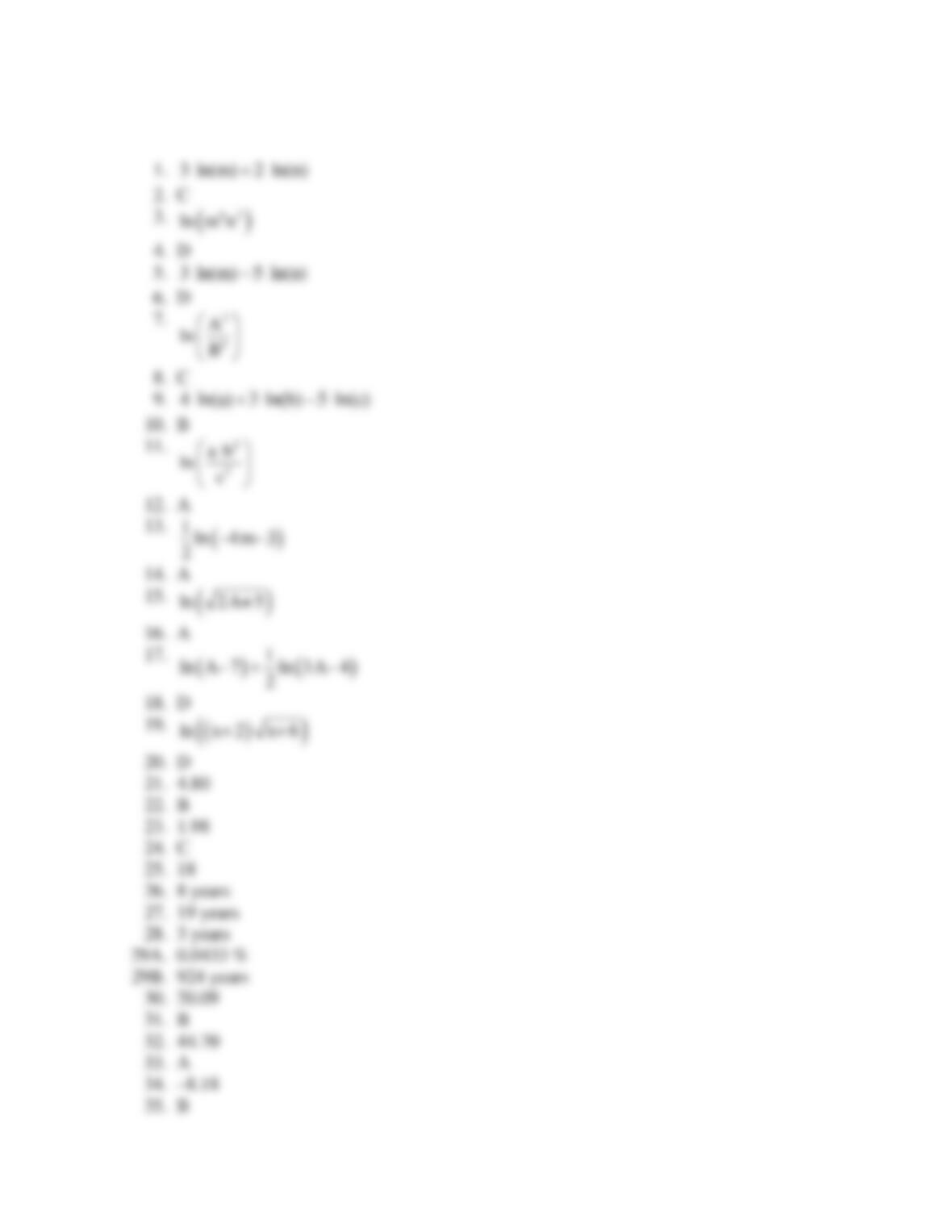
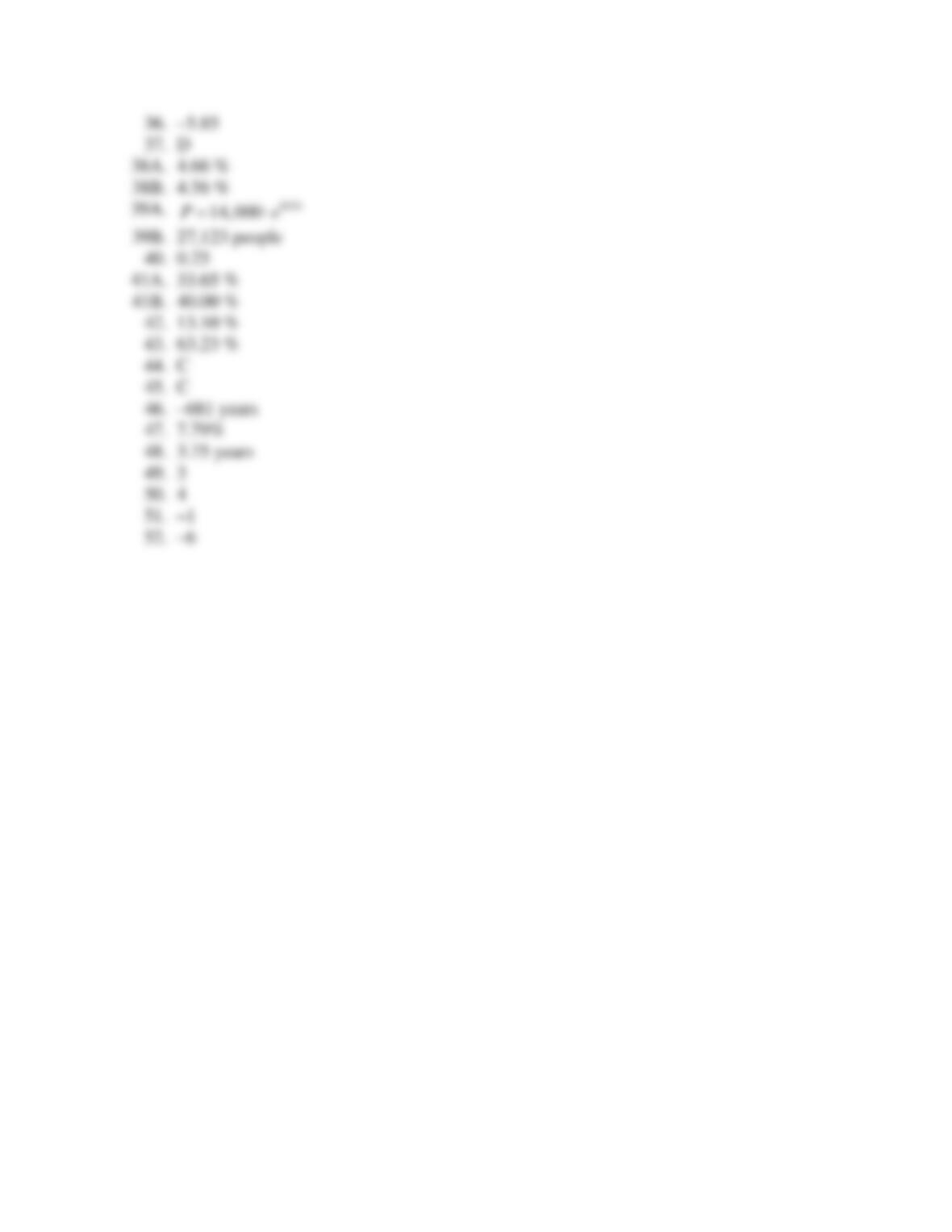
Answer Key
Page 13