Hall: Guyton and Hall Textbook of Medical Physiology, 12th Edition
Chapter 06: Contraction of Skeletal Muscle
Test Bank
1. A 28-year-old man has been training as a distance runner for the past six years.
Compared with a sprinter, which of the following is decreased in the skeletal muscles of
this athlete during resting conditions?
A. Capillary density
B. Glycolytic enzyme content
C. Mitochondrial volume density
D. Myoglobin content
E. Oxidative capacity
2. A physiology experiment is conducted in which a skeletal muscle twitch is initiated using
an electrical stimulator. Which factor contributes to the termination of a typical skeletal
muscle twitch?
A. Calcium uptake by sarcoplasmic reticulum
B. Closure of transverse tubules
C. Depletion of calcium stores from sarcoplasmic reticulum
D. Exhaustion of muscle ATP stores
E. Stimulation of dihydropyridine (DHP) receptors
3. A 24-year-old medical student goes to the local gym to lift weights. She begins by bench-
pressing 100 pounds as a warm-up procedure and then gradually increases the weight.
Which of the following occurs as she adds more weight?
A. Decreased frequency of motor nerve action potentials
B. Decreased velocity of motor nerve action potentials
C. Increased frequency of motor nerve action potentials
D. Increased velocity of motor nerve action potential
E. Involvement of fewer motor units
4. A 24-year-old woman is admitted to the emergency department after an automobile
accident in which lacerations to the left wrist severed a major tendon. The severed ends
of the tendon were overlapped by 6 cm to facilitate suturing and reattachment. Which of
the following characteristics would be expected after six weeks compared with the pre-
injured muscle? Assume that series growth of sarcomeres cannot be completed within six
weeks.
Test Bank
6-2
Passive tension Maximal active tension
A. Decrease Decrease
B. Decrease Increase
C. Increase Increase
D. Increase Decrease
E. No change No change
5. During the contraction of a skeletal muscle fiber, the actin and myosin filaments slide
past each other. Which of the following represent expected changes in the widths of I-
bands and A-bands during the contraction process?
I-band width A-band width
A. ↑ ↔
B. ↓ ↑
C. ↓ ↓
D. ↓ ↔
E. ↔ ↑
6. When a person lifts a 25-pound weight, what type or types of muscle contraction are
involved?
A. Isometric contraction only
B. Isotonic contraction only
C. Isometric contraction followed by isotonic contraction
D. Isotonic contraction followed by isometric contraction
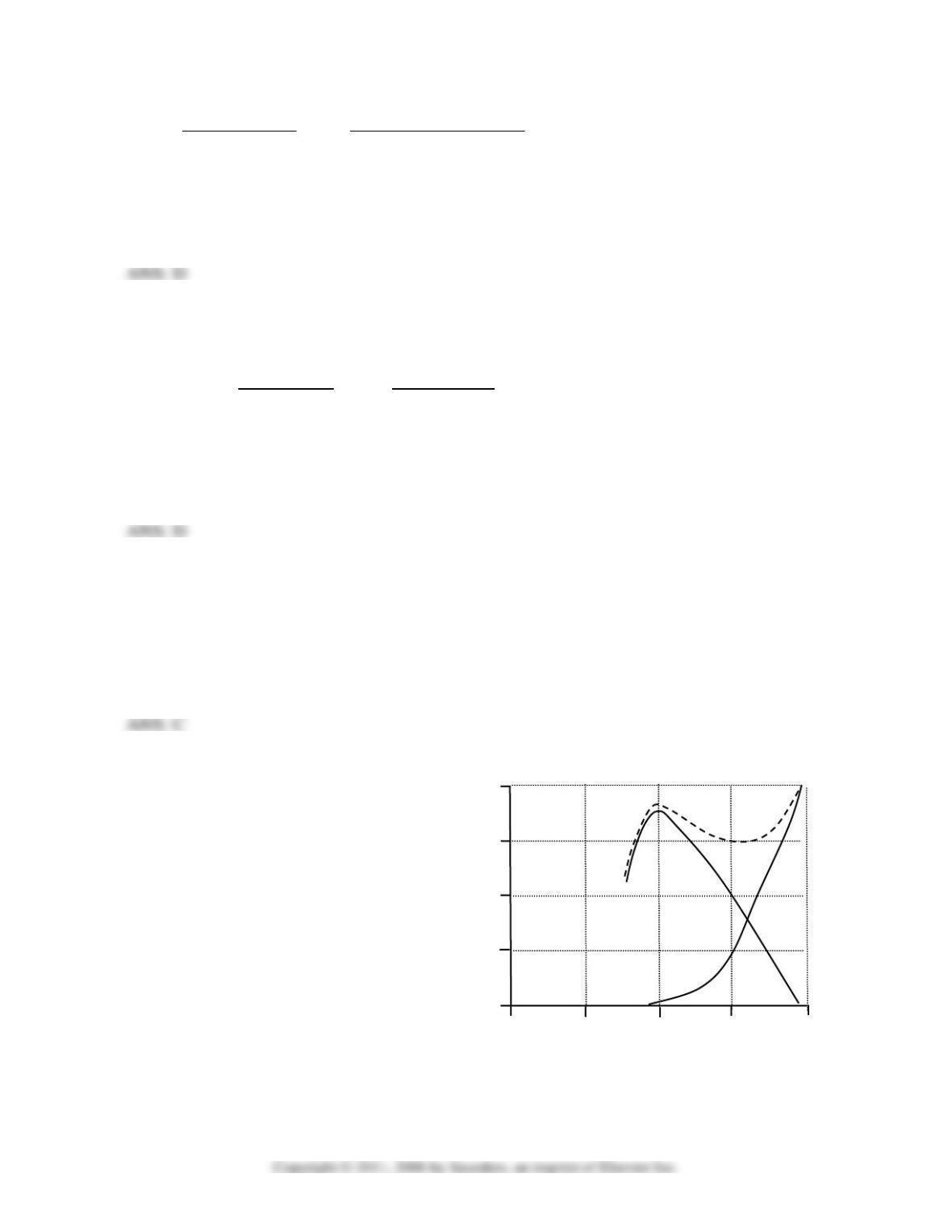
7. The length-tension diagram
shown was obtained from a
skeletal muscle with equal
numbers of red and white
fibers. Supramaximal tetanic
stimuli were used to initiate
an isometric contraction at
each muscle length studied.
The resting length was 20
cm. What is the maximum
amount of active tension this
muscle is capable of
generating at a preload of 100
grams?
A. 145 to 155 grams
B. 25 to 35 grams
Tension
(grams)
0 10 20 30 40
Length (cm)
200
150
100
50
0
Test Bank
6-3
C. 55 to 65 grams
D. 95 to105 grams
E. Cannot be determined
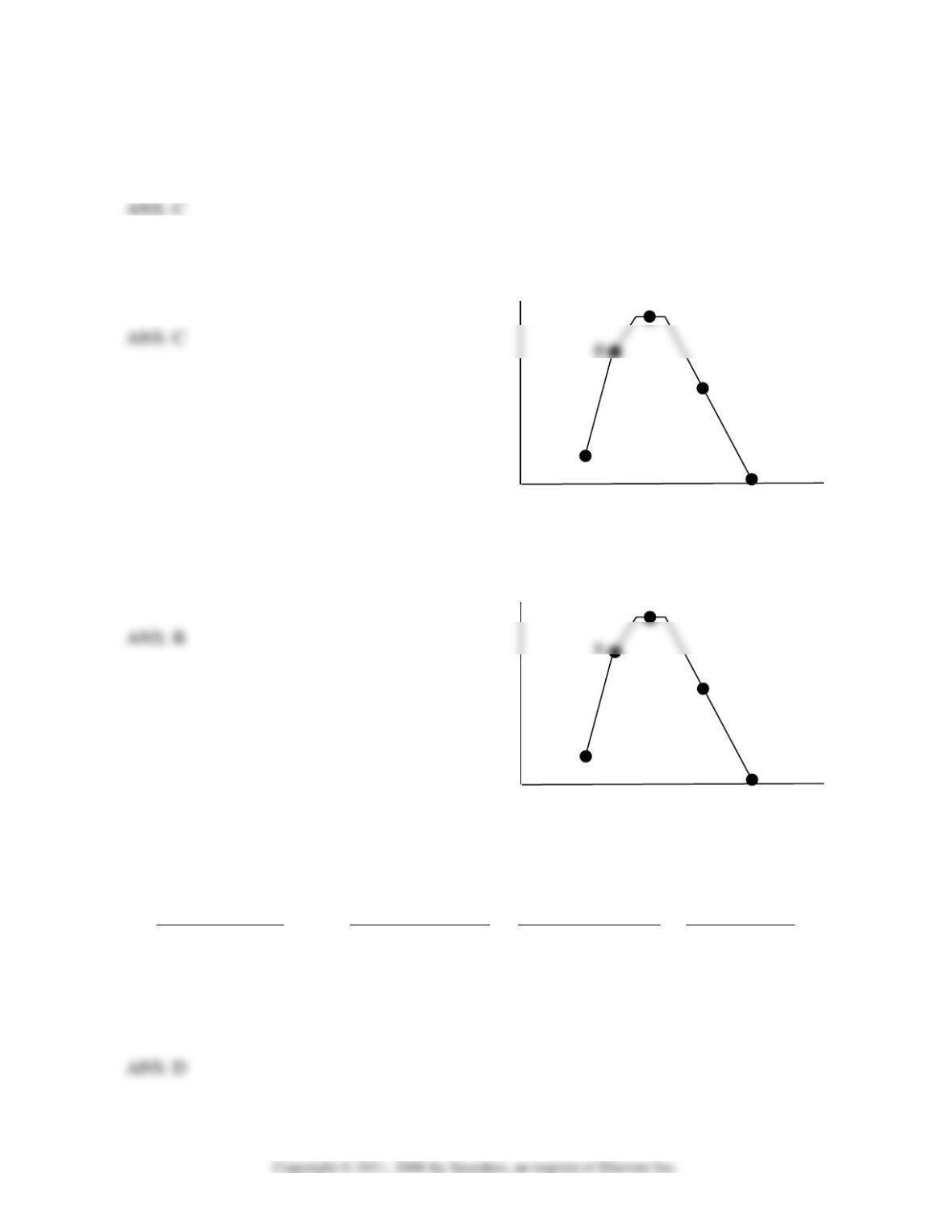
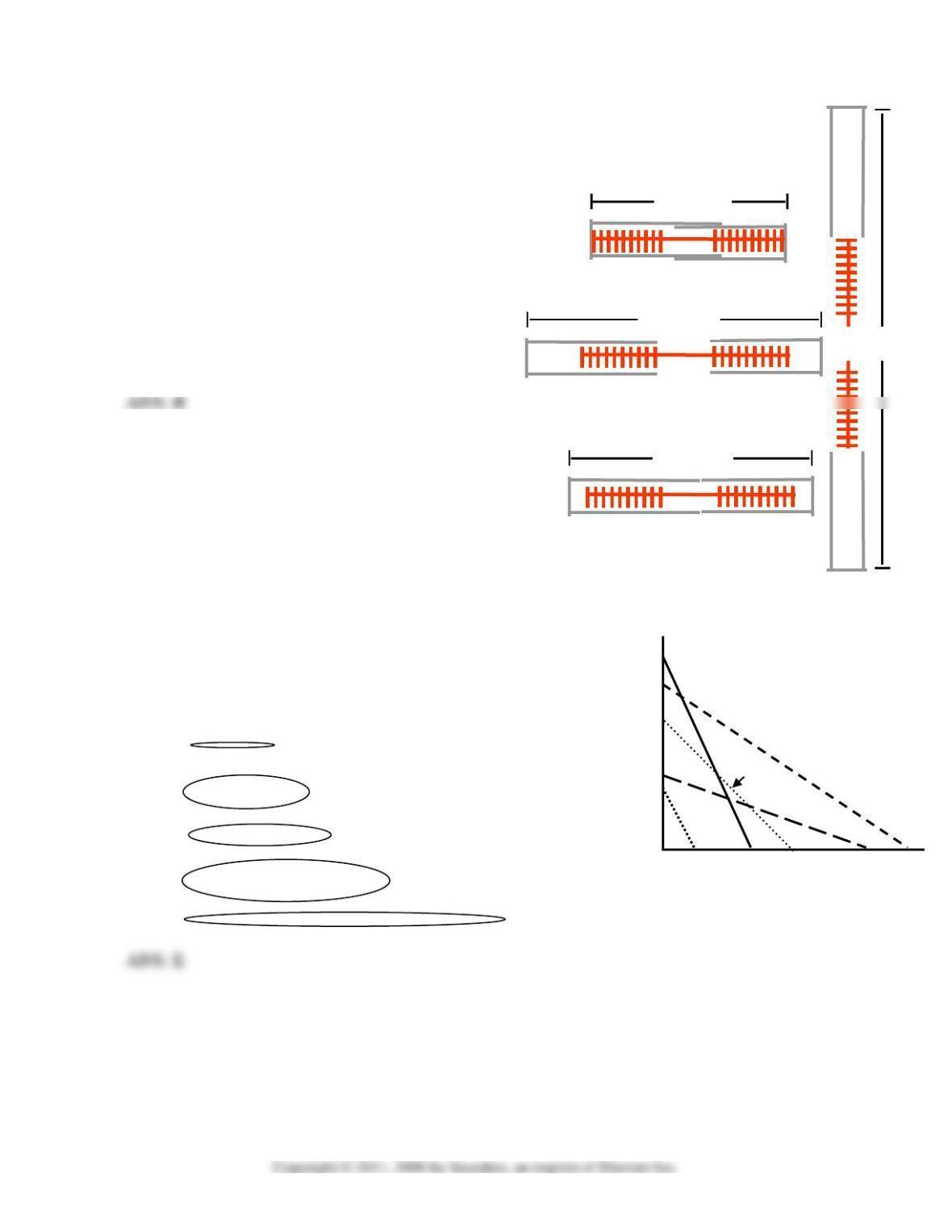
8. The diagram shows the relationship between muscle tension and sarcomere length for
muscle. Which point on the curve represents tension development at a normal resting
length for skeletal muscle?
B
9. The diagram shows the relationship between muscle tension and sarcomere length for
muscle. Which point on the curve represents tension development at a normal resting
length for cardiac muscle?
B
10. A 29-year-old woman has been training as a distance runner for the past five years.
Which set of changes best describes the skeletal muscles of this woman compared with a
sprinter?
Capillary density Oxidative capacity Myoglobin content Fiber diameter
A. Decreased Decreased Decreased Decreased
B. Decreased Decreased Increased Increased
C. Increased Increased Decreased Decreased
D. Increased Increased Increased Decreased
E. Increased Increased Increased Increased
Length
Tension
A
C
D
E
Length
Tension
A
C
D
E
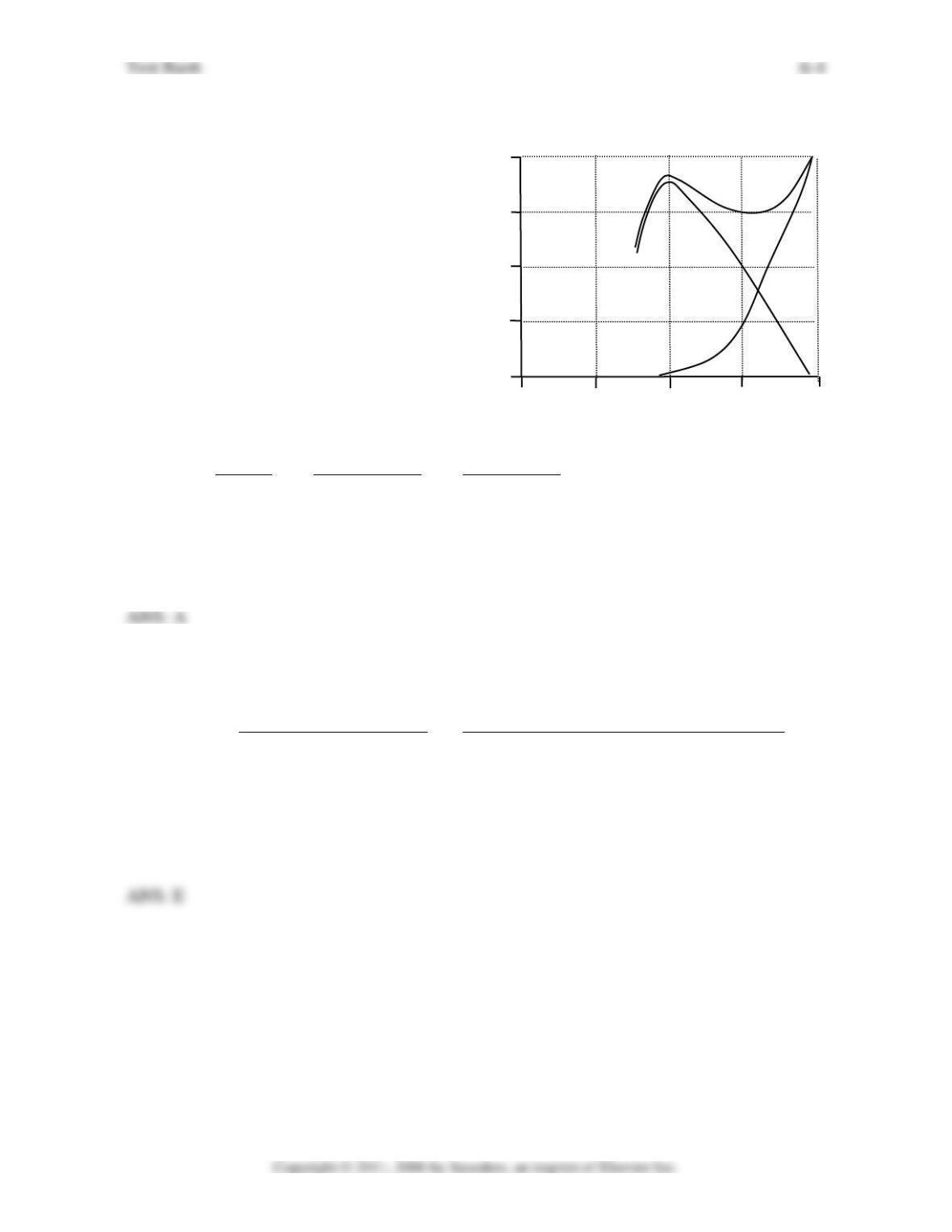
11. The length-tension diagram
shown on the right was
obtained from a skeletal
muscle with equal numbers of
red and white fibers.
Supramaximal tetanic stimuli
were used to initiate an
isometric contraction at each
muscle length studied. What
are the values in grams of
preload, active tension, and
total tension when the muscle
length is 60 cm?
Preload Active tension Total tension
A. 100 200 300
B. 100 300 200
C. 150 250 300
D. 200 100 300
E. 200 200 300
12. A 45-year-old man goes to the local gym to lift weights. He begins by bench-pressing
130 pounds as a warm-up procedure and then gradually increases the weight. Which of
the following sets of changes occur as he adds more weight?
Activation of motor units Frequency of motor nerve action potentials
A. Decreased Decreased
B. Decreased Increased
C. Decreased No change
D. Increased Decreased
E. Increased Increased
F. Increased No change
Tension
(grams)
0 20 40 60 80
Length (cm)
400
300
200
100
0
Test Bank
6-5
13. The skeletal muscle sarcomere normally has a
narrow range of lengths in vivo, but sarcomere
length can vary greatly in vitro under non-
physiological conditions. The diagram shows
sarcomeres at various lengths. At which length
can the sarcomere exert its maximum force
during an isometric contraction?
A. 1.6 µm
B. 2.1 µm
C. 2.8 µm
D. 3.0 µm
E. 3.5 µm
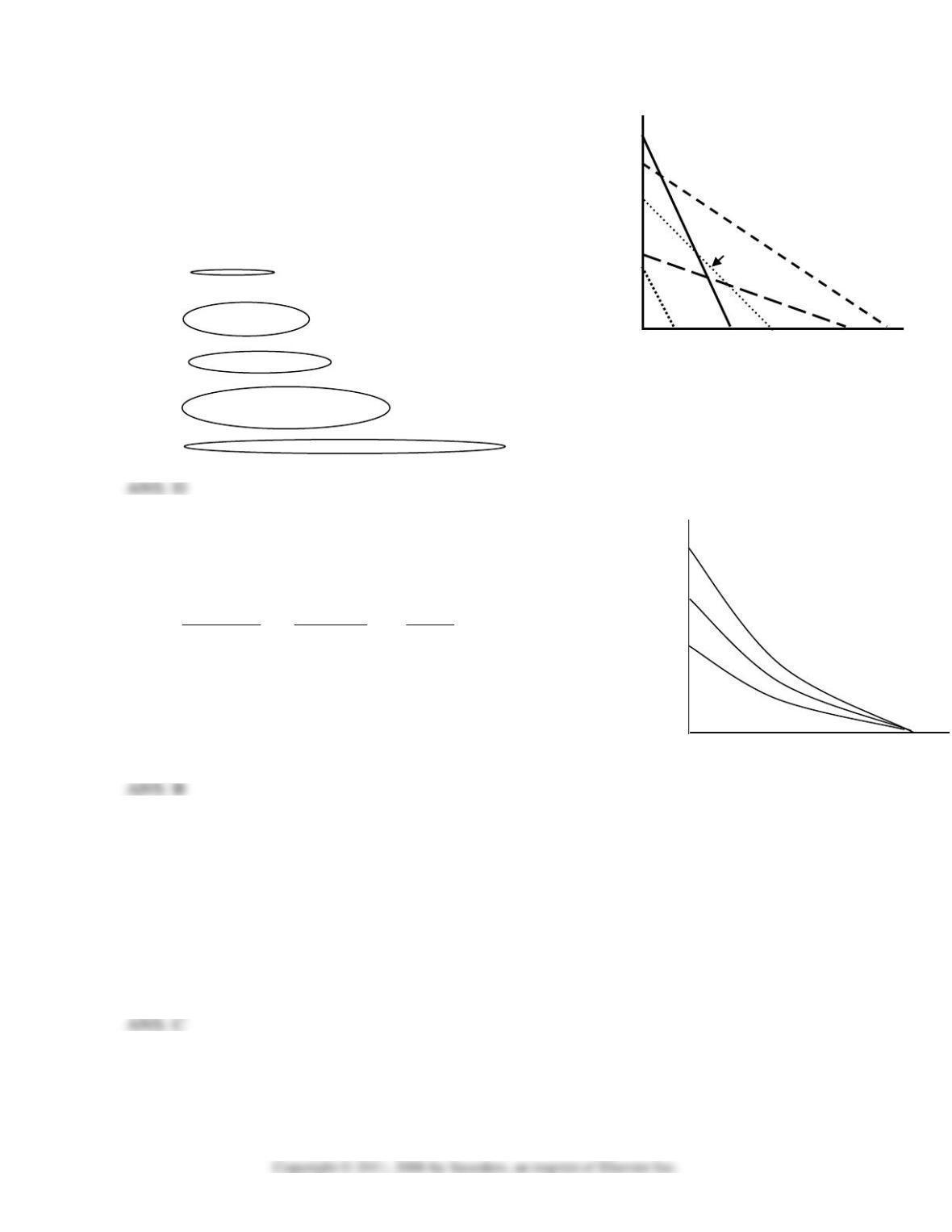
14. The diagram shows the relationship between contraction velocity and force. Which of the
following muscles is most likely to correspond to
muscle number 1 shown on the diagram (assume
that all muscles shown are at their normal resting
lengths).
A.
B.
C.
D.
E.
2.0 µm
1.6 µm
2.3 µm
3.7 µm
Contraction
velocity
Force
0
0
1
2
3
4
5
Test Bank
6-6
15. The diagram shows the relationship between
contraction velocity and force. Which of the
following muscles is most likely to correspond to
muscle number 2 shown on the diagram (assume
that all muscles shown are at their normal resting
lengths)?
A.
B.
C.
D.
E.
16. The diagram shows force-velocity relationships for
three different skeletal muscles. Which of the
following curves most likely correspond to glycolytic,
oxidative, and mixed muscle types?
Glycolytic Oxidative Mixed
A. X Y Z
B. X Z Y
C. Y X Z
D. Y Z X
E. Z X Y
F. Z Y X
17. The dark color of red skeletal muscle (slow twitch muscle) can be attributed to a relative
abundance of which of the following compared to white skeletal muscle (fast twitch
muscle)?
A. Blood capillaries
B. Mitochondria
C. Myoglobin
D. Myosin ATPase
E. Oxidative enzymes
Contraction
velocity
Force
0
0
1
2
3
4
5
Contraction
velocity
Force
X
Y
Z
0
0