Chapter 6: Process Costing
124. The following information pertains to Southland Company:
Units
Work in process, April 1 (20% complete) 8,000
Started in January 40,000
Work in process, April 30 12,000
Materials are added at the beginning of the process.
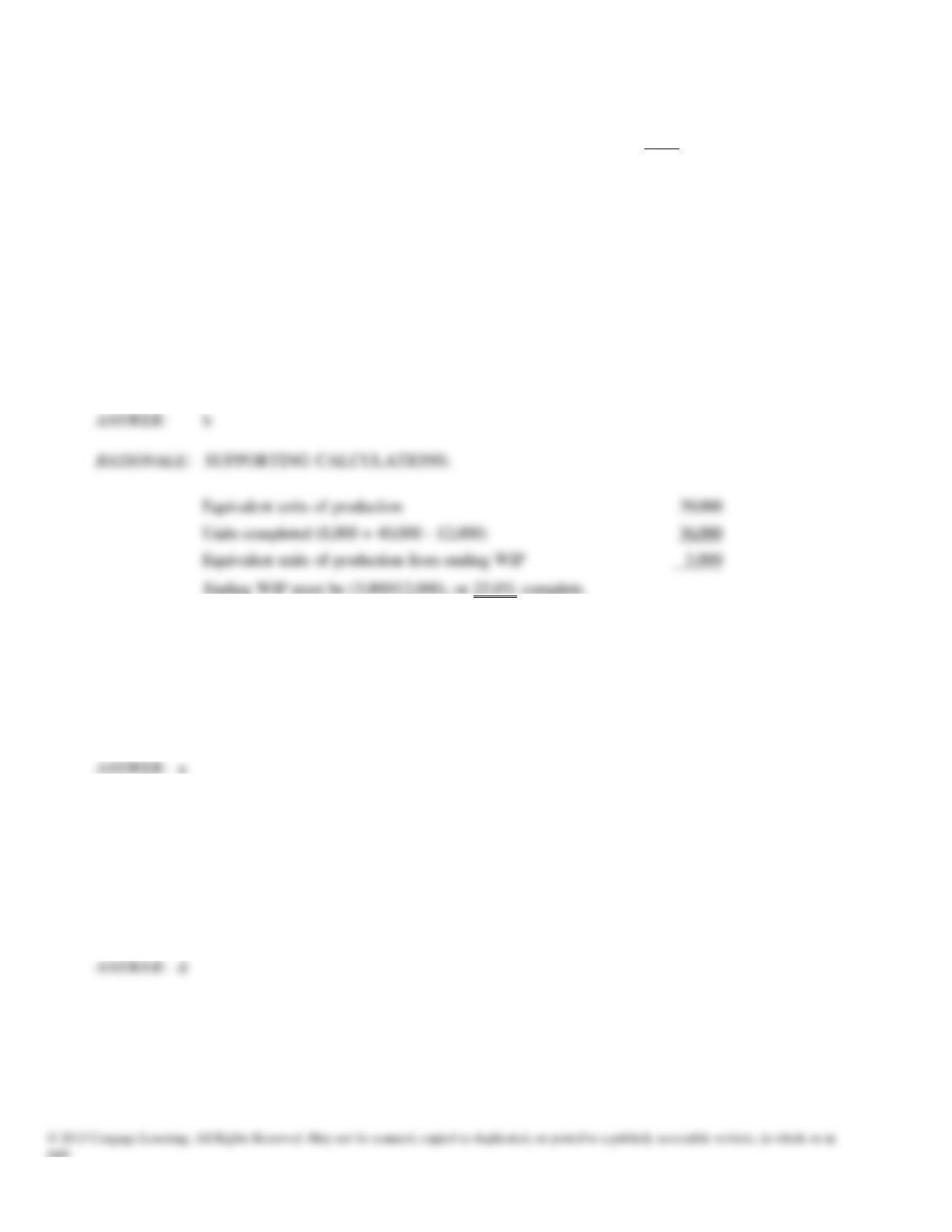
If equivalent units of production for conversion using the weighted average method was 39,000, ending work in
process at April 30 must have been
a. 15.0% complete.
b. 25.0% complete.
c. 30.0% complete.
d. 97.5% complete.
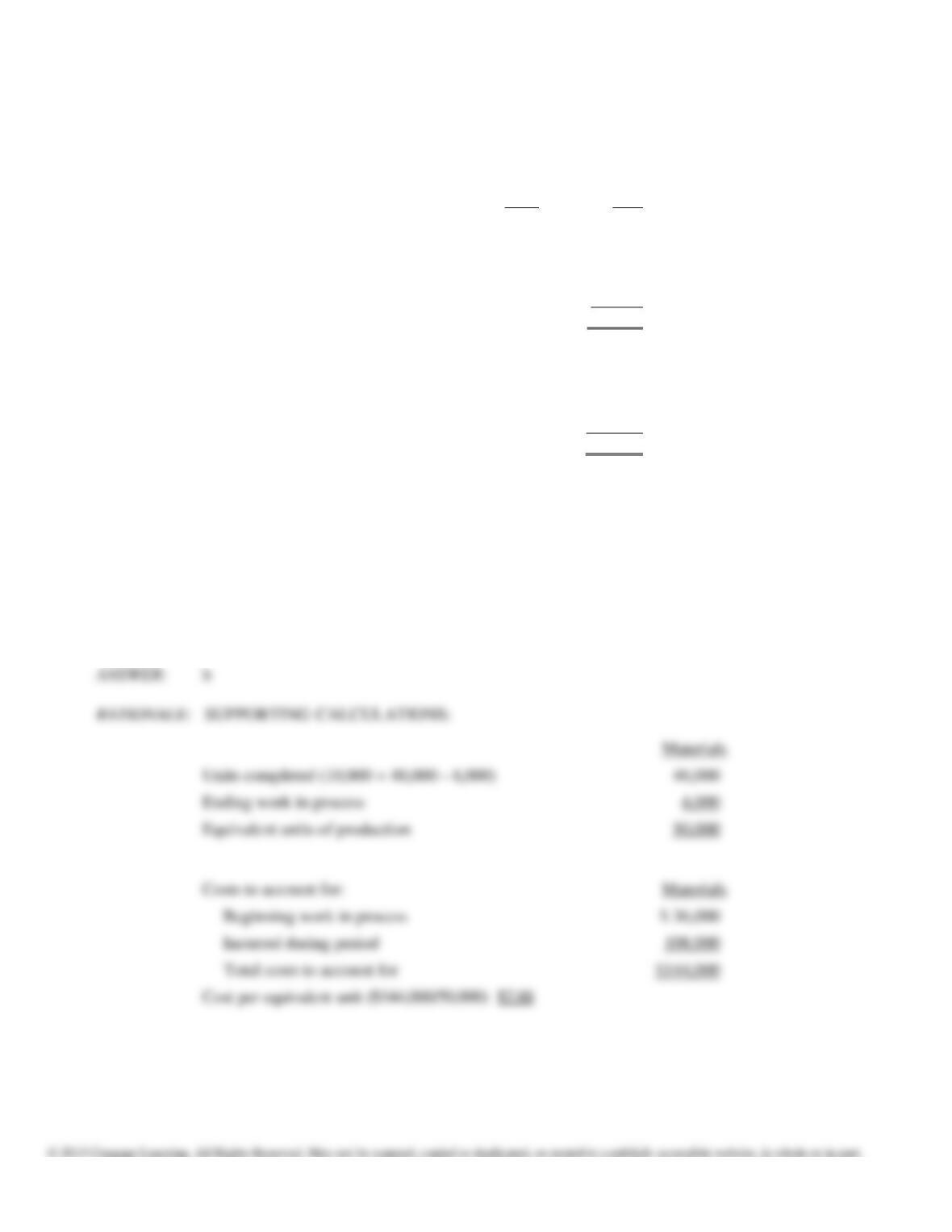
125. The material cost per equivalent unit using the weighted average method is calculated as
a. total material costs to account for/equivalent units for materials.
b. material costs added during the period/equivalent units for materials.
c. total material costs to account for/number of partially completed units for materials.
d. material costs added during the period/number of partially completed units for materials.
126. Which is NOT a disadvantage of the weighted average costing assumption in process costing?
a. There is a possibility of errors when input costs are changing significantly from one period to the next.
b. The cumulative effect of an error might produce a significant distortion in the cost of the final product.
c. The performance of the current period is combined with the performance of the current period making it
difficult to compare costs between periods.
d. Unit costs are simpler to calculate.
Chapter 6: Process Costing
Figure 6-14
The following information is available for Department C for the month of June:
Work in process, June 1 (70% complete)
Units
10,000
Cost
Direct materials
$36,000
Direct labor
18,000
Manufacturing overhead
24,000
Total work in process, June 1
$78,000
Started in production during June
Costs added:
Direct materials
40,000
Direct labor
48,000
Manufacturing overhead
60,600
Total costs added during June
$216,600
Work in process, June 30 (80% complete)
4,000
Materials are added at the beginning of the process. Round unit costs to two decimal places.
127. Refer to Figure 6-14. The cost per equivalent unit of production for materials using the weighted average method is
a. $2.70.
b. $2.88
c. $3.12.
d. $3.60.
Chapter 6: Process Costing
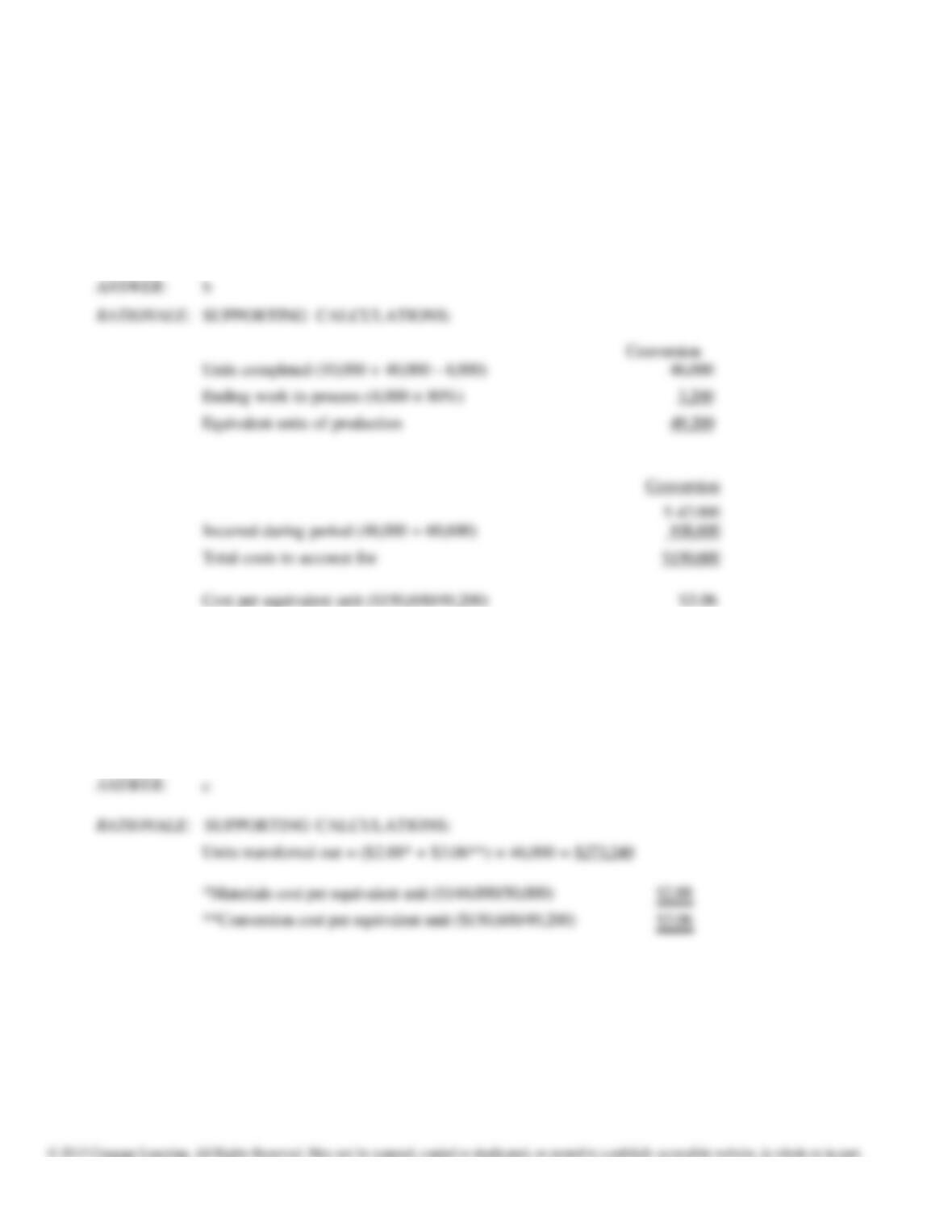
128. Refer to Figure 6-14. The cost per equivalent unit of production for conversion using the weighted average method
is
a. $3.54.
b. $3.06.
c. $2.55.
d. $2.19.
129. Refer to Figure 6-14. The cost of goods transferred out using the weighted average method is
a. $273,600.
b. $241,500.
c. $273,240.
d. none of the above.
Chapter 6: Process Costing
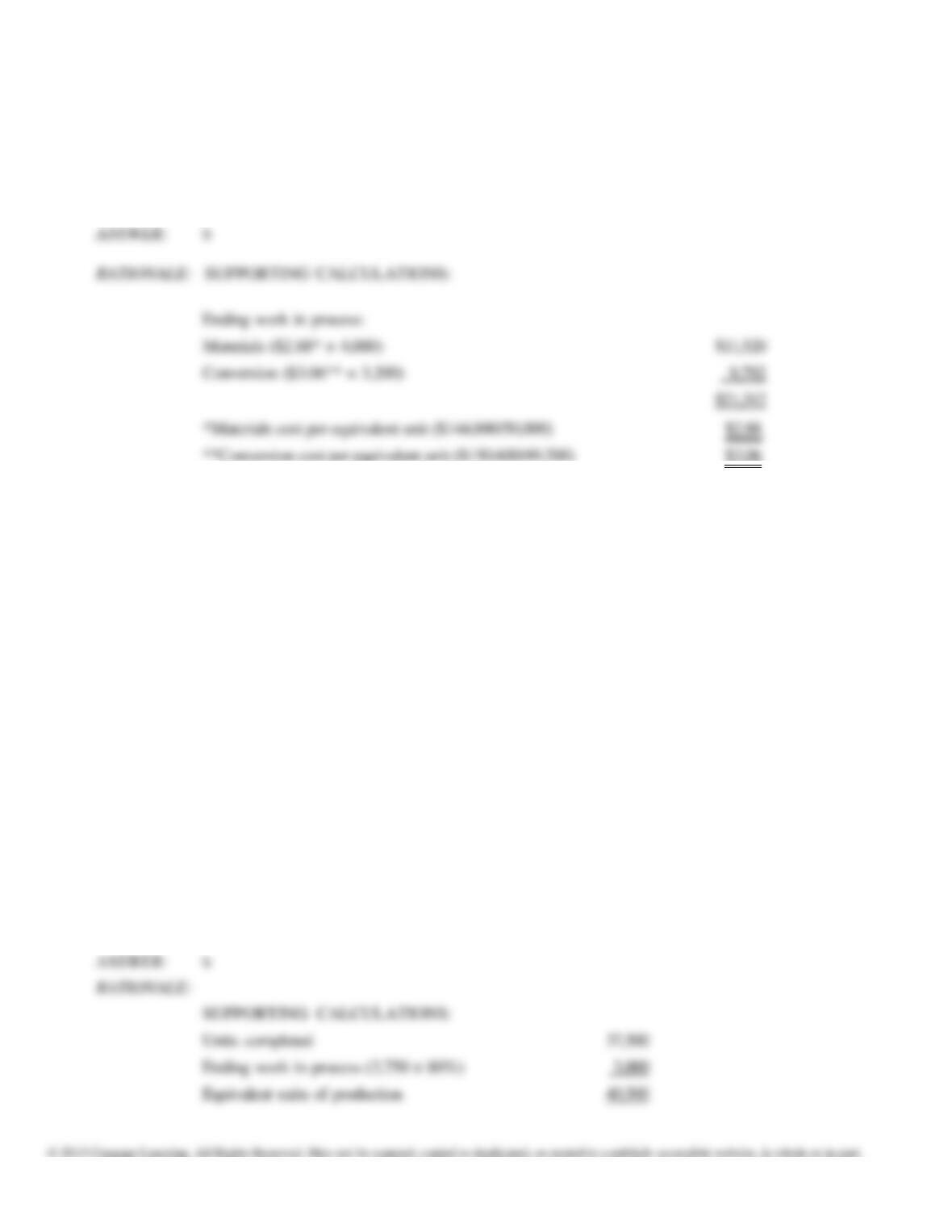
130. Refer to Figure 6-14. The cost of ending work in process using the weighted average method is
a. $23,760.
b. $21,312.
c. $16,992.
d. none of the above.
131. Mortimer Company manufactures a product that passes through two processes: Mixing and Molding. All
manufacturing costs are added uniformly in the Mixing Department. Information for the Mixing Department for
May follows:
Work in process, May 1:
Units (35% complete)
7,500
Direct materials
$36,000
Direct labor
$45,000
Overhead
$15,000
During May, 37,500 units were completed and transferred to the Molding Department. The following costs were
incurred by the Mixing Department during May:
Direct materials
$135,000
Direct labor
180,000
Overhead
45,000
There were 3,750 units that were 80 percent complete remaining in mixing at May 31. The equivalent units of
production using the weighted average method is
a. 43,125 units
b. 40,500 units
c. 30,000 units
d. 34,500 units
Chapter 6: Process Costing
132. Transferred-in costs are accounted for in the same manner as
a. materials added at the beginning of the process.
b. materials added at the end of the process.
c. conversion costs.
d. labor costs.
Figure 6-15
The Davidson Company uses a weighted average process costing system. The following information was reported
for the Assembly Process for January. Materials are added at the beginning of the process and are 100%.
Units:
units
% complete for
conversions
work in process, 1/1
60,000
15%
started
105,000
work in process, 1/31
40,000
20%
Costs:
Materials
Conversion
beginning work in process
$ 16,500
$ 33,250
current costs
$643,500
$332,500
133. Refer to Figure 6-15. What are the equivalent units for materials?
a. 133,000
b. 100,000
c. 165,000
d. 125,000
e. none of the above
134. Refer to Figure 6-15. What are the equivalent units for conversion?
a. 133,000
b. 165,000
c. 125,000
d. 100,000
e. none of the above
Chapter 6: Process Costing
135. Refer to Figure 6-15. What is the cost per unit for conversion?
a. $2.79
b. $2.75
c. $2.50
d. $2.22
e. none of the above
136. Refer to Figure 6-15. What is the cost per unit for materials?
a. $4.00
b. $3.90
c. $4.96
d. $2.75
e. none of the above
137. Refer to Figure 6-15. What is the cost assigned to the units completed and transferred to finishing?
a. $843,750
b. $708,750
c. $777,500
d. $976,000
e. none of the above
138. Which of the following process costing methods is simpler to use?
a. weighted average
b. LIFO
c. FIFO
d. specific identification
Chapter 6: Process Costing
Figure 6-16
Ramses Corporation produces a product that passes through two processes. During April, the first department
transferred 19,000 units to the second department. The cost of the units transferred was $30,000. Materials are
added uniformly in the second process. The following information is provided about the second department‘s
operations during October:
Units, beginning work in process 4,000
Units, ending work in process 5,500
139. Refer to Figure 6-16. The number of units started in the second department during April is
a. 15,000 units.
b. 13,500 units.
c. 19,000 units.
d. 23,000 units.
140. Refer to Figure 6-16. The number of units completed in the second department during April is
a. 17,500 units.
b. 9,500 units.
c. 23,000 units.
d. 28,500 units.
Chapter 6: Process Costing
141. Refer to Figure 6-16. The number of units started and completed in the second department during April is
a. 13,500 units.
b. 17,500 units.
c. 8,500 units.
d. 26,500 units.
142. Materials are added to a second production department and will not increase the number of units produced in this
department. Adding materials to the second department will
a. decrease total ending work in process.
b. change the amount of factory overhead included in the ending work in process.
c. increase total unit cost.
d. not change the dollar amount transferred out of the department.
Figure 6-17
Loganbery Corporation produces a product that passes through two processes. During January, the first department
transferred 20,000 units to the second department. The cost of the units transferred was $60,000. Materials are
added uniformly in the second process. The following information is provided about the first department’s operations
during January:
Units, beginning work in process (1/3 complete) 6,000
Units, ending work in process (1/2 complete) 4,000
143. Refer to Figure 6-17. The equivalent units for those transferred in from the prior department using weighted
average is
a. 16,000 units.
b. 20,000 units.
c. 14,000 units.
d. 26,000 units.
Chapter 6: Process Costing
144. Refer to Figure 6-17. The equivalent units for conversion using weighted average is
a. 10,000 units.
b. 16,000 units.
c. 26,000 units.
d. 24,000 units.
145. Refer to Figure 6-17. The equivalent units for those transferred in from the prior department using FIFO would be
a. 10,000 units.
b. 20,000 units.
c. 26,000 units.
d. 22,000 units.
146. Refer to Figure 6-17. The equivalent units for conversion using FIFO would be
a. 10,000 units.
b. 12,000 units.
c. 26,000 units.
d. 22,000 units.
147. The cost assigned to goods from a prior process is termed:
a. Operating costing
b. Transferred-in cost
c. Weighted average method
d. FIFO costing method
Chapter 6: Process Costing
Figure 6-18
The Round Table Company makes carpenter’s squares and uses a process costing system. There is no spoilage.
Manufacturing goes through three departments: Forming, Finishing, and Packing. Unit data for these departments
are given below:
Beginning inventory units
Forming Finishing Packing
(80% complete) 1,000 2,000 3,000
Units started 8,000 ? ?
Ending inventory units
(20% complete) 3,000 4,000 1,000
The Finishing Department adds materials at the point where processing is 50 percent complete.
148. Refer to Figure 6–18. The equivalent units for materials in the Finishing Department is
Weighted Average FIFO
a.
4,000
2,000
b.
4,800
3,200
c.
6,000
3,000
d.
8,000
8,000
e. none of the above
Chapter 6: Process Costing
Figure 6-19
Mountainside Industries manufactures specialized plastic boxes in two processes: Molding and Packaging. In the
Packaging Department, materials are added at the end of the process. The following data are given:
Costs
Units
Trans.–in
Materials
Conv.
Work in process, July 1
30
$1,590
$-0-
$513
Transferred in during July
?
Completed during July
105
Work in process, July 31
15
Costs added during July
$4,410
$1,050
$1,767
The conversion process on the beginning inventory is 70 percent completed and the ending inventory is 60 percent
completed.
149. Refer to Figure 6-19. Mountainside’s equivalent units for conversion using FIFO would be
a. 114.
b. 105.
c. 93.
d. 9.
150. Refer to Figure 6-19.Mountainside’s equivalent units for materials using weighted average would be
a. 15.
b. 90.
c. 105.
d. 120.
151. Refer to Figure 6-19. Mountainside’s equivalent units for transferred-in units using FIFO would be
a. 15.
b. 90.
c. 105.
d. 120.
Chapter 6: Process Costing
152. Refer to Figure 6-19. Mountainside’s equivalent units for transferred-in units using weighted average would be
a. 15.
b. 90.
c. 105.
d. 120.
153. Refer to Figure 6-19. Rounded to two decimal places, Mountainside’s conversion cost per unit using FIFO would be
a. $15.50.
b. $19.00.
c. $20.00.
d. $24.52.
154. Refer to Figure 6-19. Rounded to two decimal places, Mountainside’s cost per equivalent unit for conversion using
weighted average would be
a. $15.50.
b. $19.00.
c. $20.00.
d. $24.52.
155. Refer to Figure 6-19. Rounded to two decimal places, Mountainside’s cost per equivalent units for transferred-in
costs using weighted average would be
a. $49.00.
b. $50.00.
c. $57.14.
d. $66.67.
Chapter 6: Process Costing
156. Refer to Figure 6-19. Rounded to two decimal places, Mountainside’s costs transferred out using weighted average
would be
a. $6,000.
b. $8,190.
c. $8,400.
d. $9,330.
157. The costing system that uses job-order costing to assign material costs and process costing to assign conversion
costs is called:
a. Batch production process
b. Cost reconciliation
c. Operation costing
d. Equivalent unit of output
158. When job-order costing is used to assign material costs and process costing is used to assign conversion costs, it is
called
a. matrix costing.
b. blend costing.
c. operation costing.
d. variable costing.
Chapter 6: Process Costing
Figure 6-20
Outrageous Cups Corp. manufactures cups. The company‘s manufacturing operations and costs applied to products
for April were:
Molding
Heat-treat
Finishing
Direct labor
$25,000
$12,500
$ 7,500
Factory overhead
30,000
17,500
12,600
Total
$55,000
$30,000
$20,100
Three types of cups were produced in April. The quantities and direct materials costs were:
Type
Quantity
Direct Materials
Casts
5,000
$15,000
Cups
7,000
22,470
Mugs
8,000
32,500
Casts are produced in the Molding Department. Cups pass through the Molding and Finishing Departments. Mugs
pass through all three departments. An operations costing system is used.
159. Refer to Figure 6-20. What is Outrageous Cups‘ conversion cost per unit for the heat-treat operation, rounded to
two decimal places?
a. $1.50
b. $2.00
c. $2.50
d. $3.75
Chapter 6: Process Costing
160. Refer to Figure 6-20. What is Outrageous Cups’ total cost for Casts in April?
a. $13,750
b. $26,275
c. $28,750
d. $70,000
161. Refer to Figure 6-20. What is Outrageous Cups‘ total cost per unit for Cups in April?
a.$4.09
b.$7.30
c.$7.84
d.$11.05
162. The process that produces batches of different products which are identical in many ways but differ in others is
called:
a. Operating costing
b. Batch production process
c. Cost reconciliation
d. Equivalent unit of output
Chapter 6: Process Costing
Figure 6-21
Golden Ring Company produces two types of product: Large and Larger. Two work orders for two batches of the
products are shown below, along with some additional cost information:
Direct materials (actual costs)
Large
Work Order 10
$45,000
Larger
Work Order 11
$75,000
Applied conversion costs:
Mixing
?
?
Cooking
$12,000
$12,000
Bottling
$10,000
$15,000
Batch size (bottles)
5,000
5,000
In the Mixing Department, conversion costs are applied on the basis of direct labor hours. Budgeted conversion
costs for the department for the year were $50,000 for labor and $125,000 for overhead. Budgeted direct labor
hours were 2,500. It takes three minutes to mix the ingredients needed for each bottle.
Large (Work Order 10) and Larger (Work Order 11) flow through the Mixing Department first, then through the
Cooking and Bottling departments.
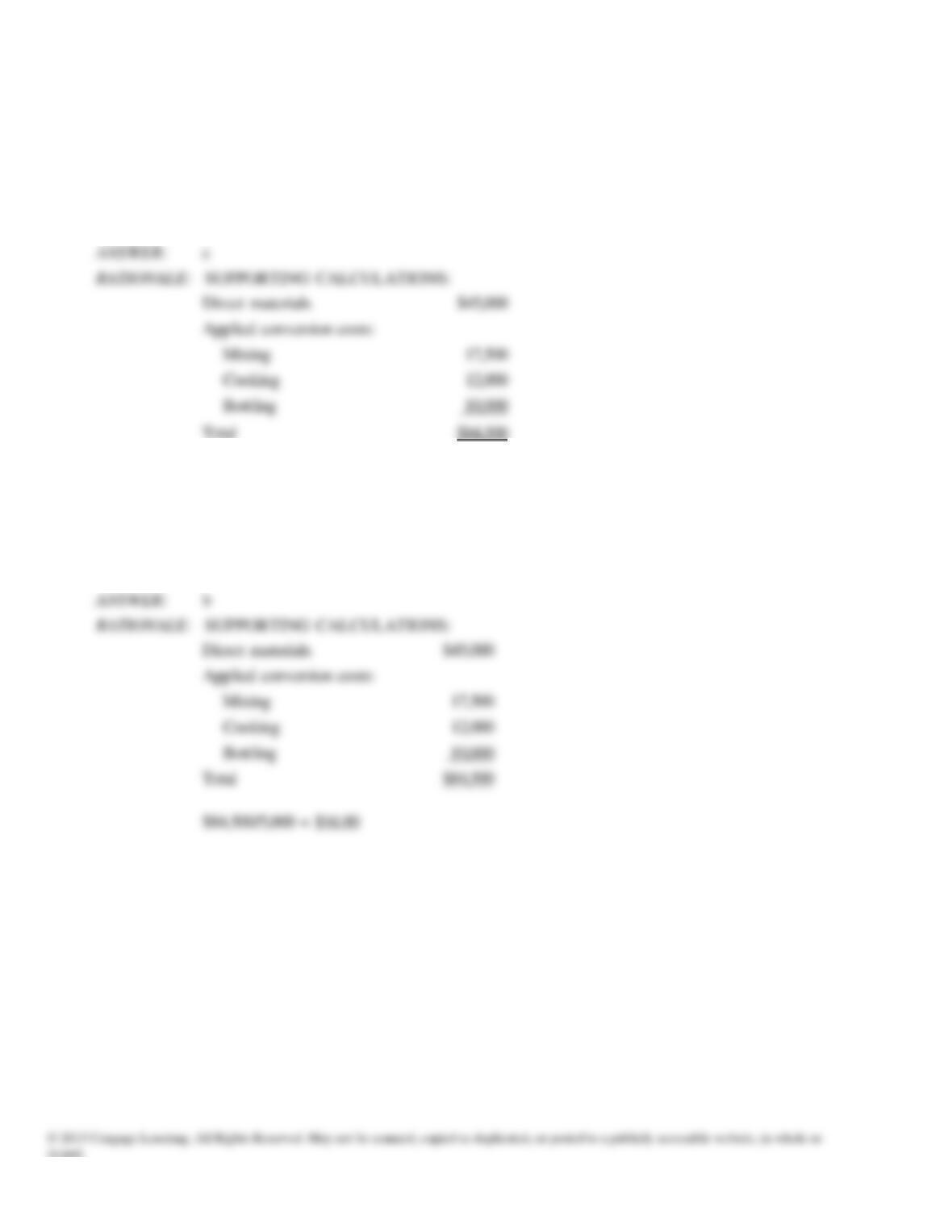
163. Refer to Figure 6-21. What are Golden Ring Company’s conversion costs applied to Large (Work Order 10) from
the Mixing Department for each batch?
a. $35,000
b. $35
c. $175,000
d. $17,500
164. Refer to Figure 6-21. What is Golden Ring Company‘s amount transferred from the Mixing Department to the
Cooking Department for Work Order 10?
a. $45,000
b. $62,500
c. $39,500
d. $84,500
Chapter 6: Process Costing
165. Refer to Figure 6-21. What is Golden Ring Company’s amount transferred from the Bottling Department to
Finished Goods for Work Order 10?
a. $45,000
b. $39,500
c. $84,500
d. $67,000
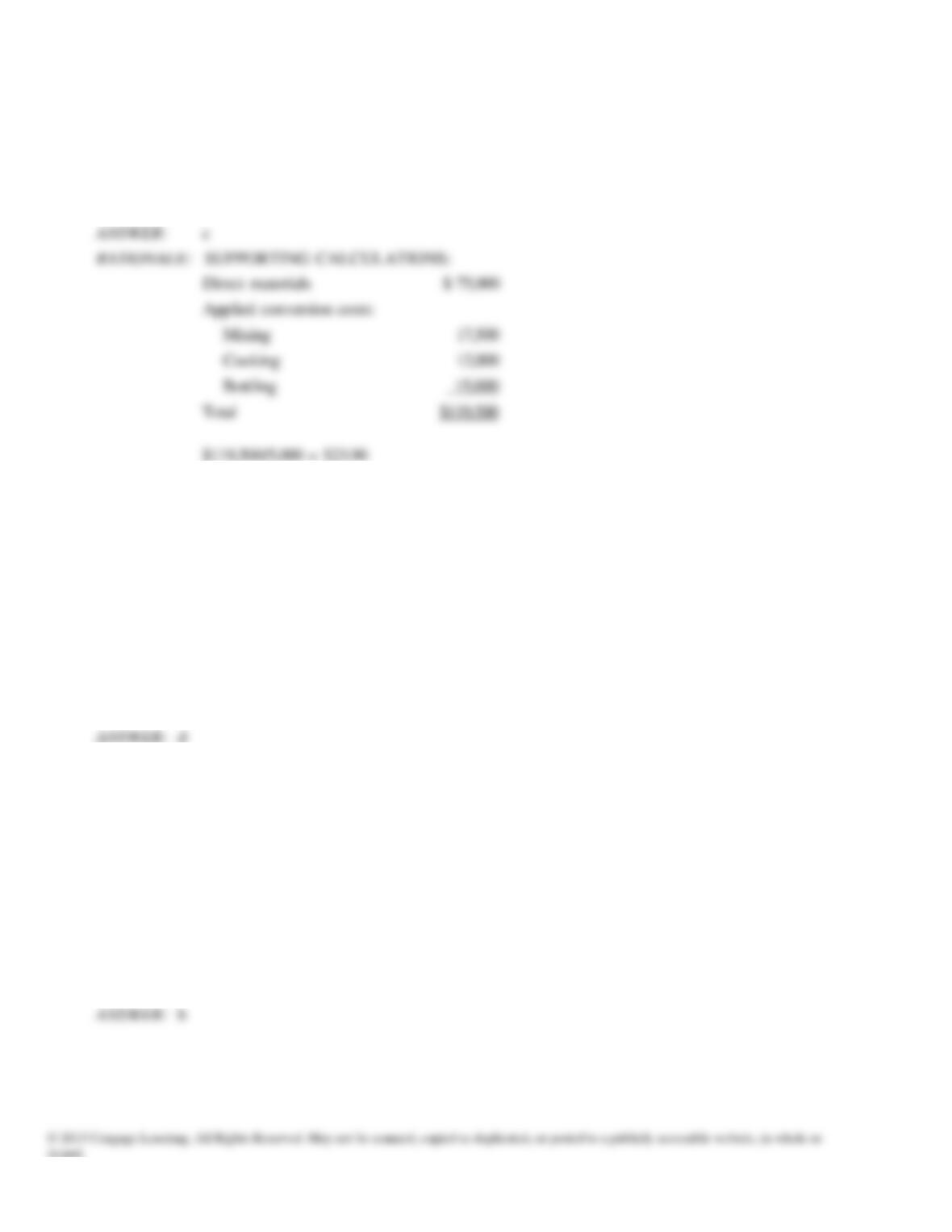
166. Refer to Figure 6-21. What is Golden Ring Company’s unit cost of Large?
a. $3.50
b. $16.90
c. $23.90
d. $70.00
Chapter 6: Process Costing
167. Refer to Figure 6-21. What is Golden Ring Company’s unit cost of Larger?
a. $3.50
b. $16.90
c. $23.90
d. $20.40
168. Refer to Figure 6-21. What is Golden Ring Company’s journal entry to record materials used in the Mixing
Department for Work Order 10?
a. Materials 45,000
Work in Process-Mixing 45,000
b. Work in Process-Mixing 17,500
Conversion Costs Control 17,500
c. Conversion Costs Control 17,500
Work in Process-Mixing 17,500
d. Work in Process-Mixing 45,000
Materials 45,000
169. Refer to Figure 6-21. What is Golden Ring Company’s journal entry to apply conversion costs in the Mixing
Department for Work Order 10?
a. Materials 45,000
Work in Process-Mixing 45,000
b. Work in Process-Mixing 17,500
Conversion Costs Control 17,500
c. Conversion Costs Control 17,500
Work in Process-Mixing 17,500
d. Work in Process-Mixing 45,000
Materials 45,000
Chapter 6: Process Costing
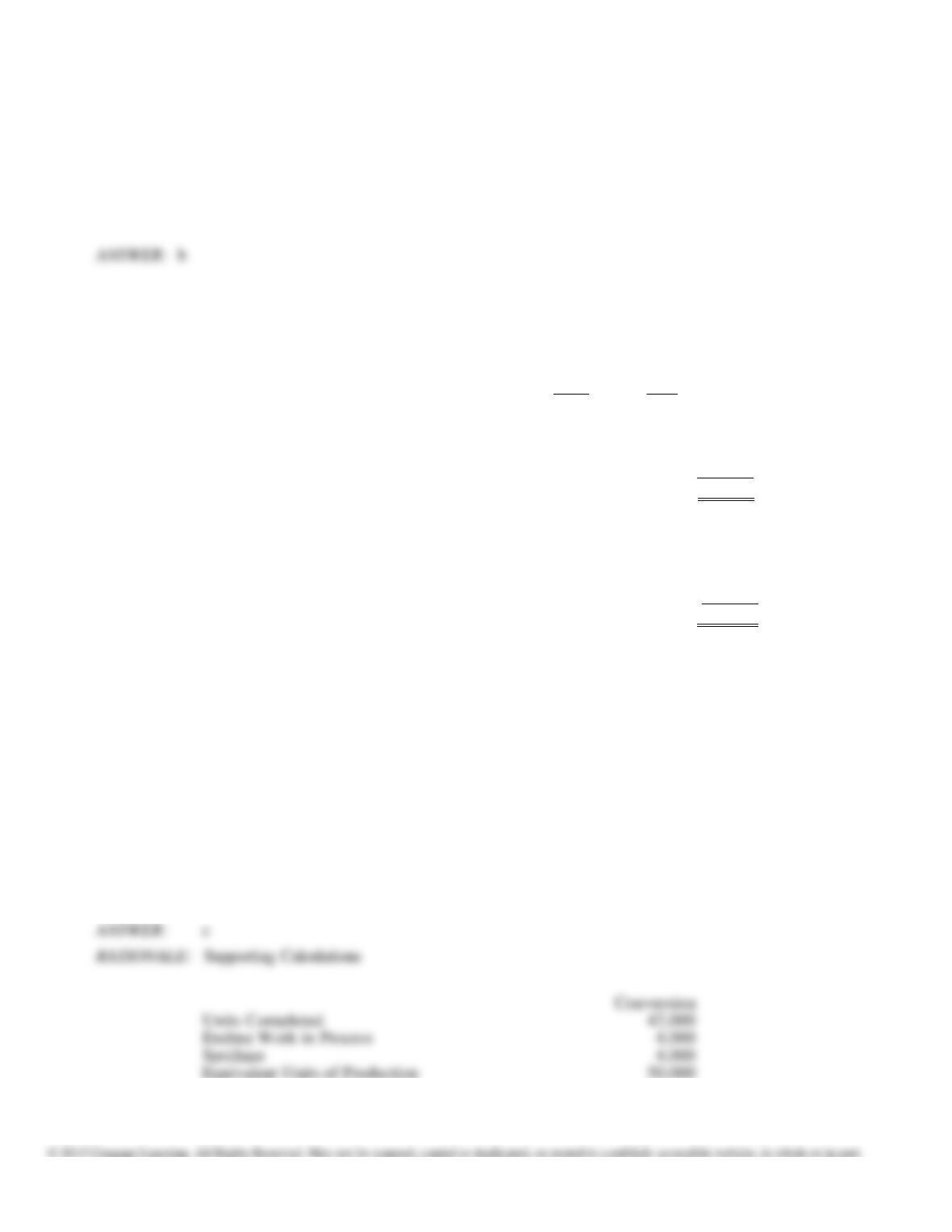
170. Which of the following would NOT be true when there is spoilage?
a. Normal and abnormal spoilage are distinguished.
b. The total units accounted for are greater than the total units to account for indicating spoilage.
c. The units to account for are greater than the total units accounted for indicating spoilage.
d. Equivalent units must be calculated for spoiled units.
Figure 6-22
The following information is available for Department C for the month of August:
Units Cost
Work in process, August 1 (70% complete) 10,000
Direct materials
$36,000
Direct labor
18,000
Manufacturing overhead
24,000
Total work in process, August 1
$78,000
Started in production during August
Costs added:
Direct materials
40,000
Direct labor
48,000
Manufacturing overhead
61,040
Total costs added during August
$217,040
Work in process, August 31 (80% complete)
4,000
Units completed and transferred out
42,000
Materials are added at the beginning of the process. Inspection takes place at the 50 percent point in the conversion
process to determine spoiled units. Round unit costs to two decimal places. The company uses the weighted
average cost flow assumption.
171. Refer to Figure 6-22. Department C’s equivalent units of production for materials using the weighted average
method is
a. 44,800.
b. 47,200.
c. 50,000.
d. 54,000.