Chapter 06 – The Peripheral Nervous System – Afferent Division – Special Senses
True
47. Endogenous opioids include the endorphins, enkephalins, and dopamine.
a.
True
b.
False
False
48. Most of the eyeball is covered by a tough outer layer of connective tissue, the macula, which forms the visible white
part of the eye.
a.
True
b.
False
False
49. The larger posterior cavity between the lens and the retina contains a clear, jellylike substance, the vitreous humor.
a.
True
b.
False
True
50. If the aqueous humor is not drained as rapidly as it forms, pressure builds within the eye and creates a condition called
cataracts.
a.
True
b.
False
False
51. The amount of light entering the eye is controlled by the iris.
a.
True
b.
False
True
52. Convex surfaces converge light rays, bringing them closer together.
a.
True
b.
False
True
53. The two structures most important in the eye’s refractive ability are the iris and the pupil.
a.
True
b.
False
False
54. The strength of the lens depends on its shape, which in turn is regulated by the ciliary muscle.
a.
True
b.
False
True
disorders
55. Rod and cone cells contain a G protein called cyclic GMP.
a.
True
b.
False
False
56. The three ossicles of the middle ear are the malleus, incus, and tympani.
a.
True
b.
False
False
57. Like photoreceptors, hair cells do not undergo action potentials.
a.
True
Chapter 06 – The Peripheral Nervous System – Afferent Division – Special Senses
b.
False
True
58. Pressure waves of frequencies associated with sound reception are transferred from the upper compartment through
the thin vestibular membrane into the cochlear duct and then through the basilar membrane into the lower compartment.
a.
True
b.
False
True
59. The peripheral nervous system (PNS) interprets greater hair bending as a louder sound.
a.
True
b.
False
False
60. Sensorineural deafness occurs when sound waves are not adequately conducted through the external and middle
portions of the ear to set the fluids in the inner ear in motion.
a.
True
b.
False
False
61. The receptor hair cells of each semicircular canal are situated on top of a saddle-shaped ridge located in the ampulla, a
swelling at the base of the canal.
a.
True
b.
False
True
62. Umami taste is an acidic taste that was first identified and named by a Japanese researcher and triggered by amino
acids, especially lysine.
a.
True
b.
False
Chapter 06 – The Peripheral Nervous System – Afferent Division – Special Senses
False
63. In addition to the olfactory mucosa, the nose contains another sense organ, the vomeronasal organ, which is common
in mammals but until recently, was thought nonexistent in humans.
a.
True
b.
False
True
64. CNS adaptation is specific for a particular odor, and responsiveness to other odors remains unchanged.
a.
True
b.
False
True
65. The conversion of stimulus energy into a receptor potential is known as ____________________.
66. ____________________ corpuscles are rapidly adapting and sensitive to light, fluttering touch, such as tickling with a
feather.
67. Pathways conveying conscious somatic sensation are called ____________________ pathways and they consist of
discrete chains of neurons, or ____________________ lines.
68. The smaller the receptive field is in a region, the greater its ____________________or discriminative ability.
acuity
69. Besides receptor density, a second factor influencing acuity is ____________________ inhibition.
70. The sensation of pain is accompanied by motivated ____________________ responses and ____________________
reactions.
71. Impulses from polymodal nociceptors that respond to chemicals released into the ECF from damaged tissue are
carried by small, unmyelinated ____________________.
72. ____________________ is a normally inactive substance that is activated by enzymes released into the ECF from
damaged tissue.
73. The normally transparent elastic fibers in the lens may become opaque so that light cannot pass through, a condition
known as a(n) ____________________.
74. The pea-sized area immediately surrounding the fovea is called the ____________________ which has a high
concentration of cones and fairly high acuity.
75. ____________________ is the process of converting light stimuli into electrical signals.
76. Photoreceptors are ____________________ by their adequate stimulus and ____________________ in the absence of
stimulation.
77. When an individual lacks a particular cone type, the resulting condition is called ____________________, which is
more common in ____________________.
78. The primary visual cortex is situated in the ____________________ lobe of the brain.
79. Photoreceptors called ____________________ are responsible for night vision.
80. The ____________________ is in the exact center of the retina and the region with greatest acuity.
81. The overlapping area seen by both eyes at the same time is known as the ____________________ field of vision.
82. The intensity or ____________________ of a sound depends on the ____________________ of the sound waves.
83. The cochlea is divided throughout most of its length into ____________________ fluid-filled
____________________ compartments.
84. The inner hair cells communicate via a chemical synapse with the terminals of afferent nerve fibers making up the
____________________ nerve.
85. The ____________________ provides information essential for the sense of equilibrium and for coordinating head
movements with eye and postural movements.
86. Each taste bud has a small opening, the ____________________, through which fluids in the mouth come into contact
with the surface of its receptor cells.
87. There are five primary tastes: salty, sour, sweet, ____________________, and ____________________.
88. Odor discrimination is coded by patterns of activity in the ____________________.
89. ____________________ are nonvolatile chemical signals passed subconsciously between individuals of the same
species.
Chapter 06 – The Peripheral Nervous System – Afferent Division – Special Senses
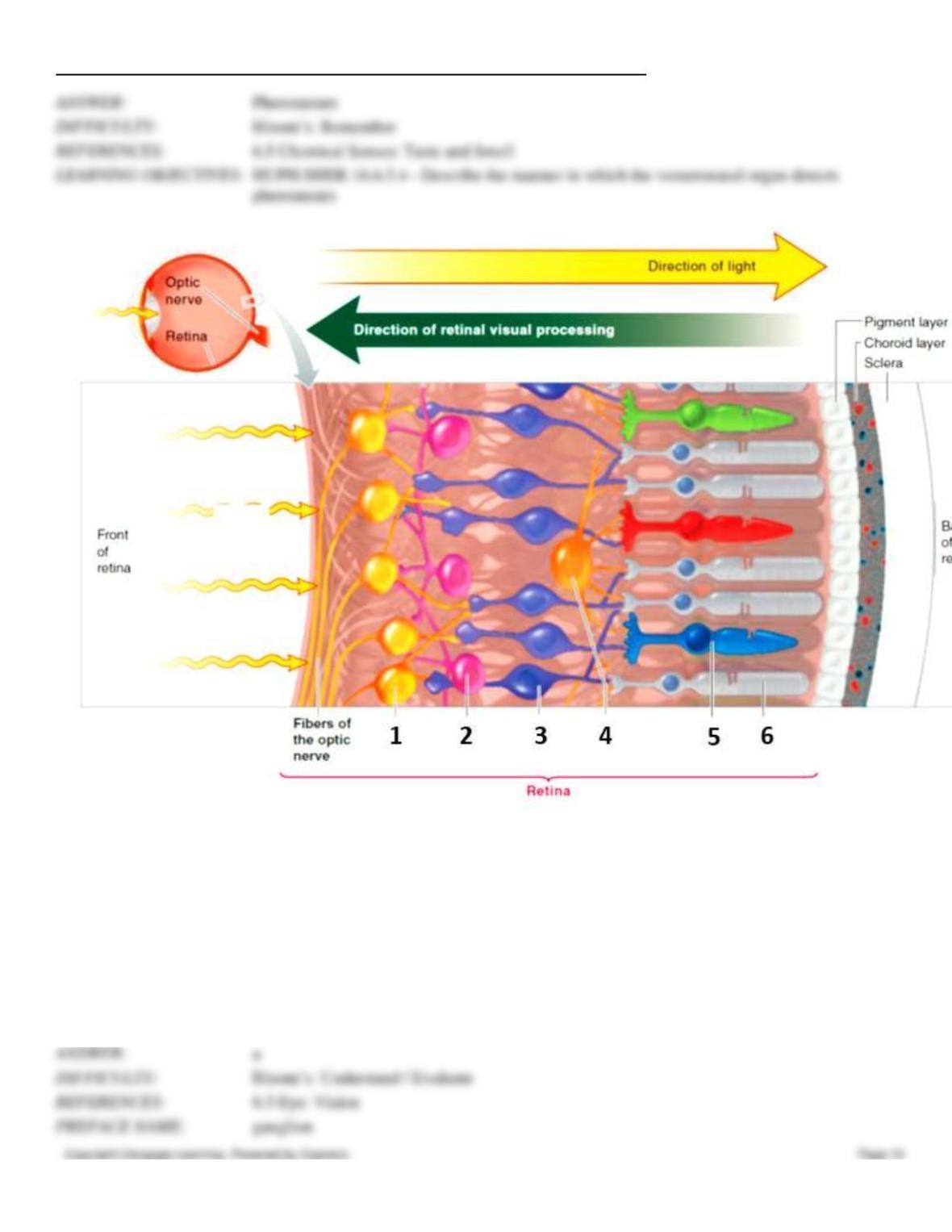
Figure 6-20
Answer the following questions using the accompanying diagram.
90. Which number in the accompanying figure represents a ganglion cell?
a.
1
b.
2
c.
3
d.
4
e.
5
f.
6
91. Which number in the accompanying figure represents a cone?
a.
1
b.
2
c.
3
d.
4
e.
5
f.
6
92. Which number in the accompanying figure represents a horizontal cell?
a.
1
b.
2
c.
3
d.
4
e.
5
f.
6
d
93. Which number in the accompanying figure represents an amacrine cell?
a.
1
b.
2
c.
3
d.
4
e.
5
f.
6
b
94. Which number in the accompanying figure represents a bipolar cell?
a.
1
b.
2
Chapter 06 – The Peripheral Nervous System – Afferent Division – Special Senses
c.
3
d.
4
e.
5
f.
6
95. Which number in the accompanying figure represents a rod?
a.
1
b.
2
c.
3
d.
4
e.
5
f.
6
96. Define perception.
97. Describe the process of dark adaptation.
98. Describe the role of the otolith organs.
99. Discuss how the gut and airways “taste” also.
100. Stimulation of a receptor alters its membrane permeability, usually by opening channels that permit an influx of what
ions?
a.
calcium
b.
chloride
c.
potassium
d.
sodium
e.
iron