
Information Technology Project Management 5e – Marchewka
Chapter 6: The Work Breakdown Structure and Project
Estimation
True/False
1. Project network diagrams provide valuable information about the logical
sequence and dependencies among the various activities and tasks so that a
completion date or deadline can be determined.
a. True
b. False
2. Predecessor activities are activities that can be worked on at the same time as
another activity.
a. True
b. False
3. Predecessor activities are activities that must be completed before another activity
can be started.
a. True
b. False
4. A parallel activity is a task that can be worked on at the same time as another
activity.
a. True
b. False

Information Technology Project Management 5e – Marchewka
5. Parallel activities can shorten the project schedule, but can have an impact on
project resources if a resource is assigned to two tasks at the same time.
a. True
b. False
6. The critical path is the shortest path in the project network and also is the longest
time in which the project can be completed.
a. True
b. False
7. The critical path is the longest path in the project network and also is the shortest
time in which the project can be completed.
a. True
b. False
8. Identifying the critical path is important because any change in the duration of the
activities or tasks on the critical path will affect the project’s schedule.
a. True
b. False
9. The critical path has zero slack (or float)
a. True
b. False

Information Technology Project Management 5e – Marchewka
10. Identifying the critical path is important because a project can only have one
critical path and it never changes.
a. True
b. False
11. PERT was developed in the 1950s to create a visual representation of scheduled
activities, their logical sequence, and interrelationships using a statistical
probability distribution.
a. True
b. False
12. Installing a server before loading the operating system is an example of a finish–
to-start relationship.
a. True
b. False
13. Start-to-Start and Finish-to-Finish relationships allow activities to be worked on
in parallel.
a. True
b. False
14. A start-to-finish activity is the most common relationship between two activities.
a. True

Information Technology Project Management 5e – Marchewka
b. False
15. The project budget is determined by the project schedule, the cost of the resources
assigned to each of the tasks, and by any other direct or indirect costs and
reserves.
a. True
b. False
16. The direct costs of using a resource is the only type of cost that should be
considered when developing the project budget.
a. True
b. False
17. Sunk costs include such things as rent, utilities, insurance, and other
administrative costs.
a. True
b. False
18. A reserve can provide a cushion when unexpected situations arise.
a. True
b. False

Information Technology Project Management 5e – Marchewka
19. An over allocated resource would arise when Mary is assigned to work on two
tasks scheduled at the same time.
a. True
b. False
20. Once the project schedule and budget are accepted by the client or sponsor, the
project plan becomes the baseline plan that will be used as a benchmark to track
the project’s actual progress.
a. True
b. False
21. A kick-off meeting is often held to develop the project plan.
a. True
b. False
22. The kick-off meeting brings closure to the planning phase of the project.
a. True
b. False

Information Technology Project Management 5e – Marchewka
Multiple Choice
1. Which of the following statements are true?:
a) Milestones are logical units of work.
b) Baseline plans are approved project plans.
c) All tasks are linear, i.e. have to be completed in a particular sequence.
d) The kick-off meeting typically begins the planning phase of a project.
e) MOV are readily changed through change control processes.
2. The tool most closely associated with activity bars across a horizontal time axis
is:
a) Project Network Diagrams
b) Gantt Charts
c) PERT
d) Activity on the Node
e) Critical Path Analysis
3. _____ is considered the most useful and widely used project management tool.
a) Project Network Diagrams
b) Gantt Charts
c) PERT
d) Activity on the Node
e) Critical Path Analysis
4. _____ can be useful for tracking and monitoring project progress because because
they are simple and straightforward.
a) Project Network Diagrams

Information Technology Project Management 5e – Marchewka
b) Gantt Charts
c) PERT
d) Activity on the Node
e) Critical Path Analysis
5. _____ provide valuable information about the logical sequence and dependencies
among the various activities and tasks:
a) Work Breakdown Schedule
b) Gantt Charts
c) PART
d) Project Network Diagrams
e) Critical Path Analysis
6. _____ can help manage the Critical Path by providing information about which
activities can be delayed without affecting the deadline target date.
a) Work Breakdown Schedule
b) Gantt Charts
c) PART
d) Project Network Diagrams
e) Critical Path Analysis
7. The amount of time an activity can be delayed before affecting the project
deadline is _____
a) slack
b) crash
c) fast-track
d) diversion
e) delay in any activity will delay the project

Information Technology Project Management 5e – Marchewka
8. The technique used to find the sequence of tasks with zero slack (or float) is most
closely associated with:
a) Project Network Diagrams
b) Gantt Charts
c) PERT
d) Activity on the Node
e) Critical Path Analysis
9. The Critical Path is:
a) the longest path in the project network.
b) the shortest path in the project network.
c) the longest time in which the project can be completed.
d) the interrelationships of project activities.
e) the most important identified tasks within the project.
10. Adding resources to an activity to shorten the critical path is called_____
a) slacking.
b) floating.
c) diverting.
d) crashing.
e) fast tracking

Information Technology Project Management 5e – Marchewka
11. Completing activities in parallel is called_____
a) slacking.
b) floating.
c) diverting.
d) crashing.
e) fast tracking
12. The technique used to help manage the Polaris submarine project and which bases
activity estimates on probabilistic estimates of three scenarios is most closely
associated with:
a) Project Network Diagrams
b) Gantt Charts
c) PERT
d) Activity on the Node
e) Critical Path Analysis
13. Starting the next task before the first task is complete is _____
a) lead
b) lag
c) negative lead
d) slack
e) float
14. An activity being analyzed under PERT was judged to most likely have a duration
of 40 days. When considering the time it would take to complete the activity if
every relevant factor went well, it was estimated to be able to be doable in 20
days and even under the worst case imaginable, the task would be take 50 days.
The estimates PERT duration of that activity is:
Information Technology Project Management 5e – Marchewka
a) 36.67 days
b) 38.33 days
c) 37.50 days
d) 28.33 days
e) 32.67 days
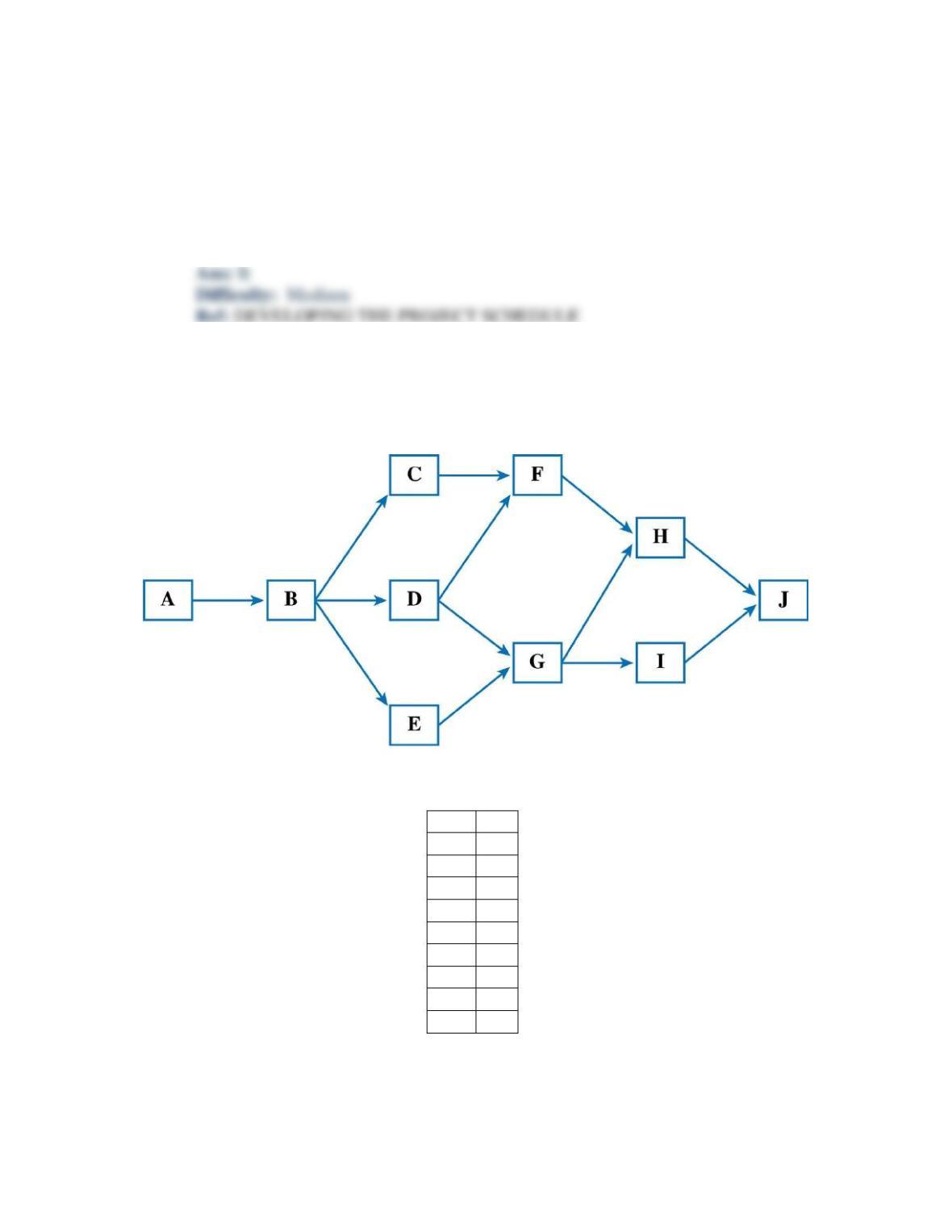
15. Based upon the following diagram and activity durations, the Critical Path is:
A
2
B
5
C
4
D
3
E
1
F
4
G
3
H
5
I
5
J
1
a) A+B+C+F+H+J
b) A+B+D+F+H+J
c) A+B+D+G+H+J

Information Technology Project Management 5e – Marchewka
d) A+B+D+G+I+J
e) A+B+E+G+I+J
16. _____ is well suited for developing simulations where the project manager can
conduct sensitivity analysis for schedule planning and risk analysis.
a) Project Network Diagrams
b) Gantt Charts
c) PERT
d) Activity on the Node
e) Critical Path Analysis
17. Under the Precedence Diagramming Method, the situation which occurs when a
relationship between two tasks that can or must start at the same time is called:
a) Finish-To-Start (FS)
b) Start-To-Start (SS)
c) Finish-To-Finish (FF)
d) Start-To-Finish (SF)
e) none of these
18. Under the Precedence Diagramming Method, the most common relationship
between two activities which implies a logical sequence is called:
a) Finish-To-Start (FS)
b) Start-To-Start (SS)
c) Finish-To-Finish (FF)
d) Start-To-Finish (SF)
e) none of these

Information Technology Project Management 5e – Marchewka
19. Installing the operating system on a computer before loading any application
packages is an example of:
a) Finish-To-Start (FS)
b) Start-To-Start (SS)
c) Finish-To-Finish (FF)
d) Start-To-Finish (SF)
e) none of these
20. Under the Precedence Diagramming Method, the situation which occurs when
two activities can start at different times, have different durations, but are planned
to be competed at the same time is called:
a) Finish-To-Start (FS)
b) Start-To-Start (SS)
c) Finish-To-Finish (FF)
d) Start-To-Finish (SF)
e) none of these
21. Under the Precedence Diagramming Method, the situation which occurs when
task A cannot end until task B starts is called:
a) Finish-To-Start (FS)
b) Start-To-Start (SS)
c) Finish-To-Finish (FF)
d) Start-To-Finish (SF)
e) none of these