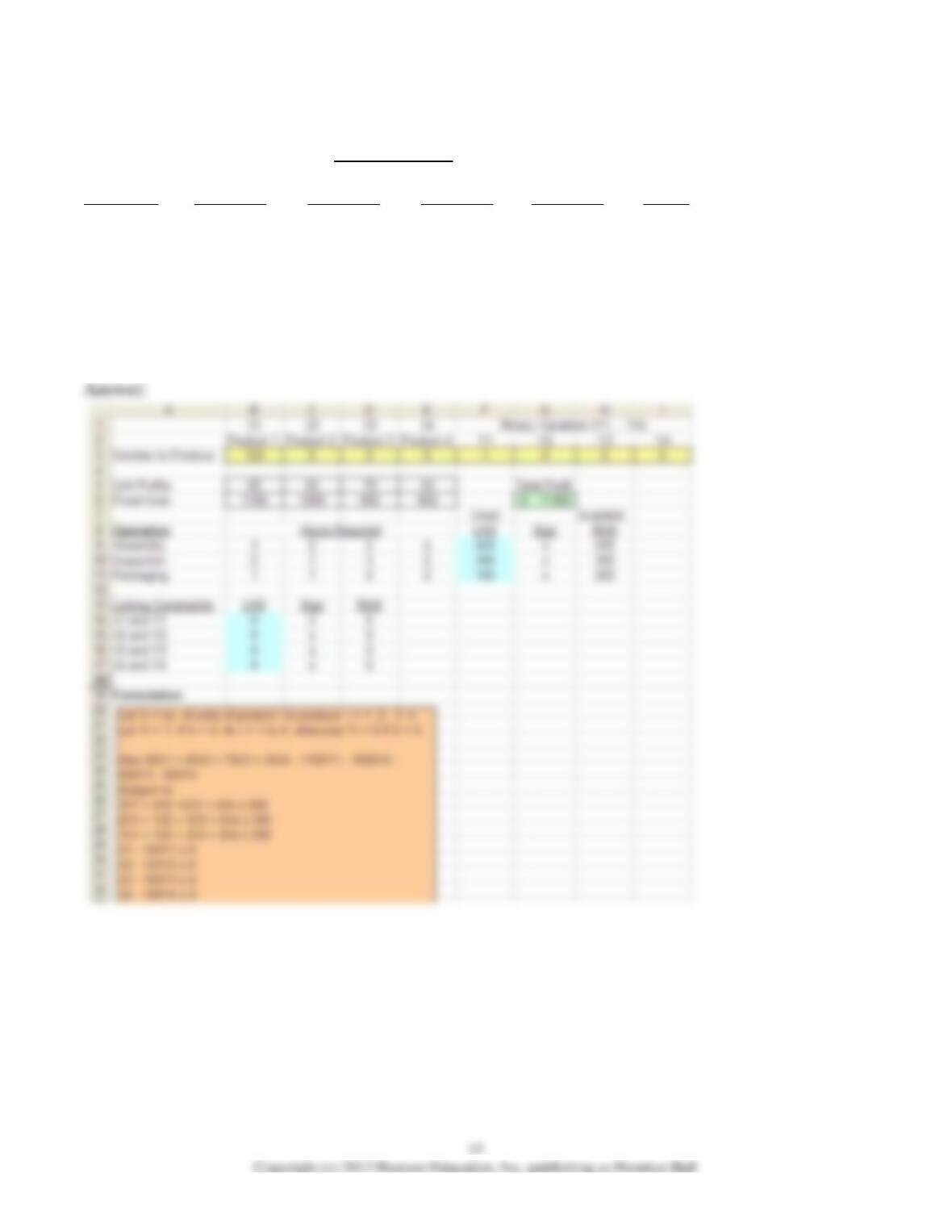
7) A company produces four products each of which must undergo assembly, inspection, and packaging.
The information below summarizes the hours required for each operation by each product, the total
hourly capacity for each operation, and the fixed cost incurred by each product if it is produced.
Hours Required
Available
Operation Product 1 Product 2 Product 3 Product 4 Hours
Assembly 3 4 5 4 500
Inspection 2 1 3 2 300
Packaging 1 1 2 2 200
Fixed Cost $1100 $1000 $900 $850
Each unit of product 1 sold will contribute $60 to profit, and each unit of products 2, 3, and 4 contributes
$65, $70, and $55, respectively. What is the optimal product mix?
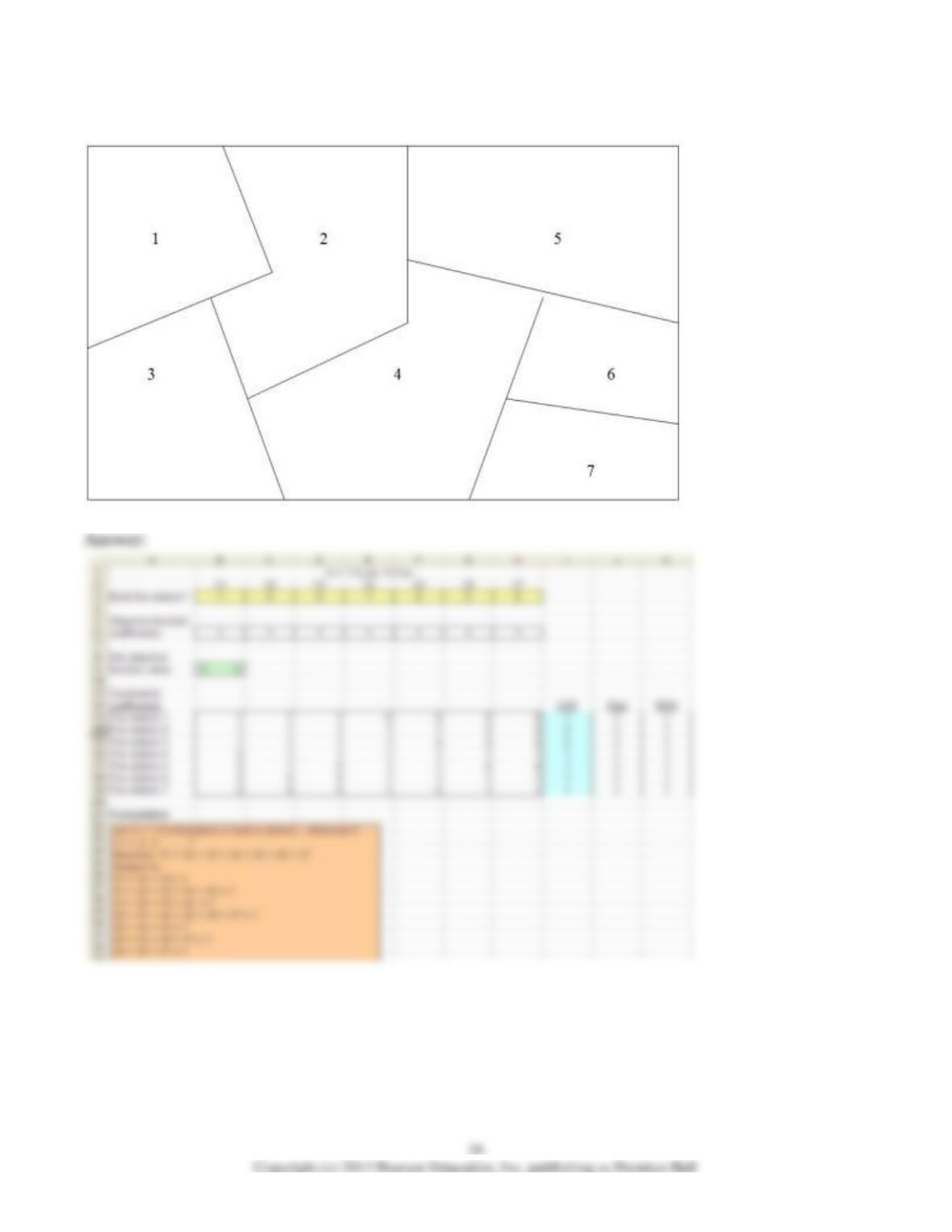
8) A city is reviewing the location of its fire stations. The city is made up of a number of districts, as
illustrated below. A fire station can be placed in any district and is able to handle the fires for both its
neighborhood and any adjacent neighborhood. The objective is to minimize the number of fire stations
used.
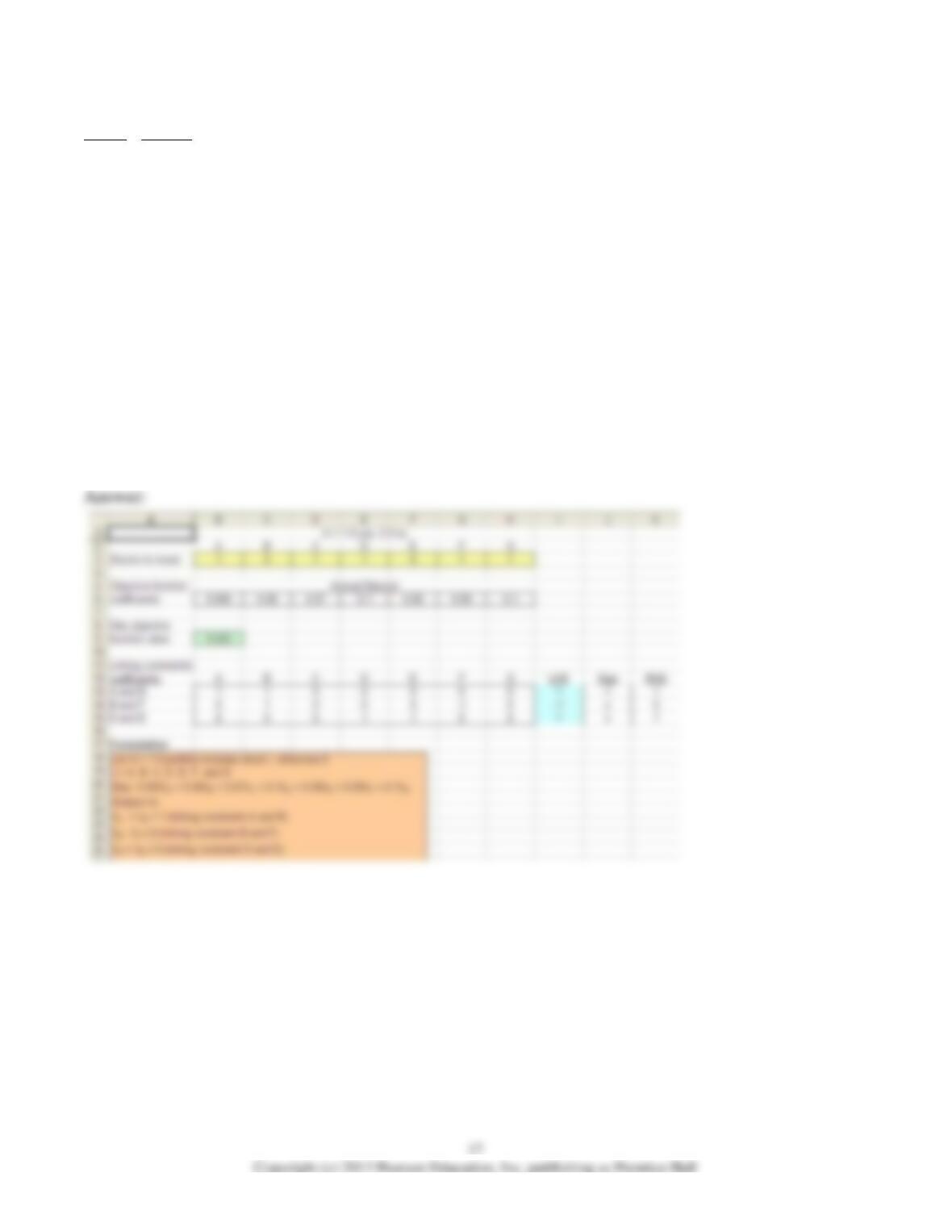
9) An investor is considering 7 different stocks: A, B, C, D, E, F, and G. The expected annual return for
each stock is provided as follows:
Annual
Stock Return
A 9.5%
B 8.0%
C 7.0%
D 10.0%
E 8.0%
F 9.0%
G 10%
The investor has imposed the following restrictions regarding the composition of the portfolio:
• the portfolio must include exactly one of the following stocks: either A or B.
• if stock B is selected, then stock F must also be selected.
• if stock D is selected, then stock E must be excluded.
Which stocks should be included in the portfolio to maximize annual return?
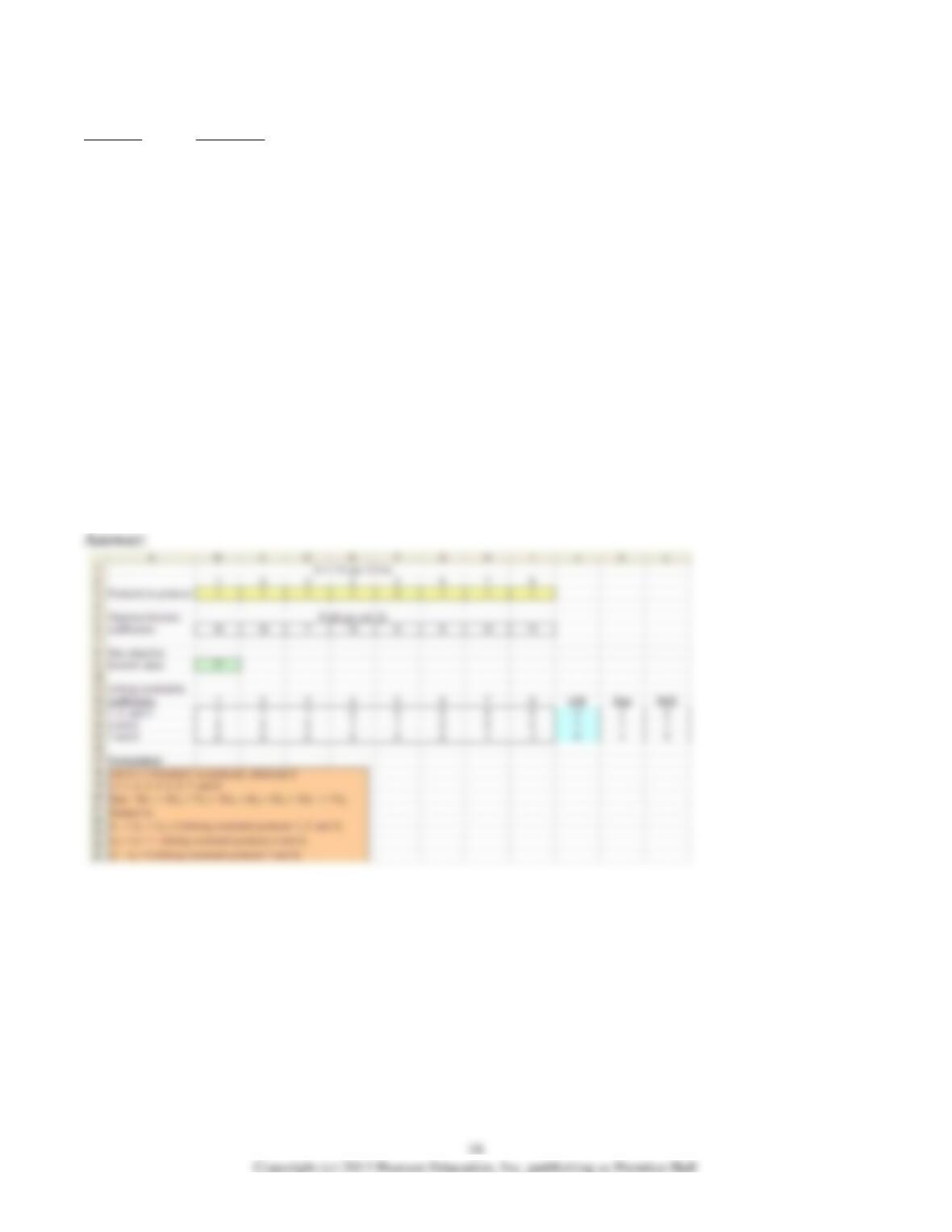
10) A company is considering producing 8 different products for the upcoming holiday season. The
profit contribution per product is illustrated below:
Product Profit ($)
1 10
2 12
3 7
4 15
5 8
6 9
7 13
8 11
The marketing manager has imposed the following restrictions on the production mix:
• Since products 1, 2, and 3 are electronic gadgets, at least two of these products must be in the
production mix.
• Since products 4 and 5 are kids-oriented, the production mix must include no more than one of these
products.
• If product 7 is included in the mix, then product 8 must be included, and vice versa.
Which products should be included in the mix to maximize profit?
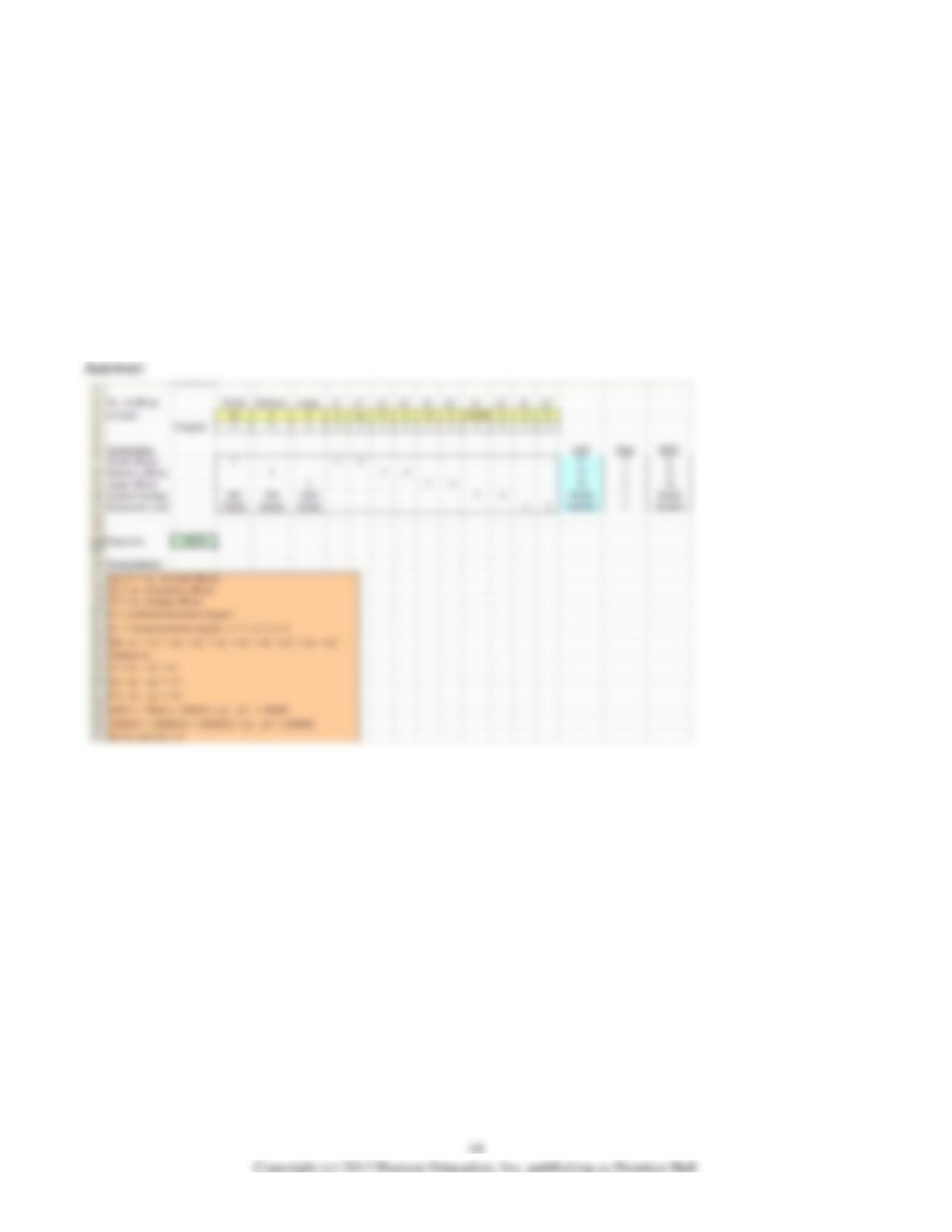
11) A developer wishes to expand an office complex and needs to determine how many small, medium,
and large offices to include in the expansion. Each small office requires 400 square feet, each medium
office requires 700 square feet, and each large office requires 1200 square feet. The current square
footage available for expansion is 35,000 square feet. The developer expects to pay $10,000 for each
small office, $20,000 for each medium office, and $35,000 for each large office. The developer wishes
to limit his expenditures to $500,000. How many of each type of office should be built if the following
goals, stated in no particular order, must be met?
Goal 1: The expansion should include approximately 6 small offices.
Goal 2: The expansion should include approximately 11 medium offices.
Goal 3: The expansion should include approximately 15 large offices.
Goal 4: The expansion should consist of approximately 35,000 square feet.
Goal 5: The expansion should cost approximately $500,000.
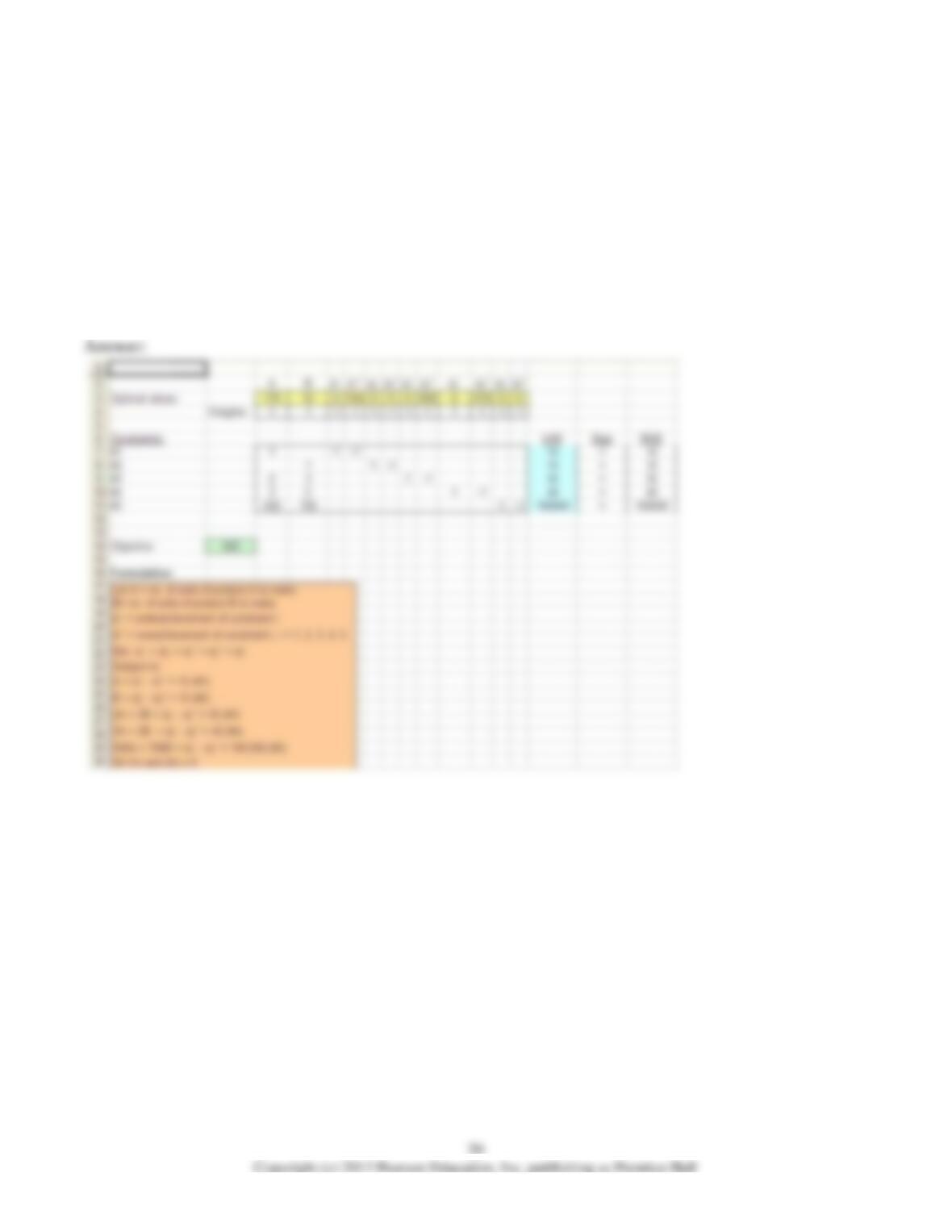
12) Consider the following linear programming problem:
Max: 500A + 700B
Subject to:
2A + 3B ≤ 35 (assembly hours)
3A + 5B ≤ 40 (machine hours)
Reformulate and solve this problem as a goal programming problem if the following goals, stated in no
particular order, must be met.
Goal 1: Produce at least 15 units of each product.
Goal 2: Avoid overtime in the assembly and machine departments.
Goal 3: Achieve at least $100,000 in profit.
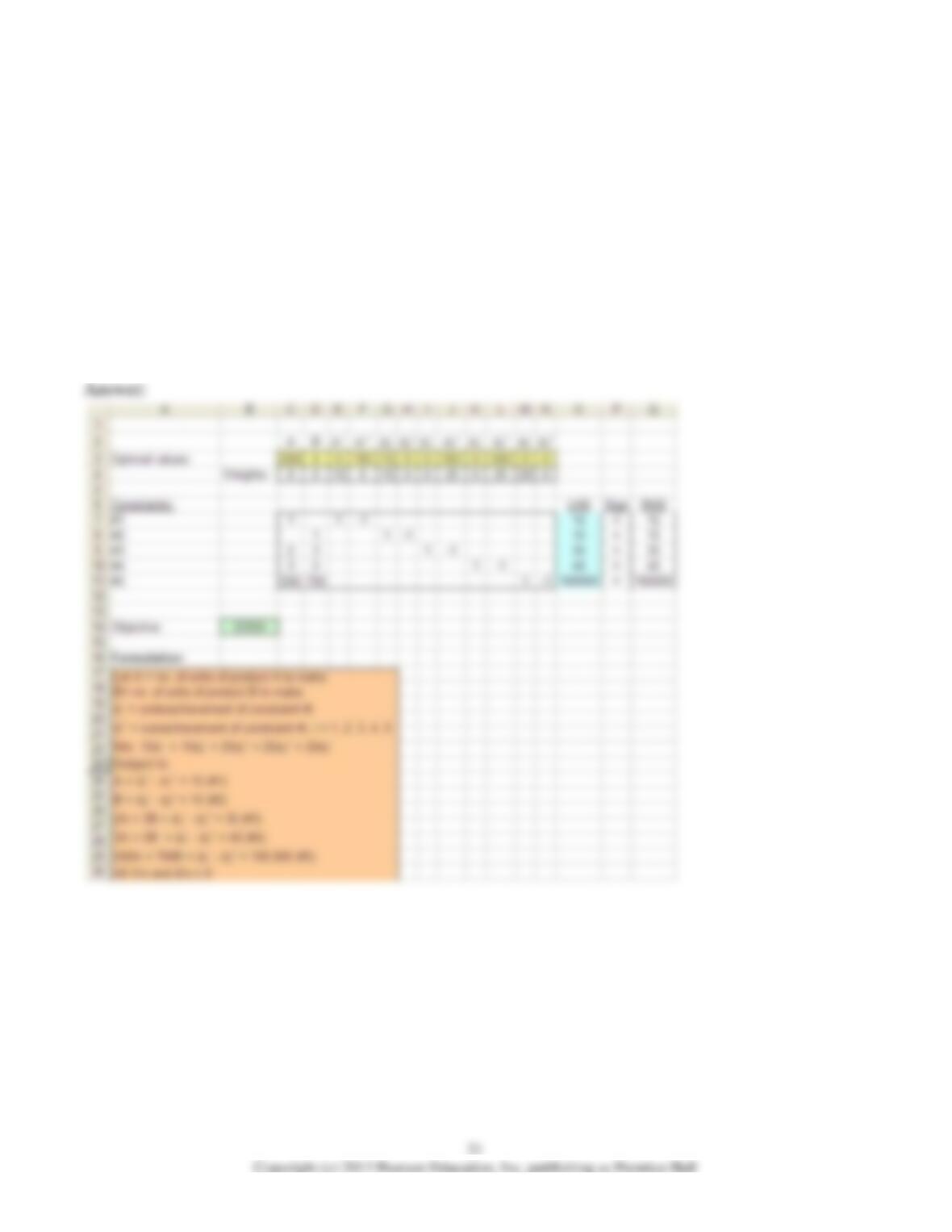
13) Consider the following linear programming problem:
Max: 500A + 700B
Subject to:
2A + 3B ≤ 35 (assembly hours)
3A + 5B ≤ 40 (machine hours)
Reformulate and solve this problem as a goal programming problem if the following goals, with their
associated weights, must be met.
Goal 1: Produce at least 15 units of product A; Weight 15
Goal 2: Produce at least 15 units of product B; Weight 15
Goal 3: Minimize overtime in assembly department; Weight 25
Goal 4: Minimize overtime in machine department; Weight 25
Goal 5: Achieve at least $100,000 in profit; Weight 20
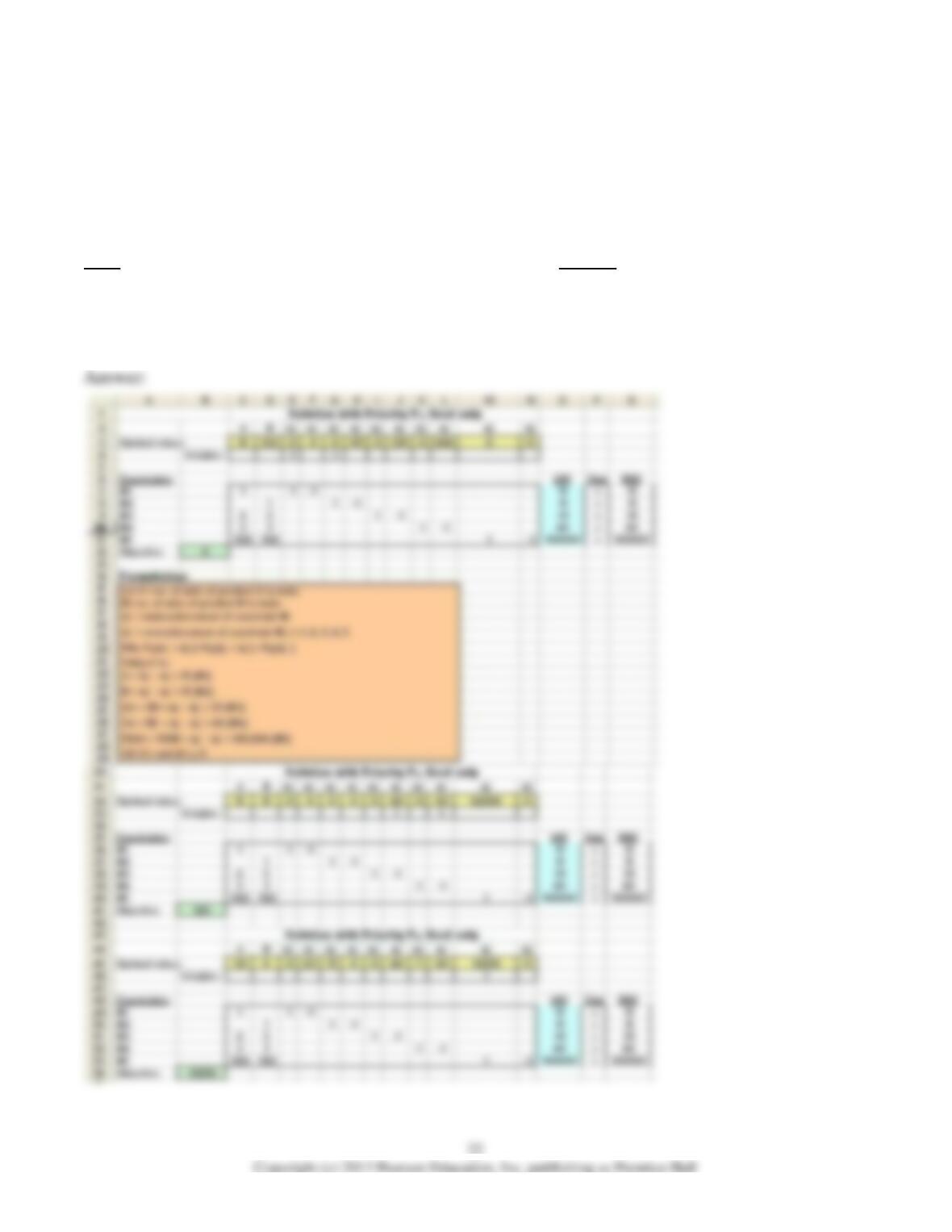
14) Consider the following linear programming problem:
Max: 500A + 700B
Subject to:
2A + 3B ≤ 35 (assembly hours)
3A + 5B ≤ 40 (machine hours)
Reformulate and solve this problem as a goal programming problem if the following prioritized goals
must be met.
Goal Priority
Produce at least 15 units of each product. P1
Minimize overtime in assembly and machine departments. P2
Achieve at least $100,000 in profit. P3
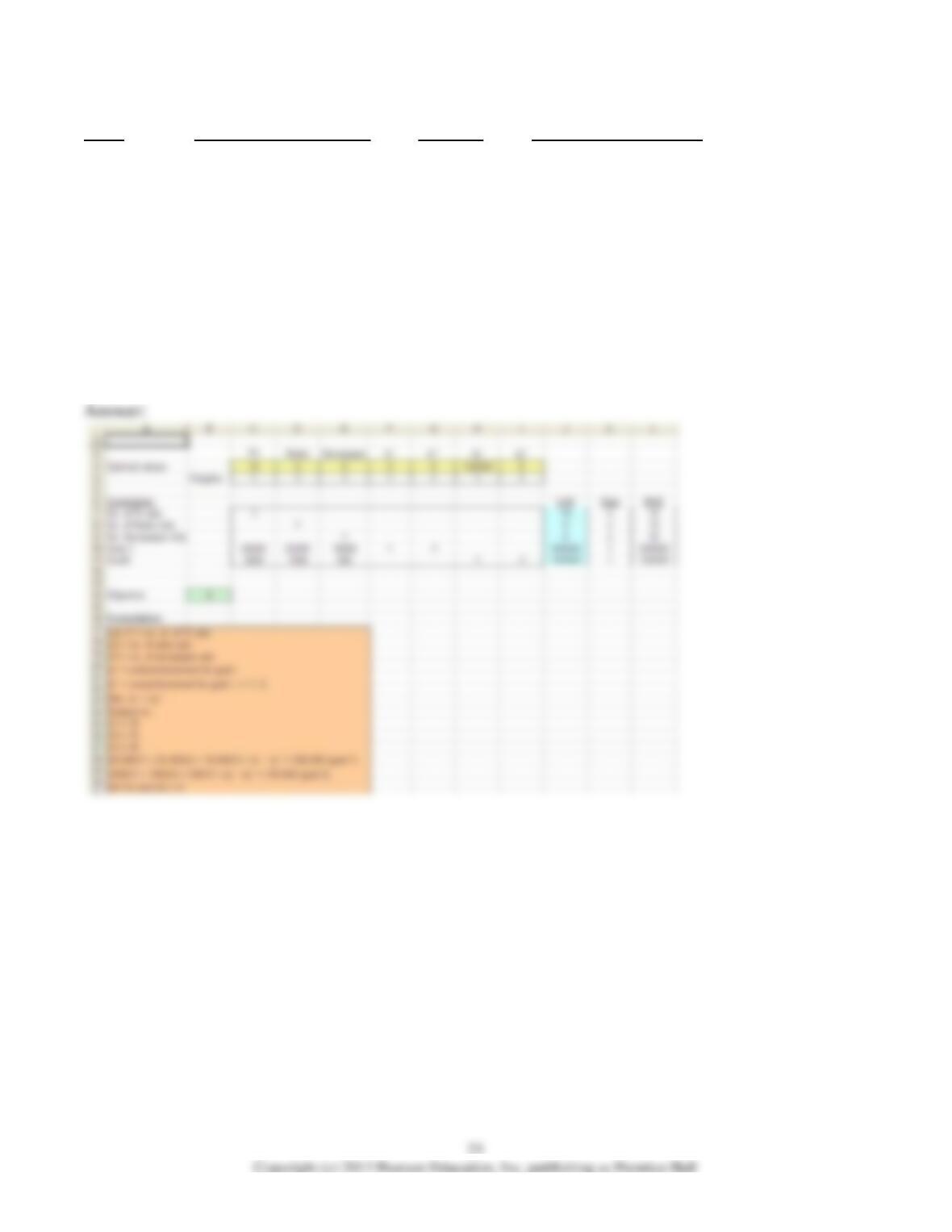
15) A marketing manager is considering the following advertising media to promote a new
product.
Type Audience Reached/Ad Cost/Ad Maximum No. of Ads
TV 50,000 $3000 10
Radio 25,000 $1000 15
Newspaper 10,000 $500 30
The marketing manager has established the following goals, stated in no particular order, for the
advertising campaign:
Goal 1: Reach at least 500,000 individuals.
Goal 2: Limit the total spending to $150,000.
Formulate and solve this goal programming problem.
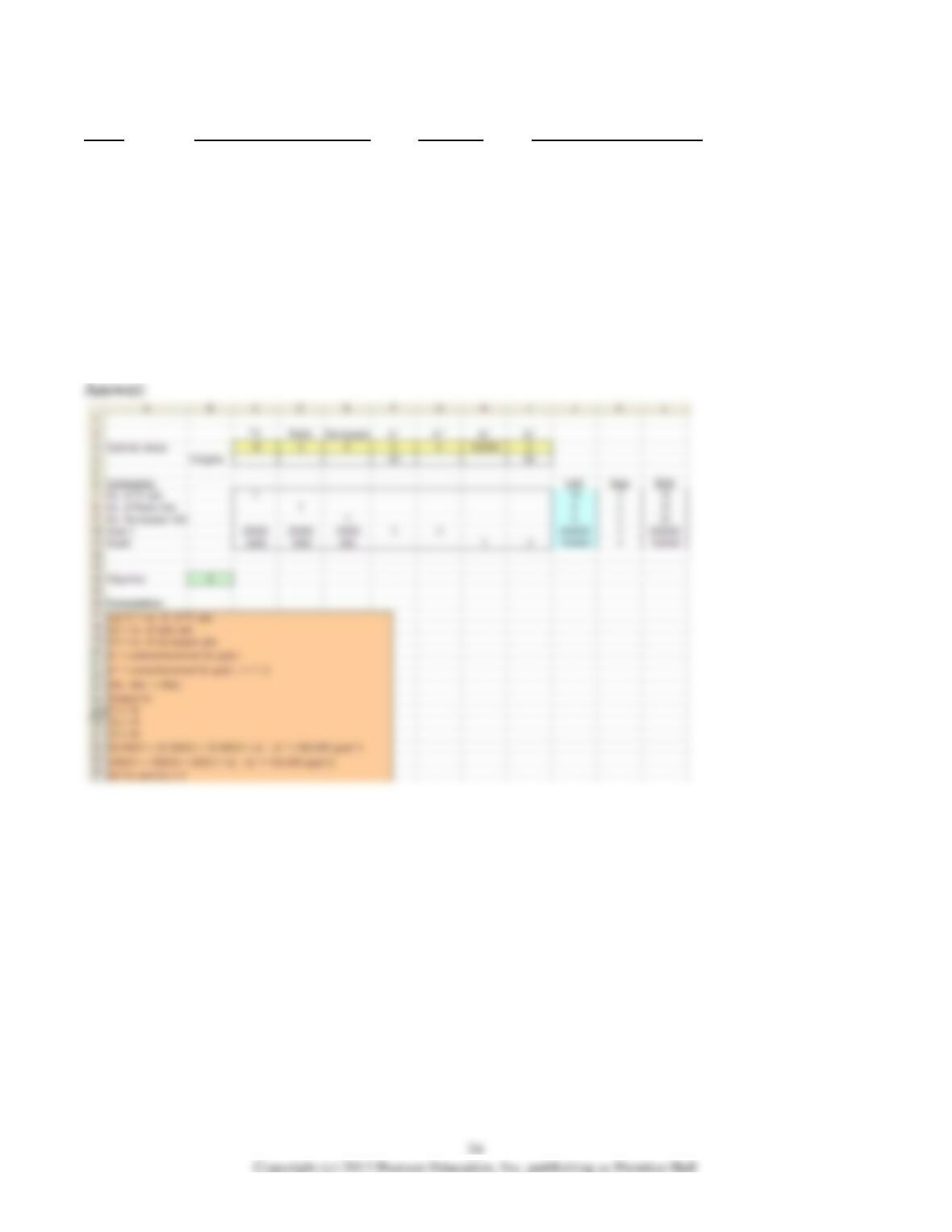
16) A marketing manager is considering the following advertising media to promote a new
product.
Type Audience Reached/Ad Cost/Ad Maximum No. of Ads
TV 50,000 $3000 10
Radio 25,000 $1000 15
Newspaper 10,000 $500 30
The marketing manager has established the following goals and weights:
Goal 1: Reach at least 500,000 individuals; Weight 40.
Goal 2: Limit the total spending to $150,000; Weight 60.
Formulate and solve this goal programming problem.
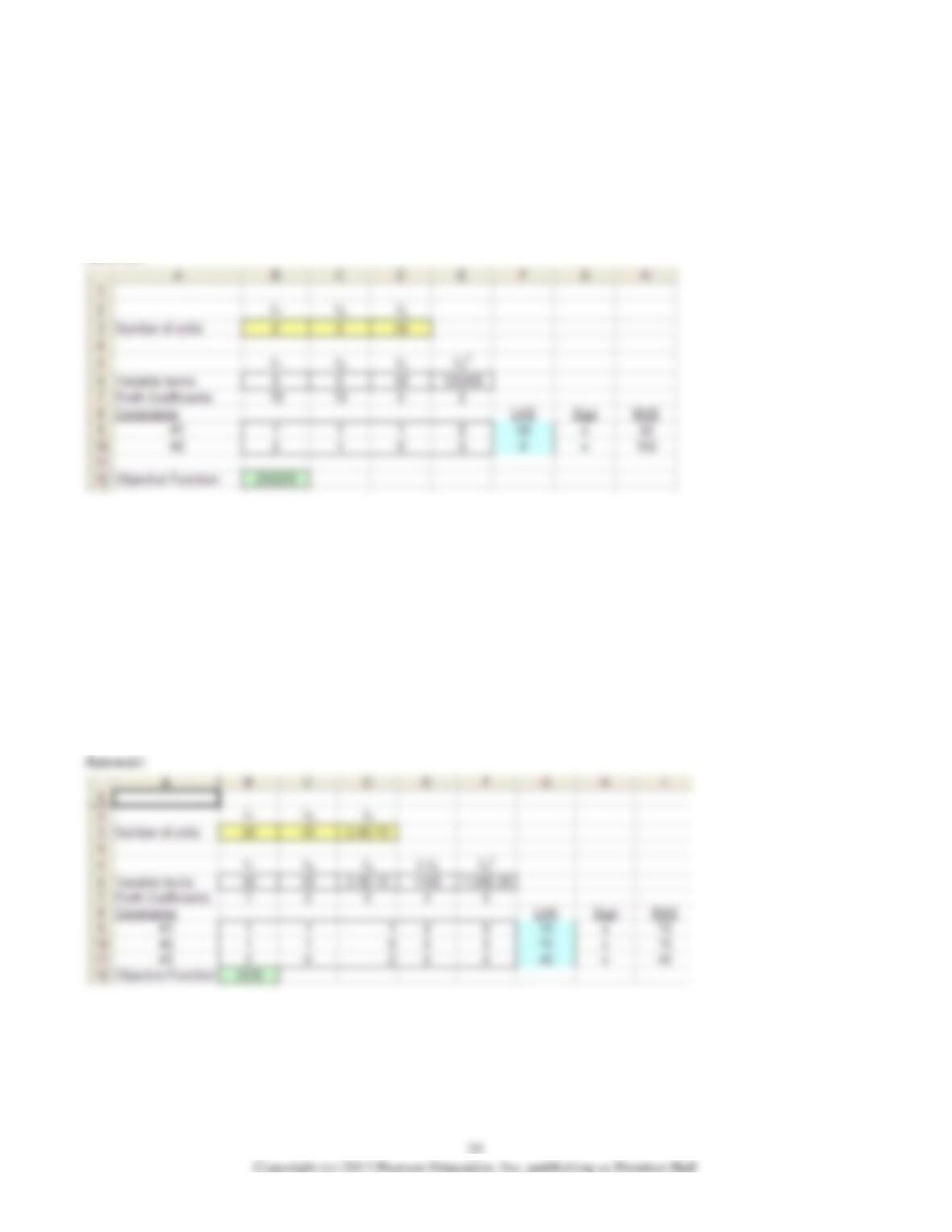
17) Set up and solve the following nonlinear programming problem using Excel:
Max: 10X1 + 15X2 + 5X3 + 2X33
Subject to
X1 + X2 + X3 ≤ 50
2X1 + 3X2 ≤ 150
X1, X2, X3≥ 0
Answer:
18) Set up and solve the following nonlinear programming problem using Excel:
Max: X1 + 2X2 + 3X1X2 + 5X33
Subject to
X1 + X2 + X3 ≤ 75
X1 + X2 ≥ 15
2X1 + 2X3 ≤ 40
X1, X2, X3 ≥ 0
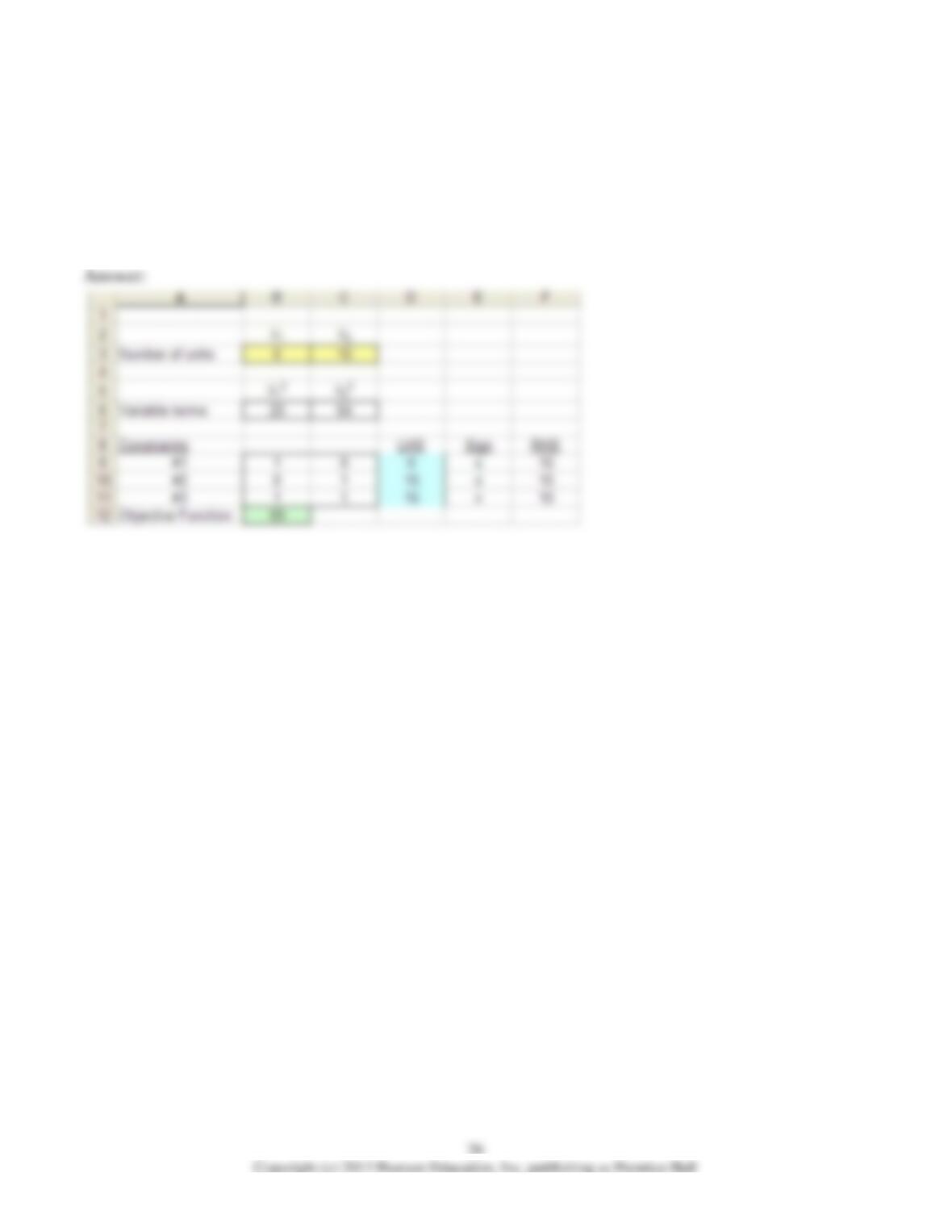
19) Set up and solve the following nonlinear programming problem using Excel:
Max: (X1 – 5)2 + (X2 – 7)2
Subject to
X1 ≤ 15
X2 ≤ 15
X1 + X2 ≥ 10
X1, X2 ≥ 0
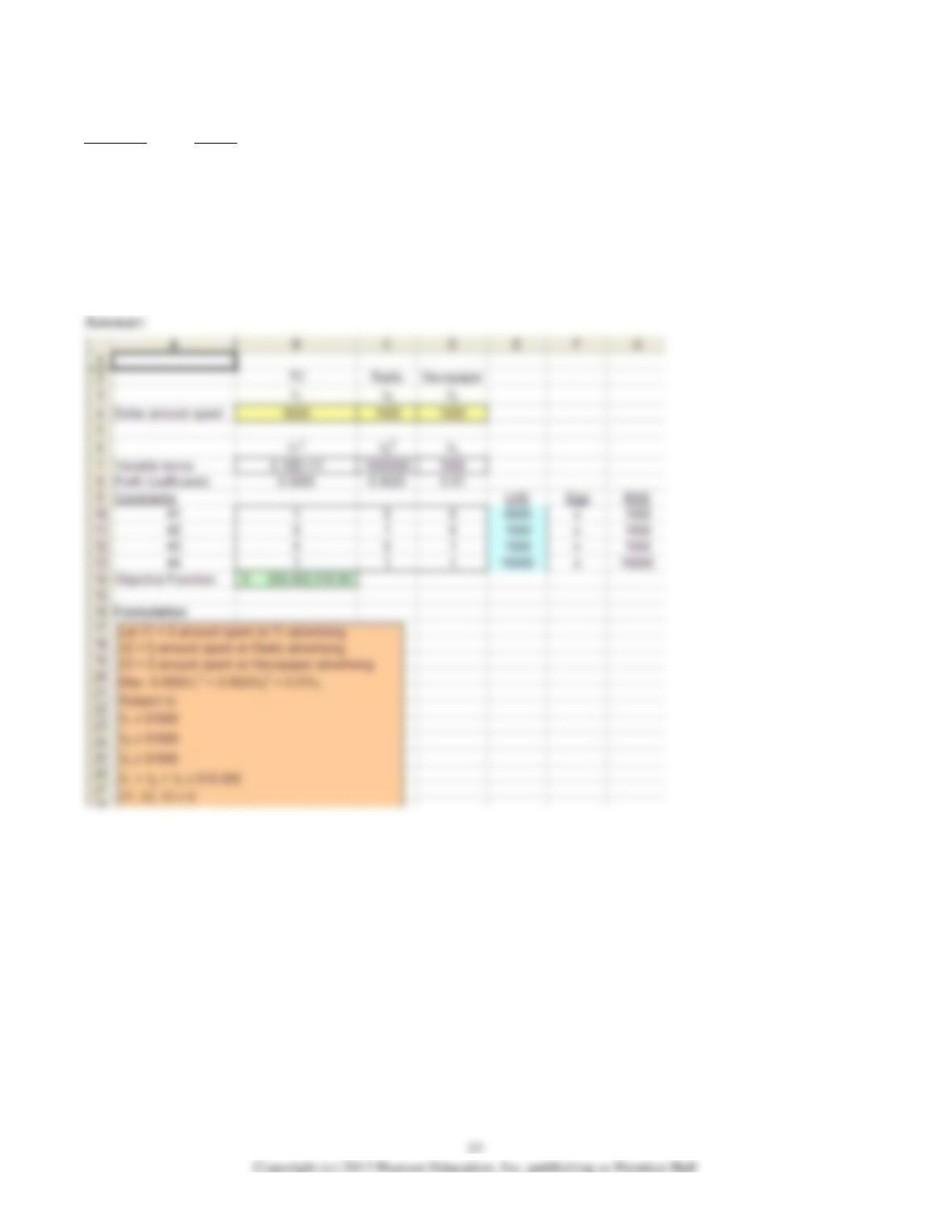
20) Consider the following profit expected from each dollar (Xi) spent in the following advertising
media:
Medium Profit
TV 0.0005Xi3
Radio 0.0025Xi2
Newspaper 0.01Xi
How should the advertising budget be allocated if the company wants to spend at least $1000 on each
medium without exceeding its $10,000 budget?