Chapter 6: Process Costing
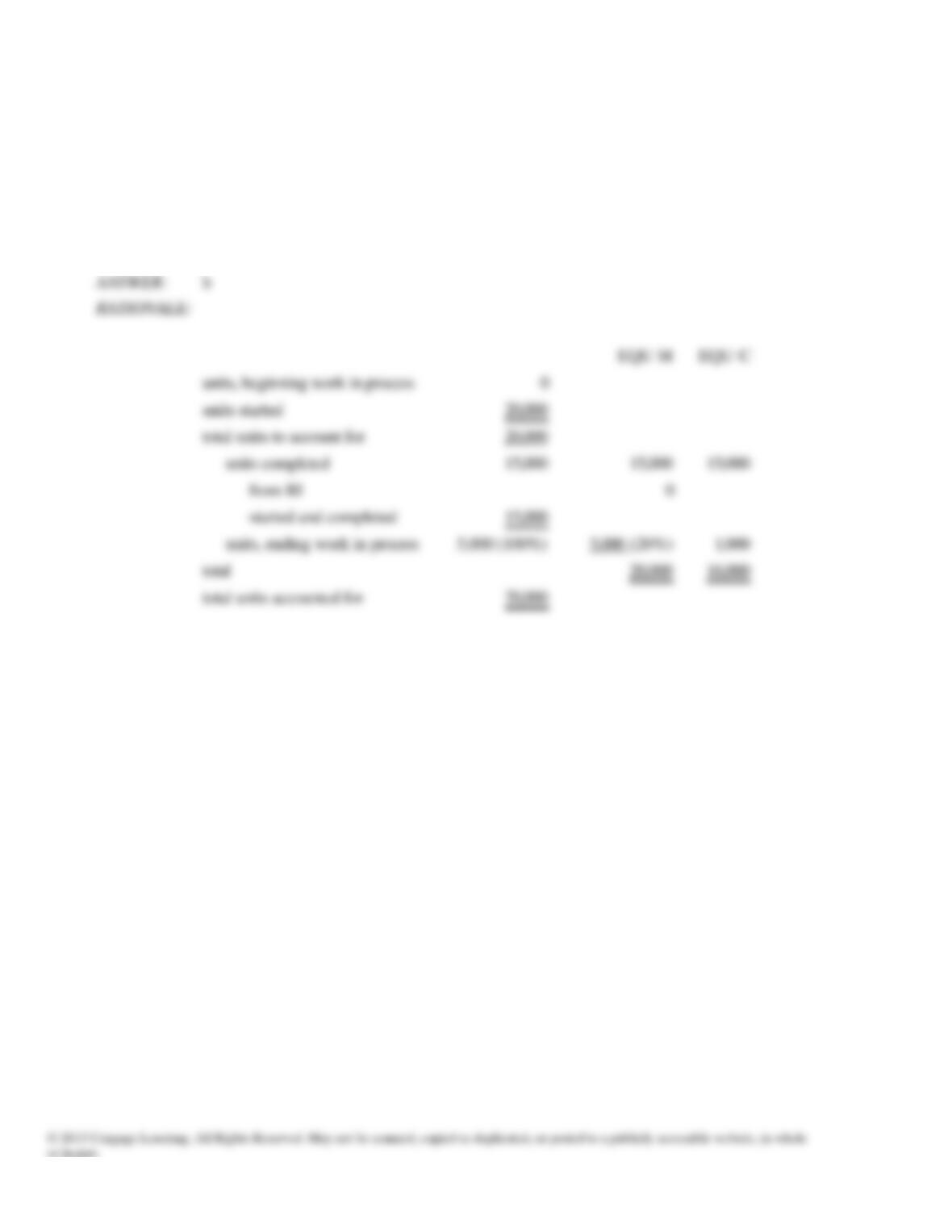
86. Refer to Figure 6-6. What are the equivalent units for materials and conversion respectively?
a. 20,000; 20,000
b. 20,000; 16,000
c. 15,000; 15,000
d. 15,000; 14,000
e. none of the above
Chapter 6: Process Costing
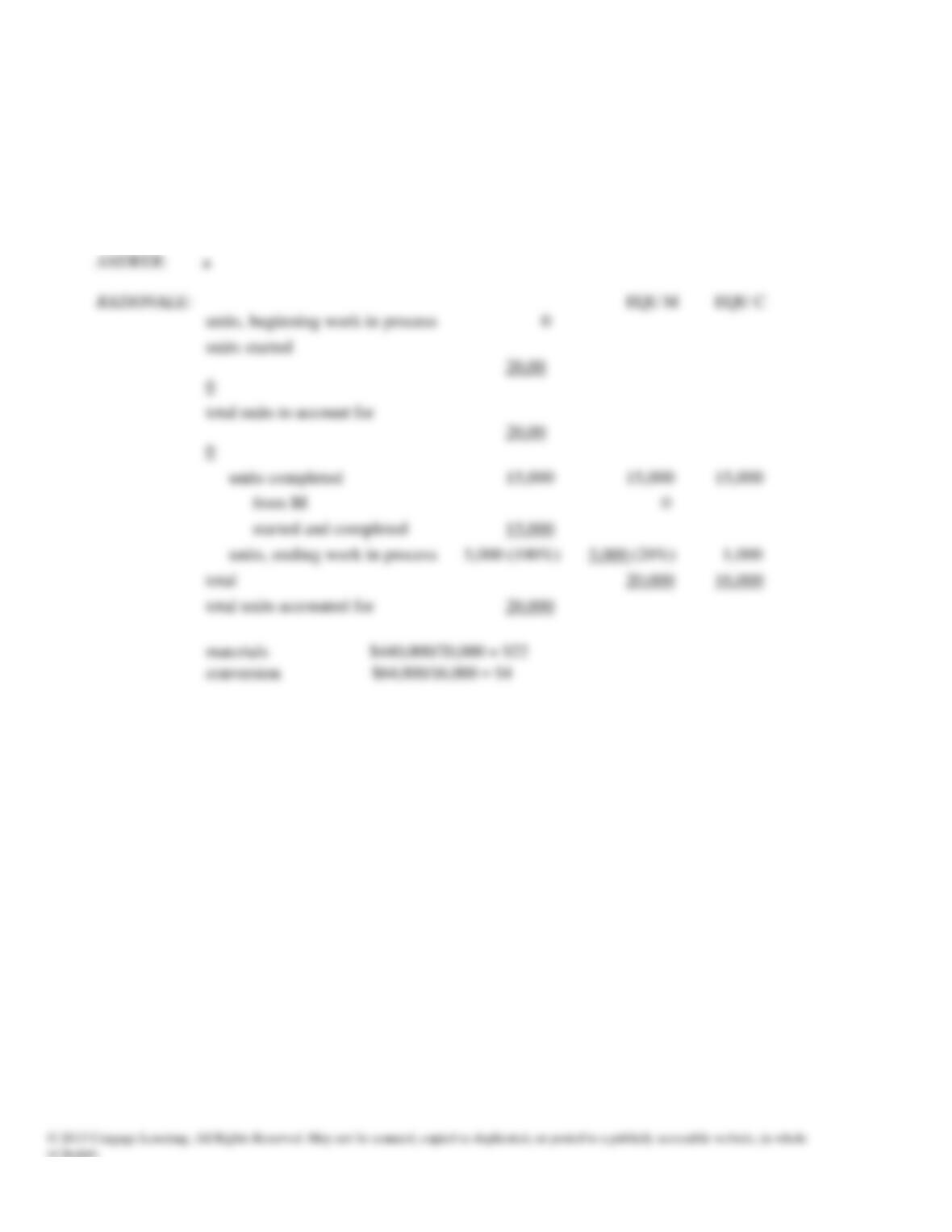
87. Refer to Figure 6-6. What are the costs per unit for materials and conversion respectively?
a. $22; $4
b. $29.33; $4.27
c. $11; $1.60
d. $88; $64
e. none of the above
Chapter 6: Process Costing
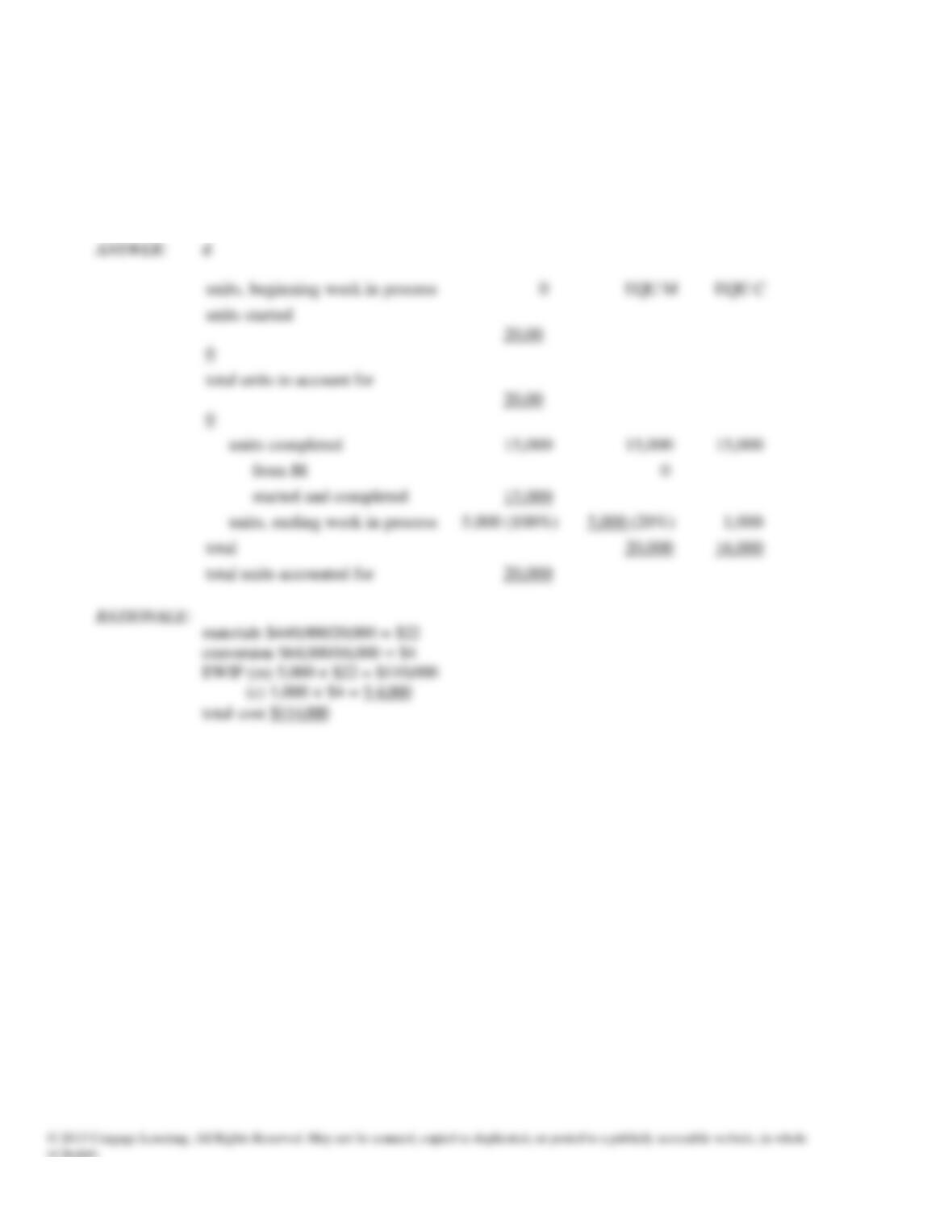
88. Refer to Figure 6-6. What cost is assigned to ending work in process?
a. $110,000
b. $126,000
c. $130,000
d. $114,000
e. none of the above
Chapter 6: Process Costing
89. The following information pertains to Firewire Corporation:
Units
Work in process, November 1 (20% complete) 3,000
Started in November 24,000
Materials are added at the beginning of the process.
If 18,000 units were completed during the month, ending work in process at November 30 is
a. 9,000 units.
b. 6,000 units.
c. 3,000 units.
d. 15,000 units.
90. The two methods used to determine equivalent units of production are
a. FIFO and LIFO.
b. weighted average and LIFO.
c. weighted average and FIFO.
d. FIFO and specific identification.
Chapter 6: Process Costing
Figure 6-7
Edelstein Company had the following data for 2016:
Units in process at the beginning of the month 4,000
Units in process at the end of the month 10,000
Units started during the month 40,000
Materials are added at the beginning of the process. Beginning work in process was 40 percent complete as to
conversion. Ending work in process was 70 percent complete as to conversion.
91. Refer to Figure 6-7. What is the number of units completed and transferred out during the period?
a. 34,000 units
b. 54,000 units
c. 44,000 units
d. 40,000 units
92. Refer to Figure 6-7. How many equivalent units for materials would there be using the FIFO method?
a. 44,000 units
b. 30,000 units
c. 40,000 units
d. 39,400 units
93. The unit-costing method that excludes prior-period work and costs in computing current-period unit work and costs
is called:
a. Transferred-in cost method
b. FIFO costing method
c. Weighted average method
d. Equivalent units method
Chapter 6: Process Costing
94. Unit cost of materials for a department using the FIFO method of process costing is found by taking the total cost
of materials issued to the department during the year divided by
a. units in process.
b. units started and completed.
c. total units manufactured.
d. equivalent units of output.
Figure 6-8
Thunder Roads Enterprises makes the following information available:
Units in process at the beginning of the month 2,000
Units in process at the end of the month 4,000
Units started during the month 30,000
Materials are added at the beginning of the process.
95. Refer to Figure 6-8. Beginning and ending units were 60 percent complete as to conversion costs. What is the
number of units started and completed?
a. 36,000 units
b. 30,000 units
c. 28,000 units
d. 26,000 units
96. Refer to Figure 6-8. Beginning and ending units were 60 percent converted. How many equivalent units for
materials would there be using the FIFO method?
a. 36,000 units
b. 34,000 units
c. 30,000 units
d. 29,200 units
Chapter 6: Process Costing
Figure 6-9
Anzalone Corporation adds raw materials to production at the beginning of the process in the Assembly
Department. Materials data for this department for May 2016 are as follows:
Costs
Units
Materials
Conversion
Work in process, May 1
25,000
$ 68,750
$167,650
Started during May
100,000
300,000
903,350
Work in process, May 31
10,000
Beginning inventory was 70 percent complete. Ending inventory was 40 percent complete.
97. Refer to Figure 6-9. How many equivalent units for materials would there be for Anzalone Corporation in May
using the FIFO method?
a. 110,000 units
b. 100,000 units
c. 125,000 units
d. 119,000 units
98. Refer to Figure 6-9. How many equivalent units for conversion costs would there be for Anzalone Corporation in
May using the FIFO method?
a. 100,000 units
b. 111,500 units
c. 125,000 units
d. 101,500 units
Chapter 6: Process Costing
99. If beginning inventory contained 3,000 units of product that were judged to be 60 percent complete as to labor, the
equivalent units of production for labor during the current period under the FIFO method for these 3,000 units are
a. 3,000 units.
b. 1,200 units.
c. 1,800 units.
d. 500 units.
100. Layla Company began making mascara in November 2016 using a single-step process. Layla incurred $42,000 for
materials and $48,640 for conversion during the month. There were 21,000 cases of mascara started in November
and 3,000 cases unfinished (40 percent complete) at the end of the period. All materials were added at the
beginning of the production process.
What is the unit cost for materials for Layla using the FIFO method?
a. $2.00
b. $2.03
c. $4.53
d. none of the above
Figure 6-10
Julius Corporation’s mixing department began January 2016 with 10,000 gallons of product (40 percent completed)
in process. During January, Julius started 100,000 gallons of new product, of which 15,000 gallons remained in
ending inventory (70 percent completed).
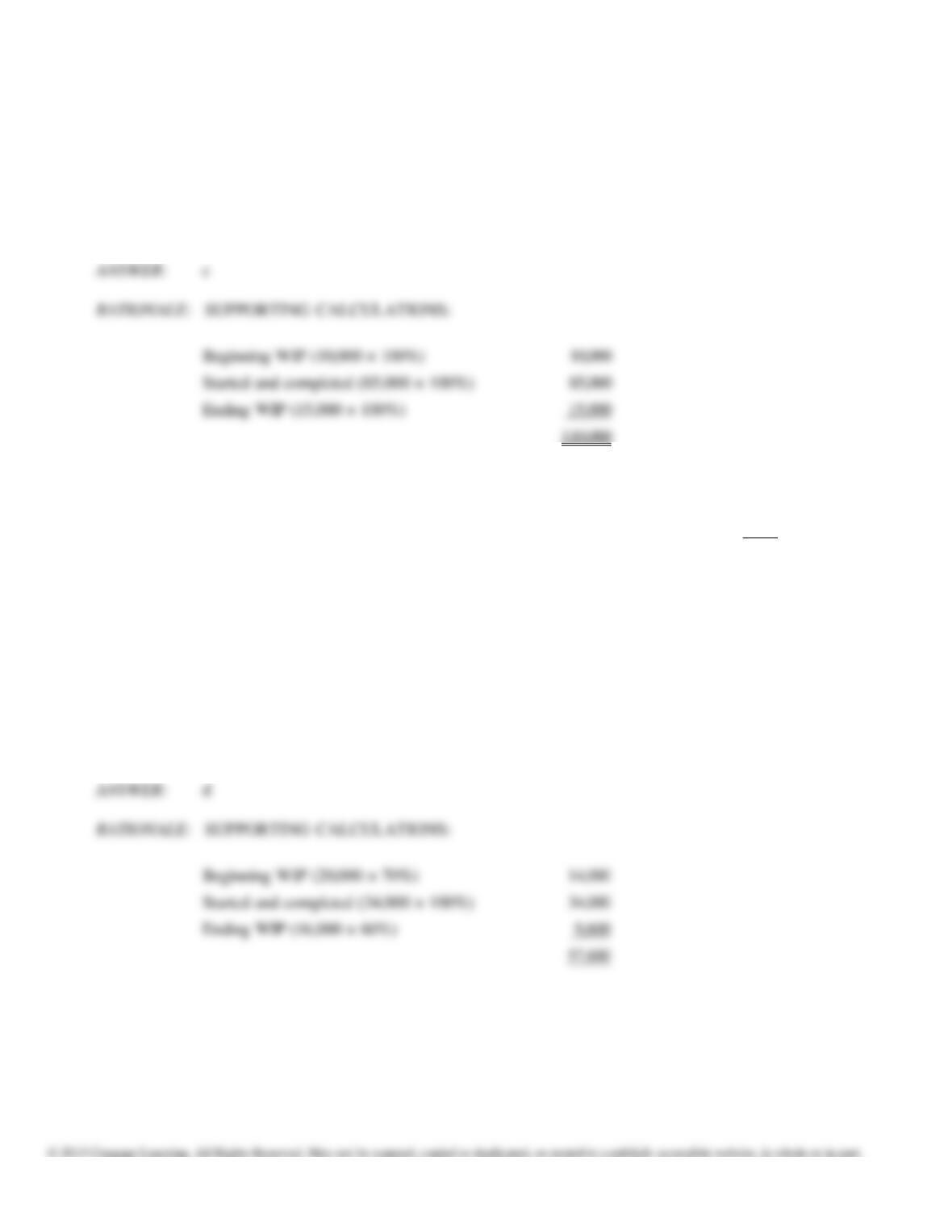
101. Refer to Figure 6-10. If materials were added at the beginning of the process, how many equivalent units of
production for conversion costs would there be for Julius using the FIFO costing method?
a. 101,500 units
b. 110,000 units
c. 105,500 units
d. 116,500 units
Chapter 6: Process Costing
102. Refer to Figure 6-10. If materials were added when the units are 50 percent complete, how many equivalent units
of production for materials would there be for Julius Corporation using the FIFO costing method?
a. 101,500 units
b. 105,500 units
c. 110,000 units
d. 85,000 units
103. The following information pertains to the Springfield Company:
Units
Work-in-process inventory, June 1 (30% complete) 20,000
Units transferred in 50,000
Work–in–process inventory, June 30 (60% complete) 16,000
Materials are added at the start of the process.
How many equivalent units for conversion costs would there be using the FIFO method?
a. 49,600 units
b. 70,000 units
c. 50,000 units
d. 57,600 units
Chapter 6: Process Costing
Figure 6-11
Rawlings, Inc. manufactures a product that passes through two processes: mixing and molding. All manufacturing
costs are added uniformly in the Mixing Department. Information for the Mixing Department for January follows:
Work in process, January 1:
Units (35% complete)
7,500
Direct materials
$36,000
Direct labor
$45,000
Overhead
$15,000
During January, 26,750 units were completed and transferred to the Molding Department. The following costs were
incurred by the Mixing Department during January:
Direct materials
$133,050
Direct labor
180,000
Overhead (applied)
45,000
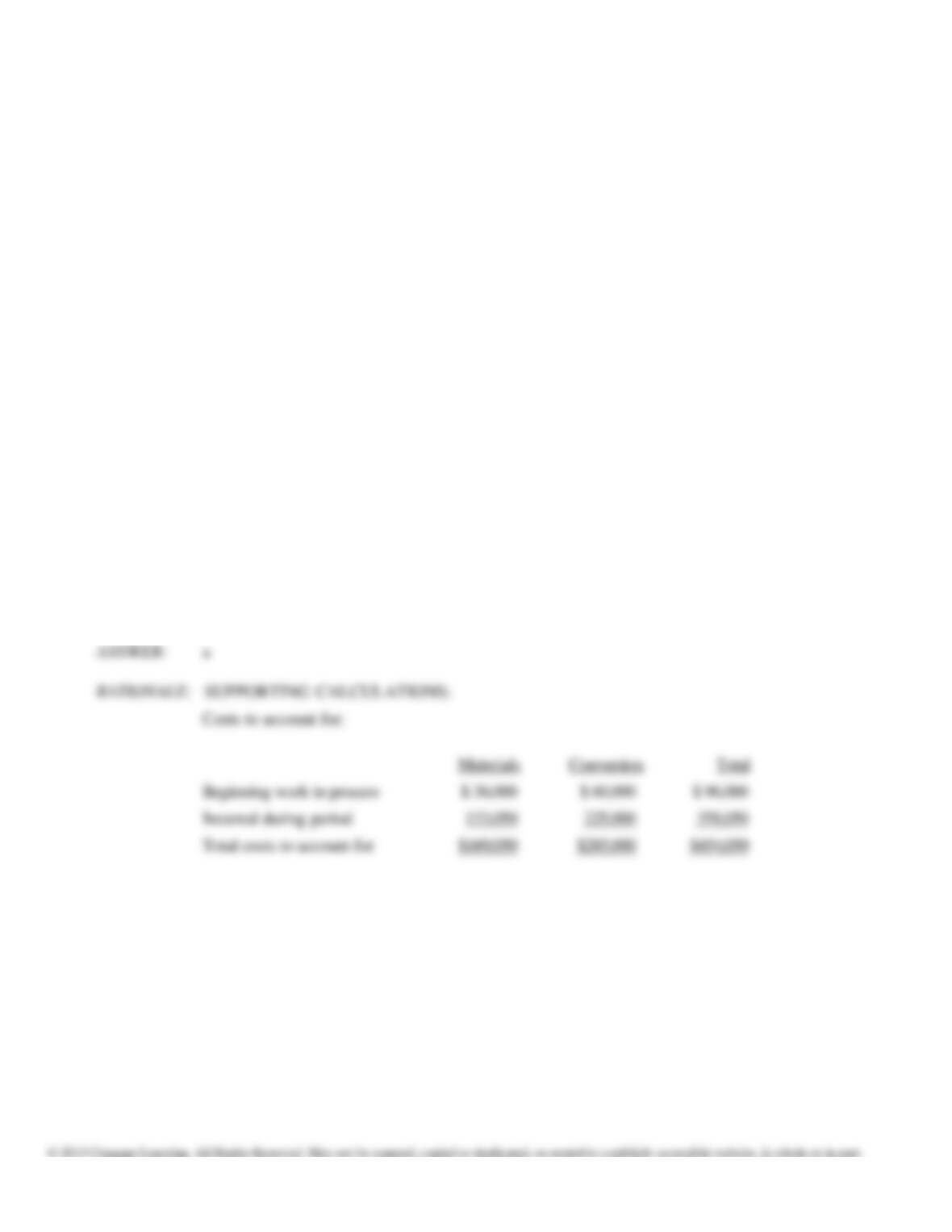
104. Refer to Figure 6-11. There were 2,500 units that were 80 percent complete remaining in Mixing at January 31.
The amount of total costs to account for is
a. $454,050.
b. $396,000.
c. $360,000.
d. none of the above.
Chapter 6: Process Costing
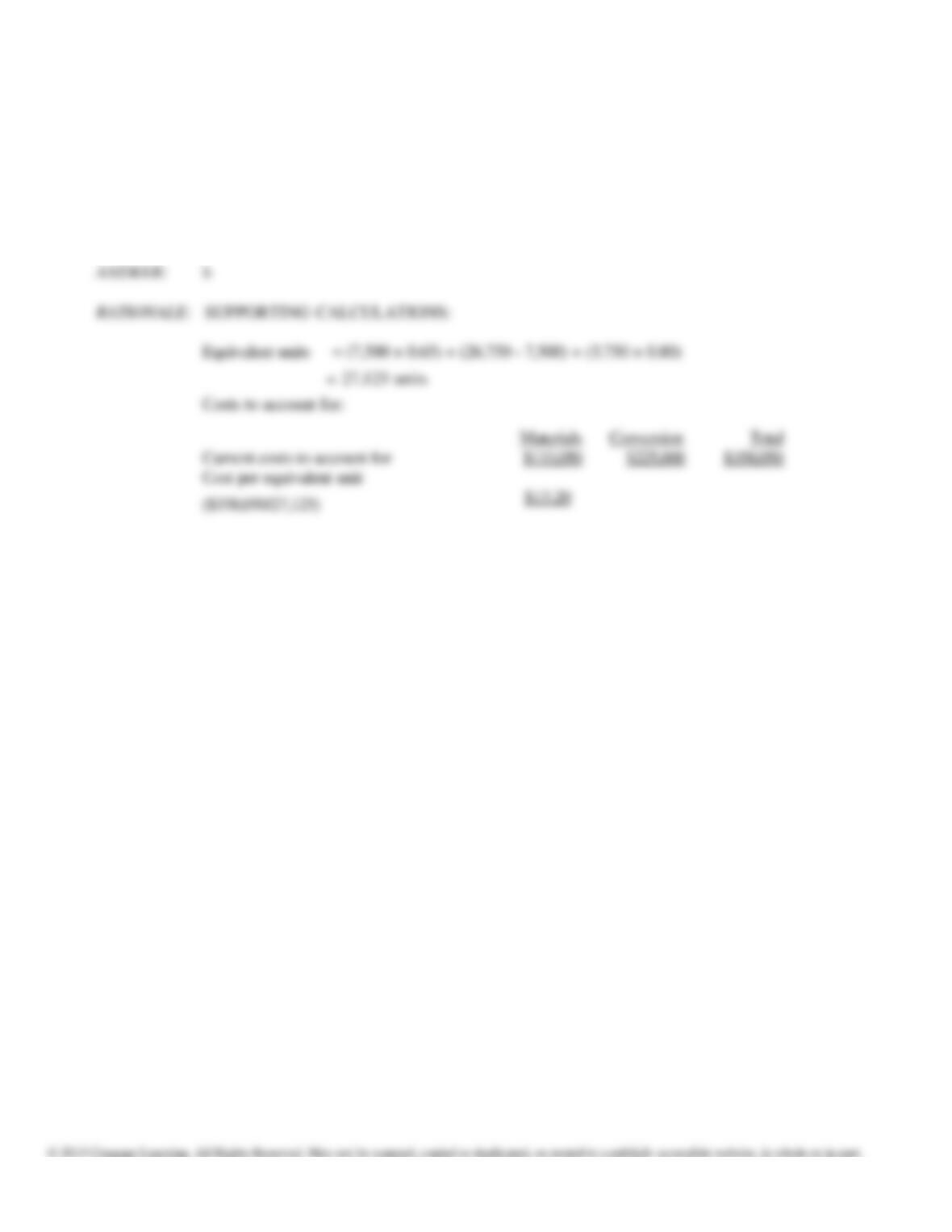
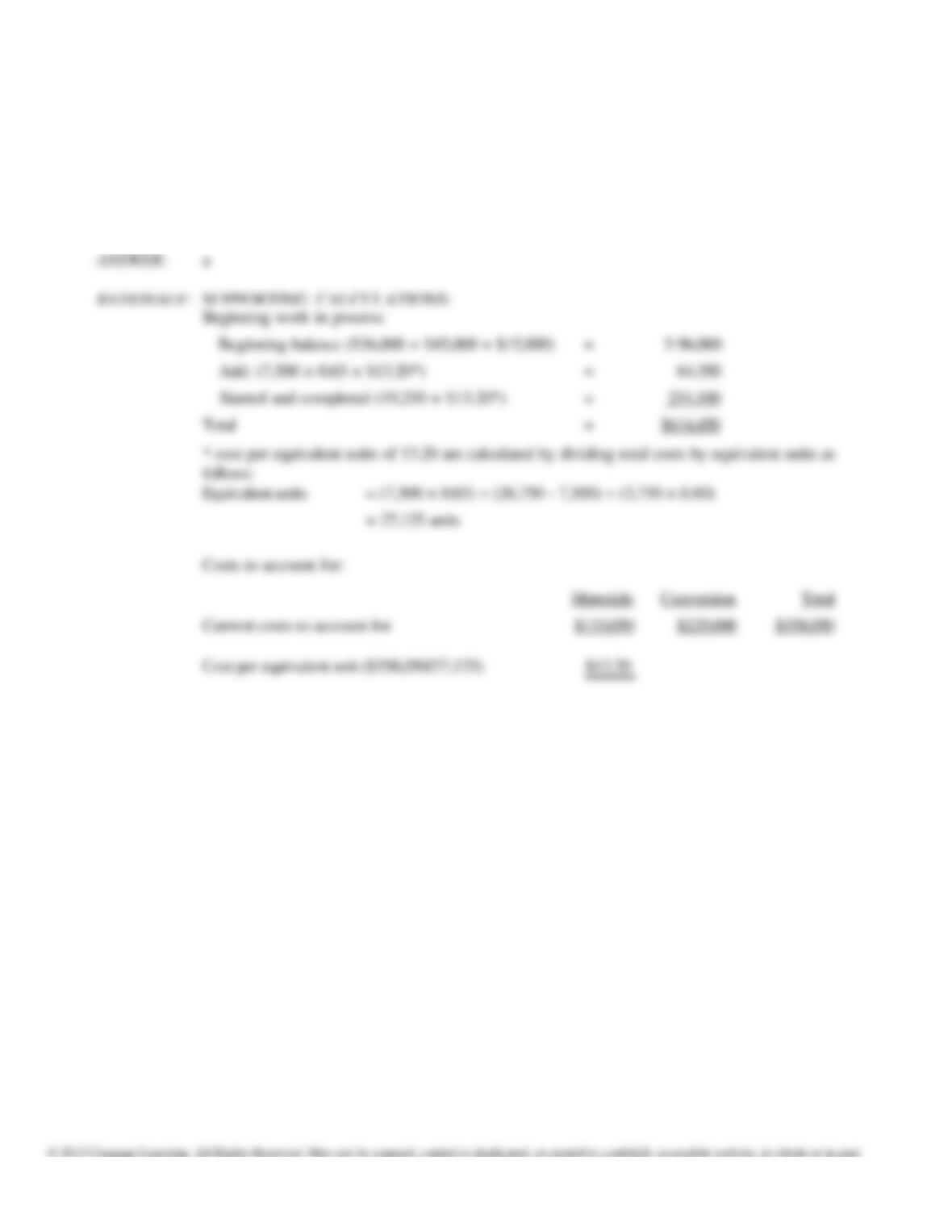
105. Refer to Figure 6-11. There were 3,750 units that were 80 percent complete remaining in Mixing at January 31.
Total cost per equivalent unit of production using the FIFO method is
a. $12.16.
b. $13.20.
c. $9.76.
d. none of the above.
Chapter 6: Process Costing
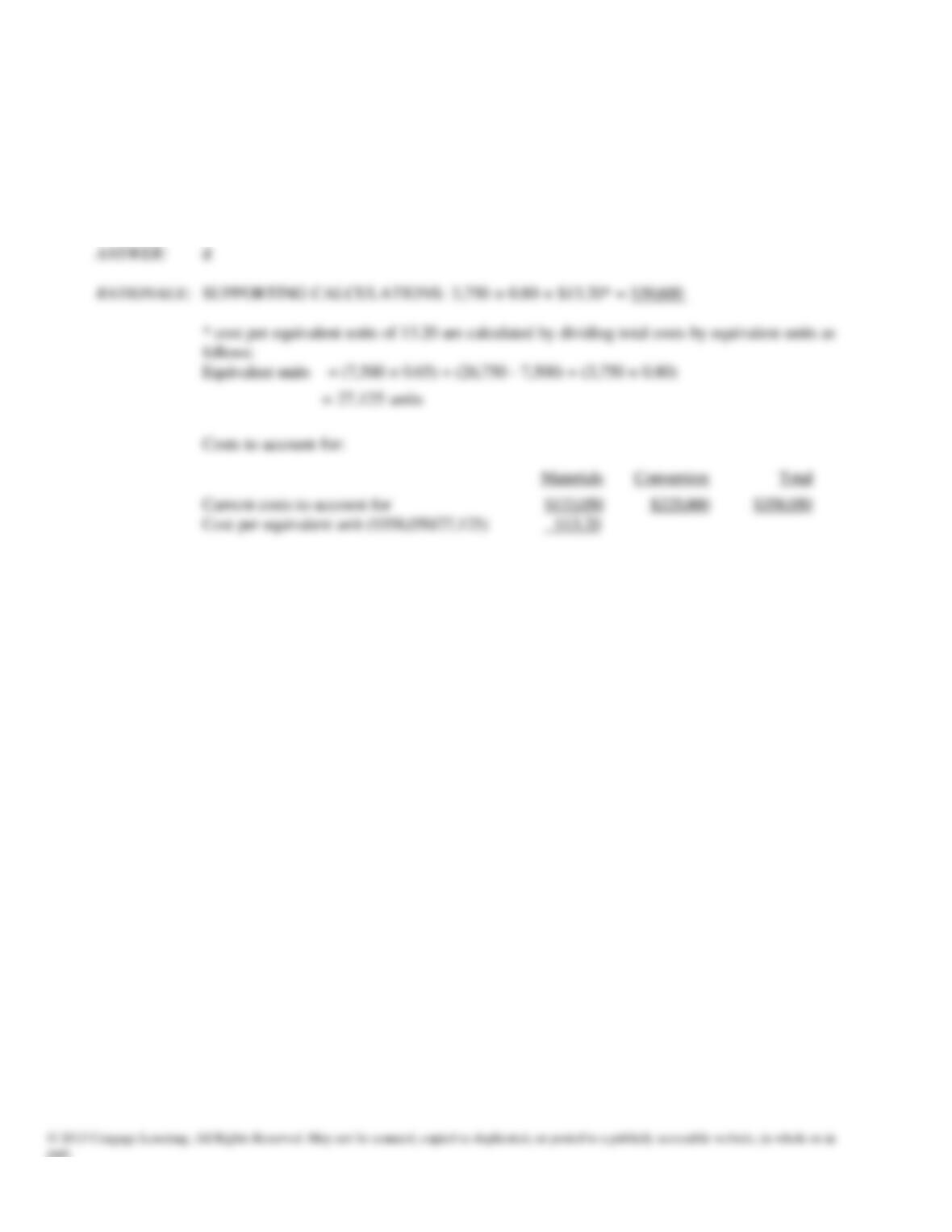
106. Refer to Figure 6-11. The cost of January’s ending work in process for the Mixing Department using the FIFO
method is
a. $26,250.
b. $50,400.
c. $63,000.
d. none of the above.
Chapter 6: Process Costing
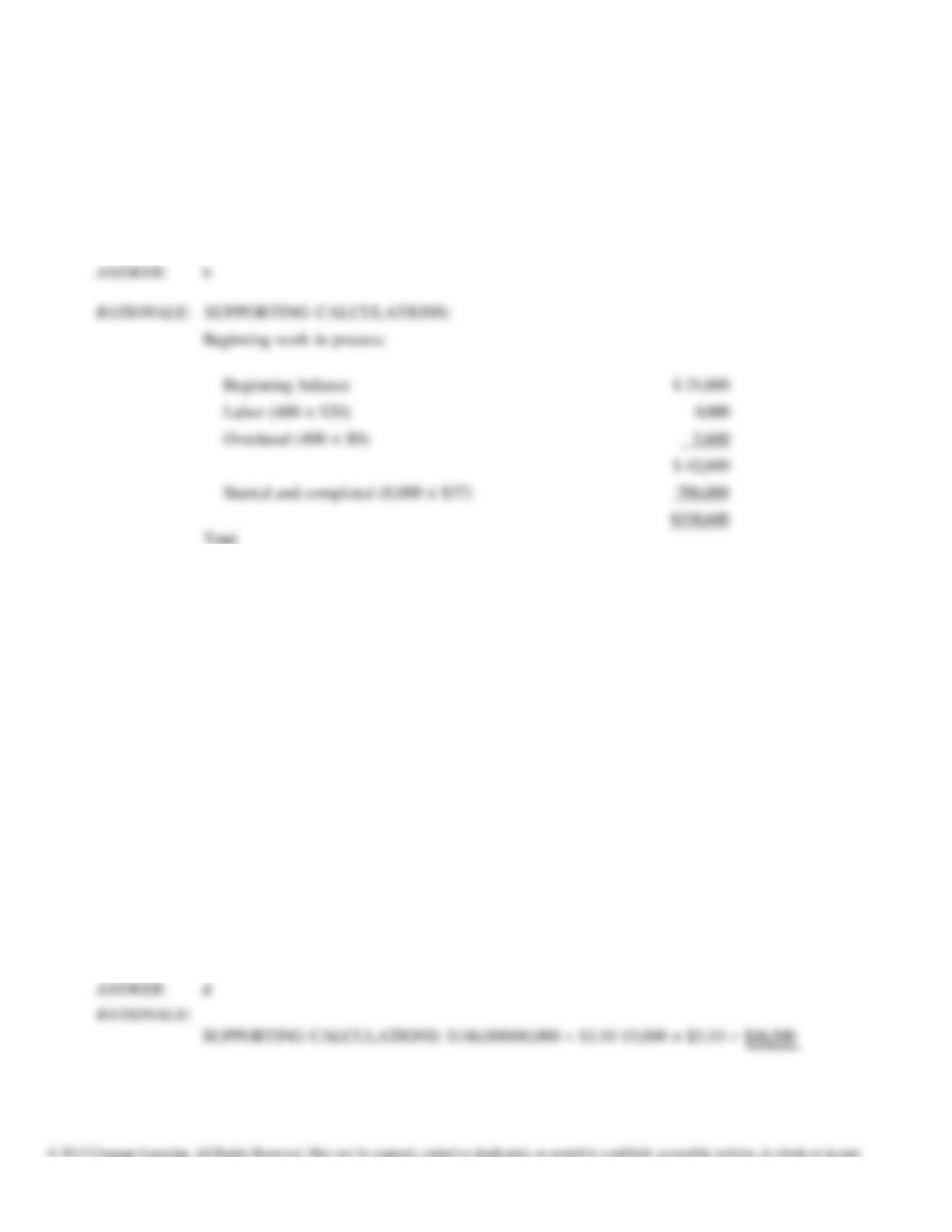
107. Refer to Figure 6-11. There were 3,750 units that were 80 percent complete remaining in Mixing at January 31.
The cost of goods transferred to the Molding Department during January using the FIFO method is
a. $414,450.
b. $391,575.
c. $323,400.
d. none of the above.
Chapter 6: Process Costing
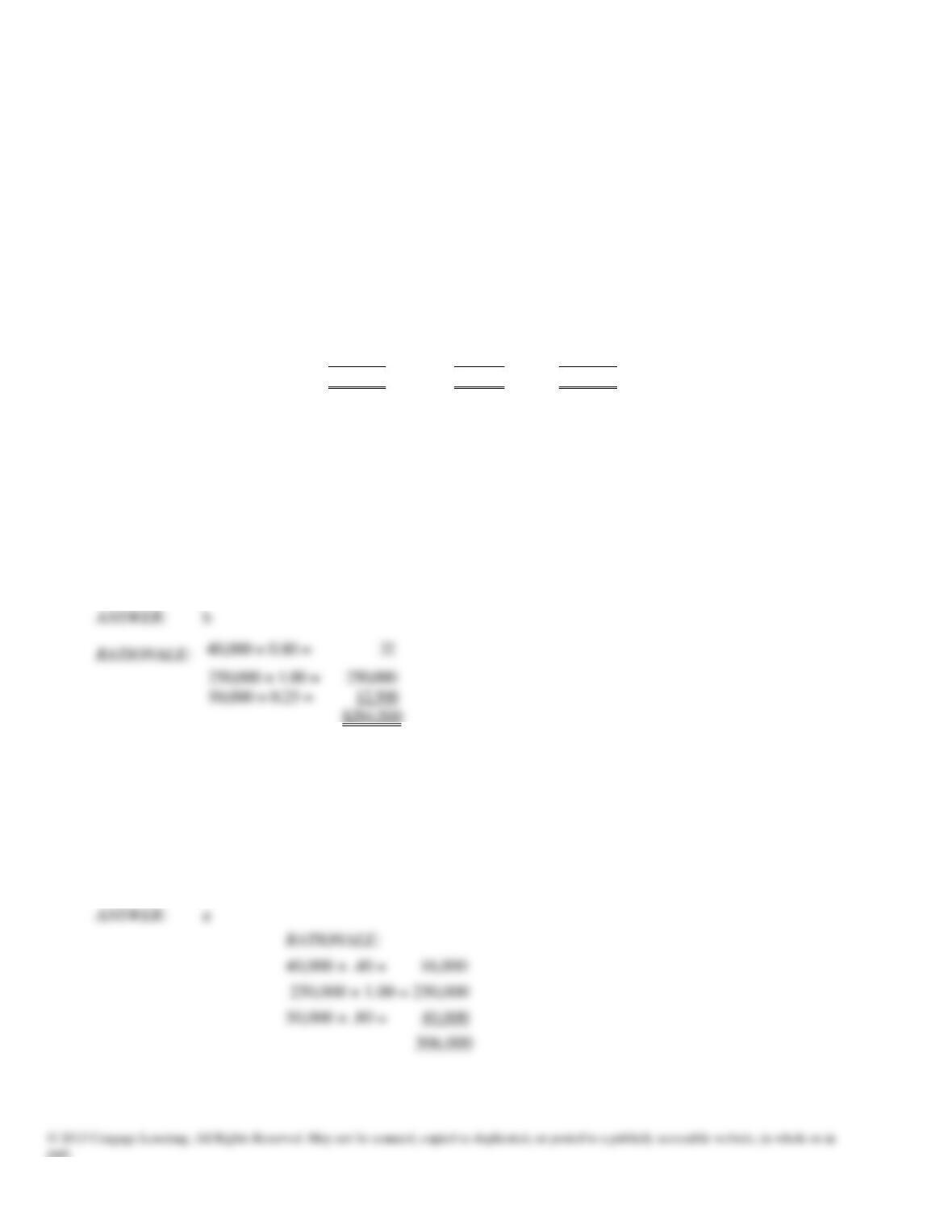
108. Beginning inventory consisted of 1,000 units with costs of $31,000. All materials and 60 percent of labor and
overhead were added in the prior period. In addition, another 8,000 units were started and completed. Unit costs are
materials, $8.00; labor, $20.00; overhead, $9.00. What is the total cost of goods transferred out using FIFO?
a. $296,000
b. $338,600
c. $332,400
d. $338,000
Started and completed (8,000 × $37)
109. Phantom Enterprises adds materials to production at the beginning of the process in the Production Department. It
uses a single-step process. Data on material for this department for July 2016 are as follows:
Production data (units):
In process, beginning of July
10,000
Started during July
60,000
Completed and transferred out during July
55,000
Manufacturing cost:
Work in process, beginning $39,000
Materials used in July $186,000
The company uses the FIFO inventory method.
The materials cost in Work in Process on July 31 is
a. $37,500.
b. $31,000.
c. $39,000.
d. $46,500.
Chapter 6: Process Costing
Figure 6-12
Twinnings Corporation manufactures Scheduling Books. There are two processes: printing and binding. The
following information is given for the printing department for September.
Units:
units, beginning work in process
40,000
(20% complete for materials, 60% complete for
started
300,000
completed
?
units, ending work in process
50,000
(25% complete for materials, 80% complete for
i )
Costs:
Materials
Conversion
Total
beginning work in process
$6,080
$2,160
$8,240
current costs
$220,875
$30,600
$251,475
total costs
$226,955
$32,760
$259,715
The company uses FIFO inventory assumption.
110. Refer to Figure 6-12. What are the FIFO equivalent units for materials?
a. 304,500
b. 294,500
c. 302,500
d. 262,500
e. none of the above
111. Refer to Figure 6-12. What are the FIFO equivalent units for conversion?
a. 306,000
b. 340,000
c. 316,000
d. 300,000
e. none of the above
Chapter 6: Process Costing
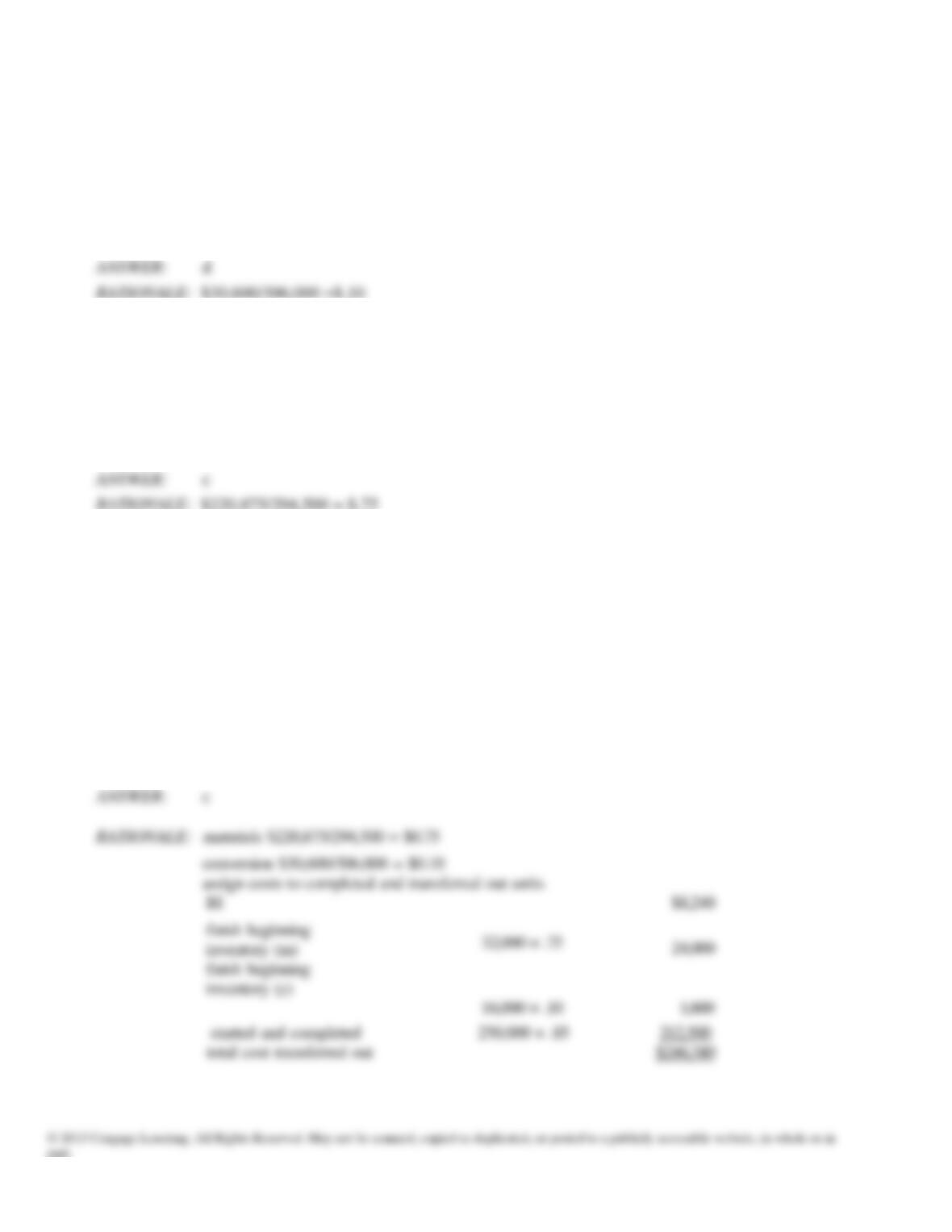
112. Refer to Figure 6-12. What are the FIFO cost per unit for conversion?
a. $0.90
b. $0.11
c. $0.66
d. $0.10
e. none of the above
113. Refer to Figure 6-12. What are the FIFO cost per unit for materials?
a. $1.00
b. $0.77
c. $0.75
d. $0.65
e. none of the above
114. Refer to Figure 6-12. What is the journal entry for the cost of goods sent to binding?
a. work in process – binding $246,500
work in process – printing $246,500
b. work in process – printing $246,340
work in process – binding $246,340
c. work in process – binding $246,340
work in process – printing $246,340
d. work in process – printing $246,500
work in process – binding $246,500
e. none of the above

Chapter 6: Process Costing
115. The unit-costing method that merges prior-period work and costs with current-period work and costs is called:
a. Operating costing
b. Transferred-in cost
c. FIFO costing method
d. Weighted average method
116. When computing equivalent units of production, the method that combines partially completed units in beginning
inventory with current period production is
a. the FIFO method.
b. the LIFO method.
c. the specific identification method.
d. the weighted average method.
Chapter 6: Process Costing
117. Beginning inventory consisted of 10,000 units (20 percent converted) and ending inventory consisted of 20,000 units
(40 percent converted). In addition, 60,000 units were started during the period. How many equivalent units for
conversion costs were produced using the weighted average method?
a. 50,000 units
b. 56,000 units
c. 70,000 units
d. 58,000 units
118. The following information is available:
Units in process, November 1 (60% converted) 2,000 units
Units in process, November 30 (60% converted) 4,000 units
Units started during the month 30,000 units
Materials are added at the beginning of the process.
How many equivalent units for conversion would there be in November using the weighted average method?
a. 30,400 units
b. 36,000 units
c. 32,000 units
d. 33,200 units
Chapter 6: Process Costing
Figure 6-13
Wonder Paints Corporation‘s Mixing Department began August 2016 with 10,000 gallons of product (40 percent
completed) in process. During August, Wonder Paints started 100,000 gallons of new product, of which 15,000
gallons remained in ending inventory (70 percent completed).
119. Refer to Figure 6-13. If materials were added at the beginning of the process, how many equivalent units of
production for conversion costs would there be for Wonder Paints using the weighted average costing method?
a. 120,500 units
b. 110,000 units
c. 105,500 units
d. 99,500 units
120. Refer to Figure 6-13. If materials were added when the units were 80 percent complete, how many equivalent units
of production for materials would there be for Wonder Paints using the weighted average costing method?
a. 95,000 units
b. 110,000 units
c. 107,000 units
d. 105,500 units
Chapter 6: Process Costing
121. The following information pertains to Mcintosh Company:
Work-in-process inventory, February 1 (30% complete) 20,000 units
Units transferred in 50,000 units
Work-in-process inventory, February 29 (60% complete) 16,000 units
Materials are added at the start of the process.
How many equivalent units for materials would there be using the weighted average method?
a. 86,000 units
b. 70,000 units
c. 50,000 units
d. 57,600 units
122. Beginning inventory for the month contained 3,000 units that were 35 percent complete with respect to materials.
55,000 units were completed and transferred out during the month. 5,500 units were in ending inventory, 10 percent
complete with respect to materials. The weighted average equivalent units of production for materials for the month
would be
a. 55,000 units.
b. 55,550 units.
c. 56,500 units.
d. 57,550 units.
123. The costs included in the cost per equivalent unit using the weighted average method are
a. current costs.
b. beginning work in process.
c. ending work in process.
d. both a and b.