73) Palestinians include all but which of the following groups?
A) residents of refugee camps
B) residents of territories occupied by Israel
C) citizens of other states calling themselves Palestinians
D) Jewish citizens of Israel
E) Muslim citizens of Israel
74) Which of these penalties were imposed by the Taliban in Afghanistan?
A) Men were beaten for shaving their beards.
B) Homosexuals were buried alive.
C) Prostitutes were hanged in public, and men were stoned for committing adultery.
D) Thieves’ hands were cut off, and women with nail polish had their fingers cut off.
E) All of these answers are correct.
75) What policy did the British follow in India?
A) They divided India into three countries.
B) They forced all of the Hindus to migrate.
C) They turned the problem over to the United Nations.
D) They encouraged the abolition of the caste system.
E) They required all education to be conducted in English.
76) From the Russian Revolution to the fall of the Soviet communist government, what was the
policy of the government towards religion?
A) All churches were closed.
B) The old church was replaced by Eastern Orthodoxy.
C) Churches remained open but played a limited role.
D) Youth were encouraged to attend so that they could be indoctrinated into communism.
E) Nearly all marriages were performed by clergy.
77) Which of the following religions is also part of a territorial concern for the Chinese
government?
A) Judaism
B) Christianity
C) Hinduism
D) Islam
E) Buddhism
78) It is reasonable to hypothesize that during the Mexican-American War (1846-1848) when
some Irish soldiers deserted from the U.S. Army to join the Mexican Army instead, most were at
least partly motivated by
A) feelings of loyalty toward fellow Roman Catholics.
B) feelings of loyalty toward fellow Protestant immigrants.
C) feelings of loyalty toward nonreligious immigrants.
D) anti-war philosophies prevalent in the Protestantism of the time.
E) the commands of Protestant church leaders.
79) Given the geographic perspectives on religion that are discussed in this chapter, we might
hypothesize in addition that victorious Spanish soldiers in 1492 were partly motivated by
A) a fanatical “holy war” mentality and their Roman Catholic faith.
B) a fanatical “holy war” mentality and their Protestant faith.
C) a peaceful vision of their Roman Catholic faith.
D) a nonreligious view of the world.
E) a fanatical “holy war” mentality that they learned from Muslims, Jews, and Eastern Orthodox
Christians.
80) Given the Soviet Union’s policies toward religion discussed in this chapter, a historian could
hypothesize that in the United States, Cold War opposition to the Soviet Union was accompanied
by a heightened
A) emphasis on religion as an area in which the United States was deficient.
B) emphasis in nonreligious policies and programs.
C) emphasis on religion as a weapon against “Godless communism.”
D) disregard for religious practices in Christian churches.
E) concern for scientific practices rather than religious practices.
81) A universalizing religion
A) is based on the physical characteristics of a particular location on Earth.
B) appeals to people living in a wide variety of locations.
C) is rarely transmitted through missionaries.
D) has celebrations that are almost entirely based on seasonal changes.
E) is less likely to be used as a reason for violence than ethnic religions.
82) Adherents of which religion controlled much of present-day Spain until 1492, but not since
then?
A) Buddhism
B) Christianity
C) Hinduism
D) Islam
E) Druze
83) The situation in Northern Ireland is the result of
A) counties in Northern Ireland voting to remain in the United Kingdom.
B) Catholic protest against discrimination by Protestants.
C) British colonial control which contributed to poor economic conditions.
D) violence committed by extreme partisans on both sides.
E) All of these answers are correct.
84) Adherents of which religion have controlled the Holy Land for most of the past 1,500 years?
A) Sikhism
B) Judaism
C) Hinduism
D) Islam
E) Christianity
85) Israel has controlled all of Jerusalem since
A) partition of Palestine by the United Nations in 1947.
B) the withdrawal of British rule in 1948.
C) the Arab-Israeli armistice of 1949.
D) the Six-Day War in 1967.
E) the Egyptian and Israeli peace treaty of 1979.
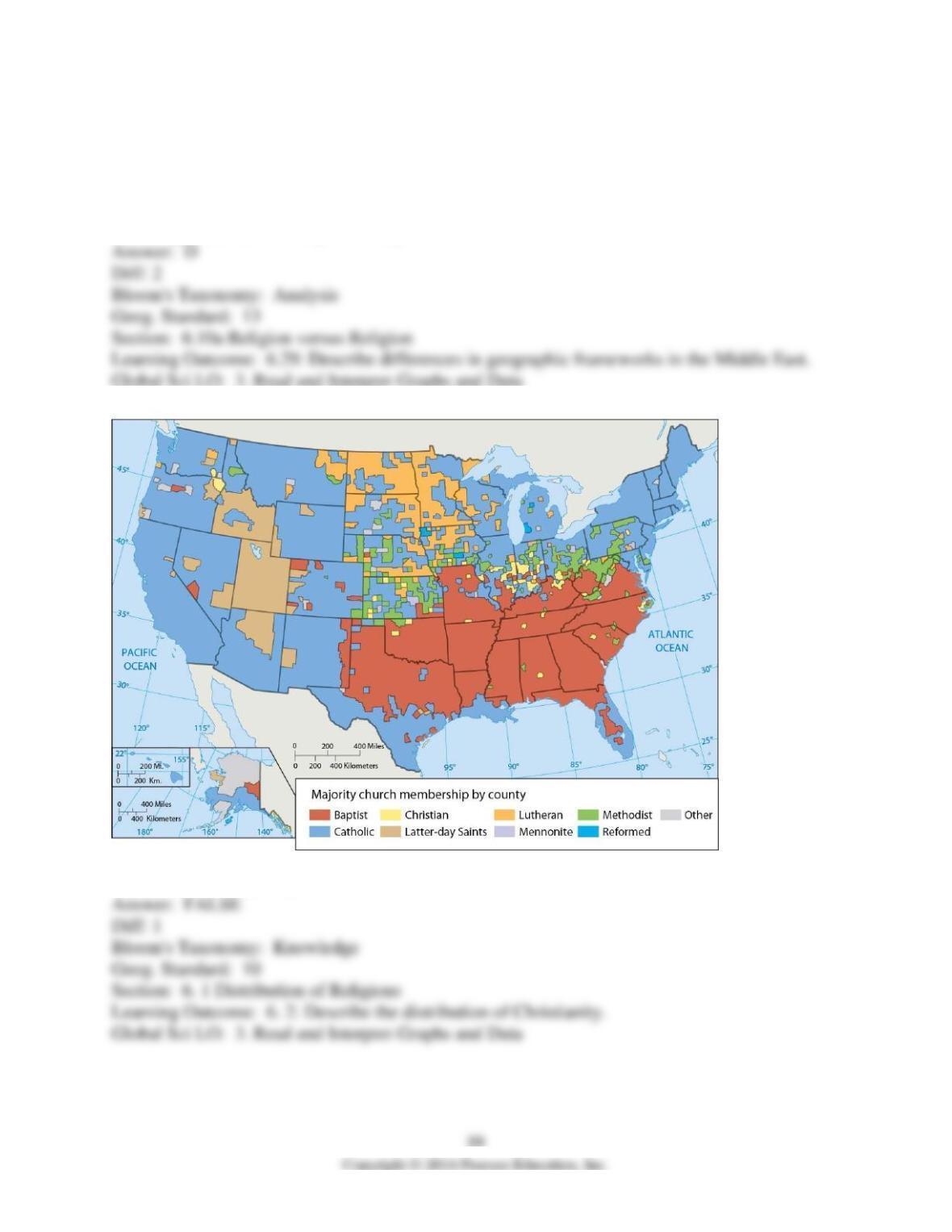
86) Lutherans in the United States are concentrated in the southeast.
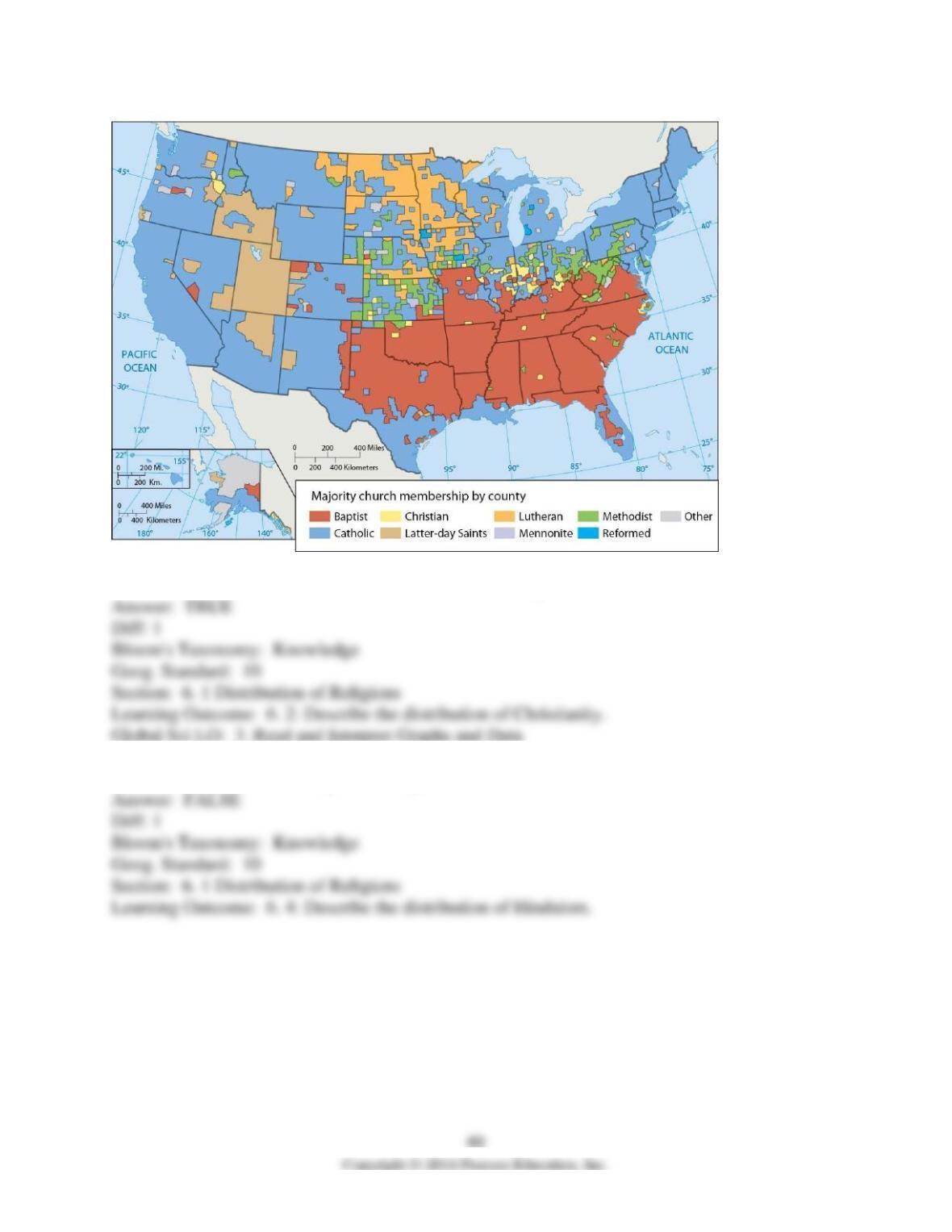
87) Catholics in the United States are concentrated mainly in the northeast and southwest.
88) Buddhism is the most important religion in India.
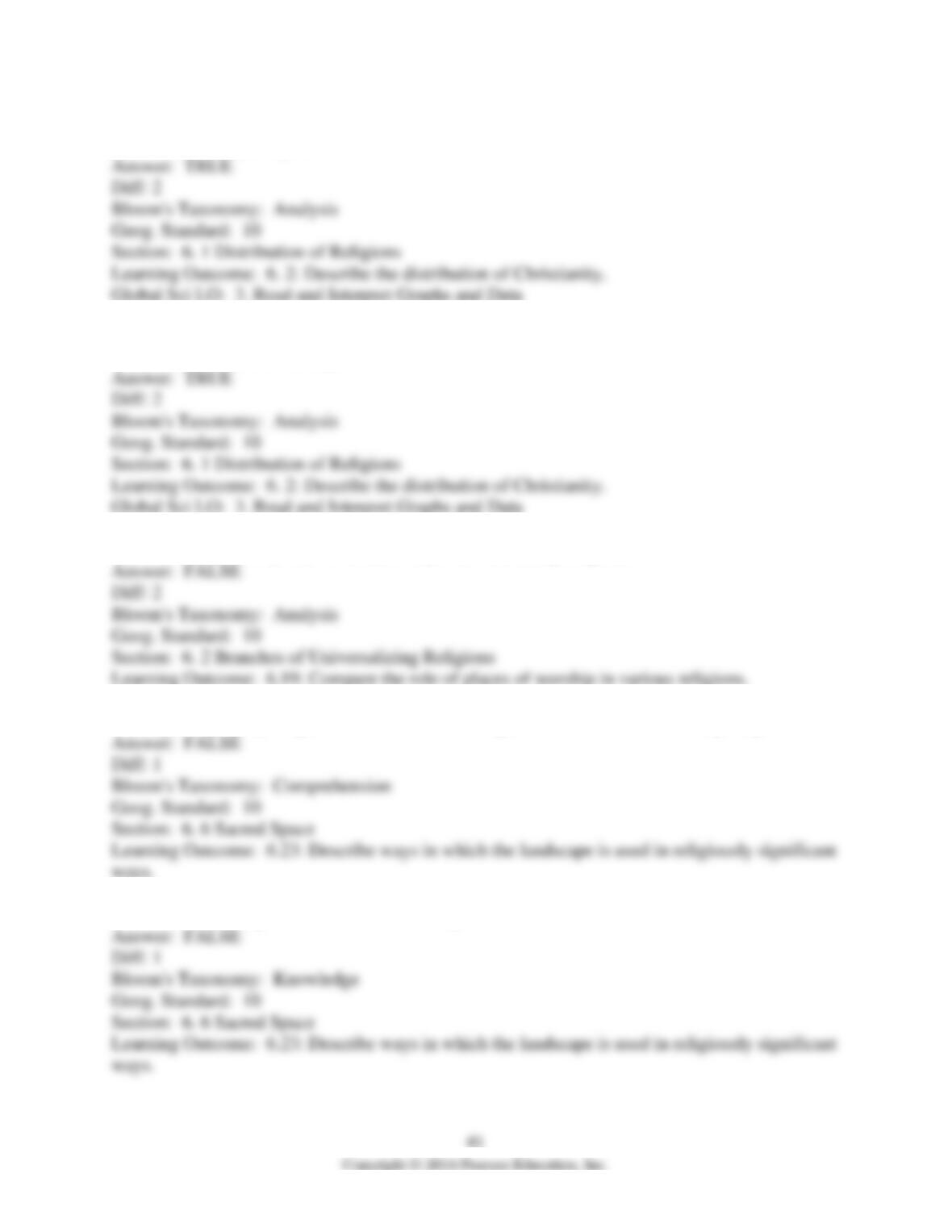
89) As the maps in this chapter illustrate, Christianity has the most widespread geographic
distribution of any religion.
90) As indicated on the maps in this chapter, the largest concentration of Eastern Orthodox
Christians is in Eastern Europe.
91) Jerusalem is a holy city to all three major universalizing religions.
92) Pilgrimages play a significant role in ethnic religions but not in universalizing religions.
93) Natural landscape features are the holiest places in Islam.
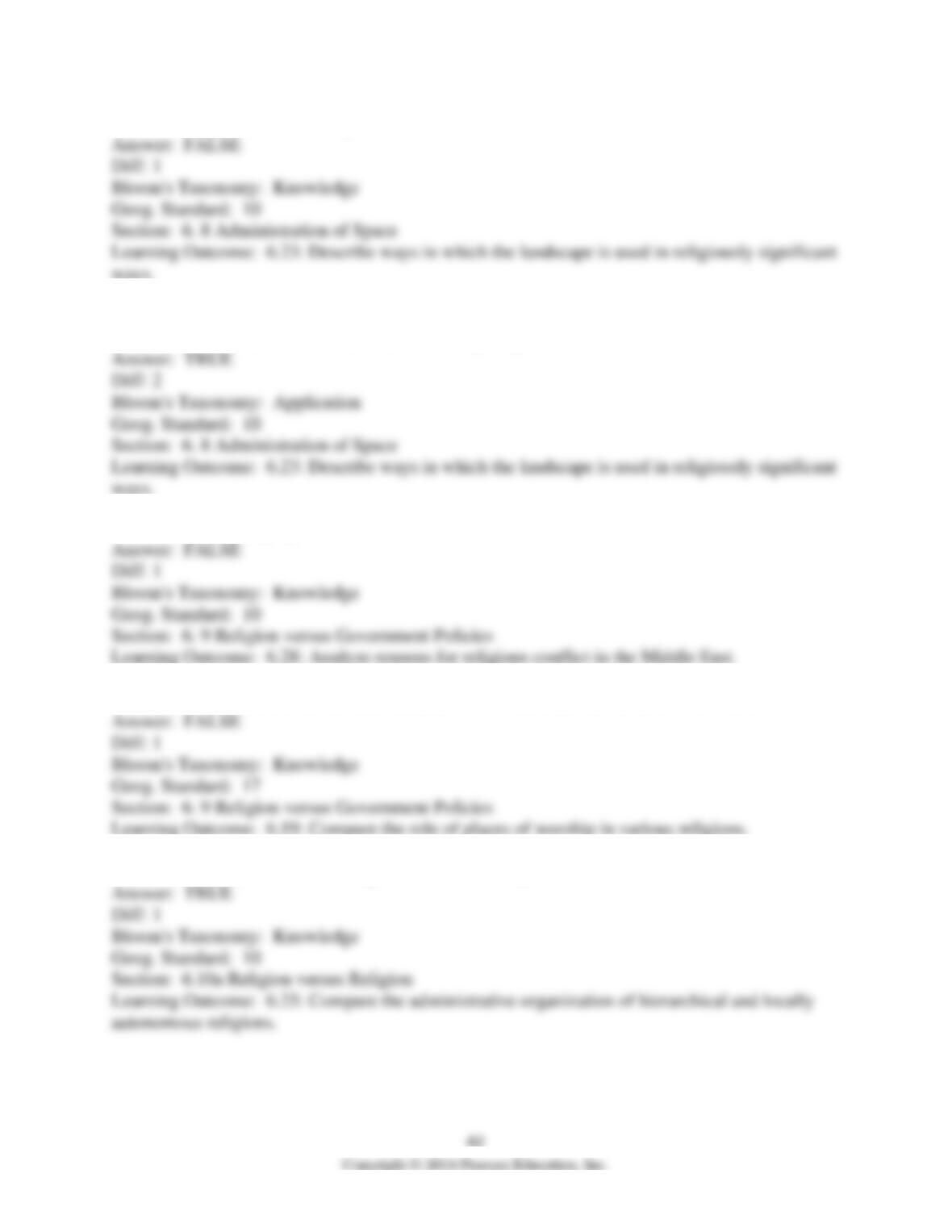
94) The Ganges is the most holy river for Muslims.
95) In terms of sacred sites and places of worship, an ethnic religion is usually more
geographically concentrated than a universalizing religion.
96) The majority of people in Lebanon are Jewish.
97) After the 1917 Revolution, the communists closed all churches in the Soviet Union.
98) Islam is a less hierarchical religion than Christianity.
99) The most troublesome religious boundary in Western Europe is in Ireland.
100) Most Europeans adhere to which of the three major universalizing religions?
101) Name the four religions dominant in East Asia. How is religious adherence different in East
Asia than in the United States?
102) What is the world’s largest ethnic religion? In what country do 99 percent of the adherents
of this religion live?
103) Name the two main branches of Islam.
104) Which branch of Islam is the largest in Iran and Lebanon?
105) What major universalizing religion originated in present-day India, and how did it diffuse
from there?
106) How do Christianity and Islam impact the cultural landscape in similar ways? And how
have they affected the landscape in different ways?
107) Judaism is classified as an ethnic religion, but in what ways does it seem different from
other ethnic religions?
108) Discuss how different religions incorporate natural features into their cosmogony.
109) How has the concept of pilgrimage changed in the modern world?
110) Describe the main difference in the most important holidays between a universalizing and
an ethnic religion.
111) Compare the impact of Christianity and Islam on the physical landscape. Consider
religiously linked attitudes toward the environment and other factors in your essay.
112) Imagine you are a Catholic living in Northern Ireland. What are your perspectives on the
British government, and how might these views differ from those of Protestants in Northern
Ireland?
113) Wars were fought in 1948, 1956, 1967, and 1973 in the land once known as Palestine.
Discuss the role of territorial expansion and contraction in these wars, and propose a territorial
solution of your own that might bring more peace and stability to the region.
114) Imagine that you are a citizen of Israel and a Muslim. What would you do to try to improve
relations between religious, national, and ethnic groups in Israel?
115) Many communities in the United States are accommodating for different Christian sects but
less so for non-Christian sects. If Muslims in your community proposed building a new mosque
in the area, what kinds of resistance or intolerance might they face, if any?
116) Imagine that you are the leader of a nongovernmental organization dedicated to peace. You
have just been granted one billion dollars to help improve relations between Muslims and Jews
in Israel and Palestine. Assuming that the money has to be spent within one year, what is your
plan?
117) Using examples from more than 200 years ago, how has religion been a source of territorial
conflict among people?
118) Discuss two or three examples from within the last 50 years, that highlight how religion has
been a source of territorial conflict among people. What other factors besides religion have also
contributed to those conflicts?