Chapter 6: Cash and Receivables
151. The following information for the month of March is available from Butters Cookies, Inc.’s accounting records:
.
Balance per bank statement, March 31, 2014
$12,100
.
Cash balance per books, March 31, 2014
15,295
.
Deposit made on February 28; recorded by bank on March 3
3,600
.
March 31, 2010, outstanding checks:
#2346
438
#2348
231
#2355
107
.
Bank service charge for March (not recorded yet by Butters)
54
.
NSF check of customer returned by bank with March statement
832
.
A check drawn on Moore Company was erroneously charged to Butters
275
.
A $347 check to a supplier in payment of account was erroneously
recorded on Batters’ books as $437
?
.
Deposit made on March 31, recorded by bank on April 3
2,900
Required:
a.
Prepare a March 31, 2014, bank reconciliation in good form.
b.
Prepare any related adjusting entries that are necessary on March 31, 2014.
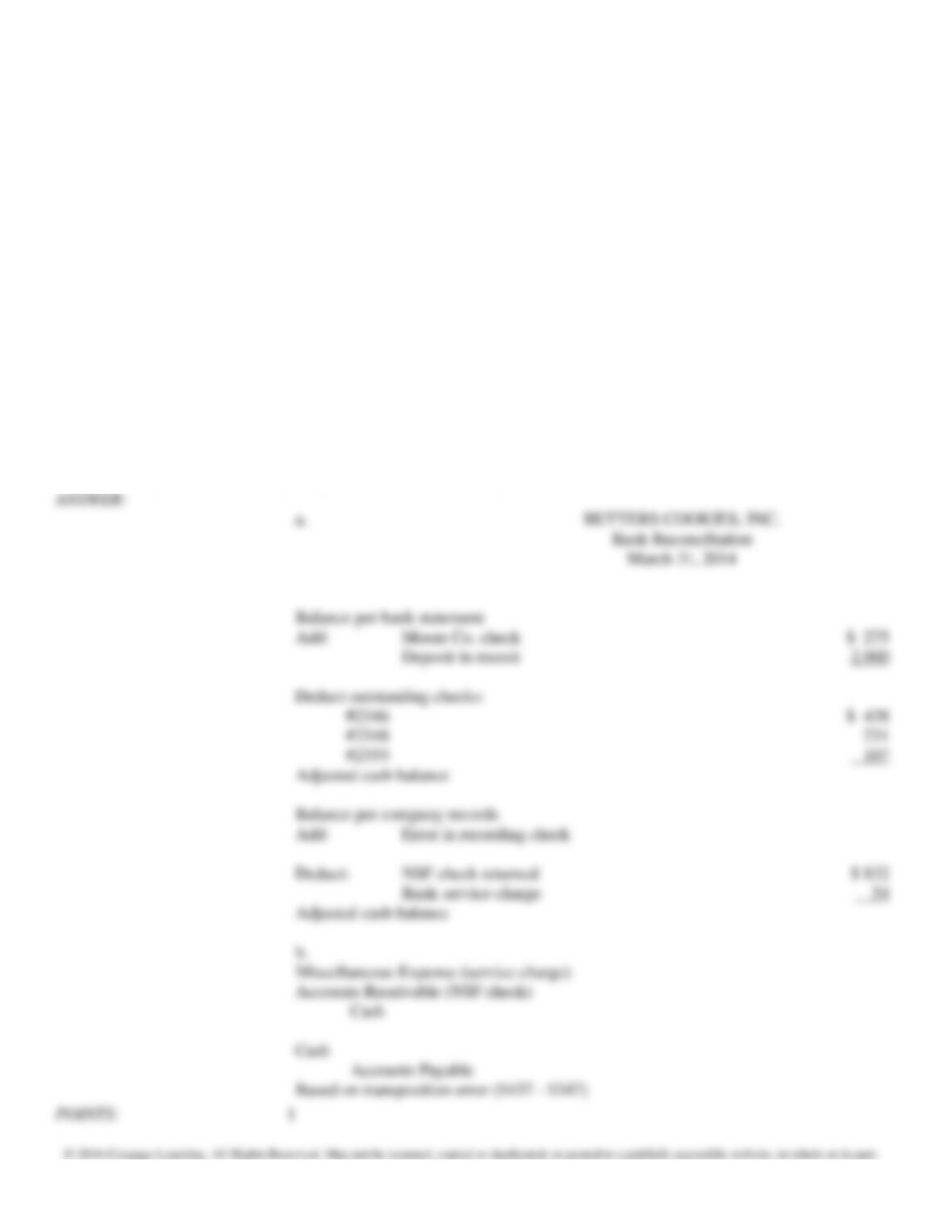
Balance per bank statement
Add:
Moore Co. check
Deposit in transit
Deduct outstanding checks:
#2346
#2348
#2355
Adjusted cash balance
Balance per company records
Add:
Error in recording check
Deduct:
NSF check returned
Bank service charge
Adjusted cash balance
b.
Miscellaneous Expense (service charge)
Accounts Receivable (NSF check)
Cash
Cash
152. Gordon Fish Co. prepares bank reconciliations that adjust to the correct balance of cash. You are given the following
information:
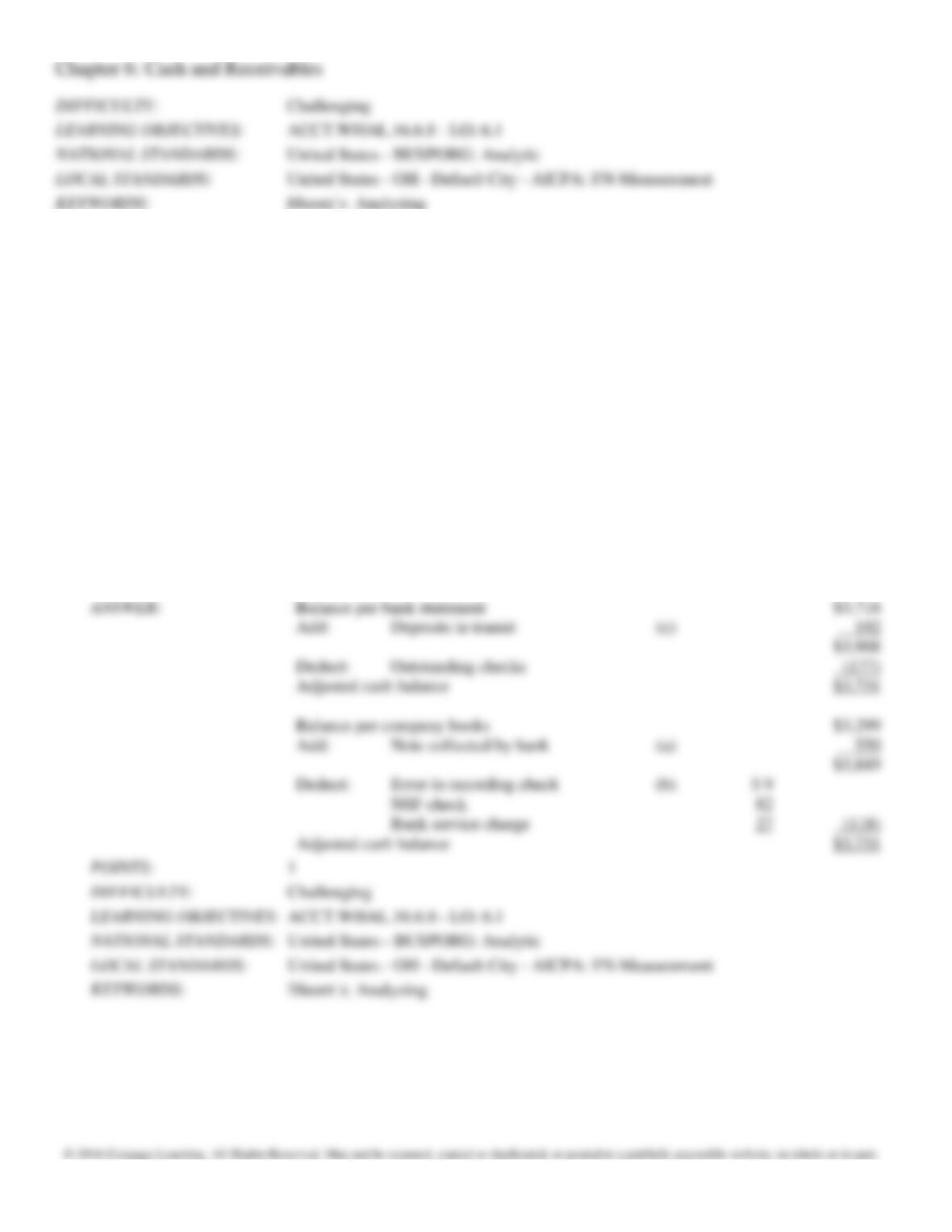
Outstanding checks
$ 177
Note collected for Gordon by bank
(a)
?
Balance per bank statement
3,716
Bank service charges
27
Adjusted cash balance
3,731
Check written for $98 incorrectly recorded in books at $89; check
cleared the bank
(b)
?
NSF check
82
Unadjusted book balance
3,299
Deposits in transit
(c)
?
Required:
Prepare the bank reconciliation. Omit the heading.
1
Challenging
ACCT.WHAL.16.6.8 – LO: 6.1
United States – BUSPORG: Analytic
United States – OH – Default City – AICPA: FN-Measurement
153. Park Playground, Inc. has lost some of its accounting records regarding its July cash receipts and payments. It
reconciled its June 30, 2015 bank statement on July 2 and made the related adjusting entries at that time. The
company has not reconciled its July 31, 2015 bank statement. It provides you with the following information on
August 3:
7/31/2015
Cash account balance
$3,278
Bank statement balance
7,010
Deposits in transit
564
Outstanding checks (cleared next month)
920
Bank service charge
44
Bank charges−NSF checks returned
380
Collection by bank of company’s notes receivable
4,000
In addition, it was found that a July check for $320 (included in the July 31 bank statement) to purchase office
supplies was erroneously recorded in the checkbook for $120.
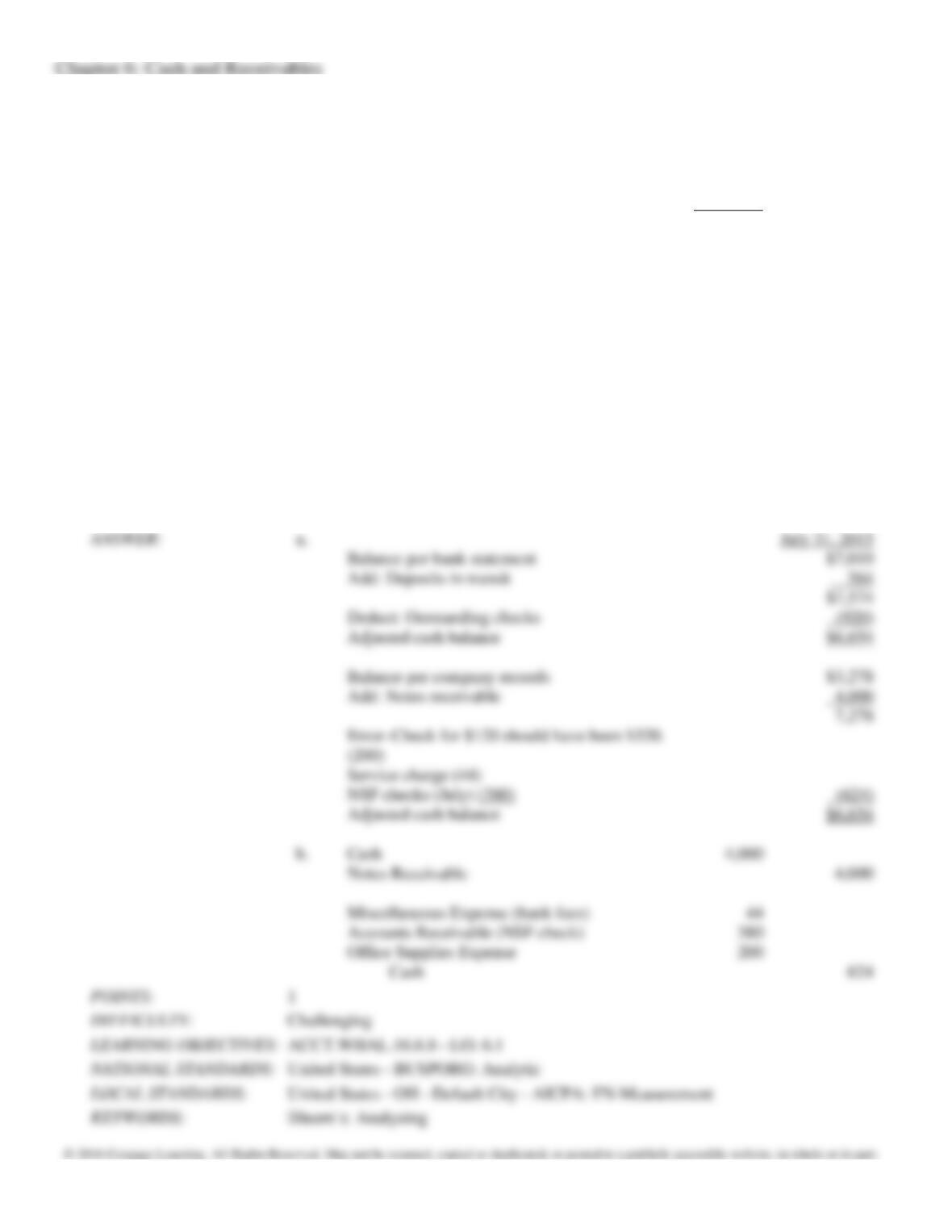
Required:
a.
Prepare a bank reconciliation for the month ended July 31, 2015.
b.
Prepare the correcting entry for the month ended July 31, 2015.
1
Challenging
ACCT.WHAL.16.6.8 – LO: 6.1
United States – OH – Default City – AICPA: FN-Measurement
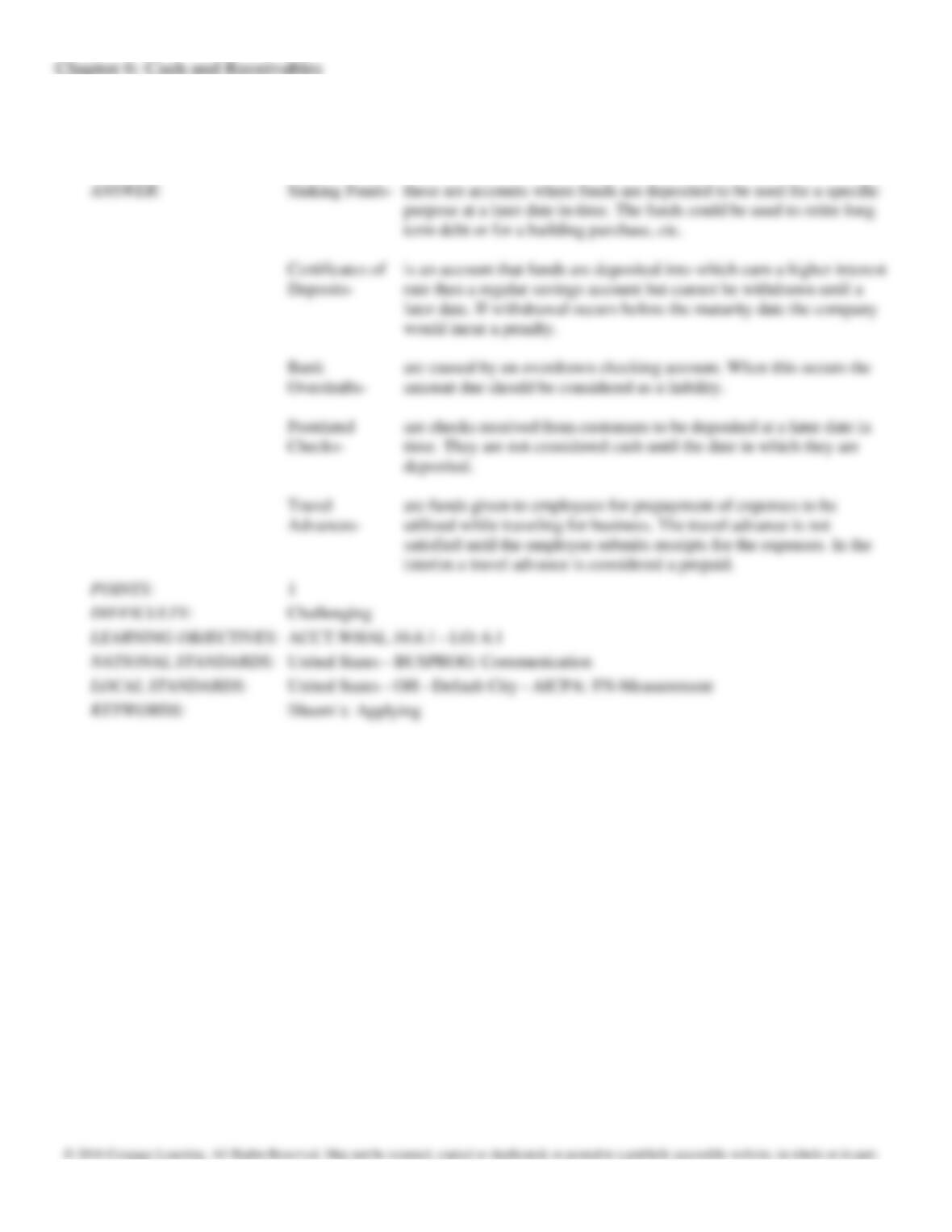
154. To be considered cash, the funds must be available to pay current obligations. Certain situations arise where cash is
restricted and therefore cannot be considered as cash. Provide a brief description of two examples of this situation.
155. Describe the key elements for internal control of cash receipts and cash payments.
Record all cash receipts in the accounting records daily.
the payment.
The bank account should be reconciled monthly.
Challenging
United States – BUSPROG: Communication
156. What is the difference between Trade Receivables and Nontrade Receivables?
Challenging
ACCT.WHAL.16.6.3 – LO: 6.4
United States – OH – Default City – AICPA: FN-Decision Modeling
157. What are the basic issues related to the valuation of receivables?
158. How does GAAP require receivables to be recorded? What about trade receivables?
159. What are the two methods for recording a sales transaction on account when a cash discount is involved? Under what
conditions is each method theoretically preferred?
160. What two types of financing agreements are available to companies who wish to obtain cash from their accounts
receivables? Why is it important to note whether or not the receivables are transferred with or without recourse?
161. What three conditions must be met for GAAP to consider the transfer of financial assets as a sale?
162. What two attributes do notes receivables have that account receivables do not?
163. What is a bank reconciliation and what is its importance?
164. A member of the board of directors has just returned from a meeting with the external auditors concerning the
company’s internal controls. The director noticed that the auditors stressed the importance of cash control and wants
you, the company controller, to explain internal controls for cash.
Required:
a.
Define internal control and explain its purpose.
b.
Identify at least four typical internal controls over cash.
1
Challenging
ACCT.WHAL.16.6.2 – LO: 6.1
United States – BUSPROG: Communication
United States – OH – Default City – AICPA: FN-Decision Modeling
165. A student in the accounting principles course comes to you, an upper-division accounting major, for an explanation
of the difference between the gross price and net price methods of recording credit sales. The principles student
wants to know why, if there is no difference in net income, a company would prefer one method over the other.
Required:
Explain the basics of each method, how each method is reported on the income statement, and the advantages and
disadvantages of each method.
166. When a company extends credit to its customers, the company realizes it will not likely collect all of the related
accounts receivable. As some accounts may prove to be uncollectible, a company must estimate its bad debt
expense.
Required:
a.
What is the purpose of estimating bad debt expense?
b.
There are two relationships that can be used to estimate the bad debt expense for a
company. Describe the two major relationships that can be used to estimate bad debts
expense and the financial statement orientation of each.
Estimating bad debts enables companies to properly value their receivables and
1
Challenging
ACCT.WHAL.16.6.5 – LO: 6.5
United States – BUSPROG: Communication
United States – OH – Default City – AICPA: FN-Decision Modeling
167. In certain circumstances a company may find it necessary to accelerate the cash inflows potentially generated from
its accounts receivable. This can be accomplished through pledging, assigning, or factoring the accounts receivable.
Required:
Explain each of these three arrangements. Include in your discussion an explanation of each agreement, who retains
the risks and benefits of ownership, whether or not the agreement is formally recorded in the company’s accounting
records, and how the agreement is disclosed in the company’s financial statements.
168. Curtis Wholesalers is planning to sell some of its receivables to pay for inventory purchases. The factor has indicated
it will require full guarantee with recourse on credit losses. What does this mean and how will the transaction be
reflected in the financial statements of Curtis Wholesalers?
169. Under U.S. GAAP, a company can designate a receivable, upon initial recognition, to be recognized at fair value
without meeting any criteria. IFRS has established qualifying criteria for fair value designation.
Required:
Describe the IFRS qualifying criteria that must be met to designate a receivable as fair value.