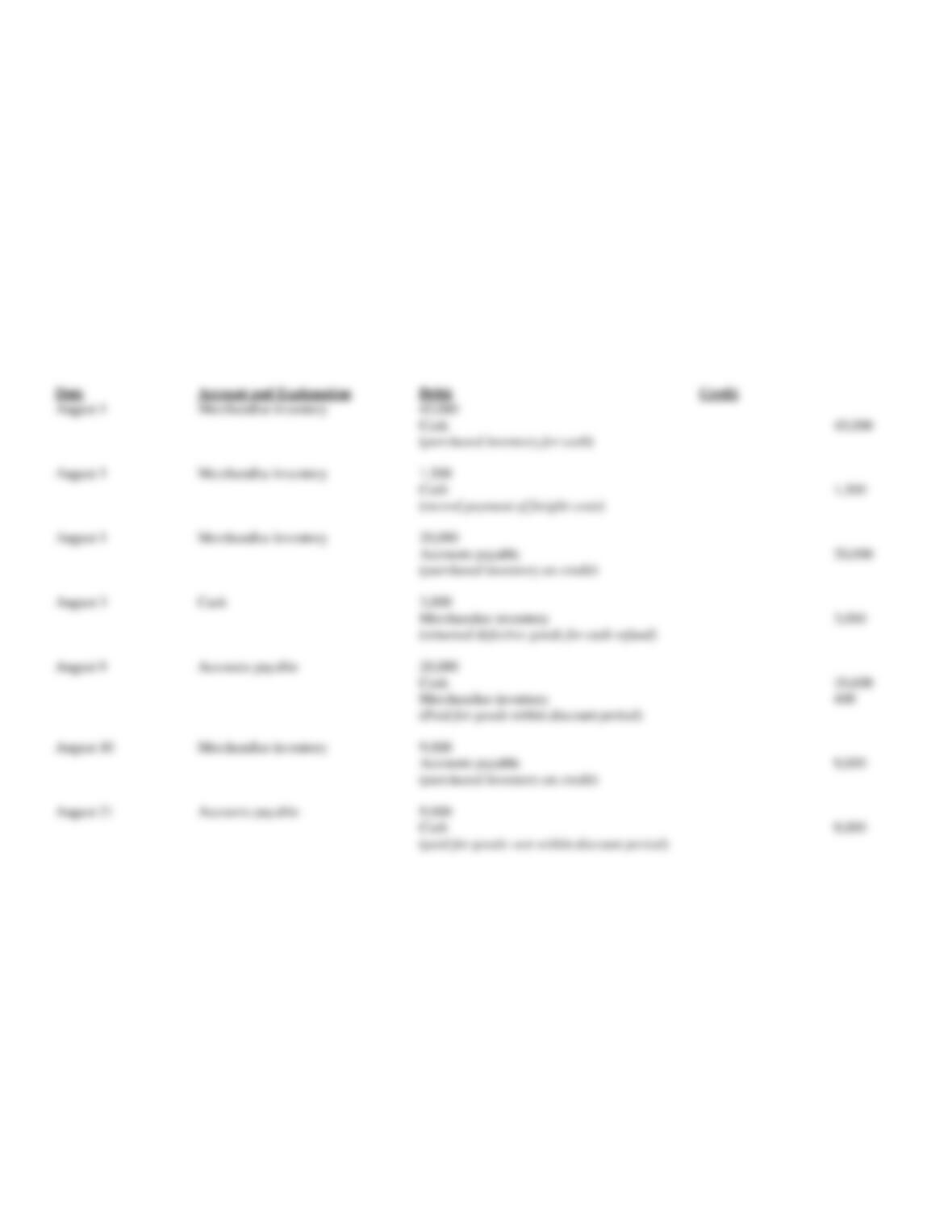
167. White Appliances
On August 1, 2013, White Appliances purchased 75 refrigerators for $45,000 cash and also paid $1,500
transportation costs related to this purchase. On the same date, White purchased 100 dishwashers for $20,000
on credit; however, the seller paid the $1,200 freight. The credit terms for the dishwashers were 2/10, n/30. On
August 3rd, White determined that 5 of the refrigerators were defective, so they were returned to the seller.
White paid for the dishwashers on August 9th. On August 10th, White purchased 90 microwave ovens for
$9,000 on credit with terms 1/10, n/30. The seller paid the freight. White paid for the microwave ovens on
August 21st.
Refer to the information presented for White Appliances. Prepare all of the company’s journal entries for
August assuming the use of a perpetual inventory system.
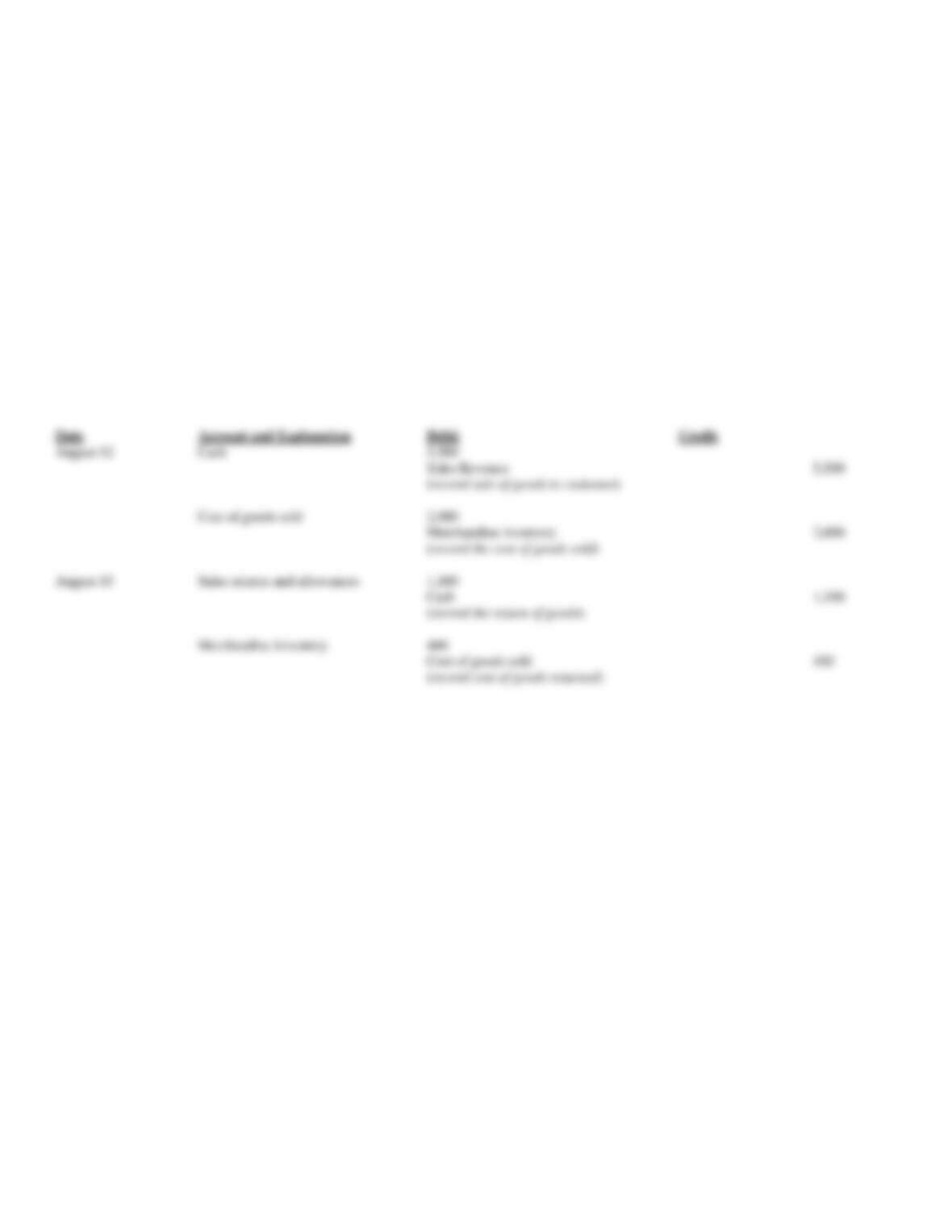
168. White Appliances
On August 1, 2013, White Appliances purchased 75 refrigerators for $45,000 cash and also paid $1,500
transportation costs related to this purchase. On the same date, White purchased 100 dishwashers for $20,000
on credit; however, the seller paid the $1,200 freight. The credit terms for the dishwashers were 2/10, n/30. On
August 3rd, White determined that 5 of the refrigerators were defective, so they were returned to the seller.
White paid for the dishwashers on August 9th. On August 10th, White purchased 90 microwave ovens for
$9,000 on credit with terms 1/10, n/30. The seller paid the freight. White paid for the microwave ovens on
August 21st.
Refer to the information presented for White Appliances. On August 12th, White sold 10 dishwashers to
customers for $550 each. White paid $200 each for these dishwashers when it purchased them from the supplier
on August 1st. On August 15th, customers returned 2 of these dishwashers for a cash refund.
Record the journal entries for this sale and sales return.
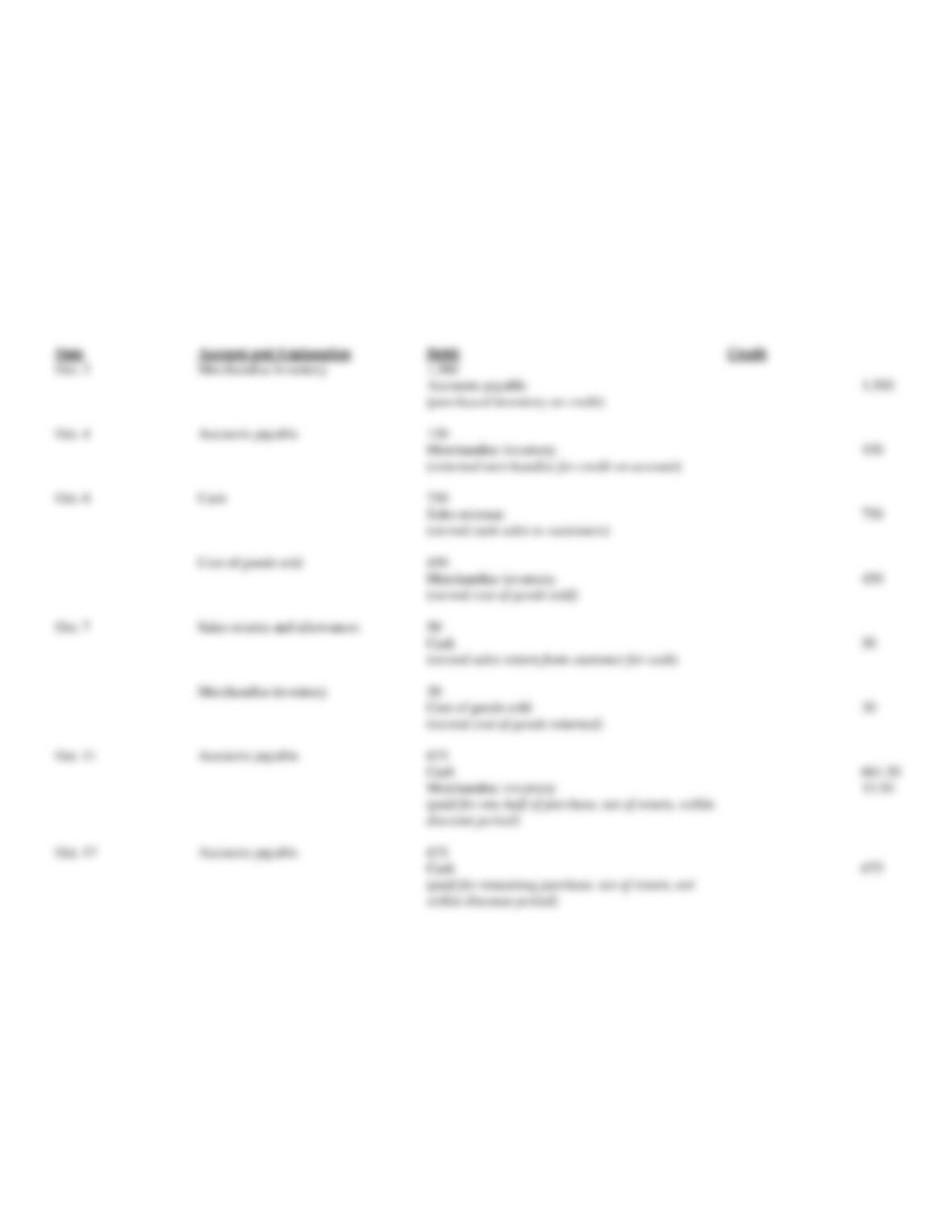
169. The following inventory transactions occurred at Zapata, Inc. which uses a perpetual inventory system:
October 2
Purchased 50 units of inventory from a supplier on credit. The goods cost $30 each and the credit terms were 2/10, n/15.
The shipping costs were $100 under the terms FOB destination.
October 4
Returned 5 units of inventory to the supplier for credit on account.
October 6
Sold 15 units for $50 each to customers for cash.
October 7
Accepted a return of one unit of inventory from the customer for a cash refund.
October 11
Paid the supplier for one-half of the inventory purchased on October 2nd.
October 17
Paid the remaining balance owed to the supplier.
Record the appropriate journal entry for each of these transactions.
Oct. 2
Merchandise inventory
1,500
Oct. 4
Accounts payable
Merchandise inventory
Oct. 6
Cash
Sales revenue
Cost of goods sold
Merchandise inventory
Oct. 7
Sales returns and allowances
Cash
Merchandise inventory
Cost of goods sold
Oct. 11
Accounts payable
Cash
Merchandise inventory
Oct. 17
Accounts payable
Cash
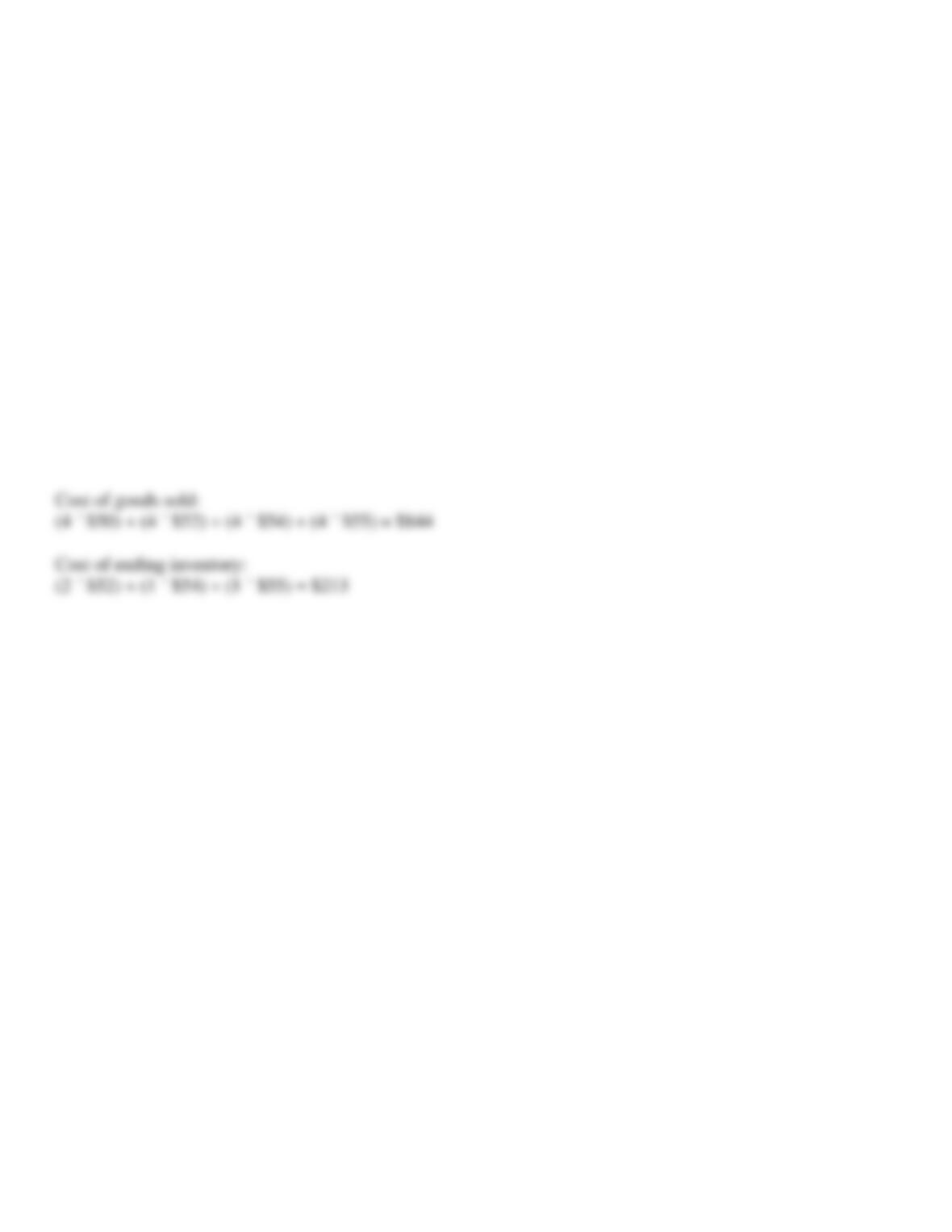
170. L.A. Sports Novelties has the following information related to purchases and sales of one of its popular
products, autographed photographs of the local lacrosse star, Christian Chance. Each photograph is unique, so
the inventory is accounted for under the specific identification method.
Dec. 1 Beginning inventory, 4 units at $50 each
3 Purchase, 6 units at $52 each
11 Sale, 8 units for $77 each
20 Purchase, 5 units for $54 each
27 Purchase, 5 units for $55 each
29 Sale, 8 units for $77 each
A review of purchase and sale information reveals that the following units remain in ending inventory at the end
of the month:
Description Units Sold Units Remaining
Beginning inventory 4 0
Dec. 3rd purchase 4 2
Dec. 20th purchase 4 1
Dec. 27th purchase 4 1
Total 16 4
Compute cost of goods sold and cost of ending inventory.
171. The following data is available for one of the products sold by Chancet Company, which uses a perpetual
inventory system:
April
1
On hand, 10 units at $8 each
$ 80
5
Purchased 30 units at $7.80 each
234
18
Purchased 40 units at $8.25 each
330
20
Sold 75 units for $13 each
24
Purchased 20 units for $8.25 each
165
Chancet Company’s ending inventory for April was 25 units.
Complete the table by determining the amounts of April 30th inventory, cost of goods sold, and gross margin under each of the inventory costing
methods listed below.
Ending Inventory Cost of Goods Sold Gross Margin
A) FIFO
B) LIFO
C) Moving Average Cost
172. Paschal Exports
The following data are available for one of the products sold by Paschal Exports, which uses a perpetual
inventory system.
July
1
Beginning inventory, 1,000 units at $2 each
$2,000
5
Purchased 2,000 units at $2.75 each
5,500
10
Sold 2,500 units for $16 each
15
Purchased 2,000 units at $4 each
8,000
25
Sold 1,500 units for $12 each
31
Ending inventory, 1,000 units
Refer to the information provided for Paschal Exports. If the LIFO method of inventory costing is used, determine the following amounts:
A) Cost of goods sold for the units sold on July 10th?
B) Ending inventory on July 31st?
173. Paschal Exports
The following data are available for one of the products sold by Paschal Exports, which uses a perpetual
inventory system.
July
1
Beginning inventory, 1,000 units at $2 each
$2,000
5
Purchased 2,000 units at $2.75 each
5,500
10
Sold 2,500 units for $16 each
15
Purchased 2,000 units at $4 each
8,000
25
Sold 1,500 units for $12 each
31
Ending inventory, 1,000 units
Refer to the information provided for Paschal Exports. If the FIFO method of inventory costing is used, determine the following amounts:
A) Cost of goods sold for the units sold on July 10th?
B) Ending inventory on July 31st?
174. Paschal Exports
The following data are available for one of the products sold by Paschal Exports, which uses a perpetual
inventory system.
July
1
Beginning inventory, 1,000 units at $2 each
$2,000
5
Purchased 2,000 units at $2.75 each
5,500
10
Sold 2,500 units for $16 each
15
Purchased 2,000 units at $4 each
8,000
25
Sold 1,500 units for $12 each
31
Ending inventory, 1,000 units
Refer to the information provided for Paschal Exports. If the moving average cost method of inventory costing is used, determine the following
amounts:
A) Cost of goods sold for the units sold on July 10th?
B) Ending inventory on July 31st?
2,500 ´ ($7,500 / 3,000) = $6,250
Ending inventory on July 10th:
($7,500 / 3,000) ´ (3,000 – 2,500) = $1,250 or 500 units at $2.50 each.
Ending inventory on July 31st:
[((500 ´ $2.50) + (2,000 ´ $4)) / 2,500] ´ 1,000 = $3,700
175. Robey Company
The following data are available for one of the products sold by Robey Company, which uses a perpetual
inventory system.
February
1
On hand, 10 units at $2 each
8
Sold, 6 units for $10 each
14
Purchased, 30 units at $3 each
25
Sold, 24 units for $10 each
Refer to the information provided for Robey Company. If the company uses the FIFO method, determine the following amounts:
A) Ending inventory on February 28th?
B) Cost of Goods sold for the month of February?
176. Robey Company
The following data are available for one of the products sold by Robey Company, which uses a perpetual
inventory system.
February
1
On hand, 10 units at $2 each
8
Sold, 6 units for $10 each
14
Purchased, 30 units at $3 each
25
Sold, 24 units for $10 each
Refer to the information provided for Robey Company. If the LIFO method is used, determine the following amounts:
A) Ending inventory on February 28th?
B) Cost of Goods sold for the month of February?
(4 ´ $2) + (6 ´ $3) = $26
(6 ´ $2) + (24 ´ $3) = $84
10 units ´ $3 = $30
(6 ´ $2) + ((4 ´ $2) + (20 ´ $3)) = $80
177. Robey Company
The following data are available for one of the products sold by Robey Company, which uses a perpetual
inventory system.
February
1
On hand, 10 units at $2 each
8
Sold, 6 units for $10 each
14
Purchased, 30 units at $3 each
25
Sold, 24 units for $10 each
Refer to the information provided for Robey Company. If the Moving Average Cost method is used, determine the following amounts:
A) Cost of Goods sold for the month of February?
B) Ending inventory on February 28th?
178. Re Company prepared the following analysis of its year-end inventory at June 30th:
Historical Cost
Replacement Cost
Product
Quantity
per unit
per unit
A
17
$430
$499
B
140
325
299
C
38
75
69
Determine the lower of cost or market value for each product in Re Company’s inventory and prepare the journal entry needed at year-end to value
the inventory at LCM.
Product
Historical Cost
Replacement Cost
LCM
Needed
A
$430 ´ 17 = $7,310
$499 ´ 17 = $8,483
$ 7,310
B
325 ´ 140 = 45,500
299 ´ 140 = 41,860
41,860
C
75 ´ 38 = 2,850
69 ´ 38 = 2,622
2,622
Totals
$55,660
$51,792
$3,868
Date
Account and Explanation
Debit
Credit
June 30
Cost of Goods Sold
3,868
Merchandise Inventory
3,868
(6 ´ $2) + [((4 ´ $2) + (30 ´ $3) / 34) ´ 24] = $81.12
(10 ´ ($98 / 34)) = $28.80*
*
possible difference due to rounding
179. The following information is available for Porter Company for its fiscal year ending January 31, 2013:
Net Sales
$745,400
Cost of Goods Sold
614,320
Inventory, 1/31/2012
80,690
Inventory, 1/31/2013
81,440
Compute the following financial ratios for Porter Company:
A) Gross Profit Ratio
B) Inventory Turnover Ratio
C) Average Days to Sell Inventory
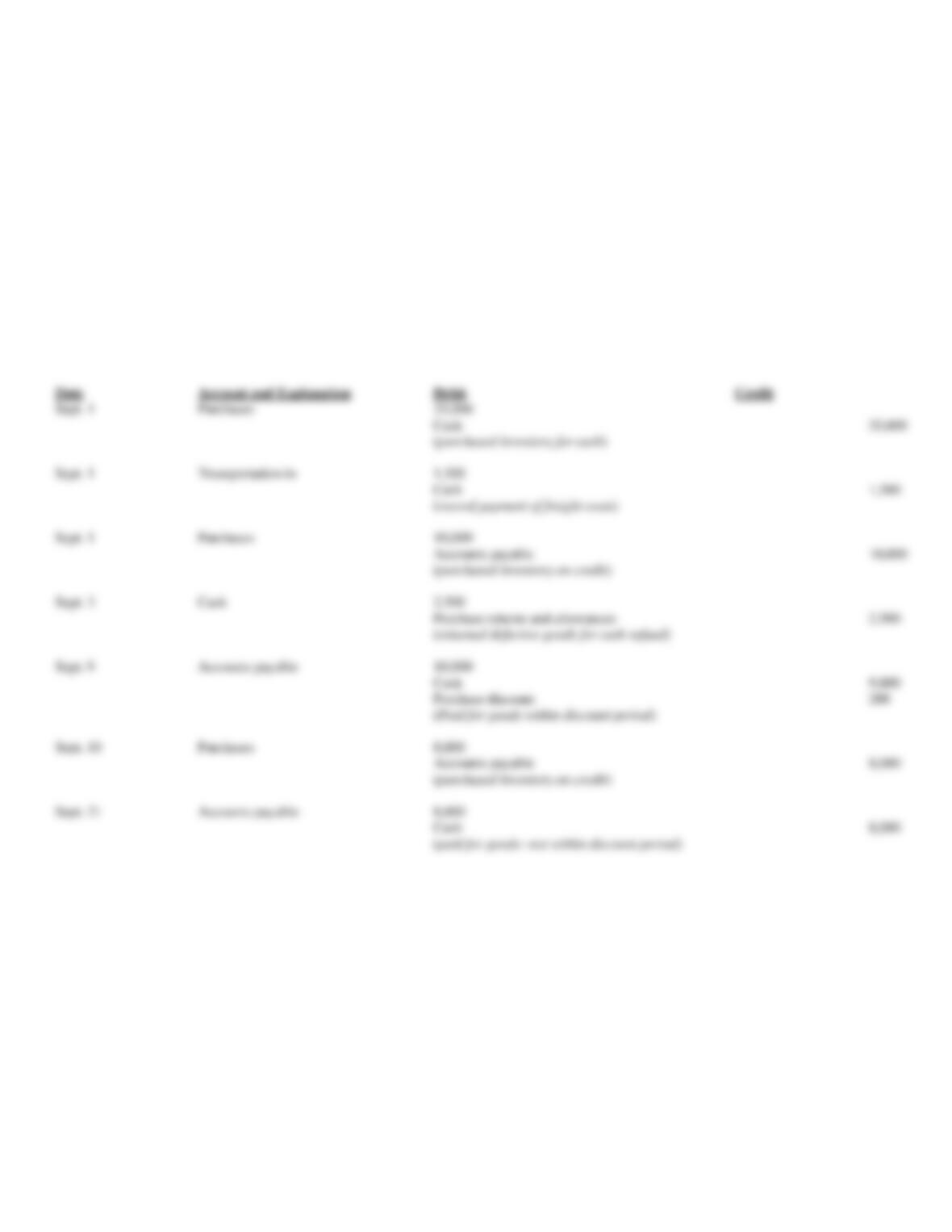
180. Roesel Fashions completed a physical inventory at the end of 2013. A review of the physical inventory
procedures and records uncovered several errors that are described below. In the columns provided, indicate the
effect, if any, on the four financial statement items listed. Use the following codes for your answers:
O = Overstatement; U = Understatement; NE = No Effect
Ending
Retained
Cost of
Net
Error
Inventory
Earnings
Goods Sold
Income
A)
One batch of goods was counted
twice
B)
One page of items was misplaced
when the inventory was calculated
C)
Goods sold FOB shipping point were
included in Roesel’s inventory
D)
Goods in transit from a supplier,
shipped FOB shipping point, were
not included in Roesel’s inventory
Ending
Retained
Cost of
Net
Error
Inventory
Earnings
Goods Sold
Income
One batch of goods was counted
B)
One page of items was misplaced
C)
Goods sold FOB shipping point were
not included in Roesel’s inventory
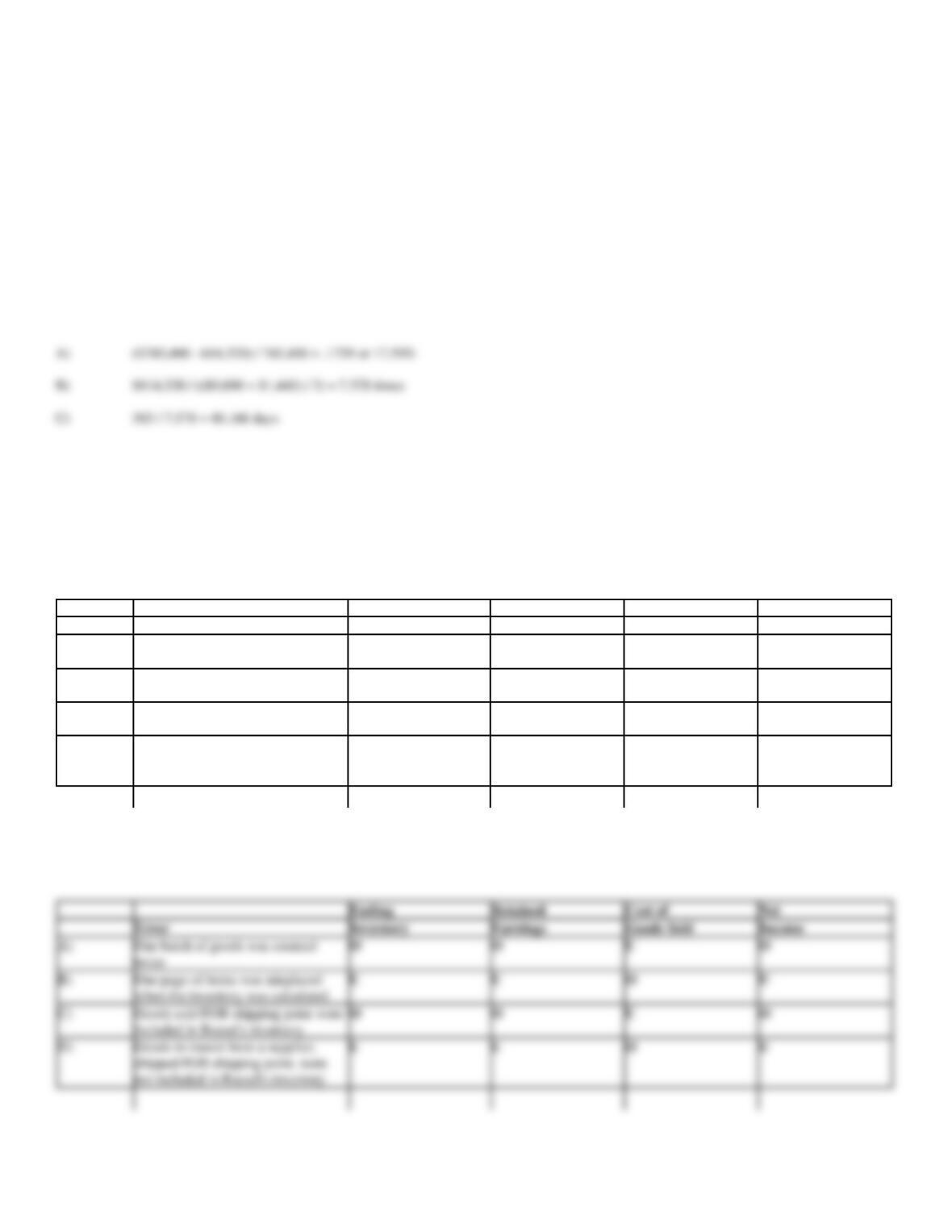
($745,400 – 614,320) / 745,400 = .1759 or 17.59%
365 / 7.578 = 48.166 days
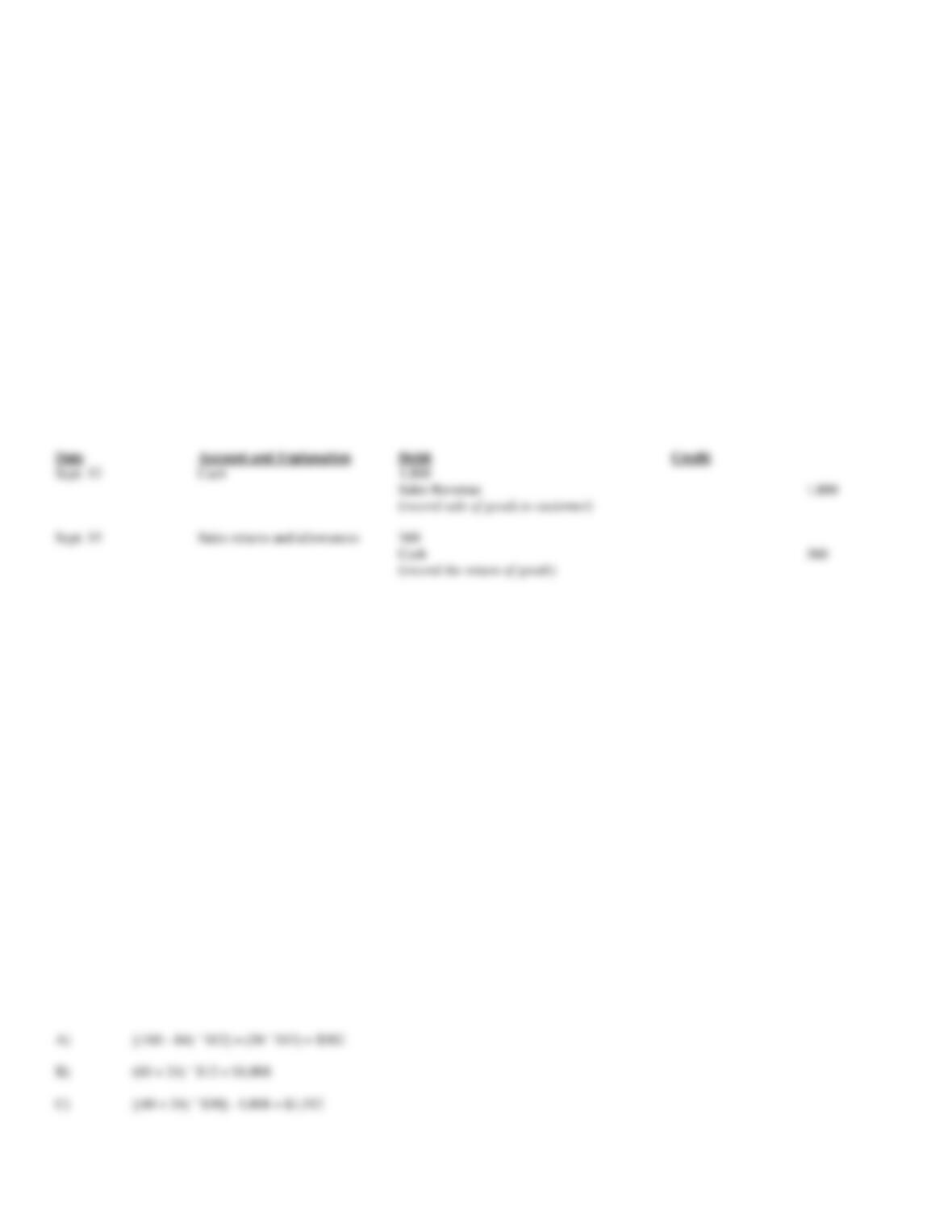
181. Serrano Company
On September 1, 2013, Serrano Company purchased 70 units of Product A for $35,000 cash and also paid
$1,500 transportation costs related to this purchase. On the same date, Serrano Company purchased 100 units of
Product B for $10,000 on credit; however, the seller paid the $1,200 freight. The credit terms for Product B
were 2/10, n/30. On September 3rd, Serrano Company determined that 5 units of Product A were defective, so
they were returned to the seller. Serrano Company paid for its purchase of Product A on September 9th. On
September 10th, Serrano Company purchased 90 units of Product C for $8,000 on credit with terms 1/10, n/30.
The seller paid the freight. Serrano Company paid for its purchase of Product C on September 21st.
Refer to the information presented for Serrano Company. Prepare all of Serrano Company’s journal entries for
September assuming the company uses a periodic inventory system.
182. Serrano Company
On September 1, 2013, Serrano Company purchased 70 units of Product A for $35,000 cash and also paid
$1,500 transportation costs related to this purchase. On the same date, Serrano Company purchased 100 units of
Product B for $10,000 on credit; however, the seller paid the $1,200 freight. The credit terms for Product B
were 2/10, n/30. On September 3rd, Serrano Company determined that 5 units of Product A were defective, so
they were returned to the seller. Serrano Company paid for its purchase of Product A on September 9th. On
September 10th, Serrano Company purchased 90 units of Product C for $8,000 on credit with terms 1/10, n/30.
The seller paid the freight. Serrano Company paid for its purchase of Product C on September 21st.
Refer to the information presented for Serrano Company. On September 12th, Serrano Company sold 10 units
of Product B to customers for $180 each. Serrano Company had paid $100 for each unit of Product B when it
purchased them from the supplier on September 1st. On September 15th, customers returned 2 units of Product
B for a cash refund.
Record the journal entries for this sale and sales return.
183. Jocque Fabrics
The following data are available for one item of merchandise sold by Jocque Fabrics, which uses a periodic
inventory system.
February
1
On hand, 100 units at $12 each
8
Sold, 60 units for $30 each
14
Purchased, 30 units at $13 each
25
Sold, 24 units for $30 each
Refer to the information provided for Jocque Fabrics. If the company uses the FIFO method, determine the following amounts:
A) Ending inventory on February 28th?
B) Cost of Goods sold for the month of February?
C) Gross Margin for February?
[(100 – 84) ´ $12] + (30 ´ $13) = $582
(60 + 24) ´ $12 = $1,008
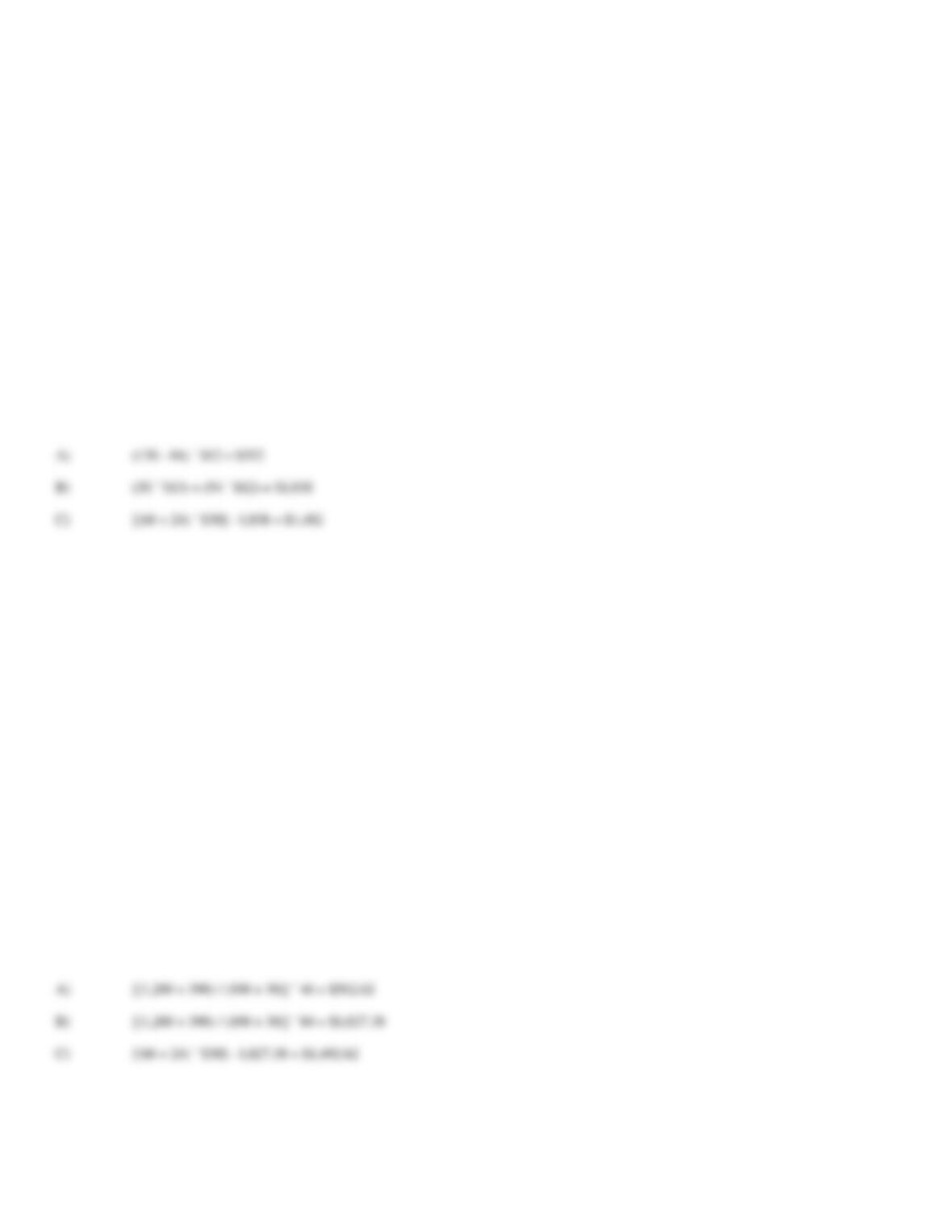
Sept. 12
Cash
1,800
Sales Revenue
1,800
Sept. 15
Sales returns and allowances
360
Cash
360
184. Jocque Fabrics
The following data are available for one item of merchandise sold by Jocque Fabrics, which uses a periodic
inventory system.
February
1
On hand, 100 units at $12 each
8
Sold, 60 units for $30 each
14
Purchased, 30 units at $13 each
25
Sold, 24 units for $30 each
Refer to the information provided for Jocque Fabrics. If the LIFO method is used, determine the following amounts:
A) Ending inventory on February 28th?
B) Cost of Goods sold for the month of February?
C) Gross Margin for February?
185. Jocque Fabrics
The following data are available for one item of merchandise sold by Jocque Fabrics, which uses a periodic
inventory system.
February
1
On hand, 100 units at $12 each
8
Sold, 60 units for $30 each
14
Purchased, 30 units at $13 each
25
Sold, 24 units for $30 each
Refer to the information provided for Jocque Fabrics. If the Average Cost method is used, determine the following amounts:
A) Ending inventory on February 28th?
B) Cost of Goods sold for the month of February?
C) Gross Margin for February?
[(1,200 + 390) / (100 + 30)] ´ 46 = $562.62
[(1,200 + 390) / (100 + 30)] ´ 84 = $1,027.38
[(60 + 24) ´ $30] – 1,027.38 = $1,492.62
(130 – 84) ´ $12 = $552
(30 ´ $13) + (54 ´ $12) = $1,038
[(60 + 24) ´ $30] – 1,038 = $1,482
186. Zellenger uses a periodic inventory system and had the following data for inventory during the most recent
year:
Cost
Date
Units
per unit
Extension
January 1
Beginning inventory
400
$7.00
January 22
Purchase
1,200
7.15
March 14
Purchase
1,100
7.20
May 24
Purchase
1,000
7.30
October 2
Purchase
1,800
7.35
– various –
Sales
4,300
December 31
Ending inventory
1,200
Calculate the company’s ending inventory and cost of goods sold under the following inventory cost flow methods:
A) FIFO
B) LIFO
C) Average Cost
187. Describe how the inventories of manufacturers differ from the inventories of retailers.
Date
Units
per unit
Extension
January 1
Beginning inventory
400
$7.00
$ 2,800
January 22
Purchase
1,200
7.15
March 14
Purchase
1,100
7.20
7,920
May 24
Purchase
1,000
7.30
7,300
October 2
Purchase
1,800
7.35
13,230
– various –
Sales
4,300
December 31
Ending inventory
1,200
$39,830
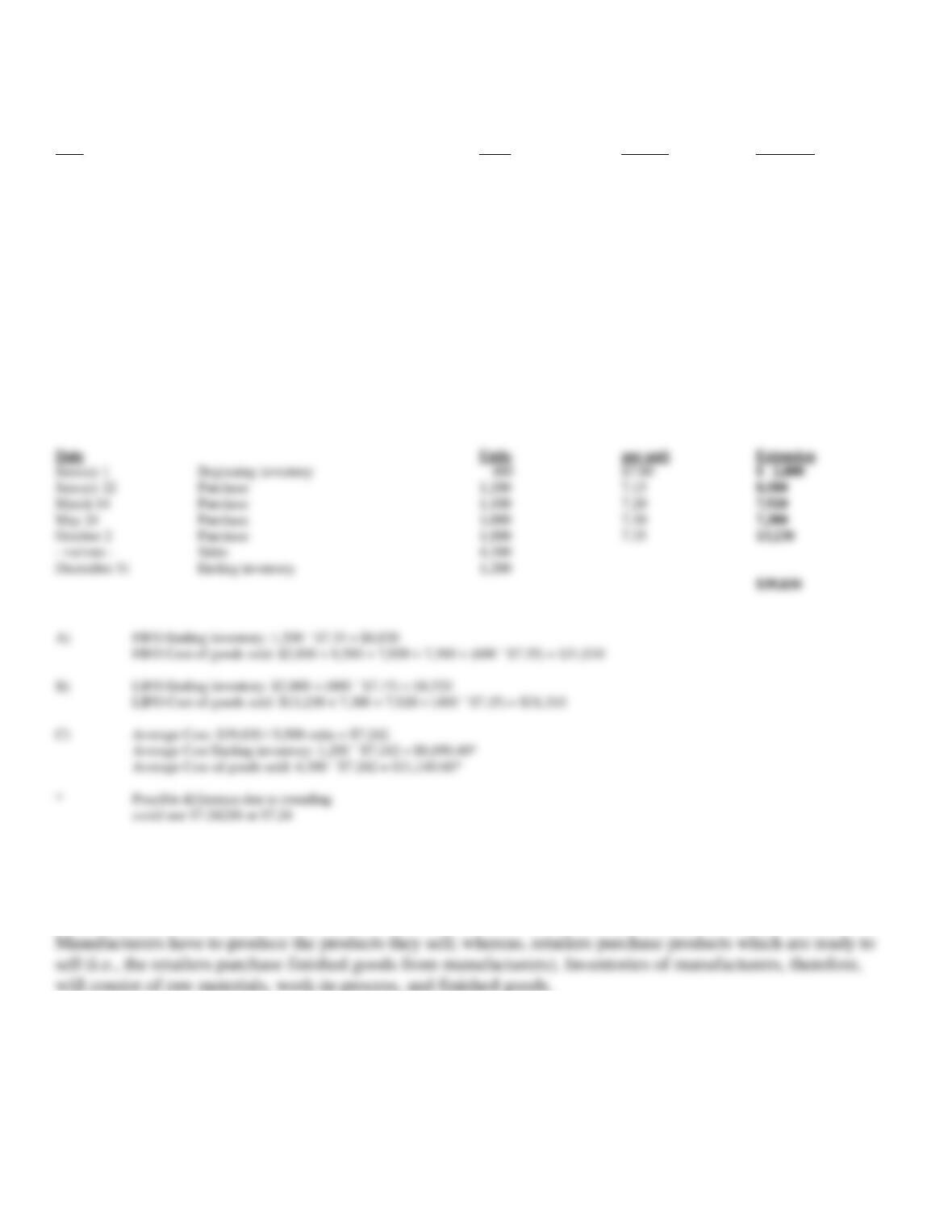
FIFO Ending inventory: 1,200 ´ $7.35 = $8,820
FIFO Cost of goods sold: $2,800 + 8,580 + 7,920 + 7,300 + (600 ´ $7.35) = $31,010
LIFO Ending inventory: $2,800 + (800 ´ $7.15) = $8,520
LIFO Cost of goods sold: $13,230 + 7,300 + 7,920 + (400 ´ $7.15) = $31,310
Average Cost: $39,830 / 5,500 units = $7.242
Average Cost Ending inventory: 1,200 ´ $7.242 = $8,690.40*
Average Cost of goods sold: 4,300 ´ $7.242 = $31,140.60*
*
Possible difference due to rounding
could use $7.24218 or $7.24
188. Yu Company
Several sales transactions and purchasing activities for Yu Company are described below. Yu Company uses a
perpetual inventory system.
A)
Yu Company purchased merchandise from Mia Company on credit.
B)
Yu Company returned to Mia Company defective merchandise before payment is made.
C)
Yu Company pays for the merchandise purchased from Mia Company.
D)
Yu Company sells merchandise to its customers for cash and on credit.
E)
Credit customers returned merchandise to Yu Company for a refund.
F)
Credit customers pay their account balances to Yu Company.
Refer to the information provided for Yu Company. For each of the items above, describe its economic effects on the company’s accounting
equation.
A)
Assets and liabilities increase.
B)
Assets and liabilities decrease.
C)
Assets and liabilities decrease.
D)
Assets and stockholders’ equity increase. In addition, assets and stockholders’ equity decrease (through an increase in expenses).
E)
Assets and stockholders’ equity decrease. In addition, assets and stockholders’ equity increase (through a decrease in expenses).
F)
Assets increase and decrease by the same amount.
189. Yu Company
Several sales transactions and purchasing activities for Yu Company are described below. Yu Company uses a
perpetual inventory system.
A)
Yu Company purchased merchandise from Mia Company on credit.
B)
Yu Company returned to Mia Company defective merchandise before payment is made.
C)
Yu Company pays for the merchandise purchased from Mia Company.
D)
Yu Company sells merchandise to its customers for cash and on credit.
E)
Credit customers returned merchandise to Yu Company for a refund.
F)
Credit customers pay their account balances to Yu Company.
Refer to the information provided for Yu Company. Explain the advantages to Yu Company for using the perpetual inventory system. Assume that
Yu Company uses a computer system which is linked to its cash registers and that all products have bar codes that are read by bar code readers
attached to the cash registers.
190. Explain the relationship between the valuation of inventory and income measurement as it related to the
balance sheet and income statement.
191. Buyer Company purchased a large shipment of luggage from Seller Company on credit near the end of its
accounting period. Seller Company shipped the luggage in January and Buyer Company received the luggage in
February. Assume that Buyer Company’s accounting period ends on January 31st, while Seller Company’s
accounting period ends on May 31st. Answer each independent question:
A)
If the luggage was shipped FOB destination, who will pay the freight costs?
B)
If the luggage was shipped FOB destination, when should Buyer Company record the purchase?
C)
If the luggage was shipped FOB shipping point, who will pay the freight costs?
D)
If the luggage was shipped FOB shipping point, when should Buyer Company record the purchase?
E)
Under what shipping terms would Buyer Company include the luggage as part of inventory on its January 31st balance sheet?
192. What is a LIFO liquidation? Why is it important to disclose the effects of a LIFO inventory liquidation?
A)
If the luggage was shipped FOB destination by Seller Company, Seller Company should pay the freight charges.
C)
If the luggage was shipped FOB shipping point, the freight charges will be paid by Buyer Company.
193. In the following information from the 2013 balance sheet of Kayla Enterprises, all amounts have been
rounded to millions of dollars.
May 31, 2013
May 31, 2012
Raw materials
$25.8
$52.1
Work-in-process
44.8
34.7
Finished goods
1,132.70
1,303.8
Inventories at FIFO
1,203.30
1,390.6
Adjustment to LIFO
5.6
21.9
Answer the following questions:
A)
Describe what costs are included in each of the three types of inventories listed for Kayla Enterprises.
B)
Even though a footnote describing the inventory costing method(s) used by the company is not provided here, what can you conclude
about the inventory costing methods(s) used by the company?
C)
Explain what the amount “Adjustment to LIFO” represents. What effect does this adjustment have on the company’s net earnings in
2012 and 2013?
194. If a company overstates its ending inventory for the current year, what are the effects on assets, cost of
goods sold, income before taxes, and retained earnings for the current year?
period. Finished goods includes costs to produce products that were completed but not sold during the period.
“adjustment to LIFO” in the inventories for 2013 from 2012.
195. Differentiate between the record keeping required for sales and cost of goods sold under a perpetual versus
a periodic inventory system.
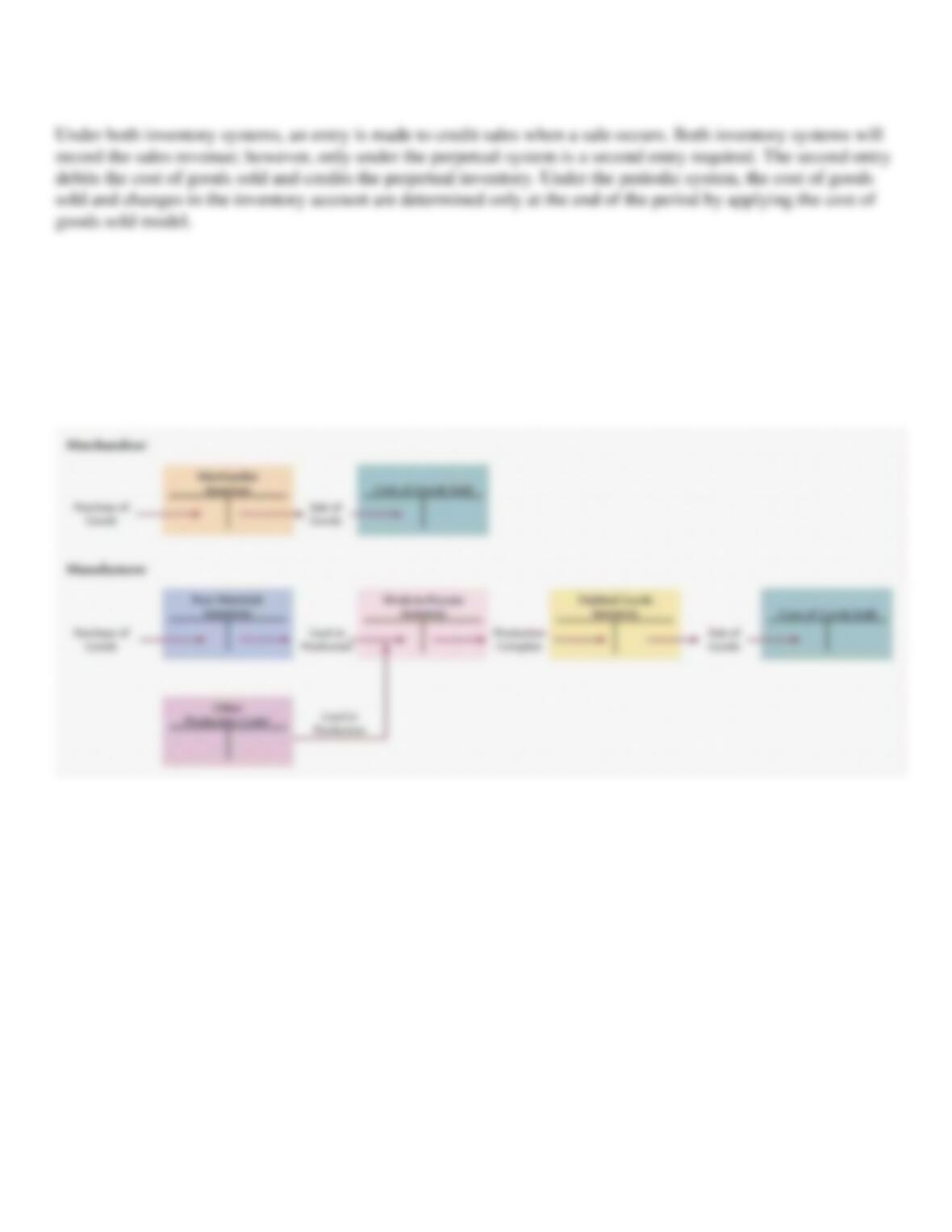
196. Draw and label T-accounts to illustrate the relationship between the various inventory accounts and cost of
goods sold for: (a) a merchandiser; and (b) a manufacturer. Use the following account titles: Cost of Goods
Sold, Finished Goods Inventory, Merchandise Inventory, Raw Materials Inventory, Work-in-Process Inventory,
and Other Production Costs.
197. “You Decide” Essay
You are the inventory accounting manager at XB Tools. Your company is considering the purchase of software
that would allow the company to switch from the periodic inventory system to a perpetual system. Prepare a
compare and contrast table to summarize the similarities and differences between the two systems. (Use the
table that has been started for you below.)
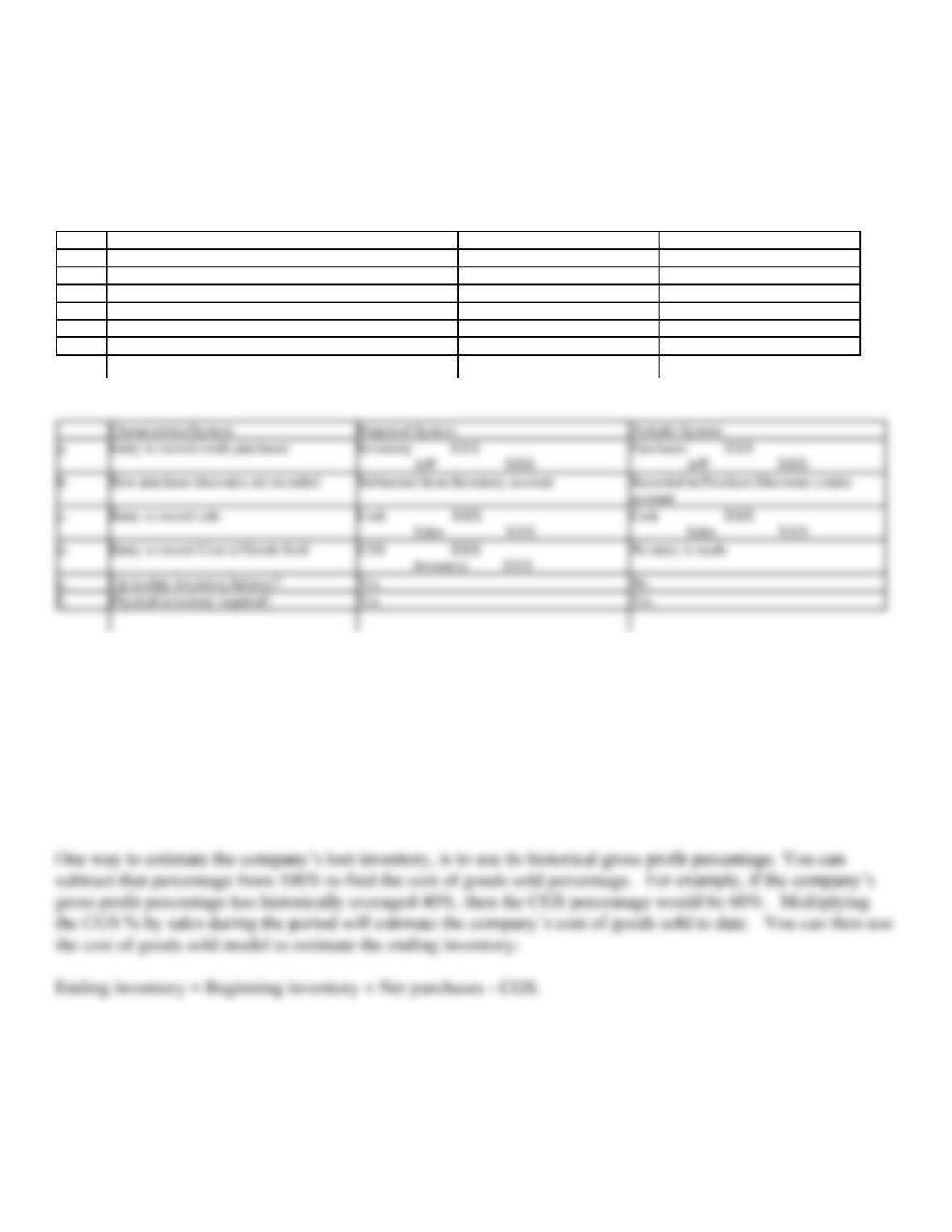
Characteristic/System
Perpetual System
Periodic System
a.
Entry to record credit purchases
b.
How purchase discounts are recorded
c.
Entry to record sale
d.
Entry to record Cost of Goods Sold
e.
Up–to-date inventory balance?
f.
Physical inventory required?
198. “You Decide” Essay
You are the Orlando store manager for Kruge Enterprises. When you came in this morning, you found the front
door ajar. Once Security had arrived and you eventually got inside, you discovered that most of your inventory
had been stolen. In order to file a claim with your insurance company you need to estimate the amount of
inventory you had yesterday at closing time. Unfortunately, Kruge Enterprises uses a periodic inventory
system. How can you estimate your lost inventory amount?
Characteristic/System
Perpetual System
Periodic System
Yes
f.
Physical inventory required?
Yes
Yes