Chapter 6: Cash and Receivables
134. Prior to recording the recovery and collection of a $2,200 account receivable previously written off and the adjusting
entry for bad debt expense for the year, the general ledger reflected the following information:
Sales
$2,600,000
Sales Discounts
12,000
Accounts Receivable, December 31
420,000
Sales Returns & Allowances
44,000
Allowance for Doubtful Accounts
1,450
(debit)
Required:
a.
Compute the amount of the bad debt expense, assuming it is based on 1.8% of net sales.
b.
Prepare the adjusting entry for bad debts assuming it is based on 3% of the ending accounts
receivable.
1
Challenging
ACCT.WHAL.16.6.5 – LO: 6.5
United States – BUSPORG: Analytic
United States – OH – Default City – AICPA: FN-Measurement
135. Zeus Inc. recorded credit sales of $1,750,000 during 2015. At December 31, 2015, the company had a $250,000 debit
balance in Accounts Receivable and a $3,000 credit balance in Allowance for Doubtful Accounts.
Required:
a.
Prepare the necessary adjusting journal entry at December 31 to record the estimated bad
debt expense, assuming that bad debts are estimated at 1% of credit sales.
b.
Prepare the necessary adjusting journal entry at December 31 to record the estimated bad
debt expense, assuming that bad debts are estimated at 8% of outstanding accounts
receivable.
c.
Assume that a customer whose $3,300 account had been written off earlier in the year now
pays the balance owed in full. Prepare the journal entry, or entries, to record the collection
of this customer’s account.
Challenging
United States – BUSPORG: Analytic
United States – OH – Default City – AICPA: FN-Measurement
136. On December 31, the Jacob, Inc. general ledger contained the following balances prior to write-offs and adjustments:
Trade Accounts Receivable
$ 623,450
Allowance for Doubtful Accounts
15,800
(credit)
Net Credit Sales
2,529,000
Before completing an aging analysis to determine the estimated amount uncollectible, Jacob decided to write off
$7,500 of an account past due over 360 days.
Aging of the accounts receivable balance after the write-off on December 31 indicated the following:
Estimated
Percentage
Age
Amount
Uncollectible
Under 30 days
$358,900
1.5%
30-90 days
134,000
3.0%
91-180 days
96,000
7.0%
181-360 days
22,700
20.0%
Over 360 days
4,350
60.0%
$615,950
Required:
a.
Prepare the necessary journal entry to record the write-off.
b.
Prepare the adjusting journal entry at December 31 to record Jacob, Inc.’s estimated bad
debts assuming that the company uses the aging of accounts receivable method.
c.
What is the net realizable value of accounts receivable on the December 31 balance sheet?
1
Challenging
ACCT.WHAL.16.6.5 – LO: 6.5
United States – OH – Default City – AICPA: FN-Measurement
137. Angler Fish Co. factored $540,000 of its accounts receivable to Gause Finance Co. Gause Finance advanced 85% of
the factored receivables and charged a 10% commission on the gross amount of the receivables. All conditions for a
sale have been met.
Required:
Prepare the journal entries necessary to record the following:
a.
The sale of the receivables.
b.
Sales Returns and Allowances of $2,200 on a factored account.
c.
The conclusion of the sale agreement when Angler would collect any balance remaining.
138. In order to resolve its cash flow problems, Town Home Company assigned $420,000 of its accounts receivable to
Wargo Finance Company on August 1. Town Home received 85% of the assigned accounts receivable less a service
charge of 5% of the cash received. Town Home was also charged 14% interest annually on the outstanding loan
balance. By August 31, Town Home had collected $276,000, and remitted this amount plus the interest to date on
August 31 to Wargo Finance.
Required:
a.
Prepare journal entries to record the above assignment transactions on Town Home’s
books.
b.
If Town Home collected an additional $50,000 on outstanding accounts and remitted this to
Wargo Finance on September 30, how much additional interest must be paid on September
30?
Challenging
United States – BUSPORG: Analytic
United States – OH – Default City – AICPA: FN-Measurement
139. On December 1, the Harrison Company sold without recourse $345,000 of its accounts receivable to Happy Finance
Company for 85% of their value. A 10% commission on the gross value of the factored accounts was charged.
Required:
a.
Prepare the journal entry to record the factoring.
b.
Briefly discuss how the factored accounts are disclosed in the financial statements.
1
Challenging
ACCT.WHAL.16.6.6 – LO: 6.4
United States – BUSPORG: Analytic
United States – OH – Default City – AICPA: FN-Measurement
140. Caymen Supplies frequently assigns its accounts receivable in order to obtain immediate cash.
Required:
Prepare journal entries for the following:
a.
The company assigned $1,340,000 of accounts receivable, receiving a 93% advance less
service charges of $25,800.
b.
The company collected $830,000 of these receivables and remitted the collection to the
finance company along with one month’s interest at 15%.
141. Prepare the journal entries for the following transactions:
a.
Sold $150,000 of goods to Georgia Co. on account.
b.
Collected $50,000 from Georgia Co.
c.
Accepted a $100,000, one-year, 10% note from Georgia Co. for the amount remaining on
the account.
d.
After 60 days, discounted the note from Georgia Co. at First National Bank at a 12%
interest rate.
Required:
Prepare the journal entries for each transaction.
142. During 2015, Davidson’s first year of operations, the following transactions occurred:
∙
Credit sales of $2,000,000.
∙
Collections on account of $1,700,000.
∙
Accounts receivable written off during the year, $5,000.
∙
Estimated uncollectible accounts, $8,000.
∙
Accepted a $10,000, one-year, 12% note receivable on June 30.
Required:
Prepare the receivables portion of Davidson’s first year operation’s balance sheet as of December 31, 2015.
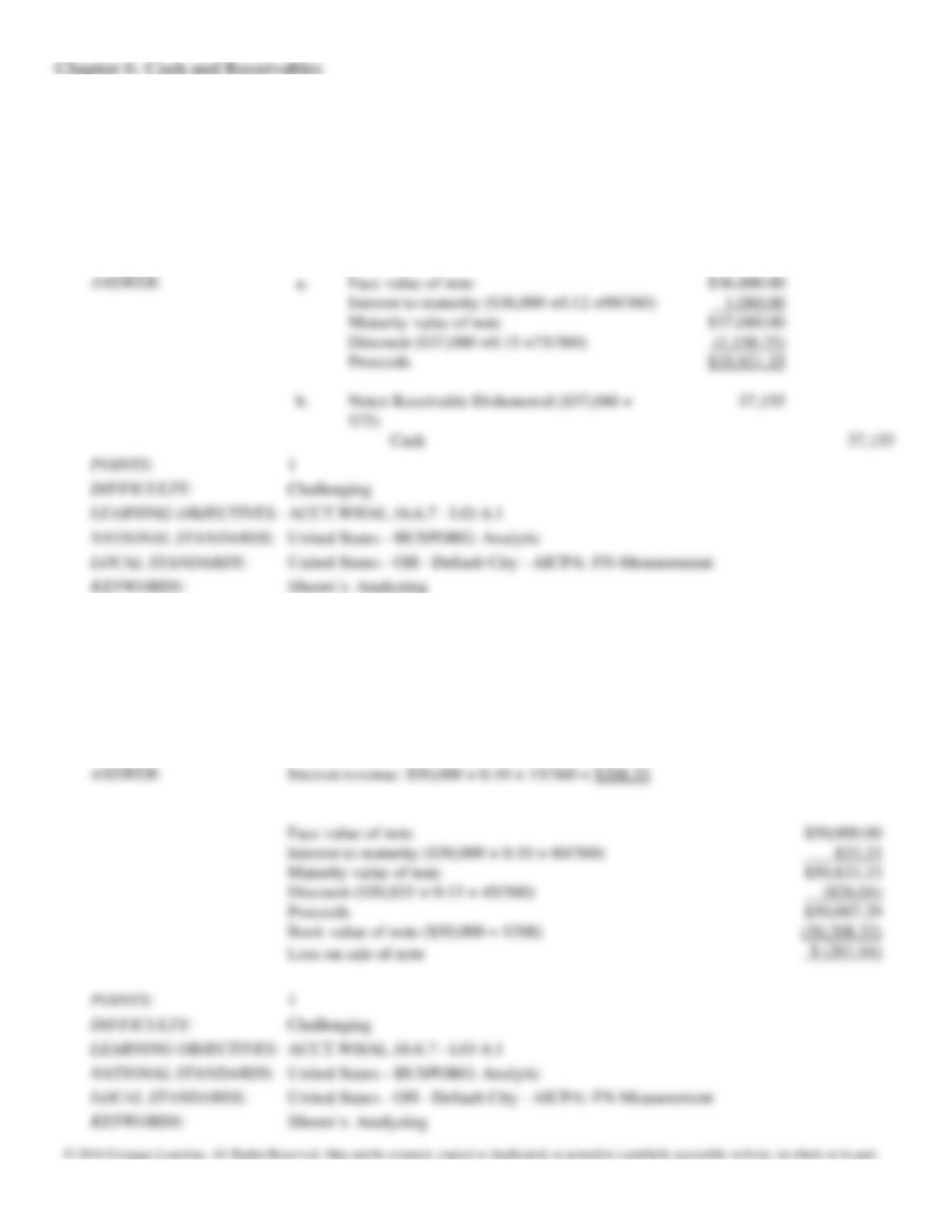
143. Max Corp. sold goods for $36,000 on July 17, 2014, and accepted a 12%, 90-day note. On August 1, the note was
sold to a bank at a 15% discount rate.
Required:
a.
Compute the proceeds.
b.
If the maker dishonored the note at maturity, prepare an entry (or entries) for Max Corp.
assuming $75 of bank protest fees.
144. On April 7, Wilhelm, Inc. sold goods for $50,000 and accepted a 10%, 60-day note. On April 22, the company sold
the note to a bank at a 13% discount rate.
Required:
Compute the amount of interest revenue and the loss on sale of the note.
Face value of note
Discount ($50,833 × 0.13 × 45/360)
Book value of note ($50,000 + $208)
1
ACCT.WHAL.16.6.7 – LO: 6.1
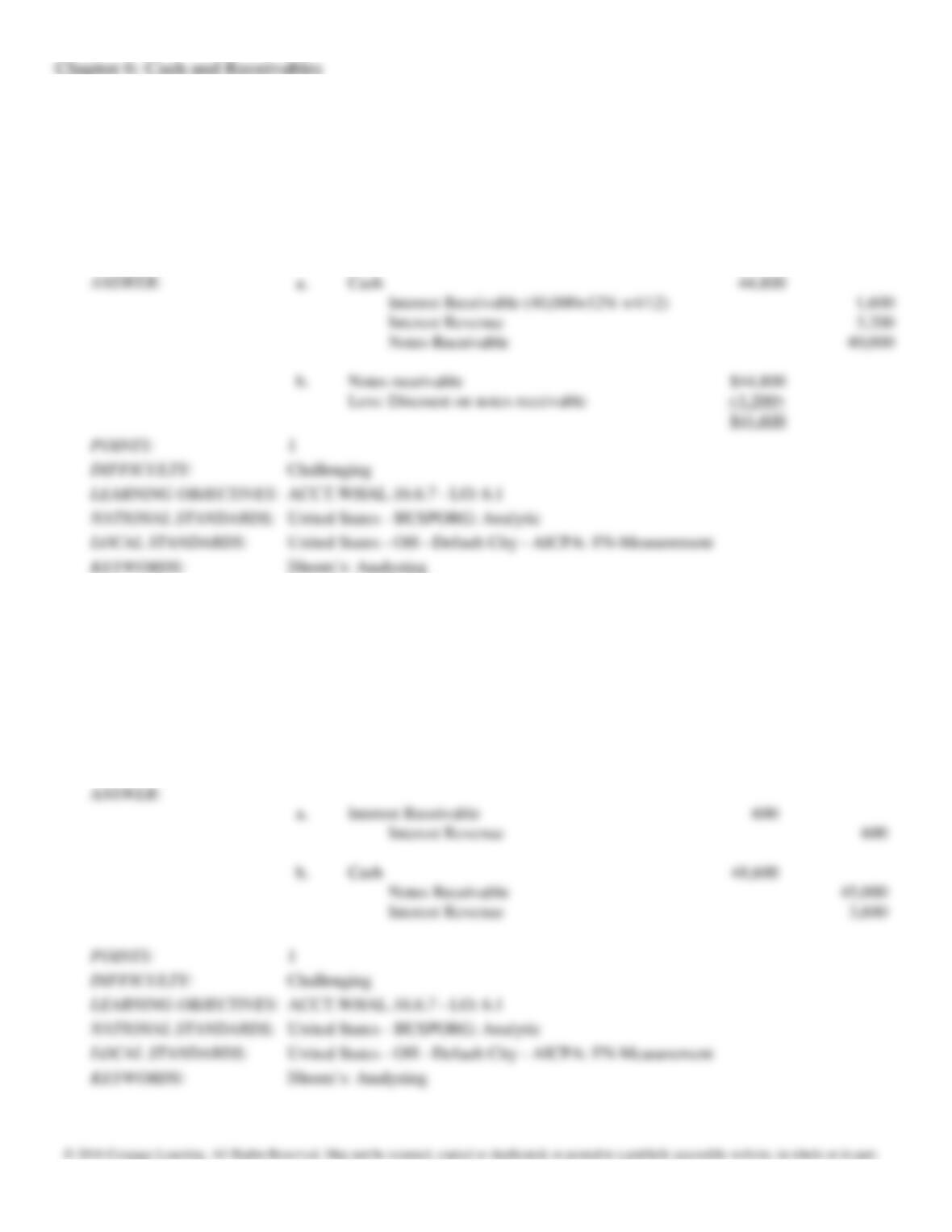
145. On September 1, 2013, Geco Co. sold $40,000 of goods and accepted a one-year, 12% note.
Required:
a.
If no reversing entries were made after December 31, 2013, and adjusting entries were
made, record the collection of the note on September 1, 2014.
b.
Assume instead that a noninterest-bearing note for $44,800 for the same goods was issued.
What balance sheet accounts and amounts would be disclosed on December 31, 2013?
a.
Cash
Interest Revenue
146. On November 1, 2014, Yellow Grove Co. sold $45,000 of goods and accepted a note bearing 8% interest. The note
was due in one year.
Required:
a.
Prepare the journal entry to accrue interest for December 31, 2014.
b.
Record the collection of the note on October 31, 2015, assuming the accrual entry above
was reversed on January 1, 2015
Interest Revenue
Notes Receivable
Challenging
United States – OH – Default City – AICPA: FN-Measurement
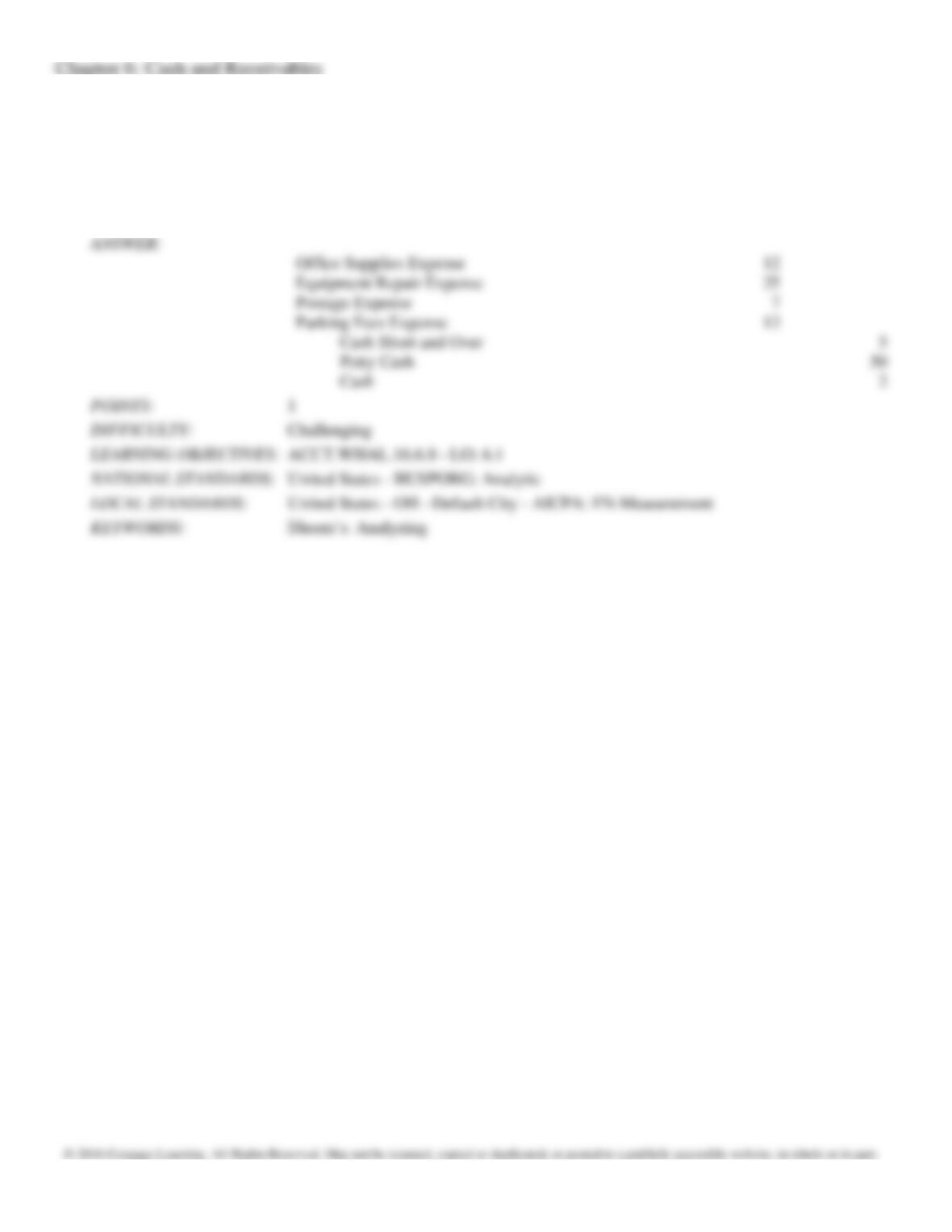
147. Moose, Inc. established a $250 petty cash fund three months ago. Today, April 21, the petty cash custodian has $198
in cash and receipts for the following: office supplies $12, equipment repairs $25, postage $7, and parking fees $13.
Required:
Prepare a compound journal entry to replenish the fund and reduce its size to $200.
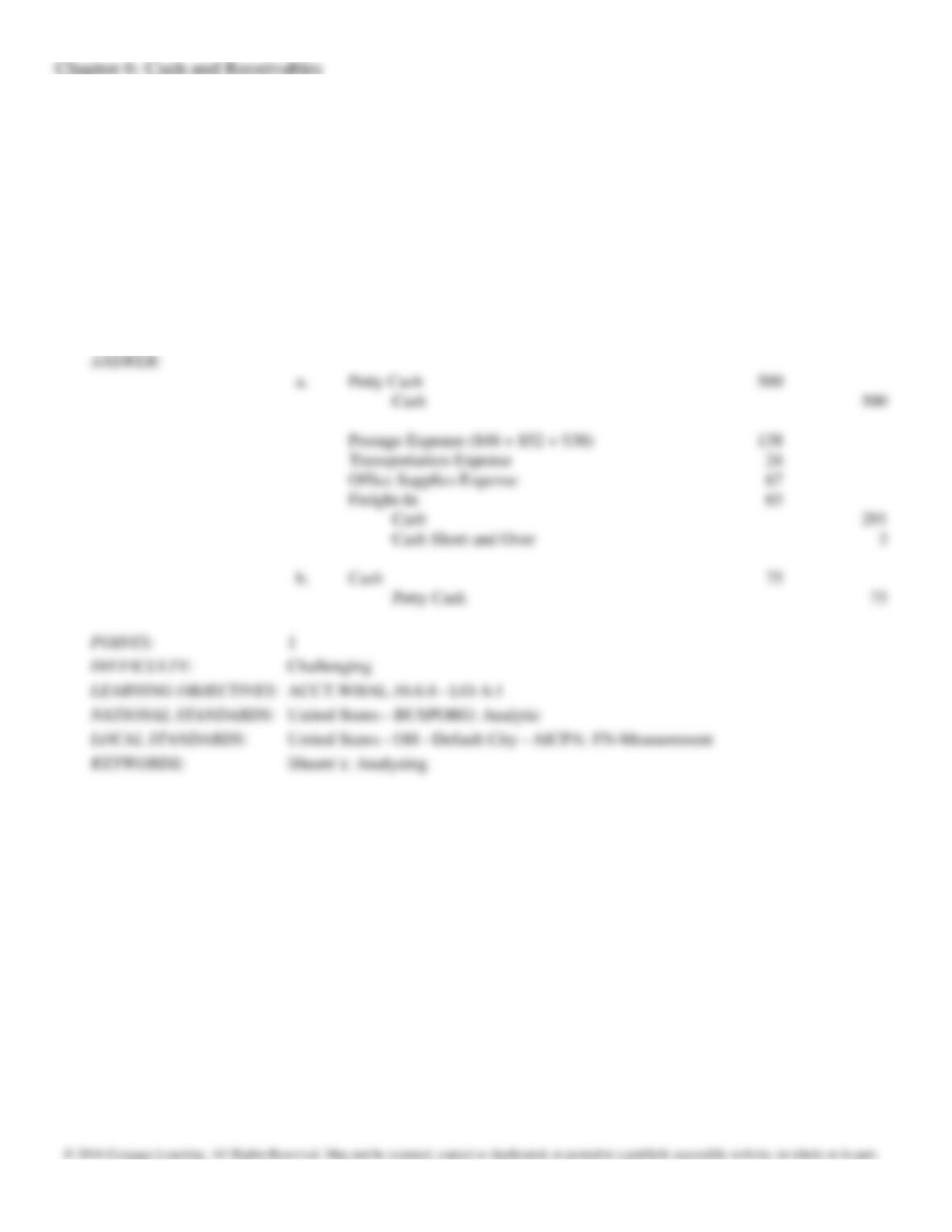
148. On January 1, 2014, Jonas Company established a petty cash fund of $500. By March 31, 2014, when the fund was
replenished, the following petty cash vouchers had been issued: January 26, postage, $48; February 16, postage, $52;
February 6, airport limousine fares, $24; January 18, office supplies, $67; March 8, postage, $38; March 4, local
express delivery charges on purchases, $65. There was $209 in coins and currency left in petty cash before
replenishment.
Required:
a.
Prepare the journal entries to record the transactions relating to Jonas Company’s petty cash
fund for the first quarter of 2014.
b.
On April 1, the size of the petty cash fund was decreased to $425. What journal entry (if
any) is necessary to record this action?
Challenging
ACCT.WHAL.16.6.8 – LO: 6.1
United States – BUSPORG: Analytic
United States – OH – Default City – AICPA: FN-Measurement
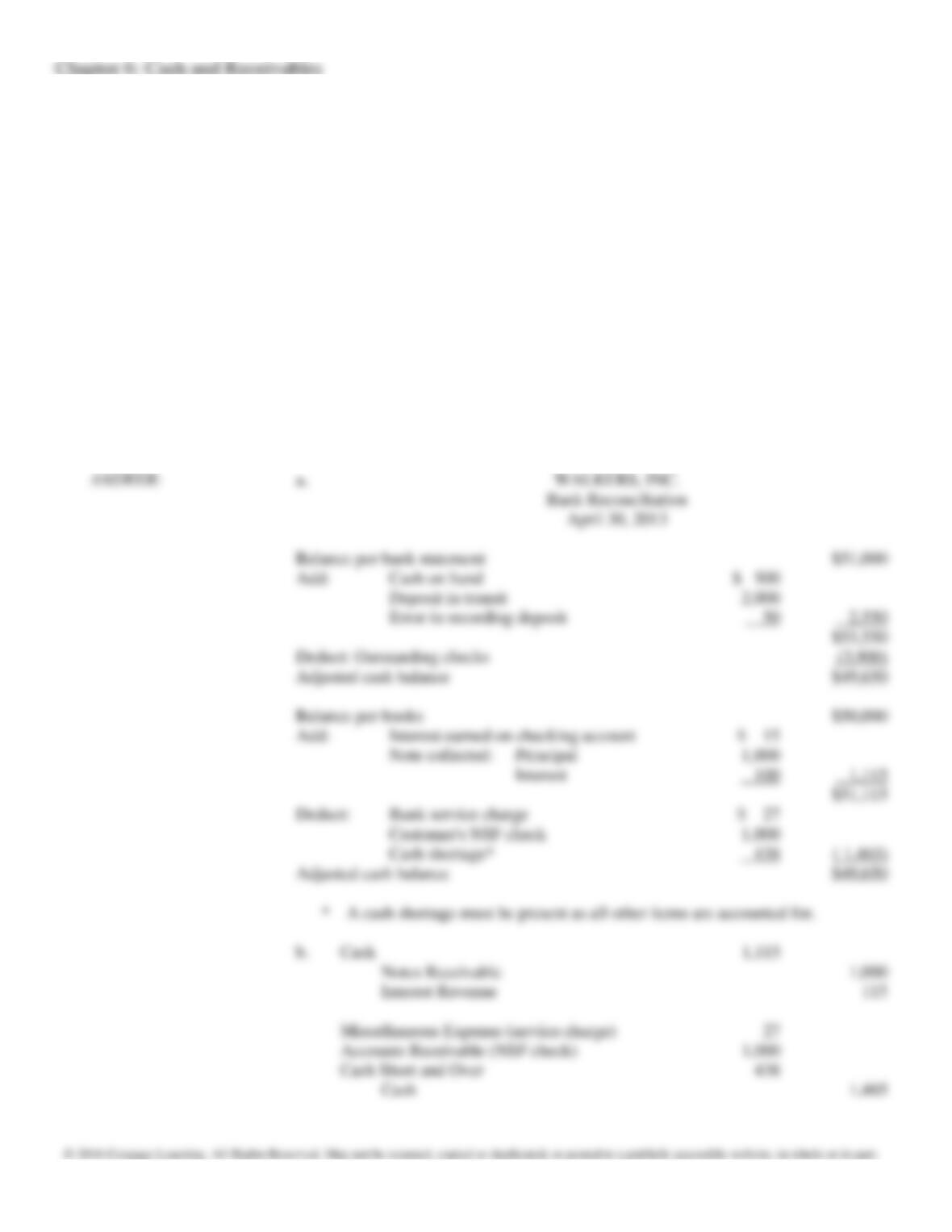
149. The accounting records and bank statement for Walkers, Inc. revealed the following information for April 30, 2013:
Bank statement balance, April 30, 2013
$51,000
Credit memo with bank statement for interest earned during April
on bank account
15
Debit memo with bank statement for April’s service charge
27
Deposits in transit on April 30
2,000
Cash on hand
500
NSF customer check on April 30
1,000
A $175 deposit made on April 3 was recorded incorrectly by the bank as
125
The bank collected a customer’s note receivable (including 10% interest)
1,100
Outstanding checks on April 30
3,900
Cash account balance, April 30, 2013
50,000
Required:
a.
Prepare a bank reconciliation using good format.
b.
Prepare any necessary adjusting journal entries for April 30, 2013.
115
1.
b
5.
2.
e
6.
3.
a
7.
4.
c
8.
150. You are in the process of preparing a bank reconciliation for Charter Boat Company as of May 31. Listed below is
information necessary to prepare the reconciliation.
Required:
In the spaces provided, place the appropriate letter to indicate whether each item of information should be
a.
deducted from the balance per bank statement
b.
added to the balance per bank statement
c.
deducted from the balance per company records
d.
added to the balance per company records
e.
omitted from the reconciliation
____
1.
Deposit in transit of $1,500 as of May 31.
____
2.
April service charge of $30 recorded by the company in May.
____
3.
Checks totaling $1,100 written in April that have not cleared the bank by May 31.
____
4.
Check of Tomi, Inc. for $780 deposited in May by Charter Boat Company and
returned by the bank with the NSF notation in May bank statement.
____
5.
Canceled check No. 205 written by Charter Boat Company for $200 to Mays, Inc.,
had been recorded on the company’s books as $2,000.
____
6.
Note receivable face value plus interest collected by the bank and deposited into
Carpenter’s account and not previously recorded by Charter Boat Company.
____
7.
Bank service charge of $35 for May.
____
8.
Check of Carpets, Inc. charged in error against Charter Boat’s account by the bank
during May and not corrected as of May 31.
1
Challenging
ACCT.WHAL.16.6.8 – LO: 6.1
United States – BUSPORG: Analytic
United States – OH – Default City – AICPA: FN-Measurement