Chapter 6: Process Costing
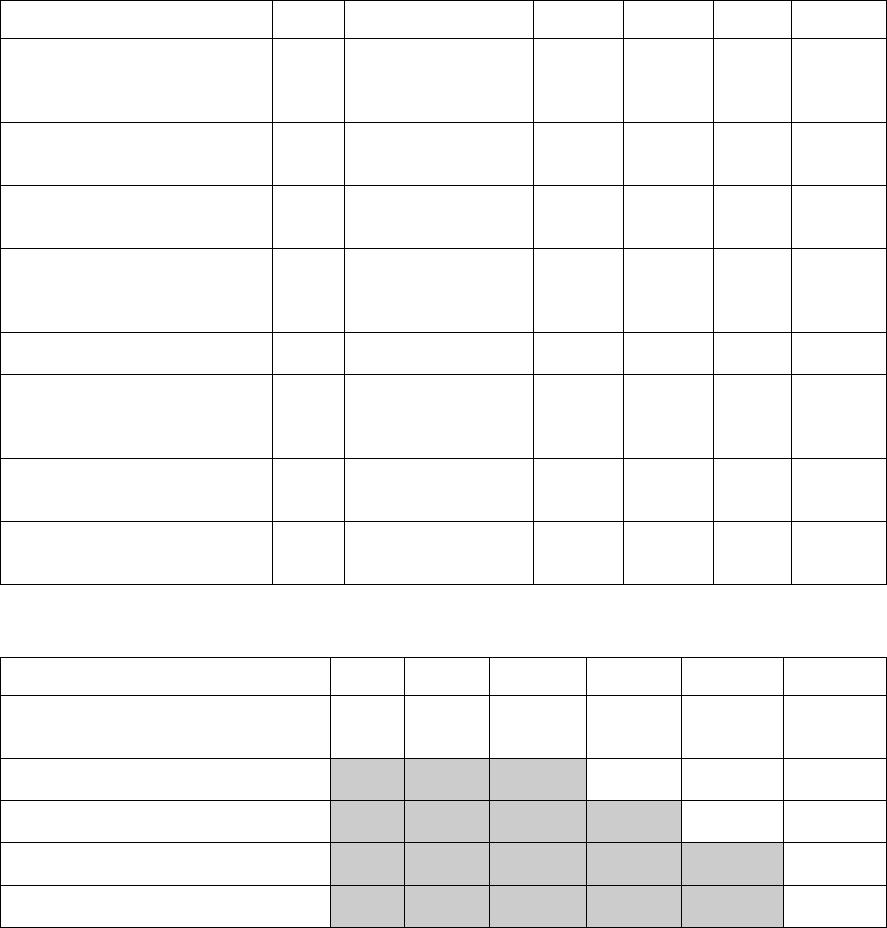
Learning Questions
True /
False
Multiple Choice
Matching
Exercises
Short
Answer
Problems
1. How are costs assigned to
mass-produced products?
1
1, 31, 32
S: 83
W: 103, 104, 111, 113,
115
3
1
2. What are equivalent units, and
how do they relate to the
production process?
2-4, 8
15, 33
S: 73–75
W: 102, 105-107
4
2
3. How is the weighted average
method used in process costing?
5-7
3, 4, 6, 11-14, 16, 36
S: 77, 79, 82, 84, 86
W: 109
2-8, 10
1
1
4. How is the FIFO method used
in process costing?
9-11
2, 5, 7-10, 17, 18, 34,
35, 37, 48, 49
S: 76, 78, 85
W: 114, 116-120
1, 4, 7, 9
1, 4
3, 4, 5
5. What alternative methods are
used for mass production?
13-15,
21, 22
43–47
1
4, 8
6. How is process costing
performed for multiple production
departments?
12, 16
19-30, 38
S: 80, 81, 87, 88, 99,
100
W: 112
3, 6, 9,
10
14
1
7. How are spoilage costs
handled in process costing?
17
39-42, 50-71
S: 89–98
W: 110
3
5-7, 9-
11, 14
3
8. What are the uses and
limitations of process cost
information?
20
S: 72
W: 101, 108
2, 4,
12, 13
1, 2, 5
S: Questions from the study guide
W: Questions from web quizzes on the student web site
Level of Complexity*
True /
False
Multiple
Choice
Matching
Exercises
Short
Answer
Problems
Foundation: Repeat or paraphrase
information; Reason to single correct
solution; Perform computations; etc.
All
All
All
All
1, 5, 6, 14
1, 3, 4, 5
Step 1: Identify the problem, relevant
information, and uncertainties
2, 3, 4, 10,
12, 13
1, 2, 3
Step 2: Explore interpretations and
connections
7, 8, 9, 11
1, 2
Step 3: Prioritize alternatives and
implement conclusions
3
Step 4: Envision and direct strategic
innovation
*Based on level in Steps for Better Thinking (Exhibit 1.10, textbook p. 16):
Note: Step 1, 2, 3, and 4 questions in this test bank are intentionally open-ended and subjective, giving students the
opportunity to demonstrate skills such as judgment, reasoning, identification of uncertainties, identification or analysis of
pros and cons, and so on. Therefore, student answers may not exactly match those shown in the solutions.

6-2 Cost Management
True / False
1. Conversion costs refer to the cost of direct labor and production overhead.
2. Equivalent units measure the resources used in partially completed units relative to the resources
needed to complete the units.
3. Equivalent units are calculated for work in process and finished goods inventory.
4. Conversion costs must be incurred uniformly throughout the production process to calculate
equivalent units.
5. When using the weighted average method to calculate cost per equivalent unit, the cost is calculated
as current period costs / equivalent units for total work.
6. In the weighted average method, costs from beginning work in process are averaged with costs
incurred during the current period and then allocated to units completed and ending work in process.
7. In the weighted average method, cost per equivalent unit is often calculated separately for materials
costs and conversion costs.
8. Managers can calculate costs per equivalent unit using the weighted average or the FIFO method.
9. In FIFO costing, the costs of units in beginning work in process are merged with current period costs
to calculate the cost per equivalent unit.
10. Managers can only use FIFO process costing if it is reflected in the physical flow of units.
11. In calculating the cost per equivalent unit using FIFO costing, the appropriate formula is current
period costs / equivalent units for work performed this period.
12. In a process costing system, direct materials are added during every production process.
13. Conversion costs may be separated into direct labor and overhead when it is relatively easy to track
direct labor and the use of labor occurs in a different pattern than the use of overhead resources.
14. Process costing is simplified when a company uses just-in-time inventory methods.
15. When an organization uses a long-term procurement contract, direct labor costs are normally stable
over long periods of time.
16. In a process costing system with multiple production departments, costs from the first department’s
ending work in process are transferred to the second department’s finished goods before going into
the second department’s work in process.
17. In a process costing system, normal spoilage is allocated to good units produced.
18. All spoilage in a process costing system is considered abnormal spoilage.
19. Spoilage costs from an unusual natural disaster would be allocated to good units produced in a
process costing system.
20. Process costing information is useful for measuring and monitoring production processes.
21. Standard cost equivalent units are calculated the same way as FIFO equivalent units.
22. When standard costs are used as benchmarks, they are compared to actual costs using either weighted
average or FIFO costs.

Chapter 6: Process Costing 6-3
Multiple Choice
1. Perry Company started 6,000 units during the month of March. 600 units were in the beginning work
in process inventory and 400 units in the ending work in process inventory. Units completed and
transferred out during March will be
a. 6,000
b. 6,400
c. 6,200
d. 5,400
Use the following information for the next 3 questions.
Salmon Manufacturing Company uses a process costing system. Direct materials are added at the beginning
of the process. During January, Department Q had a beginning inventory of 2,000 units, 25% complete for
conversion costs. During the month 14,000 units were started and there were 1,000 units in ending inventory,
60% complete for conversion costs.
2. Using FIFO process costing, the equivalent units for direct materials for the month were
a. 13,600
b. 14,000
c. 16,000
d. 15,600
3. Using weighted average process costing, the equivalent units for direct material for the month were
a. 13,600
b. 14,000
c. 16,000
d. 15,600
4. Using weighted average process costing, the equivalent units for conversion costs for the month were
a. 14,100
b. 14,000
c. 16,000
d. 15,600
Use the following information for the next 2 questions.
Gholson, Inc. employs a process costing system in which direct materials are added at the beginning of the
process. Direct material costs from the prior period for beginning work in process are $1,250. The current
period’s direct material costs total $31,500. The company began the period with 500 units, 70% complete,
started 10,500 units, and finished the period with 1,000 units, 40% complete.
5. Using a FIFO system, the direct material cost per equivalent unit is
a. $3.00
b. $2.98
c. $3.20
d. $2.55
6. Using the weighted average method, the direct material cost per equivalent unit for the period is
a. $3.00
b. $2.98
c. $3.20
d. $2.55
6-4 Cost Management
Use the following information for the next 8 questions.
Hendrix, Inc. employs a process costing system. Direct materials are added at the beginning of the process.
Here is information about July’s activities:
On July 1: Beginning inventories = 750 units, 60% complete
Direct materials cost = $5,925
Conversion costs = $4,095
During July: 15,000 units started
Direct materials added = $150,000
Conversion costs added = $83,520
On July 31: Ending inventories = 1,500 units, 40% complete
7. Using the FIFO method, the number of units started and completed in July was
a. 14,250
b. 15,000
c. 13,500
d. 15,750
8. Using the FIFO method, the number of equivalent units of conversion costs was
a. 14,400
b. 14,550
c. 14,850
d. 14,700
9. Using the FIFO method, the cost per equivalent unit for materials used during July was
a. $9.90
b. $9.80
c. $11.11
d. $10.00
10. Using the FIFO method, the cost of goods completed and transferred out during July was
a. $225,150
b. $225,060
c. $213,300
d. $213,000
11. Using the weighted average method, the number of equivalent units of material was
a. 15,750
b. 14,250
c. 15,000
d. 13,500
12. Using the weighted average method, the cost per equivalent unit for conversion costs was
a. $5.80
b. $5.90
c. $6.00
d. $6.10
13. Using the weighted average method, the cost of the goods completed and transferred out was
a. $225,150
b. $225,060
c. $213,300
d. $213,000
Chapter 6: Process Costing 6-5
14. Using the weighted average method, the cost of the ending work in process inventory for July was
a. $18,480
b. $18,540
c. $18,330
d. $18,390
15. On September 1, Kelita Company had 20,000 units in process, which were 30% completed. Materials
are added at the beginning of the process. During the month 160,000 units were started and 170,000
completed. Ending work in process was 50% complete. By what amount would the equivalent units
of materials differ if weighted average were used instead of FIFO?
a. 20,000 more
b. -0-
c. 6,000 more
d. 14,000 less
16. Assume that ending work in process is 8,000 units, 20% complete, and that 20,000 units were started
during the month. The beginning work in process was 75% complete. Materials are added at the
beginning of the process, and the cost of materials are added during the month was $61,500. Using
the weighted average method, materials are allocated at $4.00 per equivalent unit. The cost of
material included in the beginning work in process from last month was
a. $18,500
b. $20,000
c. $34,500
d. None of the above
Use the following information for the next 2 questions.
Assume there were 6,000 units in beginning work in process, 60% complete. 20,000 units were completed
during the month. Ending work in process is 40% complete, which is equivalent to 3,200 units for conversion
costs. Materials are added at the beginning of the process. The FIFO method is used.
17. The number of equivalent units of conversion costs is
a. 23,200
b. 17,680
c. 19,600
d. 21,280
18. The number of units started this month is
a. 20,000 units
b. 22,000 units
c. 28,000 units
d. 15,280 units
Use the following information for the next 10 questions.
Zuniga, Inc. uses a process costing system. During May, 1,200 units were transferred into Department 2 at a
cost of $38,040. Direct materials are added at the beginning of the process. Additionally:
On May 1: Beginning inventories = 250 units, 40% complete
Direct materials costs = $1,250
Conversion costs = $1,356
Transferred-in costs = $2,560
During May: Direct materials costs incurred = $6,000
Conversion costs incurred = $17,013
On May 31: Ending Inventories = 350 units, 20% complete
6-6 Cost Management
19. Using the FIFO method, units transferred in and completed were
a. 1,200
b. 1,100
c. 850
d. 1,450
20. Using the FIFO method, the equivalent units of material were
a. 1,200
b. 1,100
c. 850
d. 1,450
21. Using the FIFO method, the cost per equivalent unit for transferred-in units was
a. $28.00
b. $31.70
c. $26.23
d. $33.87
22. Using the FIFO method, the cost of the beginning work in process units transferred out was
a. $2,385
b. $15,476
c. $7,551
d. $6,756
23. Using the FIFO method, the cost of the ending work in process was:
a. $2,863
b. $7,113
c. $12,649
d. $13,958
24. Using the weighted average method, the number of equivalent units for conversion costs was
a. 1,070
b. 1,020
c. 1,170
d. 1,380
25. Using the weighted average method, the total transferred-in costs for the month were
a. $38,040
b. $40,600
c. $30,800
d. $33,360
26. Using the weighted average method, the cost per equivalent unit for materials was
a. $5.00
b. $4.14
c. $6.04
d. $4.44
27. Using the weighted average method, the cost of the units transferred out was
a. $53,570
b. $44,710
c. $52,261
d. $66,219

Chapter 6: Process Costing 6-7
28. Using the weighted average method, the cost of the ending work in process inventory was
a. $13,958
b. $13,944
c. $12,663
d. $12,649
Use the following information for the next 2 questions.
Assume a company’s beginning work in process consists of 20,000 units, 40% complete. Materials are added
at the beginning of the process. During the month, 90,000 units are transferred in. The ending work in
process consists of 10,000 units, 50% complete.
29. Using the weighted average method, the equivalent units of production for the month are
Transferred In Materials Conversion Costs
a. 110,000 100,000 65,000
b. 90,000 100,000 97,000
c. 110,000 110,000 105,000
d. 105,000 60,000 100,000
30. Using the FIFO method, the equivalent units of production are
Transferred In Materials Conversion Costs
a. 90,000 90,000 97,000
b. 110,000 100,000 105,000
c. 110,000 92,000 105,000
d. 90,000 100,000 105,000
31. A costing system that determines an average cost for all units of product in a particular time period is
a
a. Job costing system
b. Batch costing system
c. Process costing system
d. Direct costing system
32. Which type of company would most likely use a process costing system?
a. Chemical producer
b. Custom furniture maker
c. Printer
d. Ship builder
33. Equivalent whole units of production
a. Are the number of whole units produced in a batch
b. Include the number of units started and completed during the period
c. Compares the number of units that should have been completed with that actually produced
d. Consists of all units completed this period
34. Materials are added at the beginning of the process. The beginning work in process is 30% complete.
The total equivalent units for direct materials for the period using FIFO is equal to
a. The units in beginning work in process
b. The units started this period
c. The units started plus 70% of the units in beginning work in process
d. The units started and completed plus the beginning work in process
35. Production costs during the current period are kept separate from that of the previous period in the
a. FIFO method
b. Job costing method
c. Just-in-time method
d. Weighted average method
6-8 Cost Management
36. When using weighted average process costing
a. The costs attached to beginning work in process are kept separate from all other costs
b. The current period costs will be added to the beginning work in process costs.
c. Units in the ending inventory are not considered in making equivalent unit computations.
d. Completed units are transferred out in two separate blocks.
37. Because the weighted average and FIFO methods treat beginning inventory differently, if a firm has
beginning inventory in a process costing system and the FIFO method is used, it will
a. Always have a higher number of equivalent units of production for conversion costs than
weighted the average method
b. Always have a lower number of equivalent units of production for conversion costs than the
weighted average method
c. Always have a higher cost per equivalent unit than the weighted average method for materials
d. Always have a lower cost per equivalent unit than the weighted average method for conversion
costs
38. In a process costing system, transferred-in costs
a. Are computed for all production but not reported in the cost of process costing report
b. Usually do not include any indirect costs
c. Are the costs recorded in preceding departments
d. Are the costs of the completed units
Use the following information for the next 4 questions.
Tong, Inc. is a manufacturing company that uses a process costing system. All direct material is added at the
start of the process, and spoilage is discovered at the end. During the first period of operations 15,000 units
of material were placed into production at a cost of $20 each (ignore conversion costs for this process).
Ending work in process was 2,000 units, good units completed totaled 11,000 units, and normal spoilage is
15% of the units surviving inspection. Inspection takes place after the units are completed.
39. The unit cost assigned to the abnormal spoilage is
a. $-0-
b. $22.61
c. $20.00
d. $24.00
40. The unit cost assigned to the normal spoilage is
a. $-0-
b. $22.61
c. $20.00
d. $24.00
41. The unit cost assigned to the ending work in process inventory is
a. $-0-
b. $22.61
c. $20.00
d. $24.00
42. The unit cost assigned to the good units completed is
a. $-0-
b. $20.00
c. $24.00
d. $23.00

Chapter 6: Process Costing 6-9
43. Assume a company’s beginning work in process consists of 20,000 units, 40% complete. Materials
are added at the beginning of the process. During the month, 90,000 units are transferred in. The
ending work in process consists of 10,000 units, 50% complete. Under the standard cost method, the
equivalent units of production are
Transferred In Materials Conversion Costs
a. 90,000 90,000 97,000
b. 110,000 100,000 105,000
c. 110,000 92,000 105,000
d. 90,000 100,000 105,000
Use the following information for the next 2 questions.
Assume there were 6,000 units in beginning work in process, 60% complete. 20,000 units were completed
during the month. Ending work in process is 40% complete, which is equivalent to 3,200 units for conversion
costs. Materials are added at the beginning of the process. The standard cost method is used.
44. The number of equivalent units of conversion costs is
a. 23,200
b. 17,680
c. 19,600
d. 21,280
45. The number of units started this month is
a. 20,000 units
b. 22,000 units
c. 28,000 units
d. 15,280 units
More Difficult Multiple Choice
These multiple choice questions require more complex computations or present information differently than
in the textbook.
Use the following information for the next 2 questions.
Assume there were 6,000 units in beginning work in process, 60% complete. 20,000 units were completed
during the month. Ending work in process is 40% complete, which is equivalent to 3,200 units for conversion
costs. Materials are added at the beginning of the process. The standard cost method is used.
46. Assume that conversion costs are $122,100 for the month, and the equivalent unit cost for conversion
is $5.50. The ending work in process is 80% complete, and the beginning work in process consisted
of 2,000 units, 40% complete. The company completed 17,000 units. What is the number of whole
units in the ending work in process under the FIFO method?
a. 6,000 units
b. 6,500 units
c. 7,500 units
d. 5,200 units
47. Assume the total conversion costs allocated to the completed units was $91,650. What amount of
conversion costs are attached to the beginning work in process at the beginning of the month?
a. $1,850
b. $2,550
c. $4,400
d None of the above
6-10 Cost Management
Use the following information for the next 2 questions.
Xeno, Inc. operates a process costing system and uses the FIFO method. Beginning work in process consists
of 1,000 units, 30% complete. Ending work in process is 15% complete, and direct materials are added at the
20% point. The equivalent units of production for materials are 14,000 and for conversion costs are 18,000.
48. The number of units in ending work in process was
a. 37,000
b. 14,000
c. 18,000
d. 22,000
49. The number of units started this month was
a. 15,000
b. 18,000
c. 36,000
d. 37,000
Use the following information for the next 6 questions.
Miramar, Inc. uses a weighted-average process costing system which recognizes normal spoilage as 5% of
good output. During the current period, 14,000 units were started and 10,000 units completed. Materials are
added at the beginning of the process, conversion costs occur uniformly, and the inspection point is at the
70% point. Beginning work in process was 6,000 units, 40% complete, and ending work in process 9,000
units, 80% complete. The cost per equivalent unit for material was $1.00 and for conversion costs $3.00.
50. The number of units in abnormal spoilage was
a. 500
b. 50
c. –0-
d. 550
51. The number of equivalent units of conversion costs was
a. 17,200
b. 19,700
c. 20,000
d. 17,900
52. The cost of abnormal spoilage was
a. $200
b. $1,550
c. $155
d. $2,000
53. The cost of goods completed was
a. $41,550
b. $40,000
c. $40,816
d. $41,053
54. The cost of ending work in process was
a. $31,995
b. $30,600
c. $31,334
d. $31,547
Chapter 6: Process Costing 6-11
55. The total costs in work in process during the period were
a. $31,995
b. $70,600
c. $73,700
d. Cannot be determined
Use the following information for the next 5 questions.
Macey Company uses a weighted-average process costing system. Beginning inventory consists of 6,000
units, 40% complete. Units started are 14,000, completed are 10,000, and ending inventories are 9,000 units,
70% complete. Normal spoilage is 5% of the units inspected. Direct material is added at the 75% point and
spoilage inspection occurs at the 80% point. The cost per equivalent unit for materials was $1.00 and $3.00
for conversion costs.
56. The number of equivalent units of material was
a. 20,000
b. 18,000
c. 18,200
d. 11,000
57. The loss from abnormal spoilage was
a. $1,530
b. $1,800
c. $1,440
d. $1,080
58. The cost of the units completed was
a. $40,000
b. $42,200
c. $41,760
d. $41,870
59. The cost of the ending work in process was
a. $30,600
b. $18,900
c. $28,800
d. $36,000
60. Assume actual spoilage was 500 units and ending work in process was 9,500 units. The equivalent
units of conversion costs would be
a. 17,130
b. 17,150
c. 17,050
d. 17,200
Use the following information for the next 4 questions.
Beginning work in process consists of 7,000 units, 55% complete. 50,000 units were started and ending work
in process is 5,000 units, 25% complete. Normal spoilage is equal to 10% of the units inspected. The
inspection point occurs at the 20% point and 7,000 units were rejected. Direct materials are added at the 50%
point, direct labor at 30% and overhead is applied uniformly. The costs per equivalent unit are: direct material
$1.00; direct labor $1.50; overhead $2.00.
61. The equivalent units of labor are
a. 48,000
b. 45,000
c. 46,000
d. 46,500
6-12 Cost Management
62. The cost of abnormal spoilage is
a. $800
b. $1,400
c. $1,800
d. $4,000
63. The cost of the ending work in process is
a. $2,500
b. $2,850
c. $2,700
d. $4,000
64. The number of units completed is
a. 45,000
b. 47,000
c. 50,000
d. 57,000
Use the following information for the next 4 questions.
Kelly, Inc. uses a weighted-average process costing system that calculates normal rework as 2% of the units
passing inspection. The inspection point is at the 75% point and units failing inspection are returned to the
40% point. During the current period, 50,000 units were started; 62,000 units inspected; and 52,000 units
completed. Direct material is added at the 50% point and conversion costs occur uniformly. Beginning work
in process was 10,000 units, 55% complete and ending work in process was 8,000 units, 85% complete. Costs
per equivalent unit for material were $1.00 and $3.00 for conversion costs.
65. The number of units reworked was
a. 3,000
b. 2,000
c. 8,000
d. 10,000
66. The loss from abnormal rework was
a. $3,200
b. $1,640
c. $1,120
d. $4,018
67. The cost of the goods completed was
a. $210,132
b. $208,000
c. $210,460
d. $208,328
68. The cost of the ending work in process was
a. $28,400
b. $30,532
c. $32,328
d. $28,728
69. Normal spoilage is
a. Considered to be a cost of the good units produced
b. Recorded to a special loss account
c. Treated as a current period expense
d. Allocated to beginning work in process when it comes after the inspection point

Chapter 6: Process Costing 6-13
70. Normal spoilage can be defined as
a. Controllable spoilage
b. Spoilage that results from inefficient operations
c. A percentage of the units surviving inspection
d. A loss in the period in which it occurred
71. Abnormal spoilage is
a. The units that exceed the predetermined normal spoilage
b. A cost of production allocated to the units surviving inspection
c. Uncontrollable spoilage
d. Spoilage attributable to efficient operations
Multiple Choice from Study Guide
s72. Process costing is most likely to be used by which of the following companies?
a. Construction company that builds custom homes
b. Shipyard
c. Manufacturer of metal folding chairs
d. Producer of special order furniture
s73. Equivalent units of production are the
a. Number of units a company produced during a specified time period
b. Number of units a company worked on during a specified time period
c. Same as the number of units started and completed during a specified time period
d. Number of whole units a company could have produced during a specified time period if it would
have produced only whole units
s74. The difference between the weighted average and FIFO methods of computing equivalent units of
production is the manner in which the
a. Equivalent units for beginning inventory is computed
b. Number of units started and completed is computed
c. Equivalent units for ending inventory is computed
d. Number of units completed and transferred out is computed
s75. Which of the following statements about the weighted average and FIFO methods is true?
a. Equivalent units of production cannot be the same under the two methods.
b. Equivalent units of production under FIFO are always greater than or equal to equivalent units of
production under the weighted average method.
c. Equivalent units of production under FIFO will equal equivalent units of production under the
weighted average method only when there are no units in ending inventory.
d. Equivalent units of production for ending inventory units are the same under the two methods.
s76. Suppose that a company adds material at the beginning of production and that conversion costs are
incurred evenly throughout production. In May, the beginning work in process inventory was 20%
complete and the ending work in process inventory was 30% complete. Under the FIFO method, the
number of equivalent units of production for direct materials for May is equal to the number of units
a. Started in May
b. Started and completed in May plus 30% times the number of units in ending inventory for May
c. Started and completed in May plus 20% times the number of units in beginning inventory plus
30% times the number of units in ending inventory for May
d. Started and completed in May plus 80% times the number of units in beginning inventory plus
30% times the number of units in ending inventory for May
6-14 Cost Management
s77. Suppose that a company adds material at the beginning of production and that conversion costs are
incurred evenly throughout production. In May, the beginning work in process inventory was 20%
complete and the ending work in process inventory was 30% complete. Under the weighted average
method, the number of equivalent units of production for direct materials for May is equal to the
number of units
a. Started in May plus the number of units in beginning inventory for May
b. Started and completed in May plus 30% times the number of units in ending inventory for May
c. Started and completed in May plus 20% times the number of units in beginning inventory plus
30% times the number of units in ending inventory for May
d. Started and completed in May plus 80% times the number of units in beginning inventory plus
30% times the number of units in ending inventory for May
s78. Suppose that a company adds material at the beginning of production and that conversion costs are
incurred evenly throughout production. In May, the beginning work in process inventory was 20%
complete and the ending work in process inventory was 30% complete. Under the FIFO method, the
number of equivalent units of production for conversion costs for May is equal to the number of units
a. Started in May
b. Started and completed in May plus 30% times the number of units in ending inventory for May
c. Started and completed in May plus 20% times the number of units in beginning inventory plus
30% times the number of units in ending inventory for May
d. Started and completed in May plus 80% times the number of units in beginning inventory plus
30% times the number of units in ending inventory for May
s79. Suppose that a company adds material at the beginning of production and that conversion costs are
incurred evenly throughout production. In May, the beginning work in process inventory was 20%
complete and the ending work in process inventory was 30% complete. Under the weighted average
method, the number of equivalent units of production for conversion costs for May is equal to the
number of units
a. Completed in May plus 30% times the number of units in ending inventory for May
b. Started and completed in May plus 30% times the number of units in ending inventory for May
c. Started and completed in May plus 20% times the number of units in beginning inventory plus
30% times the number of units in ending inventory for May
d. Started and completed in May plus 80% times the number of units in beginning inventory plus
30% times the number of units in ending inventory for May
s80. When will the weighted average and FIFO methods compute the same dollar amount for the costs to
be transferred to the next department?
a. When there are no units in ending inventory
b. When there are no units in beginning inventory
c. When the number of units in beginning inventory equals the number of units in ending inventory
d. When beginning and ending inventory were at the same stage of completion
s81. Which of the following is the correct journal entry to transfer costs out of the Finishing Department,
which is the last processing department?
a. Debit Work in Process Inventory – Finishing Department and credit Finished Goods Inventory
b. Debit Cost of Goods Sold and credit Finished Goods Inventory
c. Debit Cost of Goods Sold and credit Work in Process Inventory – Finishing Department
d. Debit Finished Goods Inventory and credit Work in Process Inventory – Finishing Department
s82. Under the weighted average method of process costing, the costs attached to the units in beginning
work in process inventory are
a. Not included in the computation of cost per equivalent unit
b. Handled the same way as they are in FIFO process costing
c. Included with the current costs when cost per equivalent unit is calculated
d. Included with the costs attached to the units in ending work in process inventory

Chapter 6: Process Costing 6-15
s83. Which of the following statements is false?
a. Under the FIFO method, beginning inventory costs are kept separate from the current period’s
costs
b. Under the weighted average method, beginning inventory costs are combined with the current
period’s costs
c. The weighted average and FIFO methods will assign the same amount of costs to the ending
inventory units under a standard costing system
d. The weighted average method is superior to the FIFO method for the purposes of controlling
costs
s84. Sundae’s Sundries uses the weighted average method of process costing. The company’s ending work
in process inventory consisted of 8,000 units that were 80% complete. Materials are added at the
beginning of processing. The direct materials cost per equivalent unit was $3.20, and the conversion
cost per equivalent unit was $1.80. What is the amount of cost Sundae would assign to ending work
in process inventory?
a. $28,480
b. $37,120
c. $32,000
d. $40,000
s85. Mikey’s Mugs uses the FIFO method of process costing. The company’s ending work in process
inventory consisted of 12,000 units that were 40% complete and had incurred 80% of the materials
costs. The direct materials cost per equivalent unit was $2.40, and the conversion cost per equivalent
unit was $3.30. What is the amount of cost Mikey would assign to ending work in process inventory?
a. $27,360
b. $38,880
c. $46,800
d. $68,400
s86. Schachte Corporation uses the weighted average method of process costing. The company had 7,000
units in ending work in process inventory, and it started 70,000 units this month. There were 12,000
units in beginning work in process inventory. If the total processing cost per equivalent unit is $3,
what is the amount of cost transferred out of work in process this month?
a. $189,000
b. $210,000
c. $225,000
d. $231,000
s87. Which of the following statements is true?
a. Transferred-in costs are the materials costs from the prior department.
b. Transferred-in costs are the costs from all prior departments.
c. Transferred-in costs are the costs from the prior period.
d. All transferred-in costs will be assigned to the units completed and transferred out during the
period.
s88. Maka Manufacturing uses the weighted average method of process costing. You are given the
following information for Department 2 for February:
Units Percent Complete
Beginning work in process inventory 2,200 30%
Transferred in from the prior
department during February 70,000 –
Ending work in process inventory 4,500 20%
Suppose the conversion cost per equivalent unit is $2.10. How much conversion costs were
transferred to the next department during February?
6-16 Cost Management
a. $137,550
b. $142,170
c. $147,000
d. $151,620
s89. Normal spoilage is
a. Unacceptable units of production that occur because of an unexpected event
b. Spoilage that exceeds expectations
c. Unacceptable units of production that occur because of poor quality inputs
d. Unacceptable units of production that are considered part of normal manufacturing operations
s90. Abnormal spoilage is
a. Debited to Cost of Goods Sold
b. Spoilage that exceeds expectations
c. Considered a product cost
d. Unacceptable units of production that are considered part of normal manufacturing operations
s91. The costs of normal spoilage
a. Are debited to a loss account
b. Are included with the costs of the good units transferred out
c. Decrease the per unit processing cost for the good units transferred out
d. Do not affect the per unit processing cost for the good units transferred out
s92. The costs of abnormal spoilage
a. Are debited to a Finished Goods Inventory
b. Are included with the costs of the good units transferred out
c. Decrease the per unit processing cost for the good units transferred out
d. Do not affect the per unit processing cost for the good units transferred out
s93. You are given the following information for Joseph Manufacturing:
Beginning inventory units 1,000
Ending inventory units 5,000
Units started 24,000
Good units completed 17,000
Suppose that a 4% defect rate (based on the number of good units completed) is considered normal.
Compute the number of units of normal spoilage and the number of units of abnormal spoilage,
respectively, assuming that the inspection for spoiled units occurs at the end of processing.
a. 960 and 2,040
b. 800 and 2,200
c. 1,160and 1,840
d. 680 and 2,320
Use the following information for the next 5 questions.
You are given the following information for the SJK Company for January:
Beginning inventory units 2,000
Ending inventory units 1,000
Units started 28,000
Good units completed 27,000
The total processing cost per equivalent unit was $15 in January. SJK considers spoilage equal to 5% of the
good units transferred out to finished goods to be normal. SJK uses the weighted average method of process
costing for its sole production department, and inspection for spoiled units occurs at the end of processing.
Chapter 6: Process Costing 6-17
s94. The costs attached to normal spoilage total
a. $35,250
b. $30,000
c. $20,250
d. $9,750
s95. The costs attached to abnormal spoilage total
a. $35,250
b. $30,000
c. $20,250
d. $9,750
s96. The costs attached to good units completed and transferred out total
a. $375,000
b. $405,000
c. $425,250
d. $435,000
s97. The per unit cost of the good units transferred out equals
a. $13.89
b. $15.00
c. $15.75
d. $16.11
s98. The entry to transfer costs out of work in process and into finished goods and a loss from abnormal
spoilage account includes a credit to Work in Process Inventory for
a. $384,750
b. $414,750
c. $425,250
d. $435,000
s99. In April, the beginning work in process inventory for Department 2 was 40% complete and the ending
work in process inventory was 90% complete. Under the FIFO method, the number of equivalent
units of production for transferred-in costs for April is equal to the number of units
a. Started and completed in April plus 90% times the number of units in ending inventory for April
b. Started and completed in April plus 40% times the number of units in beginning inventory plus
90% times the number of units in ending inventory for April
c. Started and completed in April plus 40% times the number of units in beginning inventory plus
90% times the number of units in ending inventory for April
d. Started in April
s100. In April, the beginning work in process inventory for Department 2 was 40% complete and the ending
work in process inventory was 90% complete. Under the weighted average method, the number of
equivalent units of production for transferred-in costs for April is equal to the number of units
a. Started and completed in April plus 90% times the number of units in ending inventory for April
b. Started and completed in April plus 40% times the number of units in beginning inventory plus
90% times the number of units in ending inventory for April
c. Started and completed in April plus 40% times the number of units in beginning inventory plus
90% times the number of units in ending inventory for April
d. Started in April plus the number of units in beginning inventory for April

6-18 Cost Management
Multiple Choice from Web Quizzes (Available on Student Web Site)
w101. Process costing is used to account for costs in
a. Custom manufacturing
b. Services such as health care
c. Mass production
d. None of the above
w102. Equivalent units reflect
a. All of the units produced in a period
b. The amount of work that could have been completed if all effort had gone to complete whole
units instead of partially completed units
c. Only the units that are partially complete at the end of the period
d. Only the units that are partially complete at the beginning of the period
w103. Direct materials are allocated
I. Very often at the beginning of the manufacturing process
II. Uniformly throughout the manufacturing process
III. At a different rate than conversion costs and, therefore, need to be valued separately for
ending inventories
a. I only
b. I and III only
c. I, II, and III
d. I and II only
w104. Conversion costs
a. Are not used in process costing
b. Are often incurred unevenly, but are allocated evenly throughout the production process
c. Include the cost of direct materials
d. Are usually incurred and allocated evenly throughout the production process
w105. Direct materials are added at the beginning of the process. There are 10,000 units in ending WIP
inventory that are 75% complete with regard to conversion costs. The equivalent units in ending WIP
are:
Direct Materials Conversion Costs
a. 10,000 7,500
b. 7,500 7,500
c. 10,000 10,000
d. 7,500 10,000
w106. Under mass production, at the end of the period
a. The production line is stopped so that all units are completed to reduce accounting problems
b. Some units will be partially complete, and conversion costs and direct material costs need to be
assigned to them
c. The books cannot be closed because the production never stops
d. All of the units that are not complete are counted as 100% complete to reduce bookkeeping
problems
w107. Direct materials are added at the beginning of the process. This period began with 5,000 units in
beginning inventory that are 25% complete. What are the equivalent units for beginning work in
process under the FIFO method?
Direct Materials Conversion Costs
a. 5,000 1,250
b. 5,000 3,750
c. 0 1,250
d. 0 3,750
Chapter 6: Process Costing 6-19
w108. Process costing
I. Is used for assigning costs in mass production
II. Can only be used in manufacturing
III. Can be used in some service industries
a. I only
b. I and II only
c. I and III only
d. I, II, and III
w109. The weighted average method
a. Considers only this period’s costs and work
b. Includes beginning WIP costs in the equivalent unit cost calculations
c. Uses standard costs to allocate cost to units
d. Excludes ending WIP units and costs
w110. Normal spoilage includes
a. Spoilage that arises because operations are out of control
b. Spoilage that arises as a regular part of ordinary production
c. Spoilage that arises when external events cause a lot of units to be spoiled
d. Reworked units
w111. Once the physical units have been summarized
a. Costs are allocated to all of the work done this period
b. The cost report is complete
c. Equivalent units need to be summarized
d. Costs are allocated only to ending WIP inventories
w112. The cost of transferred-in units is accounted for by
a. Ignoring it
b. Adding it to beginning WIP and work performed this period as an additional cost with a separate
category
c. Adding it to direct materials and allocating it with the direct materials
d. Adding it to conversion costs and allocating it with conversion costs
w113. Once equivalent unit costs have been developed
a. Information is gathered about production
b. Costs are allocated to all units transferred out and in ending WIP
c. The equivalent units and equivalent unit costs are calculated
d. The physical units and total costs are summarized
w114. The following method(s) best reflects current period costs
I. Weighted average method
II. FIFO method
III. Standard cost method
a. I only
b. II only
c. I and III only
d. II and III only
w115. Beginning WIP units were 8,000, and 40,000 units were transferred out this period. Ending WIP is
4,000 units. What is the number of units started and completed this period?
a. 48,000
b. 40,000
c. 32,000
d. 28,000
6-20 Cost Management
Use the following information for the next 5 questions.
(CMA) The accountant for Whirly Manufacturing Inc. gathered the following information for the month of
November. Beginning WIP 16,000 units
Started in production 100,000
Completed production 92,000
Ending WIP 24,000
The beginning inventory was 60% complete for materials and 20% complete for conversion costs. The
ending inventory was 90% complete for materials and 40% complete for conversion costs.
Costs pertaining to the month of November are as follows:
Beginning inventory costs are:
Materials $54,560
Direct labor 20,320
Factory overhead 15,240
Costs incurred during November include:
Materials $468,000
Direct labor 182,880
Factory overhead 391,160
w116. Using the first-in, first-out (FIFO) method, the equivalent units of production for materials are
a. 97,600 units
b. 104,000 units
c. 107,200 units
d. 113,600 units
w117. Using the FIFO method, the equivalent units of production for conversion costs are
a. 85,600 units
b. 95,200 units
c. 98,400 units
d. 101,600 units
w118. Using the FIFO method, the equivalent unit cost of materials for November is
a. $4.12
b. $4.50
c. $4.60
d. $4.80
w119. Using the FIFO method, the equivalent unit conversion cost for November is
a. $5.65
b. $5.83
c. $6.00
d. $6.20
w120. Using the FIFO method, the total cost of units in the ending work in process inventory on November
30 is
a. $153,168
b. $154,800
c. $155,328
d. $156,960

Chapter 6: Process Costing 6-21
Matching
1. Several terms related to alternative systems for mass production are listed below on the right, and
definitions are listed on the left. Match each term with the definition that best describes it. Each
numbered item has only one correct answer. Each lettered item may be used once, more than once, or
not at all.
____ 1. Units in each batch are identical and
each batch goes through the same
production process
____ 2. Track costs using work orders for
batches of products
____ 3. Simplifies process costing because
inventories are minimized
____ 4. Provide a comparison benchmark for
actual costs
____ 5. Production costs managers expect to
incur under operating plan
assumptions
____ 6. Process costing is used to the point
of customization
____ 7. Inventory units are received and
delivered just as needed, so there is
very little beginning or ending
inventory
____ 8. Direct costs are traced to each job as
the job is customized
____ 9. Can lead to long-term price stability
for direct materials
____ 10. Allocated to units in a manner
similar to FIFO process costing
A. Hybrid costing
B. Just In Time
C. Operation costing
D. Procurement contracts
E. Standard costs
F. None of the above
Exercises
1. Following are production data for a process costing system.
Beginning work in process, 30% complete 12,000 units
Started 90,000 units
Ending work in process, 70% complete 8,000 units
Costs: Beginning work in process:
Direct Materials $ 28,800
Conversion costs 5,220
Materials used during the period 216,000
Conversion costs incurred during the period 139,200
a. Using the FIFO basis, prepare a process costing report.
b. Write out the journal entries for the costs incurred and the work performed this period under the
FIFO method.
6-22 Cost Management
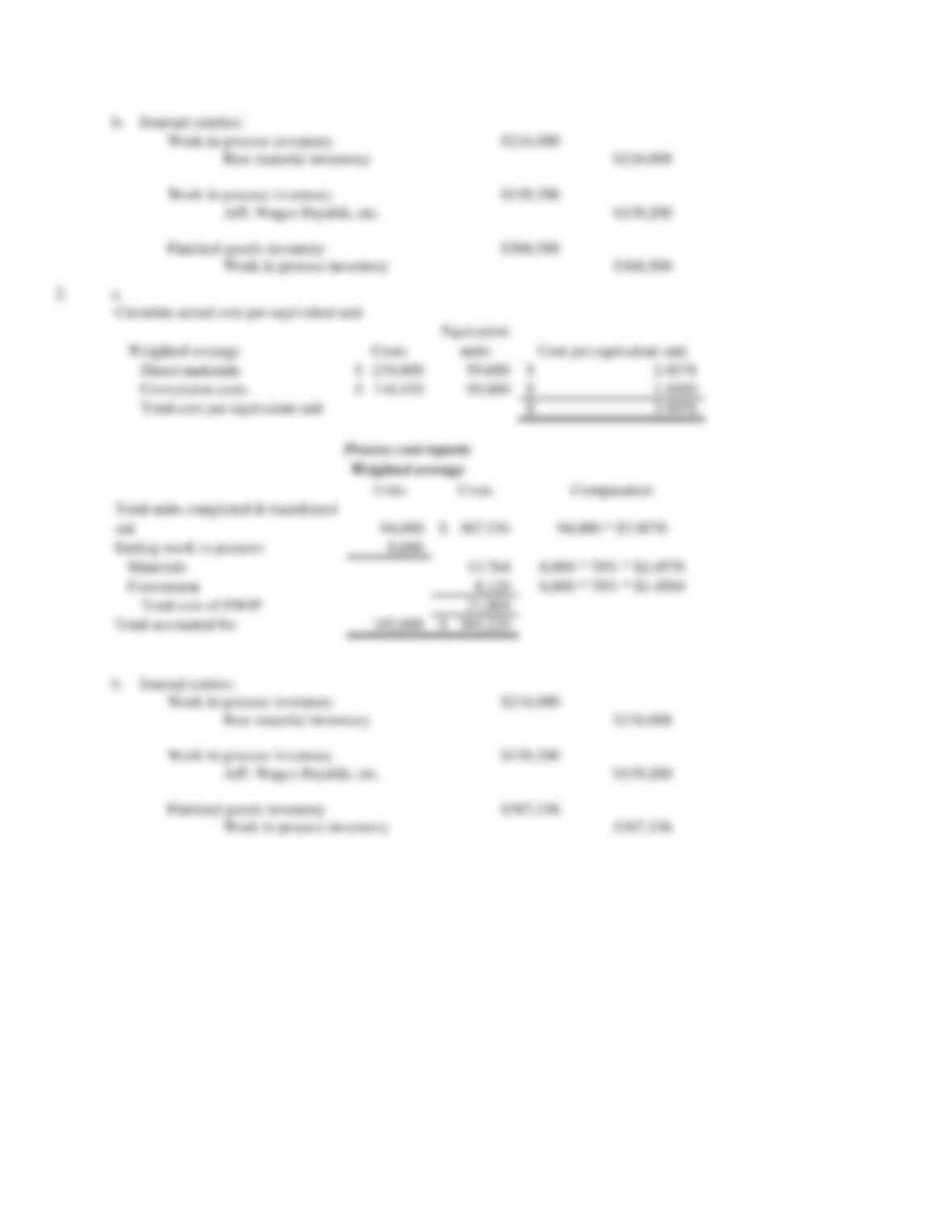
2. Following are production data for a process costing system.
Beginning work in process, 30% complete 12,000 units
Started 90,000 units
Ending work in process, 70% complete 8,000 units
Costs: Beginning work in process:
Direct Materials $ 28,800
Conversion costs 5,220
Materials used during the period 216,000
Conversion costs incurred during the period 139,200
a. Using the weighted average, prepare a process costing report.
b. Write out the journal entries for the costs incurred and the work performed this period under the
weighted average method.
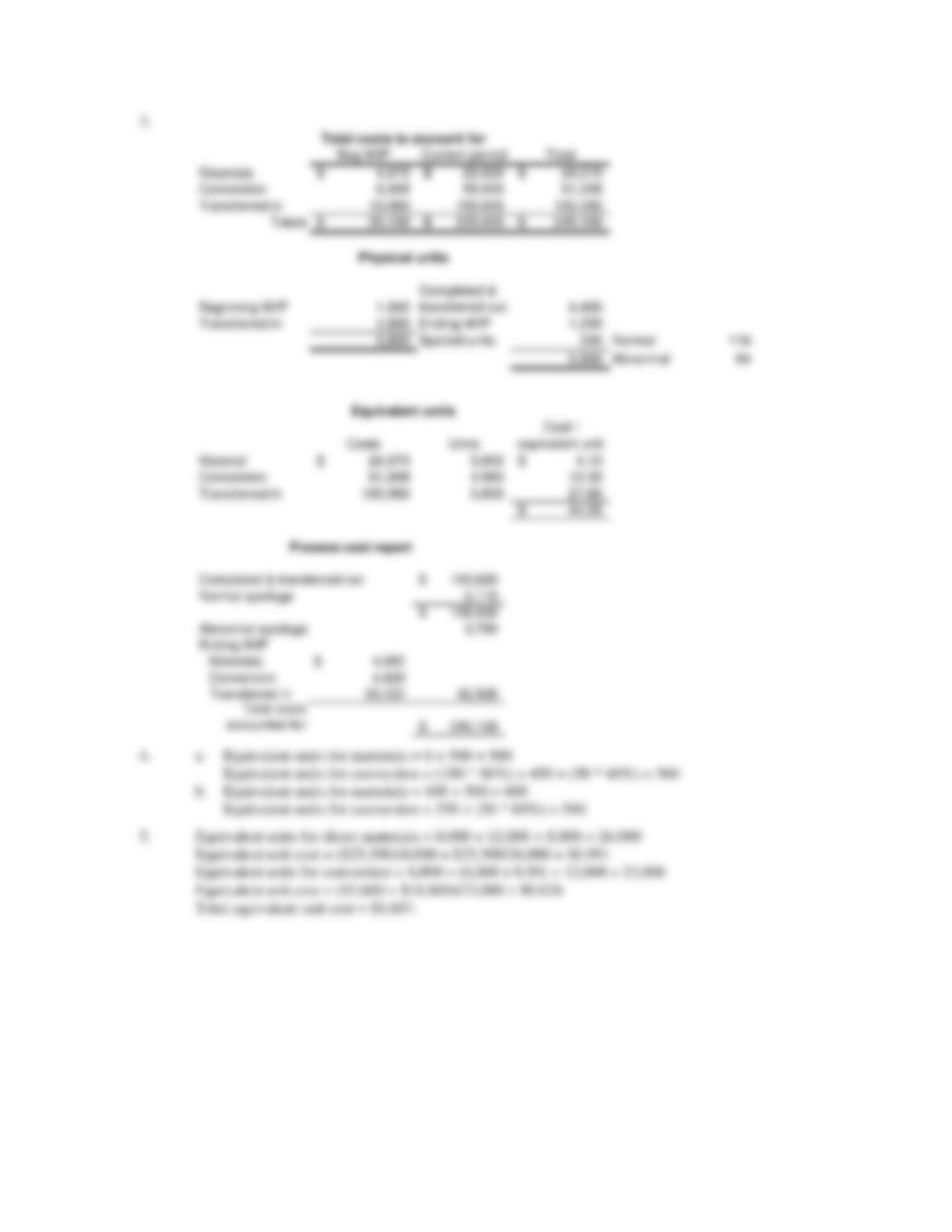
3. Mojdehi Manufacturing Co. uses a weighted average process costing system. During the current
period 4,800 units were transferred in (cost $150,000) to Department Q. In Department Q materials
were added costing $20,000 and conversion costs of $55,000 were incurred. A total of 4,400 good
units were transferred to finished goods. Normal spoilage is 2% of the units inspected, and the
inspection occurs at the end of the process. Direct materials are added at the beginning of the
process. Additionally:
Beginning WIP: 1,000 units, 40% complete
Direct materials costs = $4,070
Conversion costs = $6,008
Transferred-in costs = $10,080
Ending WIP: 1,200 units, 30% complete
Prepare a complete process costing report for the current period.
4. At the beginning of August 20×1, CHN Corporation had 100 units in beginning work in process,
which were 100% complete with respect to materials and 20% complete with respect to conversion.
CHN started 500 units during August. Ending work in process consisted of 50 units, which were
100% complete with respect to materials and 60% complete with respect to conversion.
a. Calculate CHN’s equivalent units for August using the FIFO method.
b. Calculate CHN’s equivalent units for August using the weighted average method.
5. Felix and Sons produce a small plastic toy called the Monster Car. Materials are added at the
beginning of the process in the plastic forming process. Conversion was 75% complete for the 8,000
units in work in process on February 1 and 50% complete for the 6,000 units in work in process on
February 29. During February 12,000 Monster Cars were started and completed with respect to the
forming department and transferred to the next department. There was no spoilage over the period.
Here is an analysis of the costs for the period:
Direct Materials Conversion Costs
Work in process, July 1 $ 9,900 $ 3,600
Costs added in July 15,600 10,800
$25,500 $14,400
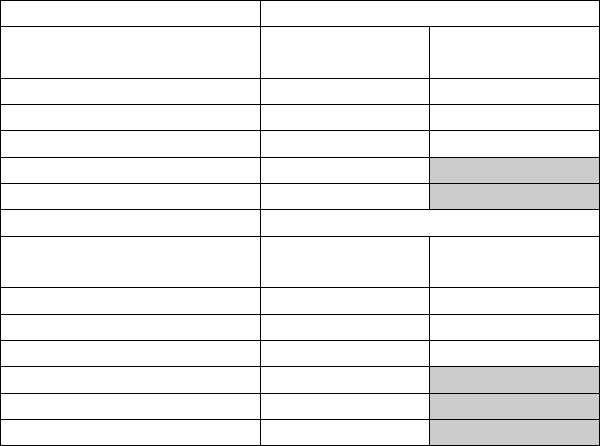
Using the weighted average method, prepare a schedule to show the calculation of the total cost per
equivalent unit for February. That is, calculate the equivalent unit cost for direct materials and for
conversion costs and then sum them.
Chapter 6: Process Costing 6-23
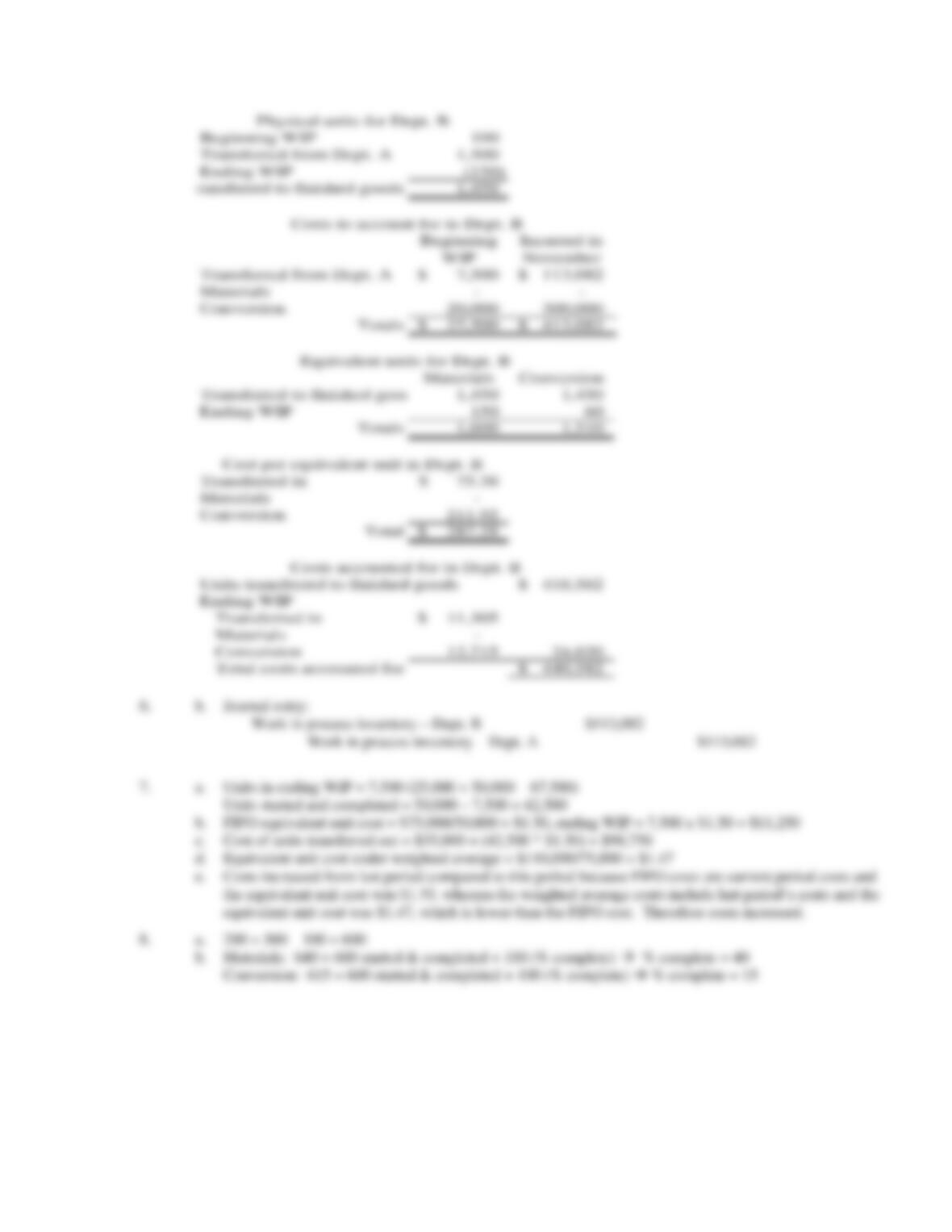
6. DPH Corporation is in the chemical manufacturing business. Products go through two production
departments (A first, then B). Data from those departments for November 20×1 are presented below.
Department A
Beginning
work in process
Ending
work in process
Number of units
500
300
% complete for materials
100%
100%
% complete for conversion
60%
30%
Total materials cost
$12,000
Total conversion cost
$15,000
Department B
Beginning
work in process
Ending
work in process
Number of units
100
150
% complete for materials
100%
100%
% complete for conversion
30%
40%
Total materials cost
-0-
Total conversion cost
$20,000
Total transferred-in costs
7,500
DPH started 1,300 units of product during the month in Department A. Costs incurred in Department
A for November 20x1 totaled $32,000 for material and $66,000 for conversion. Additionally,
Department B incurred conversion costs in November 20×1 of $300,000. Department B adds no
materials to the product.
a. Prepare a production cost report for Department B for November 20×1. DPH accounts for its
costs using the weighted-average method.
b. Write out the journal entry for the transfer of goods from Department A to Department B.
7. Sunflower Seed Producers manufactures cooking oil and other products made from sunflower seeds.
All direct materials are added at the beginning of the production process. Data for the direct materials
used in the manufacture of cooking oil for the month of December is listed below.
Production data:
Beginning work in process 25,000 units
Units started during the period 50,000 units
Completed and transferred out 67,500 units
Manufacturing costs:
Beginning work in process (direct materials) $35,000
Direct material used $75,000
a. Under the FIFO method, how many units were started and completed with respect to direct
materials during the month?
b. Under the FIFO method, what is the cost of the direct materials in ending work in process at the
end of the month?
c. Under the FIFO method, what is the amount of direct materials cost transferred out this period?
d. Calculate the direct materials cost per equivalent unit under the weighted average method.
e. Did the purchase price of direct materials increase or decrease this period compared to last
period? Explain.

6-24 Cost Management
More Difficult Exercises
These exercises require more complex computations or present information differently than in the textbook.
8. WLS Corporation uses weighted-average process costing. Equivalent units of production for
September 20×2 were 640 for materials and 615 for conversion. Other information for September
follows:
Beginning work in process totaled 200 units, 100% complete for direct materials and 80%
complete for conversion costs
500 units were started during the month.
Ending work in process consisted of 100 units.
a. Calculate the number of units completed and transferred out for September 20×2.
b. Calculate the percentage of completion for ending work in process.
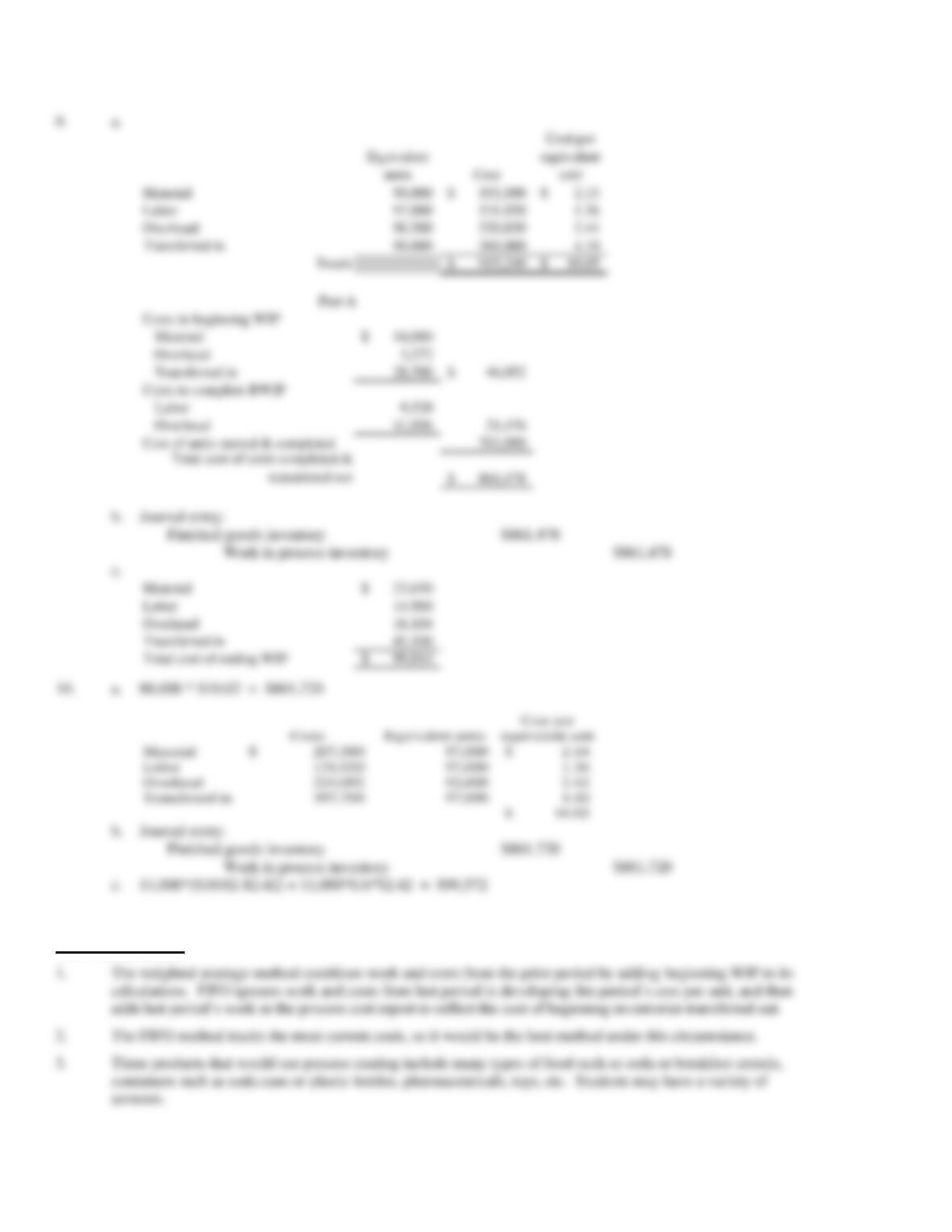
9. Indy, Inc. uses a process costing system. At the beginning of the month there were 7,000 units in
process, 30% complete. During the month 90,000 units were transferred in and 86,000 were
completed and transferred to finished goods. The ending work in process was 11,000 units, 60%
complete.
Materials are added at the beginning of the process, and labor at the 50% point. Overhead costs are
incurred uniformly. The cost of beginning work in process was $14,080 for materials, $3,272 for
overhead, and $28,700 for transferred-in costs. Current costs are $193,500 for materials, $131,920
for labor, $220,820 for overhead, and $369,000 for transferred-in costs. Indy uses the FIFO method.
a. Determine the cost of the goods completed and transferred out.
b. Write out the journal entry to record the units transferred to finished goods.
c. Determine the cost of the ending work in process.
10. Indy, Inc. uses a process costing system. At the beginning of the month there were 7,000 units in
process, 30% complete. During the month 90,000 units were transferred in and 86,000 were
completed and transferred to finished goods. The ending work in process was 11,000 units, 60%
complete.
Materials are added at the beginning of the process, and labor at the 50% point. Overhead costs are
incurred uniformly. The cost of the beginning work in process was $14,080 for materials, $3,272 for
overhead, and $28,700 for transferred-in costs. Current costs are $193,500 for materials, $131,920
for labor, $220,820 for overhead, and $369,000 for transferred-in costs. Indy uses the weighted
average method.
a. Determine the cost of the goods completed and transferred out.
b. Write out the journal entry to record the units transferred to finished goods.
c. Determine the cost of the ending work in process.
Short Answer
1. Explain the differences between the weighted average and FIFO process costing methods.
2. The manager in a plant that mass-produces computer components would like information about the
most current costs because the cost of direct materials frequently changes. Provide a recommendation
for a process costing method and give one reason for your recommendation.
3. List three products that are mass produced and for which process costing would be appropriate.
4. Explain why an organization might use both FIFO and standard costs in a process costing system.

Chapter 6: Process Costing 6-25
5. Describe normal spoilage in your own words and explain how it is recorded in a process costing
system.
6. Describe abnormal spoilage in your own words and explain how it is recorded in a process costing
system.
7. When normal spoilage levels are high, any excess spoilage is classified as abnormal spoilage and
recorded as a loss for the period. Managers are likely to be held responsible for these losses. Explain
why a manager might prefer to send more units to be reworked when spoilage levels increase.
8. The accountant at DPL Company is thinking about dividing the process costing conversion costs into
three separate cost pools: direct labor, variable overhead, and fixed overhead. Each cost pool would
be allocated separately to equivalent units. Discuss whether this approach would improve the
accuracy of costs assigned to each unit.
9. List one cost and one benefit from moving inspection to an earlier position in the manufacturing
process.
10. List a potential business risk that occurs when spoilage rates increase dramatically.
11. List one pro and one con that managers should identify when they consider the trade-offs between
investing in quality improvements and incurring the costs of undetected spoiled units.
12. Describe one factor that would affect an accountant’s choice of process costing method.
13. List two reasons why actual costs are likely to be different from standard costs in a given period.
14. Explain how normal spoilage costs are treated when goods are transferred to another department in a
process costing system.
Problems
1. OVT Corporation manufactures picture frames. Production takes place in three departments,
described below:
Cutting: Machines cut 6-foot boards into 3-, 6- and 12-inch lengths.
Assembly: Individual pieces of wood are glued together in square and rectangular shapes.
Finishing: The picture frames are painted, lacquered, and dried. They are then packed into
boxes of 100 frames each and shipped to retailers.
Inventory levels and costs at OVT are fairly constant, at the amounts shown in the following table:
Ending WIP Stage of Completion Department Cost
Inventory Direct Conversion Per Equivalent
(units) Materials Costs Unit
Cutting 150 100% 40% $1.15
Assembly 250 100% 30% 0.75
Finishing 200 100% 70% 2.10
Total cost per equivalent unit $4.00
Finished goods inventory (i.e., boxes of completed frames awaiting shipment) is typically around
300; each box of 100 frames has an approximate total cost of $450.
a. Identify and describe two risks that OVT faces as a result of keeping 300 boxes of finished goods
inventory on hand.
b. Should Joanne expect the cost per equivalent unit in each department to be the same from month
to month? If so, explain why. If not, identify two reasons why the cost of a picture frame might
vary over time.
c. Notice that the department cost per equivalent unit (excluding transferred-in costs) is lowest in
the Assembly Department and highest in the Finishing Department. Recalling that the cost per

6-26 Cost Management
equivalent unit is made up of direct material, direct labor, and overhead, suggest two reasons why
the Assembly Department’s cost is lowest.
d. OVT is considering implementing more automation in its production operation. For example,
frames are currently painted and lacquered by hand in the Finishing Department. OVT’s
president, Max Kinley, wants to replace most of the direct labor workers in the Finishing
Department with painting and lacquering machines. Explain how the use of machines in place of
direct labor workers would affect the direct labor cost and overhead cost per equivalent unit.
e. OVT currently calculates the cost of picture frames using the weighted-average method.
However, it could use the FIFO method. Explain the similarities and differences between the two
methods. Discuss one pro and one con of using the weighted average method.
f. Spoilage costs in OVT Corporation are normally minimal and are treated in the accounting
information system as abnormal costs. How would OVT’s accountant record the cost of spoiled
units? Explain the process. Describe why there is no single, correct way to account for the cost
of spoiled units in a process costing system.
g. Like most information in cost accounting, OVT’s costs are subject to some uncertainties. For
example, estimating the percentage of completion for ending work in process involves some
estimation and uncertainty. Identify and explain two additional uncertainties associated with
using process costing to calculate the cost of a picture frame.
2. Falcon Fabricating Company uses a process costing system. One of the employees is responsible for
estimating the percentage completion; however, he has never had any formal training in making these
estimates. He is wondering whether the accuracy of his estimates could be improved. A colleague in
another department suggested that he consider using techniques such as timing one unit through each
department and identifying points in the production process where units appear to be 25% complete,
50% complete, and so on.
a. Discuss why the percent completion is not generally known with absolute accuracy.
b. Comment on whether the suggested method is likely to provide an accurate estimate of work in
process.
c. List one advantage of improving the accuracy of the estimate. What might be a disadvantage?
3. Mountain Meadow Grains produces trail mix. Materials are added at the beginning of the process, and
the company uses the FIFO process costing method. Inspection takes place when the product is 100%
complete. Normal spoilage is 4% of good units completed. Here is the production information for the
latest period.
Beginning WIP (75% complete) 20,000 units
Good units completed and transferred out 80,000 units
Ending WIP inventory (90% complete) 24,000 units
Total spoilage 4,800 units
FIFO cost per equivalent unit:
Materials $1.00
Conversion costs 1.50
Total unit cost $2.50
Cost of Beginning WIP $50,000
a. Calculate the cost of abnormal spoilage.
b. Calculate the cost of good units completed and transferred, including an allocation of normal
spoilage costs.
c. The costs recorded in the accounting system for spoilage include direct materials and conversion
costs up to the point of completion. However, these recorded costs are only part of the costs
incurred when spoilage occurs. Write a brief paragraph that discusses other costs of spoilage that
are not recorded in the accounting system and explain why they might be more important to an
organization than the costs in the accounting system.
d. Discuss why uncertainties exist about how much spoilage is normal versus abnormal.
Chapter 6: Process Costing 6-27
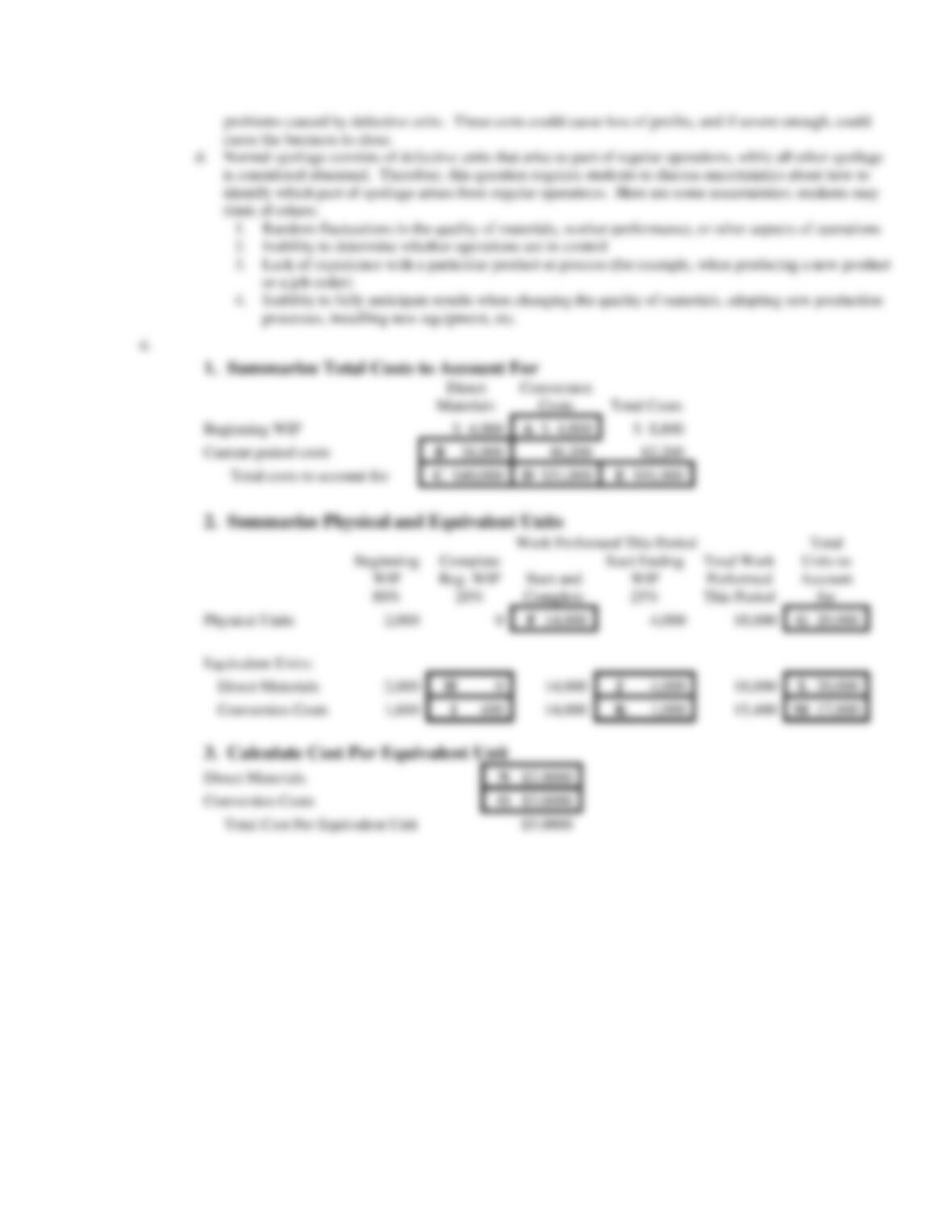
4. Johnson and Heffner make janitorial supplies and has a department that produces cleaning brushes.
All direct materials are added at the beginning of production, and conversion costs are incurred
evenly throughout production. The 2,000 units in Beginning WIP on December 1 were 80%
complete, and the 4,000 units in Ending WIP on December 31 were 25% complete. During the
month, 16,000 units of cleaning brushes were completed and transferred out as finished goods.
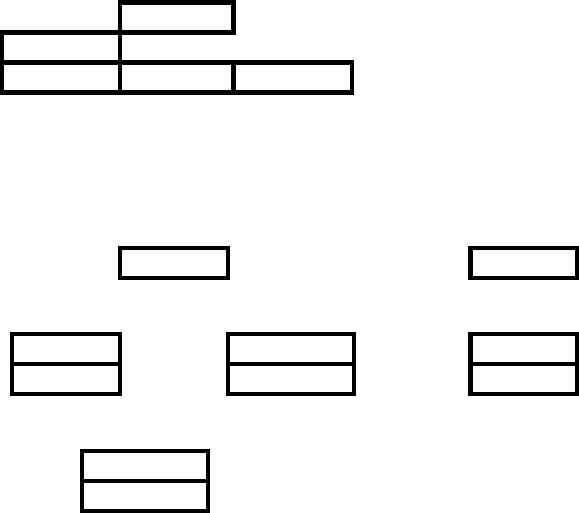
Using this information and the cost information provided below, fill in the blanks in the following
FIFO process costing report by calculating the amounts for items A-X. Round total costs to the
nearest dollar and per-unit costs to the nearest cent.
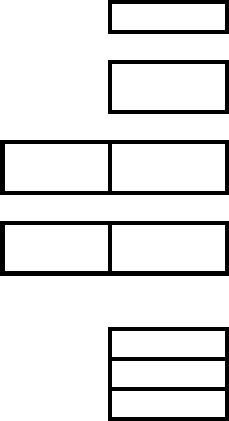
1. Summarize Total Costs to Account For
Direct
Materials
Conversion
Costs
Total Costs
Beginning WIP
$ 4,000
A
$ 8,800
Current period costs
B
46,200
82,200
Total costs to account for
C
D
E
2. Summarize Physical and Equivalent Units
Beginning
WIP
80%
Work Performed This Period
Total
Units to
Account
for
Complete
Beg. WIP
20%
Start and
Complete
Start Ending
WIP
25%
Total Work
Performed
This Period
Physical Units
2,000
0
F
4,000
18,000
G
Equivalent Units:
Direct Materials
2,000
H
14,000
J
18,000
L
Conversion Costs
1,600
I
14,000
K
15,400
M
3. Calculate Cost Per Equivalent Unit
Direct Materials
N
Conversion Costs
O
Total Cost Per Equivalent Unit
$5.0000
(continued on next page)
6-28 Cost Management
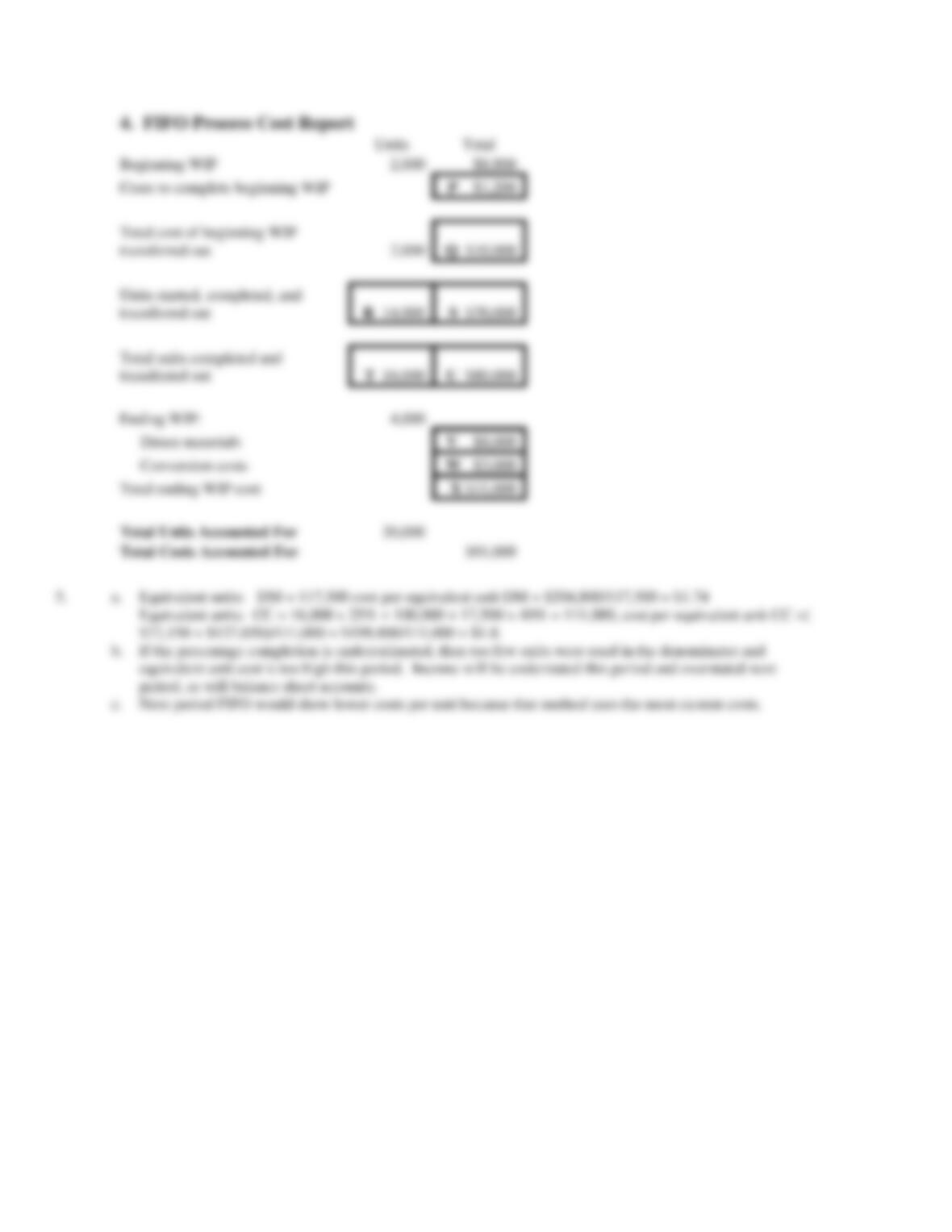
4. FIFO Process Cost Report
Units
Total
Beginning WIP
2,000
$8,800
Costs to complete beginning WIP
P
Total cost of beginning WIP
transferred out
2,000
Q
Units started, completed, and
transferred out
R
S
Total units completed and
transferred out
T
U
Ending WIP:
4,000
Direct materials
V
Conversion costs
W
Total ending WIP cost
X
Total Units Accounted For
20,000
Total Costs Accounted For
$91,000
5. Kovacik Products uses a FIFO process costing system to accumulate product costs. The Fabricating
Process center is the first center, where production of bronze lamps begins. Direct materials are used
in the beginning of the process. November’s information follows:
Beginning work in process (75% complete) 16,000 units
Started in November 117,500 units
Ending work in process (40% complete) 17,500 units
Costs for November were:
Beginning inventory $24,000 Direct materials
6,000 Direct labor
12,000 Overhead
Current costs added: $204,800 Direct materials
72,150 Direct labor
127,650 Allocated overhead
a. Calculate the equivalent units and cost per unit of direct material and conversion using the FIFO
method.
b. The manager estimating completion believes that she may have underestimated the percentage of
completion for ending inventory. Explain how this will affect the cost per equivalent unit this
period and next period.
c. Next period volumes of production are expected to increase and because of volume discounts,
direct materials costs are expected to decrease. At the end of next period, would weighted
average or FIFO show a lower cost per unit? Explain.
Chapter 6: Process Costing 6-29
Answers
True / False
Multiple Choice
6-30 Cost Management
Chapter 6: Process Costing 6-31
Matching
Exercises
6-32 Cost Management
Chapter 6: Process Costing 6-33

6-34 Cost Management
Chapter 6: Process Costing 6-35
6-36 Cost Management
Short Answer
Chapter 6: Process Costing 6-37
6-38 Cost Management
Problems
Chapter 6: Process Costing 6-39
6-40 Cost Management