Introduction to General, Organic & Biological Chemistry, 12e (Timberlake)
Chapter 6 Ionic and Molecular Compounds
6.1 Multiple-Choice Questions
1) In ionic compounds, ________ lose their valence electrons to form positively charged
________.
A) metals, anions
B) nonmetals, cations
C) metals, polyatomic ions
D) nonmetals, anions
E) metals, cations
2) How many electrons will aluminum gain or lose when it forms an ion?
A) lose 1
B) gain 5
C) lose 2
D) lose 3
E) gain 1
3) What is the symbol for the ion with 19 protons and 18 electrons?
A) F+
B) F–
C) Ar+
D) K–
E) K+
2
4) To form an ion, a sodium atom ________.
A) gains one electron
B) gains two electrons
C) loses seven electrons
D) loses one electron
E) loses two electrons
5) An anion always ________.
A) has a positive charge
B) contains a group of two or more atoms with a positive charge
C) contains a metal and a nonmetal
D) forms covalent bonds
E) has a negative charge
6) What is the ionic charge of an ion with 13 protons and 10 electrons?
A) 1+
B) 2+
C) 3+
D) 2-
E) 3-
7) The number of electrons in an ion with 16 protons and an ionic charge of 2- is ________.
A) 16
B) 18
C) 20
D) 22
E) 24
8) Elements in group 2A (2) of the periodic table form ions with a charge of ________.
3
A) 1+
B) 1-
C) 2+
D) 3+
E) 0
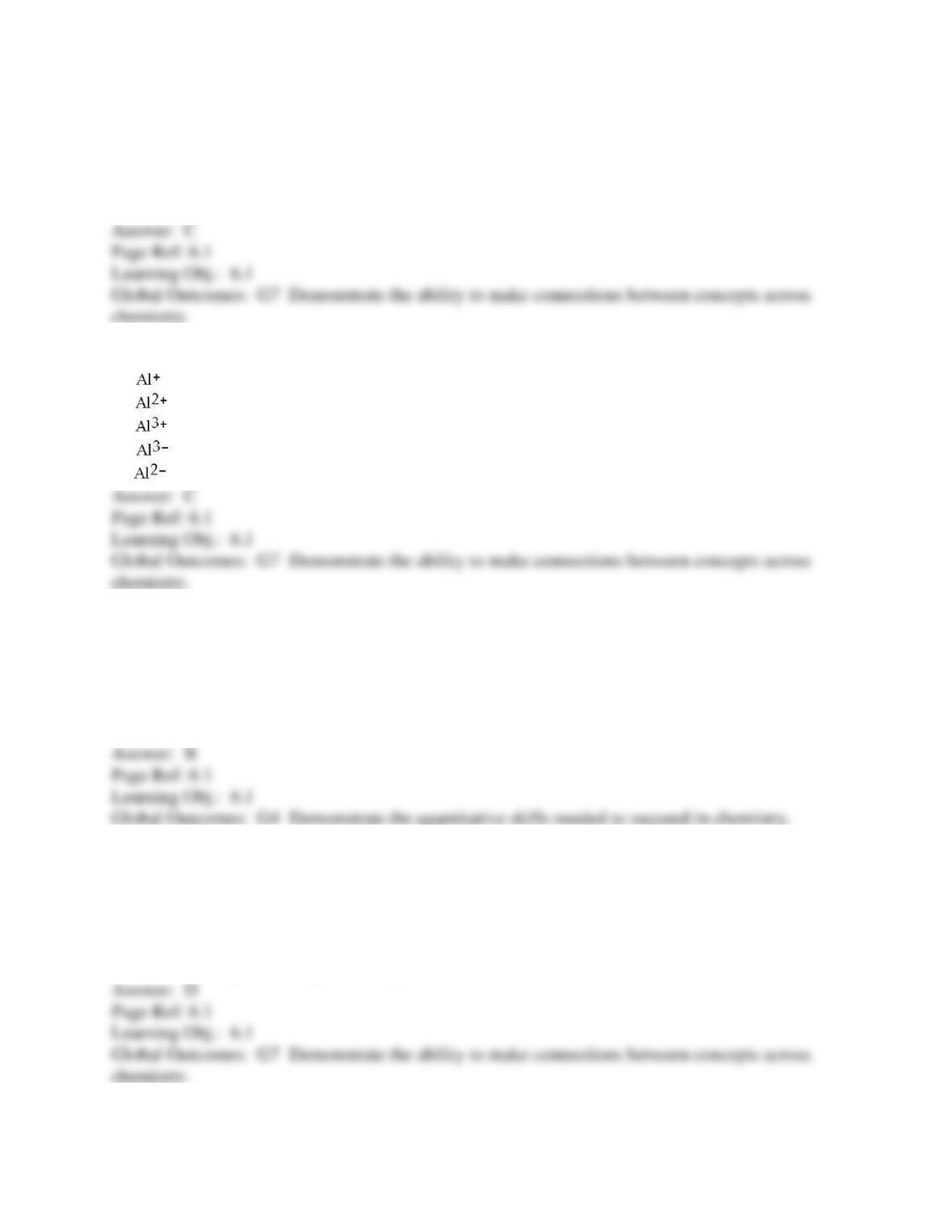
9) The ion of aluminum is ________.
A)
B)
C)
D)
E)
10) How many electrons will chlorine gain or lose when it forms an ion?
A) lose 1
B) gain 1
C) lose 7
D) gain 2
E) lose 3
11) When a cation is formed from a representative element ________.
A) electrons are gained and the ion is larger
B) electrons are gained and the ion is smaller
C) electrons are lost and the ion is larger
D) electrons are lost and the ion is smaller
E) the cation acquires a negative charge
12) An ionic compound ________.
A) has a net positive charge
B) has a net negative charge
C) contains only cations
D) contains only anions
E) has a net charge of zero
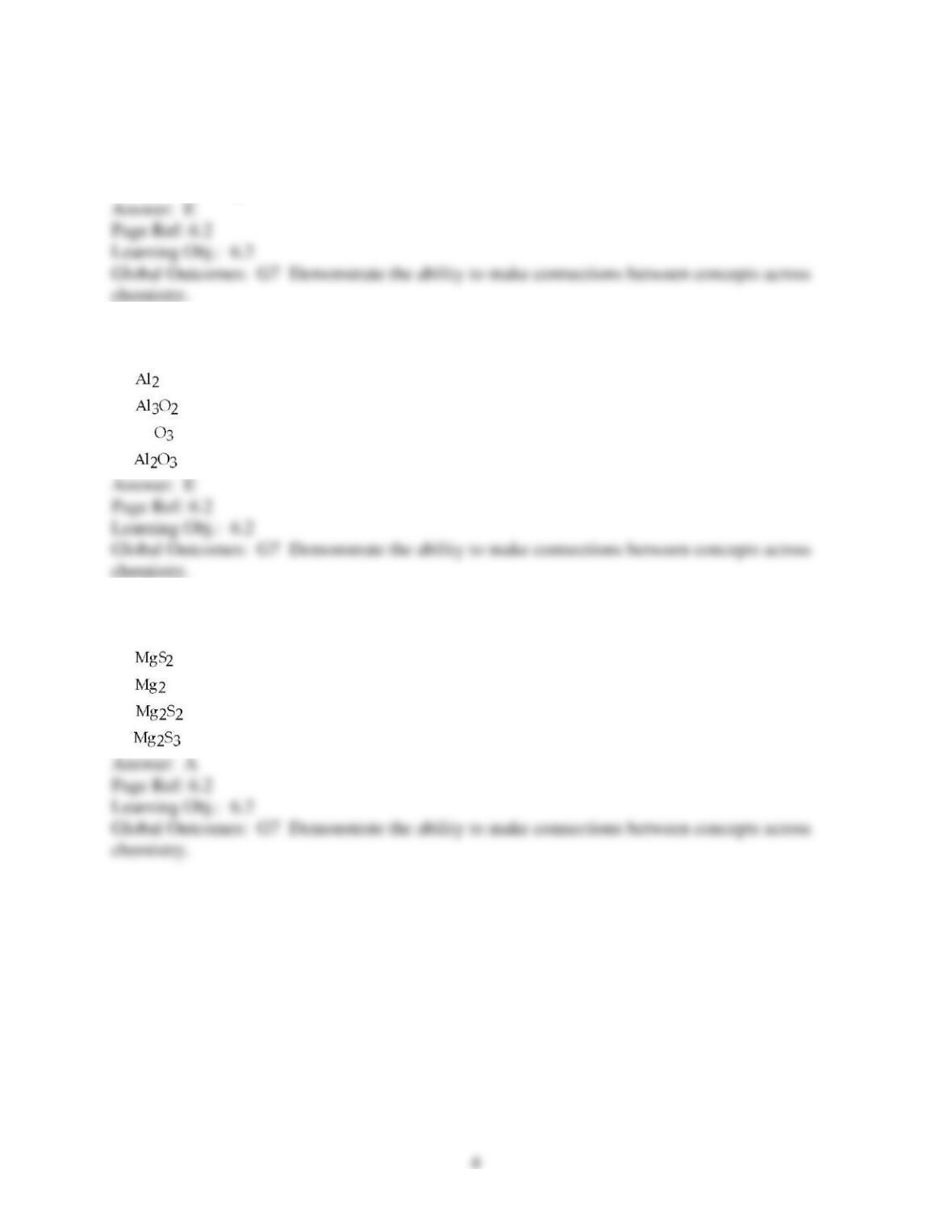
13) The correct formula for a compound formed from the elements Al and O is ________.
A) AlO
B) O
C)
D) Al
E)
14) The correct formula for the compound formed from Mg and S is ________.
A) MgS
B)
C) S
D)
E)
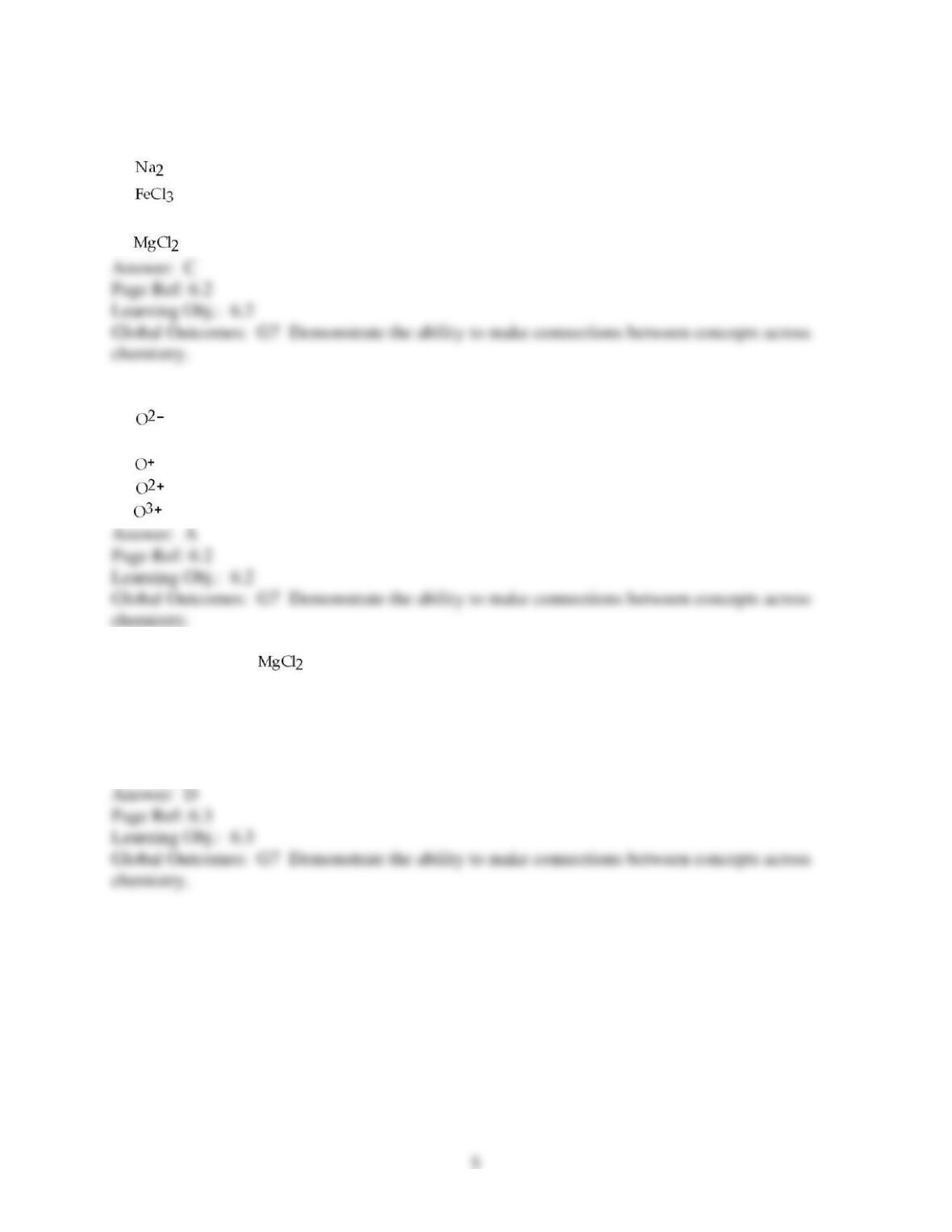
15) Which one of the following compounds contains an ion with a 3+ charge?
A) KCl
B) O
C)
D) CuCl
E)
16) What is the correct formula for the oxide ion?
A)
B) O
C)
D)
E)
17) The compound is named ________.
A) magnesium chlorine
B) magnesium dichloride
C) magnesium(II) chloride
D) magnesium chloride
E) dimagnesium chloride
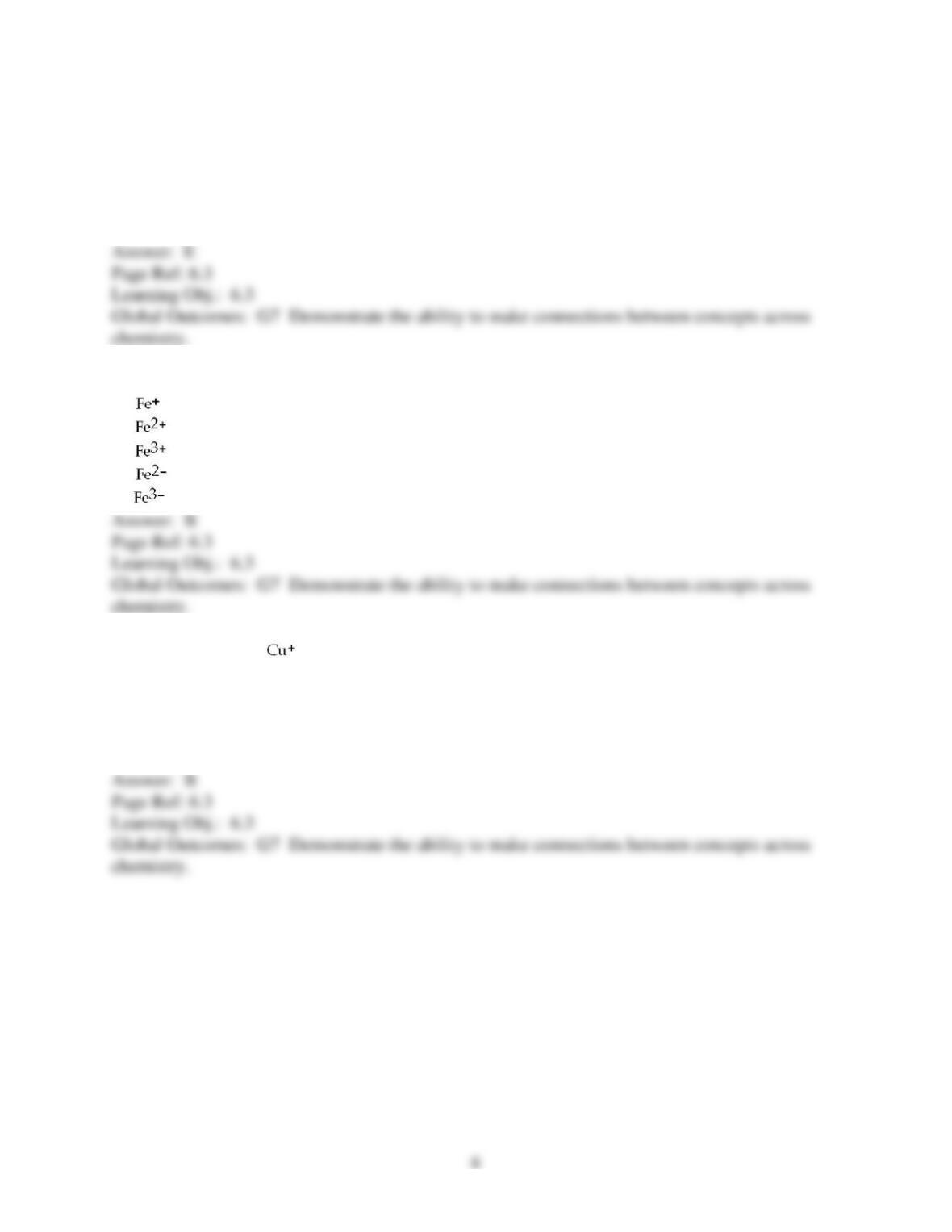
18) Which one of the following elements forms two or more ions with different ionic charges?
A) K
B) F
C) Ca
D) O
E) Fe
19) What is the correct formula for the iron(II) ion?
A)
B)
C)
D)
E)
20) The name of the ion is ________.
A) copper(II)
B) copper(I)
C) copper(III)
D) copper
E) cuprum
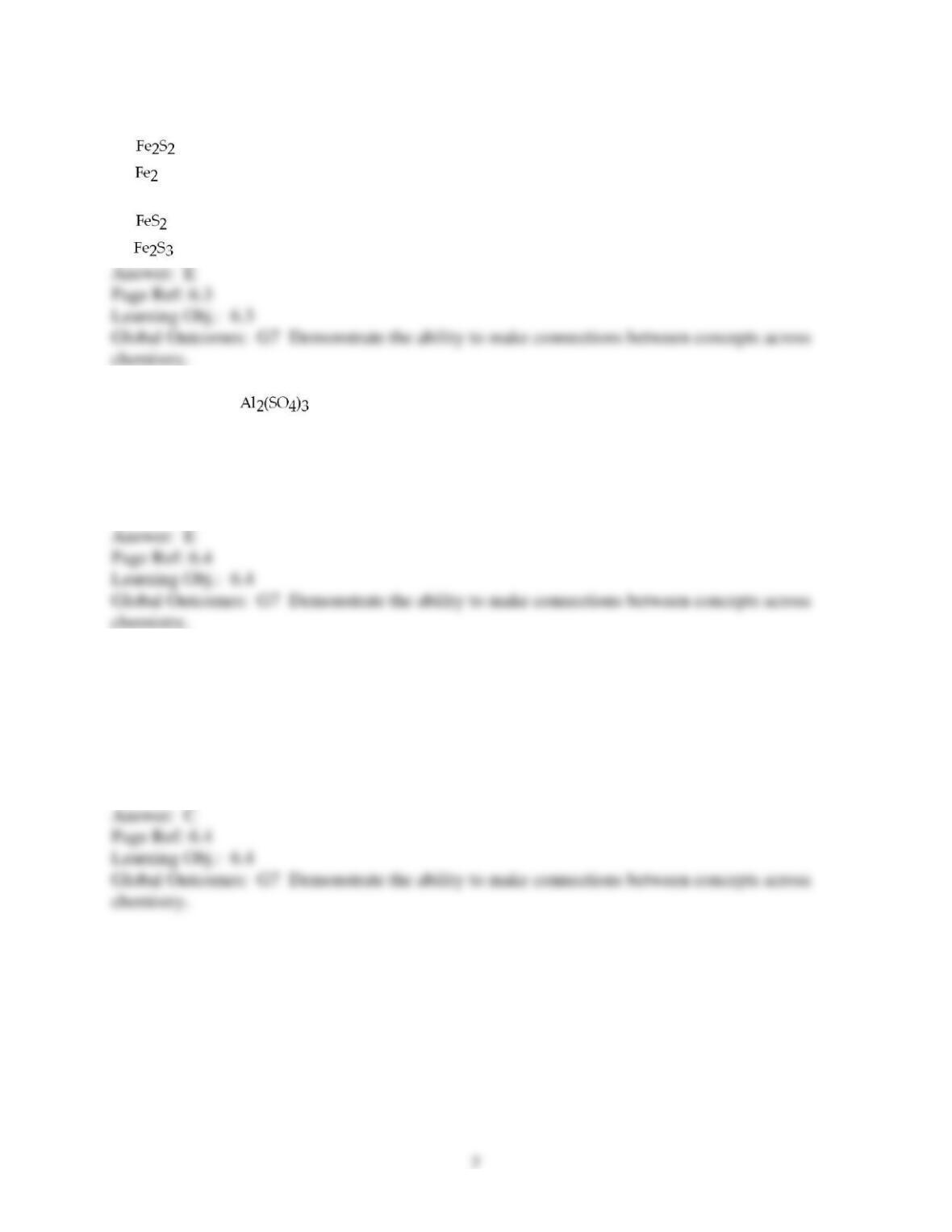
21) What is the correct formula for iron(III) sulfide?
A)
B) S
C) FeS
D)
E)
22) The name of is ________.
A) aluminum(III) sulfate
B) dialuminum trisulfate
C) dialuminum sulfate
D) dialuminum trisulfide
E) aluminum sulfate
23) A group of covalently bonded atoms that has an overall electrical charge is called a(n)
________.
A) ionic compound
B) anion
C) polyatomic ion
D) cation
E) molecule
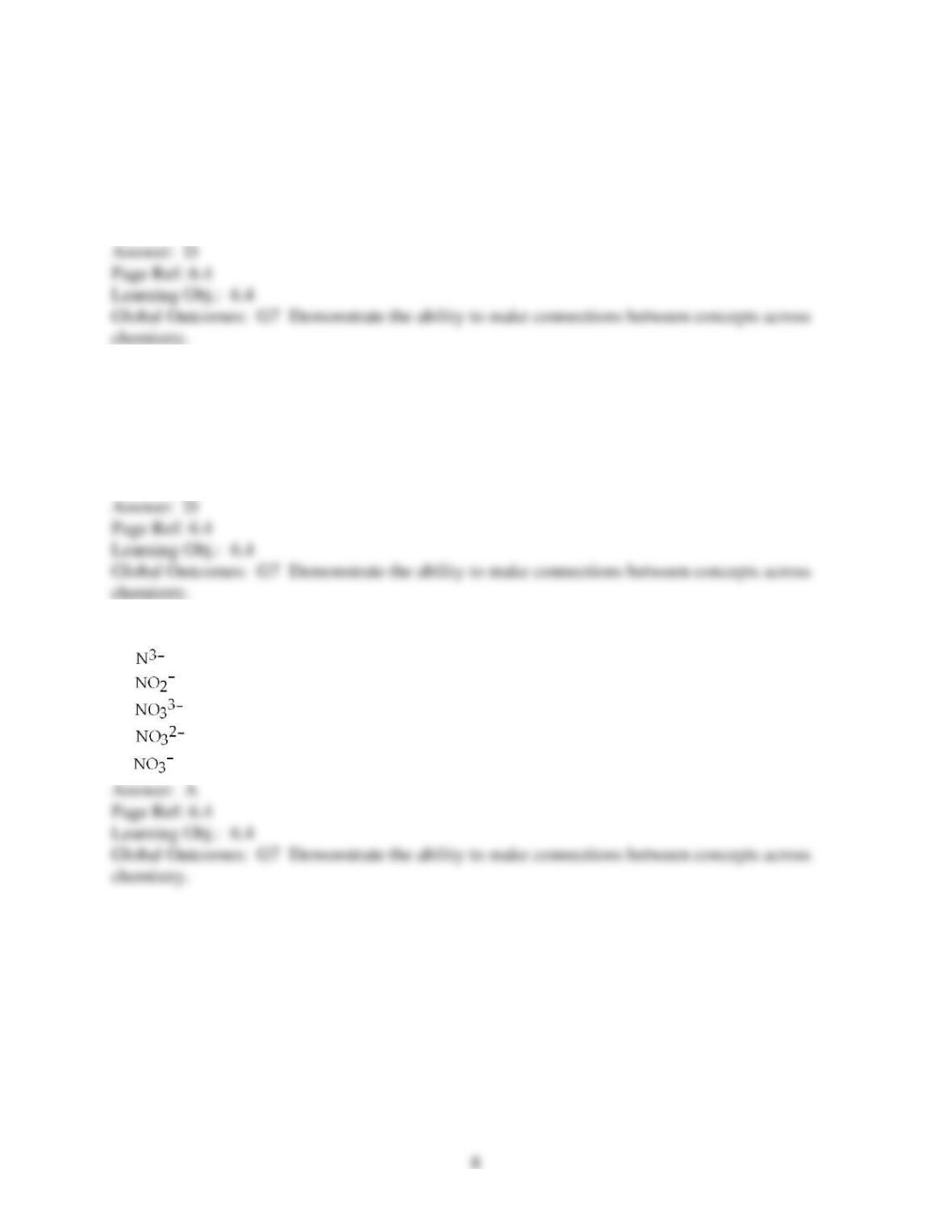
24) Which of the following polyatomic ions has a positive charge?
A) hydroxide
B) cyanide
C) hydrogen carbonate
D) ammonium
E) nitrate
25) Which of the following polyatomic ions has a 3- ionic charge?
A) hydroxide
B) nitrate
C) sulfate
D) phosphate
E) hydrogen carbonate
26) What is the formula of the nitride ion?
A)
B)
C)
D)
E)
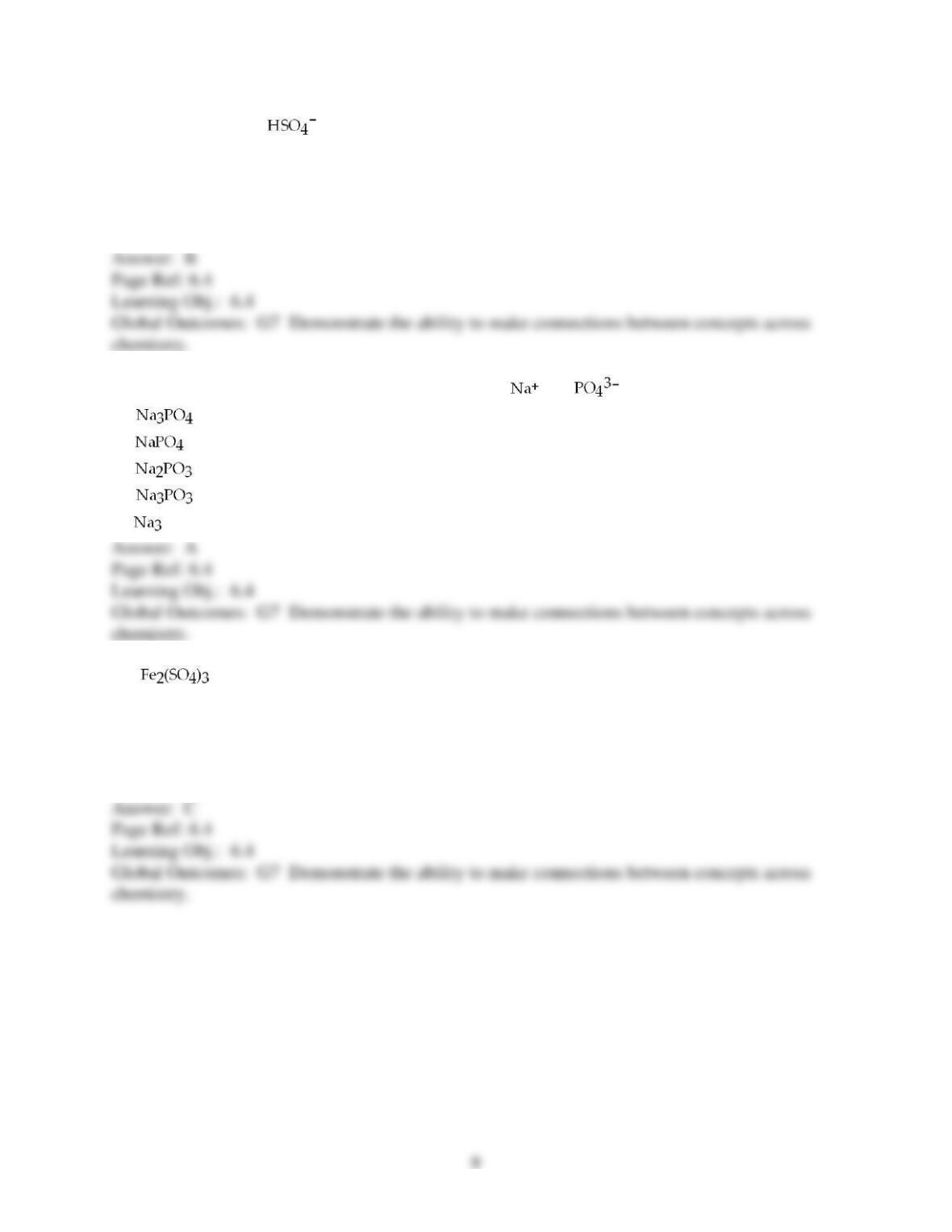
27) The name of the ion is ________.
A) sulfate
B) hydrogen sulfate
C) sulfite
D) hydrogen sulfite
E) sulfide
28) What is the formula of a compound that contains and ions?
A)
B)
C)
D)
E) P
29) is called ________.
A) iron sulfate
B) iron(II) sulfate
C) iron(III) sulfate
D) diiron trisulfate
E) iron trisulfate
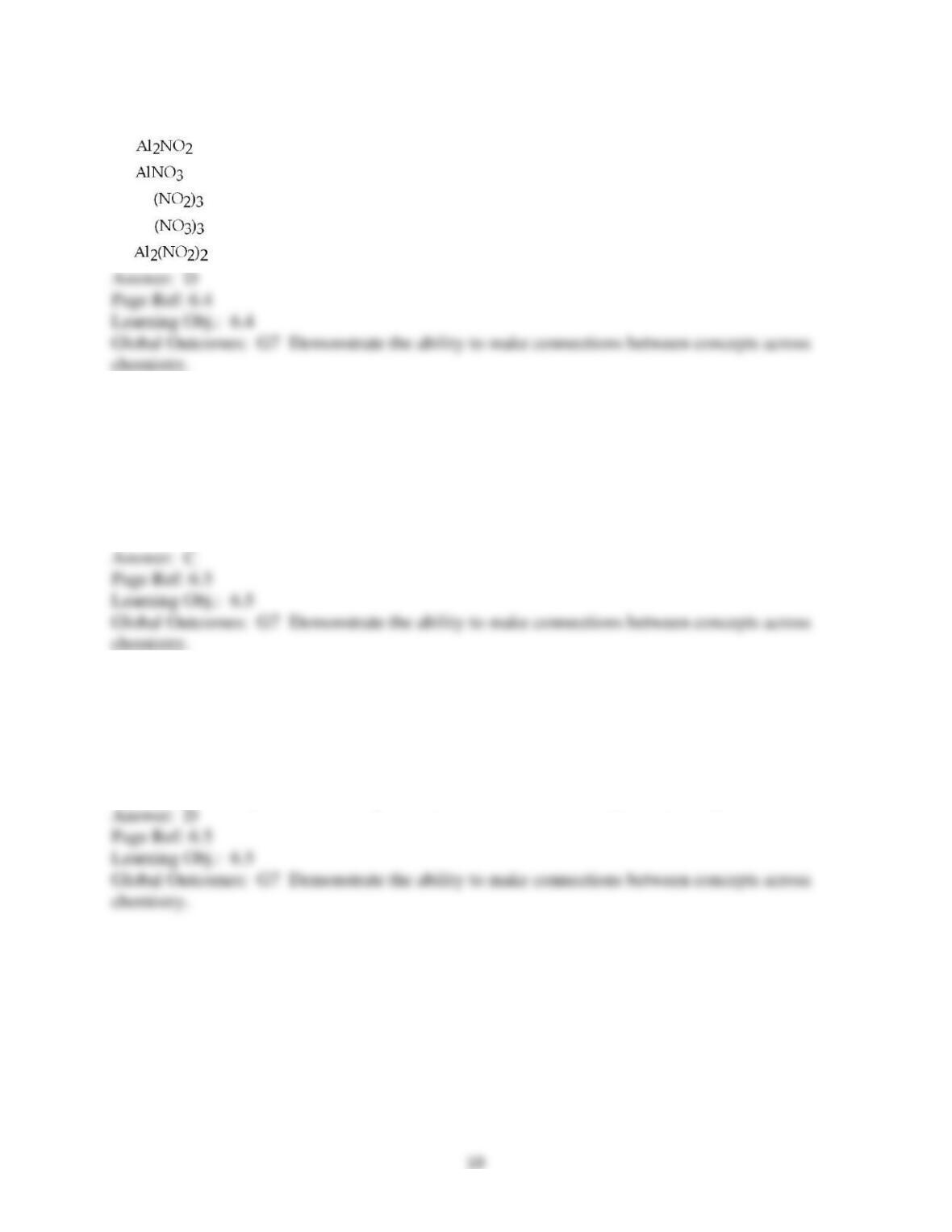
30) What is the formula for aluminum nitrate?
A)
B)
C) Al
D) Al
E)
31) A(n) ________ is the smallest neutral unit of two or more atoms held together by a covalent
bond.
A) ionic compound
B) nucleus
C) molecule
D) formula
E) unit
32) In a molecule with covalent bonding, ________.
A) oppositely charged ions are held together by strong electrical attractions
B) atoms of metals form bonds to atoms of nonmetals
C) atoms of different metals form bonds
D) atoms are held together by sharing electrons
E) atoms of noble gases are held together by attractions between oppositely charged ions
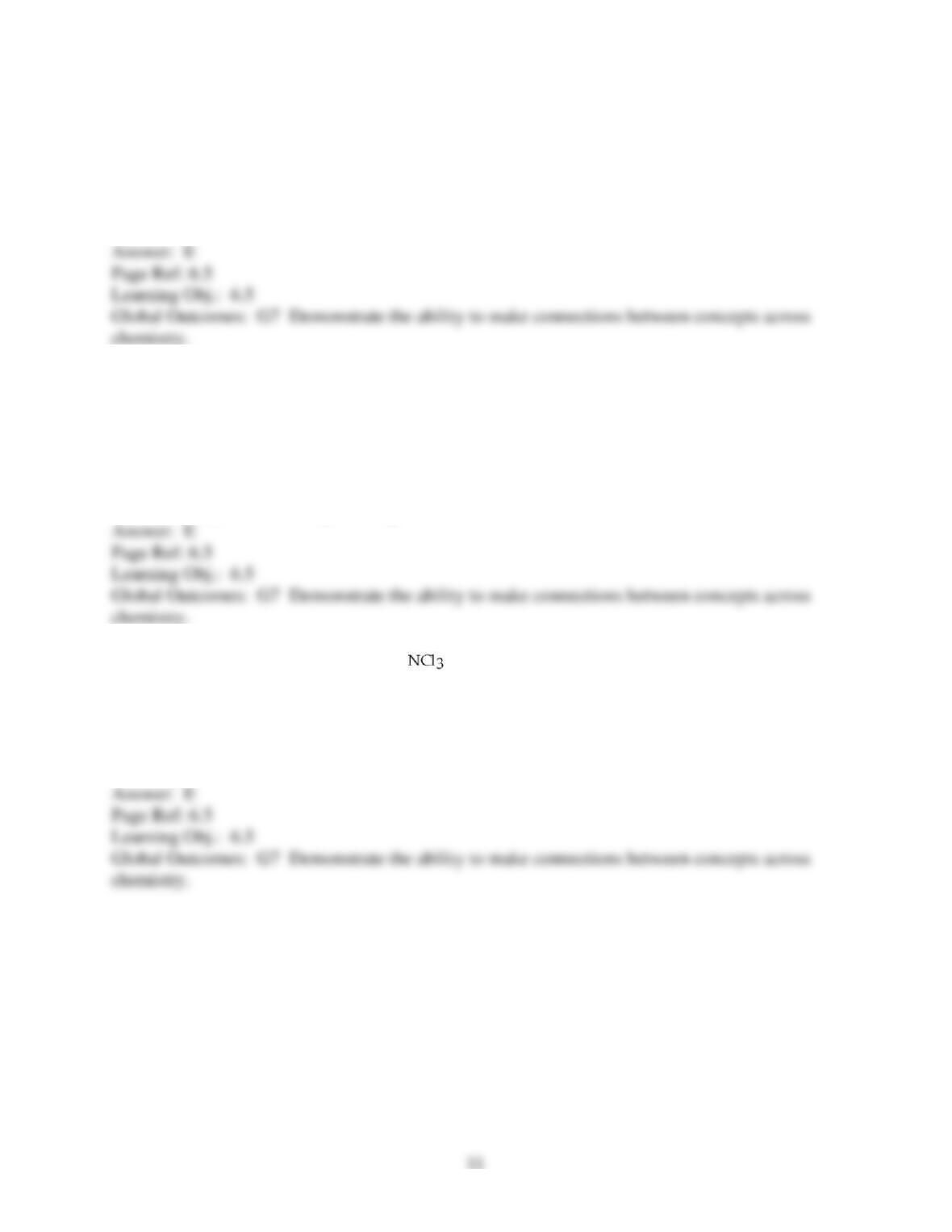
33) Which of the following elements does not exist as a diatomic molecule?
A) hydrogen
B) nitrogen
C) chlorine
D) oxygen
E) carbon
34) In a covalently bonded molecule, the number of electrons that an atom shares with others is
usually equal to the number of electrons ________.
A) in the atom
B) in its nucleus
C) in all the atoms
D) in its ion
E) needed to give it a noble gas arrangement
35) The correct name of the compound is ________.
A) nitrogen chloride
B) trinitrogen chloride
C) nitrogen(III) chloride
D) nickel chloride
E) nitrogen trichloride
36) According to naming rules, the types of compound that use prefixes in their names are
________.
A) ionic compounds
B) ionic compounds involving transition metals
C) polyatomic ions
D) molecular compounds
E) compounds that contain polyatomic ions
37) The correct name for the compound is ________.
A) nitrogen oxide
B) nitrogen trioxide
C) dinitride trioxide
D) dinitrogen oxide
E) dinitrogen trioxide
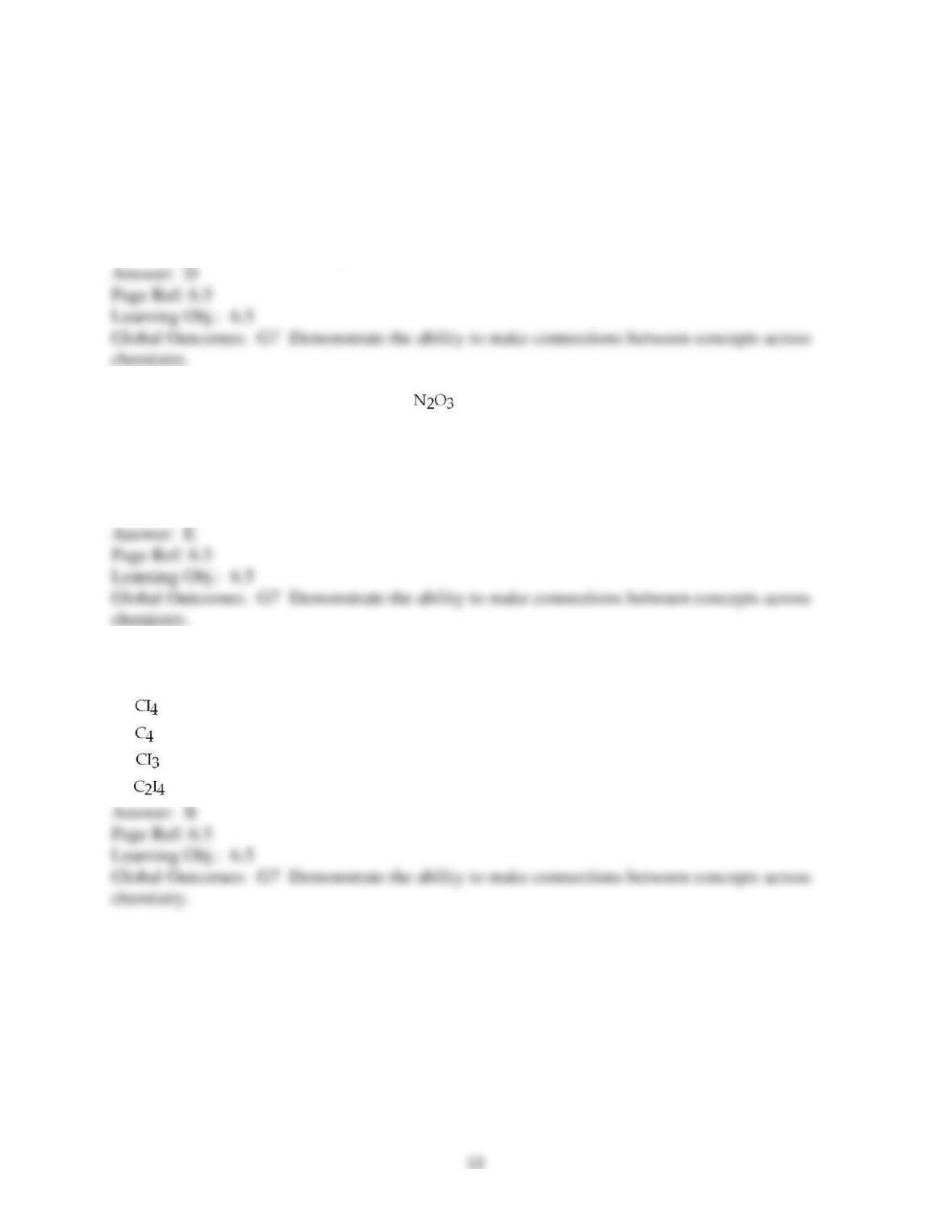
38) What is the formula of carbon tetraiodide?
A) CI
B)
C) I
D)
E)
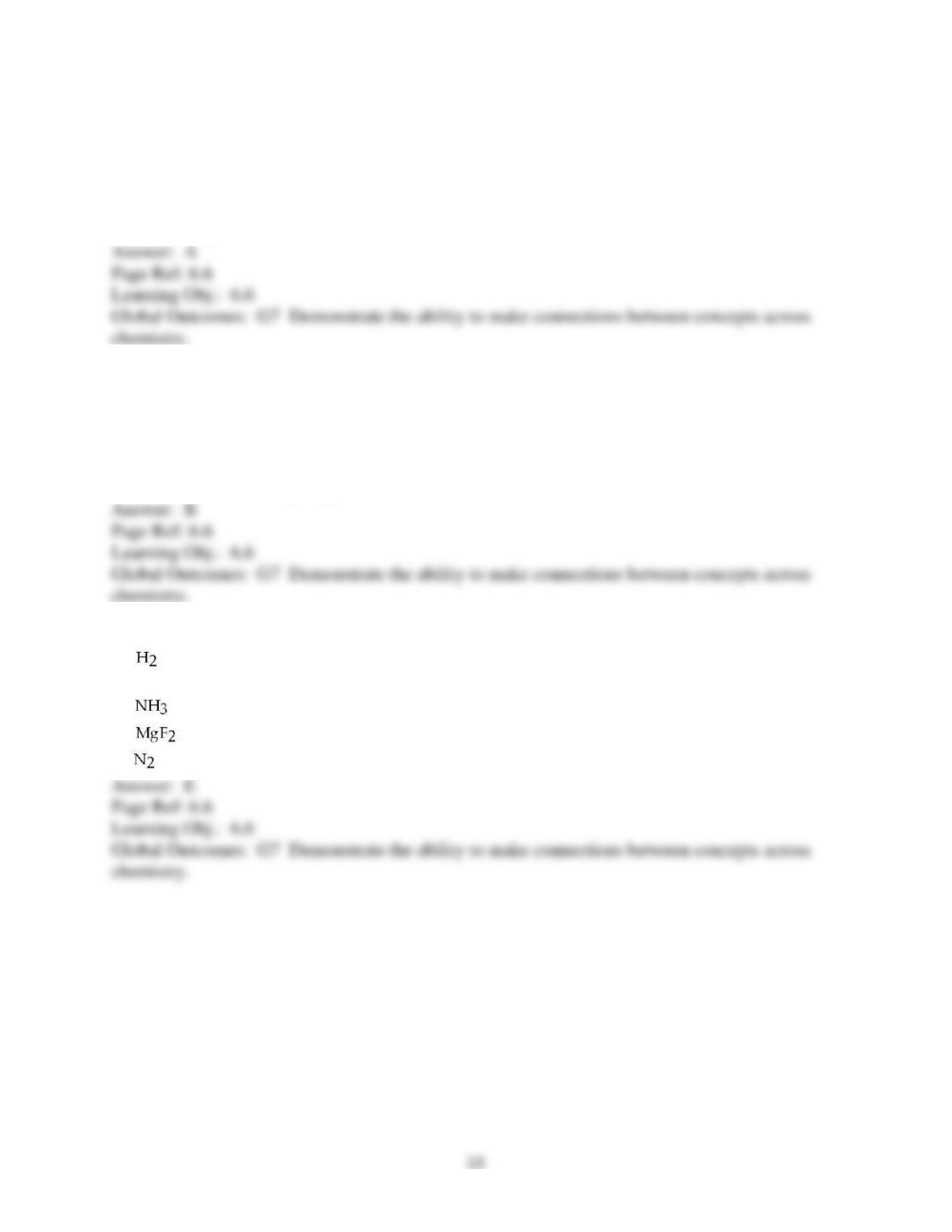
39) The ability of an atom to attract the shared electrons in a covalent bond is its ________.
A) electronegativity
B) bonding ability
C) polarity
D) ionic character
E) nonpolarity
40) Double and triple bonds form because ________.
A) the atoms involved have high electronegativities
B) single covalent bonds do not give all of the atoms in the molecule eight valence electrons
C) one of the atoms in the molecule has more than 8 valence electrons
D) the ions involved have charges larger than one
E) there is at least one hydrogen atom involved in the bond
41) Which of the following substances contains a nonpolar covalent bond?
A) O
B) NaCl
C)
D)
E)
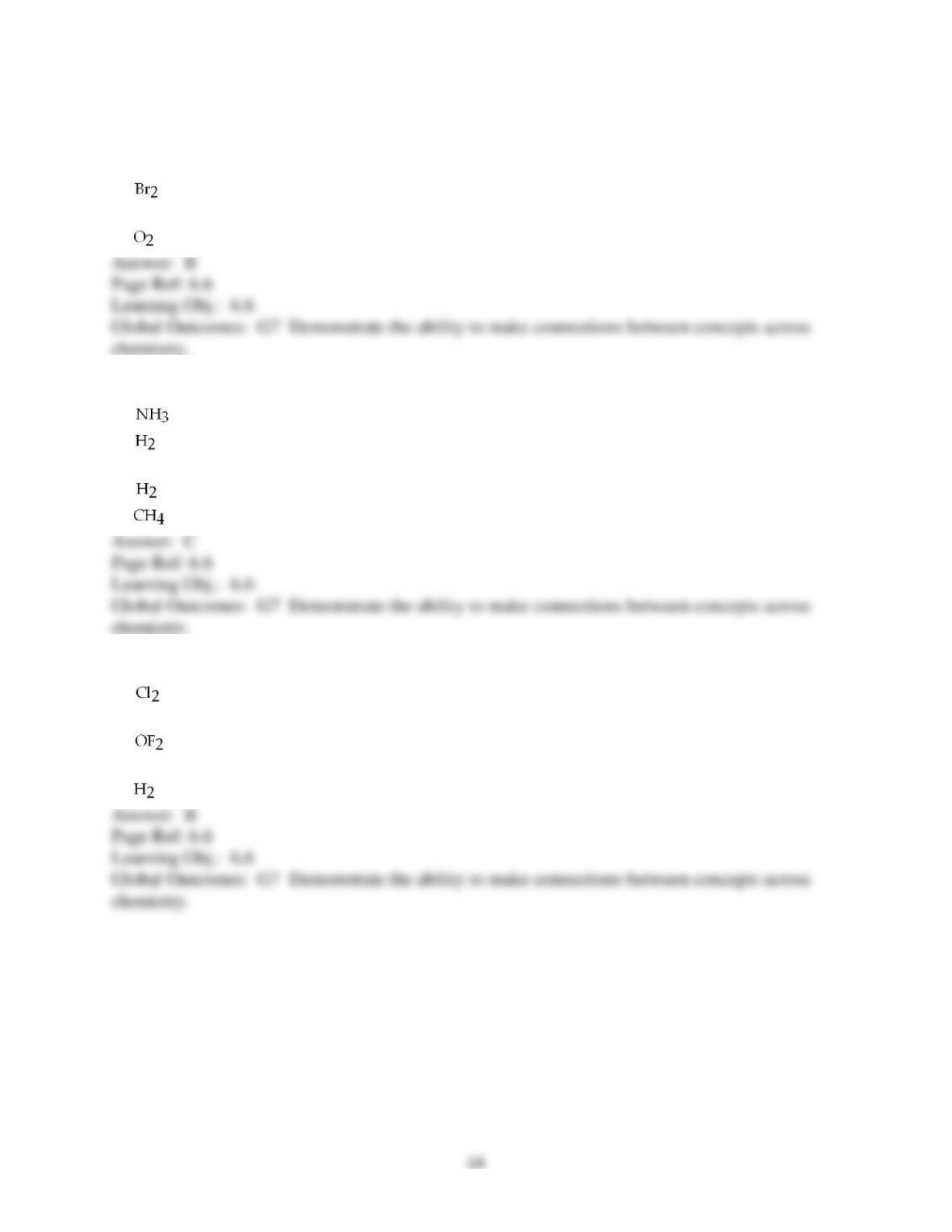
42) Which of the following compounds contains a polar covalent bond?
A) NaF
B) HCl
C)
D) MgO
E)
43) Which of the following compounds contains an ionic bond?
A)
B) O
C) CaO
D)
E)
44) Ionic bonding is expected in which of these compounds?
A)
B) KF
C)
D) HF
E)
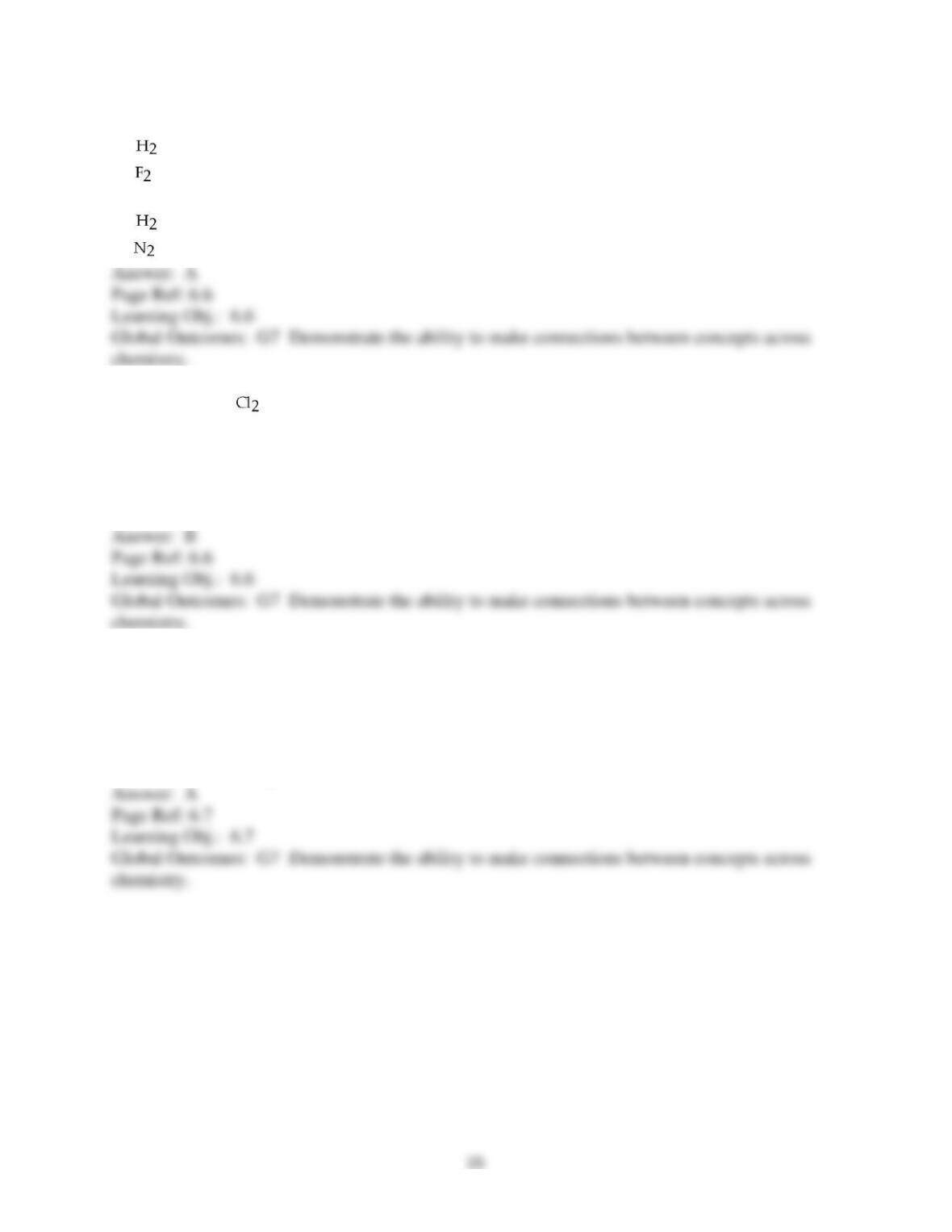
45) A polar covalent bond is found in which of these compounds?
A) O
B)
C) NaCl
D)
E)
46) The bond in is a(n) ________.
A) ionic bond
B) nonpolar covalent bond
C) metallic bond
D) polar ionic bond
E) no bond
47) The VSEPR theory allows us to determine the ________.
A) shape of a molecule
B) charge on an ion
C) color of a compound
D) bond type for a molecule
E) formula for a compound
48) The shape of the ammonia molecule (NH3) is ________.
A) linear
B) trigonal planar
C) trigonal pyramidal
D) tetrahedral
E) bent
49) The shape of the water molecule (H2O) is ________.
A) linear
B) tetrahedral
C) trigonal pyramidal
D) bent
E) trigonal planar
50) The shape of the methane molecule (CH4) is ________.
A) linear
B) tetrahedral
C) trigonal pyramidal
D) bent
E) trigonal planar
51) The carbon tetrachloride molecule, CC , has the shape of a ________.
A) tetrahedron
B) square
C) cube
D) circle
E) sphere
52) The carbon tetrachloride molecule, CC , is ________.
A) a polar molecule with polar bonds
B) a nonpolar molecule with polar bonds
C) a nonpolar molecule with nonpolar bonds
D) a polar molecule with nonpolar bonds
E) a polar molecule with ionic bonds
53) The ammonia molecule (NH3) is ________.
A) a polar molecule with polar bonds
B) a nonpolar molecule with polar bonds
C) a nonpolar molecule with nonpolar bonds
D) a polar molecule with nonpolar bonds
E) a polar molecule with ionic bonds
54) The main type of attractive forces between molecules of ammonia (NH3) are ________.
A) ionic bonds
B) hydrogen bonds
C) polar covalent
D) dipole-dipole attractions
E) dispersion forces
55) The main type of attractive forces between molecules of carbon tetrabromide (CBr4) are
________.
A) ionic bonds
B) hydrogen bonds
C) polar covalent
D) dipole-dipole attractions
E) dispersion forces
56) The main type of attractive forces between molecules of hydrogen (H2) are ________.
A) ionic bonds
B) hydrogen bonds
C) polar covalent
D) dipole-dipole attractions
E) dispersion forces
6.2 Short Answer Questions
Identify each of the following compounds as covalent or ionic.
1) carbon tetrachloride
2) potassium oxide
3) carbon dioxide
4) dihydrogen sulfide
5) sodium fluoride
6) nitrogen trichloride
6.3 True/False Questions
1) A sulfur atom gains electrons to form an ion with a charge of 2-.
2) A potassium atom gains electrons to form an ion with a charge of 1-.
3) A positive ion has more protons that electrons.
4) For halogens, the group number is the same as the ionic charge.
5) When calcium and oxygen combine, the formula of the product is CaO.
6) When barium and chlorine combine, the formula of the product is BaCl3.
8) The name of the compound AlCl3 is aluminum trichloride.
9) The common ions of iron are Fe+ and Fe2+.
10) The name of the compound CuO is copper(II) oxide.
11) The name of the compound Fe2S3 is iron(II) sulfide.
12) The name of the compound K3N is potassium nitride.
13) The formula for iron(II) sulfide is FeS.
14) The formula for hydroxide is OH–.
15) When Al3+ and SO42- combine, the formula of the product is Al2(SO4)3.
16) The name of the compound CuSO4 is copper(I) sulfate.
17) The formula of the compound chromium(III) oxide is Cr2O3.
18) Molecular compounds are formed from ions.
19) The formula of the compound boron trifluoride is BF3.
20) The name of the compound CO2 is dicarbon oxide.
21) Br2 contains a polar covalent bond.
22) Chlorine is more electronegative than bromine.
23) Sodium is more electronegative than chlorine.
24) The bond between H and O is polar covalent.
25) The bond between Li and F is polar covalent.
26) The molecule CO2 is linear.
27) The molecule SCl2 is linear.
28) Methane, (CH4), is a polar molecule.
29) Ammonia, (NH3), is a polar molecule.
30) A nonpolar molecule can have polar bonds.
31) The strongest attractive forces between molecules of H2O are dispersion forces.
32) The strongest attractive forces between molecules of Cl2 are dispersion forces.
33) The strongest attractive forces between molecules of NH3 are hydrogen bonds.
34) The strongest attractive forces between molecules of HCl are hydrogen bonds.
35) The strongest attractive forces between molecules of HBr are dipole-dipole attractions.

6.4 Matching Questions
Give the correct valence for ions of the following elements.
A) 3+
B) 2-
C) 1-
D) 2+
E) 1+
F) 0
1) Ca
Page Ref: 6.1
Learning Obj.: 6.1
Global Outcomes: G7 Demonstrate the ability to make connections between concepts across
chemistry.
2) Cl
Page Ref: 6.1
Learning Obj.: 6.1
Global Outcomes: G7 Demonstrate the ability to make connections between concepts across
chemistry.
3) O
Page Ref: 6.1
Learning Obj.: 6.1
Global Outcomes: G7 Demonstrate the ability to make connections between concepts across
chemistry.
4) Al
Page Ref: 6.1
Learning Obj.: 6.1
Global Outcomes: G7 Demonstrate the ability to make connections between concepts across
chemistry.
5) K
Page Ref: 6.1
Learning Obj.: 6.1
Global Outcomes: G7 Demonstrate the ability to make connections between concepts across
chemistry.

Match the correct name of the polyatomic ions with the formulas given.
A) hydroxide
B) hydrogen carbonate
C) hydrogen sulfate
D) nitrite
E) phosphite
F) sulfite
G) phosphate
H) carbonate
I) hydrogen sulfite
J) nitrate
K) oxide
L) sulfate
M) carbonite
6)
Page Ref: 6.4
Learning Obj.: 6.4
Global Outcomes: G7 Demonstrate the ability to make connections between concepts across
chemistry.
7)
Page Ref: 6.4
Learning Obj.: 6.4
Global Outcomes: G7 Demonstrate the ability to make connections between concepts across
chemistry.
8)
Page Ref: 6.4
Learning Obj.: 6.4
Global Outcomes: G7 Demonstrate the ability to make connections between concepts across
chemistry.
9)
Page Ref: 6.4
Learning Obj.: 6.4
Global Outcomes: G7 Demonstrate the ability to make connections between concepts across
chemistry.
10)
Page Ref: 6.4
Learning Obj.: 6.4
Global Outcomes: G7 Demonstrate the ability to make connections between concepts across
chemistry.
11)

Page Ref: 6.4
Learning Obj.: 6.4
Global Outcomes: G7 Demonstrate the ability to make connections between concepts across
chemistry.
12)
Page Ref: 6.4
Learning Obj.: 6.4
Global Outcomes: G7 Demonstrate the ability to make connections between concepts across
chemistry.
13)
Page Ref: 6.4
Learning Obj.: 6.4
Global Outcomes: G7 Demonstrate the ability to make connections between concepts across
chemistry.
14)
Page Ref: 6.4
Learning Obj.: 6.4
Global Outcomes: G7 Demonstrate the ability to make connections between concepts across
chemistry.

Match the chemical name with the correct formula.
A)
B)
C) MgS
D)
E)
15) magnesium sulfate
Page Ref: 6.4
Learning Obj.: 6.4
Global Outcomes:
G7 Demonstrate the ability to make connections between concepts across chemistry.
16) magnesium hydrogen sulfate
Page Ref: 6.4
Learning Obj.: 6.4
Global Outcomes: G7 Demonstrate the ability to make connections between concepts across
chemistry.
17) magnesium sulfide
Page Ref: 6.3
Learning Obj.: 6.3
Global Outcomes: G7 Demonstrate the ability to make connections between concepts across
chemistry.
18) magnesium sulfite
Page Ref: 6.4
Learning Obj.: 6.4
Global Outcomes: G7 Demonstrate the ability to make connections between concepts across
chemistry.
19) magnesium hydrogen sulfite
Page Ref: 6.4
Learning Obj.: 6.4
Global Outcomes: G7 Demonstrate the ability to make connections between concepts across
chemistry.

Indicate the type of bonding you would expect between the following elements.
A) ionic
B) polar covalent
C) none
D) nonpolar covalent
20) Na and F
Page Ref: 6.6
Learning Obj.: 6.6
Global Outcomes: G7 Demonstrate the ability to make connections between concepts across
chemistry.
21) N and F
Page Ref: 6.6
Learning Obj.: 6.6
Global Outcomes: G7 Demonstrate the ability to make connections between concepts across
chemistry.
22) F and F
Page Ref: 6.6
Learning Obj.: 6.6
Global Outcomes: G7 Demonstrate the ability to make connections between concepts across
chemistry.
23) He and F
Page Ref: 6.6
Learning Obj.: 6.6
Global Outcomes: G7 Demonstrate the ability to make connections between concepts across
chemistry.
24) S and F
Page Ref: 6.6
Learning Obj.: 6.6
Global Outcomes: G7 Demonstrate the ability to make connections between concepts across
chemistry.