Chapter 6
56.
If
1
2,009/ 2,010
0
1dx
x
converges, find its value. Otherwise, enter “DNC”.
57.
If
1
0
5
1dx
x−
converges, find its value. Otherwise, enter “DNC”.
58.
If
0
1
1
1dx
x
−+
converges, find its value. Otherwise, enter “DNC”.
Chapter 6
59.
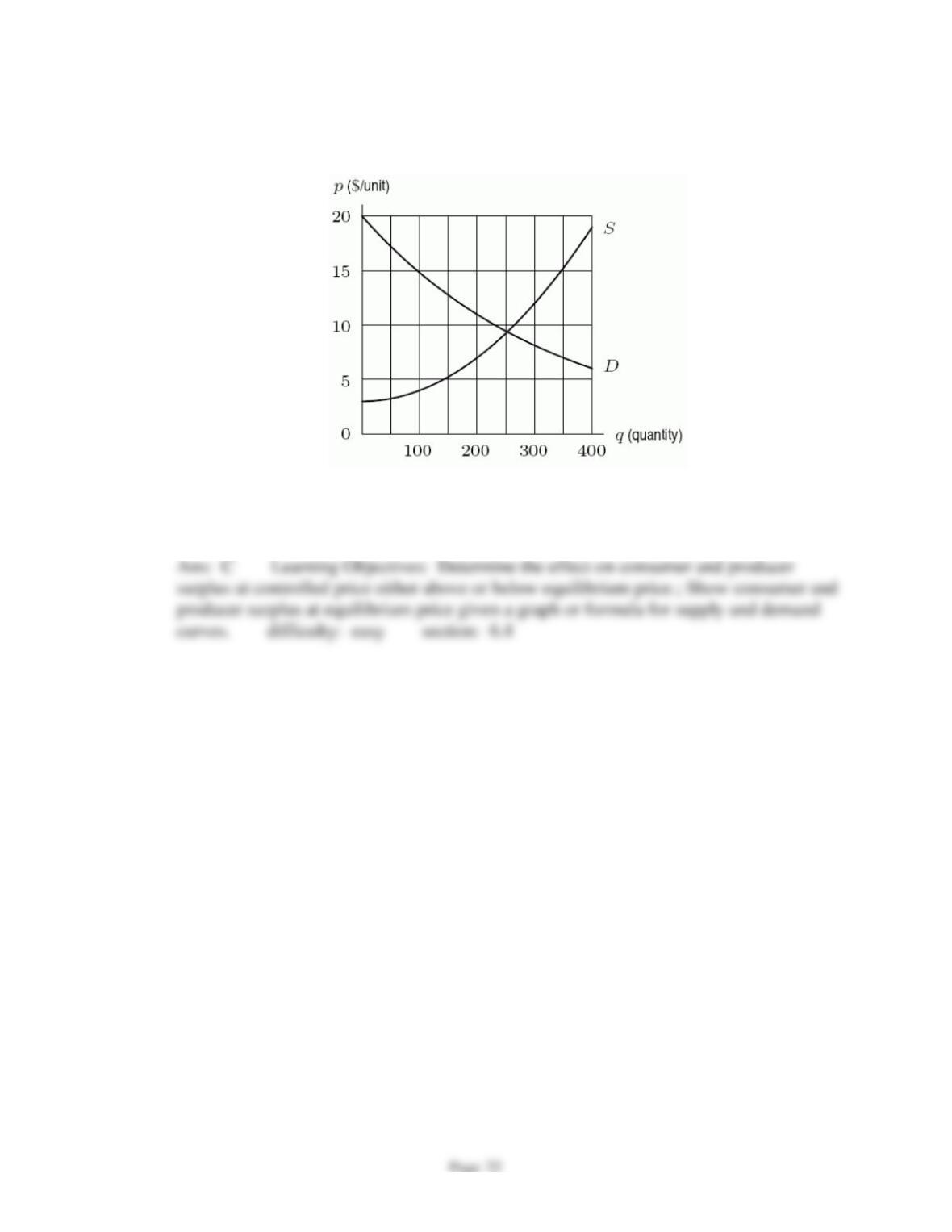
The following figure shows the demand and supply curves for a product. Estimate the
equilibrium quantity.
A)
0
B)
140
C)
250
D)
400
curves. difficulty: easy section: 6.4
Chapter 6
60.
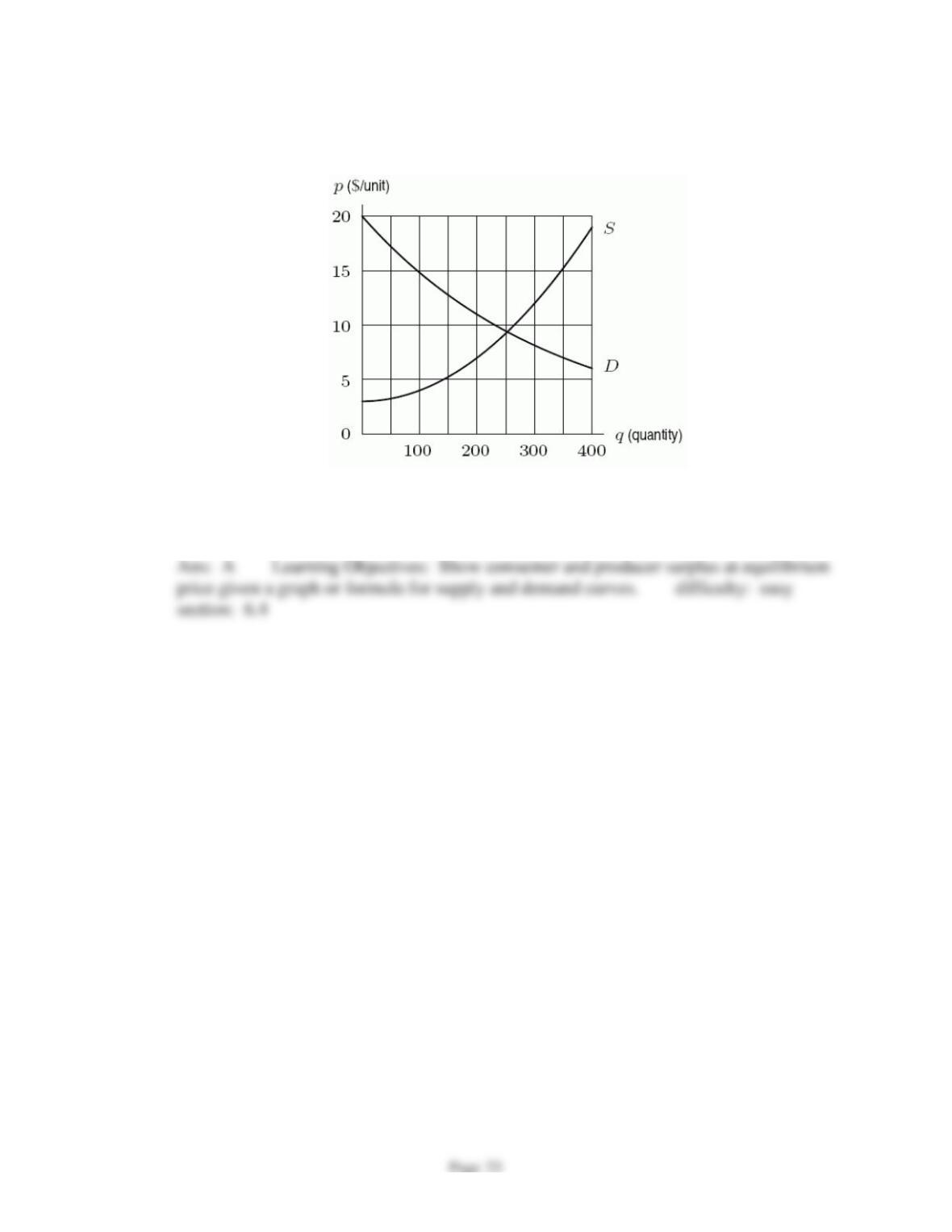
The following figure shows the demand and supply curves for a product. Estimate the
consumer surplus.
A)
$1125
B)
$1000
C)
$400
D)
$875
section: 6.4
Chapter 6
61.
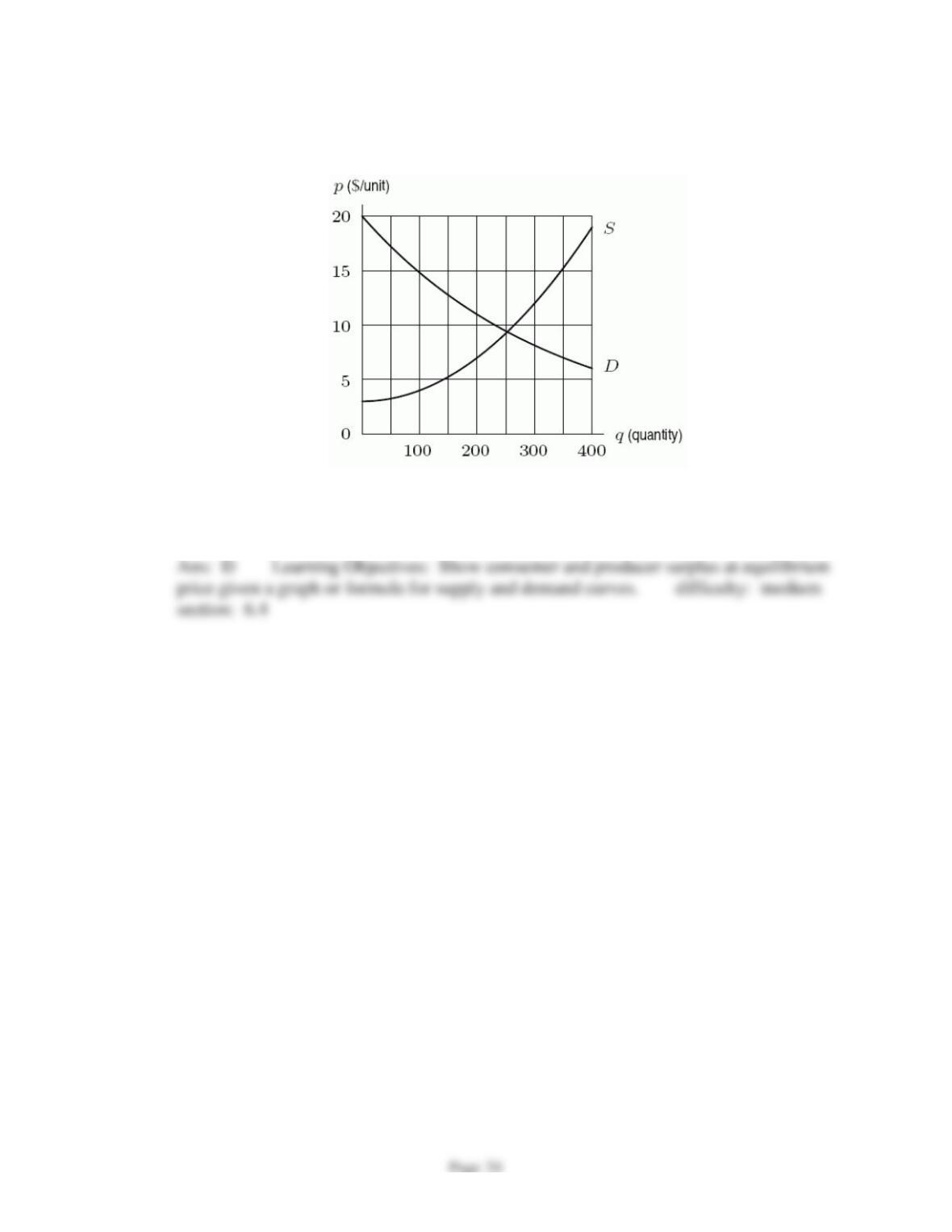
The following figure shows the demand and supply curves for a product. Estimate the
total gains from trade.
A)
$1400
B)
$2000
C)
$1275
D)
$2125
section: 6.4
Chapter 6
62.
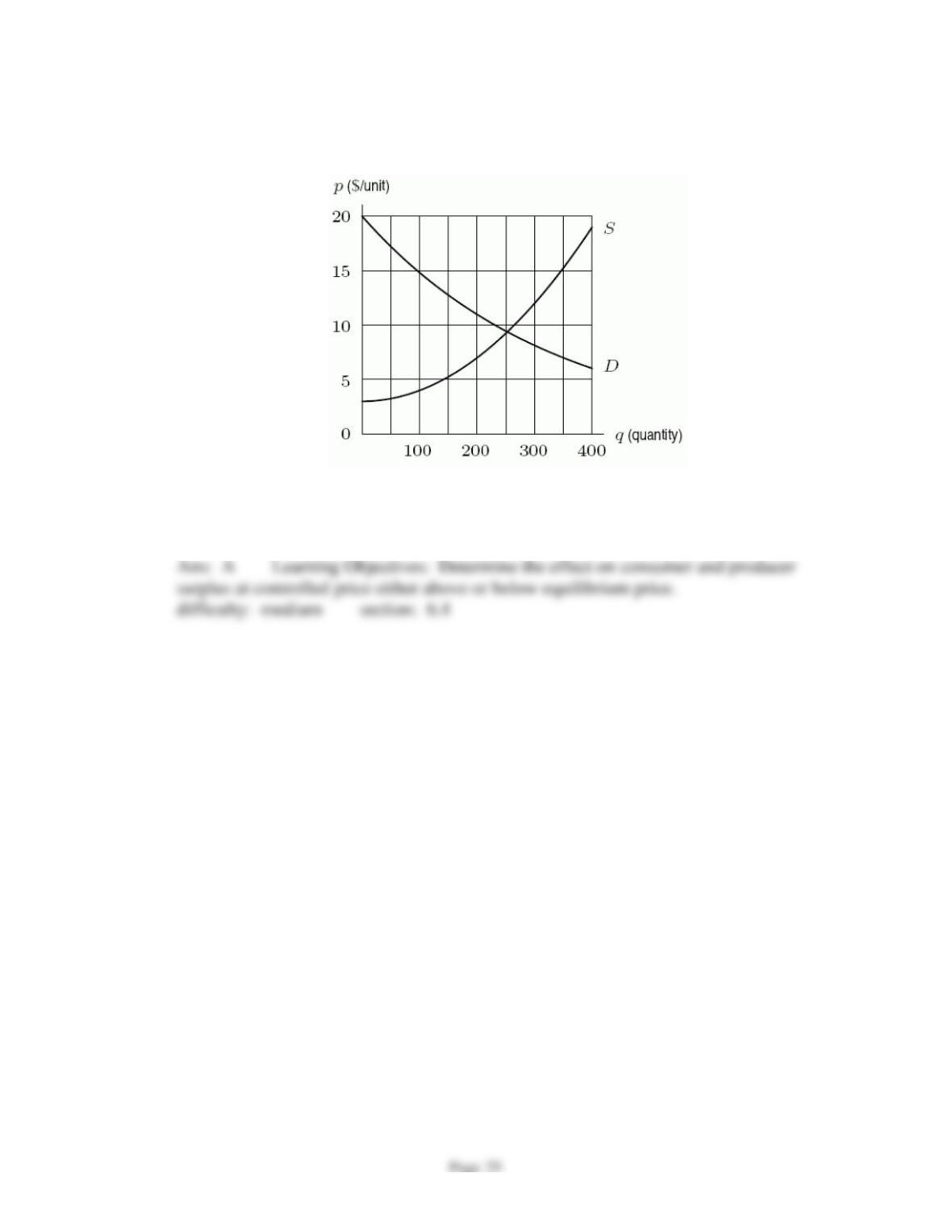
The following figure shows the demand and supply curves for a product. At an
artificially imposed price of $14, what quantity will consumers buy?
A)
120
B)
150
C)
190
D)
220
difficulty: medium section: 6.4
Chapter 6
63.
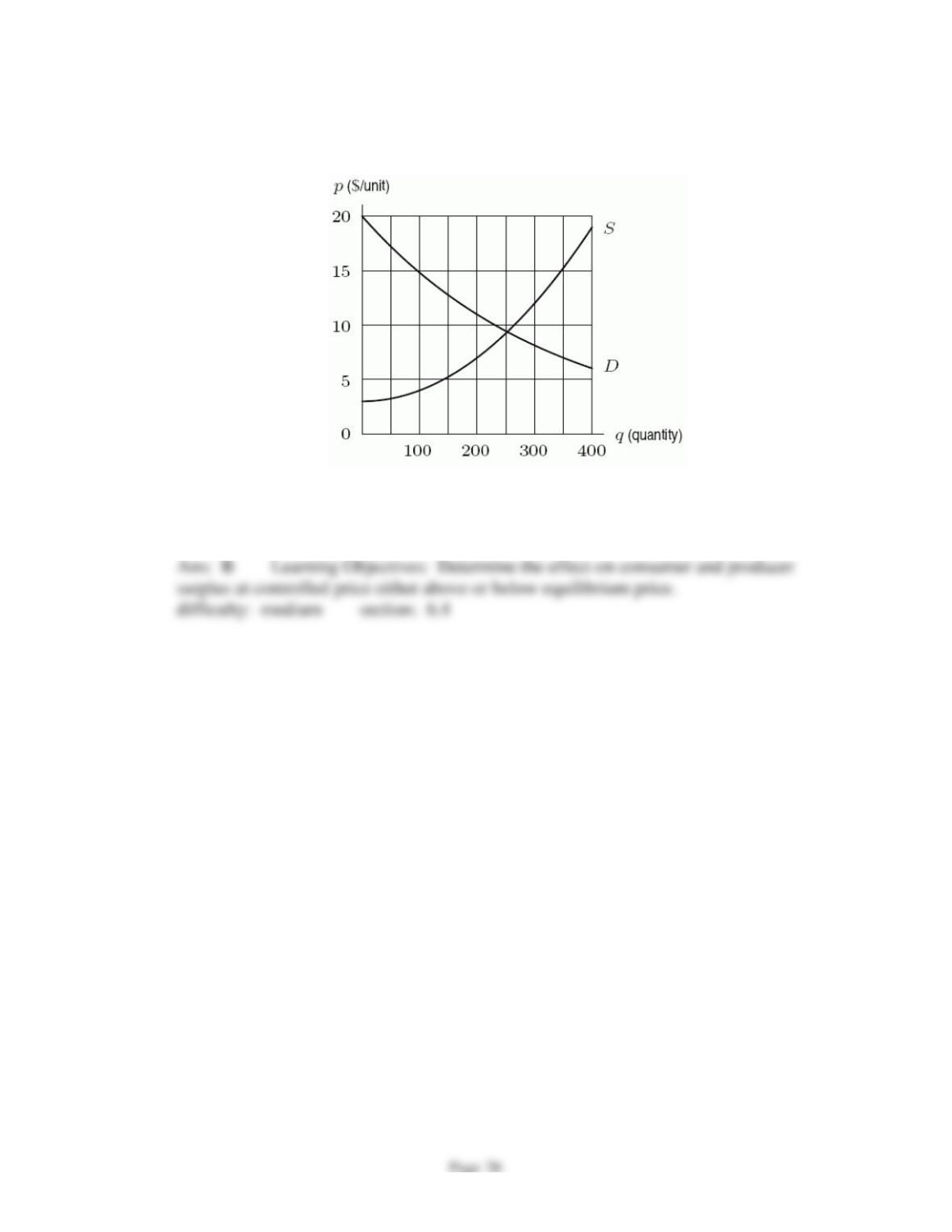
The following figure shows the demand and supply curves for a product. At an
artificially imposed price of $12, estimate the consumer surplus.
A)
$1125
B)
$625
C)
$825
D)
$1300
difficulty: medium section: 6.4
Chapter 6
64.
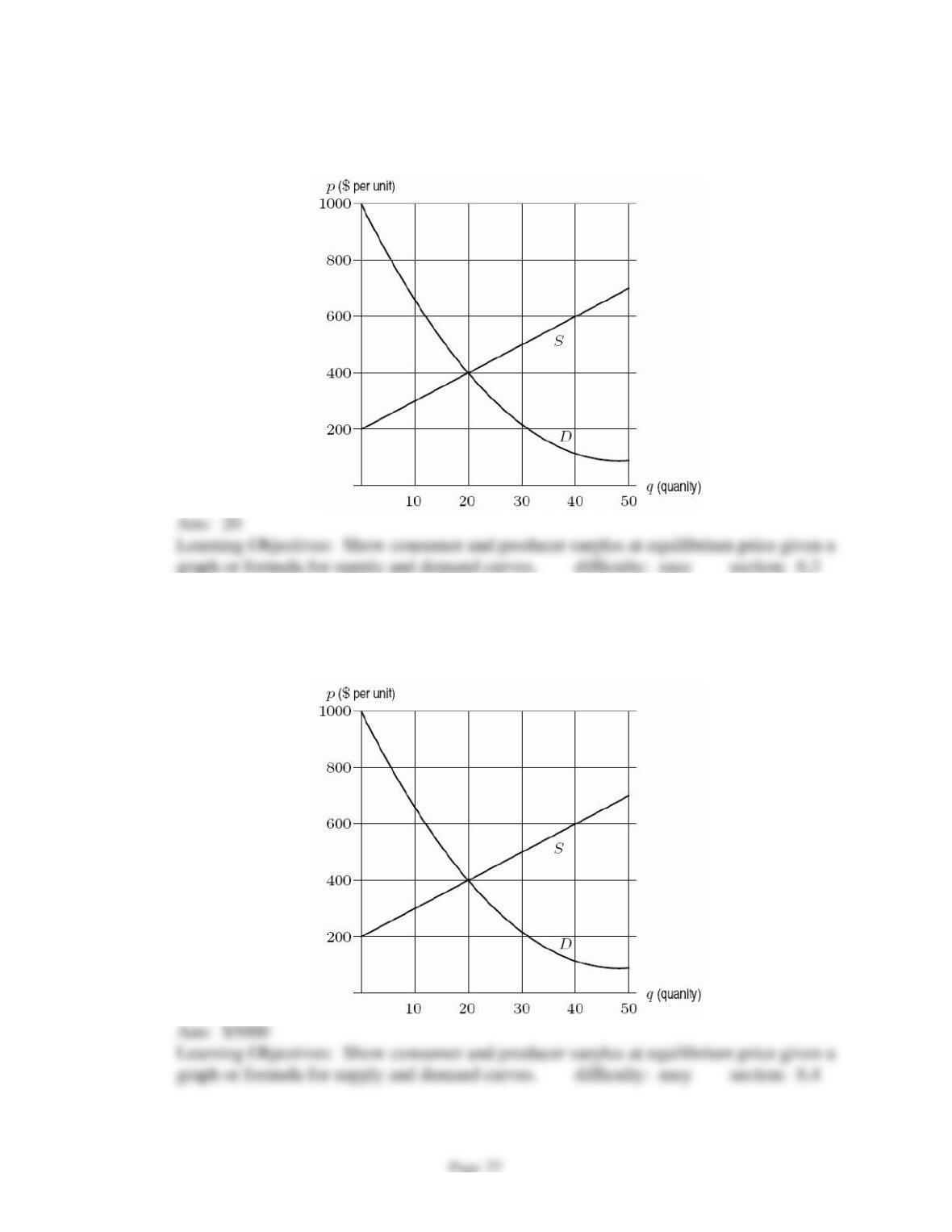
Supply and demand curves for a product are shown in the following figure. Estimate
the equilibrium quantity.
65.
Supply and demand curves for a product are shown in the following figure. Estimate
the consumer surplus, to the nearest thousand dollars.
Chapter 6
66.
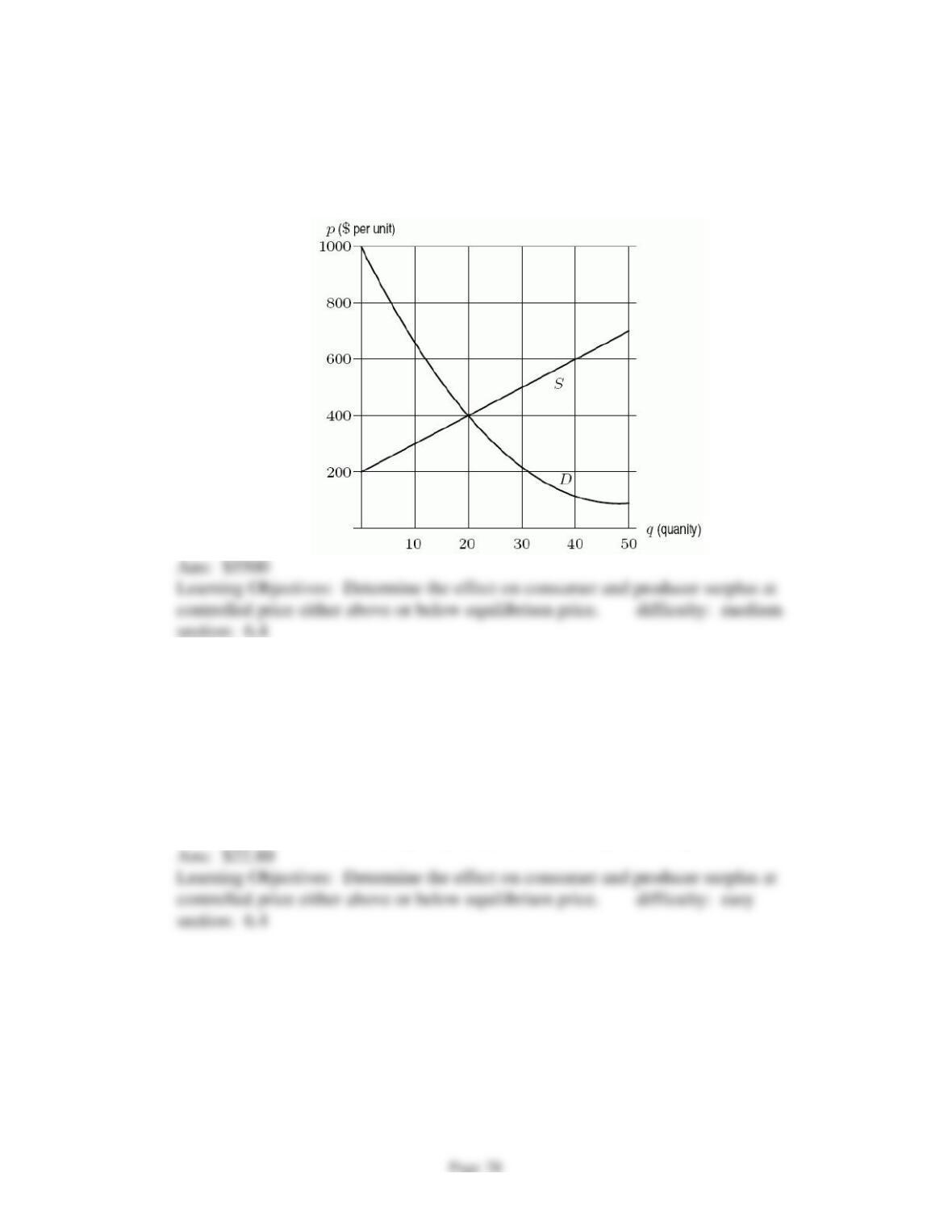
Supply and demand curves for a product are shown in the following figure. Suppose an
artificially low price of $300 is imposed. Estimate the total gains from trade now, to
the nearest 500 dollars.
Ans:
$5500
controlled price either above or below equilibrium price. difficulty: medium
section: 6.4
67.
Supply and demand curves for a product are given by the equations
Demand:
80 7.15pq=−
Supply:
2
0.2 10pq=+
where p is price in dollars and q is quantity. Find the equilibrium price.
Ans:
$22.80
Chapter 6
68.
Supply and demand curves for a product are given by the equations
Demand:
80 7.15pq=−
Supply:
2
0.2 10pq=+
where p is price in dollars and q is quantity. Compute the producer surplus. Round
to the nearest cent.
Ans:
$68.27
Learning Objectives: Determine the effect on consumer and producer surplus at
controlled price either above or below equilibrium price. difficulty: easy
section: 6.4
69.
Supply and demand data are given in the following tables.
q(quantity)
0
10
20
30
40
50
p(dollars per unit)
180
139
108
85
68
55
q(quantity)
0
10
20
30
40
50
p(dollars per unit)
50
73
108
148
190
241
Which table shows demand?
A)
The first one
B)
The second one
Ans: A Learning Objectives: Determine the effect on consumer and producer
surplus at controlled price either above or below equilibrium price.
difficulty: medium section: 6.4
70.
Supply and demand data are given in the following tables.
q(quantity)
0
10
20
30
40
50
p(dollars per unit)
180
139
108
85
68
55
q(quantity)
0
10
20
30
40
50
p(dollars per unit)
50
73
108
148
190
241
What is the equilibrium price?
Ans:
$108
Learning Objectives: Determine the effect on consumer and producer surplus at
controlled price either above or below equilibrium price. difficulty: medium
section: 6.4
Chapter 6
71.
Supply and demand data are given in the following tables.
q(quantity)
0
10
20
30
40
50
p(dollars per unit)
180
139
108
85
68
55
q(quantity)
0
10
20
30
40
50
p(dollars per unit)
50
73
108
148
190
241
Estimate the consumer surplus.
Ans:
$670 when functions are modeled with a quadratic regression, $875 when
averaging left and right sums.
72.
The demand curve for a product has equation
0.004
50 q
pe
−
=
, and the supply curve has
equation
0.1 5pq=+
for
0 400q
, where q is quantity and p is the price per unit.
Use a calculator to find the equilibrium price and quantity, and use this information to
calculate the consumer surplus, to the nearest dollar.
Ans:
$2155
Learning Objectives: Determine the effect on consumer and producer surplus at
controlled price either above or below equilibrium price. difficulty: medium
section: 6.4
73.
The demand curve for a product has equation
0.004
50 q
pe
−
=
, and the supply curve has
equation
0.1 5pq=+
for
0 400q
, where q is quantity and p is the price per unit.
At an artificially high price of $27, find the quantity consumers are willing to purchase
and the quantity producers are willing to supply. Use this information to calculate the
producer surplus at this price, to the nearest dollar.
Ans:
$2202
Learning Objectives: Determine the effect on consumer and producer surplus at
controlled price either above or below equilibrium price. difficulty: medium
section: 6.4
Chapter 6
74.
The supply and demand curves for a product have equations
()p S q=
and
()p D q=
,
respectively, with equilibrium at
( *, *)qp
. Which of the following is a formula for
consumer surplus?
A)
*
0
( ( ) *)
q
D q p dq−
B)
*
0
( ( ) *)
q
S q p dq−
C)
*
0
( * ( ))
q
p D q dq−
D)
*
0
( * ( ))
q
p S q dq
−
E)
*
0
( ( ) ( ))
q
D q S q dq
−
75.
The supply and demand curves for a product have equations
()p S q=
and
()p D q=
,
respectively, with equilibrium at
( *, *)qp
. Which of the following is a formula for
producer surplus?
A)
*
0
( ( ) *)
q
D q p dq−
B)
*
0
( ( ) *)
q
S q p dq−
C)
*
0
( * ( ))
q
p D q dq−
D)
*
0
( * ( ))
q
p S q dq
−
E)
*
0
( ( ) ( ))
q
D q S q dq
−
Chapter 6
76.
The supply and demand curves for a product have equations
()p S q=
and
()p D q=
,
respectively, with equilibrium at
( *, *)qp
. Which of the following is a formula for
total gains from trade?
A)
*
0
( ( ) *)
q
D q p dq−
B)
*
0
( ( ) *)
q
S q p dq−
C)
*
0
( * ( ))
q
p D q dq−
D)
*
0
( * ( ))
q
p S q dq
−
E)
*
0
( ( ) ( ))
q
D q S q dq
−
difficulty: medium section: 6.4
77.
The supply and demand curves for a product have equations
()p S q=
and
()p D q=
,
respectively, with equilibrium at
( *, *)qp
. Suppose an artificially high price of
+
p
is
imposed, with the resulting consumer demand of
+
q
. Which of the following is a
formula for the change in total gains from trade caused by the artificial price?
A)
+
*
( ( ) ( ))
p
p
D q S q dq−
B)
+
*
( ( ) ( ))
q
q
D q S q dq−
C)
+
0
( ( ) ( ))
q
D q S q dq−
D)
+
0
( ( ) ( ))
p
D q S q dq−
difficulty: medium section: 6.4
Chapter 6
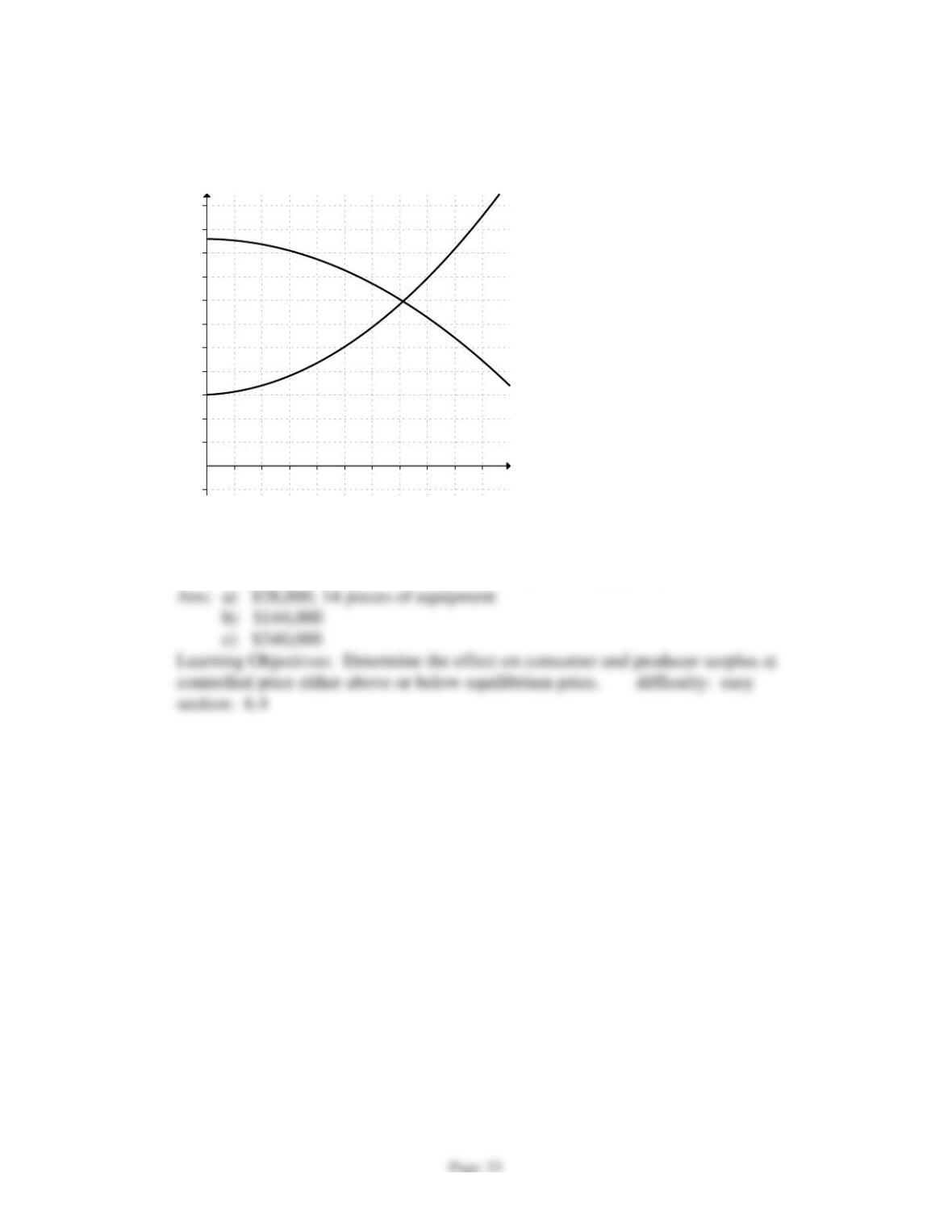
78.
Supply and demand curves for a medical equipment product are given in the graph
below.
a) Estimate the equilibrium price and quantity.
b) Estimate the producer surplus.
c) Estimate the total gains from trade for this piece of equipment.
Supply
Demand
q (quantity)
$p (price) in thousands
-4
4
8
12
16
20
24
28
32
36
40
44
2 4 6 8 10 12 14 16 18 20
Chapter 6
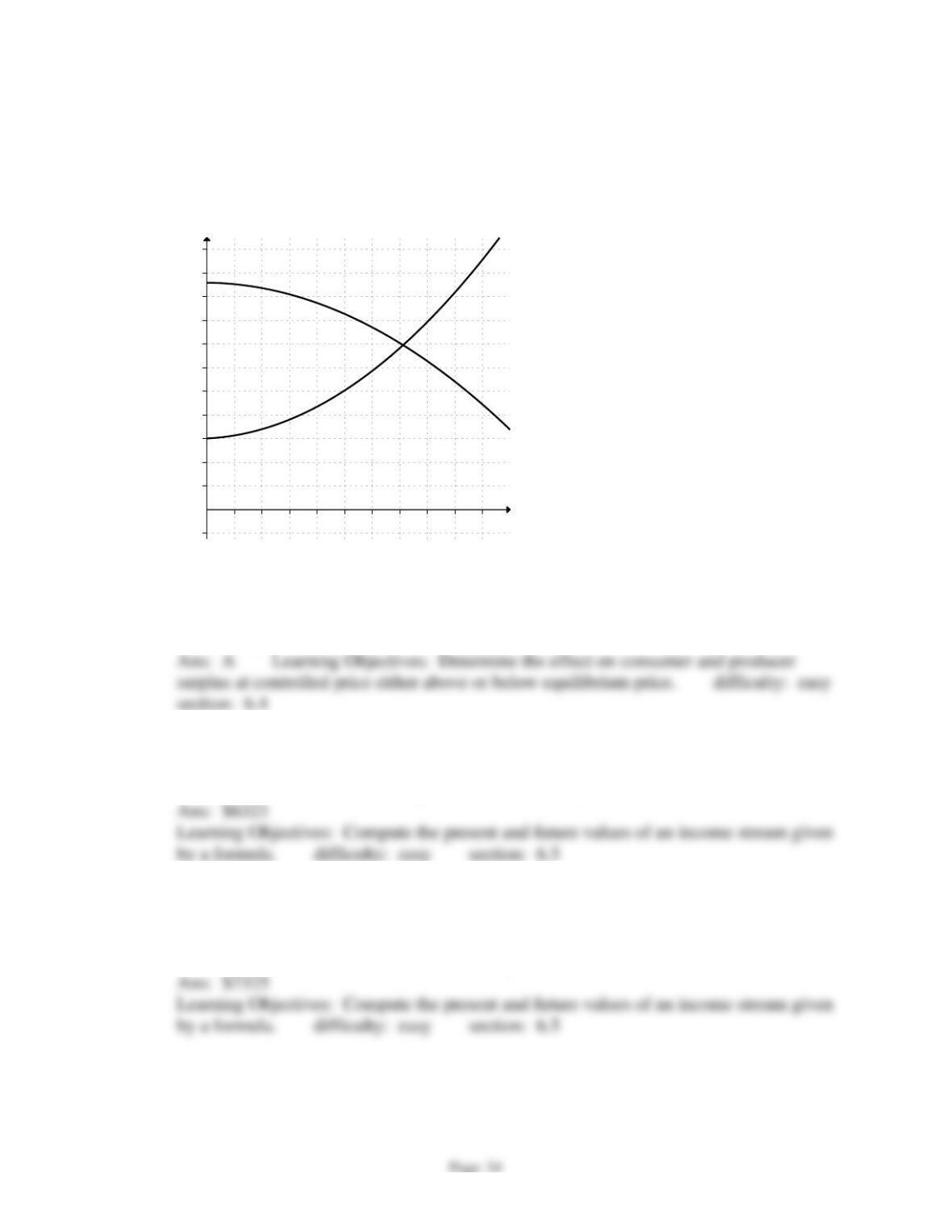
79.
Supply and demand curves for an item of medical equipment are shown in the graph
below. In order to compete with a new product by a rival company, the price is
temporarily lowered to $20,000. What is the reduction (from equilibrium) in producer
surplus that results from this artificially low price?
A)
The producer surplus is reduced by $ 48,000.
B)
The producer surplus is reduced by $ 59,000
C)
The producer surplus is unaffected.
D)
The producer surplus is reduced by $ 36,000
Ans: A Learning Objectives: Determine the effect on consumer and producer
surplus at controlled price either above or below equilibrium price. difficulty: easy
section: 6.4
80.
What is the present value of an income stream of $1000 per year for 10 years with an
annual interest rate of 10%, compounded continuously? Round to the nearest dollar.
Ans:
$6321
Learning Objectives: Compute the present and future values of an income stream given
by a formula. difficulty: easy section: 6.5
81.
From the time a child is born until he is 18, a father plans to set aside $100 times the
child’s current age each year. Find the present value of this income stream, given an
interest rate of 7% compounded continuously. Round to the nearest dollar.
Supply
Demand
q (quantity)
$p (price) in thousands
-4
4
8
12
16
20
24
28
32
36
40
44
2 4 6 8 10 12 14 16 18 20
Ans:
$7325
Learning Objectives: Compute the present and future values of an income stream given
by a formula. difficulty: easy section: 6.5
Chapter 6
82.
A. Find the present value of an income stream of $1000 per year for a period of 5 years
if the interest rate is 8%. Round to the nearest dollar.
B. Find the future value of this income stream. Round to the nearest dollar.
Part A:
A. $4121
Part B:
B. $6148
Learning Objectives: Compute the present and future values of an income stream given
by a formula. difficulty: easy section: 6.5
83.
A consultant expects an income stream of $15,000 per year for the next 8 years.
A. Find the present value of this income stream if the interest rate is 2% per year,
compounded continuously.
B. Find the future value of this income stream under the same conditions.
Part A:
A. $110,892
Part B:
B. $130,133
Learning Objectives: Compute the present and future values of an income stream given
84.
At what constant, continuous annual rate should you deposit money into an account if
you want to have $1,000,000 in 20 years? The account earns 5% interest, compounded
continuously. Round to the nearest dollar.
Ans:
$29,099
Learning Objectives: Compute the present and future values of an income stream given
by a formula. difficulty: medium section: 6.5
85.
A lottery winner is offered a choice between
A. a lump sum of $50,000 now, or
B. $5000 per year for 15 years.
If the interest rate is 5%, compounded continuously, which is a better choice? Answer
A or B.
Ans:
B
Learning Objectives: Compute the present and future values of an income stream given
by a formula. difficulty: medium section: 6.5
Chapter 6
86.
You are considering buying a salt water chlorinator for your swimming pool. The
equipment costs $1300, and you estimate that you will save $250 per year with the
saltwater system. Will the chlorinator pay for itself in 6 years (i.e. will the present value
of the cost of the chemicals equal or exceed the cost of the chlorinator)? Assume an
annual interest rate of 7%, compounded continuously. Answer “yes” or “no”.
Ans:
no
Learning Objectives: Compute the present and future values of an income stream given
by a formula. difficulty: medium section: 6.5
87.
A family invests in a snow cone stand that has an annual income of $10,000. If they
plan to keep the stand for 10 years and save all of the income in an account earning
4.5% interest, compounded continuously, what will their total savings be?
Ans:
$126,291
Learning Objectives: Compute the present and future values of an income stream given
88.
Business A predicts an income stream of
0.1
1000 t
e
dollars per year t years from now.
Business B predicts an income stream of
2
100 500t+
dollars per year t years from now.
Assuming an annual interest rate of 4%, compounded continuously, which is worth
more after 5 years? Answer “A” or “B”.
Ans:
B
89.
Business A predicts an income stream of
0.1
1000 t
e
dollars per year t years from now.
Business B predicts an income stream of
2
100 500t+
dollars per year t years from now.
Assuming an annual interest rate of 3%, compounded continuously, which is worth
more after 5 years? Answer “A” or “B”.
Ans:
B
Learning Objectives: Compute the present and future values of an income stream given
by a formula. difficulty: medium section: 6.5
Chapter 6
90.
A young couple wants to start a family in five years time. They plan to add an addition
to their home in four years so it is ready when they start their family. They estimate
that $ 130,000 will be needed in four years. They can earn 8% on an investment now.
If the couple makes one lump sum deposit now in order to have $ 130,000 in four years,
how much should they deposit.
A)
$ 94,399
B)
$ 93,763
C)
$ 95,216
D)
$ 95,355
Ans: A Learning Objectives: Compute the present and future values of an income
stream given by a formula. difficulty: easy section: 6.5
91.
A young couple wants to start a family in five years time. They plan to add an addition
to their home in four years so it is ready when they start their family. They estimate
that $90,000 will be needed in four years. They can earn 5% on an investment now.
If the couple adds money to an investment at a continuous, constant rate for the entire
four-year period, at what rate (in dollars per year) should the money be deposited in
order to reach the goal of $90,000 in four years?
A)
$ 20,325
B)
$ 20,830
C)
$ 19,413
D)
$ 20,480
Ans: A Learning Objectives: Compute the present and future values of an income
stream given by a formula. difficulty: easy section: 6.5
92.
Your company is downsizing and offers you a bonus if you retire early. You have a
choice between a lump sum of $52,000 now or an income stream of $6200 per year for
10 years. You plan to use the money for a trip around the world in 10 years. You can
earn interest at a continuous rate of 4%. Which option would be the better choice, and
how much will you have for your trip?
Ans:
lump sum, $77,575
Learning Objectives: Compute the present and future values of an income stream given
by a formula. difficulty: easy section: 6.5