Solve the problem.
54)
54)
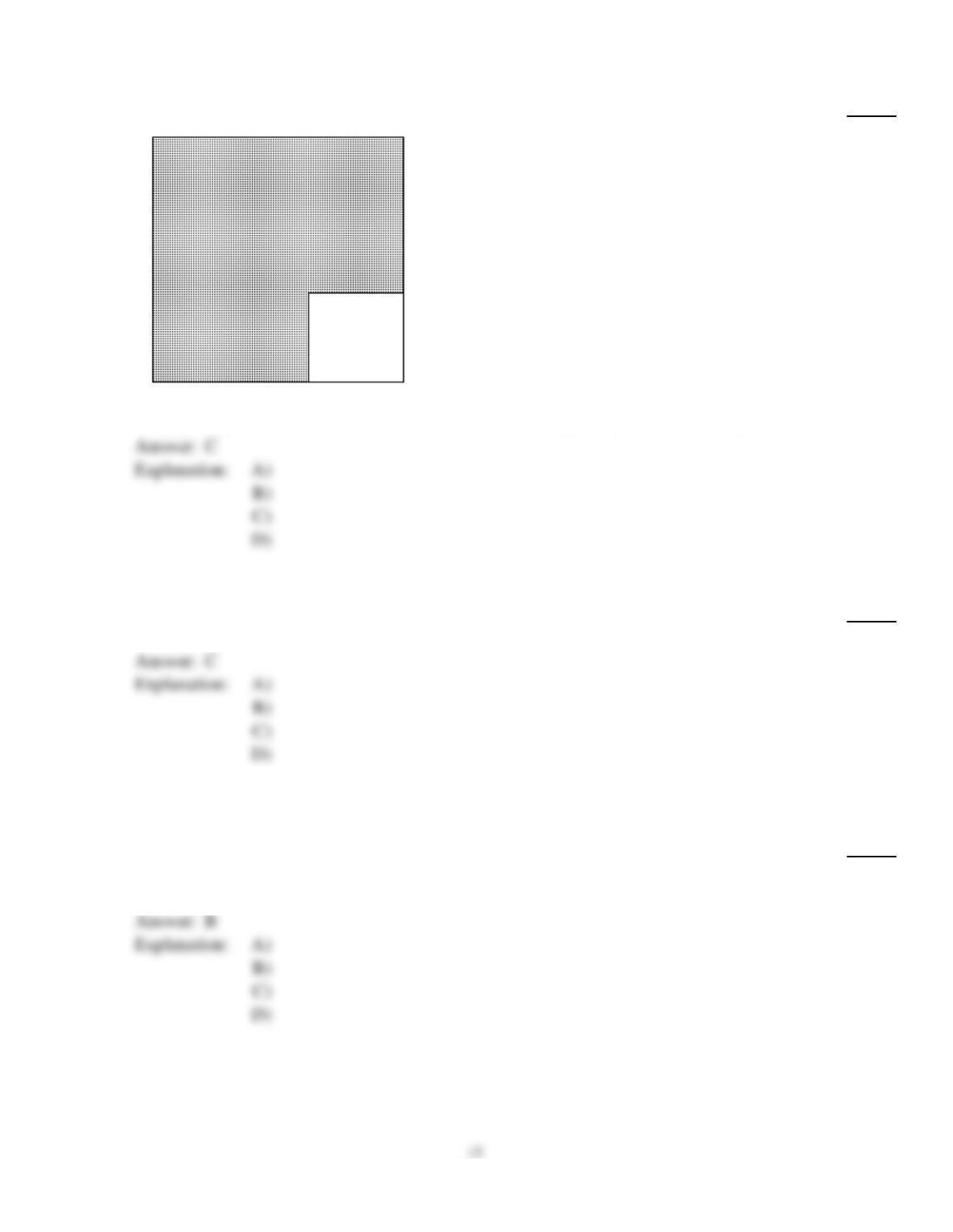
Find a formula for the area of the shaded grey region and express it in factored form.
7x
7x
1
1
A)
(x +7)(x –7)
B)
7x – 1
C)
(7x + 1)(7x – 1)
D)
(7x – 1)(7x – 1)
Factor completely. If unfactorable, indicate that the polynomial is prime.
55)
(x +6)2–16
55)
A)
(x + 22)(x – 10)
B)
x2+ 12x + 20
C)
(x + 10)(x + 2)
D)
(x – 2)(x – 10)
Factor completely using the trial and error method to factor trinomials. If unfactorable, indicate that the polynomial is
prime.
56)
x6– 3x5– 18x4
56)
A)
x4(x – 3)(x – 6)
B)
x4(x + 3)(x – 6)
C)
x4(x + 3)(x + 6)
D)
x3(x2– 3x – 18)
Solve the problem.
57)
57)
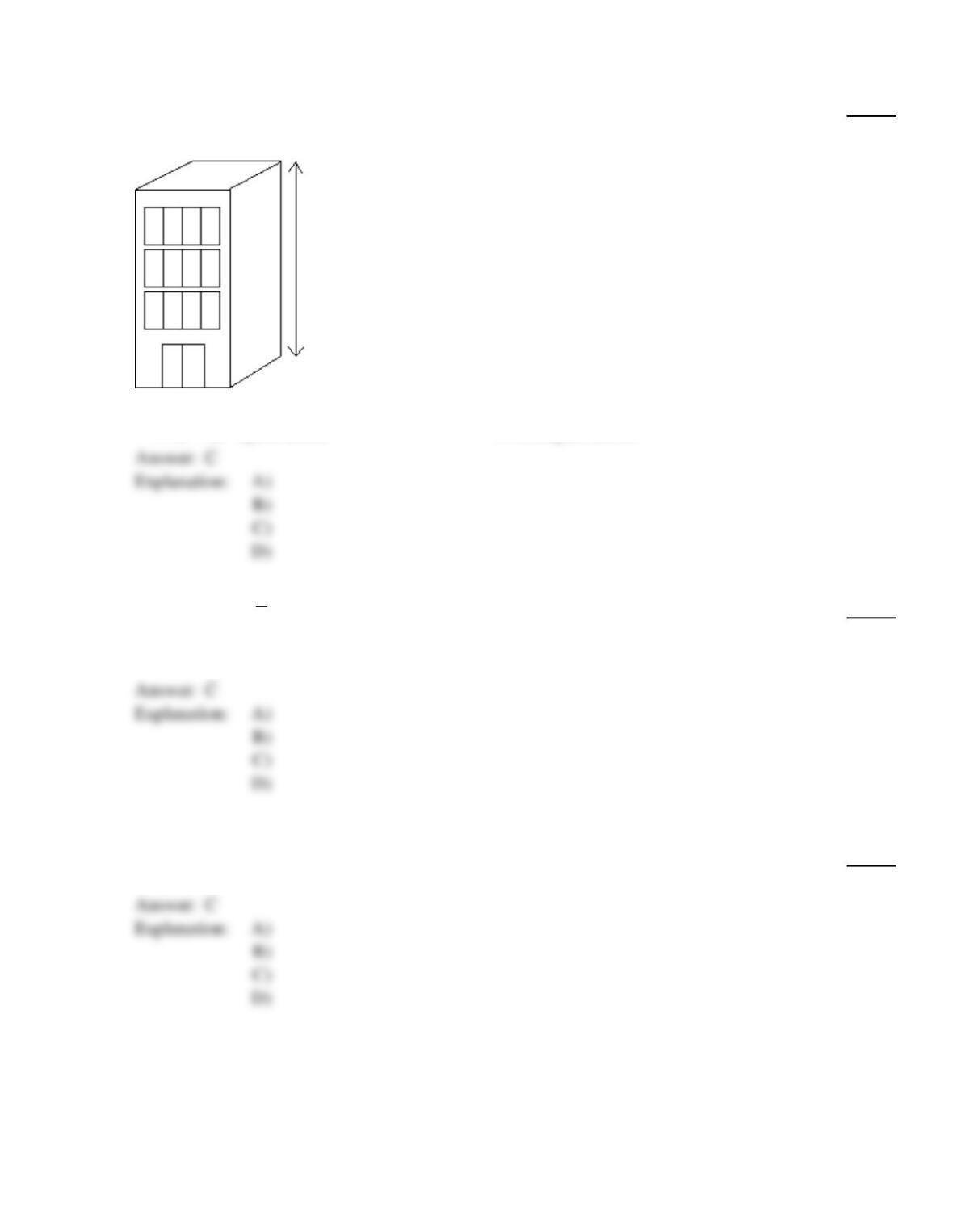
The model of a building has the shape of a rectangular solid. The height is represented by x
inches. The base of the model is square and the volume of the model is x3–60x2+900x. Express
the area of the model‘s base in terms of x.
x inches
A)
(x +30)(x –30) square inches
B)
x2–900 square inches
C)
(x –30)2 square inches
D)
60x square inches
58)
The equation D =1
2n(n – 3) gives the number of diagonals D for a polygon with n sides. Use this
equation to solve the problem. Find the number of sides n for a polygon that has 90 diagonals.
58)
A)
16 sides
B)
3 sides
C)
15 sides
D)
12 sides
Factor by grouping.
59)
x2– 4x – 3x + 12
59)
A)
(x – 3)(x + 8)
B)
(x + 3)(x – 4)
C)
(x – 3)(x – 4)
D)
–7x(x2+ 12)
16
Solve the problem.
60)
60)
An object is thrown upward from the top of a 160–foot building with an initial velocity of 48 feet
per second. The height h of the object after t seconds is given by the quadratic equation
h = – 16t2+
48t + 160. When will the object hit the ground?
A)
2 sec
B)
160 sec
C)
–2 sec
D)
5 sec
Factor completely. If unfactorable, indicate that the polynomial is prime.
61)
z2–49
61)
A)
(z –7)2
B)
(z +7)2
C)
prime
D)
(z +7)(z –7)
Factor completely, or state that the polynomial is prime.
62)
x2– 7x + 12
62)
A)
(x + 4)(x – 3)
B)
(x – 4)(x – 3)
C)
prime
D)
(x + 4)(x + 1)
Factor completely. If unfactorable, indicate that the polynomial is prime.
63)
3x7+
12x6+ 12x5
63)
A)
x7(3x + 6)(x + 2)
B)
3x7(x2+ 4x + 4)
C)
3x7(x – 2)2
D)
3x5(x + 2)2
17
Factor out the GCF from the polynomial.
64)
64)
8x + 8
A)
64x
B)
8(x + 1)
C)
8x + 1
D)
8(x + 8)
Factor completely. If unfactorable, indicate that the polynomial is prime.
65)
x2+ 23x + 24
65)
A)
prime
B)
(x + 24)(x – 1)
C)
(x – 8)(x + 3)
D)
(x + 8)(x – 3)
Factor.
66)
48m6– 48m4– 42m2
66)
A)
–m2(–48m4– 48m2+ 42)
B)
m2(48m4– 48m2– 42)
C)
6m2(8m4– 8m2– 7)
D)
6(8m6– 8m4– 7m2)
Factor completely. If unfactorable, indicate that the polynomial is prime.
67)
49x2– 16
67)
A)
(7x + 4)2
B)
prime
C)
(7x – 4)2
D)
(7x + 4)(7x – 4)
Factor completely using the trial and error method to factor trinomials. If unfactorable, indicate that the polynomial is
prime.
68)
6x2– 21x – 12
68)
A)
3(2x + 1)(x – 4)
B)
3(2x – 1)(x + 4)
C)
prime
D)
(6x – 3)(x + 4)
Solve the problem.
69)
69)
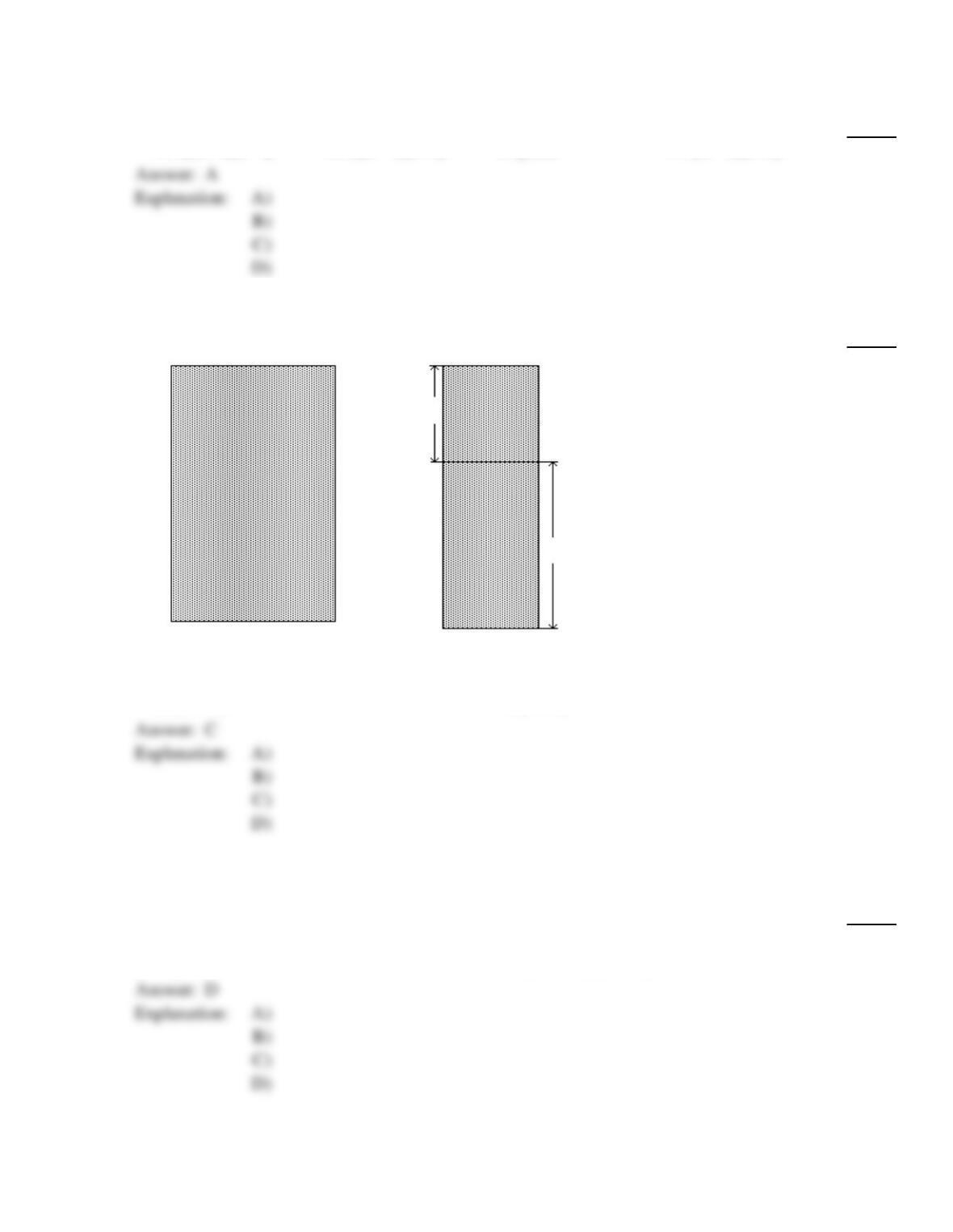
Express the total shaded area as the product of two binomials.
x 3
3
16x
8x
(The figures are not drawn to scale.)
A)
(4x +3)(4x –3)
B)
(4x +3)(16x2–24x +9)
C)
(4x +3)2
D)
(3x +4)2
Factor completely using the trial and error method to factor trinomials. If unfactorable, indicate that the polynomial is
prime.
70)
25x3y4+30x2y5+8xy6
70)
A)
x(5xy4+4y5)(5x +2y)
B)
y4(5x +4y)(5x2+2xy)
C)
prime
D)
xy4(5x +4y)(5x +2y)
19
Factor out the GCF from the polynomial.
71)
15m8+ 9m4– 6m2
71)
A)
m2(15m6+ 9m2– 6)
B)
3(5m8+ 3m4– 2m2)
C)
cannot be factored
D)
3m2(5m6+ 3m2– 2)
Factor completely. If unfactorable, indicate that the polynomial is prime.
72)
100a2+ 0a – 36
72)
A)
(20a + 12)(5a – 3)
B)
(5a + 3)(20a – 12)
C)
4(5a + 3)(5a – 3)
D)
4(5a – 3)(5a + 3)
Factor out the GCF from the polynomial.
73)
17x4– 13x6
73)
A)
17x41 –13
17 x2
B)
17(x4– 221)
C)
x4(1 – 13x2)
D)
x4(17 – 13x2)
Solve the equation.
74)
x2+ 7x – 30 = 0
74)
A)
{–10, 3}
B)
{–3, 10}
C)
{3, 10}
D)
{–10, 1}
20
Factor completely.
75)
x4–x
64
75)
A)
x2–1
4x2+1
16 x +1
64
B)
x x +1
4x2–1
4x +1
16
C)
x x2–1
4x2+1
16 x +1
64
D)
x x –1
4x2+1
4x +1
16
Find the greatest common factor of the monomials.
76)
64x8y4 and 88x5y8
76)
A)
8x5y4
B)
704x8y8
C)
8x8y8
D)
4x3y4
Factor completely.
77)
x3– x2– 12x
77)
A)
x(x + 3)(x – 4)
B)
(x2+ 1)(x – 12)
C)
x(x + 4)(x – 3)
D)
prime
78)
x2+ 12xy + 27y2
78)
A)
(x – 9y)(x + y)
B)
(x – 9y)(x + 3y)
C)
prime
D)
(x + 9y)(x + 3y)
21
Factor by grouping.
79)
10x3– 12x2y – 25xy2+ 30y3
79)
A)
(10x2– 5y2)(x – 6y)
B)
(2x2– 5y2)(5x – 6y)
C)
(2x2+ 5y2)(5x + 6y)
D)
(2x2– 5y)(5x – 6y)
Factor completely. If unfactorable, indicate that the polynomial is prime.
80)
ab4–81a3b2
80)
A)
ab2(b +9a)(b –9a)
B)
ab2(b –9a)2
C)
prime
D)
a(b2+9ab)(b2–9ab)
81)
25t6– 1
81)
A)
prime
B)
(5t3+ 1 )2
C)
(5t3– 1 )2
D)
(5t3+ 1)(5t3– 1 )
82)
25x10 +y4
82)
A)
(5x5+y2)(5x5–y2)
B)
(5x5–y2)2
C)
prime
D)
(5x5+y2)2
22
Factor out the GCF from the polynomial.
83)
14y3–6y2+10y
83)
A)
y(14y2–6y +10)
B)
2y(7y3–3y2+5y)
C)
2(7y3–3y2+5y)
D)
2y(7y2–3y +5)
Factor completely using the trial and error method to factor trinomials. If unfactorable, indicate that the polynomial is
prime.
84)
8z2+
6z – 9
84)
A)
(8z – 3)(z + 3)
B)
prime
C)
(4z – 3)(2z + 3)
D)
(4z + 3)(2z – 3)
Factor completely, or state that the polynomial is prime.
85)
21x2– 91x – 70
85)
A)
7(3x + 2)(x – 5)
B)
(21x + 14)(x – 5)
C)
7(3x – 2)(x + 5)
D)
prime
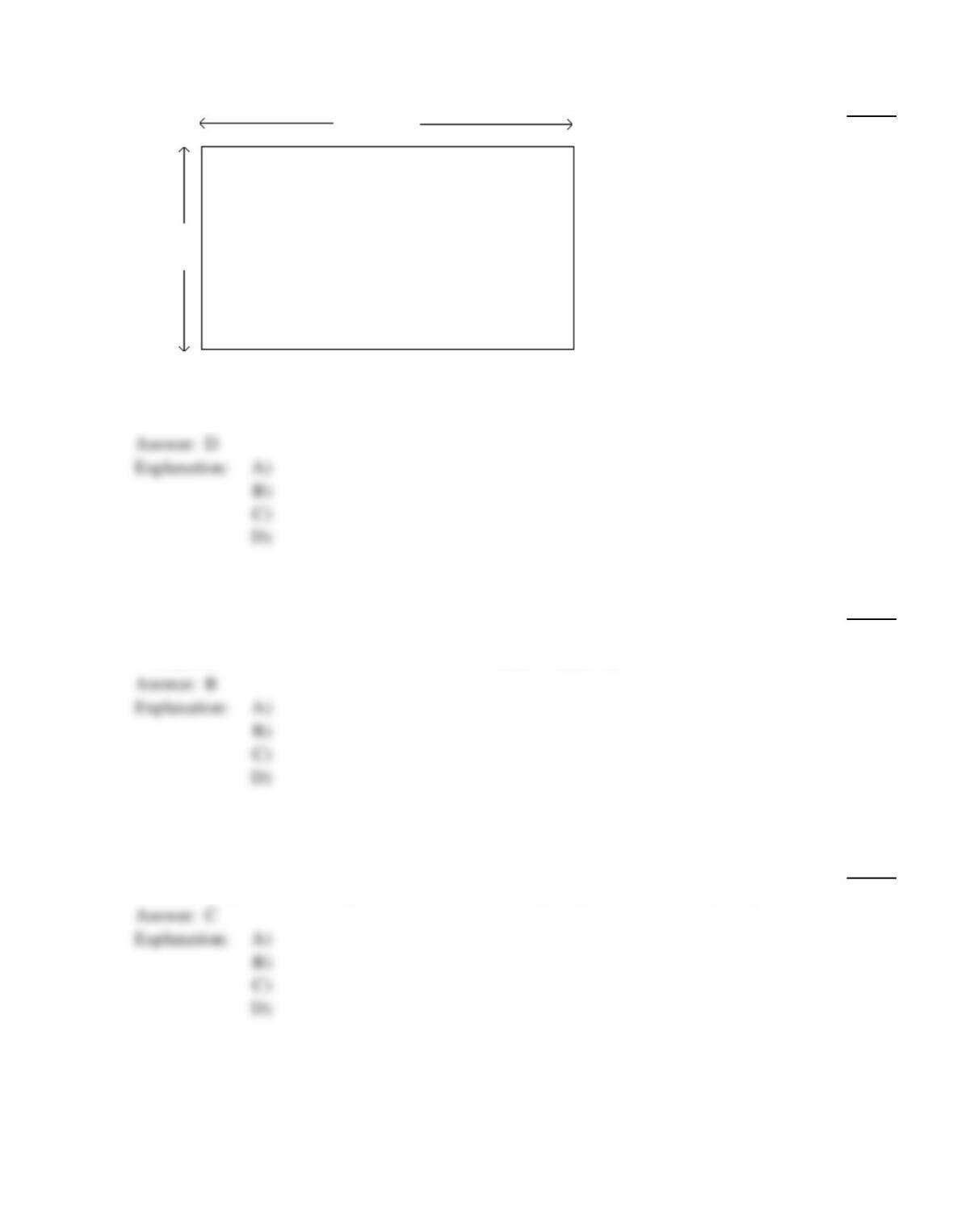
Write a polynomial for the length of the rectangle.
86)
86)
?
x – 8 Area =x2– 5x – 8x + 40 square units
A)
x + 40
B)
x2– 6x – 8x + 35
C)
x2+ 8
D)
x – 5
Factor completely. If unfactorable, indicate that the polynomial is prime.
87)
x3–25x +3x2–75
87)
A)
(x –5)2(x +3)
B)
(x +5)(x –5)(x +3)
C)
prime
D)
(x2–25)(x +3)
Factor completely using the grouping method to factor trinomials. If unfactorable, indicate that the polynomial is
prime.
88)
4y2+
18y – 10
88)
A)
(4y – 2)(y + 5)
B)
prime
C)
2(2y – 1)(y + 5)
D)
2(2y + 1)(y – 5)
24
Factor completely. If unfactorable, indicate that the polynomial is prime.
89)
28m9– 40m6– 36m3
89)
A)
prime
B)
m3(28m6– 40m3– 36)
C)
4(7m9– 10m6– 9m3)
D)
4m3(7m6– 10m3– 9)
Factor completely, or state that the polynomial is prime.
90)
35y4+ 270y3–80y2
90)
A)
5y2(7y +2)(y –8)
B)
prime
C)
5y(7y2+2)(y –8)
D)
5y2(7y –2)(y +8)
Solve the equation.
91)
91)
x(x + 13) = 0
A)
{–13, –1}
B)
{0, 13}
C)
{–13, 1}
D)
{–13, 0}
Find the greatest common factor of the monomials.
92)
–6x10 and 8x7
92)
A)
2x7
B)
–8x3
C)
–6x7
D)
2x10
Factor completely. If unfactorable, indicate that the polynomial is prime.
93)
x3–4x +3x2–12
93)
A)
(x –2)2(x +3)
B)
(x2–4)(x +3)
C)
(x +2)(x –2)(x +3)
D)
prime
Factor.
94)
x3– 512
94)
A)
(x – 8)(x2+ 8x + 64)
B)
(x + 512)(x + 1)(x – 1)
C)
(x + 8)(x2– 8x + 64)
D)
(x – 8)(x2+ 64)
Factor completely, or state that the polynomial is prime.
95)
x2– 4x + 4
95)
A)
(x – 2)2
B)
prime
C)
(x + 2)2
D)
(x – 2)(x + 2)
Factor completely. If unfactorable, indicate that the polynomial is prime.
96)
2x2+
4x – 48
96)
A)
2(x – 4)(x + 6)
B)
(x – 4)(2x + 12)
C)
2(x + 4)(x – 6)
D)
(–48x – 8)(x + 6)
26
Factor completely, or state that the polynomial is prime.
97)
x4–1
97)
A)
(x2–1)(x2–1)
B)
prime
C)
(x2+1)(x +1)(x –1)
D)
(x2+1)(x2+1)
Factor completely.
98)
x5+ 4x4– 45x3
98)
A)
x3(x – 5)(x + 9)
B)
x3(x – 5)(x – 9)
C)
x–5(x2+ 4x – 45)
D)
x3(x + 5)(x + 9)
Solve the problem.
99)
99)
The width of a rectangle is 6 kilometers less than twice its length. If its area is 56 square
kilometers, find the dimensions of the rectangle.
A)
length =4 km, width =2 km
B)
length = 3 km, width =56
3 km
C)
length =7 km, width =8 km
D)
width =7 km, length =8 km
Find the greatest common factor of the monomials.
100)
16x10 and 20x6
100)
A)
16x6
B)
4x6
C)
4x10
D)
20x4