Chapter 06 – Energy and Metabolism
Clarify Question
What is the key concept addressed by the question?
What type of thinking is required?
Gather Content
What do you already know about evolution and time? What other information is related to
the question?
Choose Answer
Do you have all necessary information to determine the relative importance of glycolysis
and the Kreb’s cycle?
Reflect on Process
Did your problem-solving process lead you to the correct answer? If not, where did the
process break down or lead you astray? How can you revise your approach to produce a
more desirable result?
Chapter 06 – Energy and Metabolism
46. Enzyme 1 converts substrate A into product B. Is this an example of a metabolic
pathway?
47. It is summer, and you are excited about going to your local amusement park, and
specifically about riding the new roller coaster that was just built. You imagine waiting at the
top of the stairs for the roller coaster to pull into the station, climbing into the car, strapping
yourself into the seatbelt, and pulling down the harness. You can imagine the cars slowly
chugging up to the top of the first hill, coming down on the other side, and the excitement you
expect to feel as you go along for the ride. Of all of the things that you have imagined, which
is an example of potential energy?
Chapter 06 – Energy and Metabolism
48. Phosphofructokinase (PFK) is an enzyme that converts fructose 6-phosphate to fructose
1,6-bisphosphate, by adding a phosphate group. This is the first committed step of the
metabolic pathway of glycolysis, and thus it is very tightly regulated. AMP binds to PFK at a
site distinct from the binding site for fructose 6-phosphate, and stimulates the formation of
fructose 1,6-bisphosphate. ATP binds to PFK at a site distinct from the binding site for
fructose 6-phosphate, and inhibits the formation of fructose 1,6-bisphosphate. There are other
regulators of this enzyme as well. What is the role of AMP in this example?
Chapter 06 – Energy and Metabolism
Clarify Question
What is the key concept addressed by the question?
What type of thinking is required?
Gather Content
What do you already know about enzymes, feedback inhibition, and glycolysis? What
other information is related to the question?
Choose Answer
Do you have all the information needed to determine how AMP helps to regulate PFK
activity?
Reflect on Process
Did your problem-solving process lead you to the correct answer? If not, where did the
process break down or lead you astray? How can you revise your approach to produce a
Chapter 06 – Energy and Metabolism
more desirable result?
49. You eat a bowl of beans as part of your dinner. As you digest the beans, the proteins that
are present get broken down to their component amino acids. As your body destroys the
macromolecules that were present in the beans, is the energy present in those molecules
destroyed?
50. While standing at the top of the stairs, you have a potential energy of 40 Joules. If you
walk all the way down the stairs, what would your potential energy be at the bottom of the
stairs?
Chapter 06 – Energy and Metabolism
Clarify Question
What is the key concept addressed by the question?
What type of thinking is required?
Gather Content
What do you already know about potential and kinetic energy? What other information is
related to the question?
Choose Answer
Do you have all the information needed to answer the question?
Reflect on Process
Did your problem-solving process lead you to the correct answer? If not, where did the
process break down or lead you astray? How can you revise your approach to produce a
more desirable result?
Chapter 06 – Energy and Metabolism
51. If you were able to increase the kinetic energy of the molecules inside your body, how
would this affect your body temperature?
Chapter 06 – Energy and Metabolism
Clarify Question
What is the key concept addressed by the question?
What type of thinking is required?
Gather Content
What do you already know about potential and kinetic energy? What other information is
related to the question?
Choose Answer
Do you have all the information needed to answer the question?
Reflect on Process
Did your problem-solving process lead you to the correct answer? If not, where did the
process break down or lead you astray? How can you revise your approach to produce a
more desirable result?
Chapter 06 – Energy and Metabolism
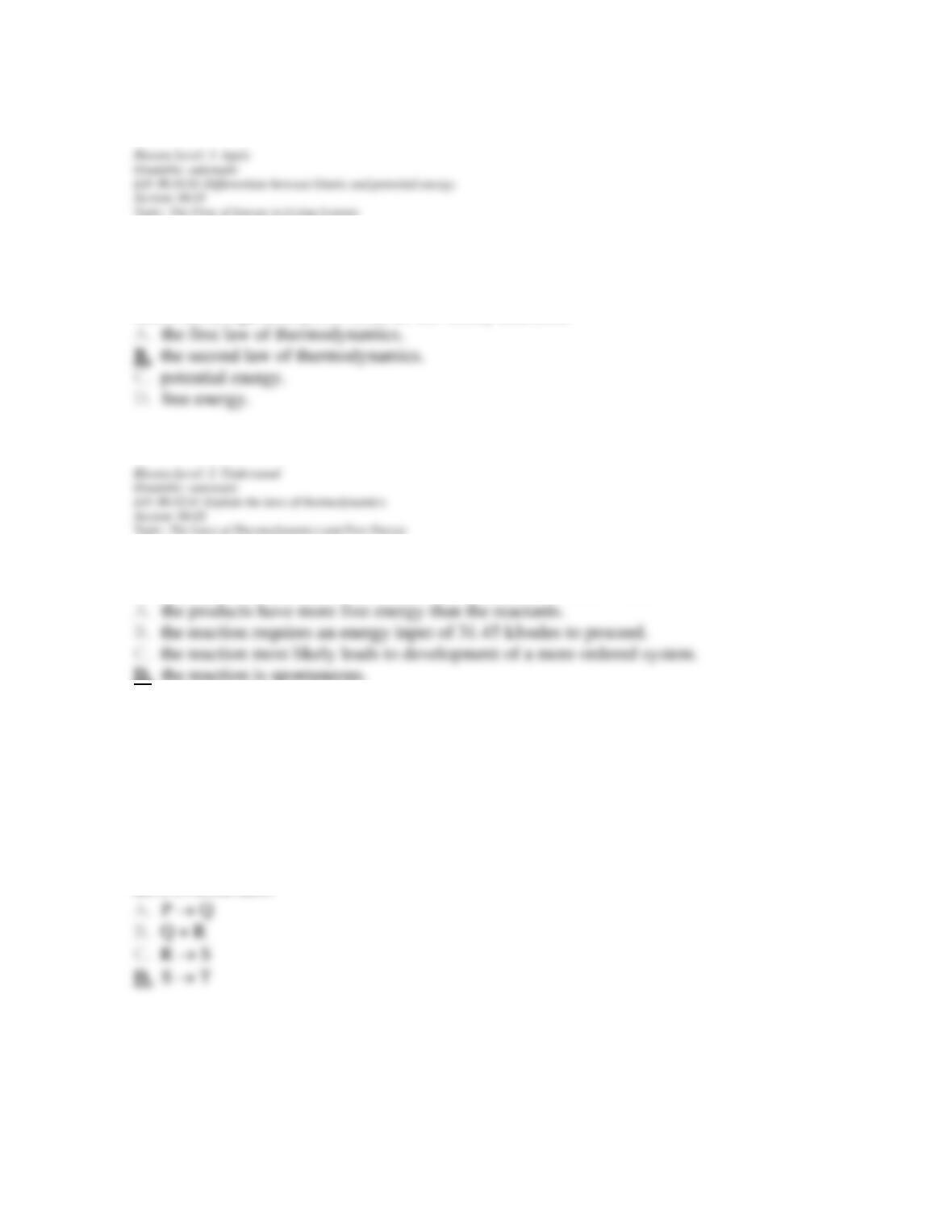
52. You return home to find that your baby brother has scattered his toy trains and trucks all
over the floor of your room. As you begin to pick up the toys and put them away, you realize
that even though he is just a baby, he has clearly mastered:
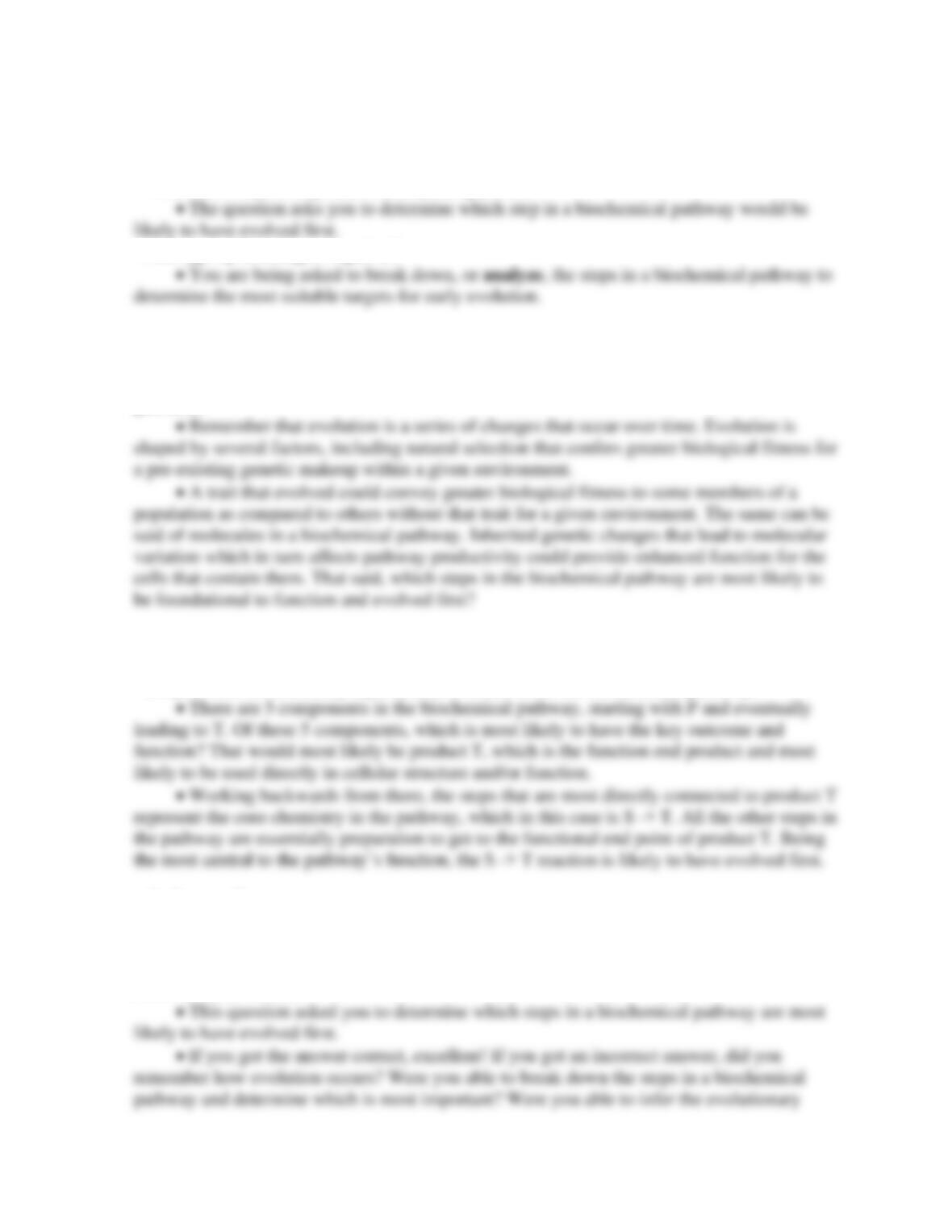
53. If the G of a reaction was -31.45 kJoules, you would know that:
Blooms Level: 2. Understand
Gradable: automatic
LO: 06.02.02 Relate free energy changes to the outcome of chemical reactions.
Section: 06.02
Topic: The Laws of Thermodynamics and Free Energy
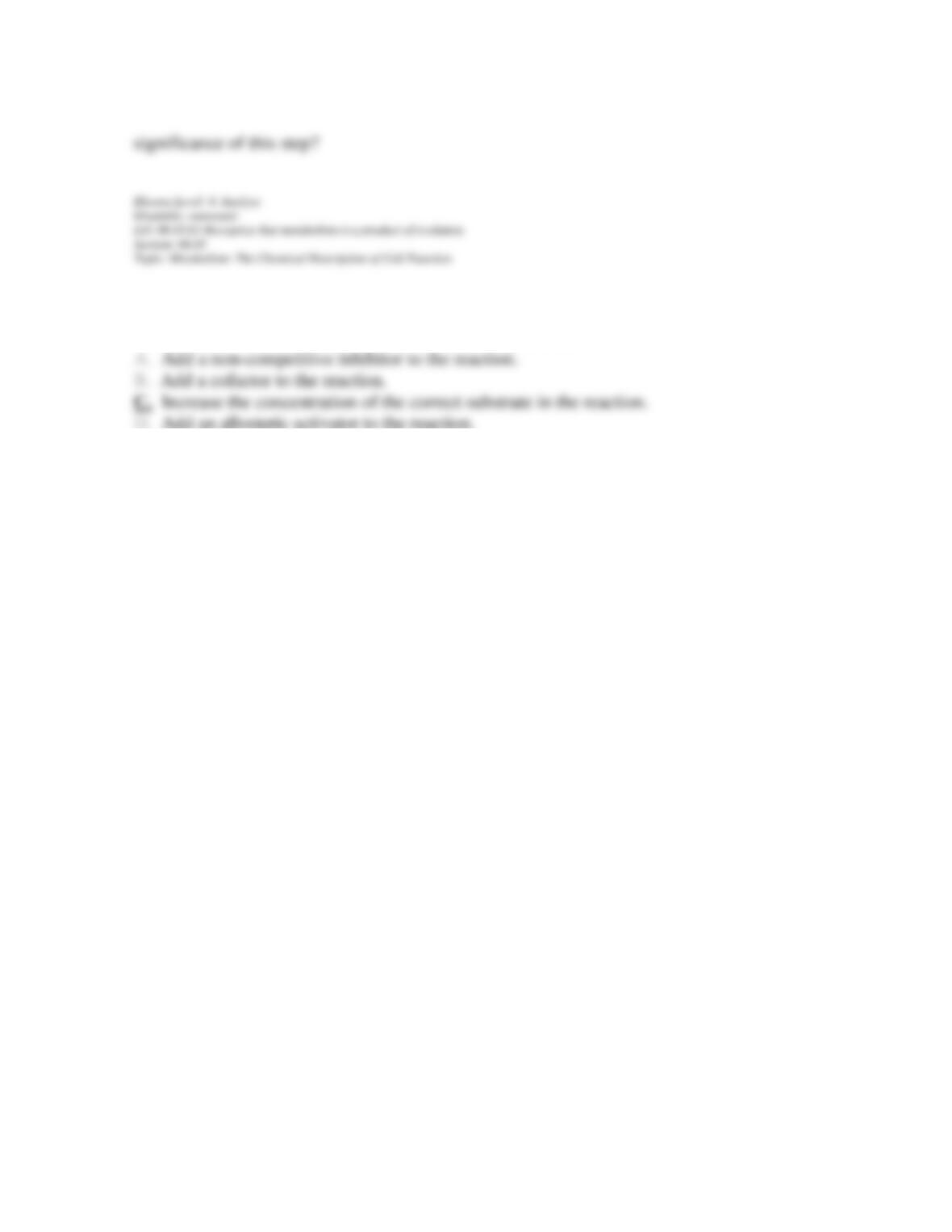
54. In the hypothetical biochemical pathway, P → Q + R → S → T, which step is likely to
have evolved first?
Chapter 06 – Energy and Metabolism
Clarify Question
What is the key concept addressed by the question?
What type of thinking is required?
Gather Content
What do you already know about evolution? What other information is related to the
question?
Choose Answer
Do you have all necessary information to break down the biochemical pathway?
Reflect on Process
Did your problem-solving process lead you to the correct answer? If not, where did the
process break down or lead you astray? How can you revise your approach to produce a
more desirable result?
Chapter 06 – Energy and Metabolism
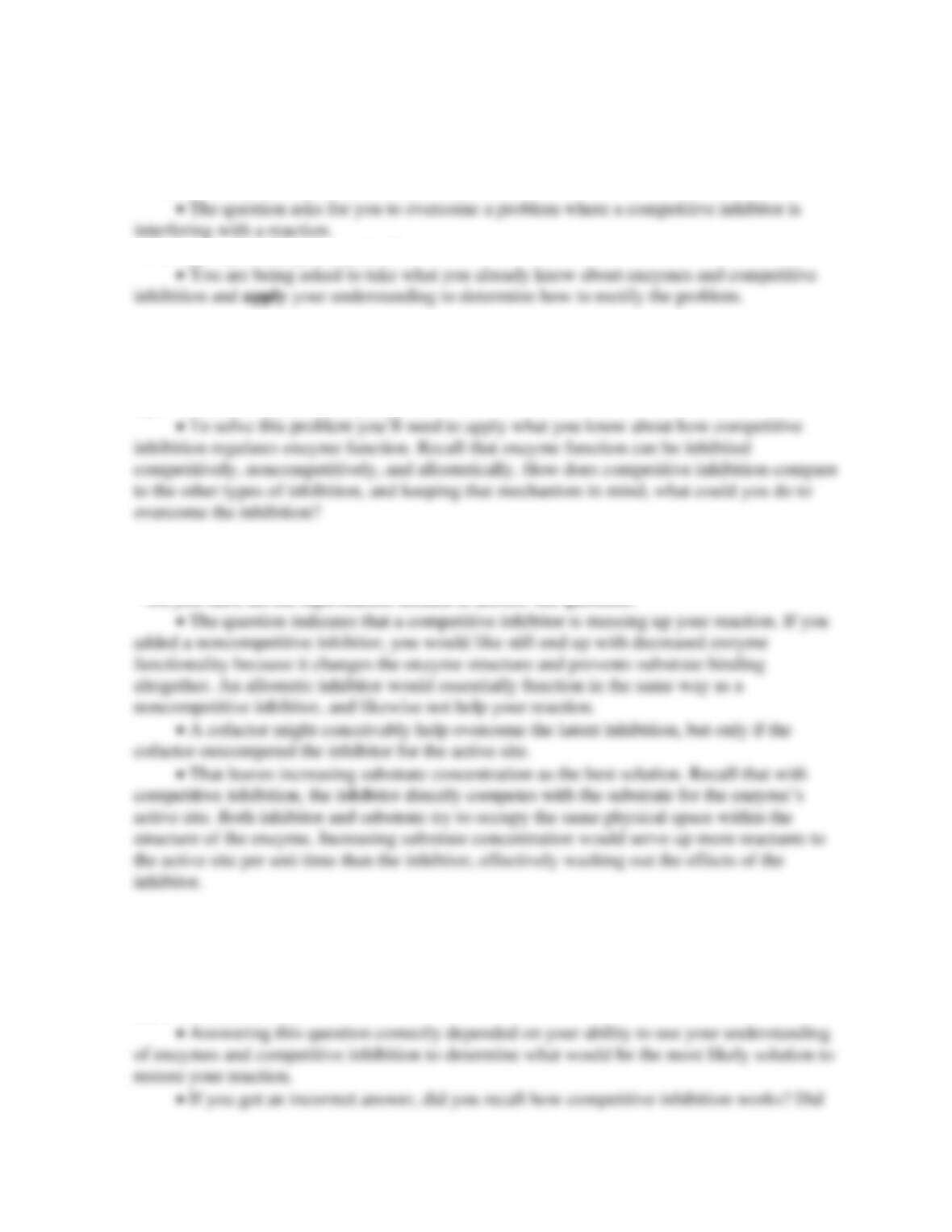
55. While conducting an experiment, you realize that a competitive inhibitor was interfering
with your reaction. How could you overcome this problem?
Chapter 06 – Energy and Metabolism
Clarify Question
What is the key concept addressed by the question?
What type of thinking is required?
Gather Content
What do you already know about enzymes and competitive inhibition? What other
information is related to the question?
Choose Answer
Do you have all the information needed to answer the question?
Reflect on Process
Did your problem-solving process lead you to the correct answer? If not, where did the
process break down or lead you astray? How can you revise your approach to produce a
more desirable result?
Chapter 06 – Energy and Metabolism
56. A ribozyme catalyzes a reaction on itself and actually changes shape. This is an example
of.