Chapter 5: Learners with Exceptionalities
CHAPTER SIX
BEHAVIORISM AND SOCIAL COGNITIVE THEORY
Behaviorist Views of Learning
* 1. Which of the following is the most valid description of learning from a behaviorist point of view?
a. Sensations paired together enough times that they become associated
b. Increases in behavior as a result of anticipating desirable consequences
c. Changes in behavior as a result of observing similar behaviors in others
d. Changes in observable behavior occurring as a result of experience
* 2. Which of the following statements is most consistent with a behaviorist theoretical orientation?
a. Learners construct their own understanding.
b. People strive for equilibrium.
c. Learning is contextual.
d. Learning is observable.
* 3. Of the following, which is most critical to the educator who subscribes to a behaviorist view of learning?
a. Observable behavior
b. Effective modeling
c. Thought processes
d. Appropriate emotions
* 4. Classical conditioning is most concerned with:
a. involuntary responses.
b. practiced behavior.
c. skilled movements.
d. thought processes.
* 5. In classical conditioning, the event that causes an instinctive or reflexive physiological or emotional
response is referred to as the:
a. unconditioned response.
b. unconditioned stimulus.
c. conditioned stimulus.
d. conditioned response.
* 6. In classical conditioning, a learned physiological or emotional response is referred to as the:
a. unconditioned response.
b. unconditioned stimulus.
c. conditioned stimulus.
d. conditioned response.
* 7. In classical conditioning, the unconditioned and conditioned stimuli must occur at essentially the same
time. We refer to this temporal connection as:
a. proximity.
b. pairing.
c. contiguity.
d. connectivity.
* 8. Of the following, the person most associated with classical conditioning is:
a. Bandura.
b. Pavlov.
c. Piaget.
d. Skinner.
Chapter 5: Learners with Exceptionalities
* 9. The meat presented to the dogs in Pavlov’s experiments is best described as a(n):
a. unconditioned stimulus.
b. conditioned stimulus.
c. conditioned response.
d. unconditioned response.
* 10. What concept describes the situation when a stimulus related to the conditioned stimulus elicits the
conditioned response all by itself?
a. Extinction
b. Reinforcement
c. Discrimination
d. Generalization
* 11. What concept describes a learner giving different responses to related but not identical stimuli?
a. Reinforcement
b. Vicarious conditioning
c. Discrimination
d. Generalization
* 12. Pedro has been very nervous when giving oral reports. However, Mrs. Mishima requires several oral
reports in her class. Now Pedro is becoming less and less nervous each time he has to give an oral report.
Of the following, the concept that best explains Pedro’s becoming less nervous is:
a. discrimination.
b. extinction.
c. conditioned responding.
d. generalization.
** 13. Kathy Kelly, a seventh-grade teacher, notices that Joanne, a new student, appears quite ill at ease in her
class. She decides to try to make her feel more comfortable, so each day when Joanne comes in, Kathy
spends a few seconds with her, smiles and puts her arm around Joanne’s shoulder. After a period of time
she notices that Joanne appears to feel much better when entering the classroom. Kathy’s efforts most
closely relate to an application of which of the following?
a. Negative reinforcement
b. Classical conditioning
c. Positive reinforcement
d. Vicarious conditioning
Use the following vignette or items 14-17.
Natasha is going to the dentist, but she doesn’t know what to think—she has no experience with dentists or dentists’
offices. Her dad takes her to the dentist, and she initially doesn’t have a reaction to being in the dentist’s office, but
once the dental procedure starts, Natasha is very uncomfortable. The procedure is noisy and even a little painful.
She goes to the dentist several times with the same experience. Now, whenever Natasha goes into the dentist’s office
she is nervous and uncomfortable.
** 14. In the preceding example, the best description of the neutral stimulus is:
a. the dentist’s office.
b. Natasha’s discomfort.
c. the procedure.
d. Natasha’s being nervous.
** 15. In the preceding example, the unconditioned stimulus is:
a. the dentist’s office.
b. the dental procedure.
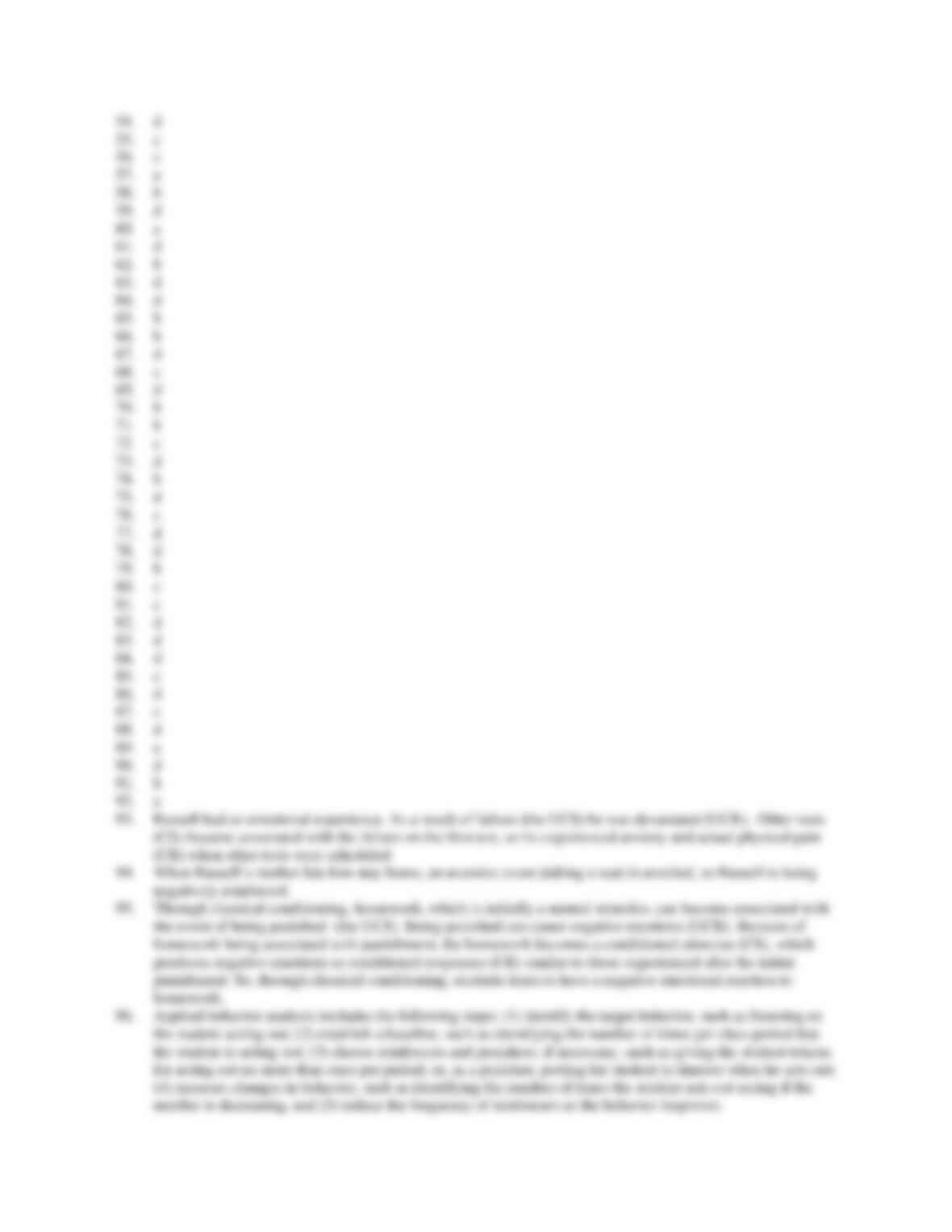
c. Natasha’s dad.
d. Natasha’s being uncomfortable.
Chapter 5: Learners with Exceptionalities
** 16. In the preceding example, the conditioned stimulus is:
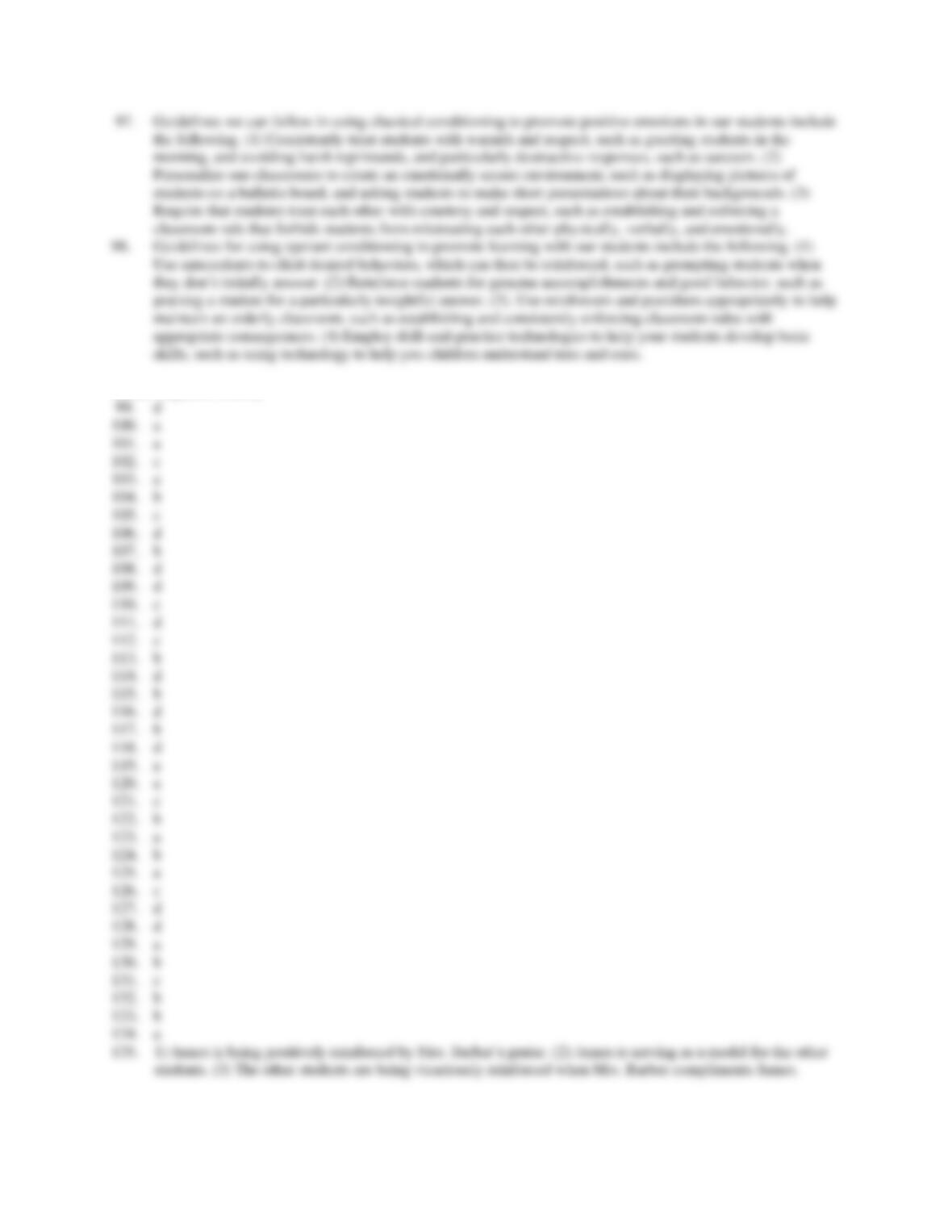
a. the dental procedure.
b. the dentist’s office.
c. Natasha’s dad.
d. Natasha’s feeling pain.
** 17. In the preceding example, the best description of the conditioned response is:
a. the dental procedure.
b. the dentist’s office.
c. Natasha’s dad.
d. Natasha being nervous and uncomfortable.
Items 18–21 are based on the following scenario.
Mike is a conscientious and hard-working student with a good attitude. Because of his excellent work in world
history, he has been placed in AP American history for the eleventh grade. He is a little uneasy, but Mrs. Brewster,
his American history teacher, is standing at the door of the room the first day and asks the students their names as
they come in. After Mike introduces himself, Mrs. Brewster smiles broadly and says, “Oh, Mike, I’m very happy to
have you in here. Mr. Dickens told me about your excellent work last year.”
Mike feels a big sense of relief. Maybe the year would be okay after all. Each morning Mrs. Brewster greets
Mike with the same positive manner as he comes into class. Now when Mike walks into American History class, he
is quite at ease as he anticipates the class. Consider this as a case of classical conditioning, and respond to the
following items.
** 18. In this situation, the best description of the unconditioned stimulus would be:
a. world history class.
b. American history class.
c. Mr. Dickens’s description of Mike’s work.
d. Mrs. Brewster’s manner.
** 19. The best description of the unconditioned response would be Mike’s:
a. conscientiousness.
b. excellent work in world history.
c. uncertainty.
d. relief.
** 20. The best description of the conditioned stimulus would be:
a. world history class.
b. Mrs. Brewster’s greetings.
c. Mr. Dickens’s description of Mike’s work.
d. American History class.
** 21. The best description of the conditioned response would be Mike’s:
a. good work habits.
b. uncertainty about American History.
c. anticipating class.
d. feeling at ease.
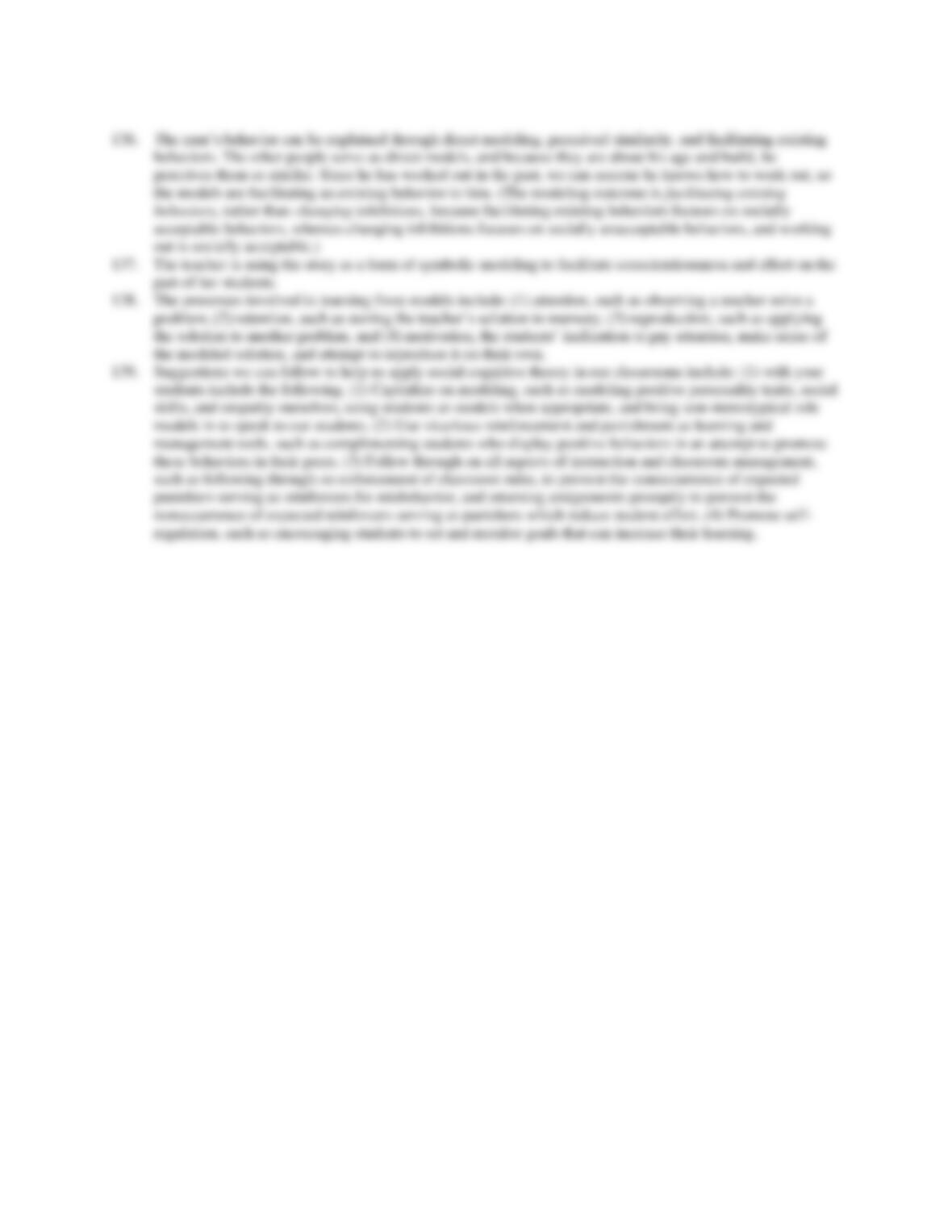
Chapter 5: Learners with Exceptionalities
Use the following information for Items 22-24.
Natasha is moving into the sixth grade in a middle school, and she is a little uncertain about it. In order to help make
the transition, Natasha’s mother drives her to school the first few days. Natasha’s mother drops her off the first day,
and Natasha waves to her mother as she walks toward the school. Mrs. Rodriguez greets her at the entrance of the
main building, smiles, and shakes her hand. Seeing Mrs. Rodriguez smile reassuringly, Natasha relaxes and feels
better.
During the first week, Mrs. Rodriguez greets Natasha each day with the same reassuring manner. Now Natasha
jumps out of the car and is happy about running into the school when her mother drops her off. In fact, she says she
now wants to ride the bus to school.
Consider this a case of classical conditioning with the conditioned response being Natasha’s happiness when
she runs into school, and identify the best description of each of the following:
** 22. The unconditioned stimulus would be:
a. the elementary school.
b. the middle school.
c. Natasha’s mother’s support.
d. Mrs. Rodriguez’s reassurance.
** 23. The unconditioned response would be:
a. Natasha’s security in the elementary school.
b. Natasha’s uneasiness in anticipating the middle school.
c. Natasha’s secure feeling with her mother.
d. Natasha’s relaxing and feeling better.
** 24. The conditioned stimulus would be:
a. the middle school.
b. the elementary school.
c. Mrs. Rodriguez’s reassurance.
d. Natasha’s riding to school with her mother.
** 25. Ramona was nervous when she had to get up in front of her English class to recite a poem and is now
nervous when she has to give a report in world history class. Of the following, the concept that best
explains her nervousness in world history is:
a. generalization.
b. discrimination.
c. extinction.
d. satiation.
** 26. Alan is uncomfortable and nervous running a business meeting, but he is not uncomfortable when working
with a small group. Of the following, the concept that best explains why he is not nervous when working
with a small group is:
a. discrimination.
b. generalization.
c. anxiety.
d. extinction.
* 27. Which of the following is most likely to result in extinction of a response?
a. Some but not all stimuli trigger responses.
b. The conditioned stimulus occurs repeatedly in the absence of the unconditioned stimulus.
c. A stimulus similar to the conditioned stimulus produces the conditioned response.
d. A response is followed by a stimulus that increases the likelihood of the response recurring.
Chapter 5: Learners with Exceptionalities
* 28. Operant conditioning relies most heavily on the events that:
a. occur most directly before eliciting a behavior.
b. initiate a behavior.
c. occur simultaneously with a behavior.
d. occur following a behavior.
* 29. Of the following, the person most associated with operant conditioning is:
a. Bandura.
b. Pavlov.
c. Skinner.
d. Freud.
* 30. The term most closely associated with the idea of stimulus-response-consequence (S1–R-S2) is:
a. vicarious learning.
b. social cognitive theory.
c. classical conditioning.
d. operant conditioning.
* 31. An increase in a behavior as the result of a consequence that follows the behavior best describes:
a. extinction.
b. punishment.
c. reinforcement.
d. generalization.
* 32. The process of increasing a behavior by presenting a consequence is:
a. positive reinforcement.
b. negative reinforcement.
c. presentation punishment.
d. removal punishment.
* 33. Teachers consciously try to praise students for good work and desirable behavior. Praise is intended as:
a. contiguity.
b. a conditioned stimulus.
c. a positive reinforcer.
d. a form of modeling.
** 34. Robert continues to improve in spelling because he has been receiving happy-face stickers when his scores
on spelling quizzes improve. Of the following, which is the best description of the happy-face stickers?
a. They are positive reinforcers.
b. They are negative reinforcers.
c. They are conditioned stimuli.
d. They are forms of response cost.
** 35. Schools often give certificates to students, which parents are encouraged to stick on the bumpers of their
cars. The certificates typically say something such as:
MY CHILD IS AN HONOR ROLL STUDENT AT WESTVIEW ELEMENTARY SCHOOL.
The certificates are intended as:
a. positive reinforcers.
b. negative reinforcers.
c. classical conditioners.
d. vicarious reinforcers.
Chapter 5: Learners with Exceptionalities
** 36. Mr. Lynch has always used his “mean face” to stop undesirable behavior in his first graders. However,
even though he looks at Tommy with this face each time Tommy talks out of turn, Tommy is talking more
than ever now. For Tommy the “mean face” is apparently a:
a. positive reinforcer.
b. negative reinforcer.
c. presentation punisher.
d. conditioned stimulus.
** 37. Jolene does not turn in her homework regularly. The teacher is particularly concerned because without
regular practice she will fall behind and she is a talented student in math. Jolene is given a token for every
homework assignment she completes. When she has eight tokens, she gets two bonus points on her math
average. She is now doing her homework regularly. This displays which type of operant conditioning?
a. Positive reinforcement
b. Negative reinforcement
c. Presentation punishment
d. Removal punishment
* 38. Using a more frequent or more desired activity as a reinforcer for a less frequent or less preferred activity is
an application of the:
a. Premack Principle.
b. First Law of Practice.
c. Principle of Contiguity.
d. Law of Effect.
* 39. The Premack principle is an application of:
a. reinforcement.
b. punishment.
c. extinction.
d. discrimination.
** 40. Of the following, the statement that best illustrates the Premack principle is:
a. “We are now five minutes into our lunch period. If you keep talking we’ll miss it altogether.”
b. “As soon as you’ve finished your seat work, I’ll let you start on your art projects.”
c. “Let’s run through our examples once more. What is 7 times 8?”
d. “That’s a good start, Steve. Now let’s try to finish the problem.”
* 41. The process used when a behavior is strengthened with the removal of an aversive stimulus is:
a. positive reinforcement.
b. negative reinforcement.
c. presentation punishment.
d. removal punishment.
** 42. You get into your car and turn the ignition key. The seat belt buzzer goes off, you fasten your seat belt, and
the buzzer stops buzzing. Of the following, fastening your seat belt best illustrates a behavior resulting
from:
a. positive reinforcement.
b. negative reinforcement.
c. presentation punishment.
d. classical conditioning.
Chapter 5: Learners with Exceptionalities
** 43. A major city developed a plan to increase carpooling among its citizens. According to the plan, any car
with two or more people in it was allowed to pass through toll booths without paying the toll. The plan
worked; carpooling increased. The plan is best described as an application of:
a. contiguity.
b. removal punishment.
c. generalization.
d. negative reinforcement.
** 44. You have had a heavy workout, and your muscles are achy and tired. You take some pain reliever to ease
your discomfort. Of the following, taking the pain reliever best illustrates a behavior resulting from:
a. discrimination.
b. negative reinforcement.
c. presentation punishment.
d. removal punishment.
** 45. When the students in the class sit without asking questions, Mr. Glen stops and just stares at them until
someone asks a question. He then stops staring at them. He is attempting to apply which of the following
to increase question-asking behavior?
a. Positive reinforcement
b. Negative reinforcement
c. Presentation punishment
d. Removal punishment
** 46. Glen and Bill like to extort lunch money from some of the smaller kids in the class. One morning before
school they caught Rick and said threateningly, “C’mon, wimp, hand it over,” as one stood on each side of
him. Rick shook his head, no, but Glen and Bill started pushing him around. Finally, after repeated
refusals, Rick handed them the money, and they left. The next week the same thing happened again. Rick
refused and struggled briefly, but then handed them the money with a sigh, and they again left, giving each
other “high fives.” Encountering Glen and Bill again later in the week, Rick faced the inevitable and just
handed them his lunch money. The best explanation for why Rick gives up his lunch money is:
a. he is being punished for giving it up.
b. he is being negatively reinforced for giving it up.
c. giving up the money has become a conditioned response.
d. he has generalized, so he gives up the money.
** 47. Jason is a chronic talker in Mr. Ayala’s class. Mr. Ayala gave him a referral to the office near the end of the
class on Monday, and he gave him another yesterday (Wednesday) about halfway through the class. Jason
begins talking at the beginning of the period today, and Mr. Ayala immediately gives him a referral and
Jason leaves for the office. The best explanation for Mr. Ayala’s behavior (giving referrals) is:
a. he is being negatively reinforced for giving referrals, since Jason is removed from the class.
b. he is being punished, because Jason is no longer learning.
c. he has developed giving referrals as a conditioned response.
d. he is giving referrals because Jason’s behavior is now extinct.
* 48. Reinforcing successive approximations of a desired behavior is referred to as:
a. satiation.
b. discrimination.
c. generalization.
d. shaping.
Chapter 5: Learners with Exceptionalities
** 49. Mrs. Dean’s algebra students typically have a difficult time with word problems, often getting lost in the
process. She wants to keep them from giving up, so when they first start doing them, she gives a point or
two on the problem if they just manage to get the problem started. Later, she requires that they get the
problem “set up” correctly in order to get any points. Mrs. Dean’s procedure is most precisely described
as:
a. increasing a behavior through positive reinforcement.
b. increasing a behavior through negative reinforcement.
c. increasing a behavior through variable-ratio reinforcement.
d. increasing a behavior through shaping
* 50. Of the following, which type of schedule of reinforcement is the most appropriate to use in the classroom
because it encourages persistence and high rates of response?
a. Continuous
b. Fixed-interval
c. Fixed-ratio
d. Variable-ratio
** 51. Mrs. Green is working with Julia, a very shy and non–communicative first grader. Every time Julia gives
any sort of response in a class activity, Mrs. Green praises her liberally. Of the following, the best
description of Mrs. Green’s technique would be called:
a. negative reinforcement.
b. continuous reinforcement.
c. variable-ratio reinforcement.
d. variable-interval reinforcement.
** 52. Mrs. Thornton gives a quiz every Friday in her pre–algebra class. Of the following, for the students who do
well on the quiz, the quiz best illustrates:
a. a form of continuous reinforcement.
b. a form of shaping.
c. a fixed-interval schedule of reinforcement.
d. a variable-ratio schedule of reinforcement.
** 53. Mrs. Johnson gives a quiz every Wednesday and Friday in her seventh-grade English class. For the
students who do well on the quiz, this process best illustrates which of the following?
a. A form of continuous reinforcement
b. A fixed-ratio schedule of reinforcement
c. A variable-interval schedule of reinforcement
d. A fixed-interval schedule of reinforcement
Use the following information for Items 54 and 55.
Mrs. Preston collects homework three days a week, but the students don’t know which days she will collect it. Mrs.
Gaston collects it on Mondays, Wednesdays, and Fridays. Both teachers score and return the homework each day
after giving it.
** 54. For the students who are successful in Mrs. Preston’s class, this practice best illustrates:
a. continuous-ratio reinforcement.
b. fixed-ratio reinforcement.
c. fixed-interval reinforcement.
d. variable-interval reinforcement.
** 55. For the students who are successful in Mrs. Gaston’s class, this practice best illustrates:
a. continuous reinforcement.
b. fixed-ratio reinforcement.
c. fixed-interval reinforcement.
d. variable-interval reinforcement.
Chapter 5: Learners with Exceptionalities
** 56. In Mark’s algebra class, there is a regularly scheduled quiz each week. The kind of reinforcement schedule
best illustrated by this process is:
a. fixed ratio.
b. variable ratio.
c. fixed interval.
d. variable interval.
** 57. Mrs. Sussman has her ninth-grade government students respond to an essay item on each one of her tests.
When students write a particularly clear response to an item, she often writes a note to them at the bottom
of the page complimenting them on their good work. This practice best represents which of the following?
a. Implementing a variable-ratio form of reinforcement
b. Implementing a variable-interval form of reinforcement
c. Implementing a fixed-interval form of reinforcement
d. Implementing a fixed-ratio form of reinforcement
** 58. Mrs. French is implementing a system to encourage “on–task” behavior when her students are doing seat
work. She has a timer that “beeps” every five minutes. If, each time the timer beeps, all the students are
conscientiously working, the class is given free time to play games and work at the computer the last half
hour of the day. Of the following, the best description of Mrs. French’s technique would be called:
a. continuous reinforcement.
b. fixed-interval reinforcement.
c. variable-interval reinforcement.
d. variable-ratio reinforcement.
** 59. Steve, a fourth grader, is working on a drill-and-practice activity with a computer. Suddenly the screen
flashes: “Congratulations, Steve! You just solved the last four problems in a row without an error.” Steve
smiles to himself and continues his work. A few minutes later the screen again flashes: “Terrific, Steve!
You have done it again. You solved four more problems without an error.” In the absence of any other
information, this example best illustrates:
a. continuous reinforcement.
b. variable-interval reinforcement.
c. variable-ratio reinforcement.
d. fixed-ratio reinforcement.
** 60. The second-grade team is concerned about the sloppy work their students are turning in, so they implement
a reinforcement scheme to promote neater work. In the process, each time students turn in a neatly written
paper, Mrs. Oakes gives them a star. Mrs. Barber gives stars after they turn in three neatly done
assignments in a row. They implement this process for a month and then they both stop giving the stars.
Research patterns indicate which of the following is most likely to be correct?
a. Neat work will appear sooner in Mrs. Oakes’s class but will also become sloppy again sooner.
b. Neat work will appear sooner in Mrs. Oakes’s class and will remain neat longer.
c. Neat work will appear sooner in Mrs. Barber’s class and will remain neat longer.
d. Neat work will appear at about the same time in both classes but will remain longer in Mrs. Barber’s
class.
* 61. Of the following, which concept is being illustrated when we ignore a behavior and it eventually
disappears?
a. Punishment
b. Reinforcement
c. Shaping
d. Extinction
Chapter 5: Learners with Exceptionalities
* 62. The elimination of a response as a result of non-reinforcement is called:
a. satiation.
b. extinction.
c. discrimination.
d. punishment.
** 63. The first week of class Marty talks a lot. Mr. Adams, his fifth–grade teacher, decides to pretend Marty isn’t
talking and doesn’t react at all. By the winter holiday break, Marty has stopped talking in class. Which of
the following has been illustrated?
a. Reinforcement
b. Punishment
c. Generalization
d. Extinction
** 64. Ben is the class clown. Mr. French, his biology teacher, decides to pretend Ben isn’t even there. Over time
Ben stops acting like a clown in class. Which component of operant conditioning is best illustrated?
a. Positive reinforcement
b. Presentation punishment
c. Removal punishment
d. Extinction
** 65. Karen, a fifth grader, waves her hand energetically, eager to answer Mr. Healy’s question. She continues
her efforts, but Mr. Healy calls on another student each time. This process continues for the next two days
with the same results. The third day Karen sits quietly, not raising her hand. Focusing on Karen’s
behavior, the case study best illustrates:
a. the negative reinforcement of a behavior.
b. non-reinforcement resulting in extinction of a behavior.
c. the elimination of a behavior through classical conditioning.
d. the elimination of a behavior through removal punishment.
** 66. Sara, a seventh grader, is eager to respond to questions in class, and regularly raises her hand to respond.
However, in spite of her efforts, Mr. Edwards calls on one of her classmates each time. This process
continues for the next two days with the same results. The third day Sara sits quietly, not raising her hand.
Focusing on Sara’s behavior, the case study best illustrates:
a. the negative reinforcement of a behavior.
b. non-reinforcement resulting in extinction of a behavior.
c. the elimination of a behavior through classical conditioning.
d. the elimination of a behavior through removal punishment.
* 67. A reinforcer occurring so often that it loses its ability to strengthen behaviors results in:
a. extinction.
b. discrimination.
c. conditioning.
d. satiation.
** 68. Suzy, a fifth-grader, loves to chew gum in class, which is against the rules. Now each morning when Suzy
comes in, Mr. Myers offers her some gum and says pleasantly, “I want you to chew this the whole period.”
Mr. Myers’s strategy would be best described as an attempt to apply which of the following?
a. Shaping
b. Generalization
c. Satiation
d. Discrimination
Chapter 5: Learners with Exceptionalities
** 69. Kevin is a “full of life” seventh grader who seems to rejoice in bugging Mrs. Wilson. One of his habits is
to “basketball” a crumpled piece of notebook paper into the wastebasket. When he misses, he then gets up
regardless of the learning activity, retrieves his paper and puts it in the basket. Exasperated, Mrs. Wilson
keeps him for a half hour after school during which they “play basketball.”
“Let’s see how long it takes you to get 30 into the basket,” she announces evenly when they are alone
together. “Go ahead and start.”
Kevin then throws crumpled paper from his desk until he had gotten 30 into the basket. Each time he
missed one, Mrs. Wilson has him get up from his desk, retrieve the paper, deposit it, and then go back to
his desk to try it again. Of the following, the concept that best illustrates the technique Mrs. Wilson was
attempting to implement is:
a. discrimination.
b. classical conditioning.
c. extinction.
d. satiation.
* 70. The major difference between negative reinforcement and punishment is:
a. negative reinforcement decreases behavior a person intended to increase, whereas punishment
intentionally decreases behavior.
b. punishment is a behavioral decrease, whereas negative reinforcement is a behavioral increase.
c. negative reinforcement is something emotional, whereas punishment is something physical, such as
picking up trash or sweeping floors.
d. negative reinforcement is used to shape behavior, but punishment is rarely used for shaping.
* 71. A decrease in behavior as a result of the elimination of something desirable is an illustration of:
a. presentation punishment.
b. removal punishment.
c. negative reinforcement.
d. positive reinforcement.
* 72. The technique of taking away a previously given reinforcer is referred to as:
a. presentation punishment.
b. negative reinforcement.
c. response cost.
d. vicarious conditioning.
** 73. When used correctly, timeout is an example of which type of operant conditioning?
a. Positive reinforcement
b. Negative reinforcement
c. Presentation punishment
d. Removal punishment
** 74. Mr. Anderson uses timeout as a technique in his classroom. When students misbehave, they are sent to an
area to the side of the class, where he can still see what is going on, but he can’t interact with any other
student. Depending on the infraction, students spend a designated number of minutes in the “timeout” area.
Mr. Anderson’s technique most nearly illustrates use of which of the following?
a. Presentation punishment
b. Removal punishment
c. Positive reinforcement
d. Vicarious punishment
Chapter 5: Learners with Exceptionalities
* 75. Three of the following choices are considered to be ineffective forms of punishment. Which one is viewed
as an acceptable form of punishment?
a. Physical punishment
b. Embarrassment
c. Class work
d. Timeout
** 76. Mrs. Esser, upon seeing Kevin whispering to his neighbor, walks over to him and puts her finger to her lips,
signaling “Shhh.” Kevin stops whispering. Focusing on Kevin’s whispering, this incident best illustrates
which of the following?
a. Negative reinforcement
b. Removal punishment
c. Presentation punishment
d. Positive reinforcement
** 77. Antonio is a gifted athlete who loves to play football. In his enthusiasm for sports, however, he has let his
schoolwork slip, has found himself ineligible, and has been dropped from the football team. Being dropped
from the team best illustrates:
a. satiation of a behavior.
b. presentation punishment of an undesired behavior.
c. negative reinforcement of an undesirable behavior.
d. removal punishment of an undesired behavior.
** 78. Luke hits his dog. Mom decides that when he hits the dog, she will put him in his room for 3 minutes. His
hitting behavior has decreased. Mom’s putting Luke in his room illustrates which type of operant
conditioning?
a. Positive reinforcement
b. Negative reinforcement
c. Presentation punishment
d. Removal punishment
** 79. At Plains High School, students who are tardy to class are given “Yard Patrol” after school. Yard patrol
amounts to cleaning up any trash found on the school grounds. The practice of having the students clean
up the trash is best described as an attempt to apply which of the following concepts from behaviorism?
a. Negative reinforcement
b. Presentation punishment
c. Satiation
d. Discrimination
** 80. Assertive discipline is a behavioral approach to classroom management. Assertive discipline suggests that
a teacher state rules in clear, simple, concise terms, and the first time the student breaks the rule, his/her
name is written on the board. Each infraction thereafter results in a check by the name, and four checks
leads to 1/2 hour of detention. The detention best illustrates:
a. positive reinforcement.
b. negative reinforcement.
c. removal punishment.
d. extinction.
** 81. Each time my nephew talks back to his mother, 10 minutes are deducted from his computer game time. Of
the following, the procedure being used by my sister is:
a. negative reinforcement.
b. presentation punishment.
c. response cost.
d. satiation.
Chapter 5: Learners with Exceptionalities
** 82. Sheila, a junior in high school, is talking to her friend Ann on the phone. “Are you ready for Friday night’s
game?” Ann asks her excitedly. “I’m not going to be able to go,” Sheila responds, crestfallen. “My folks
won’t let me go out for a month. I flunked both physics and history, and they’re berserk. I don’t know
what to think. I can’t even go out with Tim, and I don’t know how he’s going to react.”
Not letting Sheila go out and not letting her date Tim best illustrate which of the following according
to behaviorism?
a. Positive reinforcement
b. Presentation punishment
c. Negative reinforcement
d. Removal punishment
** 83. Patrick hits his mother. She decides that when he hits her she will put him down and not carry him (he
likes to be carried). His hitting behavior has decreased. Mom’s putting Patrick down illustrates which type
of operant conditioning?
a. Positive reinforcement
b. Negative reinforcement
c. Presentation punishment
d. Removal punishment
Use the following information to answer Items 84 and 85.
Mikesa learns from examples such as “tall man” and “fast horse” that tall and fast are adjectives. He then encounters
“beautiful sky” in a sentence and concludes that beautiful is an adjective.
Later, Mikesa sees “beautifully written” as part of a sentence, and says, “Beautifully is not an adjective.”
** 84. Based on the information we have, Mikesa’s saying “adjective” when he sees beautiful best describes:
a. a classically conditioned response.
b. reinforcement.
c. discrimination.
d. generalization.
** 85. Again, based on the information we have, Mikesa saying, “Beautifully is not an adjective” best describes:
a. a classically conditioned response.
b. reinforcement.
c. discrimination.
d. generalization.
** 86. Which of the following best describes saying, “mammal,” when seeing a dog, cat, cow, and horse?
a. An unconditioned response.
b. A classically conditioned response.
c. Discrimination.
d. Generalization.
** 87. Joe says “bee” to both the letters b and d. He has not learned to:
a. appropriately generalize on similar sounds.
b. state the classically conditioned response for b.
c. discriminate between b and d.
d. respond to the unconditioned stimuli b and d.
* 88. In the application of operant conditioning, the events that immediately precede or induce behaviors are
referred to as:
a. punishers.
b. consequences.
c. reinforcers.
d. antecedents.
Chapter 5: Learners with Exceptionalities
* 89. The first step in applied behavior analysis is to:
a. identify target behavior.
b. establish a baseline for target behavior.
c. measure changes in the target behaviors.
d. select reinforcers.
* 90. For which of the following groups is applied behavioral analysis most commonly used?
a. Learners who have difficulty in a particular content area, such as reading or math
b. Learners who need help with higher-level skills, such as critical thinking
c. Learners who are talented in a certain area, such as music or art
d. Learners who display specific behaviors teachers want to change
* 91. The strategy used to identify antecedents and consequences that control a behavior is referred to as:
a. investigative analysis.
b. functional analysis.
c. behavioral analysis.
d. operant analysis.
* 92. Which of the following is a criticism commonly directed at behaviorist theories?
a. Behaviorism cannot explain higher-order learning.
b. Behaviorism only works with young children.
c. Behaviorism only works with students from some cultures.
d. Behaviorism allows the learner too much independence.
Essay Items
Use the information in the following scenario for Items 93 and 94.
Russell is a fourth grader, and it is early in the school year. He is a bit above average according to intelligence tests.
His teacher has math from 9:30–10:30 each morning. One day she gave the class a math test, and unfortunately
Russell did very poorly on it. He was devastated, choking back tears when he saw the score.
Russell was determined to try harder for the second test. However, when the time came to take it, he woke up
that morning with a pain in his stomach. His mother, not sure what was wrong, let him stay home from school.
Now, whenever a math test is scheduled, Russell tells his mother that morning that he doesn’t feel well, and she
lets him stay home. He tells her later, however, that he feels better, and he then goes to school after lunch.
** 93. Classical conditioning is illustrated in the case study. Carefully describe the classical conditioning portion,
and identify specifically the concepts involved in your explanation.
** 94. Operant conditioning is also involved in the case study. Carefully describe the operant conditioning
component including an identification of the concepts involved.
** 95. You are sitting in the workroom of your school with a faculty member who has just said, “I got sick of the
students’ continually talking today, so I fixed them. I doubled their homework assignment. I had assigned
the odd problems at the end of the section, and now they get to do all the problems.”
You comment courteously, “I’m not sure that’s a good idea.”
“Why not?” your colleague retorts. “It stopped the talking.”
Using classical conditioning as a basis for your response, explain why using homework as a form of
punishment is not a good idea.
** 96. Suppose that you have a student who is acting out in your class. Describe the steps you would follow in
designing an applied behavior analysis plan to help the student learn to behave more acceptably.
** 97. Describe three guidelines we can follow to use classical conditioning as a tool to promote emotions in our
students and provide an example of each.
Chapter 5: Learners with Exceptionalities
** 98. Describe four guidelines we can follow to help us use operant conditioning as a tool when we work with
our students, and provide an example of each.
Social Cognitive Theory
* 99. Social cognitive theory is best described as a view of learning that:
a. emphasizes the social interactions that occur among students in classrooms.
b. emphasizes the ways that students perceive and think about problems.
c. emphasizes the strategies that students use to solve interpersonal problems.
d. emphasizes the effects of observing others on students’ thoughts and behavior.
* 100. Which of the following statements most accurately describes a comparison between behaviorism and social
cognitive theory?
a. Behaviorism focuses on behaviors that have direct causes outside the learner, whereas social
cognitive theory focuses on changes in behavior resulting from observing others.
b. Behaviorism focuses on stimuli and responses, as well as reinforcers and punishers, but social
cognitive theory does not consider reinforcers and punishers.
c. Behaviorism emphasizes the role of feedback in the form of reinforcers and punishers on learners’
behaviors, but feedback is not a part of social cognitive theory.
d. Behaviorism emphasizes stimuli and responses that result in observable changes in learner behavior,
whereas social cognitive theory emphasizes changes in observable behavior that result from
reinforcers and punishers.
* 101. Social cognitive theory and behaviorism differ in their views of reinforcement and punishment. This
difference is reflected in the fact that social cognitive theory:
a. emphasizes the role of expectations in interpreting reinforcers and punishers.
b. more strongly emphasizes reinforcers and tends to ignore punishers.
c. more strongly emphasizes the direct effects of reinforcers on behavior.
d. more strongly emphasizes the effects of different schedules of reinforcement on behavior.
* 102. Reciprocal causation is a term must closely associated with:
a. classical conditioning.
b. operant conditioning.
c. social cognitive learning.
d. social constructivism.
* 103. The direct imitation of behavior observed in others is called:
a. modeling.
b. contiguity.
c. generalization.
d. potency.
* 104. The process of people observing the consequences of other’s actions and adjusting their own behavior
accordingly is referred to as:
a. symbolic modeling.
b. vicarious learning.
c. operant conditioning.
d. cognitive modeling.
* 105. Adapting behavior as a result of observing the consequences of another person’s behavior is called:
a. modeling.
b. positive reinforcement.
c. vicarious learning.
d. reinforcement potency.
Chapter 5: Learners with Exceptionalities
** 106. Schools often give certificates to students, which parents are encouraged to stick on the bumpers of their
cars. The certificates typically say something such as:
MY CHILD IS AN HONOR ROLL STUDENT AT WESTVIEW ELEMENTARY SCHOOL
For the students in the class—other than the student who actually receives the certificate—the
certificates are intended as:
a. positive reinforcers.
b. negative reinforcers.
c. classical conditioners.
d. vicarious reinforcers.
** 107. You turn in an assignment, but your teacher doesn’t grade or return it, and you then exert less effort on
your next assignment. Using social cognitive theory as a basis, of the following, the best explanation for
your effort on the second assignment is:
a. the lack of feedback on the first assignment prevented you from knowing what to do on the second
assignment.
b. the nonoccurrence of an expected reinforcer for the first assignment served as a punisher for the
second assignment.
c. the lack of an appropriate model for the first assignment resulted in no behavior that could be
imitated for the second assignment.
d. the lack of feedback after your first assignment resulted in a negative emotional arousal effect on the
second assignment, and as a result, your effort was reduced.
Use the following information for items 108 and 109.
Steve, an 11th grader, happens to bring a copy of The Great Gatsby with him to his physics class. Mr. Horton, his
physics teacher, compliments him on his range of interest and his taste in American literature.
Ann, one of Steve’s classmates, is there when Steve and Mr. Horton are having their conversation. She asks
Steve if she can borrow The Great Gatsby, and she begins reading it.
** 108. Of the following, Ann’s request best illustrates a behavior resulting from:
a. classical conditioning.
b. positive reinforcement.
c. negative reinforcement.
d. vicarious learning.
** 109. Consider Mr. Horton, Steve, and Ann. Based on the information in the example, which of the following
statements is most accurate?
a. Mr. Horton was a model for both Steve and Ann.
b. Mr. Horton was a model for Steve but not Ann.
c. Mr. Horton was a model for Ann but not Steve.
d. Steve was a model for Ann.
Use the following information for items 110 and 111.
“I really like the way Andy is working so quietly,” Mrs. Evertson says to her second graders in an attempt to
encourage diligent effort in her students on a seat-work assignment.
** 110. Of the following, Mrs. Evertson’s comment best illustrates an attempt to apply which of the following with
the students in her class other than Andy?
a. Positive reinforcement
b. Negative reinforcement
c. Vicarious reinforcement
d. Continuous reinforcement
Chapter 5: Learners with Exceptionalities
** 111. Consider Mrs. Evertson, Andy, and the rest of the students. Which of the following is the most accurate
statement?
a. Mrs. Evertson is attempting to be a model for Andy as well as the rest of the students.
b. Mrs. Evertson is attempting to be a model for Andy but not necessarily for the rest of the students.
c. Mrs. Evertson is attempting to be a model for the rest of the students but not necessarily for Andy.
d. Mrs. Evertson is attempting to use Andy as a model for the rest of the students.
Use the following example for Items 112–114.
“Thomas, Antonio, we speak only when we’re given permission when we’re in a discussion,” Ms. Parado
reprimands, as Thomas and Antonio are whispering during a learning activity. The boys stop whispering. Kareem
who has also been whispering to Joe while watching Ms. Parado out of the corner of his eye, also stops.
** 112. With respect to Thomas and Antonio, Ms. Parado’s reprimand best illustrates a:
a. negative reinforcer.
b. vicarious punisher.
c. presentation punisher.
d. removal punisher.
** 113. With respect to Kareem’s behavior, the reprimand best illustrates a:
a. negative reinforcer.
b. vicarious punisher.
c. presentation punisher.
d. removal punisher.
** 114. The modeling outcome, or modeling effect, that Ms. Parado’s reprimand has on Kareem can be best
described as:
a. learning new behaviors.
b. suppressing an emotion.
c. facilitating an existing behavior.
d. strengthening an inhibition.
* 115. Of the following, which is not a process involved in learning from models?
a. Retention
b. Demonstration
c. Reproduction
d. Attention
Use the following example for Items 116 and 117.
Jeff has just watched Dr. Zhivago—the story of a Russian physician and poet, set during the Russian Revolution,
and his love affair with Lara, the subject of his poems—for the first time in his life. He finds his eyes getting moist
and he feels almost as if he wants to rush forward to help when he watches an overwhelmed Zhivago try to catch
Lara as she walks down a Moscow street.
** 116. The modeling effect, or modeling outcome, best illustrated in the case study is a(n):
a. new learning effect.
b. facilitating existing behaviors effect.
c. weakening inhibition effect.
d. emotional arousal effect.
** 117. The type of modeling illustrated in the example is best described as:
a. direct.
b. symbolic.
c. synthesized.
d. abstract.
Chapter 5: Learners with Exceptionalities
Use the following example for items 118 and 119.
Nikki wants to learn how to serve effectively in tennis, but she doesn’t quite know how to begin. Nikki watches a
DVD of Serena Williams’s serve, seeing the power and smoothness of her swing. She carefully watches Serena
serve and also listens carefully as Serena describes how difficult it was to learn to serve.
“Why don’t you study Roger Federer’s serve?” Nikki’s coach, Mrs. Cooper suggests. “It’s so easy and fluid. It
seems so natural for him.”
Nikki rents a DVD of Roger Federer’s serve and does as Mrs. Cooper suggests. She incorporates some of
Federer’s techniques into her serve, but she returns to Serena’s and her serve looks mostly like Serena’s now.
** 118. Two forms of modeling are illustrated in the example. They are:
a. direct and symbolic.
b. direct and abstract.
c. direct and synthesized.
d. symbolic and synthesized.
** 119. The modeling effect, or modeling outcome, best illustrated in the example is a(n):
a. learning new behaviors effect.
b. arousing emotions effect.
c. focusing attention effect.
d. weakening inhibition effect.
** 120. Emily watches her older brother while he plays soccer. She then goes out to soccer practice and tries to
play like he does. What type of modeling does this illustrate?
a. Direct modeling
b. Vicarious modeling
c. Symbolic modeling
d. Synthesized modeling
** 121. A second grader reads a story about Robin Hood and asks his dad to help him make a bow and arrow. Of
the following, this request best illustrates a behavior caused by:
a. direct modeling.
b. indirect modeling.
c. symbolic modeling.
d. synthesized modeling.
** 122. Lori says to her boyfriend, Fred, “C’mon, let’s dance,” as a DJ began another set.
“Wait a minute,” he responds. “Not right now. We’re having fun talking.”
“Aww,” Lori continues. “You’re such a good dancer. You can do any of these better than the other
people out there.”
Fred shrugs and smiles at Lori’s enthusiasm.
Two other couples then go out to the dance floor as Lori and Fred continued chatting and glancing
across the floor.
“Okay, let’s go,” Fred says, pulling Lori onto the floor.
Of the following, the best explanation for Fred’s wanting to dance is:
a. seeing the other couples dance weakened Fred’s inhibition about dancing.
b. seeing the other couples dance facilitated an existing behavior in Fred.
c. Fred learned the dance step from watching the other couples dance, so he learned a new behavior.
d. Lori’s enthusiasm heightened Fred’s enthusiasm, so an emotional arousal effect took place.
Chapter 5: Learners with Exceptionalities
Use the following information for items 123 and 124.
A group of people is watching a guitar soloist play a difficult piece of music. After a particularly impressive display
of skill, someone in the audience begins to applaud. The rest of the audience then applauds as well.
** 123. Of the following, the type of modeling best illustrated by the audience’s applause is:
a. direct.
b. symbolic.
c. synthesized.
d. abstract.
** 124. The modeling effect, or modeling outcome, illustrated in the example is best described as a(n):
a. emotional arousal effect.
b. facilitating existing behaviors effect.
c. focusing attention effect.
d. weakening inhibition effect.
Items 125 and 126 are related.
** 125. A pedestrian standing at a red light sees someone else cross against the light and then does the same. This
is an example of:
a. direct modeling.
b. indirect modeling.
c. symbolic modeling.
d. synthesized modeling.
** 126. The modeling effect, or modeling outcome, best illustrated in this example is:
a. learning a new behavior.
b. facilitating an existing behavior.
c. changing an inhibition.
d. arousing an emotion.
** 127. A four-year-old observes his brother kick the basketball after missing a shot and hears his father cuss after
making a mistake. When he plays basketball and misses a shot, he kicks the ball and cusses. This is an
example of:
a. direct modeling.
b. indirect modeling.
c. symbolic modeling.
d. synthesized modeling.
** 128. Janine is coloring a bird. Her teacher walks by and says to Natalie, “Oh, your bird is so colorful. I like the
reds and yellows.” Janine quickly picks up a red crayon and starts adding more red to her bird. This is an
example of:
a. symbolic learning.
b. reciprocal causation.
c. inhibitory learning.
d. vicarious learning.
** 129. On career day a teacher is careful to invite in nonstereotypical role models (e.g. male nurses and female
engineers). Of the following, the most likely reason the teacher does this is that she realizes a model’s
effectiveness depends on:
a. perceived similarity.
b. perceived competence.
c. perceived status.
d. perceived reward.
Chapter 5: Learners with Exceptionalities
** 130. Prominent celebrities and athletes are often recruited to endorse certain products, even though they don’t
necessarily know anything about the product—such as an athlete endorsing a type of underwear. We can
explain this tendency with social cognitive theory by saying:
a. the celebrities and athletes are effective models because they’re rich.
b. the celebrities and athletes are effective models because they have high status.
c. the celebrities and athletes are effective models because they get large monetary rewards.
c. the celebrities and athletes are effective models because they’re usually physically attractive.
* 131. Self-regulation can best be described as the process in which students:
a. use models to know how and when to act.
b. use the consequences of peers’ behaviors to decide appropriate behavior.
c. use thoughts and actions to reach academic goals.
d. use vicarious learning to learn cognitive strategies.
* 132. Of the following, which is the most important characteristic of an effective goal?
a. It is set by the teacher rather than the students.
b. It is challenging but realistic.
c. It is realistic vs. overly optimistic.
d. It is mental vs. tangible.
* 133. Of the following, the most effective way teachers can promote self–assessment is to:
a. provide frequent quizzes and tests.
b. encourage students to check their answers on their assignments before handing them in.
c. encourage students to work with and compare their performance to other students.
d. provide grades that help students know how they are doing in comparison to other students.
* 134. Which of the following statements best describes cognitive behavior modification?
a. It combines behaviorist principles and learners’ thoughts.
b. It focuses on behavioral change but rejects behaviorist principles.
c. It emphasizes learners’ thoughts and disregards observable behavior.
d. It emphasizes the influence of teacher modeling on changes in learners’ behaviors.
Essay Items
** 135. Mrs. Barber announces to her third graders at the beginning of math, “Congratulations, James. Because
you’ve been so good about bringing your math work all week, I’m giving you this certificate,” and she
handed James a certificate, which said:
JAMES IS A MATH WHIZ.
CONGRATULATIONS ON YOUR
CONSCIENTIOUS MATH WORK.
Mrs. Barber
Identify one concept from behaviorism and two concepts from social cognitive theory that Mrs. Barber is
attempting to apply with her comment and this certificate. Explain.
** 136. A middle-age man who has become a little rotund would like to get in shape but is reluctant, since he hasn’t
worked out for a long time, and he has long ago lost his “athletic appearance.” At the urging of friend, he
finally goes to a fitness club near where he lives just to take a look.
Upon arriving at the club he is surprised to see several people about his age and build laboring over the
machines and free weights. The man is now consistently working out.
Using social cognitive theory as a basis, provide a detailed explanation for the man’s behavior. Include
the form of modeling, the modeling outcome, and the effectiveness of the modeling in your explanation.
Chapter 5: Learners with Exceptionalities
** 137. A nursery school teacher spends some time each day reading stories such as The Little Engine That Could
(a story of a little locomotive that chugged up a hill saying, “I think I can, I think I can.”). Using social
cognitive theory as a basis, explain why a teacher would choose to read stories such as these.
** 138. Identify the four processes involved in learning from models, and provide a classroom illustration of each.
** 139. Describe four suggestions we can follow to apply social cognitive theory in our classrooms, and provide an
example of each.

Chapter 5: Learners with Exceptionalities
CHAPTER SIX ANSWERS
Behaviorist Views of Learning
Chapter 5: Learners with Exceptionalities
Chapter 5: Learners with Exceptionalities
Social Cognitive Theory
Chapter 5: Learners with Exceptionalities