Chapter 6 Learners with Learning Disabilities
6.1 Multiple-Choice Questions
1) Dyslexia refers to a severe impairment in the ability to
A) read.
B) write.
C) compute.
D) use expressive language.
Praxis: I.C.
CEC: CC1K5
2) The most commonly used definition of learning disabilities is that endorsed by
A) AAIDD.
B) NJCLD.
C) LDA.
D) the federal government.
Praxis: I.C.
CEC: CC1K5
3) Each of the following is an element of the NJCLD definition EXCEPT
A) Learning disabilities are due to central nervous system dysfunction.
B) Learning disabilities are a lifelong condition.
C) Spelling is a specific manifestation of learning disabilities.
D) Learning disabilities can occur concurrently with mental retardation.
Praxis: I.C.
CEC: CC1K5
4) Definitions used to make eligibility and classification decisions related to learning
disabilities traditionally include which one of the following factors?
A) IQ-achievement discrepancy
B) learning problems due to visual, hearing, or motor handicaps, or
environmental, cultural, or economic disadvantage
C) neurological evidence of brain injury
D) deficits in adaptive behavior
Praxis: I.C.
CEC: CC1K5
5) According to law, states
A) must require the use of severe discrepancy between intellectual ability and
achievement, but may permit the use of response to intervention.
B) must not require the use of severe discrepancy between intellectual ability and
achievement, and must permit the use of response to intervention.
C) must require the use of severe discrepancy between intellectual ability and
achievement, and must require the use of response to intervention.
D) must not require the use of severe discrepancy between intellectual ability and
achievement, and must not require the use of response to intervention.
Praxis: II.A.
CEC: CC1K6
6) One of the major advantages of the response to intervention method of identifying
learning disabilities is that
A) it is easy to implement.
B) it is not subject to the same “wait-to fail” criticism.
C) it ensures that a student’s low achievement is not simply due to ineffective
instruction.
D) A great deal of research has been done to show how best to implement RTI.
Praxis: I.C.
CEC: CC1K5
7) Which statement is TRUE regarding concerns about the use of RTI for identifying
students with learning disabilities?
A) There is ample evidence regarding the effectiveness of RTI for this purpose.
B) Most of what is validated about RTI is focused just on reading.
C) Most RTI models are used to identify learning disabilities in grades 3–5.
D) Tiered models are efficient because most students progress through the tiers in
the proscribed manner.
Praxis: I.C.
CEC: CC1K5
8) In a typical school of 1000 students, about how many students with learning
disabilities would you expect to find?
A) 10
B) 50
C) 150
D) 250
Praxis: I.C.
CEC: CC1K5
9) Changes in the number of students in the learning disabilities category has been
attributed to all of the following factors EXCEPT
A) poor diagnostic procedures.
B) teachers’ reluctance to change teaching methods.
C) increase in poverty.
D) increase in prevalence of mental retardation.
Praxis: I.C.
CEC: CC1K5
10) Each of the following is suggested in the textbook as an explanation for why boys
outnumber girls in the learning disabilities category EXCEPT
A) greater biological vulnerability of boys
B) referral bias against boys
C) other behavior by boys (hyperactivity) leads to referral
D) lower academic expectations for girls
Praxis: I.C.
CEC: CC1K5
11) Research using CAT scans, MRIs, PET scans, and ERPs suggest that some cases of
learning disability are caused by
A) poor nutrition.
B) brain damage.
C) structural and functional differences in the brain.
D) allergies to food additives.
Praxis: I.C.
CEC: CC2K1
12) The technology often used with infants to measure the brain’s response to perceptual
and cognitive processing is
A) ERP
B) MRI
C) PET scan
D) fMRI
Praxis: I.C.
CEC: CC2K1
13) Over the years, evidence has accumulated showing that learning disabilities
A) dramatically improve in the adult years.
B) can be inherited.
C) manifest themselves prior to age three.
D) occur more often in first-born children.
Praxis: I.C.
CEC: CC2K1
14) The degree to which a certain condition, such as a learning disability, occurs in a
single family is determined by
A) heritability studies.
B) neuroimaging studies.
C) familiality studies.
D) retrospective studies.
Praxis: I.C.
CEC: CC2K1
15) John, Jim, and Ann are fifth-grade students with learning disabilities. Which one of
the following statements best illustrates the concept of interindividual differences?
A) John has problems with math, while Ann has problems with reading.
B) In comparison to the nondisabled students in her class, Ann scores lower in
reading and math.
C) Jim does well in reading, but not in math.
D) John has high intelligence, but low achievement in spelling.
Praxis: I.B.
CEC: CC2K5
16) Freda, Sam, and Liz are eighth-grade students with learning disabilities. Which one
of the following statements best illustrates the concept of intraindividual variation?
A) Freda scores high in math, but not in spelling.
B) In comparison to eighth graders nationally, Sam scores lower in reading and
written expression.
C) In comparison to Freda and Sam, Liz has higher achievement in math.
D) Liz has lower reading scores than any of the nondisabled students in her class.
Praxis: I.B.
CEC: CC2K6
17) By definition, every student with learning disabilities has
A) academic problems.
B) brain damage.
C) hyperactivity.
D) deficits in all academic areas.
Praxis: I.B.
CEC: CC2K2
18) Which poses the most difficulty for most children with learning disabilities?
A) reading
B) spelling
C) handwriting
D) math
Praxis: I.B.
CEC: CC2K2
19) The ability to understand the rules of how sounds combine to make up words is
A) phonological awareness.
B) phonemic awareness.
C) decoding.
D) reading fluency.
Praxis: I.B.
CEC: CC2K2
20) Students with poor phonological skills are most likely to have problems with which
aspect of written language?
A) handwriting
B) spelling
C) metacognitive strategies
D) creative writing
Praxis: I.B.
CEC: CC2K2
21) When writing creatively, students with learning disabilities tend to
A) use less complex sentence structures than their peers.
B) write paragraphs that are generally as well organized as their peers.
C) include about the same number of ideas as their peers.
D) have the same type and degree of handwriting problems as their peers.
Praxis: I.B.
CEC: CC2K2
22) Gareth is a twelve-year-old with learning disabilities who makes many grammatical
errors when speaking. Gareth has a problem with which aspect of language?
A) phonology
B) semantics
C) pragmatics
D) syntax
Praxis: I.B.
CEC: CC2K2
23) Pragmatics is the study of
A) word order within sentences.
B) the sound structure of words.
C) the meaning of language.
D) language use in social settings.
Praxis: I.B.
CEC: CC2K2
24) An academic area that may cause just as much trouble for students with learning
disabilities as reading is
A) spoken language.
B) science.
C) written language.
D) math.
Praxis: I.B.
CEC: CC2K2
25) A tendency to reverse letters when writing may be due to problems in
A) visual perception.
B) auditory perception.
C) perceptual-motor skills.
D) general coordination.
Praxis: I.B.
CEC: CC2K2
26) What percentage of children with learning disabilities do recent estimates indicate
also have attention problems?
A) 25 to 50%
B) 10 to 25%
C) 50 to 75%
D) 75 to 100%
Praxis: I.B.
CEC: CC2K2
27) One of the major reasons why children with learning disabilities do poorly on
memory tasks is
A) neurological abnormalities.
B) attention deficits.
C) strategy use deficits.
D) perceptual disorders.
Praxis: I.B.
CEC: CC2K2
28) Which one of the following problems best illustrates difficulty in metacognition?
A) Joelle reverses b and d.
B) Simon is always active and out of his seat.
C) Rita can’t tell the difference between the spoken words think and thing.
D) Oscar neglects to slow down when reading a difficult passage.
Praxis: I.B.
CEC: CC2K2
29) Difficulties experienced by students with learning disabilities in interpreting the
feeling and emotions of others reflects a problem with
A) visual perception.
B) social cognition.
C) nonverbal learning disabilities.
D) referential communication.
Praxis: I.B.
CEC: CC2K2
30) Individuals who have a cluster of disabilities in social interaction, math, visual-spatial
tasks, and tactual tasks are referred to as having
A) nonverbal learning disabilities.
B) motivational problems.
C) social cognition problems.
D) locus of control deficits.
Praxis: I.B.
CEC: CC2K2
31) Brianna is a junior in high school who has a learning disability and an external locus
of control. When she succeeds on a homework assignment in math, she is most likely
to attribute her success to
A) effort.
B) help from others.
C) math ability.
D) intelligence.
Praxis: I.B.
CEC: CC2K2
32) Cognitive training involves all of the following EXCEPT
A) changing thought processes.
B) providing strategies for learning.
C) teaching self-initiative.
D) multisensory training.
Praxis: III.E.
CEC: CC4S2
33) Making students aware of the stages of problem-solving tasks while they are
performing them and bringing behavior under verbal control is
A) self-instruction.
B) self-monitoring.
C) scaffolded instruction.
D) reciprocal teaching.
Praxis: III.E.
CEC: CC4S2
34) A method in which assistance is provided to students when they are first learning
tasks, then gradually reduced until the students do the tasks independently is
A) scaffolded instruction.
B) self-monitoring.
C) prompted instruction.
D) self-regulated strategy development.
Praxis: III.E.
CEC: CC4S4
35) A method in which the teacher-student relationship is similar to that of an expert and
an apprentice is
A) reciprocal teaching.
B) scaffolded instruction
C) co-teaching.
D) team teaching.
Praxis: III.B.
CEC: CC4S3
36) Repeated readings is a technique specifically used to improve
A) phonemic awareness.
B) reading fluency.
C) phonics.
D) reading comprehension.
Praxis: III.B.
CEC: CC4S3
37) Effective writing instruction involves teaching systematic strategies for each of the
following EXCEPT
A) planning.
B) handwriting skills.
C) revising.
D) editing.
Praxis: III.B.
CEC: CC4S3
38) Which approach to mathematics instruction is most efficient for students with
learning disabilities?
A) constructivist
B) discovery-oriented
C) teacher-directed
D) student-centered
Praxis: III.B.
CEC: CC4S3
39) Visual devices that employ lines, circles, and boxes to organize information are
A) mnemonic organizers.
B) linear organizers.
C) graphic organizers.
D) geometric organizers.
Praxis: III.E.
CEC: CC4S3
40) All of the following are features of Direct Instruction EXCEPT
A) fast-paced lessons.
B) emphasis on drill and practice.
C) student-centered lessons.
D) immediate corrective feedback.
Praxis: III.E.
CEC: CC4S1
41) A method involving breaking down academic problems into their component parts
that can be taught separately and then combined is called
A) direct instruction.
B) scaffolded instruction.
C) cognitive training.
D) task analysis.
Praxis: III.E.
CEC: CC4S3
42) Each of the following is true of peer-assisted learning strategies (PALS) EXCEPT
A) it involves pairing a higher-performing student with a lower-performing
student.
B) it is not effective for high school students without learning disabilities.
C) students take turns being “coach” and “reader.”
D) students participate in three 35-minute-long tutoring sessions each week.
Praxis: III.E.
CEC: CC4S1
43) The most common placement for students with learning disabilities is
A) self-contained special classes.
B) special schools.
C) resource room.
D) general education classroom.
Praxis: III.D.
CEC: CC1K1
44) The part of the graph typically used with curriculum-based measurement to depict
where a student should be performing at a given point in time is the
A) baseline data point.
B) expected growth norm.
C) aim line.
D) expected aim point.
Praxis: III.C.
CEC: CC8S5
45) All of the following practices are typical of curriculum-based assessment EXCEPT
A) frequent observation of child’s behavior.
B) testing completed by classroom teacher.
C) comparison of child to national norms.
D) use of curriculum the student has been exposed to.
Praxis: III.C.
CEC: CC8K4
46) An informal reading inventory is primarily used to
A) determine what kinds of reading errors a student makes.
B) explain the cause of a student’s reading problems.
C) estimate the appropriate difficulty level of reading materials.
D) design instructional interventions.
Praxis: III.C.
CEC: CC8S5
47) The most common testing accommodations for students with learning disabilities are
A) extended time and small group administration.
B) dividing assessment into multiple sessions and individual assessment.
C) having directions read aloud and group administration.
D) extended time and group administration.
Praxis: III.E.
CEC: CC7K1
48) Rather than talking about identification of learning disabilities at the preschool level,
educators emphasize
A) preacademic skills.
B) prediction.
C) adaptive behavior.
D) classification.
Praxis: I.B.
CEC: CC1K5
49) Each of the following are areas of development important to early educators
EXCEPT
A) comprehension and/or expression of spoken language.
B) emergent literacy skills.
C) functional reading and math skills.
D) perceptual-motor skills.
Praxis: III.E.
CEC: CC7K1
50) In addition to a transition plan, federal law now requires that schools develop a(n)
A) summary of performance
B) exit interview.
C) assessment review.
D) list of ongoing accommodations.
Praxis: III.E.
CEC: ICC8S10
6.2 True/False Questions
1) Psychological processing disorders are considered to be the primary reason for most
learning disabilities.
Praxis: I.C.
CEC: CC2K1
2) Response to intervention is the federally preferred method of identifying learning
disabilities.
Praxis: I.C.
CEC: CC1K5
3) Children and youths with learning disabilities comprise over half of all students who
receive special education.
Praxis: I.C.
CEC: CC2K2
4) All types of disabilities are more prevalent in males than in females.
Praxis: I.B.
CEC: CC2K6
5) In the case of most children with learning disabilities, there is little neurological
evidence of actual damage to the brain tissues.
Praxis: I.B.
CEC: CC2K1
6) As many as 25% of students with learning disabilities also have problems with
attention.
Praxis: I.B.
CEC: CC3K1
7) The vast majority of children with learning disabilities develop social-emotional
problems.
Praxis: I.B.
CEC: CC3K1
8) The resource room is the most popular placement for students with learning
disabilities.
Praxis: III.D.
CEC: CC1K1
9) All the major professional and parent organizations have developed position papers
against placing students with learning disabilities in full-inclusion programs.
Praxis: III.D.
CEC: CC1K6
10) Most children with learning disabilities outgrow their disabilities as adults.
Praxis: I.B.
CEC: CC3K1
6.3 Short Answer Questions
1) Describe two reasons why defining learning disabilities has been so problematic.
Praxis: I.C.
CEC: CC1K5
2) Define IQ-achievement discrepancy and list three objections to using it for identifying
learning disabilities.
Praxis: I.C.
CEC: CC1K5
3) Describe three explanations for the increase in the number of students identified as
having learning disabilities in the last 20 years.
Praxis: I.C.
CEC: CC1K5
4) Describe four psychological or behavioral characteristics of students with learning
disabilities.
Praxis: I.B.
CEC: CC2K6
5) Which is a more convincing method for determining whether learning disabilities are
inherited: heritability studies or familiality studies? Why?
Praxis: I.B.
CEC: CC2K1
6) Write a scenario illustrating the relationship between “locus of control” and “learned
helplessness.”
Praxis: I.B.
CEC: CC2K2
7) Identify the main features of cognitive training and describe two techniques that fall
under this heading.
Praxis: III.C.
CEC: CC4S2
8) Identify the major features of direct instruction (DI) and describe the benefit of this
approach for students with learning disabilities.
Praxis: III.E.
CEC: CC7K1
9) Describe how the training for teachers of students with learning disabilities can be
utilized in collaborative models with general education teachers (include three specific
skills of special education teachers).
Praxis: III.B.
CEC: CC10K1
10) Describe the problems that many individuals with learning disabilities encounter in
making the transition from student to adult life.
Praxis: I.B.
CEC: CC3K1
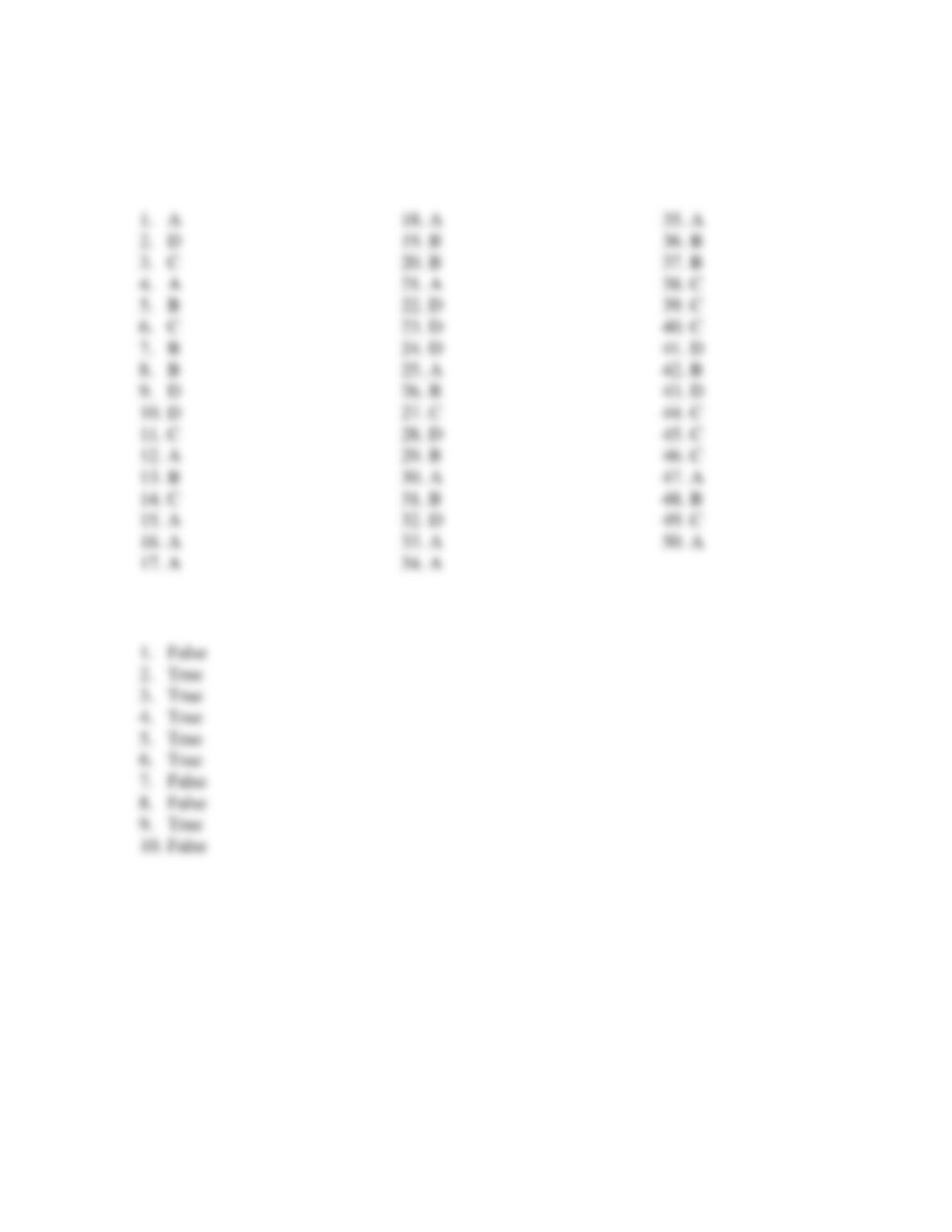
Chapter 6 Learners with Learning Disabilities
6.1 Multiple Choice Questions
6.2 True/False Questions
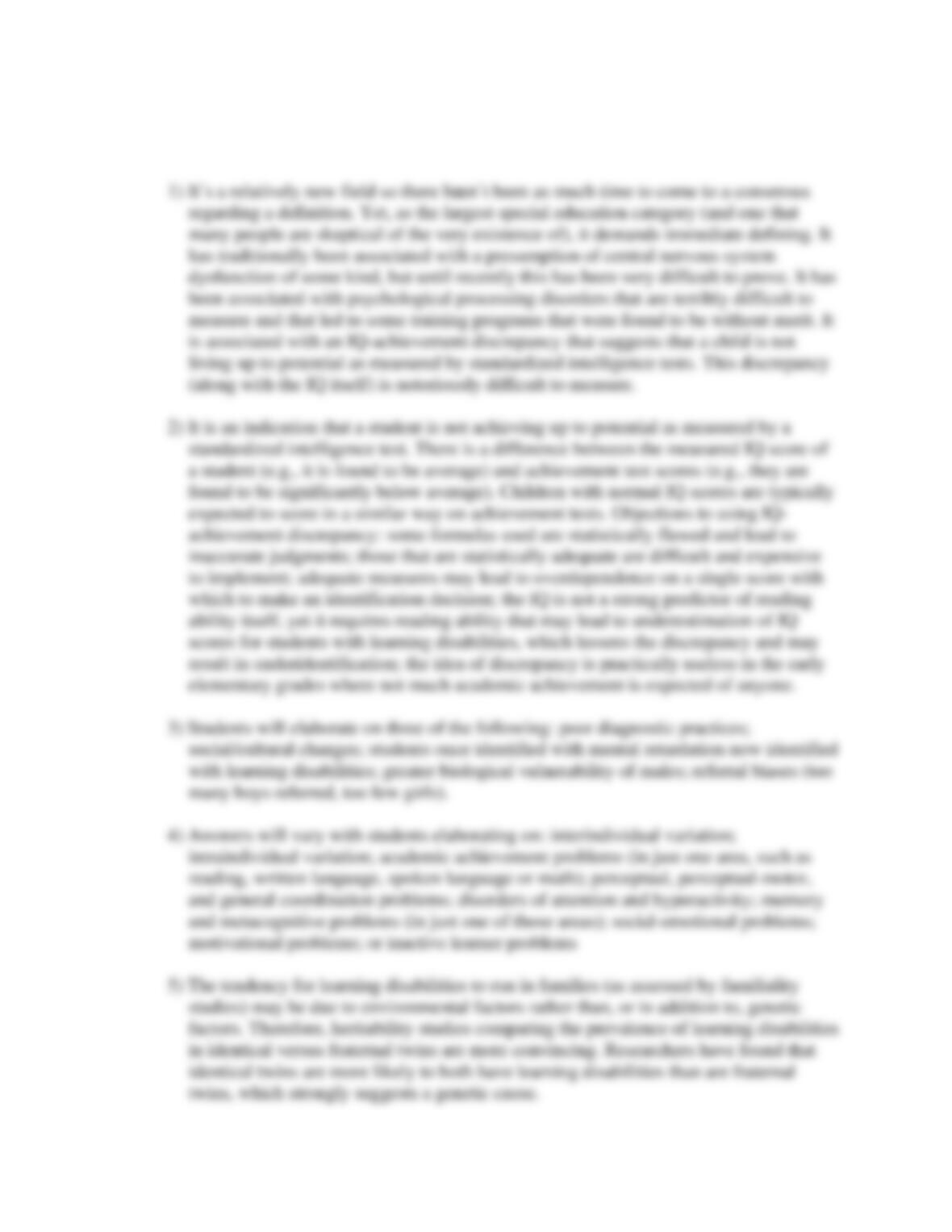
6.3 Short Answer Questions