1
Chapter 6 Selecting measurement instruments
Suggested Activities
Chapter 6 has a large amount of very diverse content and will likely take a lot of class time. In addition to
quantity of content, there are several topics, such as variables, included in Chapter 6 that students in
introductory research courses find difficult.
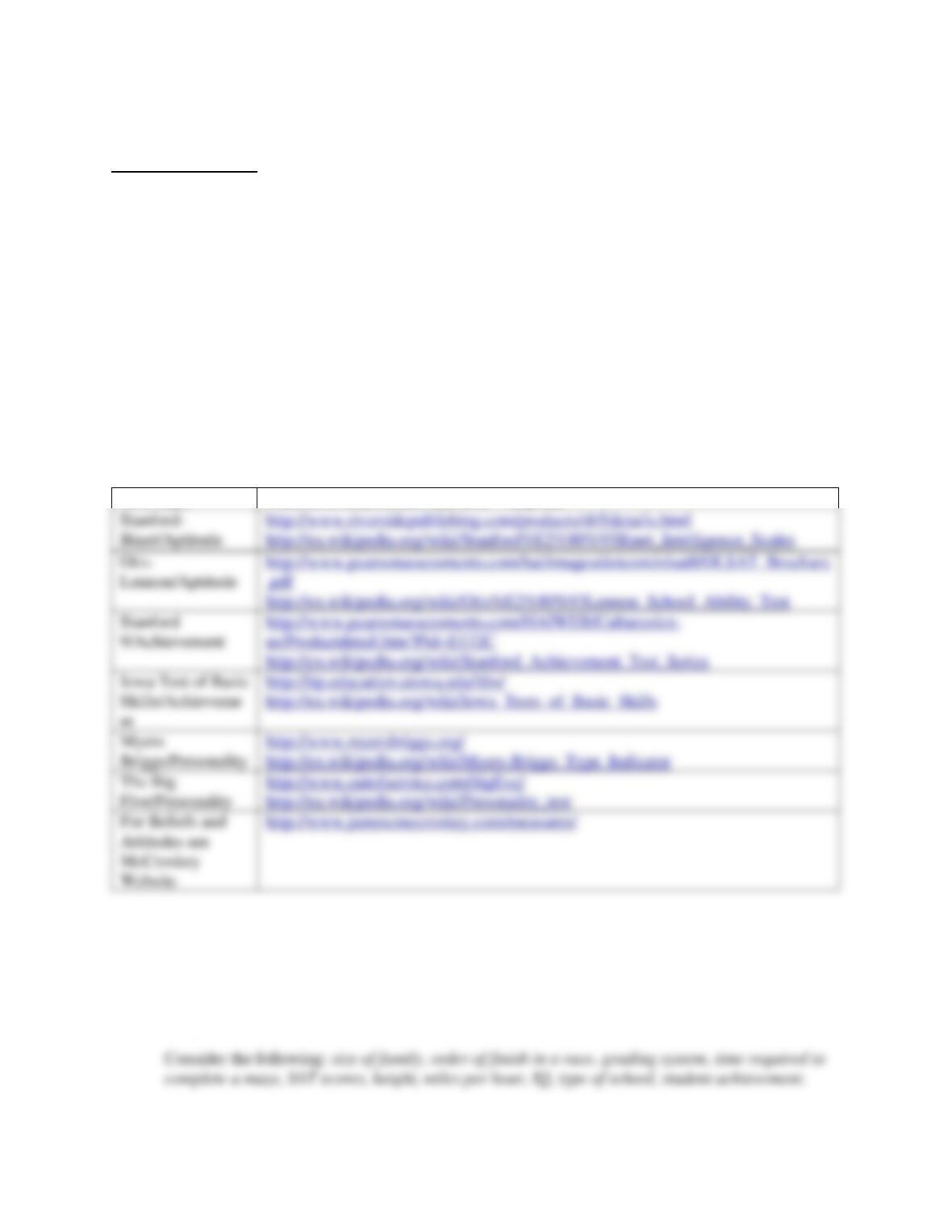
1. The text discusses different types of measurement instruments. I often share examples of sample
items from standardized achievement tests, aptitude tests, personality measures, and attitude
scales to support text content. Consider the following sources for each. Comparing the purposes
of the instruments helps students to see the differences between aptitude and achievement and
between personality and attitude, both of which are sometimes initially confusing to students in
my class. The links below provide publishers sites and review sites such as Wikipedia for each.
James McCroskey at West Virginia University has developed and researched, with his students
and colleagues, dozens of attitude and belief measures. His link is found below where you can
select from these options. Examining item structure will help students clearly understand
different types of measurement instruments.
Test/Type
Citation from publisher and then Wikipedia
2. Students will have difficulty with levels of measurement. The following are some suggestions of
variables to consider for discussion. Some are redundant to the text to promote understanding
through class discussion (e.g., type of school). Some are necessarily vague to facilitate discussion
of operationalizing variables (e.g., grading system).
2
3. Handout 6.3 (located in the Appendix) contains four examples to use as a handout or overhead. It
lists some potential research topics to use for guided practice with the students in identifying
independent and dependent variables and to practice operationalizing variables. I have students
do the exercise in pairs and then discuss it as a group. I always tell them before they start that
there is not ONE answer and that it is much more difficult than it looks. The class discussion will
also provide an opportunity to discuss mediating and moderating variables. There are only four
examples but they are necessarily fairly vague and therefore, the exercise will take a bit of class
time. You might elect to have each pair pick two and then discuss all of the examples as a group
assuming not all pairs will select the same two examples.
Answers to Handout 6.3:
For each research topic identify the dependent and independent variable. Develop the topic by
operationalizing variables.
Are there differences between rural and urban children’s attitudes regarding diversity?
Is there a relationship between years of post-secondary schooling and social competence?
3
What are the academic variables that account for a successful collegiate experiences?
4. Recently The Standards for Educational and Psychological Testing also known by some as the
joint standards because the publication in a collaborative effort of APA, AERA, and NCME has
been under revision. The last version of the standards was published in 1999. During the
5. One resource I have used in this course for many years is Rudner’s (1994) Test Evaluation paper.
This paper provides several very good references and standards for use of tests. Rudner reviews
most aspects of selecting an instrument. The paper also includes a series of questions that
researchers can ask themselves about tests they may be considering for use. This paper is an
excellent source for students to use when selecting research materials and it also provides a nice
review of types of reliability and validity. I usually pass it out in class or have students access it
online and select a couple points to discuss in class. I also use it for the next two exercises. For
your convenience, this Eric document is found in the Appendix.
4
6. To support Task 5, I have my students complete reviews of instruments and we work through
them in class. I bring in copies of an instrument that has also been reviewed by MMY, along with
the MMY reviews. At times, I bring in instruments for which I have published MMY reviews as
sometimes the instruments contain a number of materials and this allows the students to see
alternatives to simple paper and pencil measures and it affords them the opportunity of working
with technical reports and test manuals. This exercise works best in small groups. Compare your
class review(s) with the reviewers’ entries in MMY. As students may lack enough background
knowledge to conduct an adequate review, I have them use the Rudner (1994) ERIC document
found in the Appendix to assist their review.
7. APA has a special website dedicated to testing information. This site is an EXCELLENT
resource. It would be a good class activity to have students review sections of the site in small
8. One additional resource that contains peer-reviewed articles on item construction and related
9. If your library subscribes to Buros’s Institute of Mental Measurements online, take time in class to
access a review of interest to one or more of your students. Alternatively, I have presented
examples of ones I have contributed and shared what other reviewers wrote about the same
10. Although it is a little older now, I continue to use the Murphy and Alexander (2000)
Contemporary Educational Psychology article as a means to discuss operationalizing variables.
In this article the authors review literature related to the construct of motivation overall and
several sub-constructs. Many prominent researchers’ work is presented in the article and
displayed as systematically not clearly operationalized. While motivation is clearly a construct
that needs to be operationalized, using an example in class like student achievement or learning
can also illustrate to the students that there are differences in the way that we will define
constructs, and differences in definition lead to differences in interpretation. Another simple,
quick example is overall GRE scores. Students will include or not include analytical for example
and sometimes when I have asked graduate students, they simply report their content test score.
Murphy, P. K., & Alexander, P. A. (2000). A motivated exploration of motivation terminology.
Contemporary Educational Psychology, 25, 3-53.

5
Chapter 6 Test Items
1. Gender is considered a(n) ___________ level variable.
a. nominal
b. ordinal
c. interval
d. ratio
2. Marital status is considered a(n) ______________ level variable.
a. nominal
b. ordinal
c. interval
d. ratio
3. Age is considered a(n) ________________level variable.
a. nominal
b. ordinal
c. interval
d. ratio
4. Performance on an attitude measure with Likert type items is considered a(n)
_____________ level variable.
a. nominal
b. ordinal
c. interval
d. ratio
5. Standardized test scores are often given as percentile ranks. These data are considered
________________ level measurement.
a. nominal
b. ordinal
c. interval
d. ratio
6. Political party affiliation is considered __________ level data.
a. nominal
b. ordinal
c. interval
d. ratio
• 7. In a study that compares different drop out rates of college students by intended
major; intended major is considered a(n)________level variable.
a. nominal
b. ordinal
c. interval
d. ratio
6
• 8. Marty assesses teachers’ attitudes toward inclusion based upon number of years
of teacher experience. He groups his teachers as those that have 4 or less years of
experience, 5-10 years of experience, 11-20 years of experience and more than 20 years.
The variable of years of experience in Marty’s study illustrates an example of
___________level data.
a. nominal
b. ordinal
c. interval
d. ratio
• 9. Ne is a program evaluator for a large school district. This past year the district
implemented a new reading program. Ne must measure the level of implementation of
the program by individual schools in the district. In this study, school is measured as a
__________ level variable.
a. nominal
b. ordinal
c. interval
d. ratio
• 10. Test scores, reported as proportion correct, on a recent math test in Ms. Polk’s
fourth grade class represent _____________ level data.
a. nominal
b. ordinal
c. interval
d. ratio
• 11.-14. A local government group recently conducted a survey to ask those living in the
community if they would like to see a new pool facility built. The survey asked the
following six questions:
1. Do you live in the community defined by zip codes 16801,16802, 16803 or
16804? Y_______ N_______
2. Do you currently own a membership to any community or private swimming
pools? Y_______ N_______
3. How many people live at your residence.
1_______ 2_________ 3-6_________ 6+___________
4. Please indicate the combined annual income of the members of your residence in
thousands of dollars. $__________________
Given the following scale answer questions 5 and 6.
1=Strongly Disagree, 2=Disagree, 3 =Neutral, 4=Agree, 5=Strongly Agree
5. Our community should build a new indoor pool facility. 1 2 3 4 5
6. I support spending tax dollars for recreational opportunities. 1 2 3 4 5
• 11. Given the above survey, Item 1 data would represent ________ level data.
a. nominal
b. ordinal
c. interval
d. ratio
7
• 12. Given the above survey, Item 4 data would represent _______level data.
a. nominal
b. ordinal
c. interval
d. ratio
• 13. Given the above survey, Item 5 would represent ________ level data.
a. nominal
b. ordinal
c. interval
d. ratio
• 14. Item 6 best represents an example of which of the following types of items?
a. Semantic Differential Scale
b. Likert Scale
c. Mann-Whitney Scale
d. Wilcoxon Scale
• 15. Given the following research question: “Are there differences in individual
student achievement scores in advanced science classes between classes where students
sit in the lecture style seating and those where students sit in cluster seating?”
Achievement scores represents a(n)
a. independent variable.
b. dependent variable.
c. extraneous variable.
d. affective variable.
• 16. Given the following research question: “Are there differences in individual
student achievement scores in advanced science classes between classes where students
sit in the lecture style seating and those where students sit in cluster seating?” Type of
classroom represents a(n)
a. independent variable.
b. dependent variable.
c. extraneous variable.
d. affective variable.
• 17.-19. Gary is a researcher interested in self-esteem. He develops an instrument he
names the “I am great questionnaire.” He administers the survey and collects
information from 500 middle school learners. He calculates a self-esteem score for each
child in the study and then groups the students as low, medium, or high self-esteem.
Given this scenario please answer the following questions.
• 17. The instrument that Gary developed is an example of _______________ a(n)
assessment.
a. affective
b. cognitive
c. projective
d. aptitude
8
• 18. The information that Gary collects from the learners is referred to
a. assessment.
b. data.
c. constructs.
d. variables.
• 19. Self-esteem, in Gary’s study, is measured as a(n)___________ level variable.
a. nominal
b. ordinal
c. interval
d. ratio
• 20-26. Matilda is interested in number of books read by each of the third grade children in her
school district during the academic year. She believes that there may be differences in
the number of books read by classroom and by school and she thinks there is a positive
relationship between number of books read and reading achievement as measured on the
standardized assessment given at the end of the year.
• 20. In Matilda’s study the variable ‘classroom’ would be considered a(n) ___________
level variable.
a. nominal
b. ordinal
c. interval
d. ratio
• 21. In Matilda’s study the variable ‘school’ would be considered a(n) ____________
level variable.
a. nominal
b. ordinal
c. interval
d. ratio
• 22. In Matilda’s study the variable ‘reading achievement’ would be considered a(n)
___________ level variable.
a. nominal
b. ordinal
c. interval
d. ratio
• 23. In Matilda’s study the variable ‘number of books read’ would be considered a(n)
___________ level variable.
a. nominal
b. ordinal
c. interval
d. ratio
9
• 24. In Matilda’s study the variable ‘school’ represents which of the following type of
variable?
a. Independent variable
b. Neutral variable
c. Manipulated variable
d. Dependent variable
• 25. Matilda’s study addresses two primary research questions. One addresses
whether there are differences in number of books read by class and by school. The type
of research addressed by this question represents a(n) _________research study.
a. Descriptive
b. Casual-Comparative
c. Correlational
d. Experimental
• 26. Matilda’s study addresses two primary research questions. One addresses
whether there is a positive relationship between number of books read by standardized
test score. The type of research addressed by this question represents a(n)
_________research study.
a. Descriptive
b. Casual-Comparative
c. Correlational
d. Experimental
• 27. Mitch’s study addresses the role of parental involvement in the classroom and the
effects on student grades. In his work, final averages in the core subject areas are
compared between children who are in classrooms with parent volunteers and those in
classrooms with no parent volunteers. His dependent measure, final averages in core
subjects, illustrates which type of assessment?
a. Cognitive
b. Aptitude
c. Attitude
d. Personality
• 28-29. Hanna is conducting a problem-solving study that relates learners’ motivation to
number of challenging problems attempted. She defines motivation as self-efficacy. She
uses a self-report instrument to measure self-efficacy.
• 28. Hanna has operationalized which of the following variables?
a. Self-efficacy
b. Motivation
c. Problem-solving
d. Challenging problems
• 29. Paul is a participant in Hanna’s study. His score on the self-efficacy measure is
considered
a. a variable.
b. a construct.
c. data.

10
d. knowledge.
30. Of the following, which is considered an affective measurement?
a. The Scholastic Aptitude Test (SAT)
b. Preschool Reading Ability Measure
c. A Field Dependence Test
d. A self-esteem measure
• 31.-32. Sam is a psychology researcher interested in personality differences between
university faculty who do and do not include computer-assisted technology in their class
lectures. He groups the faculty based upon use of computer-assisted technology and he
administers a 13-item Likert scale personality assessment.
• 31. In Sam’s study, personality is considered a(n)
a. aptitude measure.
b. affective measure.
c. achievement measure.
d. cognitive measure.
• 32. In Sam’s study, personality is measured with a(n)
a. nonprojective instrument.
b. projective instrument.
c. standardized instrument.
d. alternative assessment.
• 33. Which of the following is the best example of a standardized test?
a. A classroom-based teacher developed test
b. An attitude measure developed by a researcher
c. The national achievement test
d. The outcome measures of amount learned in an experimental study
• 34. Jill correctly answered 15 items on a fifty-item, 150 point biology test correctly.
The 15 items represent Jill’s
a. percentile score.
b. raw score.
c. stanine score.
d. grade-equivalent score.
35. A formal, systematic procedure for gathering information is a(n)
a. measurement.
b. observation.
c. instrument.
d. score.
36. Assessments include all of the following EXCEPT
a. measurements.
b. tests.
c. observations.
d. interviews.
11
37. Of the following which is a supply method for collecting data?
a. Multiple choice
b. True/false
c. Fill-in-the-blank
d. Matching
38. Selection methods of assessment include
a. essays.
b. authentic assessments.
c. short answer.
d. matching.
39. Performance assessments include
a. fill-in-the-blank.
b. lab demonstrations.
c. multiple choice.
d. true/false.
• 40. Lara administers an exam to her 10th grade history class. The test includes
multiple-choice, true/false, matching, and fill-in–the-blank items. Lara’s instrument
includes
a. selection method items only.
b. supply method items only.
c. both supply and selection method items.
d. neither supply nor selection method items.
• 41. Susan has her life skills class keep a bank account and ‘pay bills’ throughout the
semester. Susan’s assessment strategy illustrates
a. performance assessment.
b. supply methods of assessment.
c. selection methods of assessment.
d. problem-based assessment.
• 42. Which of the following illustrates norm-referenced scoring?
a. Sally got all the items correct on her exam.
b. Sally performed at the average of the class.
c. Sally’s score on the exam was an 85.
d. Sally’s score indicated improvement.
• 43. Of the following, which is an example of self-referenced approach?
a. Jon finished first in the race.
b. Jon performed worse than his teammates.
c. Jon ran the mile in less than 6 minutes.
d. Jon ran the mile faster than his last race.
• 44. Of the following which illustrates criterion-referenced scoring?
a. Jody got the highest score on the test.

12
b. Jody performed worse than she did on the midterm.
c. Jody received an 86 which was a B.
d. Jody received an 86 which was the average.
• 45. Sheri got her son’s standardized achievement scores back. One of the things she
noted was that her son achieved a national percentile ranking of 89 in math. This score
represents
a. a norm-referenced score.
b. a criterion-referenced score.
c. that her son likely got a B in his math class.
d. that her son is better in math than his classmates.
• 46. On the test report Sheri received from the standardized achievement test, there
were several different tests reported. This indicates that the test represented a(n)
a. affective test.
b. multitrait test.
c. test battery.
d. subtest.
47. Tests of logical reasoning are generally found on
a. achievement tests.
b. aptitude tests.
c. affective tests.
d. attitude scales.
• 48. Jillian is struggling in mathematics. Her teacher wants to administer a test to
assist in a decision about whether to provide remedial math classes for Jillian. Of the
following, which is the test most likely the type of assessment to be administered for this
purpose?
a. An attitude assessment
b. A cognitive test
c. An affective test
d. A self-referenced test
49. The Columbia Mental Maturity Scale is an example of an
a. achievement test.
b. aptitude test.
c. affective test.
d. attitude scale.
50. The type of instrument that examines our values is classified as a(n)
a. diagnostic assessment.
b. projective assessment.
c. affective assessment.
d. cognitive assessment.
51. Which of the following is NOT an example of an affective assessment?
a. The Thurstone scales
b. The Otis-Lennon School Ability Test
c. The Strong-Cambell Interest Inventory
d. The Minnesota Multiphasic Personality Inventory
13
52. Some individual differences, such as cultural differences for example, may distort
information obtained from an assessment. This is referred to as
a. response set.
b. bias.
c. interpretation error.
d. sampling error.
53. Projective tests are an example of
a. cognitive tests.
b. achievement tests.
c. affective tests.
d. self-referenced tests.
54. Generally projective tests, but not achievement tests, are administered
a. in groups.
b. across several testing sessions.
c. by the classroom teacher.
d. individually.
55. In The Thematic Apperception Test, participants are asked to tell a story about each of a
series of pictures. This is an example of a(n)
a. a projective test.
b. an aptitude test.
c. an achievement test.
d. an interest scale.
• 56.-57. Recently, many lawmakers have been advocating for assessments to be
administered to all children at varying levels in their schooling.
• 56. These types of assessments are designed to be
a. aptitude tests.
b. achievement tests.
c. attitude tests.
d. affective tests.
• 57. These types of assessments are used as __________ assessments
a. criterion-referenced
b. self-referenced
c. norm-referenced
d. individual-referenced
• 58. Stephenie recently took an interest inventory to determine which career might be
good for her. She answered ‘strongly interested’ to almost every question. The career
counselor suggested a different strategy because her results were not informative. What
is most likely the reason for Stephenie’s answers?
a. Bias
14
b. Validity
c. Reliability
d. Response set
59. In a semantic differential scale a neutral response is recorded as a
a. 0.
b. 3.
c. 5.
d. 50.
60. Sal recently took an instrument that asked him to rate his opinions about the effectiveness
of different instructional practices as ‘Strongly Agree’, ‘Agree’, ‘Uncertain’, ‘Disagree’,
‘Strongly Disagree’. This instrument is using a
a. Semantic Differential Scale.
b. Guttman Scale.
c. Likert Scale.
d. Thurstone Scale.
61. The type of validity that focuses on the extent to which the test relates to future
performance is referred to as _________ validity.
a. predictive
b. concurrent
c. content
d. construct
62. The type of validity that addresses if the test appears to measure the variable of interest is
referred to as ________________ validity.
a. content
b. criterion-related
c. construct
d. consequential
63. The extent to which unintended outcomes arise from the testing activity is referred to as
___________ validity.
a. content
b. criterion-related
c. construct
d. consequential
64. The extent to which a test actually measures what it is designed to measure is referred to
as ____________ validity.
a. content
b. criterion-related
c. construct
d. consequential
• 65. Gavin recently administered a science test to his fourth grade class. He questions
the validity of the test as a science test because although it looks as if it measures science
content, it relies heavily on reading ability. Gavin’s concern is with the _____________
validity of the test.

15
a. content
b. criterion-related
c. construct.
d. consequential
• 66. Michael left the Physics final and complained. The content on the cumulative
final only covered about one quarter of the concepts for the course. Michael is
questioning the _____________ validity of the test.
a. content
b. criterion-related
c. construct
d. consequential
• 67. The district is considering changing the achievement tests that they administer.
A new alternative test is much shorter and if valid to measure student achievement could
save substantial instructional time. This year the school will administer both tests and
assess the ____________ validity.
a. content
b. concurrent
c. predictive
d. sampling
68. According to your text the most important type of validity is _____________validity.
a. content
b. criterion-related
c. construct
d. consequential
69. The rationale for selection of a given assessment should be included in the
______________ section of your research plan.
a. participants
b. design
c. procedures
d. results
70. The degree to which an instrument consistently measures the construct of interest is
referred to as
a. predictive validity.
b. criterion-related validity.
c. content validity.
d. reliability.
71. Split-half and odd-even reliability are both measures of
a. test-retest reliability.
b. alternate forms reliability.
c. internal consistency reliability.
d. external reliability.
16
• 72. You have recently constructed a self-report measure of achievement motivation.
You are sure your measure is better than other measures because it is shorter than they
are. You decide to administer your measure along with a standard measure generally
used in the field. Which type of validity will this strategy help you to assess?
a. Content
b. Consequential
c. Criterion-related
d. Construct
• 73. You want to make sure the math test you give your students is reliable. You are
afraid they can memorize facts so your test is all word problems. However, you now are
concerned that you have hindered the validity of the test. It still looks like a math test, so
which type of validity have you potentially violated?
a. Content
b. Consequential
c. Predictive
d. Construct
• 74. Some of the students in his class had to take an AP physics exam on the day his
US History final was scheduled so Mike will have to administer two different versions of
his test. With which of the following reliability constructs should Mike be most
concerned?
a. Internal consistency
b. Split-Half
c. Test-retest
d. Alternate forms
• 75. A recent study reported about a new instrument that measures students’
motivation for challenging academic tasks. In the study the instrument had been given to
a number of children at the beginning of their academic year. After reading the study,
Susan wondered if students’ responses would be different at the end of the academic
year. She decides to conduct a study that administers the instrument several times over
the course of an academic year and measures the correlation across administrations.
Susan has addressed a concern with which of the following types of reliability?
a. Internal consistency
b. Split-Half
c. Stability
d. Equivalence
• 76. The University uses an algebra test to screen students into statistics courses.
Students’ responses are scored as correct or incorrect and are summed for a total score.
The test is really long and seems to cover a lot of content. So Carlos divides the test in
two and assesses the reliability of the entire test and the reliability of the two halves.
Carlos is assessing the ________________ of the test.
a. content validity
b. internal consistency reliability.
c. test-retest reliability

17
d. criterion-related validity
77. Cronbach’s alpha is a measure of
a. Standard Error of Measurement.
b. Internal consistency reliability.
c. Criterion related validity.
d. Alternate-form reliability.
• 78. Robert scored an 87 on a recent mathematics placement test. John scored an 86.
The standard error of measurement of the test is 4. What can we conclude about the two
students’ actual measures?
a. Robert’s true score is higher than John’s
b. John’s true score is higher than Robert’s
c. Robert’s true score may be higher than John’s
d. The two student’s true scores are equal
79. Standard error of measurement is an expression of an instruments’
a. internal consistency reliability.
b. consequential validity.
c. test-retest reliability.
d. construct validity.
• 80. Lori has found two measures of attitudes about technology that she thinks might
work for her dissertation. She would like to examine reviews of the two instruments.
From the following choices which should Lori consult for actual reviews?
a. PRO-ED
b. Tests in Print
c. Mental Measurements Yearbooks
d. ETS test collection
81. In order to calculate the Standard Error of Measurement (SEm), which of the following
information regarding a test must you know?
a. The number of items and reliability coefficient
b. The number of items and standard deviation
c. The standard deviation and reliability coefficients
d. The average score and the standard deviation
82. The relationship between reliability and SEm is that
a. if reliability increases SEm increases.
b. if reliability increases SEm decreases.
c. if reliability is positive SEm is positive.
d. if Reliability is positive SEm is negative.
83. Buro’s institute of Mental Measurements Yearbooks provides
a. a directory of all test publishers.
b. reviews of various forms of tests.
c. copies of tests to use for research and practice.
d. formulas to use to compute reliability coefficients.
18
84. When considering a particular test, the most important consideration is
a. ease of administration.
b. cost of the administration.
c. reliability.
d. validity.
• 85. The local school district administers two different writing assessments. One
requires learners to identify errors in examples and answer them objectively. The second
requires the learners to write an essay. Of the following which is likely true regarding
these assessments?
a. The objective test is more reliable than the essay.
b. The objective test is less reliable than the essay.
c. The objective test is less valid than the essay.
d. The objective test is more consequentially valid than the essay.
• 86. An instrument that measures mathematics knowledge, reading comprehension,
and computation skills provides four measures, one score for each scale and an overall
score. Which of the following is likely regarding the properties of the scores?
a. The reliabilities of the individual scores are lower than the overall score.
b. The reliabilities of the individual scores are higher than the overall score.
c. The reliability of the overall score is the average of the reliabilities of the individual
scores.
d. The reliability of the overall score is the sum of the reliabilities of the individual
scores.
• 87. Gwen is conducting a study on mathematics skills. She is interested in a test that
measures computation of basic algebra. She found one with a reported KR-20 of .34.
What is one conclusion Gwen can make regarding the test as a measure of algebra skills?
a. The reliability is generally low
b. The content validity is generally valid
c. The predictive validity is moderately valid
d. The consequential validity is moderately valid
88. The required information needed in order to compute KR-21 includes
a. number of items on the test, mean score, and median score.
b. number of items on the test, mean score, and standard deviation.
c. mean score, standard deviation, median score.
d. mean score, reliability coefficient, and standard deviation.
• 89. As Ron, a sixth grade teacher, is administering a State mandated test, he finds
that one of the reading passages is a section from a book the class read this year.
Therefore, the students in his class have been exposed to the test content before the exam.
Which of the following is accurate regarding the test as measure of Ron’s class’s
reading?
a. The content validity of the test will go up.
b. The construct validity of the test will go down.
19
c. The construct validity of the test will go up.
d. The predictive validity of the test will go up.
• 90. Given a 50 item multiple-choice test with a mean of 30,standard deviation of 4,
and a reliability coefficient of .80, calculate the Standard Error of Measurement.
a. 2.60
b. 1.80
c. –2.40
d. 0.80
• 91. Given the following information about a test, compute the KR-21. The test has
50 items, the median is 36, the mode is 34, the mean is 35, and the standard deviation is
4.
a. .30
b. .35
c. .40
d. .45
• 92.-95 Jana is an action researcher who wants to better understand what predicts student
success on the statewide standardized biology competency test. As her data sources, she
administers the Biology Interest Survey (BIS) to all of her students, she categorizes
students into two groups: those who have taken biology before and those who have not,
and she also administers an in-class exam. The scores from the in class exam are then
‘curved’. She uses these data sources as a means to predict student performance on the
statewide biology competency exam.
• 92. The level of data represented by the variable previous class experience is
a. nominal.
b. ordinal.
c. interval.
d. ratio.
• 93. The level of data represented by the in class exam is
a. nominal.
b. ordinal.
c. interval.
d. ratio.
• 94. In Jana’s study, the in-class biology exam is best described as
a. an aptitude test.
b. an achievement test.
c. an attitudinal measure.
d. a projective assessment.
• 95. In Jana’s study the Biology Interest Survey is best described as
a. an aptitude test.
b. an achievement test.
c. an attitudinal measure.
d. a projective assessment.
20
• 96. Given what we know, in Jana’s study the statewide biology exam is best
described as
a. an aptitude test.
b. a criterion-referenced test.
c. a norm-referenced test.
d. a standards-based test.
• 97.-101. Maya recently conducted a survey to ask community members about whether
they would like the town to invest money into widening roads to accommodate a bicycle
lane. Her survey included the following 5 questions.
1. Do you live in Healthy Township?
Y_______ N_______
2. Do you own a bicycle?
Y_______ N _______
3. How many miles a week do you drive your car?
a. 0-15
b. 15-30
c. 30-45
d. 45-60
e. Greater than 60
Given the following scale answer questions 4 and 5.
1=Strongly Disagree, 2=Disagree, 3 =Neutral, 4=Agree, 5=Strongly Agree
4. I would ride my bike to work if there was a bike lane. 1 2 3 4 5
5. I believe we should widen the roads to accommodate a bike lane. 1 2 3 4 5
• 97. Given the above survey, Item 3 data would represent ________ level data.
a. nominal
b. ordinal
c. interval
d. ratio
• 98. Given the above survey, Item 4 data would represent _______level data.
a. nominal
b. ordinal
c. interval
d. ratio
• 99. Given the above survey, Item 2 would represent ________ level data.
a. nominal
b. ordinal
c. interval
21
d. ratio
• 100. Item 5 best represents an example of which of the following types of items?
a. Semantic Differential Scale
b. Cronbach’s Scale
c. Pearson’s Scale
d. Likert Scale
• 101. Given the following information about a test, compute the KR-21 reliability
estimate. The test has 20 items, the median is 12, the mode is 14, the mean is 12, and the
standard deviation is 3.
a. .33
b. .37
c. .45
d. .49
• 102.-103. Jianan is conducting a thesis study that relates learners’ working memory to
speed in algebraic problem solving. She measures working memory by a digit span task.
She uses a researcher created test to measure problem solving. She will also collect
demographic data and measure beliefs and attitudes about science.
• 102. Jianan operationalized which of the following variables?
a. Age
b. Science
c. Working memory
d. Beliefs
• 103. Tristan is a participant in Jianan’s study. His score on the problem solving
measure is considered
a. data.
b. a construct.
c. a variable.
d. knowledge.
• 104.-105.Jonah has developed a new scale to measure tolerance of software engineers
during technology renovations. He selects a sample of software engineers and
administers the draft instrument to them and calculated a KR 20 of .45. Given what you
know about this type of measurement, please answer the following questions.
• 104. The type of instrument that Jonah developed is referred to as
a. An aptitude measure
b. An attitude scale
c. An personality scale
d. A projective measure
• 105. Given the KR 20 value, which can you conclude about this instrument?
22
a. It demonstrates high reliability
b. It demonstrates sound reliability
c. It demonstrates average reliability
d. It demonstrates inadequate reliability
Chapter 6 Answers

24