178.
Match each term with its description.
Products that have started the production process
Companies that purchase inventories that are
Inventory items for which the manufacturing
Cost of components that will become part of the
finished product but have not yet been used in
Companies that produce the inventories they sell,
rather than buying them from suppliers in finished
Companies that earn revenues by providing
services to their customers rather than selling
Inventory that has been purchased in its finished
179.
Match each term used in a multiple-step income statement with its description.
Amount recorded from the sale of products and
Amount of profit after including nonoperating
Expenses arising from activities that are not part
Profit from normal operations that is a key
Expenses arising from activities that are part of
Profit most directly related to the sale of
180.
Match each inventory method with its definition.
Assume inventory sold for the year includes the items
2. Specific Identification
Ending inventory represents the actual units not sold
Assume ending inventory for the year includes the items
Assume ending inventory for the year includes a random
181.
Match each term related to inventory methods with its description.
5
Results in higher ending inventory during periods of
3
LIFO must be used for financial reporting if elected for
3. LIFO conformity rule
2
Additional amount of inventory a company would report
4. Consistency
Once a company chooses an inventory method, it is not
allowed to frequently change to another one.
4
1
Best matches cost of inventory sold with its related
182.
Match each term related to recording inventory transactions with its description.
1. Perpetual inventory
Account to credit when inventory is sold. The amount to
Record inventory purchases at the time inventory
Record inventory purchases at the time inventory arrives
7. Periodic inventory
Account to credit when inventory is sold. The amount to
6-105
183.
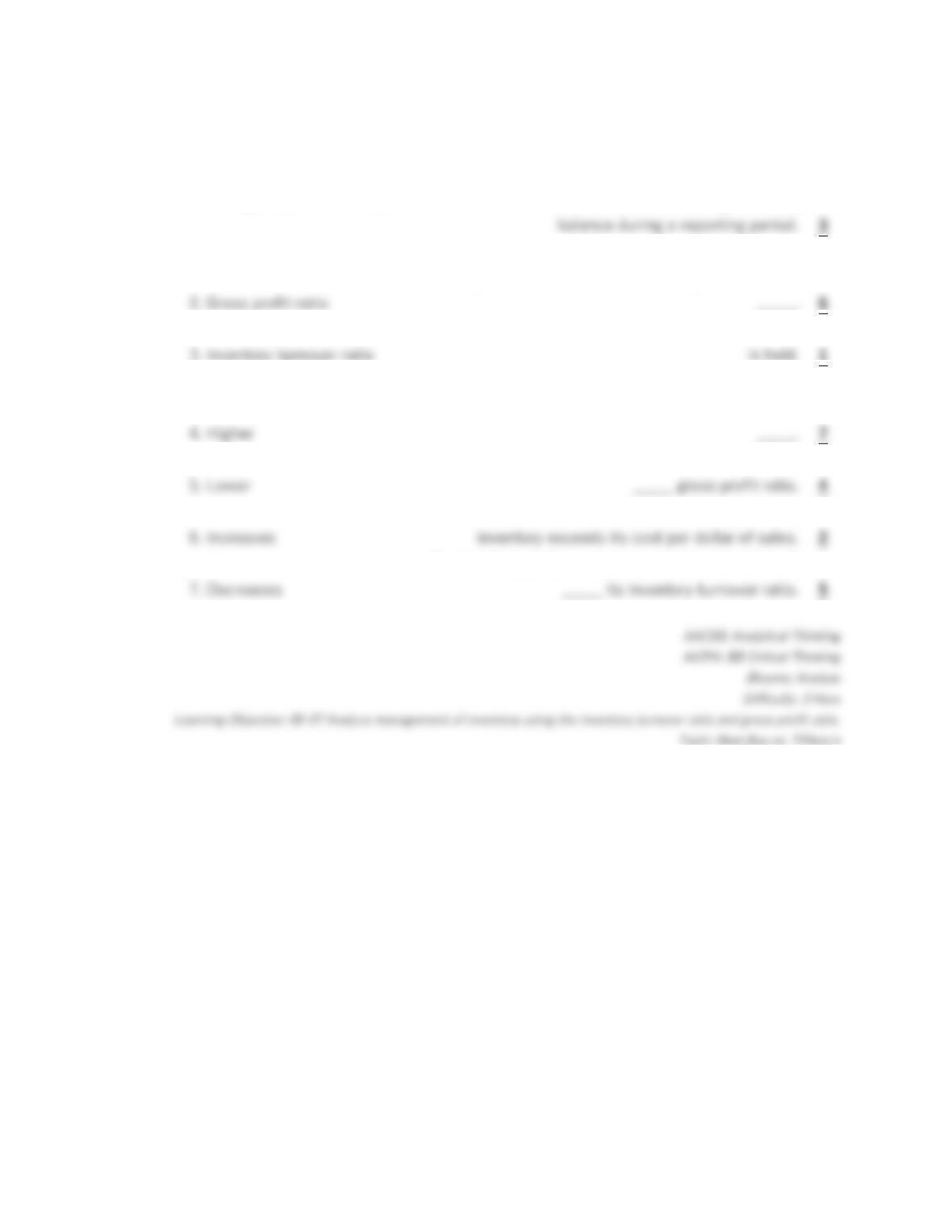
Match each term related to inventory analysis with its description.
1. Average days in inventory
The number of times a firm sells its average inventory
2. Gross profit ratio
6
If a company’s cost of inventory decreases and its
selling price remains the same, the gross profit ratio
3. Inventory turnover ratio
The approximate length of time the average inventory
is held.
1
7
When a company purchases inventory at the end of
the year and does not sell it, the inventory turnover ratio
5. Lower
4
Typically, the more specialized the inventory item, the
6. Increases
2
A measure of the amount by which the sale of
5
The less frequently a company sells its inventory, the
Topic: Best Buy vs. Tiffany’s
Essay Questions
3
184.
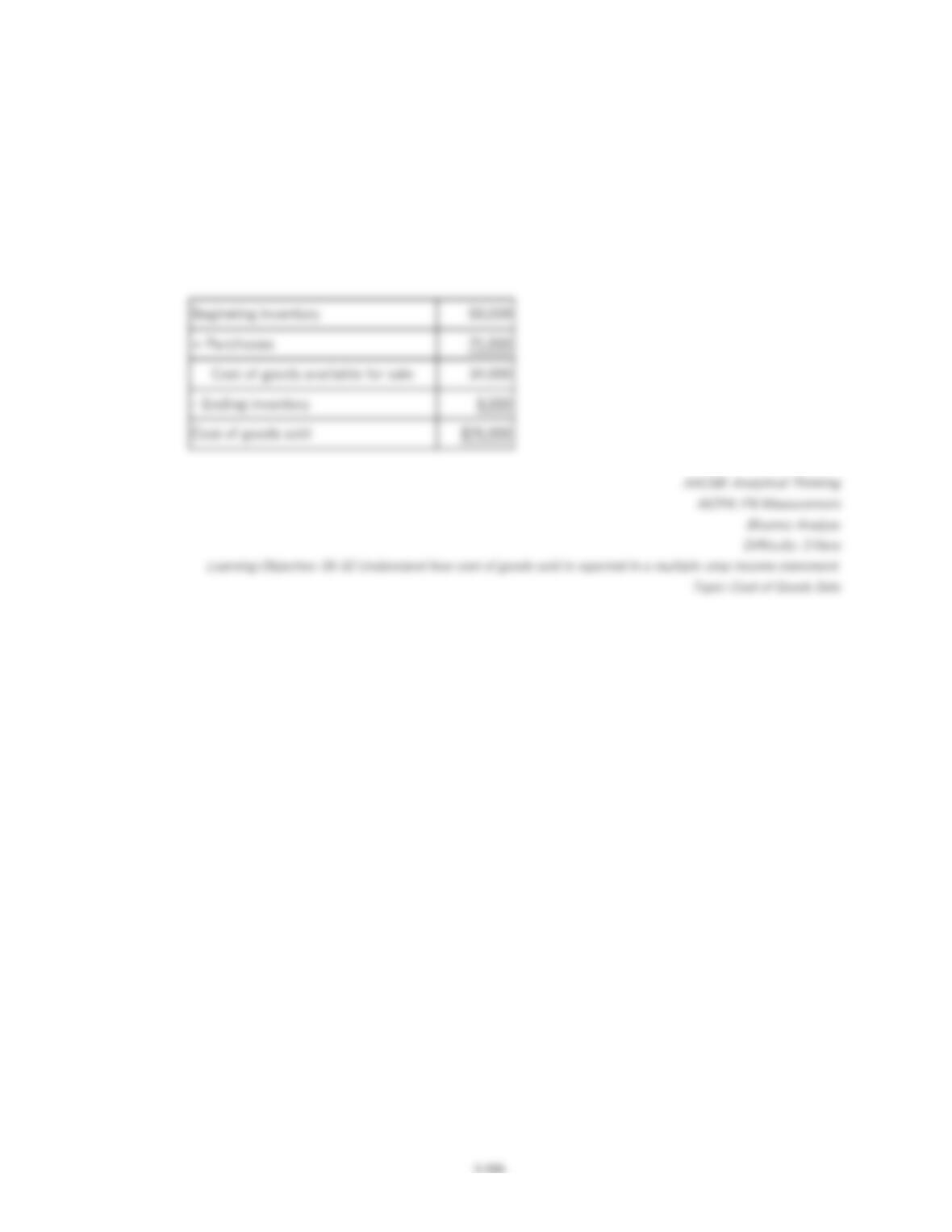
At the beginning of 2018, Calston Incorporated reports inventory of $9,000. During 2018,
the company purchases additional inventory for $25,000. At the end of 2018, the cost of
inventory remaining is $8,000. Calculate cost of goods sold for 2018.
185.
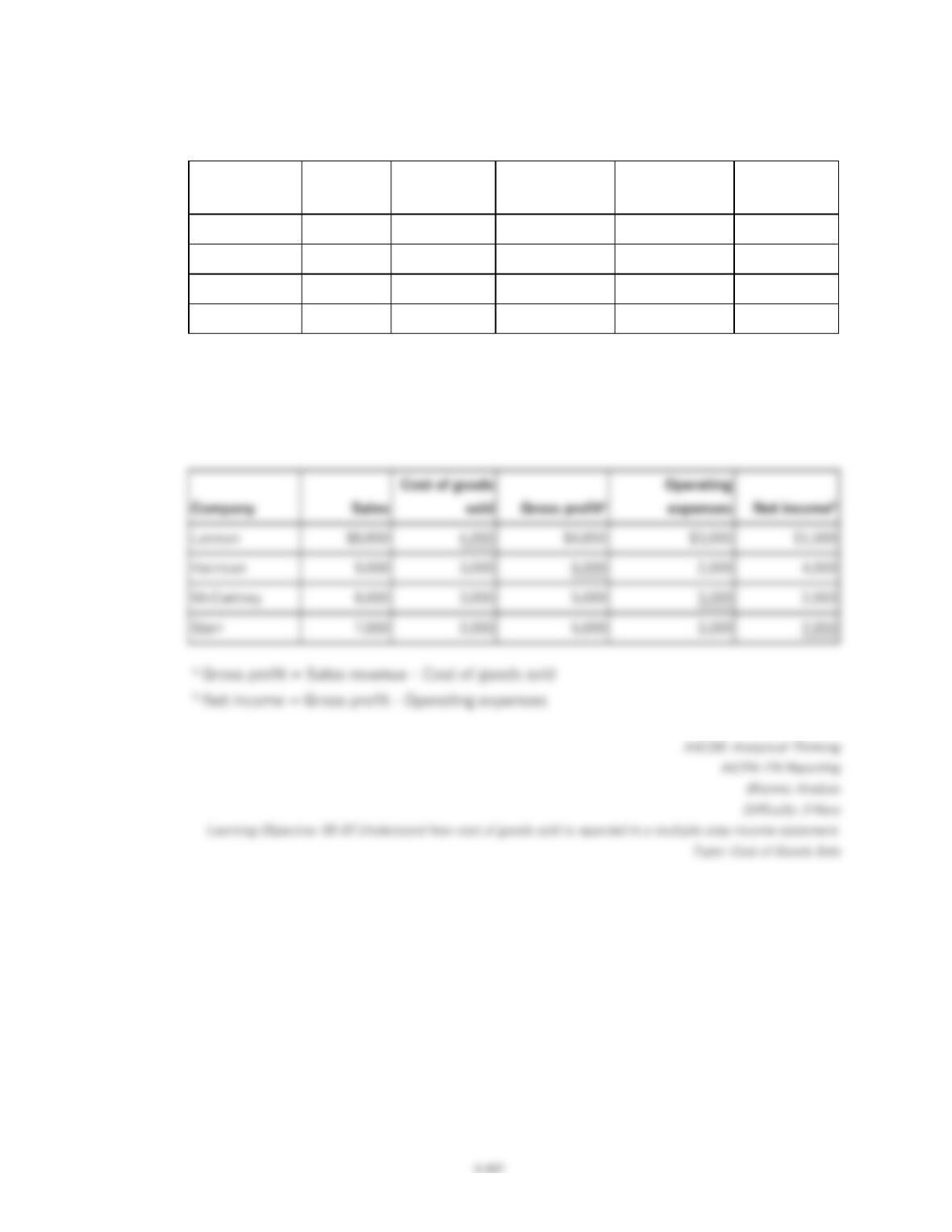
For each company, calculate the missing amount.
Company
Sales
Cost of Goods
Sold
Gross Profit
Operating
Expenses
Net Income
Lennon
$8,000
(a)
$4,000
$3,000
$1,000
Harrison
9,000
3,000
(b)
2,000
4,000
McCartney
8,000
3,000
5,000
(c)
2,000
Starr
7,000
3,000
5,000
3,000
(d)
Lennon
4,000
Harrison
3,000
4,000
McCartney
3,000
2,000
Starr
2,000
2,000

186.
Below are some of the items found in a multiple-step income statement:
a. Sales revenue
b. Net income
c. Operating income
d. Income before income taxes
e. Gross profit
Place these items in the order they would appear from first to last.
187.
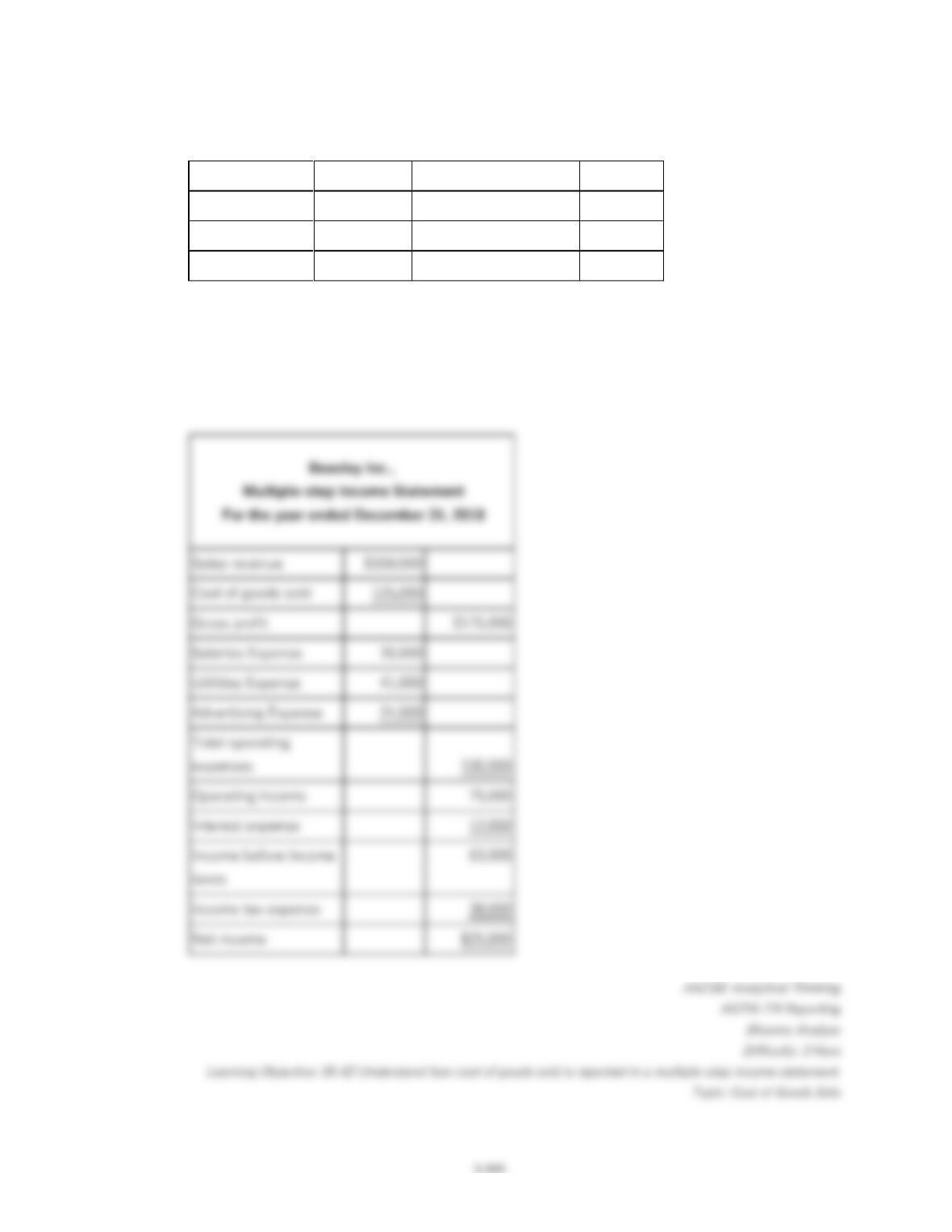
Beasley Inc., reports the following amounts in its December 31, 2018, income statement.
Sales revenue
$300,000
Income tax expense
$38,000
Interest expense
12,000
Cost of goods sold
125,000
Salaries expense
35,000
Advertising expense
24,000
Utilities expense
41,000
Sales revenue
Cost of goods sold
Gross profit
Salaries Expense
35,000
Utilities Expense
41,000
Advertising Expense
24,000
Income tax expense
Net income
$25,000
Prepare a multiple-step income statement.
188.
During 2018, a company sells 20 units of inventory. The company has the following
inventory purchase transactions for 2018:
Date
Transaction
Number of Units
Unit Cost
Total Cost
Jan. 1
Beginning inventory
15
$60
$900
Sep. 8
Purchase
10
62
620
25
$1,520
Calculate ending inventory and cost of goods sold for 2018 assuming the company uses
FIFO with a periodic inventory system.
189.
During 2018, a company sells 20 units of inventory. The company has the following
inventory purchase transactions for 2018:
Date
Transaction
Number of Units
Unit Cost
Total Cost
Jan. 1
Beginning inventory
15
$60
$900
Sep. 8
Purchase
10
62
620
25
$1,520
Calculate ending inventory and cost of goods sold for 2018 assuming the company uses
LIFO with a periodic inventory system.
190.
During 2018, a company sells 20 units of inventory. The company has the following
inventory purchase transactions for 2018:
Date
Transaction
Number of Units
Unit Cost
Total Cost
Jan. 1
Beginning inventory
15
$60
$900
Sep. 8
Purchase
10
62
620
25
$1,520
Calculate ending inventory and cost of goods sold for 2018 assuming the company uses
weighted-average cost with a periodic inventory system.
6-113
191.
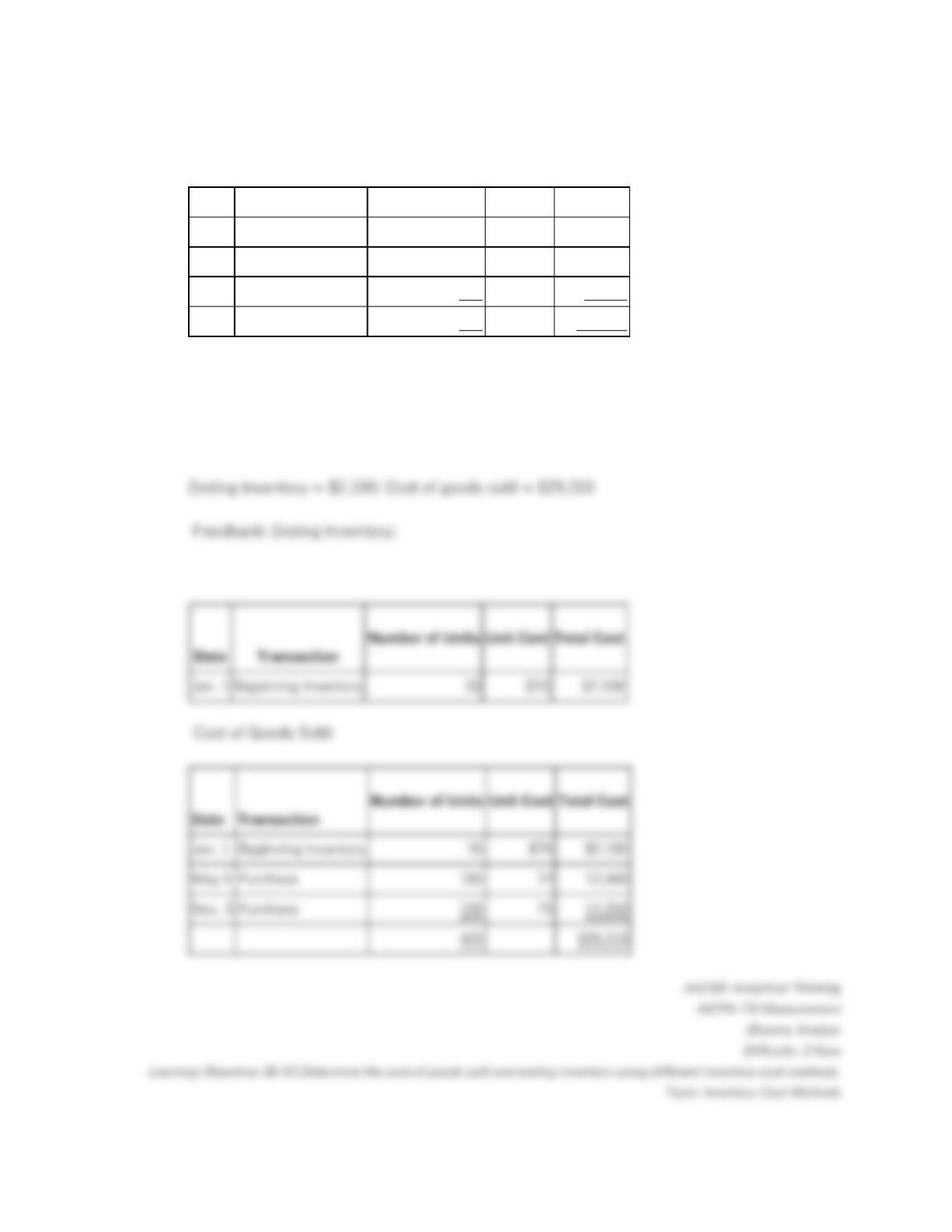
During 2018, a company sells 300 units of inventory for $85 each. The company has the
following inventory purchase transactions for 2018:
Date
Transaction
Number of Units
Unit Cost
Total Cost
Jan. 1
Beginning inventory
60
$71
$4,260
May 5
Purchase
170
72
12,240
Nov. 3
Purchase
180
74
13,320
410
$29,820
Calculate ending inventory and cost of goods sold for 2018 assuming the company uses
FIFO with a periodic inventory system.
Nov. 3
Purchase
6-114
192.
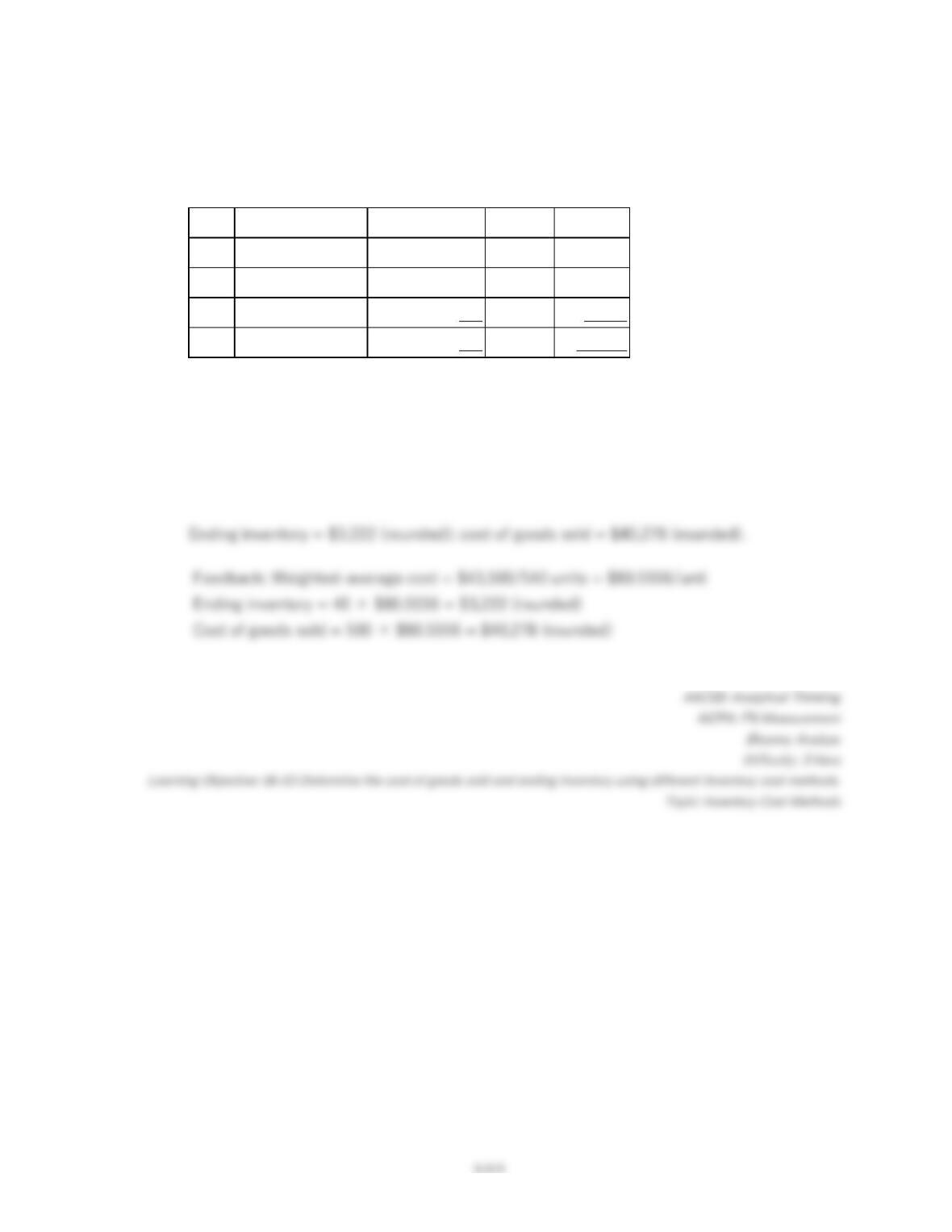
During 2018, a company sells 400 units of inventory for $85 each. The company has the
following inventory purchase transactions for 2018:
Date
Transaction
Number of Units
Unit Cost
Total Cost
Jan. 1
Beginning inventory
60
$70
$4,200
May 5
Purchase
180
72
12,960
Nov. 3
Purchase
190
75
14,250
430
$31,410
Calculate ending inventory and cost of goods sold for 2018 assuming the company uses
LIFO with a periodic inventory system.
193.
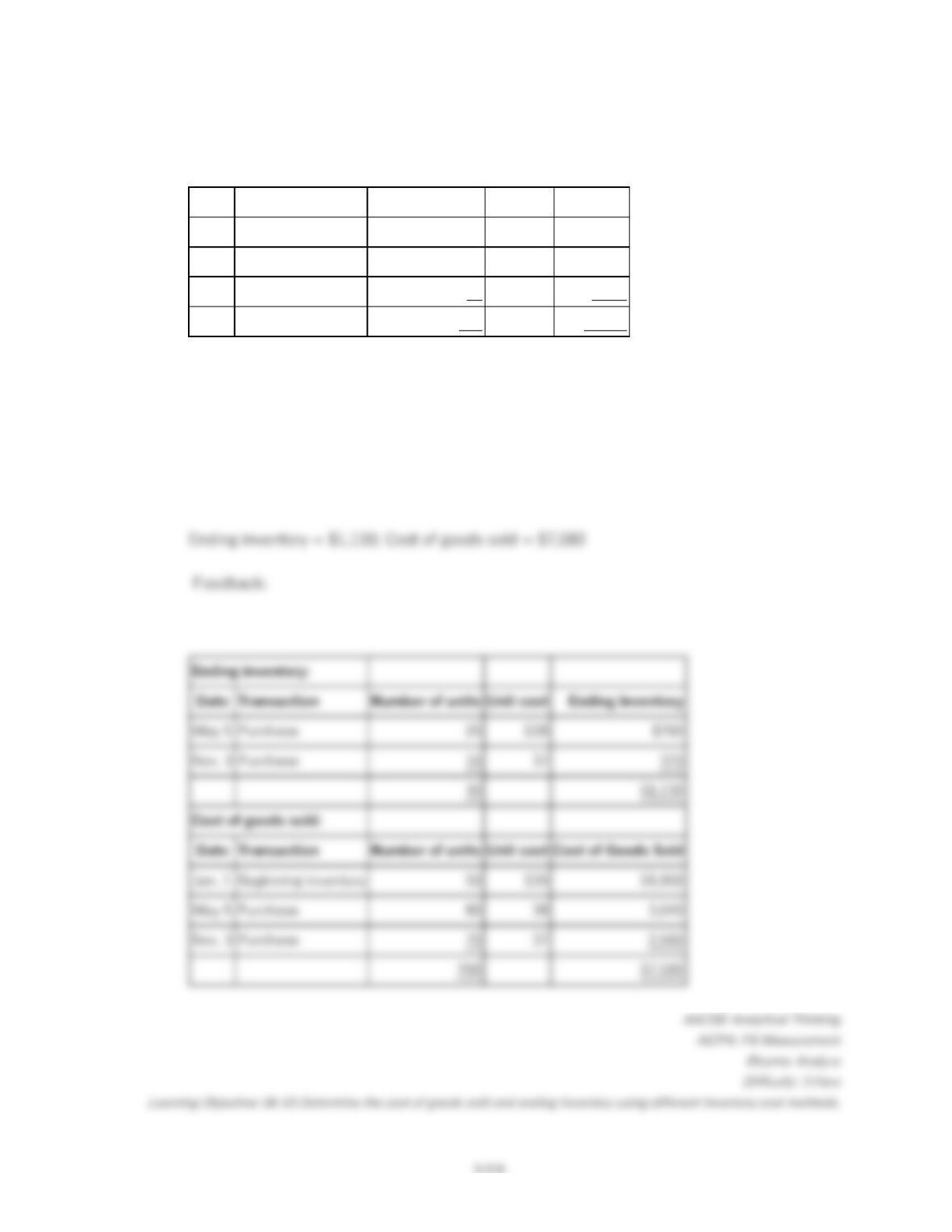
During 2018, a company sells 500 units of inventory for $90 each. The company has the
following inventory purchase transactions for 2018:
Date
Transaction
Number of Units
Unit Cost
Total Cost
Jan. 1
Beginning inventory
80
$79
$6,320
May 5
Purchase
270
80
21,600
Nov. 3
Purchase
190
82
15,580
540
$43,500
Calculate cost of goods sold and ending inventory for 2018 assuming the company uses
weighted-average cost with a periodic inventory system (round weighted-average unit cost
to four decimals if necessary).
194.
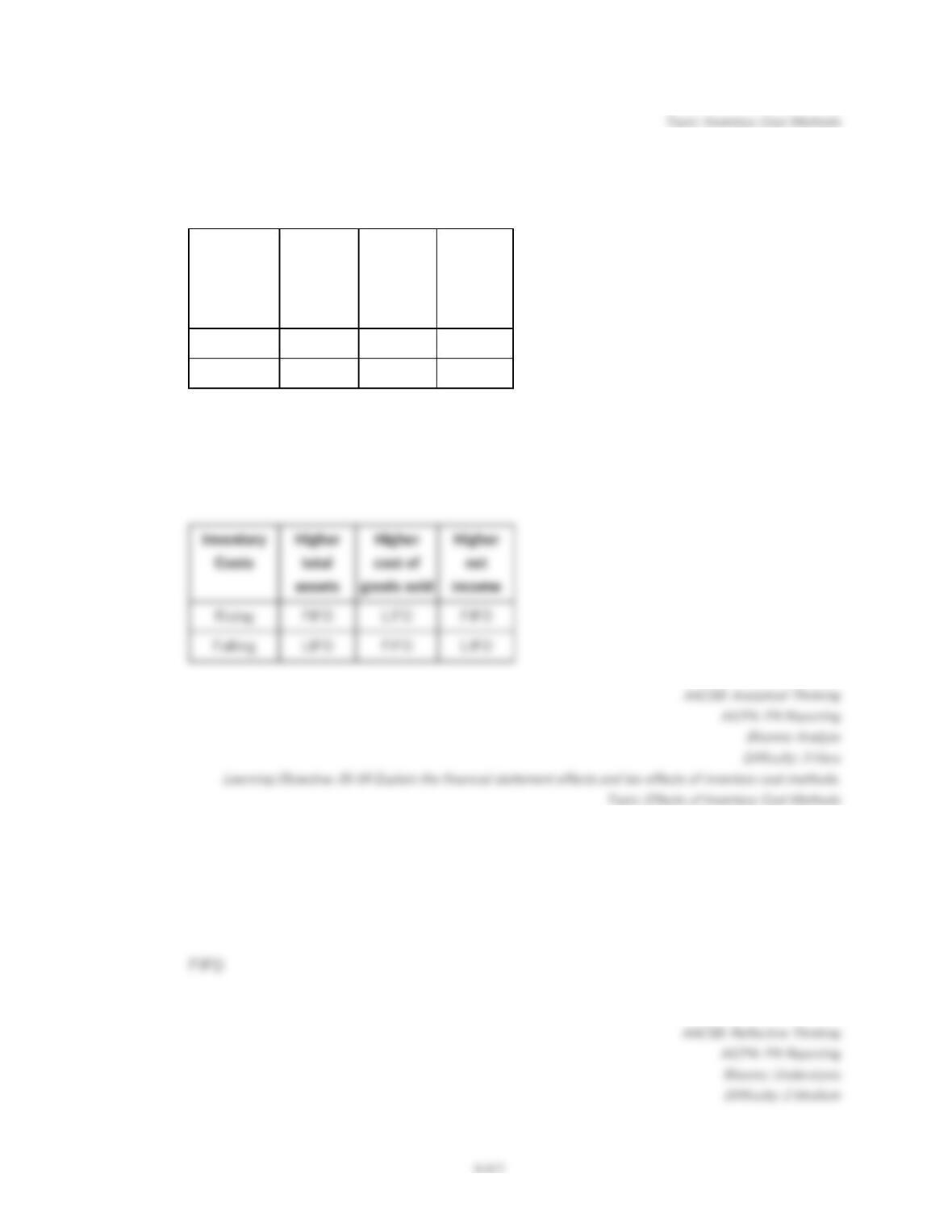
During 2018, a company sells 200 units of inventory for $50 each. The company has the
following inventory purchase transactions for 2018:
Date
Transaction
Number of Units
Unit Cost
Total Cost
Jan. 1
Beginning inventory
50
$39
$1,950
May 5
Purchase
100
38
3,800
Nov. 3
Purchase
80
37
2,960
230
$8,710
Actual sales by the company include its entire beginning inventory, 80 units of inventory
from the May 5 purchase, and 70 units from the November 3 purchase. Calculate cost of
goods sold and ending inventory for 2018 assuming the company uses specific
identification.
195.
For each item below, indicate whether FIFO or LIFO will generally result in a higher
reported amount when inventory costs are rising versus falling.
Inventory
Costs
Higher
Total
Assets
Higher
Cost of
Goods
Sold
Higher
Net
Income
Rising
Falling
196.
When inventory costs are rising, __________ generally results in a higher amount of
reported net income.
197.
When inventory costs are declining, __________ generally results in a lower amount of
reported cost of goods sold.
198.
When inventory costs are declining, __________ generally results in a lower amount of
reported inventory.
199.
When inventory costs are rising, __________ generally results in a lower amount of
reported cost of goods sold.
200.
When inventory costs are declining, __________ generally results in a higher amount of
reported net income.
201.
__________ is commonly referred to as the balance sheet approach.
202.
__________ is commonly referred to as the income statement approach.
203.
When inventory costs are rising, __________ generally results in a lower income tax
obligation.
204.
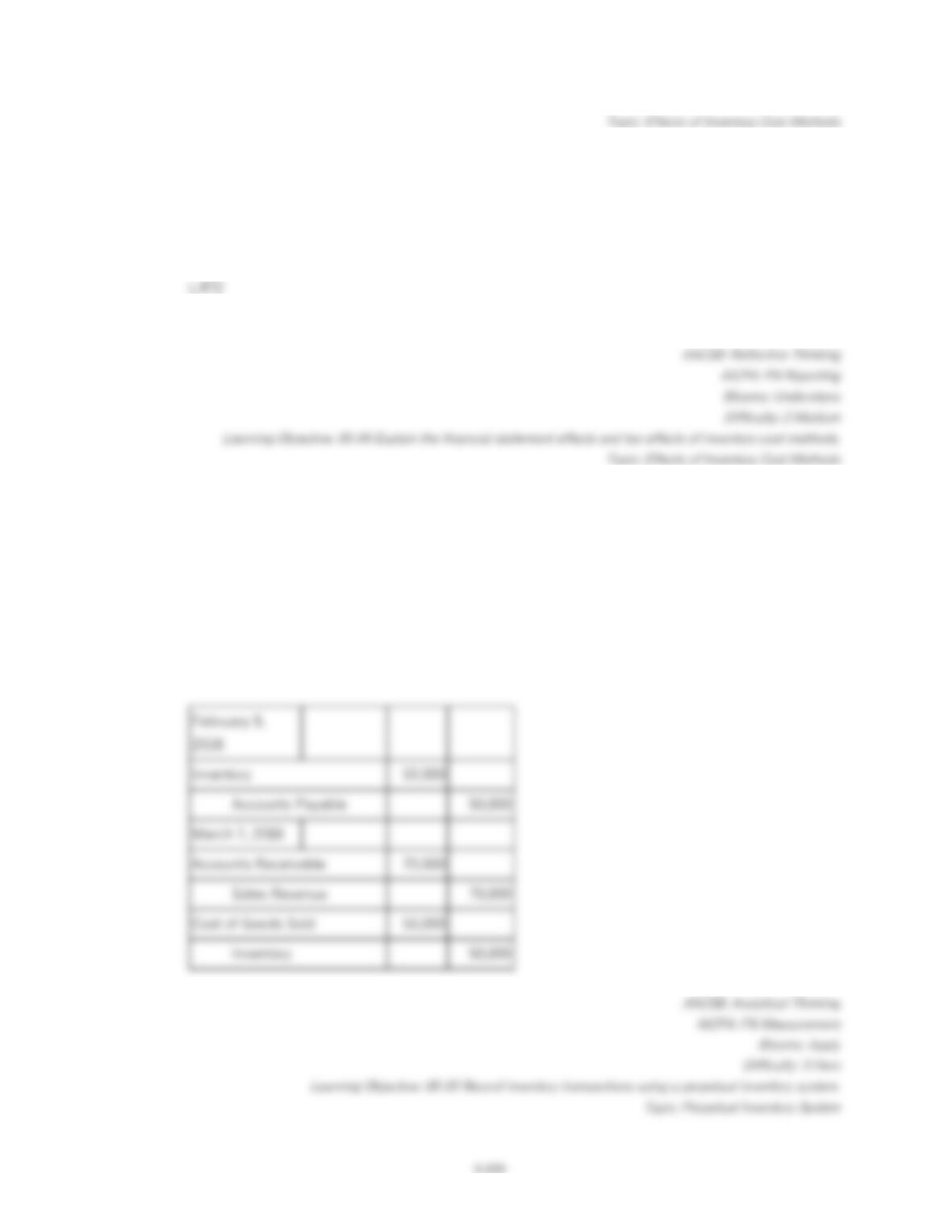
A company uses a perpetual system to record inventory transactions. The company
purchases inventory on account on February 9, 2018, for $50,000 and then sells this
inventory on account on March 7, 2018, for $70,000. Record the transactions for the
purchase and sale of the inventory.