Name:
Class:
Date:
Chapter 06: Consumer Choice and Demand
e. play more golf because it costs less.
86. Basil maximizes his utility by allocating his budget between tea and crumpets. If the marginal utility of his last cup of
tea was 24 units of utility and that of his last crumpet was 6 units of utility, then which of the following is true?
a. The price of tea is six times the price of crumpets.
b. The price of crumpets is four times the price of tea.
c. The prices of tea and crumpets are equal.
d. The price of tea is four times the price of crumpets.
e. The price of crumpets is six times the price of tea.
87. Suppose the price of a glass of orange juice is $2 and that of a glass of soft drink is $1. A utility-maximizing consumer
would buy:
a. more glasses of juice as a glass of juice has higher marginal utility than a glass of soft drink.
b. more glasses of soft drink as a glass of soft drink has higher marginal utility than a glass of juice.
c. equal quantities of juice and soft drink as the marginal utilities of a glass of juice and a glass of soft drink are the
same.
d. more soft drink as a glass of soft drink is cheaper than a glass of juice.
e. more glasses of juice as the ratio of total utility of an extra glass of juice to its price is more than that of a glass of
juice .
88. If the price of a good falls, _____.
a. the marginal utility of per dollar spent on consuming a specific unit of that good falls
b. the marginal utility of per dollar spent on consuming a specific unit of that good remains unchanged
c. the marginal utility of per dollar spent on consuming a specific unit of that good rises
d. the total utility from consuming a specific unit of that good decreases
e. the total utility from consuming a specific unit of that good remains constant
89. Tyrell has $50 to spend on good A and good B per week. The price of good A is $5 and that of good B is $4. He buys
six units of good A and five units of good B. The marginal utility of the sixth unit of A is 25 units, and the marginal utility
of the fifth unit of B is 20 units. Which of the following is true?
a. He is maximizing his utility.
b. His last dollar spent on good A exceeds the last dollar spent on good B.
c. He is not maximizing his utility and should buy more of A.
d. He is not maximizing his utility and should buy more of B.
e. He is not maximizing his utility because he is not spending all of his income.
90. Along the demand curve for a good, _____.
a. the dollar value of marginal utility changes
b. total utility changes due to changes in income levels
c. real income changes due to changes in the price of the good
d. marginal valuation changes due to changes in income levels
e. consumer surplus changes due to changes in income levels
Name:
Class:
Date:
Chapter 06: Consumer Choice and Demand
91. In order to derive a demand curve for cheese, one would change:
a. income and hold other things constant.
b. tastes and hold other things constant.
c. the price of other goods and hold everything else constant.
d. the price of cheese and hold other things constant.
e. the price of all goods, including cheese, and hold other things constant.
92. Which of the following varies along the demand curve for a good?
a. Consumer preferences
b. Prices of substitutes
c. Prices of complements
d. The price of the good itself
e. Income
93. Suppose Lorna buys more sweaters even if the price of sweaters rises. Other things constant, she is acting contrary to
the law of _____.
a. equi-marginal utility
b. increasing costs
c. one price
d. diminishing costs
e. demand
94. The law of demand states that:
a. quantity demanded is inversely related to price.
b. quantity demanded is directly related to income.
c. marginal utility is directly related to quantity consumed.
d. total utility from consumption of a good is directly related to its price.
e. marginal valuation of the good is directly related to demand.
95. Along a consumer’s demand curve the:
a. price of a good reflects the producer’s costs.
b. price reflects the dollar value of the total utility derived from the good.
c. price reflects the dollar value of the marginal utility of each additional unit of the good.
d. quantity demanded reflects the dollar value of the income earned.
e. quantity demanded reflects the dollar value of a substitute.
96. If the price of a good increases and an individual’s demand is elastic, identify the correct statement about total utility
(TU), marginal utility (MU), consumer surplus (CS), and total expenditure (TE).
a. TU increases, MU decreases, CS decreases, and TE decreases.
b. TU increases, MU increases, CS increases, and TE decreases.
c. TU decreases, MU increases, CS decreases, and TE increases.
Name:
Class:
Date:
Chapter 06: Consumer Choice and Demand
d. TU decreases, MU decreases, CS decreases, and TE decreases.
e. TU decreases, MU increases, CS decreases, and TE decreases.
97. If the amount paid for a good by consumers reflected the value of the total benefits they receive from consuming it:
a. the value of the total utility derived from consumption of the good exceeds the total spending on the good.
b. the value of consumer surplus would be zero.
c. the marginal valuation of the good would be irrational.
d. the value of total utility derived from consumption of the good would be equal to zero.
e. the value of marginal utility of an additional unit of the good would be negative.
98. Water is essential to life, while diamonds are not. However, water is cheap and diamonds are expensive. This paradox
can be resolved by focusing on:
a. total utility rather than average utility.
b. average utility rather than marginal utility.
c. marginal utility rather than total utility.
d. total utility rather than marginal utility.
e. average utility rather than total utility.
99. While purchasing diamonds and water, a consumer would maximize utility by:
a. dividing expenditure equally between the two goods.
b. equating the marginal utilities of each good.
c. equating the average utilities of each good.
d. equating the total utility of per dollar spent on each good.
e. equating the marginal utility per dollar spent on each good.
100. Arthur has $7,800 dollars. He goes into an upscale men’s store and buys 32 green sweaters, each costing $200. If
Arthur has maximized his utility from this purchase, which of the following is the marginal utility of the thirty-third green
sweater?
a. Negative
b. Greater than $200
c. Less than $200
d. $0
e. $200
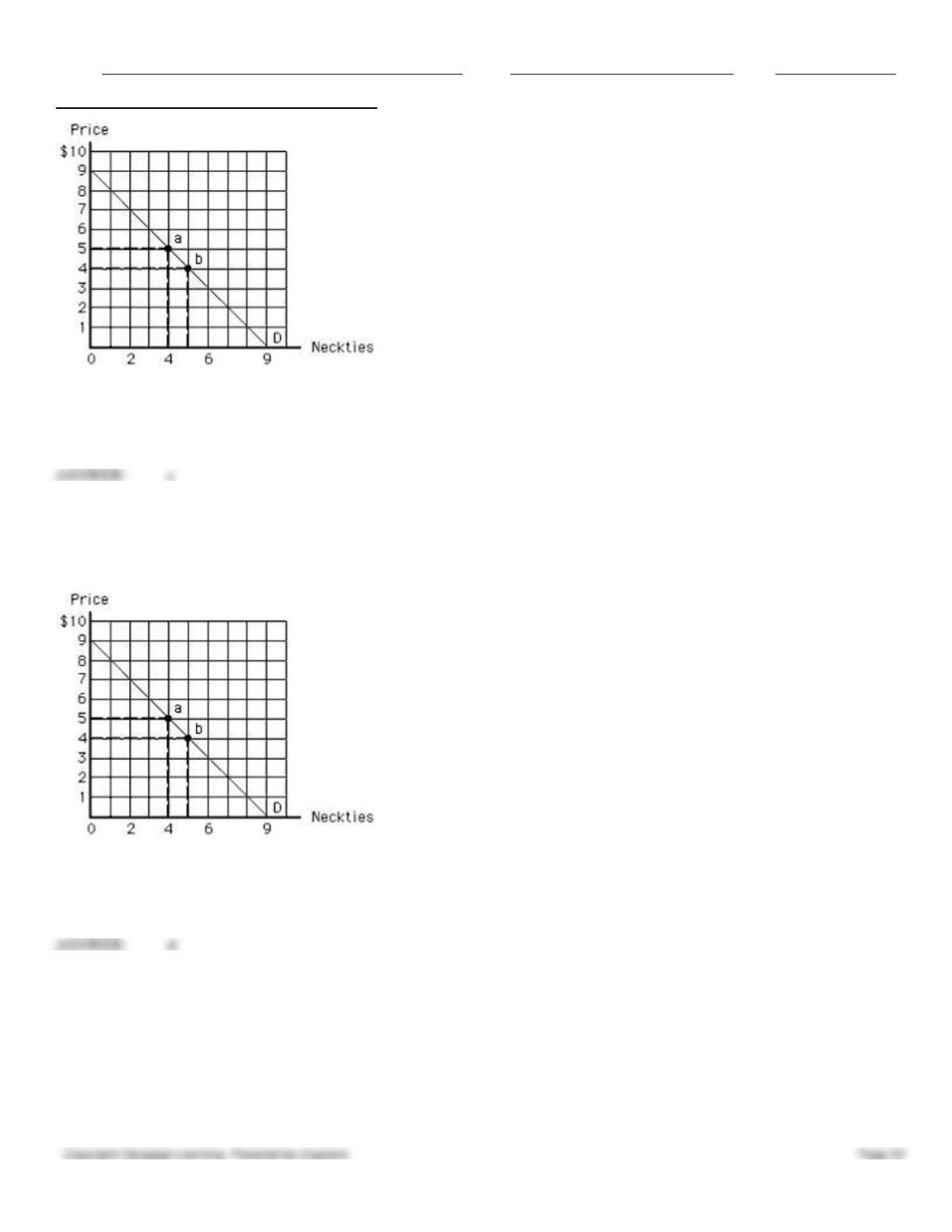
101. The following diagram shows the demand curve for neckties. At point a, total expenditure on neckties is:
Figure 6.3
Name:
Class:
Date:
Chapter 06: Consumer Choice and Demand
a. $5.
b. $9.
c. $20.
d. $26.
e. $45.
102. The following diagram shows the demand curve for neckties. At point a, the monetary value of the total utility
received by a consumer is:
Figure 6.3
a. $5.
b. $9.
c. $20.
d. $26.
e. $45.
103. The following image shows the demand curve for neckties. At point a, consumer surplus is _____.
Figure 6.3
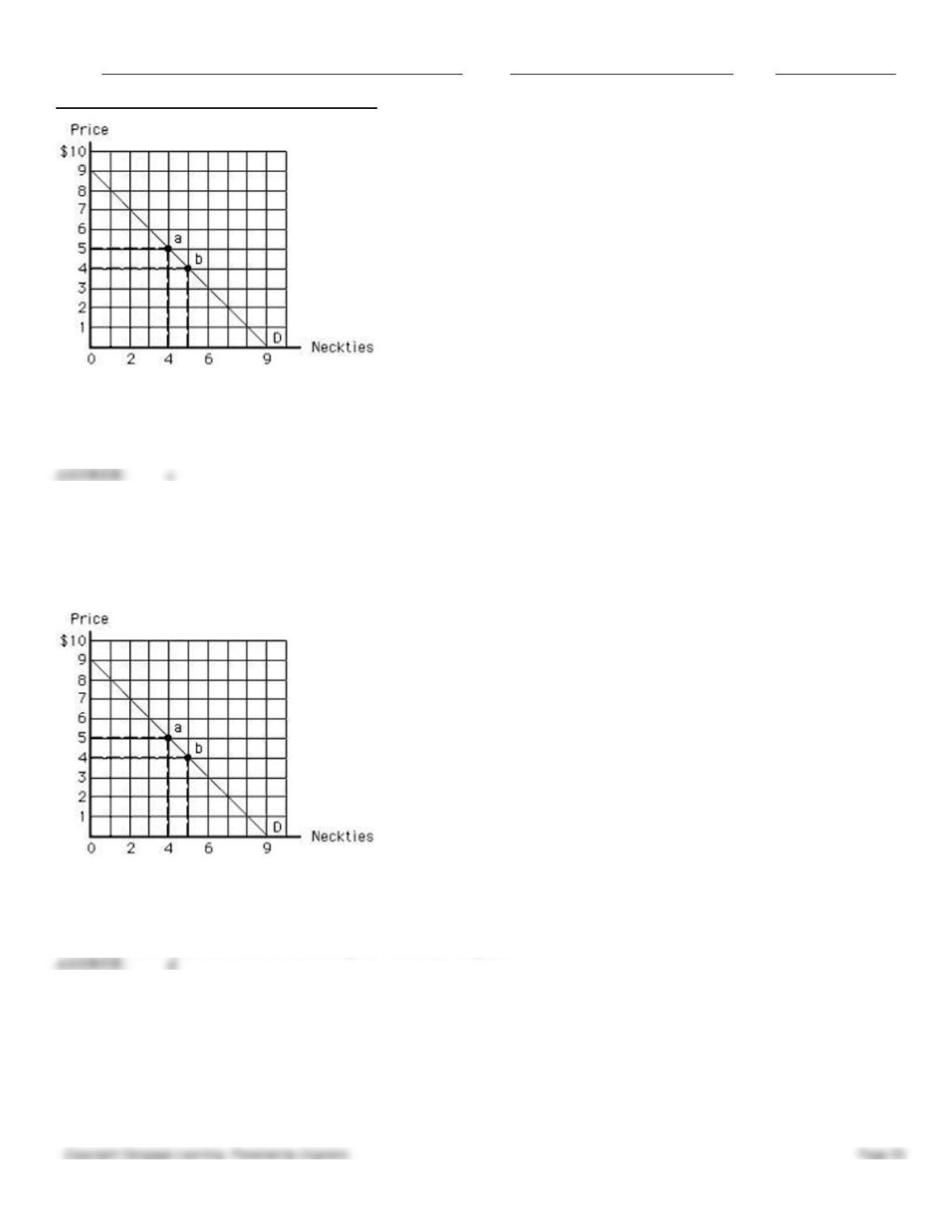
Name:
Class:
Date:
Chapter 06: Consumer Choice and Demand
a. $0
b. $5
c. $8
d. $20
e. $26
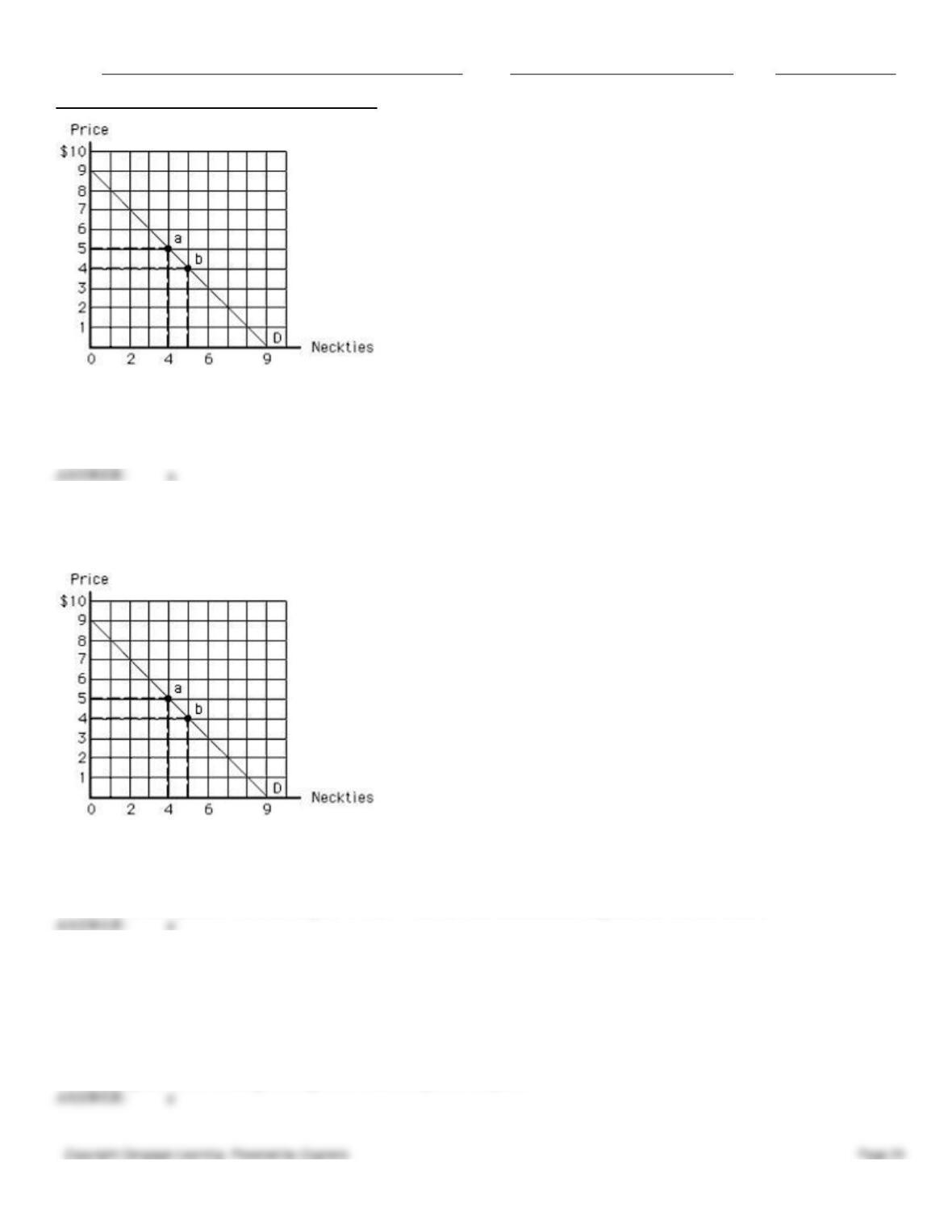
104. The following diagram shows Ken’s demand curve for neckties. When the price of neckties is $5, Ken purchases
four neckties. When the price of neckties falls to $4, he purchases five neckties. A decline in the price of neckties causes
his expenditure to:
Figure 6.3
a. increase from $20 to $25, increasing his consumer surplus.
b. increase from $20 to $25, decreasing his consumer surplus.
c. remain constant at $20, leaving his consumer surplus unchanged.
d. remain constant at $20, increasing his consumer surplus.
e. decrease from $20 to $15, increasing his consumer surplus.
105. The following diagram shows Ken’s demand curve for neckties. Point a on the curve shows that when the price of
neckties is $5, Ken purchases four neckties. Point b on the curve shows that when the price of neckties falls to $4, he
purchases five neckties. At point b, the dollar value of the total utility is valued at:
Figure 6.3
Name:
Class:
Date:
Chapter 06: Consumer Choice and Demand
a. $30.
b. $26.
c. $20.
d. $35.
e. $25.
106. The following image shows the demand curve for neckties. If neckties were available free of cost, then _____.
Figure 6.3
a. total utility, consumer surplus, and consumer expenditure would be undefined
b. total utility and consumer surplus would be valued at $20, but consumer expenditure would be undefined
c. total utility, consumer surplus, and consumer expenditure would all be equal to zero
d. total utility, consumer surplus, and consumer expenditure would all be at its maximum
e. total utility and consumer surplus would be valued at $36; consumer expenditure would be zero
107. If a consumer buys a good, the expected:
a. marginal utility of the good is zero
b. opportunity cost of buying the good is more than its price
c. marginal utility of per dollar spent on the good equals its price
d. total utility derived from the consumption of the good is less than its price
e. marginal value of the good is greater than or equal to its price
Name:
Class:
Date:
Chapter 06: Consumer Choice and Demand
108. As price falls along the demand curve for pretzels, _____.
a. the ratio of marginal utility of pretzels to its price increases
b. the marginal valuation of pretzels increases
c. consumption of pretzels increases and marginal utility decreases
d. the marginal valuation of pretzels decreases
e. total utility and marginal utility remains unchanged
109. As price falls along the demand curve for pretzels, _____.
a. consumer surplus remains unchanged
b. consumer surplus decreases
c. total utility decreases
d. consumer expenditure changes
e. marginal utility increases
110. A decrease in price along the elastic segment of a demand curve will:
a. decrease marginal utility and increase total utility.
b. decrease total utility as well as marginal utility.
c. increase marginal utility and decrease total utility.
d. increase total utility as well as marginal utility.
e. decrease consumer surplus and increase consumer expenditure.
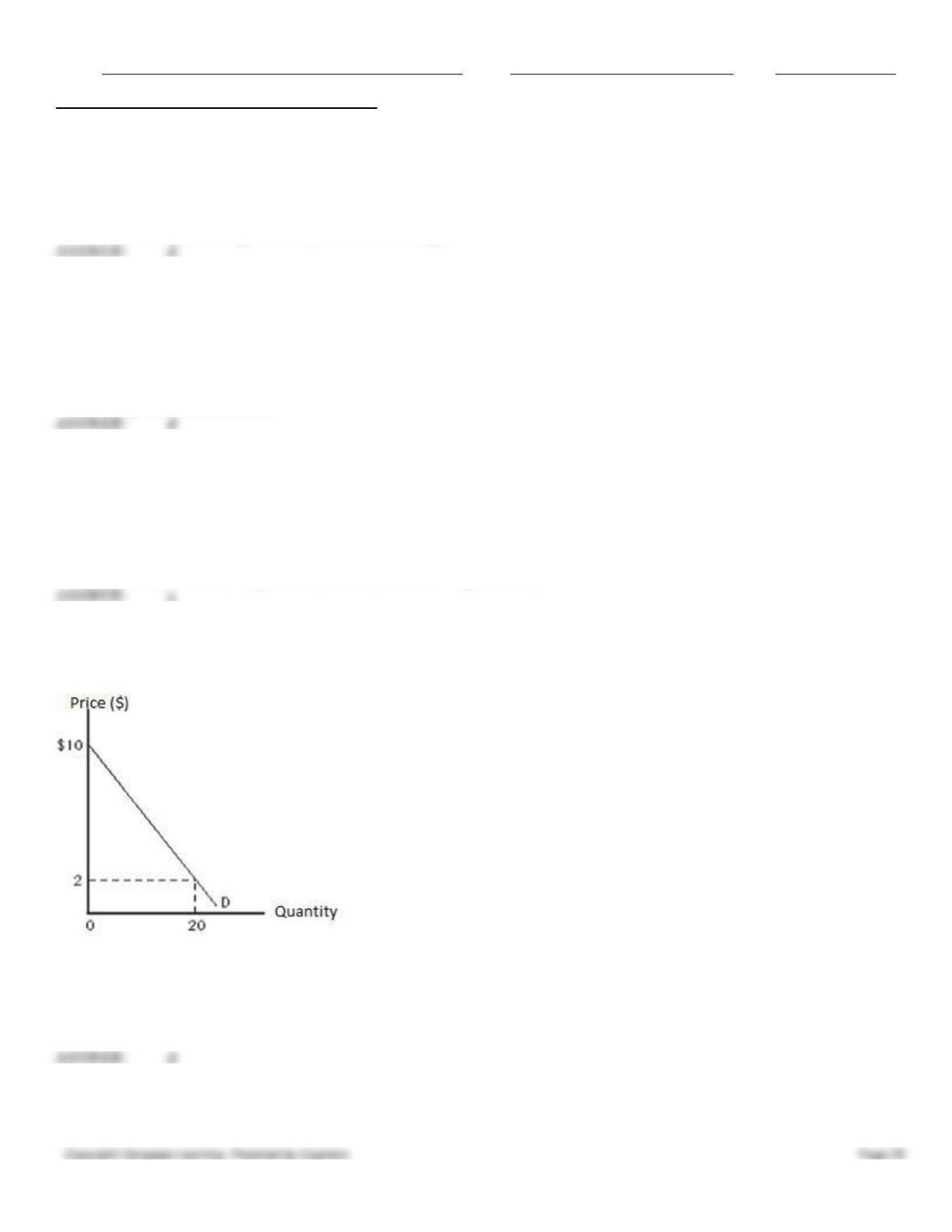
111. The following diagram shows a consumer’s demand schedule for a good. At a price of $2, consumer surplus is:
Figure 6.4
a. $4.
b. $5.
c. $10.
d. $80.
e. $200.
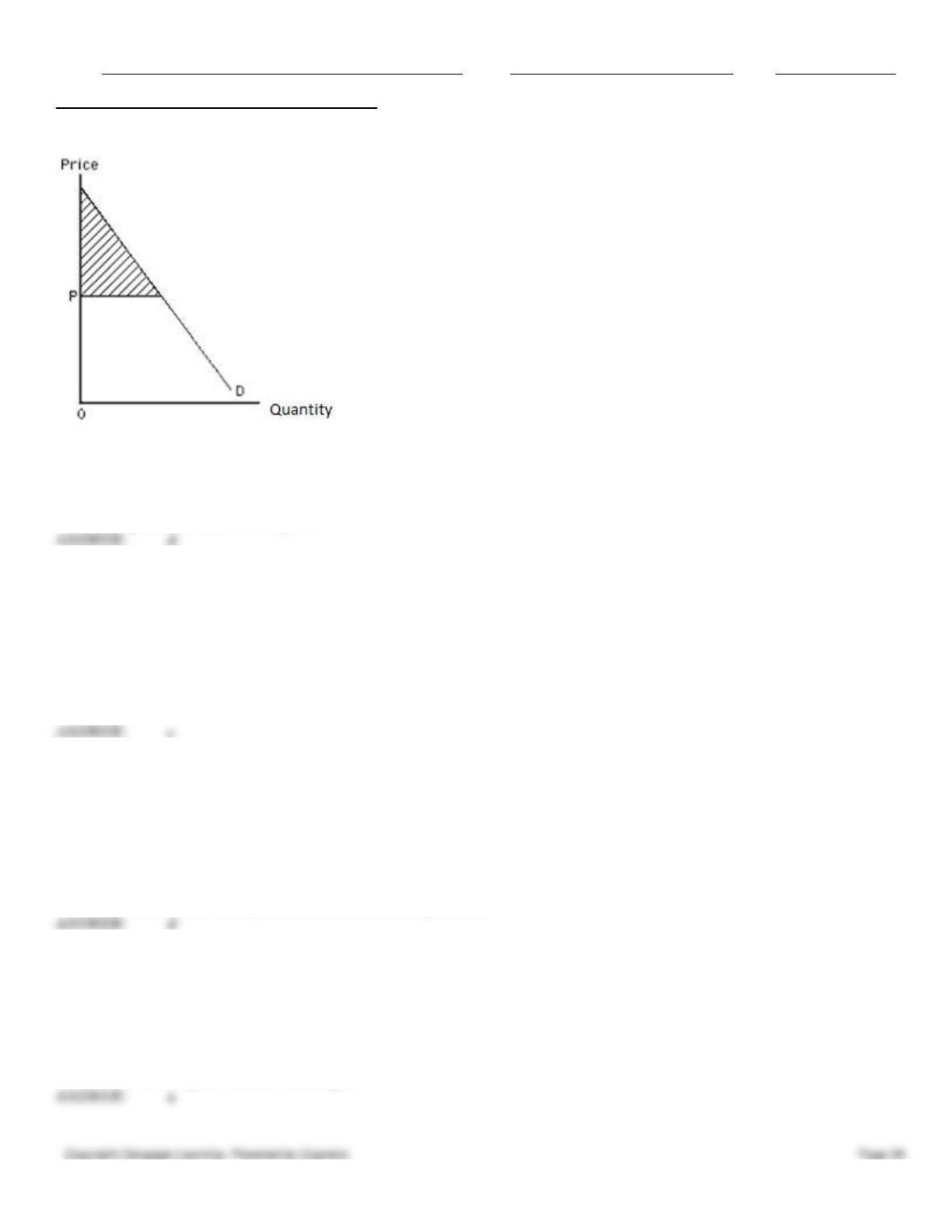
112. The following diagram shows the market demand schedule for a good. When the price of the good is P, the shaded
area represents:
Name:
Class:
Date:
Chapter 06: Consumer Choice and Demand
Figure 6.5
a. shortage.
b. marginal utility of the good.
c. price floor.
d. consumer surplus.
e. marginal valuation of the good.
113. Elvis values the first gravy sandwich at $5, the second at $4.50, the third at $4. If he buys three for $4 each, his
consumer surplus has a value of:
a. $5.
b. $4.
c. $1.50.
d. $9.50.
e. $12.
114. Jerry consumes three hamburgers at McDonald’s. He figures out that the last hamburger he ate was just worth the
price he paid for it. If the price of a hamburger is $1, _____.
a. he has no consumer surplus
b. he would have a consumer surplus if he eats one more hamburger
c. he has a consumer surplus on the first hamburger
d. he has a consumer surplus on the first two hamburgers
e. he has a consumer surplus on the third hamburger alone
115. Which of the following is true when the price of a good falls?
a. Consumer surplus always increases.
b. Consumer surplus always decreases.
c. Consumer surplus never changes.
d. Producer surplus increases.
e. Producer surplus remains unchanged.
Name:
Class:
Date:
Chapter 06: Consumer Choice and Demand
116. Suppose Hannah spends $3 to buy five biscuits. The marginal utility of the fifth biscuit is valued at $0.60. The total
utility derived from five biscuits is valued at $4.20. Hannah’s consumer surplus is valued at _____.
a. $20
b. $15
c. $5
d. $2.40
e. $1.20
117. Consumer surplus is:
a. the amount by which quantity supplied exceeds quantity demanded at the current market price.
b. the amount by which quantity demanded exceeds quantity supplied at the current market price.
c. the change in total utility derived from a one-unit change in the consumption of a good.
d. the horizontal sum of the individual demand curves for all consumers in the market.
e. valued by the difference between the maximum price consumers are willing to pay and the amount they actually
pay.
118. The following diagram shows a market equilibrium. D is the demand curve for a good and S is the supply curve of
the good. The consumer surplus at a price of $b is given by the area:
Figure 6.6
a. below the curve D and above the curve S.
b. below the curve D and above the market price of $b.
c. below the curve D and above the market price of $d.
d. above the curve D.
e. below the curve S.
119. Suppose Debbie is willing to pay $50 for a pair of shoes but has to pay $20 because the shoes are on sale. Her
consumer surplus is:
a. $50.
b. $20.
c. $70.
d. $30.
Name:
Class:
Date:
Chapter 06: Consumer Choice and Demand
e. $25.
120. The difference between the maximum amount a person is willing to pay for a given quantity of a good and the
amount actually paid for that quantity is known as:
a. producer surplus.
b. the substitution effect.
c. price discrimination.
d. the income effect.
e. consumer surplus.
121. Consumers derive consumer surplus when:
a. the monetary value of total utility equals total expenditure.
b. the monetary value of total utility is greater than total expenditure.
c. the monetary value of total utility is less than total expenditure.
d. marginal utility is greater than total utility.
e. marginal utility is less than total utility.
122. Dale is willing to pay $300 for a pair of Rollerblades and he purchases them on sale for $200. His consumer surplus
is valued at:
a. $300.
b. $1.5.
c. $100.
d. $200.
e. $0.
123. Fred truthfully tells a car dealer that the maximum amount he is willing to pay for a Ford Mustang is $20,000. The
dealer says, “You’re lucky; we have only one left on the lot for $20,000.” Which of the following statements is true?
a. Fred gets a consumer surplus of $15,000.
b. Fred and the dealer get a consumer surplus of $10,000 each.
c. Fred gets a consumer surplus of $20,000.
d. Fred gets no consumer surplus.
e. The dealer earns a consumer surplus of $20,000.
124. Ed is willing to pay a maximum of $200 for a tweed sport coat but buys one for $180. The $20 saved is:
a. his reservation price.
b. the store’s producer surplus.
c. his total expenditure.
d. his marginal utility.
e. his consumer surplus.
125. The consumer surplus derived from the last unit of a good purchased:
Name:
Class:
Date:
Chapter 06: Consumer Choice and Demand
a. tends to be less than zero.
b. tends to be equal to zero.
c. tends to equal the price of the good.
d. tends to be greater than the price of the good.
e. tends to be greater than the marginal utility of the first unit purchased.
126. If Joel buys ten floppy disks, which are worth a total of $30 to him, and he pays $1 per disk, his consumer surplus is:
a. $24.
b. $15.
c. $20.
d. $10.
e. $30.
127. The following diagram shows the market equilibrium for opera tickets. The demand curve for opera tickets is labeled
D and the supply curve S. At market equilibrium, area _____ represents the consumer surplus of all buyers in the market.
Figure 6.7
a. a
b. b
c. c
d. a + b + c
e. a + b
128. The following image shows the market equilibrium for opera tickets. The graph shows that a demand curve for opera
tickets, labeled D and a supply curve of opera tickets, labeled S. Area _____ represents the maximum amount that
consumers are willing to pay for 10 opera tickets?.
Figure 6.7
Name:
Class:
Date:
Chapter 06: Consumer Choice and Demand
a. a
b. b
c. c
d. a + b + c
e. a + b
129. The following table shows Reggie’s demand for apples at various prices. Suppose there are 100 people in an
economy, and each has the same demand for apples as Reggie. At a price of $6, the total quantity of apples demanded in
the market is _____ pounds.
Table 6.7
Price
per pound($) Quantity
Demanded (pound)
8 1
6 2
4 3
a. 600
b. 200
c. 300
d. 500
e. 800
130. At a zero price, the consumer surplus of all buyers in a market:
a. is equal to zero.
b. is equal to the value of the total utility derived from the consumption of goods.
c. is greater than the value of the total utility derived from the consumption of goods.
d. is equal to the value of the marginal utility of additional unit of goods.
e. is lesser than the value of the total utility derived from the consumption of goods.
131. If medical care is provided free of charge, _____.
a. beneficiaries consume it up to the point at which the marginal utility of the final unit is positive
b. beneficiaries will consume it up to the point at which the demand curve intersects the vertical axis
Name:
Class:
Date:
Chapter 06: Consumer Choice and Demand
c. beneficiaries will derive no consumer surplus from medical care
d. beneficiaries will consume it up to the point at which the marginal utility of the final unit is negative
e. beneficiaries will consume it up to the point at which the marginal utility of the final unit is zero
132. When consumers are required to pay a fraction of the cost of their medical treatment:
a. it reduces the demand for health care services to zero.
b. it has no effect on the demand for health care services, but does generate revenue for the government.
c. it reduces the income elasticity of demand for health care services.
d. it actually increases the amount of consumer surplus they receive from health care services.
e. it increases the financial burden of most consumers.
133. Demand for a service like medical care:
a. is an example of the negative substitution effect.
b. is perfectly inelastic.
c. is perfectly elastic.
d. is sensitive to the time component of cost.
e. varies directly with the price of that care.
134. Which of the following people is least likely to clip discount coupons?
a. A retired person
b. An unemployed person
c. A low-income worker
d. A high-priced consultant
e. A graduate student loafing during her summer break
135. A consumer might buy from a high-priced local hardware store instead of going to a big discount store several miles
away because:
a. the local store will still have lower money prices.
b. the time cost of going to the local store is equal to going to the discount store.
c. the local hardware store is a bargain for people who value time highly.
d. the local hardware store is a bargain for people who earn low hourly wages.
e. the time cost of going to the discount store is less than going to the local hardware store.
136. Which of the following statements is true?
a. The money price of a good is usually the same as the time price for most consumers.
b. The money price is always more than the time price.
c. The money price is usually more for high-wage workers than for low-wage workers.
d. The time price is usually less for low-wage workers than for high-wage workers.
e. The time price of a good is directly proportional to the money price.
Name:
Class:
Date:
Chapter 06: Consumer Choice and Demand
137. Sally wants to visit Orlando during the week-long spring break. She can get there by bus in two and one-half days or
fly there in four hours. The round trip by bus and plane would cost $20 and $200, respectively. Which of the following is
not true?
a. She would compare the marginal utility of per dollar spent on air travel with that spent on bus travel.
b. Depending on what else she could do during that week, it may be economically rational for her not to go at all
rather than go by bus.
c. The true cost of going to Orlando is either the time or the money she spends traveling, whichever she values
more.
d. The more she enjoys Orlando, the more economically rational it becomes for her to fly there instead of taking the
bus.
e. It may be rational for her to fly and rational for others to take the bus.
138. People who use drive-through windows at restaurants and eat while on the road:
a. are likely to enjoy less consumer surplus than those who dine at restaurants.
b. are likely to have a high opportunity cost of time.
c. do not maximize their utility.
d. gain less marginal utility than they would if they dined at restaurants.
e. value their money more than their time.
139. The cost of consumption has two components, _____.
a. the substitution effect and the income effect
b. the law of demand and the law of diminishing marginal utility
c. the price effect and the income effect
d. the money price and the time price
e. saving and taxes
140. A consumer’s willingness to pay additional money for time-saving goods depends primarily on:
a. the opportunity cost of his or her time.
b. the wealth and property he or she possesses.
c. his or her social status.
d. the number of people in his or her household.
e. the distance between his or her home and workplace.
141. Which of the following people would least likely search the newspaper advertisements for bargains?
a. A retired person
b. An unemployed person
c. A waitress earning $5 per hour
d. An attorney earning $100 per hour
e. A student spending her summer vacation in Florida
142. Although some tastes do change over time, economists believe that tastes are relatively stable. If tastes were not
stable enough, then _____.
a. the supply curve of a good could not be drawn.
Name:
Class:
Date:
Chapter 06: Consumer Choice and Demand
b. the “other-things-constant” assumption required for demand analysis could not be made.
c. the average cost curve of a firm could not be drawn.
d. consumers could not increase utility by reallocating their budget.
e. the law of diminishing marginal utility would not hold true.
143. Which of the following is true of “cabin fever”?
a. Each additional warm day adds increasing marginal utility.
b. Each additional cold day adds disutility.
c. Each additional spring day adds disutility.
d. “Spring fever” breaks with the arrival of “cabin fever.”
e. Each additional cold day adds utility.
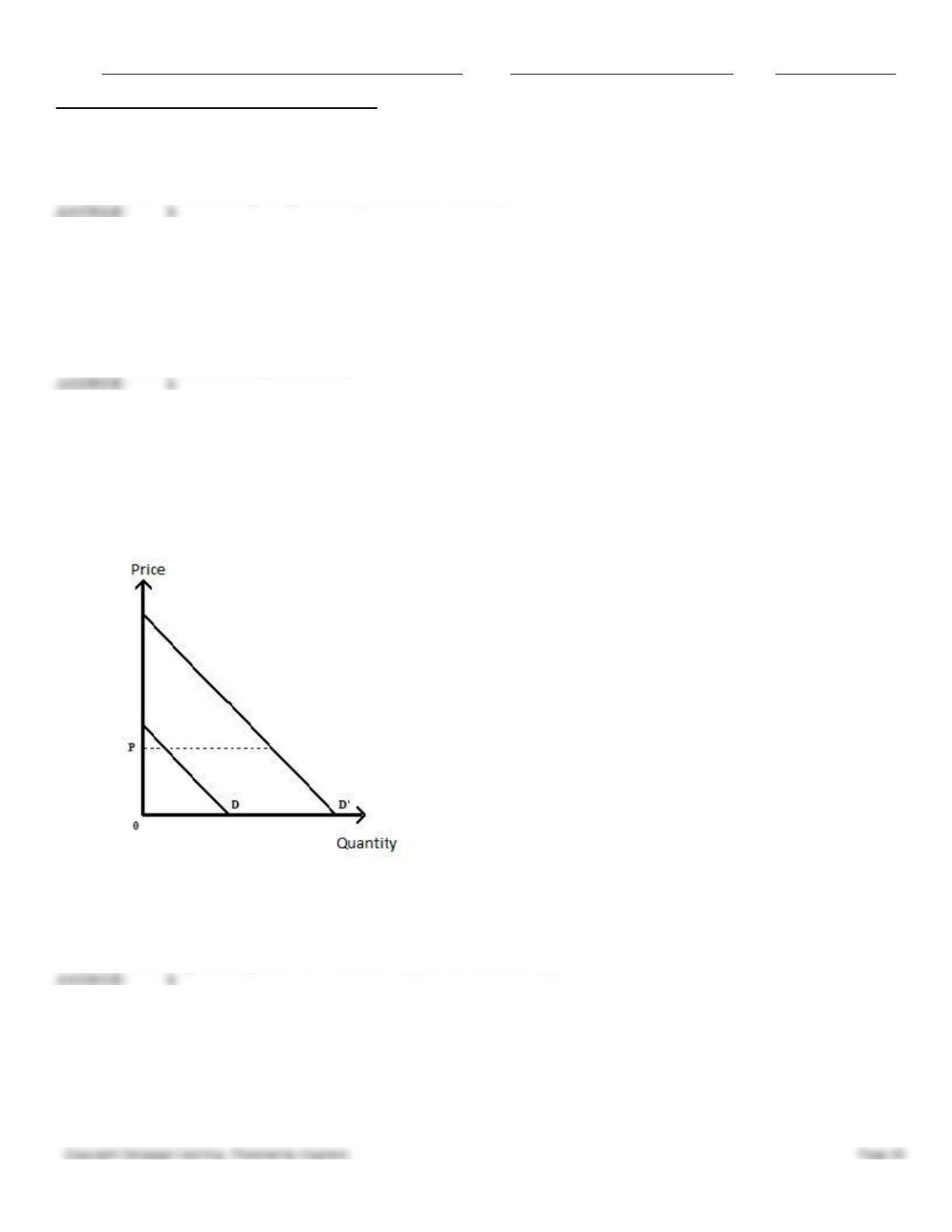
144. The following diagram shows Emily’s demand curves for hot chocolate. On a normal day, Emily’s demand curve for
a cup of hot chocolate is shown as D. On a freezing day, her demand curve shifts rightward to D’. At a price P, Emily’s
consumer surplus on a freezing day:
Figure 6.8
a. cannot be determined without calculating her marginal valuation of a cup of hot chocolate.
b. increases significantly over her consumer surplus on a normal day.
c. will vary depending on whether hot chocolate is a normal or an inferior good.
d. increases only if her demand curve is unit-elastic.
e. decreases significantly over her consumer surplus on a normal day.
145. _____ can be used to compare the effects of different market structures, tax structures, and public programs on
consumer well-being.
a. Consumer surplus
b. Producer surplus
c. Indifference curves
d. Market supply
Name:
Class:
Date:
Chapter 06: Consumer Choice and Demand
e. Changes in consumer tastes and preferences
146. After paying the price of admission, Alan enters King’s Island Amusement Park near Fujiwara. He sees boards
listing the waiting times for each attraction and ride. At that point, Alan’s marginal dollar cost of each attraction and ride
is:
a. zero and so are the marginal time costs of each attraction and ride.
b. zero, so he will base his next move on the marginal time costs of each attraction or ride.
c. greater than zero based on the admission price, so he will base his next move on the marginal time costs of each
attraction or ride.
d. greater than zero based on the admission price, so he will ignore the marginal time costs of each attraction or ride.
e. less than zero and so are the marginal time costs of each attraction or ride.
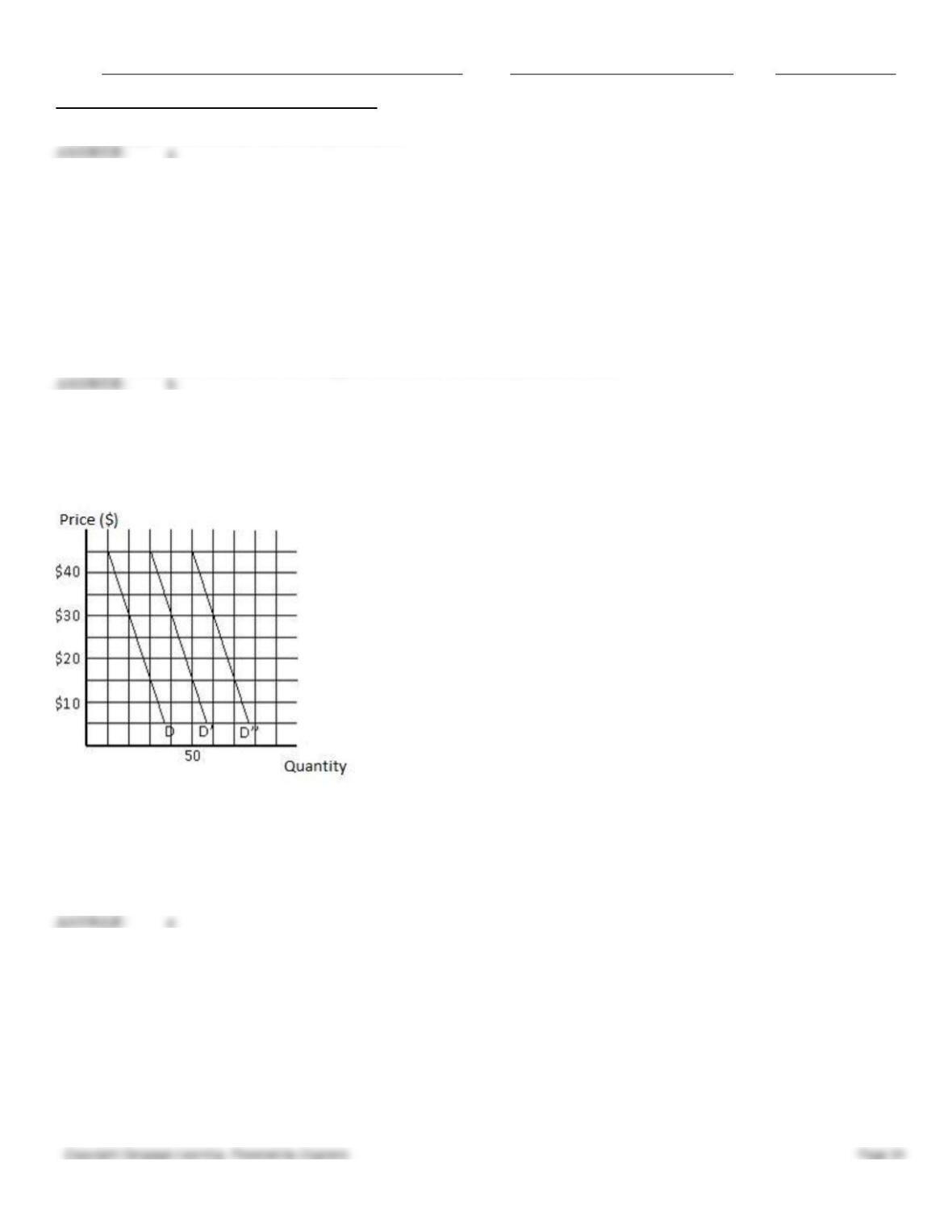
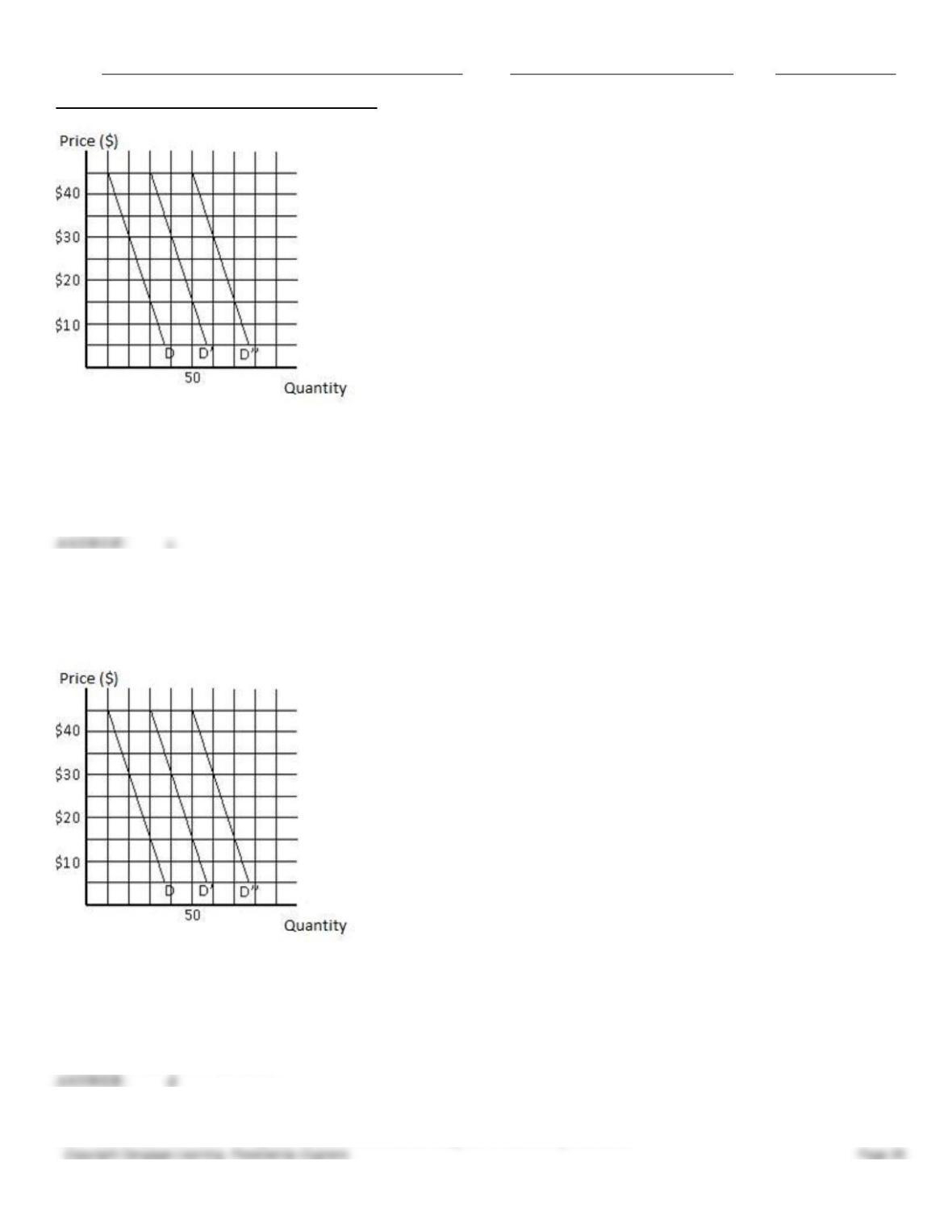
147. The following graph shows the demand curves for three consumers in the market, represented by D, D’ and D’’. At a
price of $30, the market quantity demanded for the good will be _____ units.
Figure 6.10
a. 40
b. 60
c. 80
d. 100
e. 120
148. The following graph shows the demand curves for three consumers in the market, as represented by D, D’ and D’’.
At a price of $45, the market quantity demanded for the good will be _____ units.
Figure 6.10
Name:
Class:
Date:
Chapter 06: Consumer Choice and Demand
a. 50
b. 70
c. 90
d. 110
e. 130
149. The following graph shows the demand curves for three consumers in the market, as represented by D, D’ and D’’.
The market demand curve will _____.
Figure 6.10
a. be steeper than each of the three individual demand curves
b. be more elastic than each of the three individual demand curves
c. be flatter than each of the three individual demand curves
d. be more inelastic than each of the three individual demand curves
e. lie to the left of the curve D
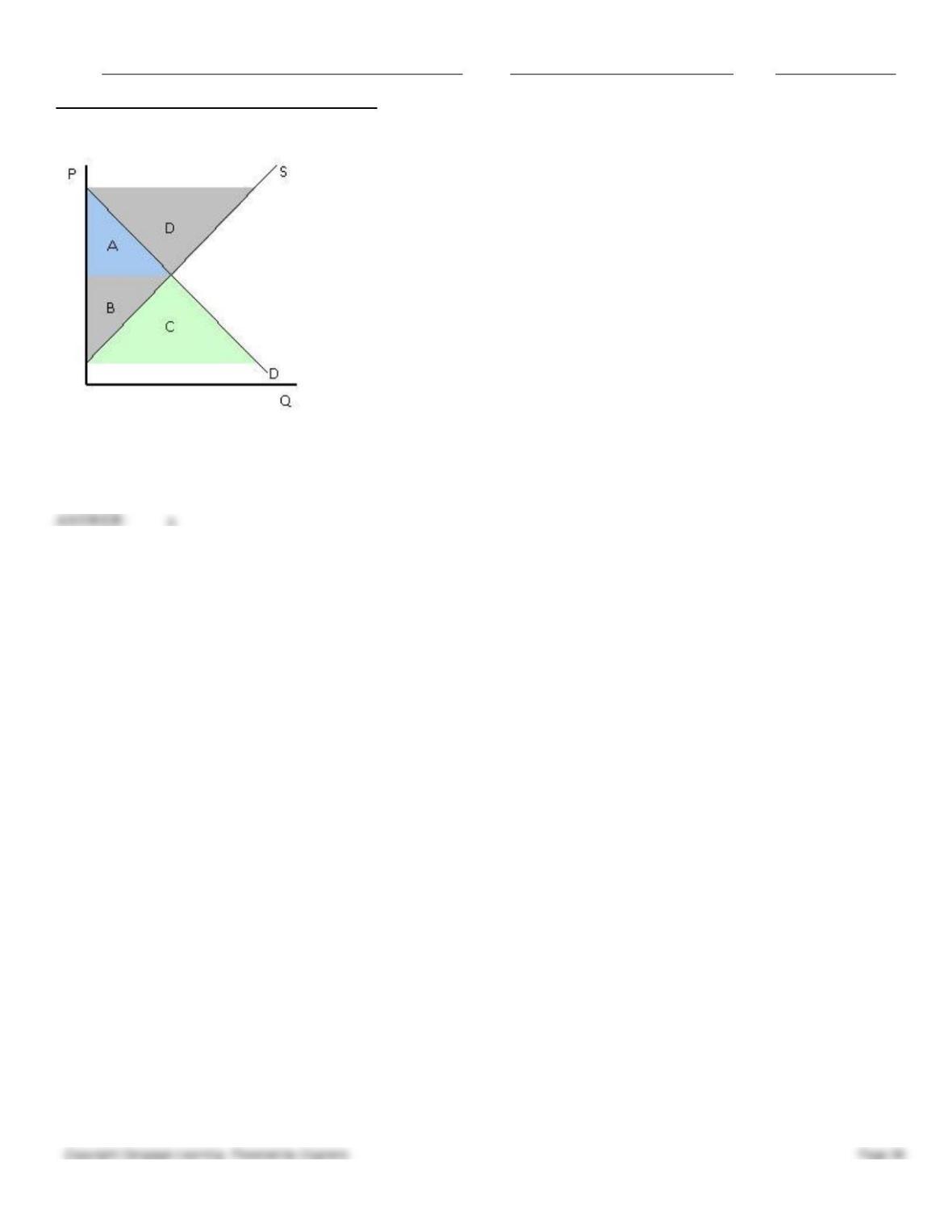
150. When this market is in equilibrium, the consumer surplus is shown by the area:
Name:
Class:
Date:
Chapter 06: Consumer Choice and Demand
Figure 6.11
a. A.
b. A + B.
c. B.
d. C.
e. D.