Chapter 6: Process Costing
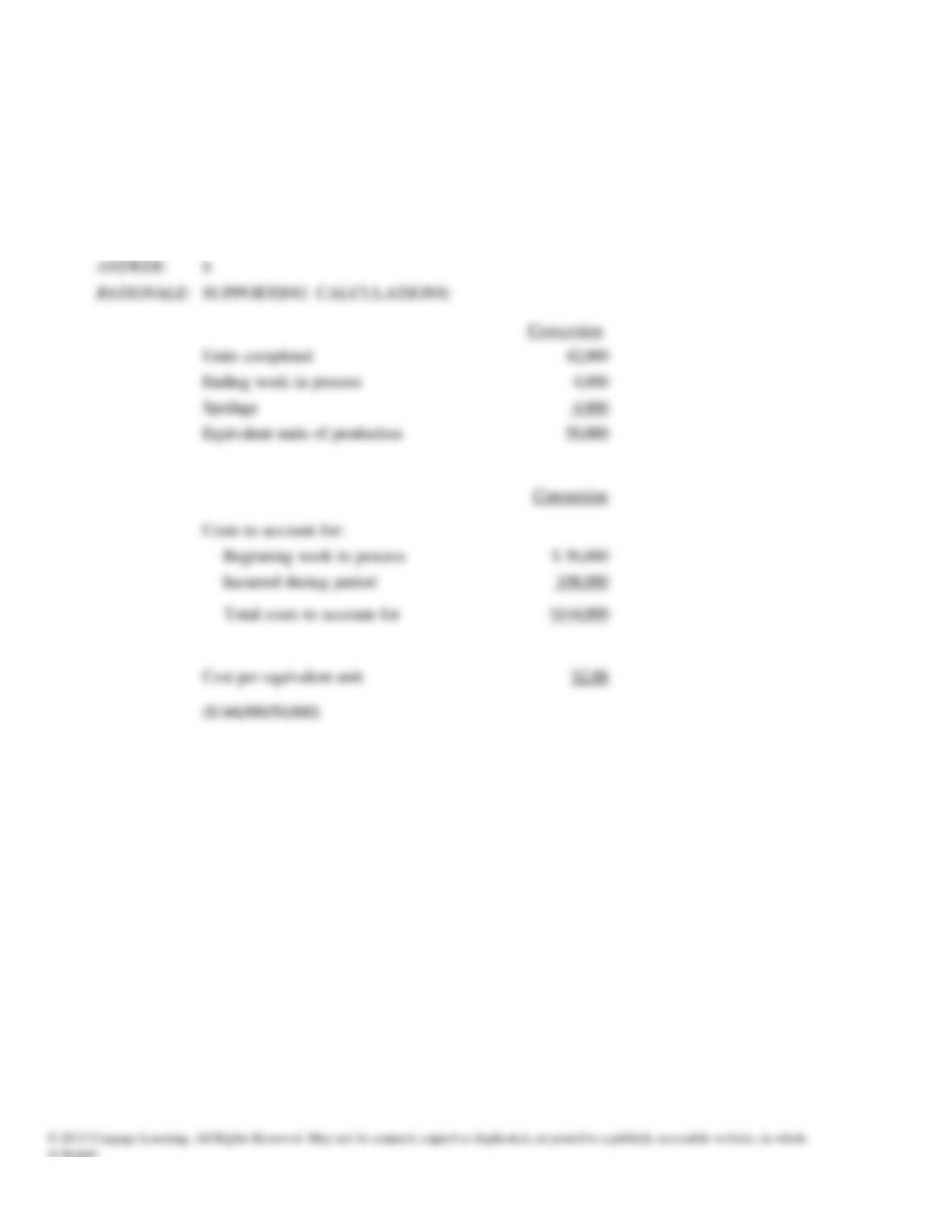
172. Refer to Figure 6-22. Department C’s cost per unit for materials using the weighted average method is
a. $2.16.
b. $2.88.
c. $3.43.
d. $3.60.
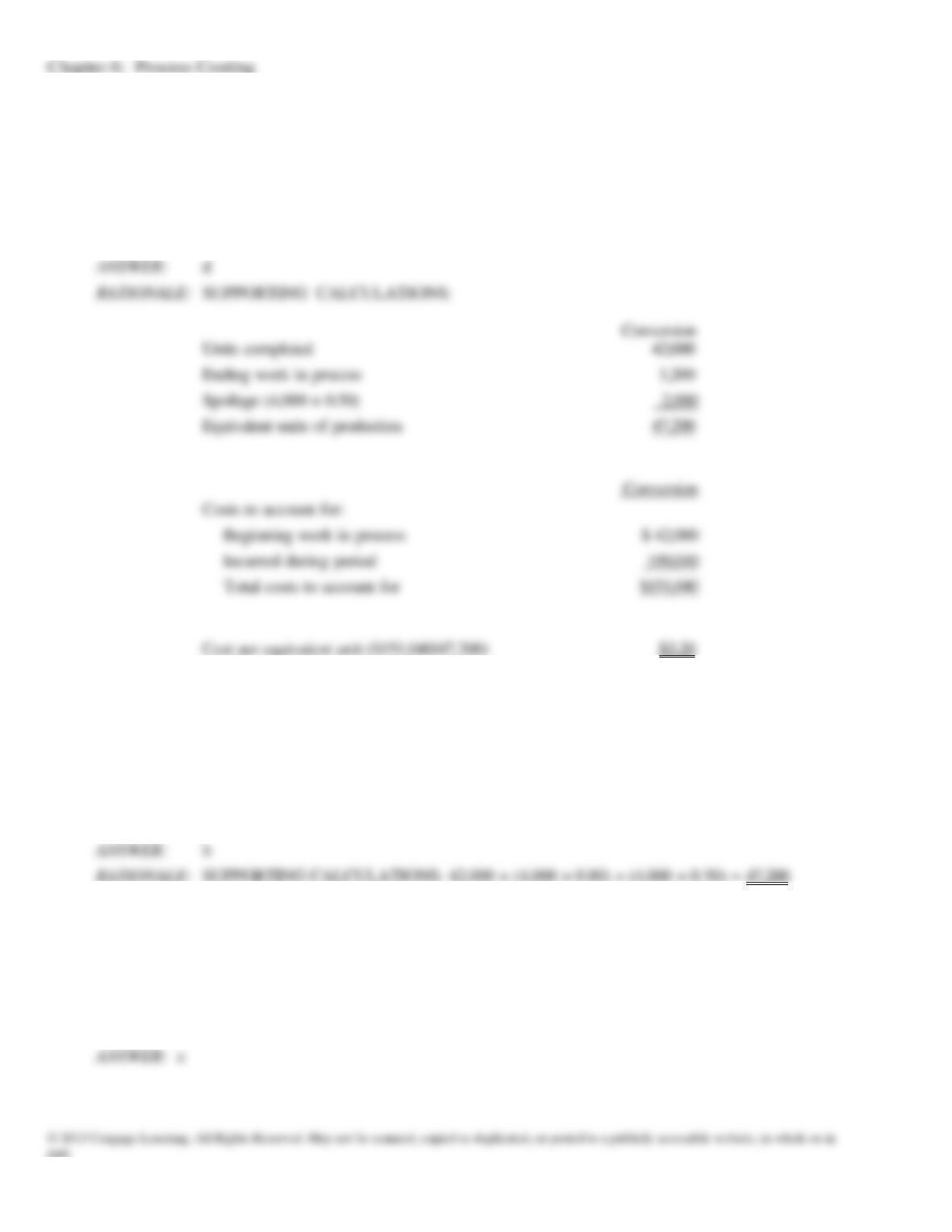
173. Refer to Figure 6-22. Department C’s conversion cost per unit using the weighted average method is
a. $2.18.
b. $2.22.
c. $2.31.
d. $3.20.
174. Refer to Figure 6-22. Department C’s equivalent units of production for conversion using the weighted average
method is
a. 44,800.
b. 47,200.
c. 50,000.
d. 54,000.
175. Abnormal spoilage is treated differently from normal spoilage in what way?
a. Equivalent units are calculated for abnormal spoilage but not for normal spoilage.
b. Equivalent units are calculated for normal spoilage but not for abnormal spoilage.
c. Normal spoilage is absorbed as part of the product cost but abnormal spoilage costs are treated separately.
d. Abnormal spoilage is not assigned costs but normal spoilage is.

Chapter 6: Process Costing
176. Spoilage in a process costing process means
a. fewer units leave the process than enter it.
b. fewer units enter a process than leave it.
c. a process is no longer viable.
d. products are receiving too much attention.
Chapter 6: Process Costing
Materials purchased
$150,000
Materials issued to production
120,000
Direct labor
40,000
Factory overhead
30,000
Finished goods for period
180,000
Beginning work in process
–0-
Ending work in process:
Materials
3,000
Direct labor
Factory overhead
?
?
177. Banzai Corporation produces calculators on an assembly line in a single-step process. Factrory overhead is
applied based on direct labor cost. The following data pertains to September 2016:
Current manufacturing costs:
Required:
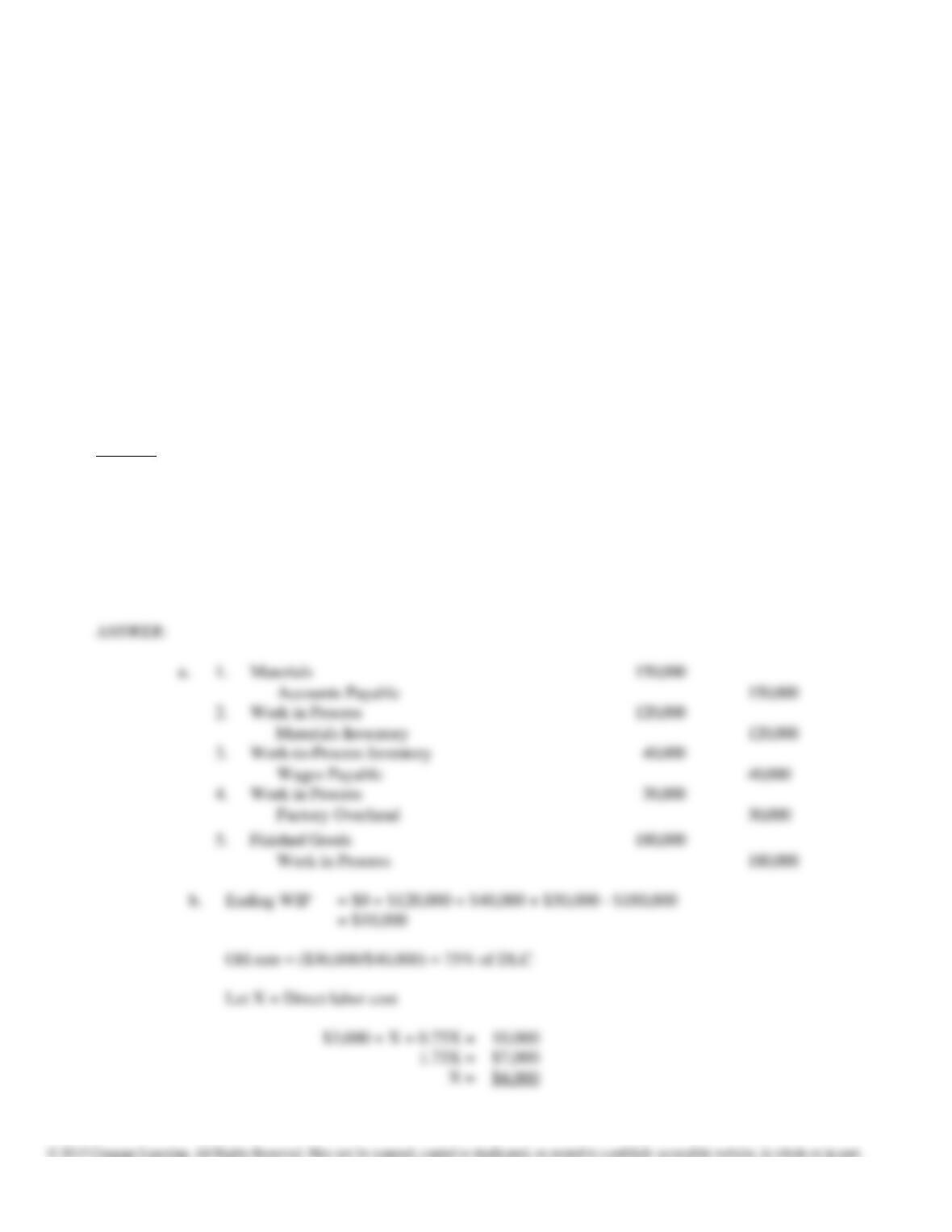
a. Prepare traditional journal entries for the following events in September:
1. Purchase of materials on account
2. Requisition of materials into production
3. Usage of direct labor
4. Application of overhead
5. Completion of finished goods
b. What is the amount of direct labor in ending work in process?
Chapter 6: Process Costing
178. The local USPS office sorts letters by zip code. During the month of March, 200,000 letters were sorted. The
cost of sorting includes the following:
Direct labor
$12,000
Overhead
8,000
Total
$20,000
Required:
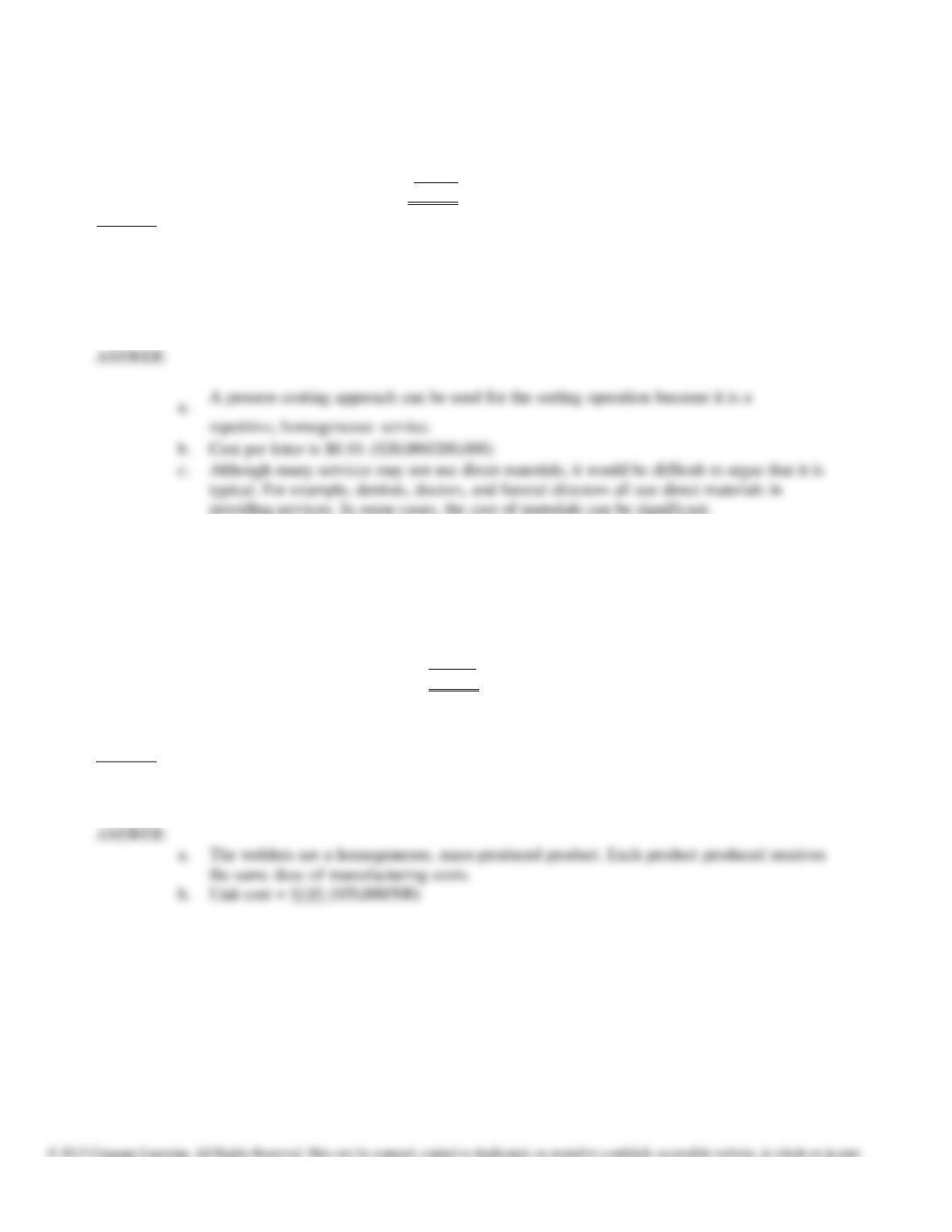
a. Explain why process costing is appropriate for this operation.
b. Calculate the cost per letter for this operation.
c. There are no direct materials used for the sorting operation. Is the absence of direct
materials typical of services? If not, provide examples of services that use direct materials.
179. The Tolstoy Corporation uses JIT manufacturing. There are several manufacturing cells set up within one of
its factories. One of the cells makes welders. The cost of production for the month of December is as
follows:
Cell labor
$10,000
Direct materials
25,000
Overhead
20,000
Total
$55,000
During December, Tolstoy Corporation produced and sold 500 welders.
Required:
a. Why can process costing be used to compute the cost of the welders?
b. Calculate the unit cost of a welder..
Chapter 6: Process Costing
Work in process, beginning
$14,730
Materials
$45,000
Direct labor cost
$102,960
Factory overhead cost
$51,480
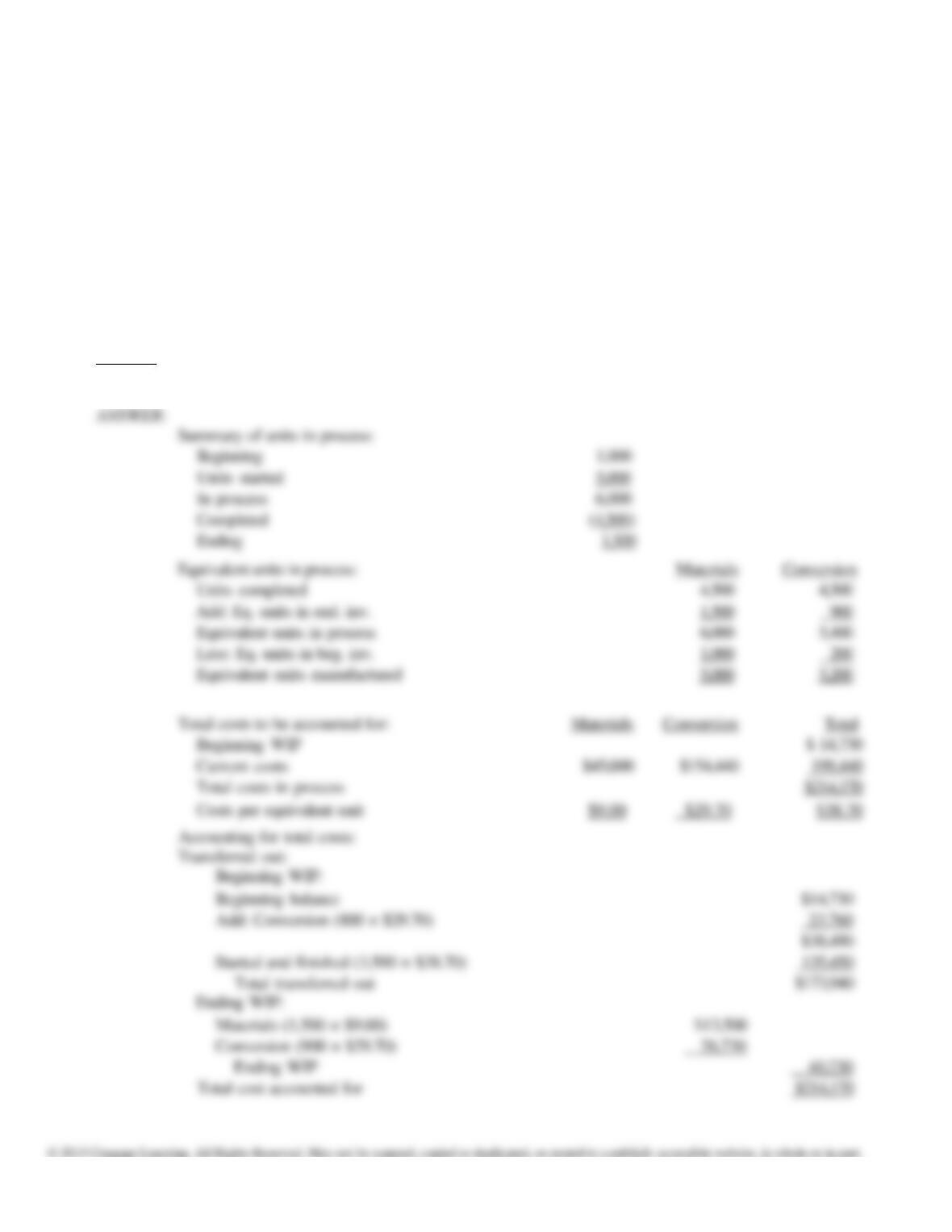
180. Suburbia Company manufactures a product through a continuous single-step process. All materials are added at
the beginning of processing. Production and cost data for the company for February 2016 are as follows:
Production data:
In process, beginning of month (20% converted) 1,000 units
Started during February 5,000 units
Completed and transferred to finished goods 4,500 units
In process, end of month (60% converted) 1,500 units
Manufacturing costs:
Required:
Prepare a cost of production report for February 2016. Use FIFO process costing.
Units started
Completed
Add: Eq. units in end. inv.
Costs per equivalent unit
$9.00
$29.70
Chapter 6: Process Costing
181. Xavier Corporation manufactures a plastic toy product in a two-stage production process. Plastic material is
brought into the Forming Department where it is shaped. Shaped products are then moved to the Finishing
Department where metal is added. The following data is given for the Forming Department for November:
Units for November:
Work in process, beginning inventory November 1 300 units
Direct materials (100% complete)
Conversion (40% complete)
Units started in November: 2,200 units
Work in process, ending inventory November 30 500 units
Direct materials (100% complete)
Conversion (25%)
Costs for November:
Work in process, beginning inventory
Direct materials $7,100
Conversion $4,525
Costs added during November:
Direct materials $70,400
Conversion $40,100
Round to two decimal places.
Required:
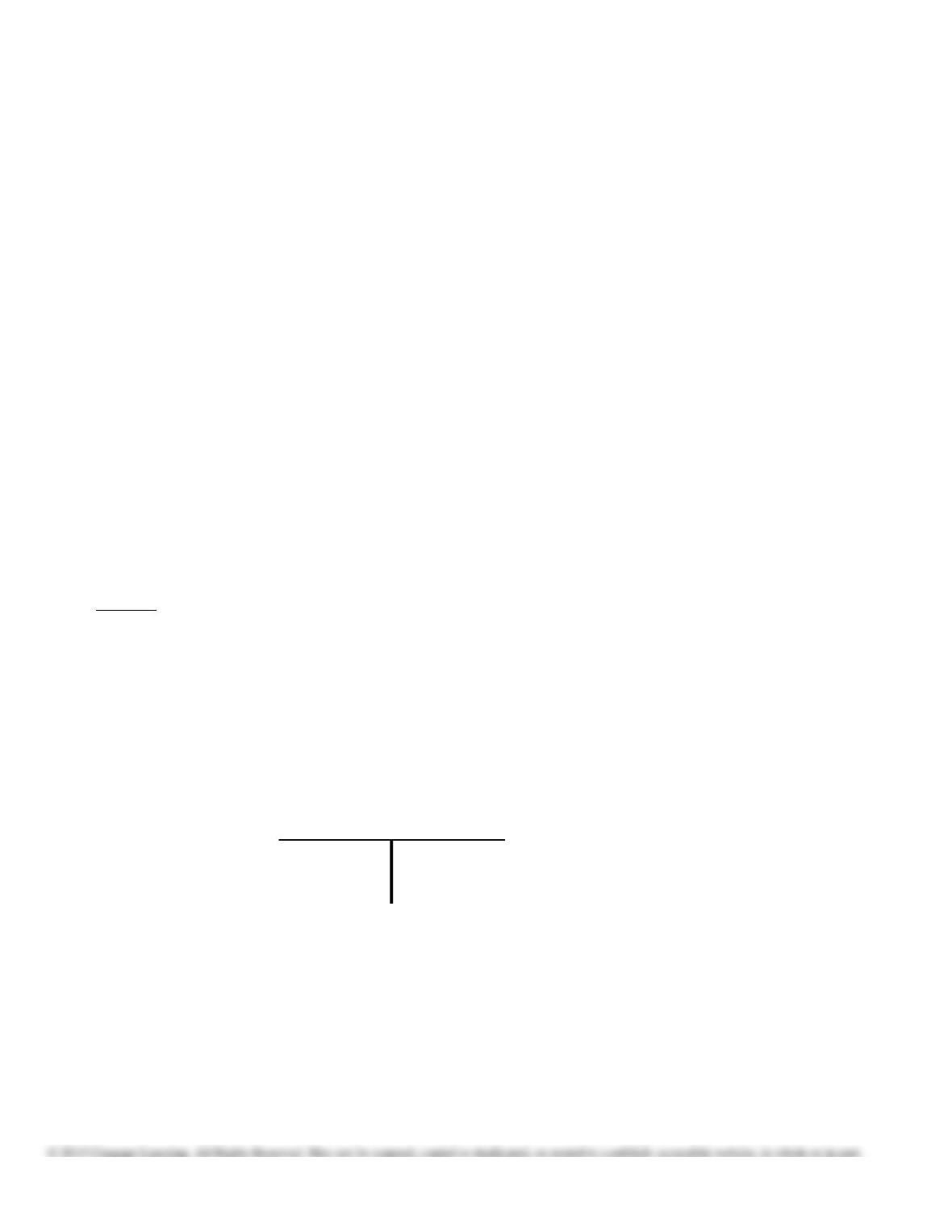
a. How many units were transferred to Finishing?
b. How many units were started and completed during November?
c. How many equivalent units of conversion does it take to complete the beginning inventory in the
current period?
d. What is the FIFO cost assigned to the ending inventory?
e. What is the FIFO cost assigned to the units transferred out?
f. Show the T-account for the forming process.
(Weighted Average)
Forming
Chapter 6: Process Costing
Chapter 6: Process Costing
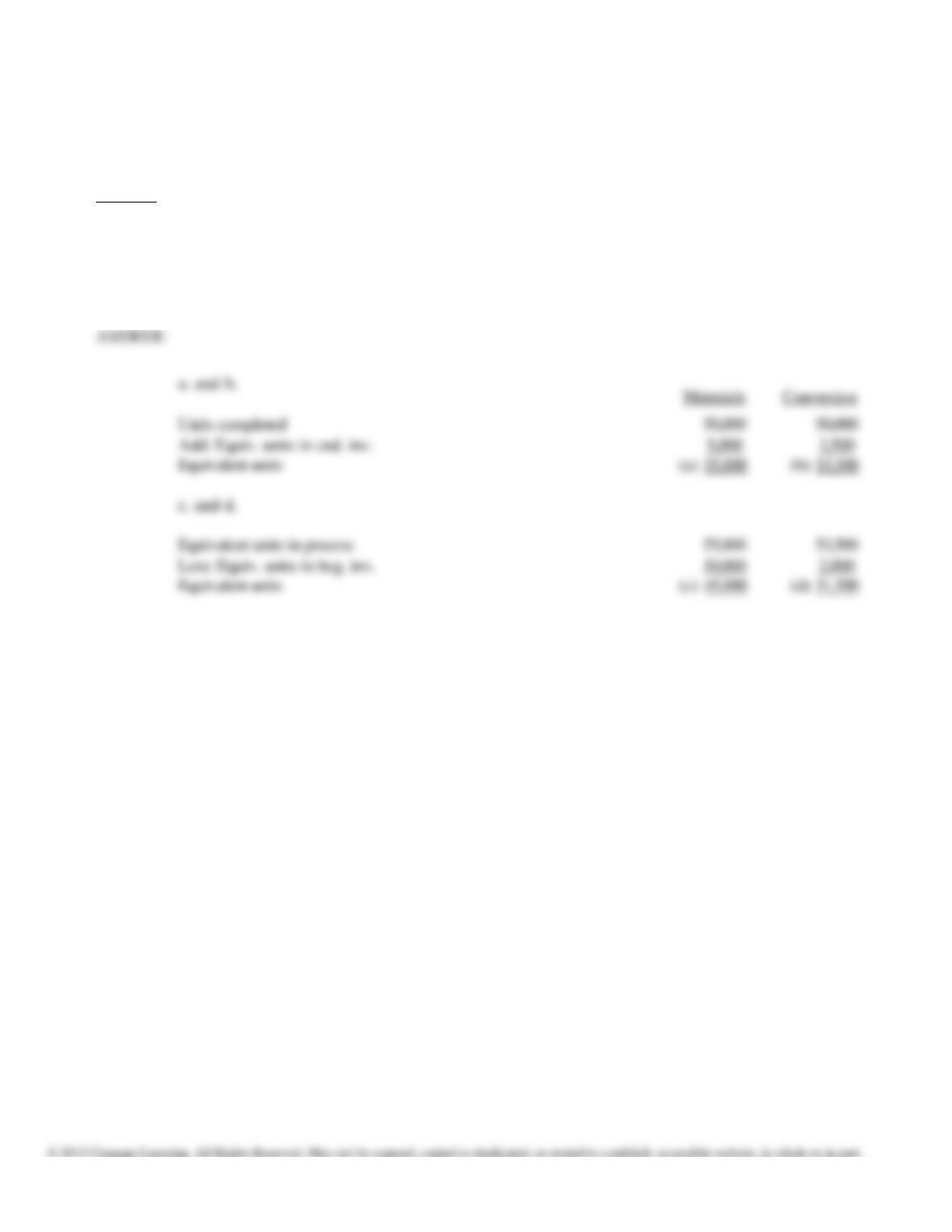
182. Triton Manufacturing Company began June 2016 with 10,000 units of inventory in process, 20 percent completed.
During the period, 50,000 units were completed and transferred to the finished goods warehouse. Ending inventory
consisted of 5,000 units, 70 percent completed. Materials were added at the beginning of the process.
Required:
Calculate the equivalent units for:
a. Materials costs under the weighted average process cost method.
b. Conversion costs under the weighted average process cost method.
c. Materials costs under the FIFO process cost method.
d. Conversion costs under the FIFO process cost method.
Chapter 6: Process Costing
183. Victory, Inc., manufactures a product that passes through two processes: Mixing and Packaging. All manufacturing
costs are added uniformly in the Mixing Department. Information for the Mixing Department for October follows:
Work in process, October 1:
Units (30% complete)
7,500
Direct materials
$2,000
Direct labor
$1,500
Overhead
$1,188
During October, 150,000 units were completed and transferred to Packaging. The following costs were incurred by
the Mixing Department during October:
Direct materials
$25,000
Direct labor
15,000
Overhead
6,000
There were 12,000 units that were 70 percent complete remaining in the Mixing Department at October 31. Use
the weighted average method and round unit costs to two decimal places.
Required:
a. Determine the equivalent units of production for October.
b. Determine the total costs to account for in October.
c. Determine the total cost per equivalent unit of production.
d. Calculate the cost of goods transferred to the Packaging Department.
e. Calculate the cost of October’s ending work in process for the Mixing Department.
Chapter 6: Process Costing
184. GanMaoling Corporation produces a product that passes through two departments. For May, the following
equivalent unit schedule was prepared for the first department:
Materials
Conversion
Units completed
180,000
180,000
Units, EWIP × percentage complete:
15,000 × 100%
15,000
15,000 × 40%
6,000
Equivalent units of output
195,000
186,000
Costs assigned to beginning work in process:
Materials: $51,000
Conversion: $24,750
Manufacturing costs incurred during the month:
Materials: $56,250
Conversion: $45,000
Required:
a. Compute the unit cost for May using the weighted average method.
b. Determine the cost of goods transferred out.
c. Determine the cost of ending work in process.
Chapter 6: Process Costing
185. Countryview Company manufactures a product that passes through two processes. The following information is
available for the first department for June:
• All materials are added at the beginning of the process.
• Beginning work in process consisted of 7,000 units that were 90 percent complete with respect
to conversion.
• Ending work in process consisted of 3,000 units that were 40 percent complete with respect to
conversion.
• There were 35,000 units started in process during the month.
Required:
a. Prepare a physical flow schedule.
b. Compute equivalent units using the weighted average method.

Chapter 6: Process Costing
186. Xanadu Company manufactures a product that passes through two departments, Assembly and Finishing. In the
Finishing Department, materials are added at the end of the process. Conversion costs are incurred uniformly
throughout the process. During the month of January, the Finishing Department received 60,000 units from the
Assembly Department. The transferred-in cost of the 60,000 units was $69,900.
Costs added by Finishing during January included the following:
Direct materials
$35,200
Direct labor
56,000
Overhead
25,600
On January 1, the Finishing Department had 10,000 units in inventory that were 30 percent complete with respect to
conversion costs. On January 31, 12,000 units were in inventory, one-third complete with respect to conversion
costs. The costs associated with the 10,000 units in beginning inventory were as follows:
Transferred in
$11,650
Direct labor
8,750
Overhead
4,000
Required:
Prepare a cost of production report using the weighted average method.
Chapter 6: Process Costing
Chapter 6: Process Costing
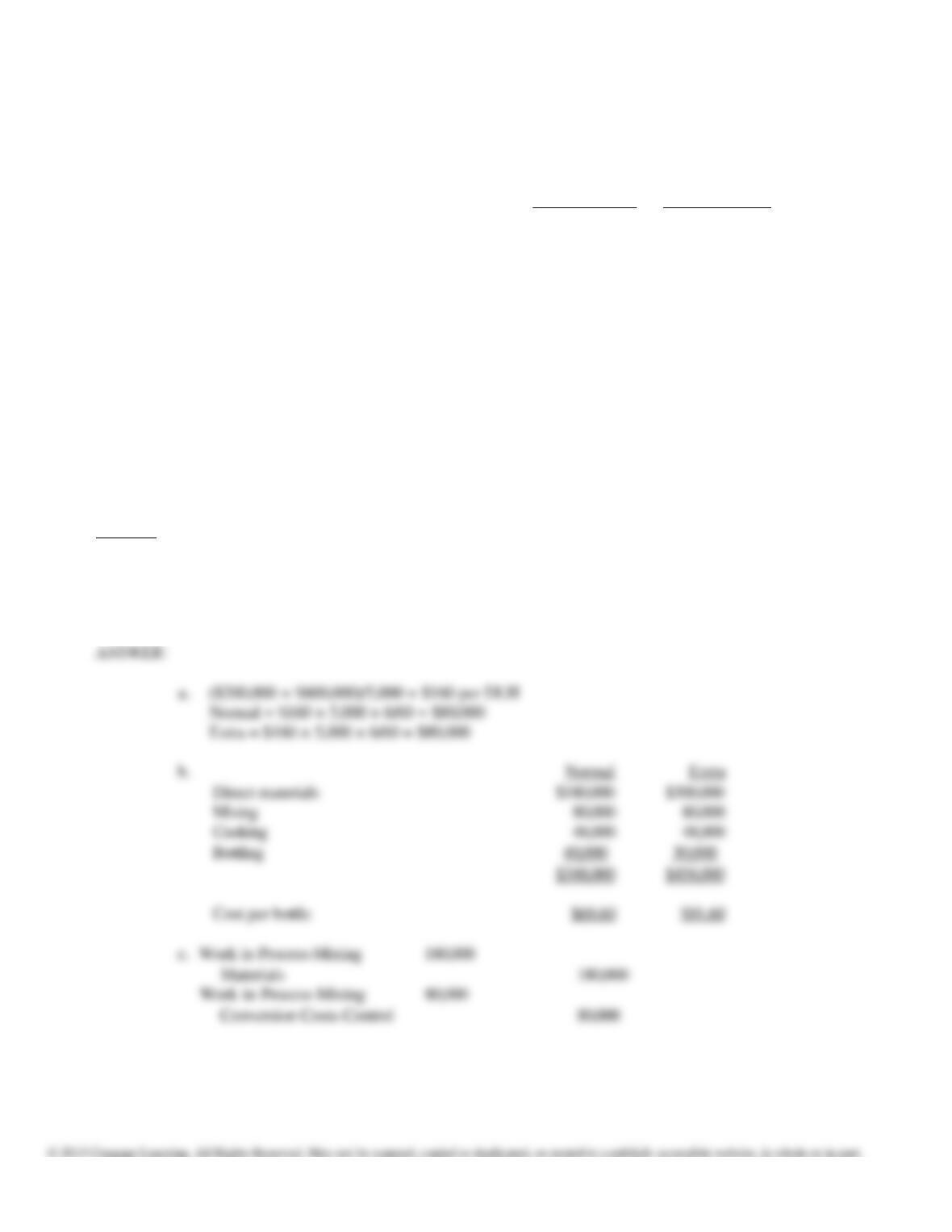
187. Lakeside Corporation produces two types of product: Normal and Extra. Two work orders for two batches of the
products are shown below, along with some additional cost information:
Normal
Extra
Work Order 5
Work Order 6
Direct materials (actual costs)
$180,000
$300,000
Applied conversion costs:
Mixing
?
?
Cooking
$48,000
$48,000
Bottling
$40,000
$30,000
Batch size (bottles) 5,000 5,000
In the Mixing Department, conversion costs are applied on the basis of direct labor hours. Budgeted conversion
costs for the department for the year were $200,000 for labor and $600,000 for overhead. Budgeted direct labor
hours were 5,000. It takes 6 minutes to mix the ingredients needed for each bottle.
Normal and Extra flow through the Mixing Department, followed by the Cooking and Bottling departments.
Required:
a. What are the conversion costs applied to Normal and Extra from the Mixing Department for
each batch?
b. Calculate the cost per bottle for Normal and Extra.
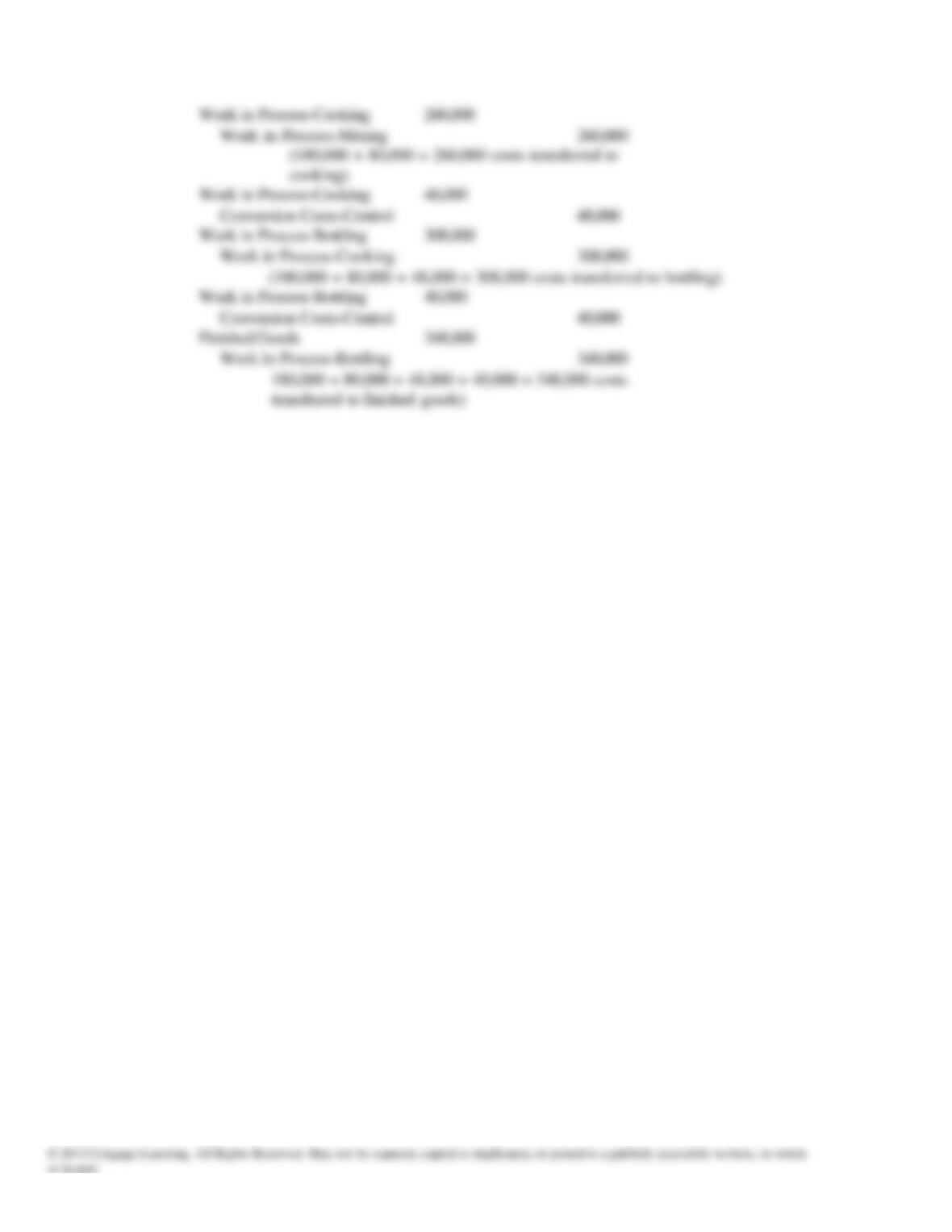
c. Prepare the journal entries that record the costs of a batch of 5,000 bottles of Normal.
Chapter 6: Process Costing
Chapter 6: Process Costing
188. The Painting Department of Salacious Company reported the following information for the month of
September:
Conversion
Units
Percentage Completed
Units started
28,000
Completed and transferred
27,000
Work in process, 9/1
10,000
80%
Work in process, 9/30
8,000
30%
Labor and
Materials
Overhead
Transferred-In
Costs for September:
Work in process, 9/1
$ 51,720
$ 65,048
$ 80,624
Added during the month
$145,880
$194,224
$234,320
All materials are added at the beginning of the process. Inspection occurs 60 percent of the way
through the process. Normal spoilage is 10 percent of the good units completed. (Round to two
decimal places.)
Required:
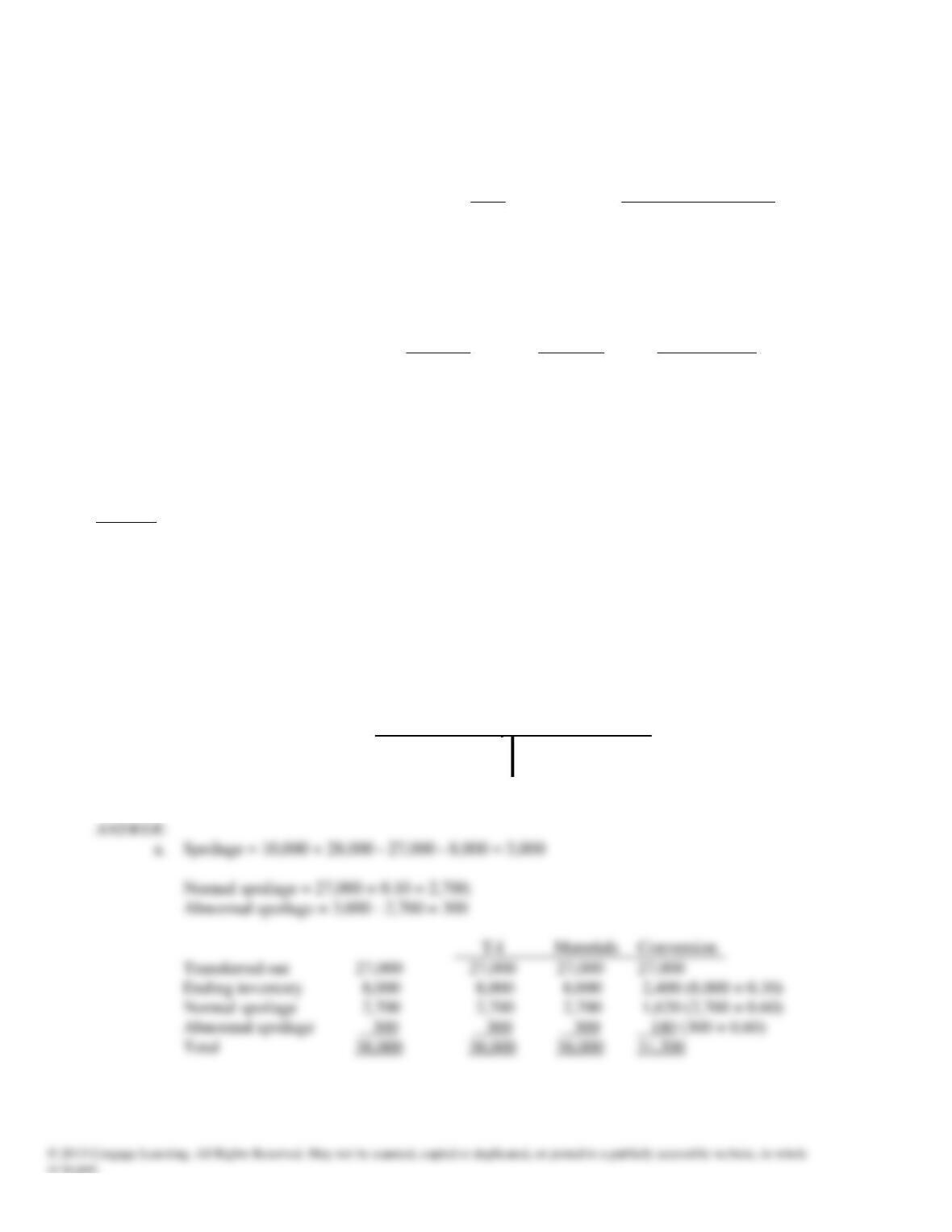
a. What are the weighted average equivalent units for materials, transferred-in and conversion?
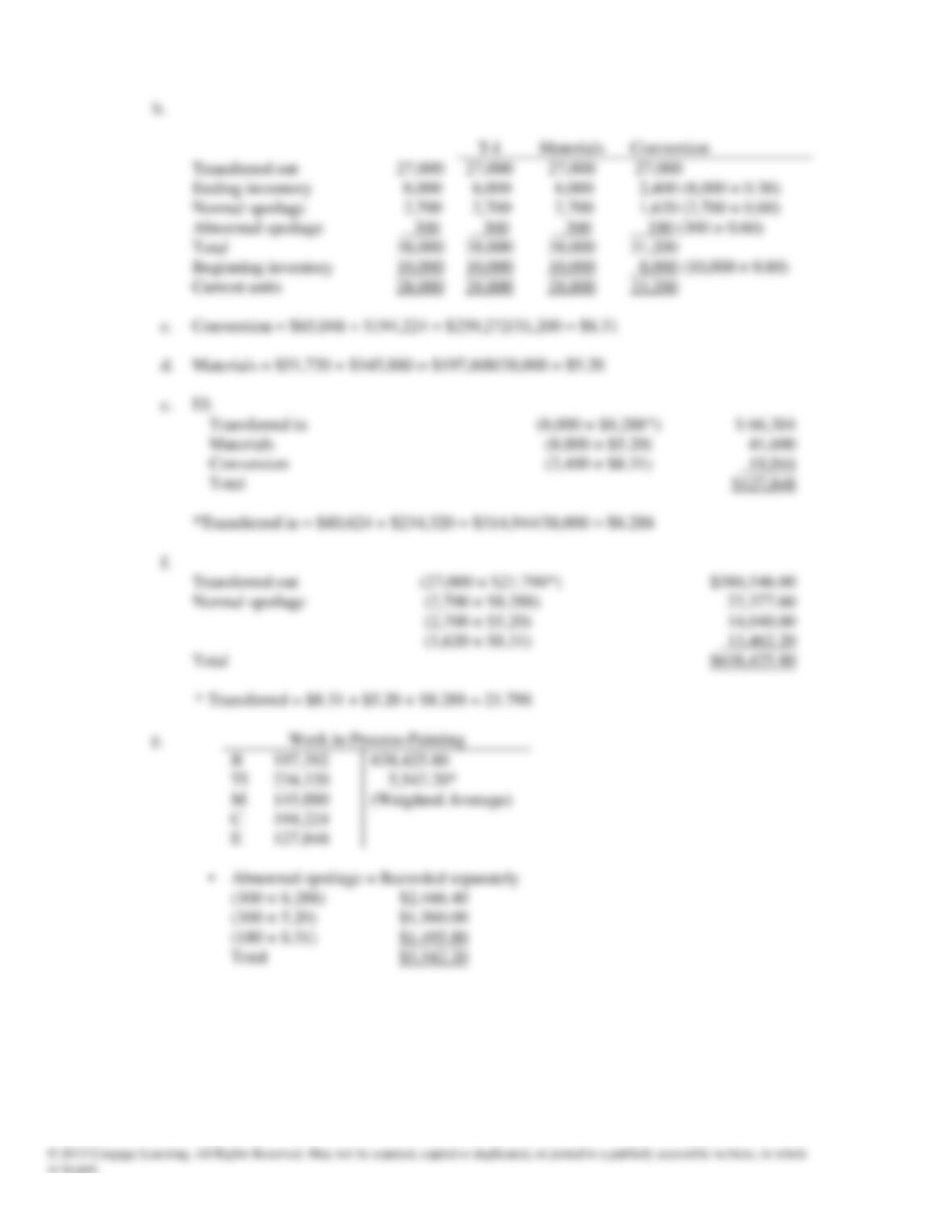
b. What are the FIFO equivalent units for materials, transferred-in, and conversion?
c. What is the weighted average cost per unit for conversion?
d. What is the weighted average cost per unit for materials?
e. What is the cost assigned to ending work in process using weighted average?
f. What is the cost assigned to transferred out using weighted average?
g. Show the entries to the following T-account:
Work in Process-Painting
(Weighted Average)
Spoilage = 10,000 + 28,000 – 27,000 – 8,000 = 3,000
Normal spoilage = 27,000 × 0.10 = 2,700;
Abnormal spoilage = 3,000 – 2,700 = 300
Conversion
Transferred out
27,000
Ending inventory
2,400 (8,000 × 0.30)
Normal spoilage
1,620 (2,700 × 0.60)
Abnormal spoilage
180 (300 × 0.60)
Total
31,200
Chapter 6: Process Costing