Chapter 6 Bonds-Characteristics and Valuation 111
46. JRJ Corporation recently issued 10-year bonds at a price of $1,000. These bonds pay $60 in
interest each six months. Their price has remained stable since they were issued, i.e., they still sell
for $1,000. Due to additional financing needs, the firm wishes to issue new bonds that would
have a maturity of 10 years, a par value of $1,000, and pay $40 in interest every six months. If
both bonds have the same yield, how many new bonds must JRJ issue to raise $2,000,000 cash?
a.
2,400
b.
2,596
c.
3,000
d.
5,000
e.
4,275
112 Chapter 6 Bonds-Characteristics and Valuation
47. Assume that you are considering the purchase of a $1,000 par value bond that pays interest of $70
each six months and has 10 years to go before it matures. If you buy this bond, you expect to hold
it for 5 years and then to sell it in the market. You (and other investors) currently require a simple
annual rate of 16 percent, but you expect the market to require a rate of only 12 percent when you
sell the bond due to a general decline in interest rates. How much should you be willing to pay for
this bond?
a.
$842.00
b.
$1,115.81
c.
$1,359.26
d.
$966.99
e.
$731.85
48. Cold Boxes Ltd. has 100 bonds outstanding (maturity value = $1,000). The required rate of return
on these bonds is currently 10 percent, and interest is paid semiannually. The bonds mature in 5
years, and their current market value is $768 per bond. What is the annual coupon interest rate?
a.
8%
b.
6%
c.
4%
d.
2%
e.
0%
Chapter 6 Bonds-Characteristics and Valuation 113
49. The current price of a 10-year, $1,000 par value bond is $1,158.91. Interest on this bond is paid
every six months, and the simple annual yield is 14 percent. Given these facts, what is the annual
coupon rate on this bond?
a.
10%
b.
12%
c.
14%
d.
17%
e.
21%
50. Rick bought a bond when it was issued by Macroflex Corporation 14 years ago. The bond, which
has a $1,000 face value and a coupon rate equal to 10 percent, matures in six years. Interest is
paid every six months; the next interest payment is scheduled for six months from today. If the
yield on similar risk investments is 14 percent, what is the current market value (price) of the
bond?
a.
$841.15
b.
$1,238.28
c.
$904.67
d.
$757.26
e.
$844.45
114 Chapter 6 Bonds-Characteristics and Valuation
51. Devine Divots issued a bond a few years ago that has a face value equal to $1,000 and pays
investors $30 interest every six months. The bond has eight years remaining until maturity. If you
require a 7 percent rate of return to invest in this bond, what is the maximum price you should be
willing to pay to purchase the bond?
a.
$761.15
b.
$939.53
c.
$940.29
d.
$965.63
e.
$1,062.81
52. Recently, Ohio Hospitals Inc. filed for bankruptcy. The firm was reorganized as American
Hospitals Inc., and the court permitted a new indenture on an outstanding bond issue to be put
into effect. The issue has 10 years to maturity and a coupon rate of 10 percent, paid annually. The
new agreement allows the firm to pay no interest for 5 years. Then, interest payments will be
resumed for the next 5 years. Finally, at maturity (Year 10), the principal plus the interest that
was not paid during the first 5 years will be paid. However, no interest will be paid on the
deferred interest. If the required return is 20 percent, what should the bonds sell for in the market
today?
a.
$242.26
b.
$281.69
c.
$578.31
d.
$362.44
e.
$813.69
Chapter 6 Bonds-Characteristics and Valuation 115
Financial Calculator Section
The following question(s) may require the use of a financial calculator.
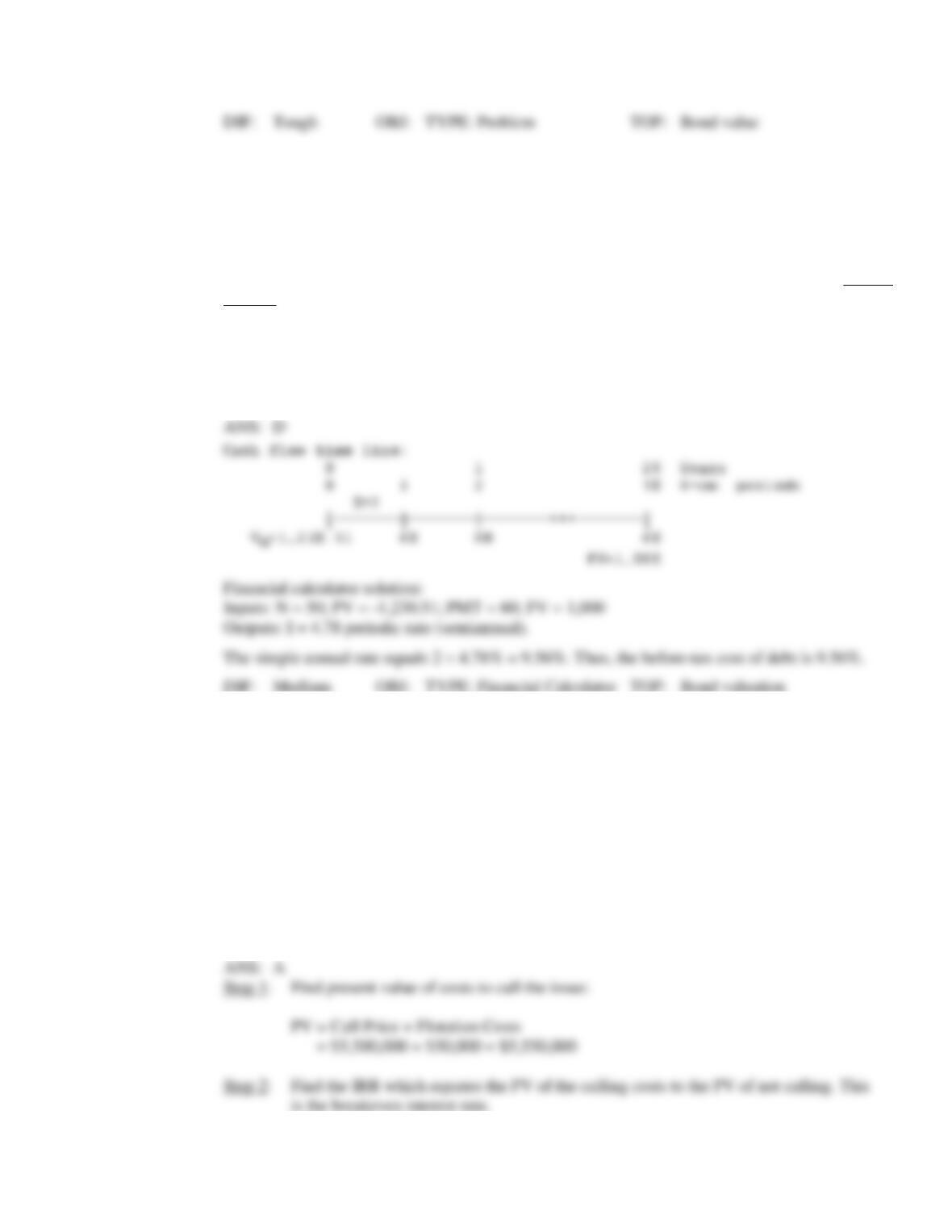
53. Trickle Corporation’s 12 percent coupon rate, semiannual payment, $1,000 par value bonds which
mature in 25 years. The bonds currently sell for $1,230.51 in the market, and the yield curve is
flat. Assuming that the yield curve is expected to remain flat, what is Trickle’s most likely before-
tax cost of debt if it issues new bonds today?
a.
4.78%
b.
6.46%
c.
7.70%
d.
9.56%
e.
12.92%
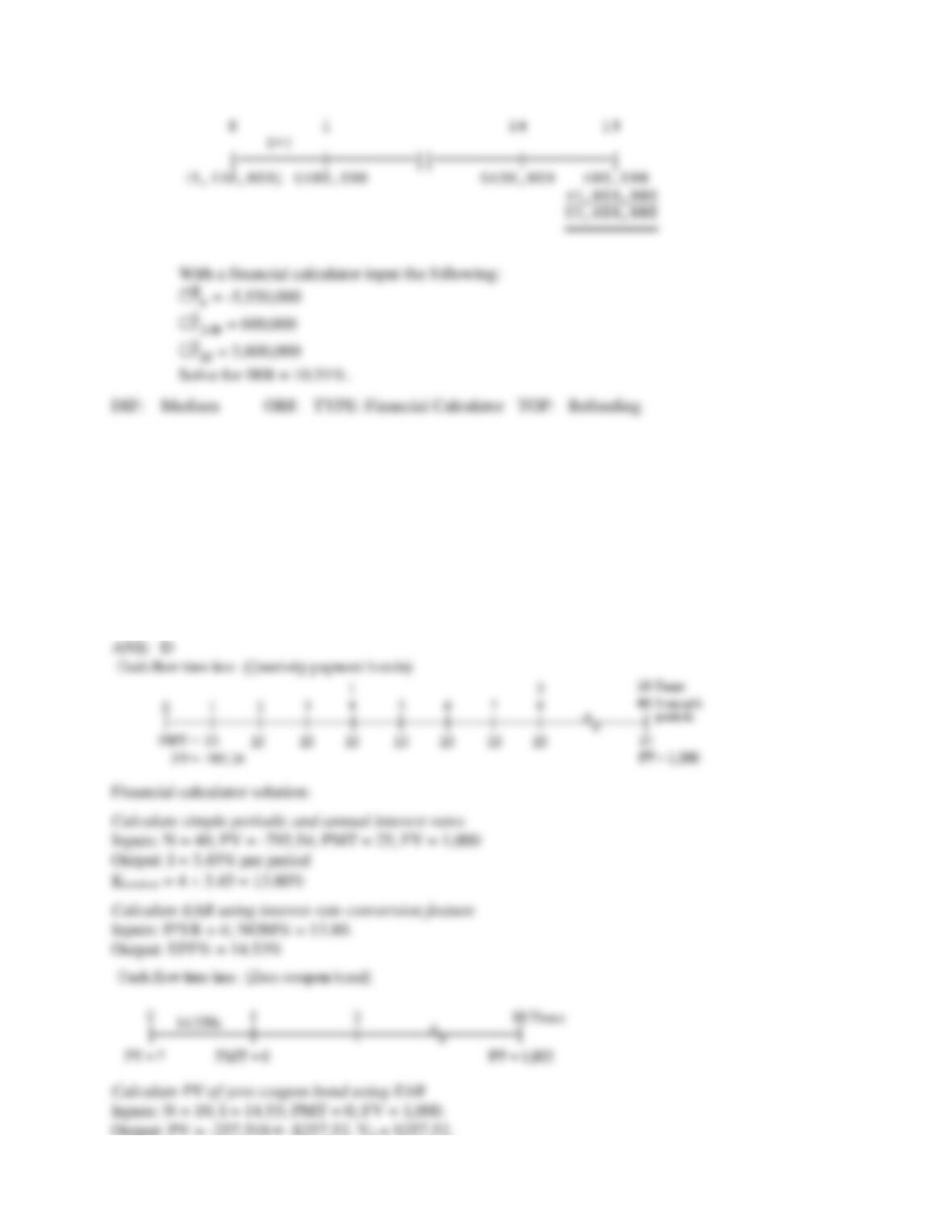
54. Leyland Enterprises has $5,000,000 in bonds outstanding. The bonds each have a maturity value
of $1,000, an annual coupon of 12 percent, and 15 years left until maturity. The bonds can be
called at any time at a call price of $1,100 per bond. If the bonds are called, the company must
pay flotation costs of $50,000 ($10 for every $1,000 of bonds outstanding). Ignore tax
considerations. Assume that the tax rate is zero. The company’s decision whether to call the bonds
depends critically on the current interest rate it would pay on new bonds issued. What is the
breakeven interest rate, below which it is profitable to call in the bonds?
a.
10.51%
b.
11.21%
c.
12.57%
d.
13.33%
e.
14.89%
PV = Call Price + Flotation Costs
116 Chapter 6 Bonds-Characteristics and Valuation
55. U.S. Delay Corporation, a subsidiary of the Postal Service, must decide whether to issue zero
coupon bonds or quarterly payment bonds to fund construction of new facilities. The 1,000 par
value quarterly payment bonds would sell at $795.54, have a 10 percent annual coupon rate, and
mature in ten years. At what price would the zero coupon bonds with a maturity of 10 years have
to sell to earn the same effective annual rate as the quarterly payment bonds?
a.
$274.50
b.
$271.99
c.
$198.89
d.
$257.52
e.
$254.84
Chapter 6 Bonds-Characteristics and Valuation 117
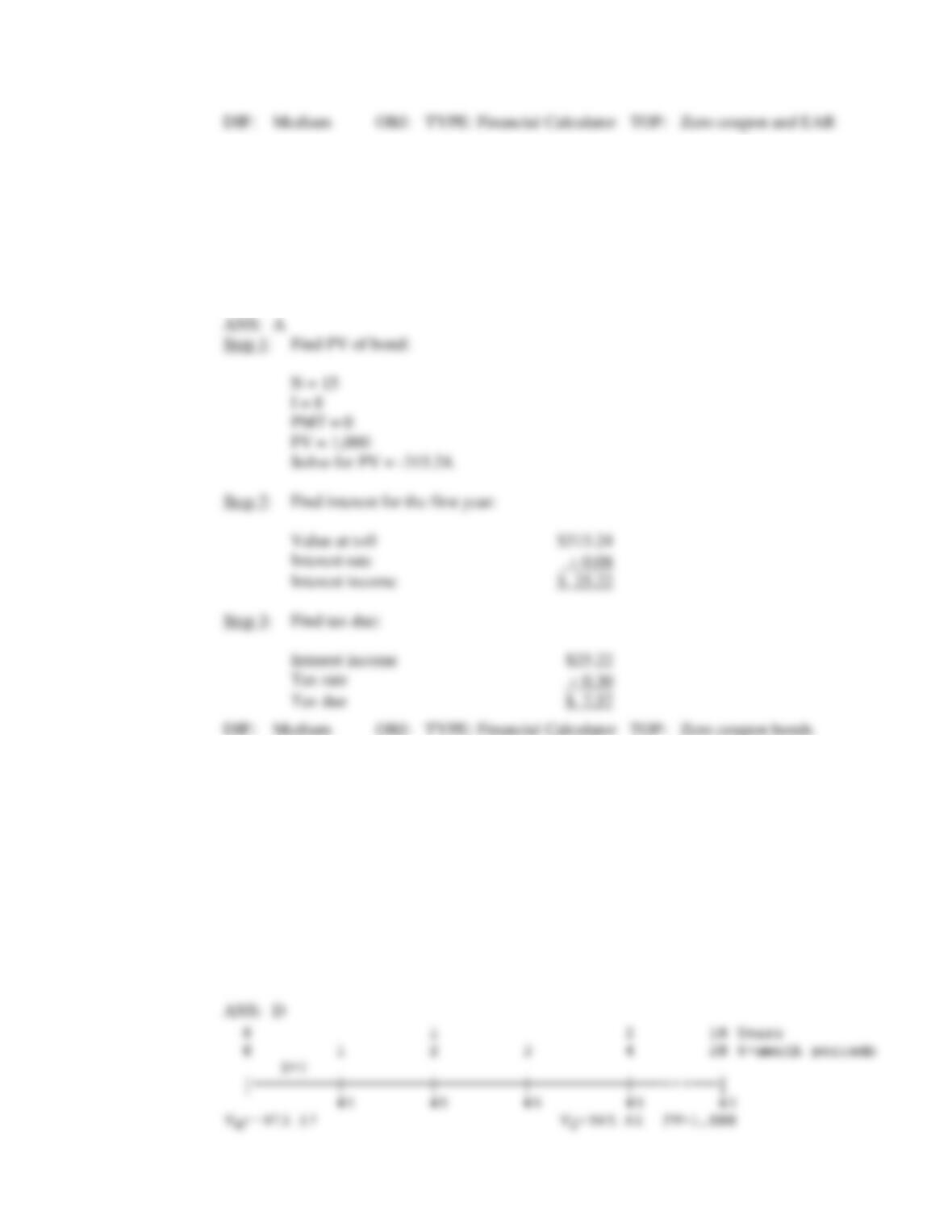
56. A 15-year zero coupon bond has a yield to maturity of 8 percent and a maturity value of $1,000.
What is the amount of tax that an investor in the 30 percent tax bracket would pay during the first
year of owning the bond?
a.
$7.57
b.
$10.41
c.
$15.89
d.
$20.44
e.
$25.22
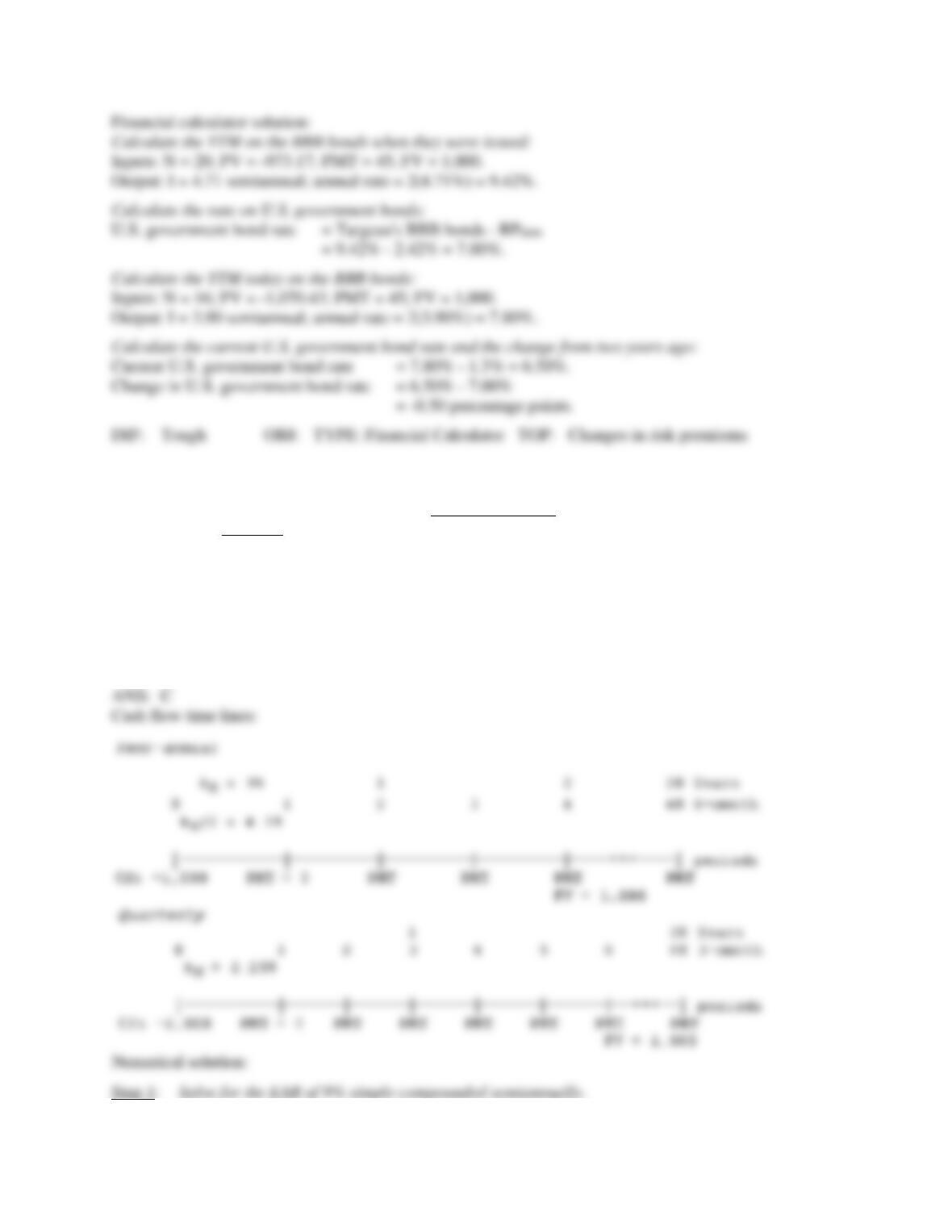
57. Two years ago, Targeau Corporation issued BBB rated bonds and the risk premium was 2.42
percentage points as marked up on long-term U.S. government bonds. The firm’s bonds had a 10-
year maturity, were semiannual payment 9 percent coupon bonds with a $1,000 par value, and
were originally priced at $973.17. Currently, Targeau’s BBB-rated bonds have 8 years to maturity
and are priced at $1,070.43. The current risk premium on BBB rated bonds is 1.3 percentage
points. By how many percentage points did the long-term government bond rates change in two
years?
a.
-0.38%
b.
-1.12%
c.
-0.62%
d.
-0.50%
e.
-1.50%
118 Chapter 6 Bonds-Characteristics and Valuation
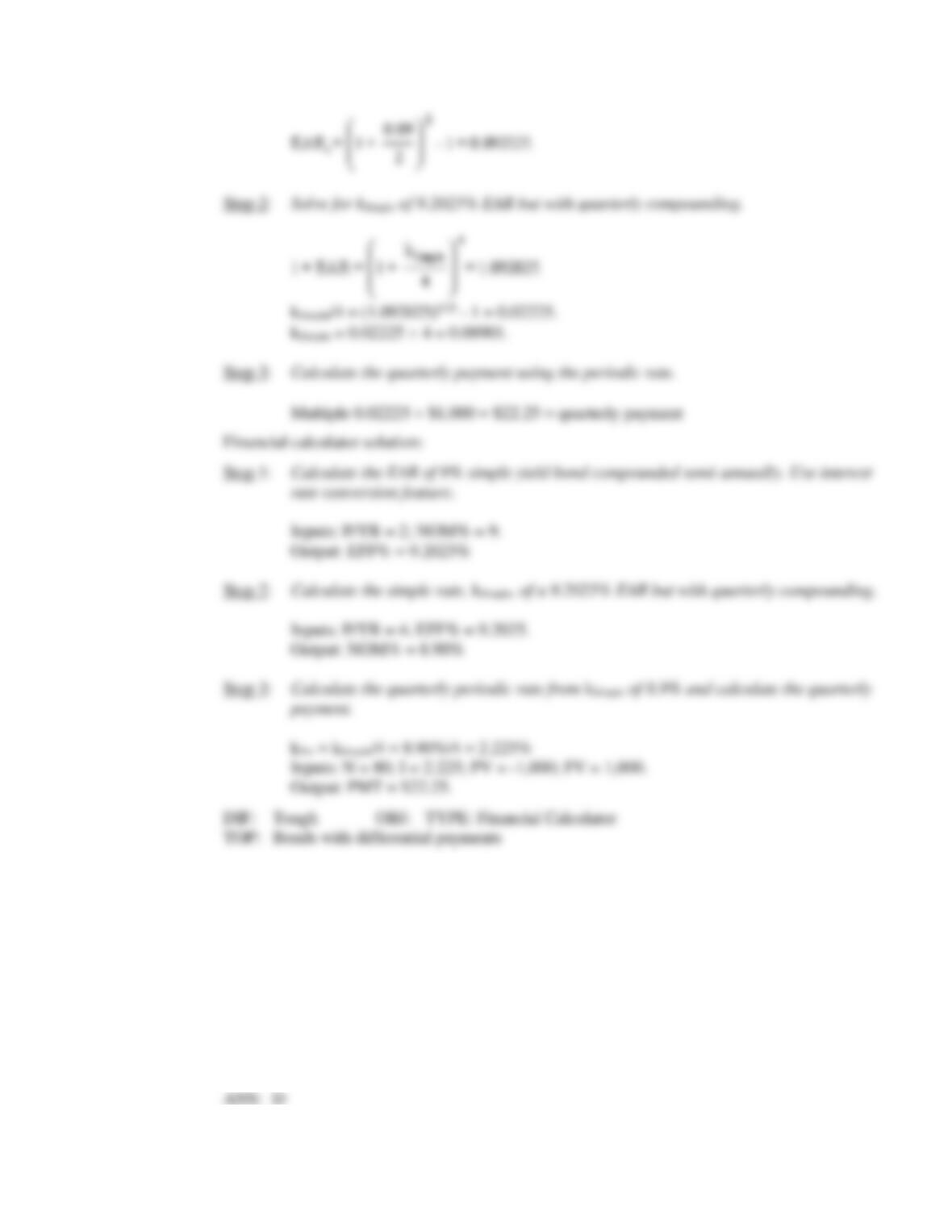
58. Semiannual payment bonds with the same risk (Aaa) and maturity (20 years) as your company’s
bonds have a simple (not EAR) yield of 9 percent. Your company’s treasurer is thinking of
issuing at par some $1,000 par value, 20-year, quarterly payment bonds. She has asked you to
determine what quarterly interest payment, in dollars, the company would have to set in order to
provide the same effective annual rate (EAR) as those on the 20-year, semiannual payment bonds.
What would the quarterly interest payment be, in dollars?
a.
$45.00
b.
$25.00
c.
$22.25
d.
$27.50
e.
$23.00
Chapter 6 Bonds-Characteristics and Valuation 119
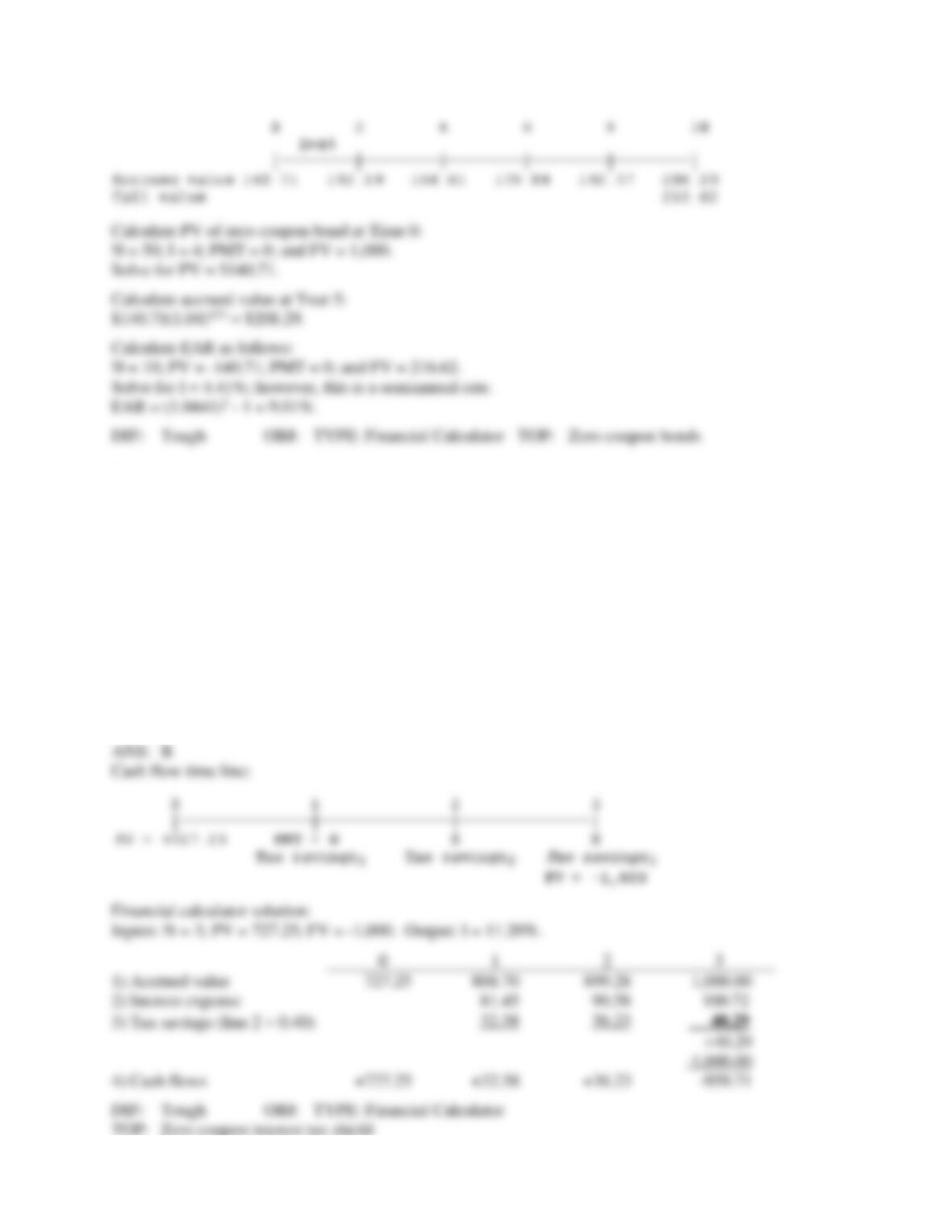
59. Assume that the State of Florida sold tax-exempt, zero coupon bonds with a $1,000 maturity
value 5 years ago. The bonds had a 25-year maturity when they were issued, and the interest rate
built into the issue was 8 percent, compounded semiannually. The bonds are now callable at a
premium of 4 percent over the accrued value. What effective annual rate of return would an
investor who bought the bonds when they were issued and who still owns them earn if they were
called today?
a.
4.41%
b.
6.73%
c.
8.25%
d.
9.01%
e.
9.52%
120 Chapter 6 Bonds-Characteristics and Valuation
Gargoyle Unlimited
Gargoyle Unlimited is planning to issue a zero coupon bond to fund a project that will yield its
first positive cash flow in three years. That cash flow will be sufficient to pay off the entire debt
issue. The bond’s par value will be $1,000, it will mature in 3 years, and it will sell in the market
for $727.25. The firm’s marginal tax rate is 40 percent.
60. Refer to Gargoyle Unlimited. What is the dollar value of the interest tax savings to the firm in
the third year of the issue?
a.
$32.58
b.
$40.29
c.
$100.72
d.
$60.43
e.
$109.10
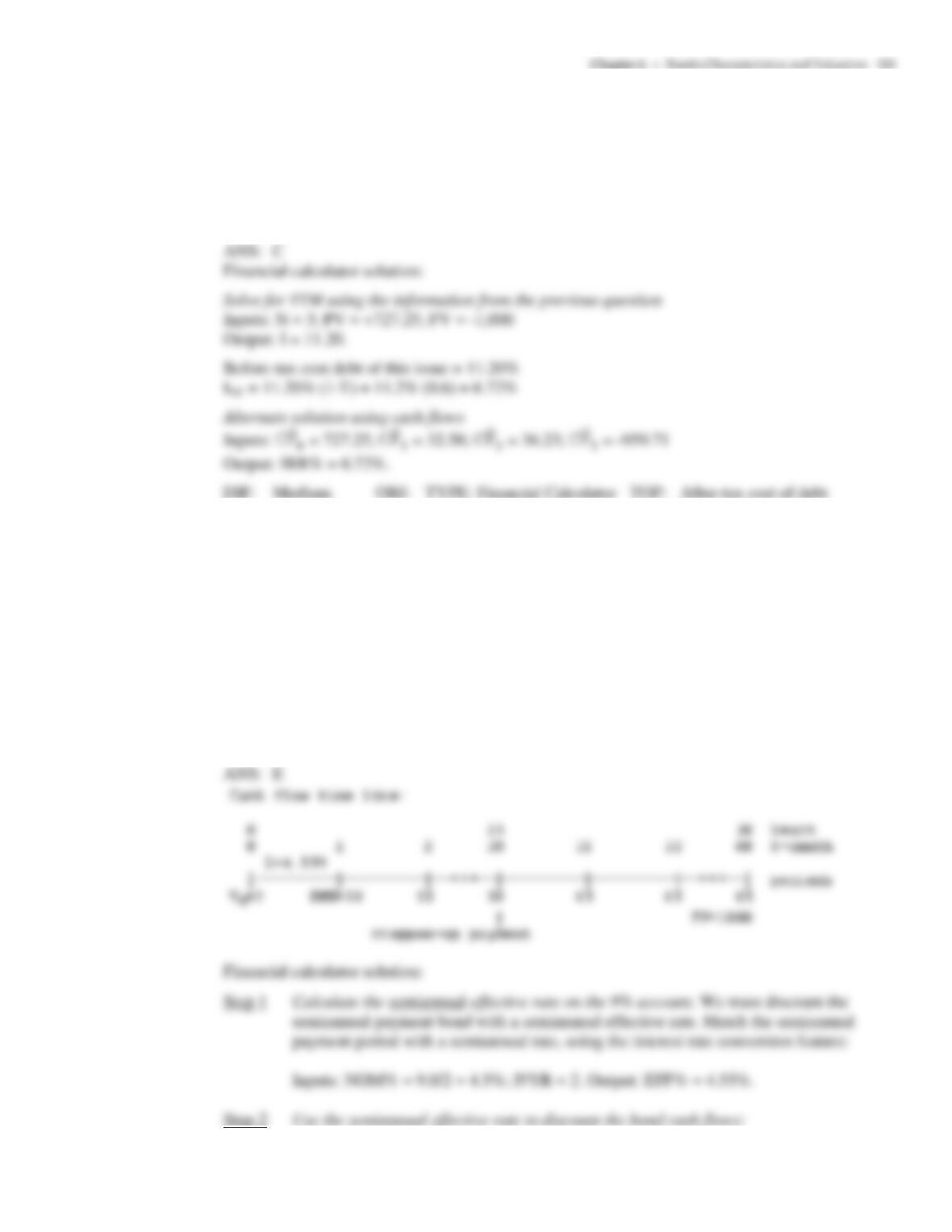
61. Refer to Gargoyle Unlimited. What is the expected after-tax cost of this debt issue?
a.
11.20%
b.
4.48%
c.
6.72%
d.
6.10%
e.
4.00%
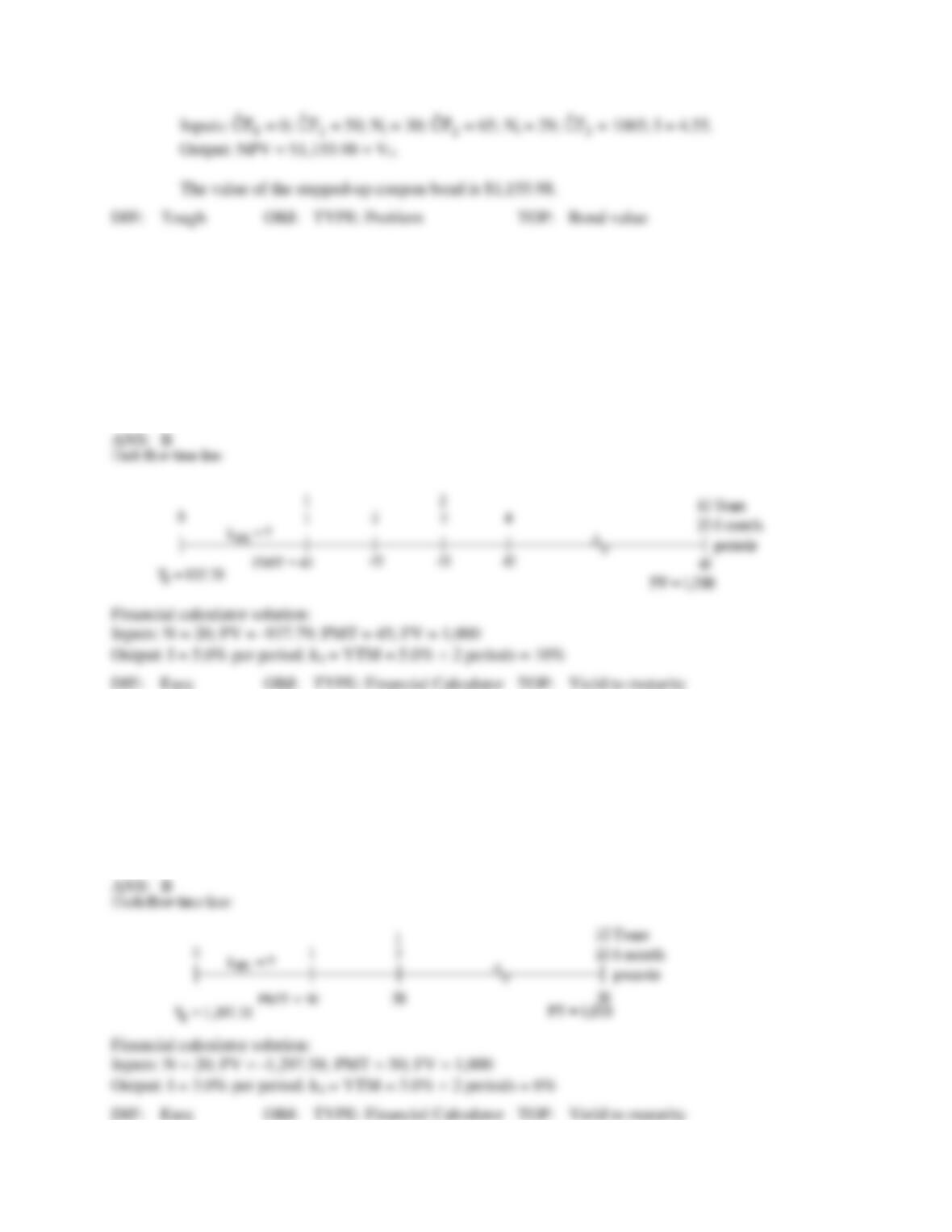
62. You are offered a $1,000 par value bond which has a stepped-up coupon interest rate. The annual
coupon rate is 10 percent coupon, payable semiannually ($50 each 6 months) for the first 15
years, and then the annual coupon increases to 13 percent, also payable semiannually, for the next
15 years. The first interest payment will be made 6 months from today, and the $1,000 principal
amount will be returned at the end of Year 30. You currently have savings in an account which is
earning a 9 percent simple rate, but with quarterly compounding; this is your opportunity cost for
purposes of analyzing the bond. What is the value of the bond to you today?
a.
$1,614.53
b.
$1,419.18
c.
$1,306.21
d.
$1,250.25
e.
$1,155.98
122 Chapter 6 Bonds-Characteristics and Valuation
63. Tony’s Pizzeria plans to issue bonds with a par value of $1,000 and 10 years to maturity. These
bonds will pay $45 interest every 6 months. Current market conditions are such that the bonds
will be sold to net $937.79. What is the YTM of the issue as a broker would quote it to an
investor?
a.
11%
b.
10%
c.
9%
d.
8%
e.
7%
64. The current market price of Smith Corporation’s 10 percent, 10-year bonds is $1,297.58. A 10
percent coupon interest rate is paid semiannually, and the par value is equal to $1,000. What is
the YTM (stated on a simple, or annual, basis) if the bonds mature 10 years from today?
a.
8%
b.
6%
c.
4%
d.
2%
e.
1%
Chapter 6 Bonds-Characteristics and Valuation 123
65. A $1,000 par value bond sells for $1,216. It matures in 20 years, has a 14 percent coupon, pays
interest semiannually, and can be called in 5 years at a price of $1,100. What is the bond’s YTM?
a.
6.05%
b.
10.00%
c.
10.06%
d.
8.59%
e.
11.26%
66. You have just been offered a $1,000 par value bond for $847.88. The coupon rate is 8 percent,
payable annually, and interest rates on new issues of the same degree of risk are 10 percent. You
want to know how many more interest payments you will receive, but the party selling the bond
cannot remember. Can you determine how many interest payments remain?
a.
14
b.
15
c.
12
d.
20
e.
10
124 Chapter 6 Bonds-Characteristics and Valuation
67. Assume that McDonald’s and Burger King have similar $1,000 par value bond issues outstanding.
The bonds are equally risky. The Burger King bond has interest payments of $80 paid annually
and matures 20 years from today. The McDonald’s bond has interest payments of $80 paid
semiannually, and it also matures in 20 years. If the simple required rate of return, kd, is 12
percent, semiannual basis, for both bonds, what is the difference in current market prices of the
two bonds?
a.
No difference.
b.
$2.20
c.
$3.77
d.
$17.53
e.
$6.28
68. An 8 percent annual coupon, noncallable bond has ten years until it matures and a yield to
maturity of 9.1 percent. What should be the price of a 10-year bond of equal risk which pays an 8
percent semiannual coupon? Assume both bonds have a maturity value of $1,000.
a.
$898.64
b.
$736.86
c.
$854.27
d.
$941.08
e.
$964.23
Chapter 6 Bonds-Characteristics and Valuation 125
69. Fish & Chips Inc. has two bond issues outstanding, and both sell for $701.22. The first issue has a
coupon rate of 8 percent and 20 years to maturity. The second has an identical yield to maturity as
the first bond, but only 5 years until maturity. Both issues pay interest annually. What is the
annual interest payment on the second issue?
a.
$120.00
b.
$37.12
c.
$56.42
d.
$29.68
e.
$11.16
126 Chapter 6 Bonds-Characteristics and Valuation
70. A two-year zero-coupon Treasury bond with a maturity value of $1,000 has a price of $873.4387.
A one-year zero-coupon Treasury bond with a maturity value of $1,000 has a price of $938.9671.
If the pure expectations theory is correct, for what price should one-year zero-coupon Treasury
bonds sell one year from now?
a.
$798.89
b.
$824.66
c.
$852.28
d.
$930.23
e.
$989.11
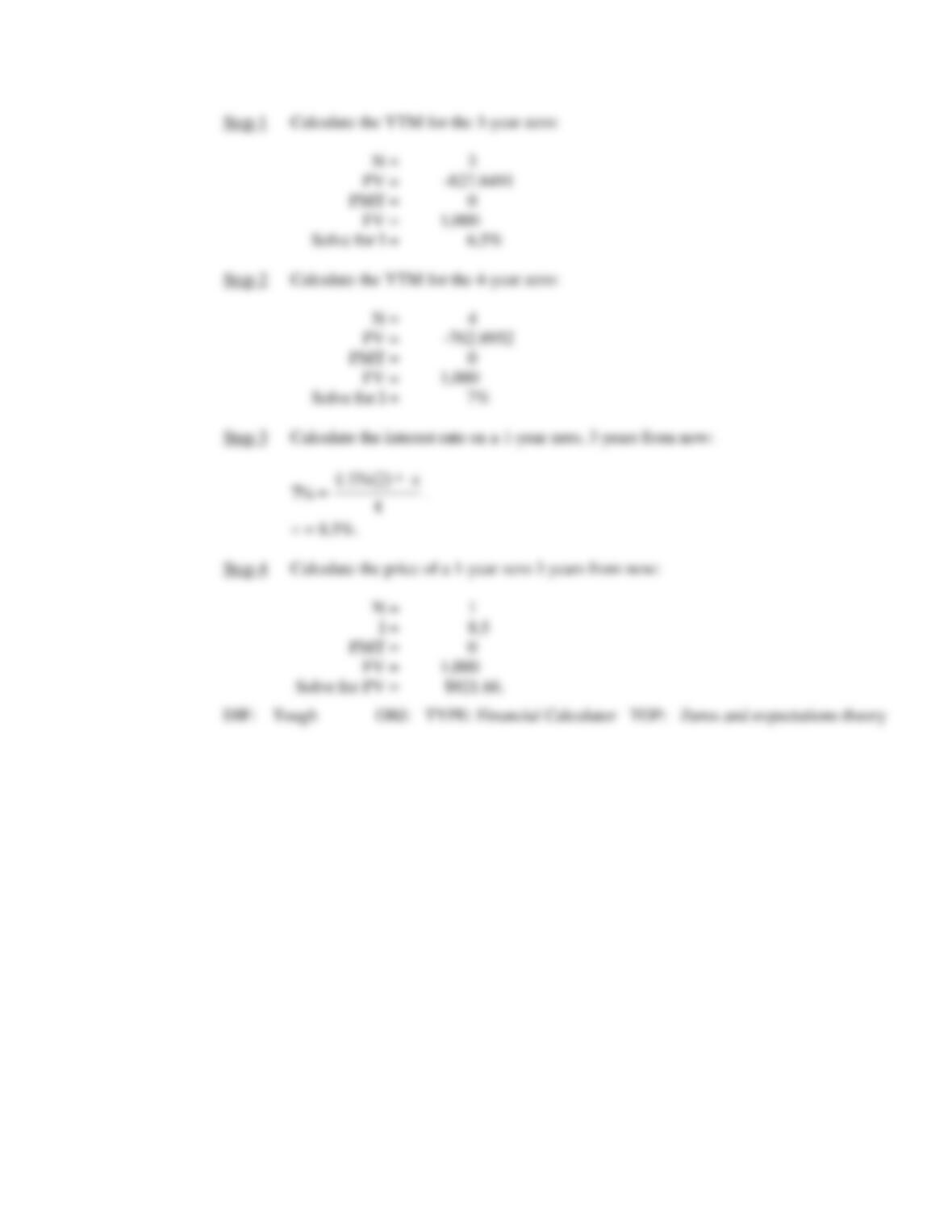
71. A four-year, zero-coupon Treasury bond sells at a price of $762.8952. A three-year, zero-coupon
Treasury bond sells at a price of $827.8491. Assuming the pure expectations theory is correct,
what does the market believe the price of one-year, zero-coupon bonds will be in three years?
a.
$921.66
b.
$934.58
c.
$938.97
d.
$945.26
e.
$950.47
Chapter 6 Bonds-Characteristics and Valuation 127