
107. Klump Co.
Klump Co. uses a perpetual inventory system and had the following inventory transactions for the month of
June.
June 1 On hand, 50 units at $18.00 each $ 900.00
4 Purchased 115 units at $18.20 each 2,093.00
5 Sold 100 units
10 Purchased 75 units at $18.25 each 1,368.75
24 Sold 40 units
Total cost of goods available for sale $4,361.75
30 On hand, 100 units
Refer to the information provided for Klump Co. If the company uses the FIFO inventory costing method, cost
of goods sold for the month of June is:
108. Klump Co.
Klump Co. uses a perpetual inventory system and had the following inventory transactions for the month of
June.
June 1 On hand, 50 units at $18.00 each $ 900.00
4 Purchased 115 units at $18.20 each 2,093.00
5 Sold 100 units
10 Purchased 75 units at $18.25 each 1,368.75
24 Sold 40 units
Total cost of goods available for sale $4,361.75
30 On hand, 100 units
Refer to the information provided for Klump Co. If the company uses the LIFO inventory costing method,
ending inventory at June 30th is:

109. Klump Co.
Klump Co. uses a perpetual inventory system and had the following inventory transactions for the month of
June.
June 1 On hand, 50 units at $18.00 each $ 900.00
4 Purchased 115 units at $18.20 each 2,093.00
5 Sold 100 units
10 Purchased 75 units at $18.25 each 1,368.75
24 Sold 40 units
Total cost of goods available for sale $4,361.75
30 On hand, 100 units
Refer to the information provided for Klump Co. If the company uses the LIFO inventory costing method, cost
of goods sold for the month of June is:
110. Klump Co.
Klump Co. uses a perpetual inventory system and had the following inventory transactions for the month of
June.
June 1 On hand, 50 units at $18.00 each $ 900.00
4 Purchased 115 units at $18.20 each 2,093.00
5 Sold 100 units
10 Purchased 75 units at $18.25 each 1,368.75
24 Sold 40 units
Total cost of goods available for sale $4,361.75
30 On hand, 100 units
Refer to the information provided for Klump Co. If the company uses the (moving) Average Cost inventory
costing method, ending inventory at June 30th is:

111. Klump Co.
Klump Co. uses a perpetual inventory system and had the following inventory transactions for the month of
June.
June 1 On hand, 50 units at $18.00 each $ 900.00
4 Purchased 115 units at $18.20 each 2,093.00
5 Sold 100 units
10 Purchased 75 units at $18.25 each 1,368.75
24 Sold 40 units
Total cost of goods available for sale $4,361.75
30 On hand, 100 units
Refer to the information provided for Klump Co. If the company uses the (moving) Average Cost inventory
costing method, cost of goods sold for the month of June is:
112. Lemke Corp.
Lemke Corp. uses a perpetual inventory system with a (moving) weighted average inventory costing method.
The following information is available for the month of April:
Apr. 1 On hand, 30 units at $5.00 each $150
8 Purchased 40 units at $5.35 each 214
15 Sold 50 units
22 Purchased 40 units at $5.50 each 220
30 On hand, 60 units
Refer to the information provided for Lemke Corp. How much is the cost of goods sold for the units sold on
April 15th?
113. Lemke Corp.
Lemke Corp. uses a perpetual inventory system with a (moving) weighted average inventory costing method.
The following information is available for the month of April:
Apr. 1 On hand, 30 units at $5.00 each $150
8 Purchased 40 units at $5.35 each 214
15 Sold 50 units
22 Purchased 40 units at $5.50 each 220
30 On hand, 60 units
Refer to the information provided for Lemke Corp. How much is ending inventory on April 30th?
114. Lowery Company
Lowery Company uses a perpetual inventory system. The following information is available for the month of
March:
Mar. 1 On hand, 10 units at $2 each $ 20
4 Sold 8 units for $10 each 80
22 Purchased 50 units at $4 each 200
26 Sold 48 units for $10 each 480
Refer to the information provided for Lowery Company. If the company uses the FIFO inventory costing
method, how much is cost of goods sold for March?
115. Lowery Company
Lowery Company uses a perpetual inventory system. The following information is available for the month of
March:
Mar. 1 On hand, 10 units at $2 each $ 20
4 Sold 8 units for $10 each 80
22 Purchased 50 units at $4 each 200
26 Sold 48 units for $10 each 480
Refer to the information provided for Lowery Company. If the company uses the FIFO inventory costing
method, how much is ending inventory at March 31st?
116. Lowery Company
Lowery Company uses a perpetual inventory system. The following information is available for the month of
March:
Mar. 1 On hand, 10 units at $2 each $ 20
4 Sold 8 units for $10 each 80
22 Purchased 50 units at $4 each 200
26 Sold 48 units for $10 each 480
Refer to the information provided for Lowery Company. If the company uses the LIFO inventory costing
method, how much is cost of goods sold for the month of March?
117. Which of the following statements is false regarding the choice between alternative inventory costing
methods?
118. All of the following are acceptable for financial accounting purposes EXCEPT:
119. Which inventory costing method results in the highest inventory balance during a period of rising purchase
prices?
120. Which inventory costing method might allow a company to manipulate income by making significant
inventory purchases at year end?
121. Which inventory costing method results in the lowest income tax expense during a period of decreasing
purchase prices?
122. During a period of increasing purchase prices, which inventory costing method will yield the lowest cost of
goods sold?
123. Madlock Company, which started business at the beginning of 2013, selected the FIFO method for its
inventory costing. In order to maximize profits for 2013 under this method, purchase prices must be:
124. Noland, Inc. uses the LIFO method of inventory costing and is facing the possibility of a LIFO liquidation
for the current year. Merchandise purchase prices have increased since the LIFO method was adopted. If the
company does not purchase additional merchandise before year-end, which one of the following effects will
occur as a result of a LIFO liquidation?
125. A LIFO inventory liquidation occurs when a company that uses the LIFO inventory costing method:
126. Oliver & Co. has been in business for fifteen years. During that time, the company has consistently used
the LIFO inventory costing method. Because of inflation, purchase prices for merchandise have increased
consistently over the fifteen years. The company has maintained the same inventory quantities over the fifteen
years. Which of the following statements is true for the company?
127. Which one of the following statements regarding changing inventory costing methods is true?
128. When the market value of inventory items has declined below their cost, which method would be the most
appropriate in complying with GAAP?
129. When inventories are written down due to the application of the lower of cost or market (LCM) rule, which
of the following is usually increased?
130. Which of the following statements regarding the application of the lower of cost or market method is true?
131. The lower of cost or market rule applies to the write-down of inventory values when market value exceeds
cost. Why does this rule not allow for write-ups in inventory value?
132. Parlato Corp. has an inventory turnover rate of 8 times. If its cost of goods sold is $150,000, then the
company:
133. Parlato Corp. has an inventory turnover rate of 8 times. Calculate the company’s average days to sell
inventory.
134. Pham Enterprises
The following selected financial information is available for Pham Enterprises for the year ended December 31,
2013:
Net sales $450,000 Inventory, 1/1/10 $48,400
Cost of goods sold $299,500 Inventory, 12/31/10 $49,670
Refer to the information provided for Pham Enterprises. What is the company’s gross profit ratio for 2013?
135. Pham Enterprises
The following selected financial information is available for Pham Enterprises for the year ended December 31,
2013:
Net sales $450,000 Inventory, 1/1/10 $48,400
Cost of goods sold $299,500 Inventory, 12/31/10 $49,670
Refer to the information provided for Pham Enterprises. What is the company’s inventory turnover ratio for
2013?
136. Pham Enterprises
The following selected financial information is available for Pham Enterprises for the year ended December 31,
2013:
Net sales $450,000 Inventory, 1/1/10 $48,400
Cost of goods sold $299,500 Inventory, 12/31/10 $49,670
Refer to the information provided for Pham Enterprises. What is the company’s average-days-to-sell inventory
measure?
137. If the amount assigned to ending inventory is incorrect,
138. Qualls Department Store counted some of its inventory items twice. As a result, its operating expenses will
be:
139. If a company understates its inventory, what are the effects on cost of goods sold and net income for the
current year?
140. Regan Company
Regan Company reported net income of $95,000 for 2013. Early in 2014, the company discovered that its 2013
ending inventory was overstated by $5,000.
Refer to the information provided for Regan Company. Determine the effects of the inventory errors for
2013.
141. Regan Company
Regan Company reported net income of $95,000 for 2013. Early in 2014, the company discovered that its 2013
ending inventory was overstated by $5,000.
Refer to the information provided for Regan Company. Determine the financial statement effects of the
inventory error for 2014.
142. How are purchase returns and purchase discounts recorded by a company using the periodic inventory
system?
143. Roe Company purchased merchandise on account from Rodriguez Company on December 12, 2013. On
December 13, 2013, Roe Company returned damaged merchandise to Rodriguez Company and was granted an
adjustment on its account. Roe Company uses the periodic inventory system. What effect does the merchandise
return have on Roe Company’s accounting equation?
144. Satoor, Inc.
Satoor, Inc., which uses a periodic inventory system, purchased merchandise from Taye Company on July 7,
2013, for $15,000. The credit terms were 1/10, n/30. The goods were shipped FOB shipping point on July 7,
2013. Satoor, Inc. received the merchandise on July 10 and paid the amount due on July 15.
Refer to the information provided for Satoor, Inc. When did title to the merchandise transfer from the seller to
the buyer?
145. Satoor, Inc.
Satoor, Inc., which uses a periodic inventory system, purchased merchandise from Taye Company on July 7,
2013, for $15,000. The credit terms were 1/10, n/30. The goods were shipped FOB shipping point on July 7,
2013. Satoor, Inc. received the merchandise on July 10 and paid the amount due on July 15.
Refer to the information provided for Satoor, Inc. Who is responsible for payment of the transportation costs
on the merchandise sold?
146. Satoor, Inc.
Satoor, Inc., which uses a periodic inventory system, purchased merchandise from Taye Company on July 7,
2013, for $15,000. The credit terms were 1/10, n/30. The goods were shipped FOB shipping point on July 7,
2013. Satoor, Inc. received the merchandise on July 10 and paid the amount due on July 15.
Refer to the information provided for Satoor, Inc. What effect does recording the purchase of merchandise on
July 7, 2013 have on the buyer’s accounting equation?
147. Satoor, Inc.
Satoor, Inc., which uses a periodic inventory system, purchased merchandise from Taye Company on July 7,
2013, for $15,000. The credit terms were 1/10, n/30. The goods were shipped FOB shipping point on July 7,
2013. Satoor, Inc. received the merchandise on July 10 and paid the amount due on July 15.
Refer to the information provided for Satoor, Inc. When the buyer records the payment on July 15th, its journal
entry will include:
148. Stallworth Corp.
Stallworth Corp. uses a periodic inventory system. The following information is available for the month of
November:
Nov. 1 On hand, 50 units at $15 each $ 750.00
5 Purchased, 115 units at $15.10 each 1,736.50
16 Purchased, 75 units at $15.20 each 1,140.00
Total cost of goods available for sale $3,626.50
30 On hand, 100 units
Refer to the information provided for Stallworth Corp. How many units did the company sell during
November?
149. Stallworth Corp.
Stallworth Corp. uses a periodic inventory system. The following information is available for the month of
November:
Nov. 1 On hand, 50 units at $15 each $ 750.00
5 Purchased, 115 units at $15.10 each 1,736.50
16 Purchased, 75 units at $15.20 each 1,140.00
Total cost of goods available for sale $3,626.50
30 On hand, 100 units
Refer to the information provided for Stallworth Corp. If the company uses the FIFO inventory costing
method, the amount assigned to the November 30th inventory would be:

150. Stallworth Corp.
Stallworth Corp. uses a periodic inventory system. The following information is available for the month of
November:
Nov. 1 On hand, 50 units at $15 each $ 750.00
5 Purchased, 115 units at $15.10 each 1,736.50
16 Purchased, 75 units at $15.20 each 1,140.00
Total cost of goods available for sale $3,626.50
30 On hand, 100 units
Refer to the information provided for Stallworth Corp. If the company uses the LIFO inventory costing
method, the cost of goods sold for November would be:
151. Stallworth Corp.
Stallworth Corp. uses a periodic inventory system. The following information is available for the month of
November:
Nov. 1 On hand, 50 units at $15 each $ 750.00
5 Purchased, 115 units at $15.10 each 1,736.50
16 Purchased, 75 units at $15.20 each 1,140.00
Total cost of goods available for sale $3,626.50
30 On hand, 100 units
Refer to the information provided for Stallworth Corp. If the company uses the weighted average cost method,
the cost assigned to each unit in ending inventory would be:
152. Tedder Co.
Tedder uses a periodic inventory system. At the end of January, 20 units were on hand. The following
additional information is available for the month of January:
Jan. 1 Beginning inventory: 10 units at $2 each $ 20
20 Purchased 90 units for $3 each 270
Cost of goods available for sale $290
Refer to the information provided for Tedder Co. Which of the following entries correctly records the purchase
assuming the units were acquired on credit under terms of 2/10, n/30?
153. Tedder Co.
Tedder uses a periodic inventory system. At the end of January, 20 units were on hand. The following
additional information is available for the month of January:
Jan. 1 Beginning inventory: 10 units at $2 each $ 20
20 Purchased 90 units for $3 each 270
Cost of goods available for sale $290
Refer to the information provided for Tedder Co. If the company uses FIFO inventory costing, how much is
cost of goods sold for January?
154. Tedder Co.
Tedder uses a periodic inventory system. At the end of January, 20 units were on hand. The following
additional information is available for the month of January:
Jan. 1 Beginning inventory: 10 units at $2 each $ 20
20 Purchased 90 units for $3 each 270
Cost of goods available for sale $290
Refer to the information provided for Tedder Co. If the company uses the LIFO inventory method, how much
is inventory on the balance sheet at the end of January?
155. Tedder Co.
Tedder uses a periodic inventory system. At the end of January, 20 units were on hand. The following
additional information is available for the month of January:
Jan. 1 Beginning inventory: 10 units at $2 each $ 20
20 Purchased 90 units for $3 each 270
Cost of goods available for sale $290
Refer to the information provided for Tedder Co. If the company uses the weighted average method of
inventory costing, how much is cost of goods sold for January?
156. Touchton Company reported the following financial results for 2012 and 2013:
2013
2012
Sales
$500,000
$600,000
Sales returns & allowances
10,000
D
Net sales
490,000
580,000
Cost of goods sold:
Beginning inventory
30,000
E
Net purchases
A
340,000
Cost of goods available for sale
250,000
380,000
Ending inventory
40,000
30,000
Cost of goods sold
B
F
Gross profit
C
G
Provide the answer for each missing letter above.
$250,000 – 30,000 = $220,000.
$250,000 – 40,000 = $210,000.
$490,000 – 210,000 = $280,000.
$600,000 – 580,000 = $20,000.
$380,000 – 340,000 = $40,000.
$380,000 – 30,000 = $350,000.
$580,000 – 350,000 = $230,000.
157. Tarpley & Underwood
Selected data from the financial statements for Tarpley & Underwood are presented below:
Net sales
$170,000
Cost of goods sold
136,000
Selling, general, & administrative expenses
63,000
Other operating expenses
600
Income tax expense
3,000
Beginning inventory
13,000
Ending inventory
11,000
Ending retained earnings
39,000
Refer to the information presented for Tarpley & Underwood. First, determine the dollar amount of cost of goods purchased. Then, prepare a cost
of goods sold schedule using the cost of goods sold model illustrated in the text.
158. Tarpley & Underwood
Selected data from the financial statements for Tarpley & Underwood are presented below:
Net sales
$170,000
Cost of goods sold
136,000
Selling, general, & administrative expenses
63,000
Other operating expenses
600
Income tax expense
3,000
Beginning inventory
13,000
Ending inventory
11,000
Ending retained earnings
39,000
Refer to the information presented for Tarpley & Underwood. What is the gross profit ratio?
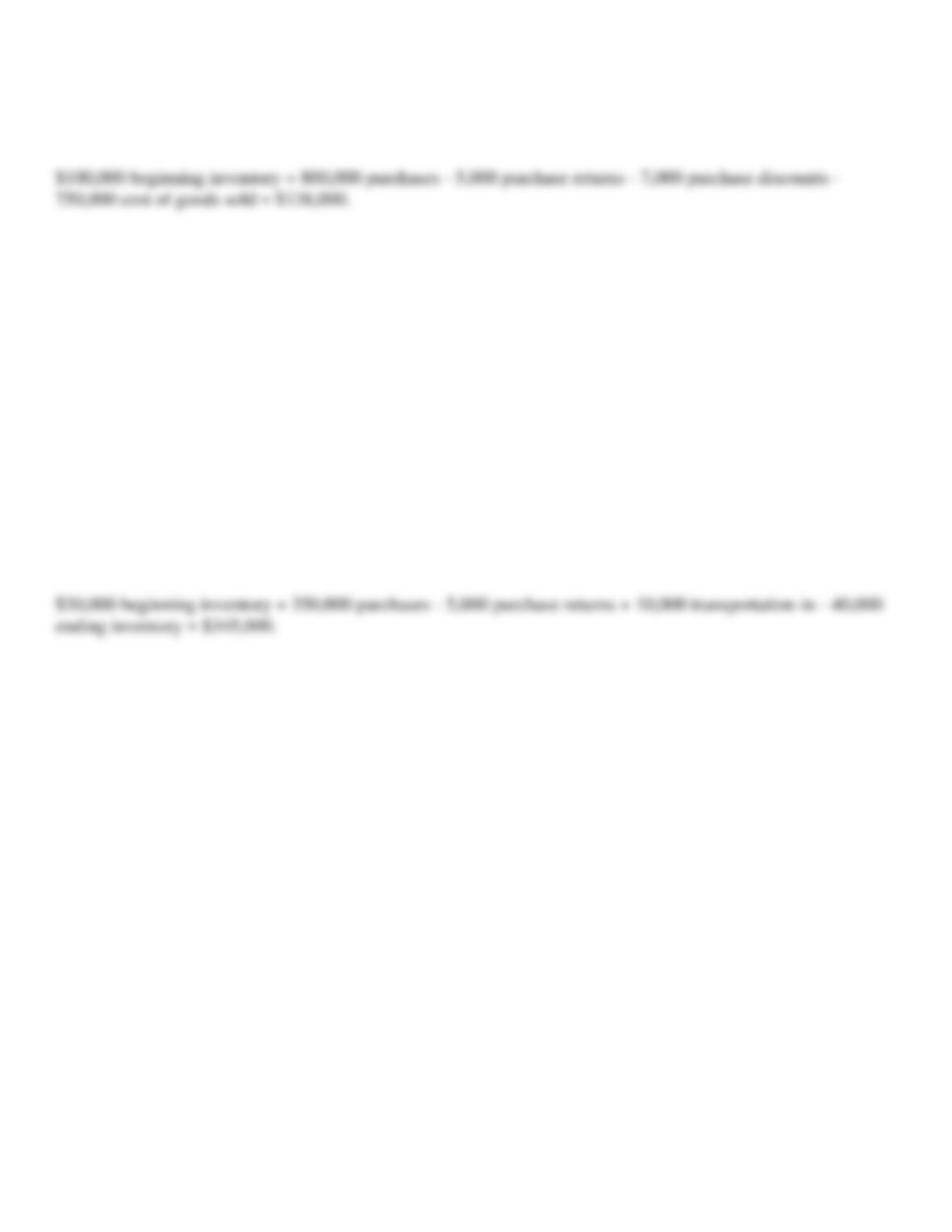
159. The cost of goods sold for Uzzi Corp. totaled $750,000. Sales returns and purchase returns were $3,000
and $5,000, respectively. Purchases totaled $800,000. Purchase discounts totaled $7,000, while sales discounts
totaled $9,000. Beginning inventory was $100,000. Determine the amount of ending inventory to be reported on
the company’s balance sheet.
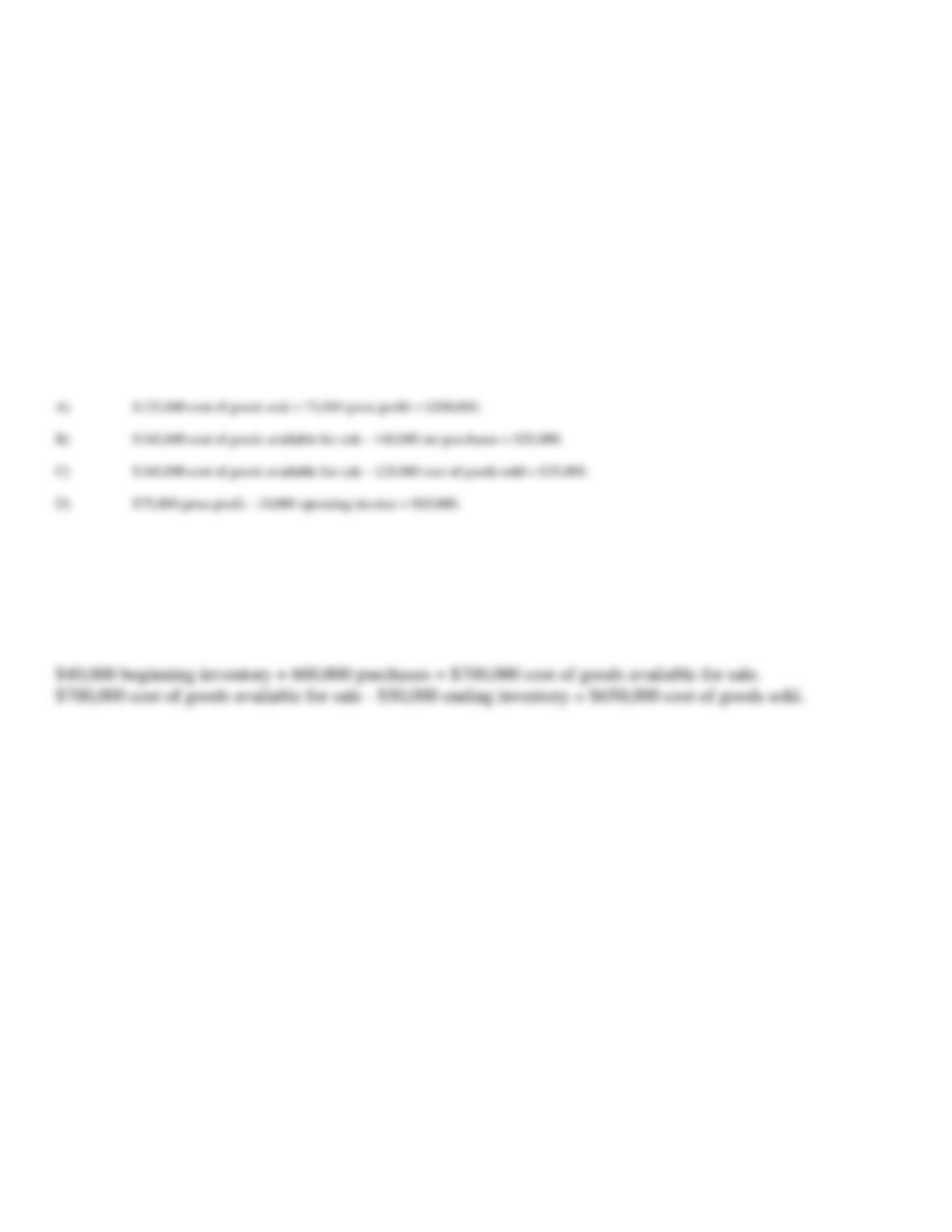
160. Vaden Company uses the periodic inventory system. The data presented below is from the company’s
accounting records for the year ended December 31, 2013:
Sales
$600,000
Sales discounts
10,000
Purchases
350,000
Purchase returns
5,000
Beginning inventory
30,000
Ending inventory
40,000
Operating expenses
150,000
Transportation-in
10,000
Beginning retained earnings
71,000
Calculate the company’s cost of goods sold for 2013.
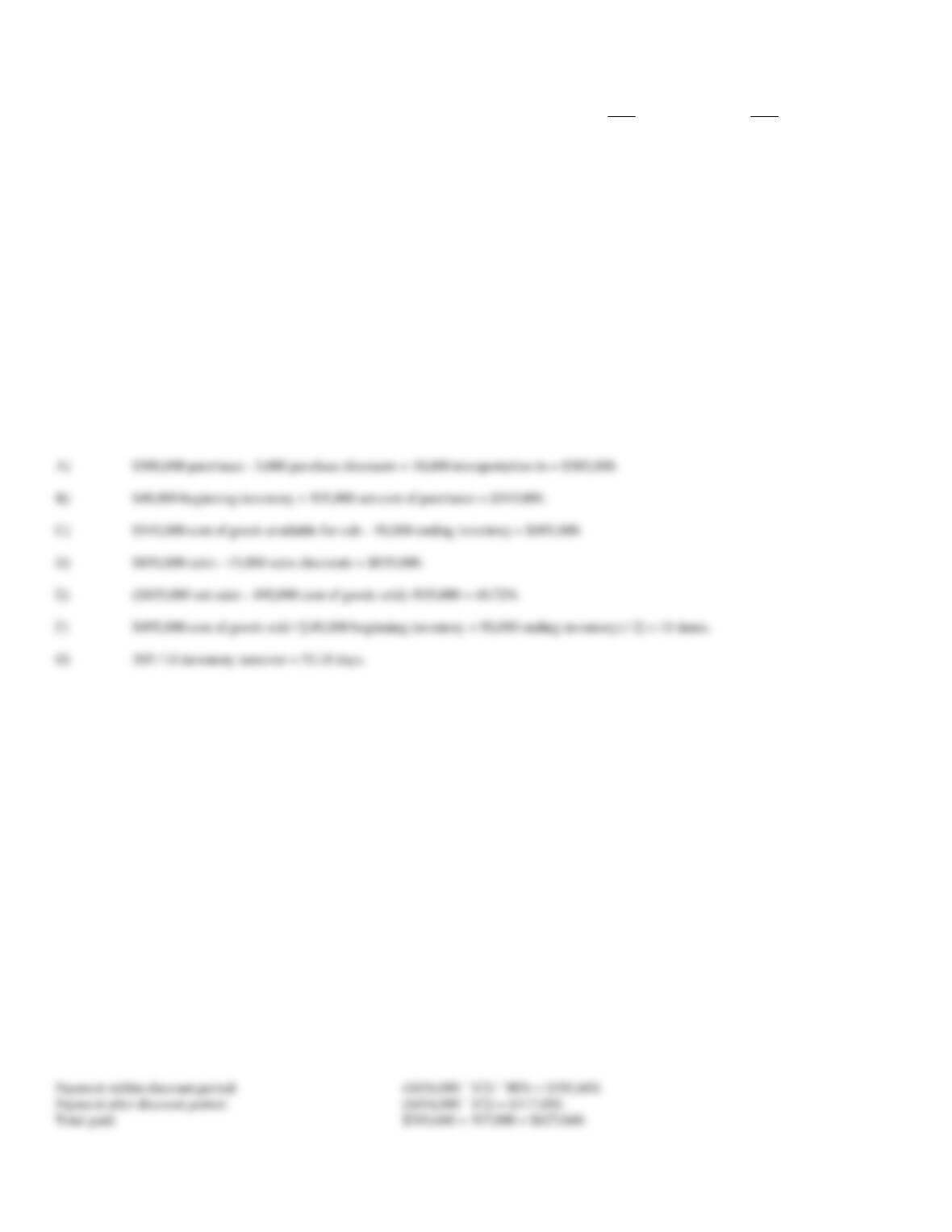
161. Presented below is a partially-completed income statement for Waddy Corp. for 2013. Determine the
missing amounts for each letter.
Net sales
$ A
Cost of goods sold:
Beginning inventory
B
Net purchases
140,000
Cost of goods available for sale
160,000
Ending inventory
C
Cost of goods sold
125,000
Gross profit
75,000
Selling, general & administrative expenses
D
Operating income
10,000
162. Ward Company had beginning inventory of $40,000 on January 1, 2013. During 2013, the company
purchased $660,000 of goods from a supplier. On December 31, 2013, the cost of unsold inventory was
$50,000. Compute Ward Company’s cost of goods available for sale and cost of goods sold for 2013.
$125,000 cost of goods sold + 75,000 gross profit = $200,000.
$160,000 cost of goods available for sale – 140,000 net purchases = $20,000.
$160,000 cost of goods available for sale – 125,000 cost of goods sold = $35,000.
$75,000 gross profit – 10,000 operating income = $65,000.
163. Xu, Inc. reported the following information for 2013 and 2012:
2013
2012
Sales
$850,000
$890,000
Sales discounts
15,000
23,000
Purchases
500,000
600,000
Ending inventory
50,000
40,000
Transportation-in
10,000
19,000
Purchase discounts
5,000
5,000
Determine the following amounts for Xu, Inc. for 2013:
A) Net cost of inventory purchases
B) Cost of goods available for sale
C) Cost of goods sold
D) Net sales
E) Gross profit ratio
F) Inventory turnover ratio
G) Average days to sell inventory
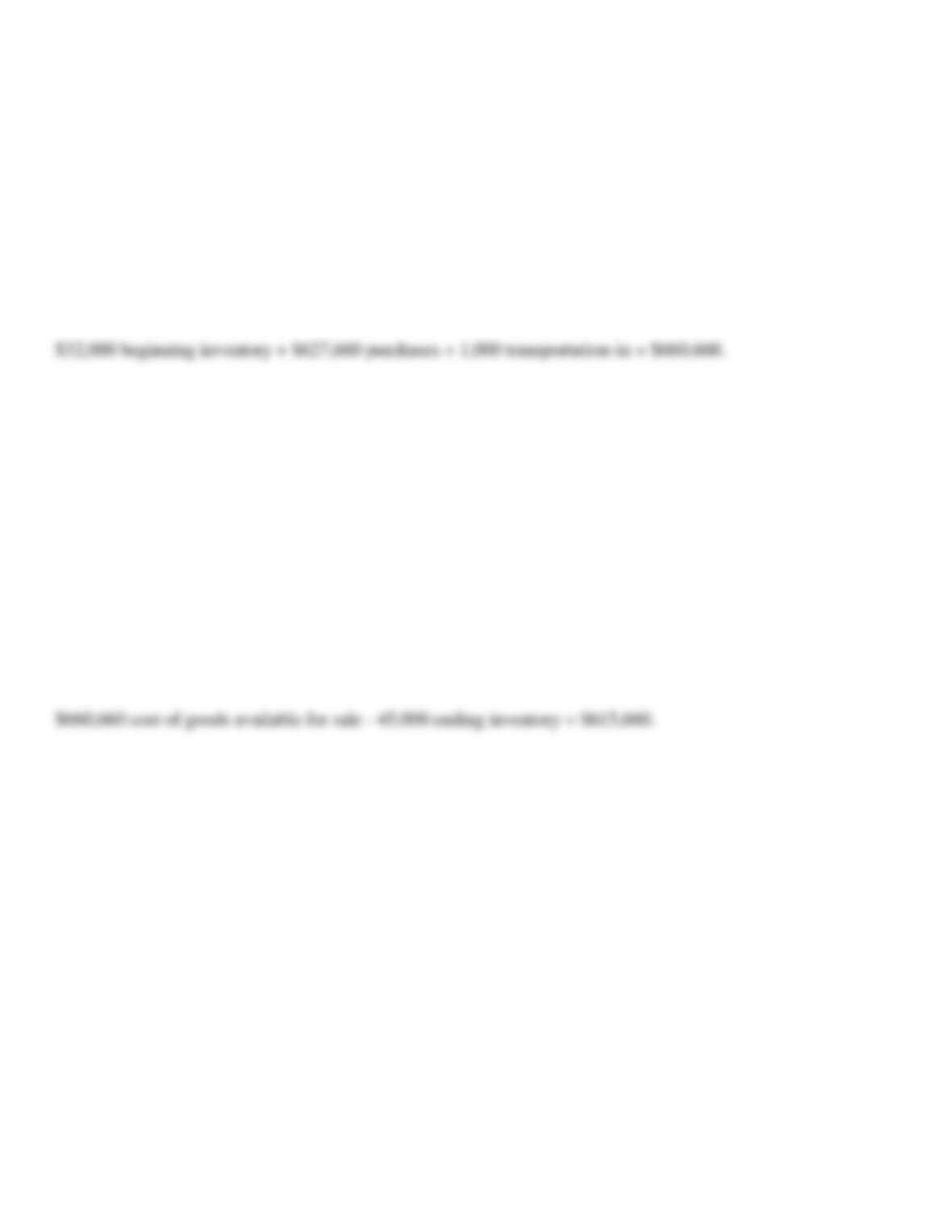
164. Yancey Company
The following information is available for Yancey Company, a retail store, for the year 2013. The company
uses a periodic inventory system.
Beginning inventory was $32,000. During the year, Yancey Company purchased goods totaling $634,000 on
account with terms of 2/10, n/30, FOB shipping point. Yancey Company paid $1,000 in total freight charges
directly to the freight company. At the end of the year, inventory on hand totaled $45,000. Net sales reported on
the income statement for the year totaled $1,300,000.
Refer to the information provided for Yancey Company. How much would Yancey Company pay its supplier
if it paid for one-half of the goods acquired within the discount period, and the other half after the expiration of
the discount period?
$500,000 purchases – 5,000 purchase discounts + 10,000 transportation-in = $505,000.
$40,000 beginning inventory + 505,000 net cost of purchases = $545,000.
$545,000 cost of goods available for sale – 50,000 ending inventory = $495,000.
$850,000 sales – 15,000 sales discounts = $835,000.
($835,000 net sales – 495,000 cost of goods sold) /835,000 = 40.72%
$495,000 cost of goods sold / [(40,000 beginning inventory + 50,000 ending inventory) / 2] = 11 times.
365 / 11 inventory turnover = 33.18 days.
165. Yancey Company
The following information is available for Yancey Company, a retail store, for the year 2013. The company
uses a periodic inventory system.
Beginning inventory was $32,000. During the year, Yancey Company purchased goods totaling $634,000 on
account with terms of 2/10, n/30, FOB shipping point. Yancey Company paid $1,000 in total freight charges
directly to the freight company. At the end of the year, inventory on hand totaled $45,000. Net sales reported on
the income statement for the year totaled $1,300,000.
Refer to the information provided for Yancey Company. How much is cost of goods available for sale for 2013
assuming that Yancey Company take advantage of one-half of the cash discounts?
166. Yancey Company
The following information is available for Yancey Company, a retail store, for the year 2013. The company
uses a periodic inventory system.
Beginning inventory was $32,000. During the year, Yancey Company purchased goods totaling $634,000 on
account with terms of 2/10, n/30, FOB shipping point. Yancey Company paid $1,000 in total freight charges
directly to the freight company. At the end of the year, inventory on hand totaled $45,000. Net sales reported on
the income statement for the year totaled $1,300,000.
Refer to the information provided for Yancey Company. How much is cost of goods sold assuming that
Yancey Company takes advantage of one-half of the cash discount?