
Chapter 6 — Foreign Currency Transactions
MULTIPLE CHOICE
1. The best definition for direct quotes would be “direct quotes measure
a.
how much foreign currency must be exchanged to receive 1 domestic
currency.”
b.
current or spot rates.”
c.
how much domestic currency must be exchanged to receive 1 foreign
currency.”
d.
exchange rates at a future point in time.”
2. A U.S. company purchases medical lab equipment from a Japanese company.
The Japanese company requires payment in Japanese yen. In this
transaction, the yen would be referred to as the
a.
domestic currency for the U.S. company.
b.
denominated currency.
c.
purchasing currency.
d.
selling currency.
3. A U.S. company that has purchased inventory from a German vendor would
be exposed to a net exchange gain on the unpaid balance if the
a.
amount to be paid was denominated in dollars.
b.
dollar weakened relative to the Euro and the Euro was the
denominated currency.
c.
dollar strengthened relative to the Euro and the Euro was the
denominated currency.
d.
U.S. company purchased a forward contract to buy Euros.
4. A U.S. company that has sold its product to a German firm would be
exposed to a net exchange gain on the unpaid receivable if the
a.
amount to be paid was denominated in dollars.
b.
dollar weakened relative to the Euro and the Euro was the
denominated currency.
c.
dollar strengthened relative to the Euro and the Euro was the
denominated currency.
d.
U.S. company purchased a forward contract to buy Euros.
5. A bank dealing in foreign currency tells you that the foreign currency
will buy you $.80 US dollars. The bank has given you
a.
a direct quote.
b.
an indirect quote.
c.
the official (fixed) rate.
d.
a forward rate.

Chapter 6
6-2
6. When an economic transaction is denominated in a currency other than
the entity’s domestic currency, the entity must establish a
a.
domestic rate.
b.
hedge rate.
c.
rate of currency change.
d.
rate of exchange.
7. A forward exchange contract is being transacted at a premium if the
current forward rate is
a.
less than the expected spot rate.
b.
greater than the expected spot rate.
c.
less than the current spot rate.
d.
greater than the current spot rate.
8. Which of the following factors influences the spread between forward
and spot rates?
a.
which currency is denominated as the domestic currency
b.
the length of the forward exchange contract
c.
the current cross rate between the two currencies
d.
all are factors that may influence the spread
9. Foreign currency transactions not involving a hedge should be accounted
for using
a.
the one-transaction method.
b.
the two-transaction method.
c.
a hybrid of the one- and two-transaction methods.
d.
either the one– or the two-transaction method (allowed by the
FASB).
10. A transaction denominated in a foreign currency will most likely result
in gains and losses to the reporting entity if the
a.
forward exchange contract is selling at a premium.
b.
transaction is denominated and measured in the reporting entity’s
currency.
c.
transaction takes place in a country with a tiered monetary
system.
d.
transaction is denominated in a foreign currency and measured in
the reporting entity’s currency.
Chapter 6
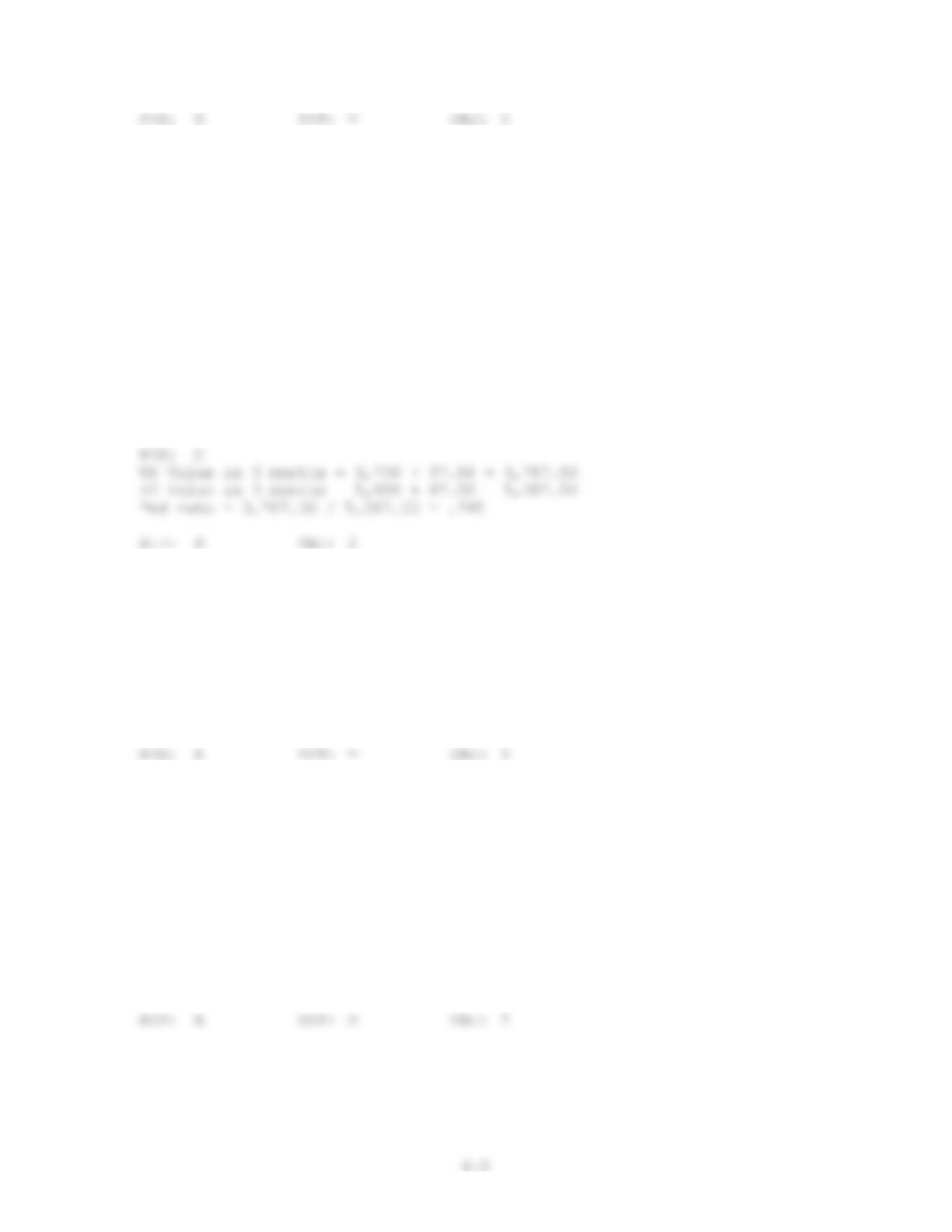
11. Given the following information for a 90 day contract:
US Dollars FC
Value Today 3,750 5,000
Interest Rate 4% 7%
3 months interest 37.50 87.50
Value in 3 months ?? ??
The spot rate today is 1FC = .75
What will be the forward rate?
a.
1FC = .75 US Dollars
b.
1FC = .57 US Dollars
c.
1FC = .745 US Dollars
d.
1FC = .70 US Dollars
12. A U.S. firm has purchased, for 50,000 FCs, an electric generator from a
foreign firm. The exchange rates were 1 FC = $0.80 on the delivery date
and 1 FC = $0.76 when the payable was paid. What is the final recorded
value if the two-transaction method is used?
a.
$40,000
b.
$38,000
c.
$42,000
d.
$50,000
13. A U.S. manufacturer has sold computer services to a foreign firm and
received 200,000 foreign currency units (FCs). The exchange rates were
1 FC = $.75 on the date of the sale and 1 FC = $.80 when the receivable
was settled. On the transaction date, the settlement exchange rate is
estimated to be 1FC = $.72. By the settlement date, what is the total
exchange gain or loss recorded for the transaction if the two–
transaction method is used?
a.
$10,000 exchange gain
b.
$6,000 exchange loss
c.
$10,000 exchange loss
d.
no gain or loss

Chapter 6
14. A U.S. manufacturer has sold goods to a foreign firm for a sale price
of 80,000FC on 12/15/X1. The invoice is due 1/15/X2. The U.S. Firm
fiscal year is 12/31/X1. Given the following exchange rates, what gain
or loss would the US firm record on 12/31?
12/15 1FC = $0.60 US Dollars
12/31 1FC = $0.65 US Dollars
1/15 1FC = $0.63 US Dollars
a.
loss of $4,000
b.
loss of $1,600
c.
gain of $2,400
d.
gain of $4,000
15. Which of the following does not represent an exchange risk on an
exposed position to a company transacting business with a foreign
vendor?
a.
transaction is denominated in foreign currency, settled at a
future date
b.
firm commitment to purchase inventory to be paid for in foreign
currency
c.
Forecasted foreign currency transaction with a high probability of
occurrence
d.
firm commitment to purchase inventory denominated in U.S. dollars
16. Exchange gains and losses on a forward exchange contract that covers
the same time period as the transaction which it provides a hedge for
should be recognized as
a.
an extraordinary item.
b.
part of the original sales transaction.
c.
income from continuing operations.
d.
income from continuing operations, but only if material.

Chapter 6
17. On August 1, 20X1, an American firm purchased a machine costing
200,000,000 yen from a Japanese firm to be paid for on October 1, 20X1.
Also on August 1, 20X1, the American firm entered into a contract to
purchase 200,000,000 yen to be delivered on October 1, 20X1, at a
forward rate of 1 Yen = $0.00783. The exchange rates were as follows:
Spot
August 1, 20X1…………………… 1 Yen = $0.00781
August 31, 20X1…………………… 1 Yen = $0.00777
October 1, 20X1…………………… 1 Yen = $0.00779
Which of the following statements is incorrect concerning the
accounting treatment of these transactions?
a.
The machine’s final recorded value was $1,558,000.
b.
The beginning balance in the accounts payable was $1,562,000.
c.
An exchange gain on the accounts payable of $4,000 was recognized
on October 1, 20X1.
d.
The value of the accounts payable just before payment, on October
1, 20X1, was $1,558,000.
18. Questions 18 and 19 utilize the following information.
On 6/1/X2, an American firm purchased a inventory costing 100,000
Canadian Dollars from a Canadian firm to be paid for on 8/1/X2. Also on
6/1/X2, the American firm entered into a forward contract to purchase
100,000 Canadian dollars for delivery on 8/1/X2. The exchange rates
were as follows:
Spot Forward
6/1/X2 ……………………….1 CD = $0.73 1 CD = $0.74
6/30/X2 ……………………….1 CD = $0.70 1 CD = $0.75
8/1/X2 ……………………….1 CD = $0.68 1 CD = $0.68
The American firms fiscal year end is 6/30/X2. The changes in the value
of the forward contract should be discounted at 8%.
What is the value of the Forward Contract Receivable-FC on 6/1/X2?
a.
$73,000
b.
$74,000
c.
$68,000
d.
$70,000
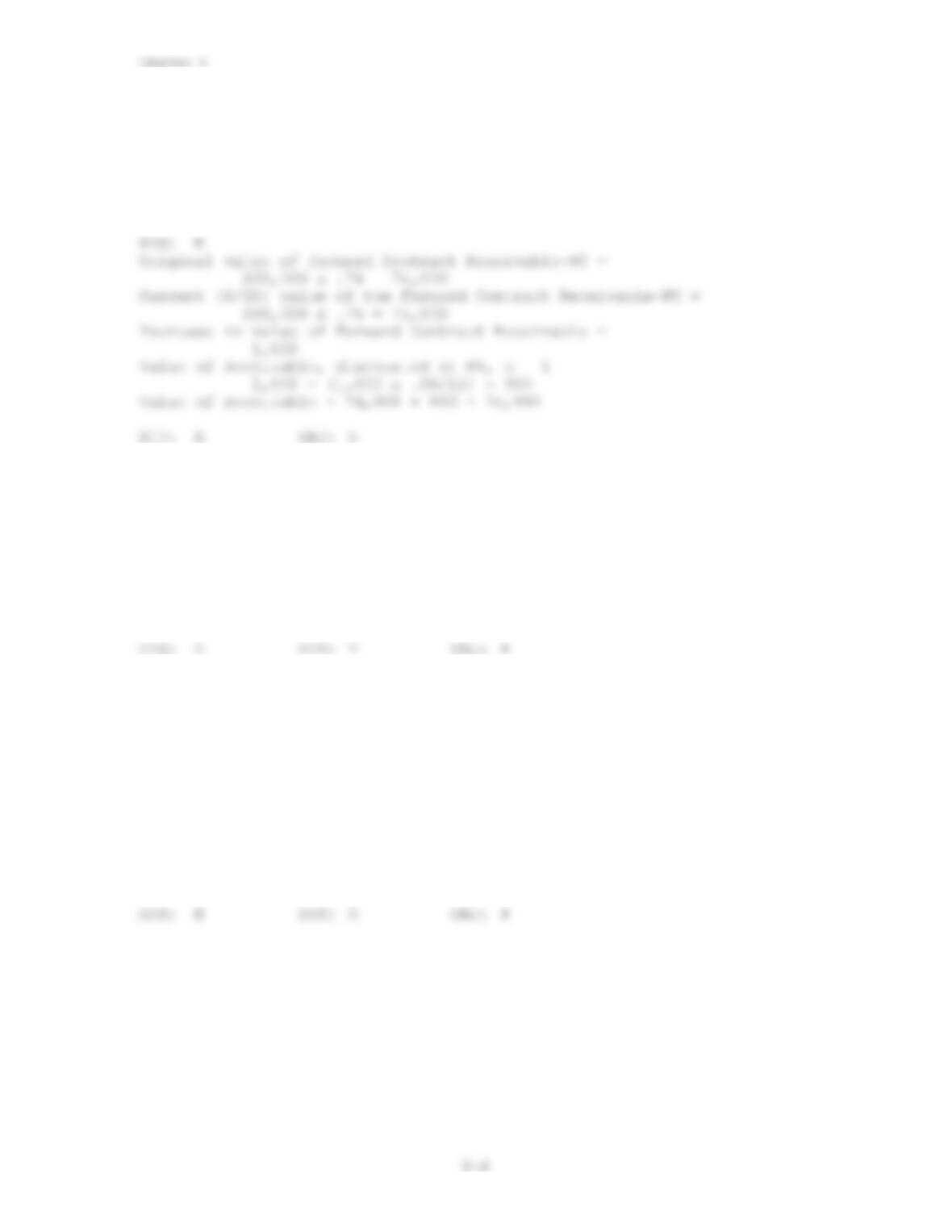
19. What is the value of the Forward Contract Receivable-FC on 6/30/X2?
a.
$75,000
b.
$75,693
c.
$74,693
d.
$74,993
20. The purpose of a hedge on an identifiable commitment where the US
company is selling goods is to:
a.
fix the basis of sales revenue to the date of the commitment
b.
eliminate all exchange gains/losses from the date of commitment to
the date of settlement
c.
fix the basis of cost of goods sold to the date of commitment
d.
eliminate any exchange gains/losses from the transaction date to
the settlement date
21. Which of the following statements is not true regarding forward
contracts that cover periods of time different from the settlement
period (transaction date to the settlement date)?
a.
If the forward contract expires before the settlement date, the
gain or loss will partially offset the gain or loss on the foreign
currency transaction.
b.
If the forward contract expires after the settlement date, post–
settlement date gains and losses are not recognized as components
of current operating income.
c.
Premium and discount are amortized over the life of the contract.
d.
All of these statements are true.
Chapter 6
22. Questions 22 & 23 use the following information:
On 4/1/X3, a US Company commits to sell a piece of equipment to a
French customer. At that time, the US company enters into a forward
contract to sell foreign currency on 8/1/X3(120 days). Delivery will
take place 7/1/X3 with payment due on 8/1/X3. The fiscal year end for
the company is 6/30/X3. The sales price of the equipment is 200,000
Euros. Various exchange rates are as follows:
Spot Forward
4/1/X3 1FC = $0.60 1FC = $0.58
6/30/X3 1FC = $0.58 1FC = $0.56
(also 7/1/X3)
8/1/X3 1FC = $0.55 1FC = $0.55
Discount rate is 12%.
What is the amount in the Firm Commitment account on 6/30/X3?
a.
4,000 debit
b.
8,000 debit
c.
4,000 credit
d.
10,000 credit
23. What is the value of Forward Contract Payable-FC on 6/30?
a.
112,000
b.
112,040
c.
116,000
d.
none of the above

Chapter 6
6-8
24. Which of the following statements is true concerning forward contracts
classified as hedges of an identifiable foreign currency commitment?
a.
Forward contracts used as hedges cannot exceed the foreign
currency commitment.
b.
Forward contracts cannot extend for a time period after the
transaction date of the commitment.
c.
The gain or loss traceable to the time period after the
transaction date of the commitment should not be deferred.
d.
None of these statements is true.
25. Which of the following is not true concerning the accounting for hedges
of forecasted transactions using an option?
a.
An intrinsic value must be calculate throughout the hedge period
b.
The accounting requires revaluing the market value of the option
c.
The option fixes the value of the transaction to the date of the
commitment.
d.
All of these statements are true.
26. The accounting treatment given a cash flow hedge of a forecasted
transaction continues unless:
a.
The hedging relationship is no longer highly effective based on
management policies.
b.
The derivative instrument is sold, terminated, or exercised.
c.
The derivative instrument is no longer designated as a hedge on a
forecasted transaction.
d.
all of these statements are true.
27. A United States based company that has not hedged an exposed asset
position would experience an exchange gain if
a.
forward rates increased.
b.
forward rates decreased.
c.
spot rates increased.
d.
spot rates decreased.
28. In the accounting for forward exchange contracts, gains and losses are
measured using either spot or forward rates. Which of the following
statements concerning measurement of gains and losses is true?
a.
The gains or losses in a hedge on an exposed asset will use the
spot rate for the asset and the forward rate for the forward
contract.
b.
The gains or losses in a speculative hedge will use the forward
rate throughout the contract.
c.
The gains or losses in a hedge on an identifiable commitment will
use the spot rate for the commitment and the forward rate for the
forward contract.
Chapter 6
6-9
d.
All of these statements are true.
29. The time value of an option is the difference between the
a.
premium paid and its current rate.
b.
premium paid and its intrinsic value.
c.
exercise price and its current rate.
d.
call option price and the put option price.
30. The two distinguishing characteristics of a financial instrument are
a.
one or more options and one or more exchange rates.
b.
one or more underlyings and one or more notional amounts.
c.
cash flows and economic exchange.
d.
a per share price and a quantity.
31. Hugh, Inc. purchased merchandise for 300,000 FC from a British vendor
on November 30, 20X3. Payment in British pounds is due January 31,
20X4. Exchange rates to purchase 1 FC is as follows:
Nov. 30, 20X3 Dec. 31, 20X3
Spot…………….. $1.65 $1.62
30 day…………… $1.64 $1.59
60 day…………… $1.63 $1.56
In the December 31, 20X3 income statement, what amount should Hugh
report as foreign exchange gain from this transaction?
a.
$12,000
b.
$9,000
c.
$6,000
d.
$0
32. Wild, Inc. sold merchandise for 500,000 FC to a foreign vendor on
November 30, 20X5. Payment in foreign currency is due January 31, 20X6.
Exchange rates to purchase 1 foreign currency unit are as follows:
Nov. 30, 20X5 Dec. 31, 20X5 Jan. 31, 20X6
Spot…………. $1.49 $1.45 $1.44
30 day……….. $1.48 $1.43 $1.43
60 day……….. $1.46 $1.41 $1.42
In the year in which the sale was made, 20X5, what amount should Wild
report as foreign exchange gain/loss from this transaction?
a.
$25,000
b.
$20,000
c.
$5,000
d.
$0

Chapter 6
33. Pile, Inc. purchased merchandise for 500,000 FC from a foreign vendor
on November 30, 20X5. Payment in foreign currency is due January 31,
20X6. On the same day, Pile signed an agreement with a foreign exchange
broker to buy 500,000 FC on January 31, 20X4. Exchange rates to
purchase 1 FC are as follows:
Nov. 30, 20X5 Dec. 31, 20X5 Jan. 31, 20X6
Spot…………. $1.49 $1.45 $1.44
30 day……….. $1.48 $1.43 $1.43
60 day……….. $1.46 $1.41 $1.42
What will be the adjustment to the account payable included in the
journal entry record on November 30, 20X5?
a.
$20,000 debit
b.
$20,000 credit
c.
$30,000 debit
d.
$0
34. Larson, Inc. sold merchandise for 600,000 FC to a foreign vendor on
November 30, 20X5. Payment in foreign currency is due January 31, 20X6.
On the same day, Larson signed an agreement with a foreign exchange
broker to sell 600,000 FC on January 31, 20X6. Exchange rates to
purchase 1 FC are as follows:
Nov. 30, 20X5 Dec. 31, 20X5 Jan. 31, 20X6
Spot…………. $1.49 $1.46 $1.43
30 day……….. $1.48 $1.43 $1.44
60 day……….. $1.47 $1.40 $1.42
What will be the amount of the Forward Contract Receivable-Dollars on
November 30, 20X5?
a.
$894,000
b.
$888,000
c.
$882,000
d.
$858,000

Chapter 6
6-11
35. Happ, Inc. agreed to purchase merchandise from a British vendor on
November 30, 20X3. The goods will arrive on January 31, 20X4 and
payment of 100,000 British pounds is due February 28, 20X4. On November
30, 20X3, Happ signed an agreement with a foreign exchange broker to
buy 100,000 British pounds on February 28, 20X4. Exchange rates to
purchase 1 British pound are as follows:
Nov. 30, 20X3 Dec. 31, 20X3 Jan. 31, 20X4 Feb. 28, 20X4
Spot… $1.65 $1.62 $1.59 $1.57
30 day. $1.64 $1.59 $1.60 $1.59
60 day. $1.63 $1.56 $1.58 $1.58
Because of this commitment hedge, Happ, Inc. will record the
merchandise at what value when it arrives in January?
a.
$165,000
b.
$164,000
c.
$160,000
d.
$159,000
36. In a hedge of a forecasted transaction, gains or losses on derivative
instruments prior to the occurrence of the actual transaction should be
reported as
a.
a component of stockholders’ equity.
b.
a component of other comprehensive income.
c.
an extraordinary item.
d.
income from continuing operations.
37. A critical characteristic of a derivative is that the instrument
a.
derives its value from a related asset or liability.
b.
derives its value from changes in value of a related asset or
liability.
c.
requires that the related asset or liability be sold or bought at
settlement.
d.
requires the holder of the derivative instrument to make a
significant investment.
38. The notional amount of a derivative instrument is
a.
related to the number of units specified in the derivative and the
price that relates to the asset or liability underlying the
derivative.
b.
the change in the price or rate that relates to the asset or

Chapter 6
6-12
liability underlying the derivative.
c.
the price or rate that relates to the asset or liability
underlying the derivative.
d.
the number of units that is specified in the derivative
instrument.
39. The total value of a derivative is determined by the
a.
number of units specified in the derivative and the price that
relates to the asset or liability underlying the derivative.
b.
change in the price or rate that relates to the asset or liability
underlying the derivative.
c.
price or rate that relates to the asset or liability underlying
the derivative.
d.
number of units that is specified in the derivative instrument.
40. A forward contract
a.
is NOT traded on an organized exchange and is customized to meet
the needs of the parties.
b.
is NOT traded on an organized exchange and is subject to formal
regulation which results in standardized contracts.
c.
is traded on an organized exchange and is subject to formal
regulation which results in standardized contracts.
d.
is traded on an organized exchange and is customized to meet the
needs of the parties.
41. On September 1st of the current year, Mooney Company writes a
contract agreeing to sell to Berry Company 200,000 foreign currency
(FC) units at a specific price of $2.14 per FC with delivery in 30
days. The spot rate at the end of 30 days is $2.17. The appropriate
discount rate for both Mooney Company and Berry Company is 9%.
On the settlement of the contract, Mooney would record a
a.
gain of $6,000.
b.
gain of $5,955.
c.
loss of $6,000.
d.
loss of $5,955.
42. For a derivative instrument, the underlying amount is
a.
related to the number of units specified in the derivative and the
price that relates to the asset or liability underlying the
derivative.
b.
the change in the price or rate that relates to the asset or
liability underlying the derivative.
c.
the price or rate that relates to the asset or liability
Chapter 6
underlying the derivative.
d.
the number of units that is specified in the derivative
instrument.
PROBLEM
1. Describe the risks and uncertainty a U.S. company faces when purchasing
goods from a foreign corporation and settling the transaction in the
foreign currency.
2. On September 15, 20X2, Wall Company, a U.S. firm, purchased a piece of
equipment from a foreign firm for 500,000 FCs. Payment for the
equipment was to be made in FCs on January 15, 20X3. The spot rates on
selected dates were as follows:
Date Spot Rate
9/15/X2………………………….. 1 FC = $0.30
12/31/X2…………………………. 1 FC = $0.33
1/15/X3………………………….. 1 FC = $0.315
Required:
a.
Assuming that the US Corp. has a December 31 year end, prepare
the necessary journal entries to account for the series of
transactions involving the purchase.
b.
Prepare all the necessary journal entries assuming that the US
Corp. will be paying for the equipment in U.S. dollars.
Chapter 6
3. On November 1, 20X1, DEMO Corp., a U.S. firm, sold merchandise to a
foreign firm for 60,000 FCs. DEMO will be paid on January 31, 20X2, in
FCs. The spot rates on selected dates were as follows:
Date Spot Rate
November 1, 20X1………………………….. 1 FC = $0.50
December 31, 20X1…………………………. 1 FC = $0.55
January 31, 20X2………………………….. 1 FC = $0.53
Required:
Assuming that DEMO has a December 31 year end, prepare the necessary
journal entries to account for the series of transactions involving the
sale.
Chapter 6
4. A U.S. Corp. purchased a computer from a French firm on July 1, 20X5,
when a Euro cost $0.25. The U.S. firm will be required to pay the
French manufacturer 75,000 Euros on August 1, 20X5, when the Euro costs
$0.23.
Required:
Make the necessary journal entries for the U.S. firm on July 1 and
August 1.
5. On January 1, 20X1, a U.S. firm bought a truck from a foreign firm for
10,000 FCs, to be paid on March 1 in FCs. The spot rate was 1 FC =
$1.25 on January 1 and 1 FC = $1.265 on March 1. To protect themselves
from exchange rate changes, the U.S. firm entered into a forward
exchange contract on January 1 to buy FCs on March 1 for $1.28.
Required:
Make all the necessary journal entries to record the transactions for
the U.S. firm on January 1 and March 1.
Chapter 6
6-16
6. Explain how the risks differ for holders and writers of foreign
exchange options. Additionally, describe the difference between
American and European options. Finally, how is the intrinsic value of
an option calculated?
7. For a hedge on an exposed position, describe the process of valuing the
forward contract as the fiscal period end date.
8. Wolters Corporation is a U.S. corporation that purchased 50,000
chocolate bars from a foreign manufacturer on March 1, 20X9 for 80,000
foreign currency units, to be paid on April 30, 20X9. On March 1, 20X9
Wolters also entered into a forward contract to purchase 80,000 foreign
currency units on April 30, 20X9. Wolters has a December 31 year end.
Exchange rates are as follows:
Chapter 6
Date _ Spot Rate Forward Rate
3/1/X9…………………………….. $0.69 $0.65
3/31/X9……………………………. $0.61 $0.65
4/30/X9……………………………. $0.66 $0.66
Required:
Prepare the journal entries to record the transactions through April
30, 20X9. March 31 is NOT a fiscal period end. Ignore the split between
spot gain/loss and time value.
9. Describe the disclosures required by the FASB of firms using
derivatives as foreign currency hedges.
Chapter 6
10. Rex Corporation, a U.S. firm with a calendar accounting year, agreed to
buy a specially made truck from a Japanese firm for delivery on January
31, 20X2 with payment due on 2/28/X2. On the same date the agreement
was signed, November 1, 20X1, a forward contract due on February 28,
20X2, was also signed to purchase 1,000,000 yen, the contract price of
the truck. Exchange rates were as follows:
Date Spot Rate Forward Rate
11/1/X1 ………………………….. $0.0076 $0.0078
12/31/X1 ………………………….. $0.0081 $0.0080
1/31/X2 ………………………….. $0.0084 $0.0083
2/28/X2 ………………………….. $0.0085 $0.0085
Discount rate = 8%
Required:
Prepare the journal entries needed to properly reflect the purchase and
forward contract through the end of the fiscal year.
Chapter 6
6-19
11. On January 1, 20X1, a domestic firm agrees to sell goods to a foreign
customer, with delivery to be made on March 1, 20X1. The goods, valued
at 50,000 FCs, are to be paid for 30 days after delivery. On January 1,
20X1, the domestic firm purchased a 90-day forward contract to sell
50,000 FCs. Exchange rates on selected dates are as follows:
Date Spot Rate Fwd Rate
1/1/X1…………………………… 1 FC = $1.00 1FC = $0.99
3/1/X1…………………………… 1 FC = $0.98 1FC = $0.97
4/1/X1…………………………… 1 FC = $0.96 1FC = $0.96
Discount rate = 10%
Required:
Prepare the journal entries needed to properly reflect the sales
transaction and the forward exchange contract. The forward contract
meets the conditions necessary to be classified as a hedge on an
identifiable foreign currency commitment. Include the table to
calculate the split between exchange gains or losses on the contract
due to changes in spot rates and the changes in time value.
Chapter 6
Chapter 6
12. Wolters Corporation is a U.S. corporation that purchased 50,000
chocolate bars from a foreign manufacturer on 6/1/X9 for 80,000 foreign
currency units, to be paid on 9/1/X9. On 6/1/X9 Wolters also entered
into a forward contract to purchase 80,000 foreign currency units on
9/1/X9. Wolters has a July 31 year end.
Exchange rates are as follows:
Date _ Spot Rate Fwd Rate
6/1/X9……………………………. $0.64 $0.645
7/31/X9…………………………… $0.66 $0.68
9/1/X9……………………………. $0.69 $0.69
Discount rate = 12%
Required:
Make the necessary journal entries for Wolters for the period June 1
through September 1, 20X9.
Chapter 6
6-22
13. Lion Corporation, a U.S. firm, entered into several foreign currency
transactions during the year. Determine the effect of each transaction
on net income for that current accounting year only. Bear has a June 30
year end.
Required:
a.
On January 15, Lion sold $30,000 (Canadian) in merchandise to
a Canadian firm, to be paid for on February 15 in Canadian
dollars. Canadian dollars were worth $0.85 (U.S.) on January
15 and $0.82 (U.S.) on February 15.
b.
On June 1, Lion purchased and received a computer costing
100,000 euros from a German firm. Bear paid for the computer
on August 1. On June 1, to reduce exchange risks, Lion
purchased a contract to buy 100,000 marks in 60 days. Exchange
rates are as follows:
Spot Fwd
6/1 $0.53 $0.60
6/30 $0.54 $0.58
Discount rate = 6%
c.
On June 1, Lion purchased an option to sell 100,000 FC in 60
days to hedge a forecasted sale to a customer. The option sold
for a premium of $6,500 and a strike price of $1.20. The value
of the option 6/30 was $12,500. The spot rate on 6/1 was $1.19
Chapter 6
6-23
and at 6/30 $1.25.
14. Differentiate between the following monetary systems: floating system,
controlled float system and tiered system.
15. On November 1, 20X1, a U.S. company purchased inventory from a foreign
supplier for 100,000 FCs, with payment to be made on January 31, 20X2,
in FCs. To hedge against fluctuations in exchange rates, the firm
entered into a forward exchange contract on November 1 to purchase
100,000 FCs on January 31, 20X2. The U.S. firm has a December 31 year
end for accounting purposes. The following exchange rates may apply:
Date Spot Rate Fwd Rate
11/1/X1…………………………… $0.15 $0.13
12/31/X1………………………….. $0.16 $0.14
1/31/X2…………………………… $0.165 $0.165
Chapter 6
Discount rate = 12%
Required:
Make all the necessary journal entries for the U.S. firm relative to
these events occurring between November 1, 20X1, and January 31, 20X2.
Chapter 6
16. On November 1, 20X1, a U.S. company sold merchandise to a foreign firm
for 100,000 FCs with payment to be made on January 31, 20X2, in FCs. To
hedge against fluctuations in exchange rates, the firm entered into a
forward exchange contract on December 1, 20X1 to sell 100,000 FCs on
January 31, 20X2. The U.S. firm has a December 31 year end for
accounting purposes. The following exchange rates may apply:
Date Spot Rate Fwd Rate
11/1/X1………………………….. $0.15
12/1/X1………………………….. $0.155 $0.17
12/31/X1…………………………. $0.16 $0.175
1/31/X2………………………….. $0.165 $0.165
Discount rate = 10%
Required:
Make all the necessary journal entries for the U.S. firm relative to
these events occurring between November 1, 20X1, and January 31, 20X2.
Chapter 6
6-26
17. Zerlie’s Imports purchased automotive parts from a German firm on July
1, 20X1. The parts cost 150,000 Euros to be paid for on August 15. To
pay for the parts, Zerlie’s Imports borrowed 150,000 euros from a
German bank on July 16. The loan bears an 11% interest rate to be
repaid on August 15 in euros.
Another option would have been for Zerlie’s to have hedged the purchase
with a forward exchange contract on July 1 to buy 150,000 euros at a
forward rate of $0.67. Exchange rates were as follows:
Date Spot Rate
July 1, 20X1……………………………… 1 M = $0.65
July 16, 20X1…………………………….. 1 M = $0.60
August 15, 20X1…………………………… 1 M = $0.62
Chapter 6
6-27
Required:
a.
Compute the effect on net income assuming the following:
(1) Zerlie did not borrow to pay for the transaction or hedge the
transaction on July 1.
(2) Zerlie borrowed from the German bank on July 16.
(3) Zerlie hedged the full purchase on July 1.
**ignore present values and discount rates
b.
Determine which of these three alternatives would have been
the best for Zerlie under the situation described.
18. Bulldog Enterprise, a U.S. firm, agreed on February 1, 20X1, to buy
gears from a Mexican firm for 75,000 pesos. Delivery is scheduled for
April 1, 20X1, with payment due on May 1, 20X1. On February 1, 20X1,
Bulldog also acquired a forward contract to buy 75,000 pesos on May 1,
20X1. (The gears represent inventory to the U.S. firm.) There are no
fiscal period ends.
Required:
Prepare the journal entries necessary for Bulldog Enterprise to record
this activity. Assume that the following exchange rates existed:
Date Spot Rate Forward Rate
February 1, 20X1…….. 1 peso = $0.223 1 peso = $0.227
April 1, 20X1……….. 1 peso = $0.228 1 peso = $0.230
May 1, 20X1…………. 1 peso = $0.226 1 peso = $0.226
Discount rate = 15%
borrow.
Chapter 6
19. On November 1, 20X8 Desket, Inc. a U.S. company agreed to sell goods to
a foreign buyer for 200,000 FC. The goods were to be shipped on
December 1 with payment to be received January 31, 20X9.
The hedging contract, signed on November 1, 20X8, called for the sale
of 200,000 FC on January 31, 20X9. Assume the December 31 is fiscal
year end. Exchange rates are as follows:
Spot Rate Fwd Rate
11/1/X8 ………………….. $0.66 $0.69
12/1/X8 ………………….. $0.67 $0.68
12/31/X8 …………………. $0.65 $0.66
Discount rate = 12%
Required:
Prepare all necessary entries through December 31, 20X8 for the
commitment hedge and sale.
Chapter 6
6-30
20. Red & Blue Company, a U.S. corporation, agreed to purchase merchandise
from a British vendor on January 1, 20X4. The goods will be shipped on
January 31, 20X4 and payment of 200,000 British pounds is due February
28, 20X4. On January 1, USA signed an agreement with a foreign exchange
broker to buy 200,000 British pounds on February 28, 20X4. Exchange
rates to purchase 1 British pound are as follows:
Spot Rate Fwd Rate
1/1/X4……………… $1.65 $1.63
1/31/X4…………….. $1.62 $1.605
2/28/X4…………….. $1.59 $1.59
Discount Rate = 15%
Required:
Journalize these transactions.
Chapter 6
6-31
ANS:
Chapter 6
21. On January 1, 20X4, Branson Company, a U.S. corporation, purchased lab
equipment from a Japanese vendor for 1,000,000 FC. The 1,000,000 FC is
to be paid on March 31, 20X4. On February 1 the company purchased a
forward contract to buy foreign currency which would expire on March
31, 20X4. The contract was to purchase 1,000,000 FC.
Exchange Rates are as follows:
Date Spot Rate Fwd Rate
1/1/X4 …………… $0.018 $0.011
2/1/X4 …………… $0.014 $0.011
3/31X4 …………… $0.013 $0.013
Discount rate = 15%
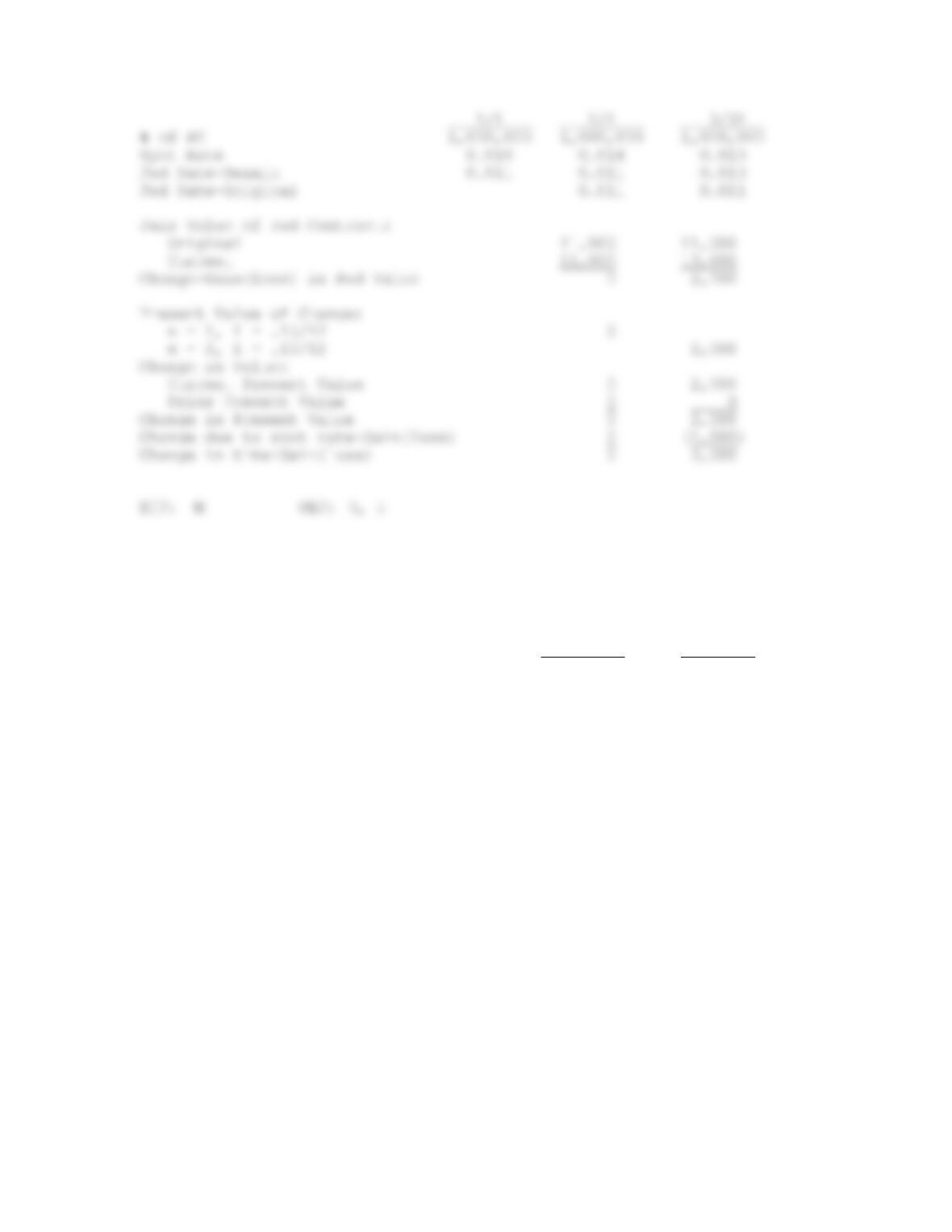
Required:
Prepare the entries to record the transactions.
Chapter 6
6-33
22. Blue & Green, Inc. purchased merchandise for 100,000 FC from a foreign
vendor on December 1, 20X5. Payment in FC is due January 31, 20X6. On
December 1, 20X5, Blue & Green signed an agreement with a foreign
exchange broker to buy 100,000 FC on January 30, 20X6. Exchange rates
to purchase 1 FC are as follows:
Spot Rate Fwd Rate
12/1/X5…………………………….. $1.45 $1.40
12/31/X5…………………………… $1.43 $1.35
1/31/X6…………………………… $1.41 $1.41
Fiscal Year End is 12/31; Discount rate = 12%
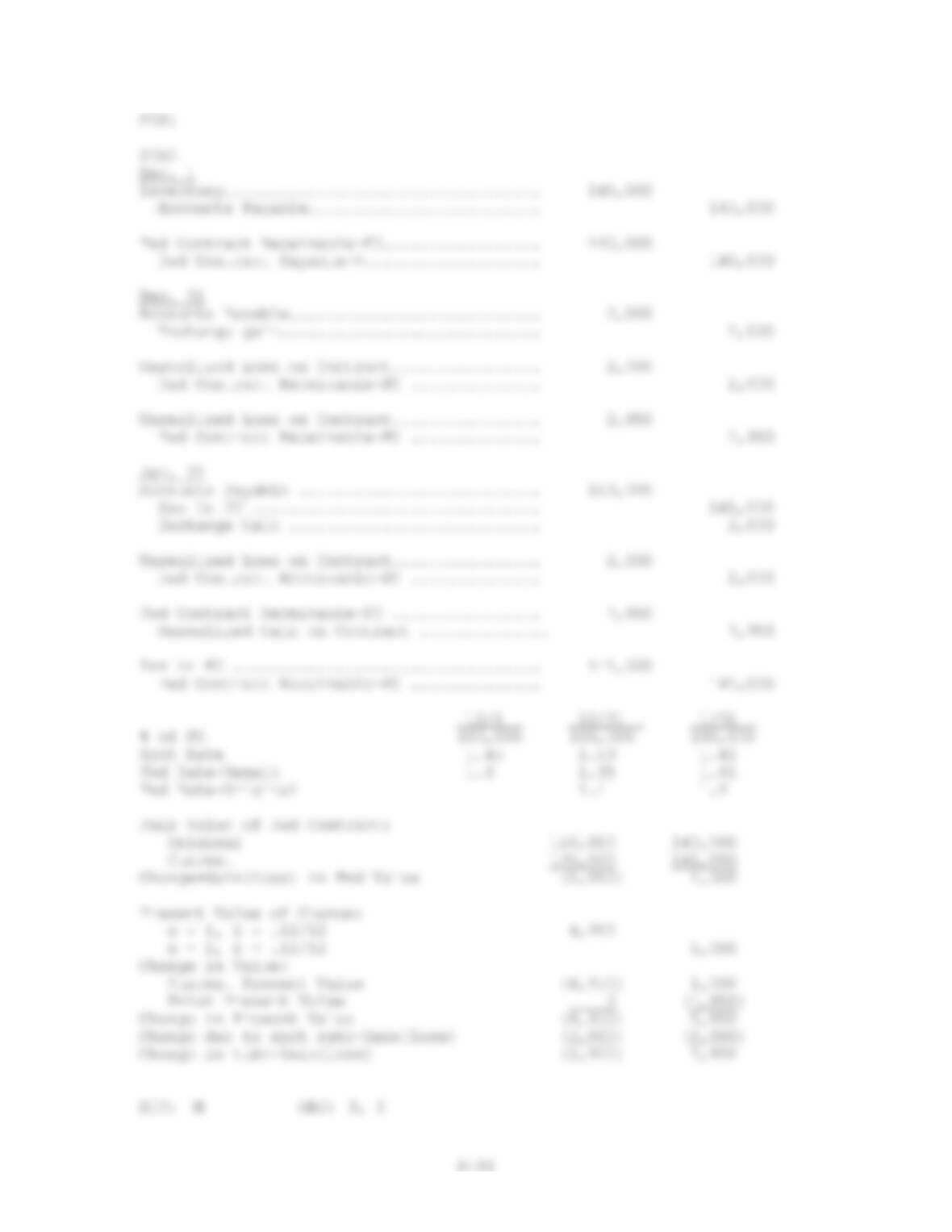
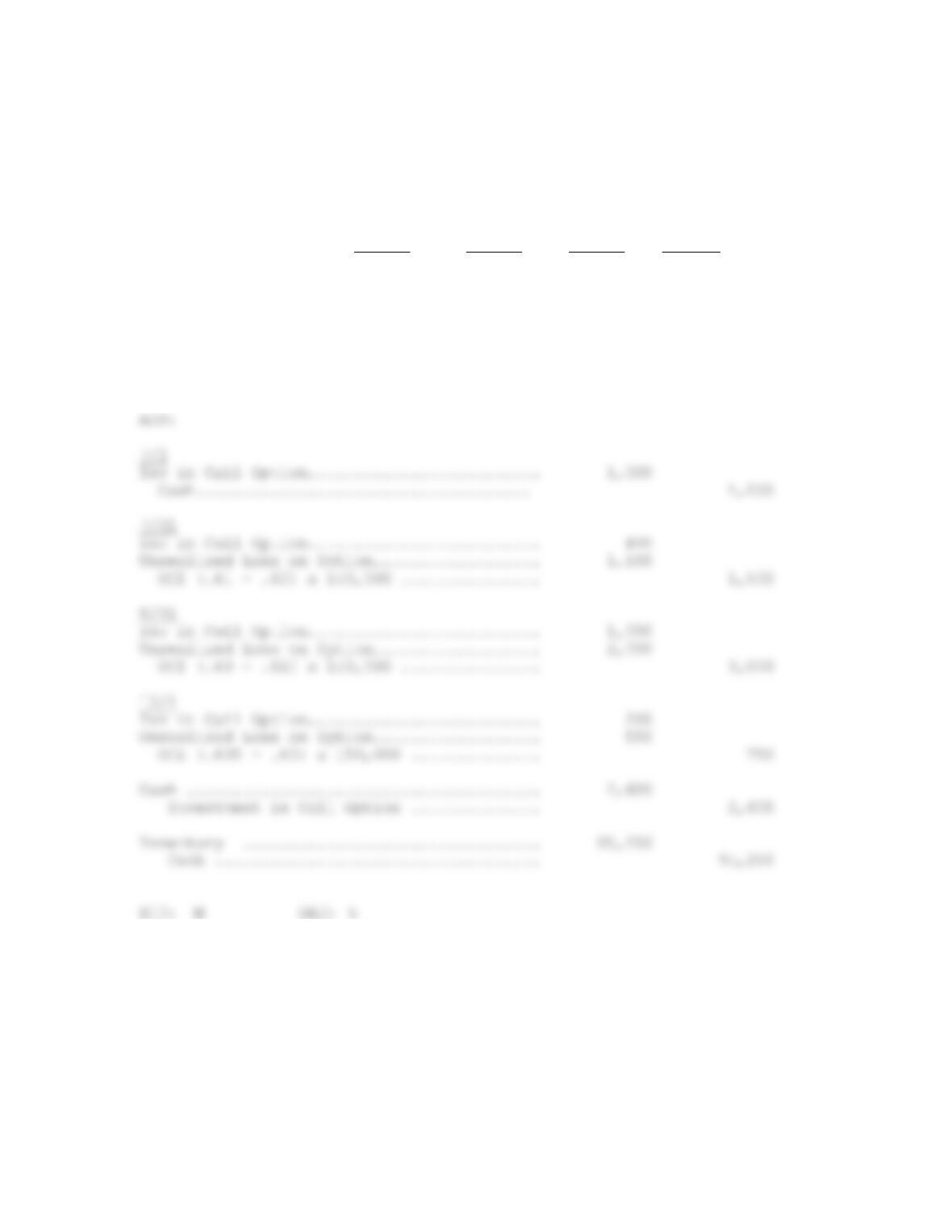
Required:
Prepare the journal entries for December 1 through January 31 related
to the events described above.
Chapter 6
Chapter 6
6-35
23. On 7/1, a company forecasts the purchase of 10,000 units of inventory
from a foreign vendor. The forecasted cost is estimated to be
150,000FC. It is estimated inventory will be delivered 11/1. Also, on
7/1, the company purchased a call option to buy 150,000 FC at a strike
price of $0.60 anytime during October. An option premium of $1,000.
7/1 7/31 8/31 10/1
Spot…………….. $0.58 $0.61 $0.63 $0.635
FV of Option……… $1,000 $1,400 $2,400 $2,600
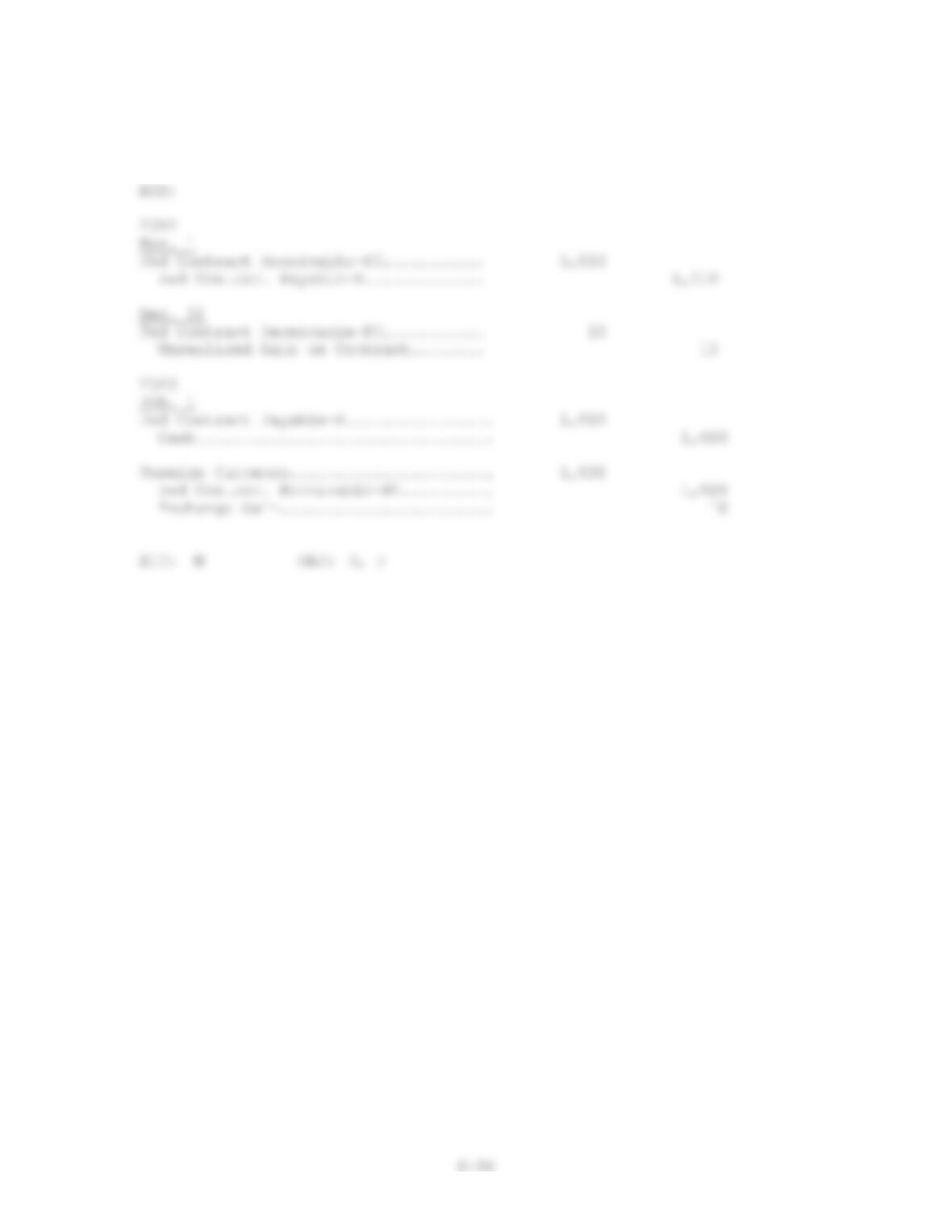
Required:
Prepare the journal entries required through 10/1:
24. On November 1, 20X2, a calendar-year investor purchased a 90–day
forward contract to buy 1,000 FCs at a forward rate of 1 FC = $1.01,
when the spot rate was 1 FC = $1.00. On December 31, 20X2, the forward
rate for a 30-day forward contract was 1 FC = $1.02. On February 1,
20X3, when the spot rate was 1 FC = $1.03, the investor paid the broker
and received the foreign currency.
Required:
Chapter 6
Prepare the entries necessary to record this information. Ignore the
present value calculations.