Exam
Name___________________________________
TRUE/FALSE. Write ‘T’ if the statement is true and ‘F’ if the statement is false.
1)
A forecast is an accurate estimate of future demand.
1)
2)
Lenders require pro forma statements because they want to make sure the business will generate
enough profit for the owner to get a large salary.
2)
3)
Lenders require pro forma statements because they want to make sure the business will generate
enough profit to pay back both the principal and interest on the loan.
3)
4)
There is a direct relationship between the forecast accuracy and time.
4)
5)
The longer the time horizon, the more accurate the forecast will be.
5)
6)
Once we select a forecasting model, changing market conditions may require us to change the
model if it no longer performs as desired.
6)
7)
Judgmental models are qualitative because they use expert opinion and previous experience to
determine the forecast.
7)
8)
Judgmental models are quantitative because they use expert opinion and previous experience to
determine the forecast.
8)
9)
Time Series models use previous experience to determine the forecast.
9)
10)
Time Series models use historical records that are readily available within the firm to predict future
sales.
10)
11)
Historical Analogy uses historical records that are readily available within the firm to predict
future sales.
11)
12)
In exponential smoothing, the value of alpha can be any whole number.
12)
13)
The formula for a regression line is y = a + bx.
13)
14)
A dependent variable is one that relies on the value of other variables for its value.
14)
15)
On a pro forma income statement, the value we enter for sales revenue is normally derived from
our forecast.
15)
16)
On a pro forma income statement, all values will increase by the same percentage as sales increase.
16)
17)
The start–up business has very little history.
17)
18)
The difference between an actual figure and a budgeted figure is known as a variance.
18)
19)
In the percentage of sales method of determining new financing, if the final number is positive we
do not require new financing.
19)
20)
The vast majority of entrepreneurs desire to go into a business where they already have some prior
experience.
20)
21)
One should only forecast the best–case scenario.
21)
22)
An increase in sales on the income statement will cause a buildup in assets.
22)
23)
Start–up expenses are those expenses that will be incurred by the business one time.
23)
24)
Operating margin often increases by an amount greater than the increase in sales.
24)
25)
One does not need to determine if the operating expenses are in line with industry averages.
25)
26)
An income statement is a cash flow statement.
26)
27)
In those months where cash inflows exceed cash outflows, we repay the lender the amount that
exceeds the minimum cash balance.
27)

28)
The pro forma cash budget projects future receipts and expenditures.
28)
MULTIPLE CHOICE. Choose the one alternative that best completes the statement or answers the question.
29)
A forecast is used to
29)
A)
help plan for the hiring of personnel.
B)
help plan for the purchase of equipment and machinery.
C)
determine the physical size of the plant.
D)
determine future sales and revenue.
E)
all of the above.
30)
Which of the following is NOT one of the six basic questions that a forecast must answer?
30)
A)
What is the time period of the forecast?
B)
How much time do I have to develop the forecast?
C)
How relevant is and what is the availability of historical data?
D)
How much profit will the firm be able to make?
E)
Who will be using the forecast?
31)
Which of the following statements about forecasting is FALSE?
31)
A)
The forecasting horizon should be at least as long as your strategic plan.
B)
The longer the time horizon the more inaccurate the forecast will be.
C)
The longer the time horizon the more accurate the forecast will be.
D)
There is an inverse relationship between forecast accuracy and time.
E)
Product life cycle influences the length of the forecast.
32)
Once we have a forecasting model, the specific units of measurement used in the model are
32)
A)
the same for every area of the business.
B)
expressed in units of production to determine future requirements for plant and equipment.
C)
expressed in job descriptions for human resource planners.
D)
expressed in units of production for long–range plans.
E)
All of the above are correct.
33)
When interest rates increase by one percent, housing starts will decrease by five percent. The
forecasting method that is used for this data is
33)
A)
cause and effect.
B)
qualitative.
C)
quantitative.
D)
expert opinion.
34)
Judgmental models include all of the following EXCEPT
34)
A)
historical analogy.
B)
moving average.
C)
market research.
D)
survey of customers.
E)
survey of sales forces.

35)
Which of the following is the most appropriate firm to use the survey of sales force?
35)
A)
Best Buy®
B)
Burger King®
C)
Kmart®
D)
IBM
E)
Ace Hardware®
36)
Which of the following is most appropriate firm to use the survey of customers?
36)
A)
Kmart®
B)
Ace Hardware®
C)
IBM
D)
Best Buy®
E)
all of the above
37)
The Bagel and Bean currently has six shops located in your city and they want to open a new shop.
When evaluating property for this shop, they will most likely use the ________ model.
37)
A)
Delphi Method
B)
Historical Analogy
C)
Market Research
D)
Survey of Customers
E)
Survey of Sales Forces
38)
A firm has just developed a unique new product that can easily be copied by a competitor. They
want to determine how many units to produce. The forecasting method they will most likely use is
the ________ model.
38)
A)
Delphi Method
B)
Historical Analogy
C)
Market Research
D)
Survey of Customers
E)
Survey of Sales Forces
39)
When you check out at your local appliance store, they ask you for your zip code before ringing up
your sale. This appliance store is most likely using the ________ model.
39)
A)
Historical Analogy
B)
Market Research
C)
Survey of Customers
D)
both A and B above
E)
both B and C above
40)
The forecasting model that uses a panel of experts who may not even know each other is the
________ model.
40)
A)
Delphi Method
B)
Historical Analogy
C)
Market Research
D)
Survey of Customers
E)
Survey of Sales Forces
41)
The forecasting model that uses the constant alpha as an adjustment is
41)
A)
exponential smoothing.
B)
historical analogy.
C)
mean absolute deviation.
D)
moving average.
E)
weighted moving average.
42)
The forecasting model that assumes previous time periods have an equal influence on future sales
is
42)
A)
exponential smoothing.
B)
historical analogy.
C)
mean absolute deviation.
D)
moving average.
E)
weighted moving average.
43)
The forecasting model that assumes previous time periods have some influence on future sales, but
the influence varies by time period, is
43)
A)
exponential smoothing.
B)
historical analogy.
C)
mean absolute deviation.
D)
moving average.
E)
weighted moving average.
44)
The forecasting model that is not a time series model is
44)
A)
exponential smoothing.
B)
historical analogy.
C)
mean absolute deviation.
D)
moving average.
E)
weighted moving average.
45)
The absolute value of any number is
45)
A)
positive.
B)
positive or negative.
C)
zero.
D)
negative.
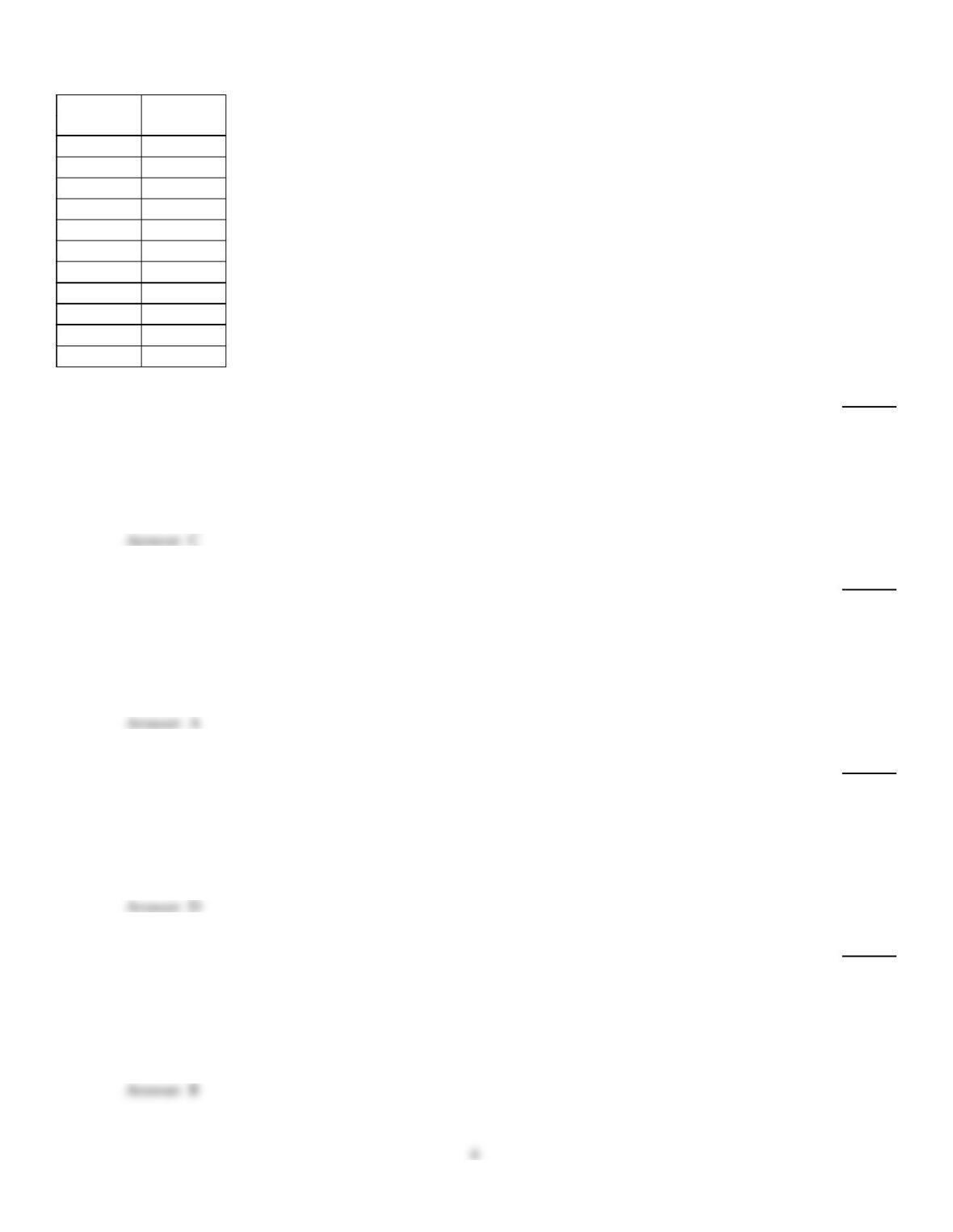
Table 6–1. Actual Sales Data
Time
Period Actual
Sales
1345
2378
3425
4450
5470
6500
7532
8548
9590
10 625
11 650
46)
Refer to Table 6–1. Using a three–month moving average, the forecast sales for periods 5 and 6 are
approximately
46)
A)
383 and 418.
B)
383 and 448.
C)
418 and 448.
D)
418 and 473.
E)
448 and 473.
47)
Refer to Table 6–1. Using a three–month moving average, the forecast sales for periods 4 and 5 are
approximately
47)
A)
383 and 418.
B)
383 and 448.
C)
418 and 448.
D)
418 and 473.
E)
448 and 473.
48)
Refer to Table 6–1. Using a three–month moving average, the forecast sales for periods 5 and 7 are
approximately
48)
A)
383 and 418.
B)
383 and 448.
C)
418 and 448.
D)
418 and 473.
E)
448 and 473.
49)
Refer to Table 6–1. Using a three–month moving average, the forecast sales for periods 4 and 6 are
approximately
49)
A)
383 and 418.
B)
383 and 448.
C)
418 and 448.
D)
418 and 473.
E)
448 and 473.
50)
Refer to Table 6–1. Using a weighted moving average with weights of 0.1, 0.3, and 0.6, the forecast
sales for periods 4 and 5 are approximately
50)
A)
363 and 399.
B)
383 and 418.
C)
403 and 435.
D)
418 and 448.
E)
435 and 460.
51)
Refer to Table 6–1. Using the exponential smoothing model with an of 0.2 and a smoothed
forecast for period 1 of 350, what is the forecast for period 4?
51)
A)
349
B)
355
C)
369
D)
385
E)
402
52)
Refer to Table 6–1. Using the exponential smoothing model with an of 0.2 and a smoothed
forecast for period 1 of 350, what is the forecast for period 2?
52)
A)
349
B)
355
C)
369
D)
385
E)
402
53)
Refer to Table 6–1. Using the exponential smoothing model with an of 0.2 and a smoothed
forecast for period 1 of 350, what is the forecast for period 3?
53)
A)
349
B)
355
C)
369
D)
385
E)
402
54)
The formula for a regression line is Y = a + bx. If your solution is Y = 15 + 4x, then the regression
line will move
54)
A)
up and to the left.
B)
down and to the right.
C)
up and to the right.
D)
down and to the left.
E)
Cannot tell with the information provided.
55)
The formula for a regression line is Y = a + bx. If your solution is Y = 15 – 4x, then the regression
line will move
55)
A)
up and to the left.
B)
down and to the right.
C)
down and to the left.
D)
up and to the right.
E)
Cannot tell with the information provided.
56)
The formula for a regression line is Y = a + bx. If your solution is Y = 15 + 4x and the value of x is 5,
then the value of a is
56)
A)
4.
B)
5.
C)
15.
D)
35.
57)
The formula for a regression line is Y = a + bx. If your solution is Y = 15 + 4x and the value of x is 5,
then the value of Y is
57)
A)
4.
B)
5.
C)
15.
D)
35.
7
Table 6–2.
Time
Period Actual
Sales
1230
2238
3260
4275
5300
6285
7270
8290
9305
10 320
11 335
12
58)
Refer to Table 6–2. The regression line formula for this set of numbers is
58)
A)
Y= 230 + 11x.
B)
Y= 228.66 + 230x.
C)
Y= 235 + 8.98x.
D)
Y= 8.98+ 228.66x.
E)
Y= 228.66 + 8.98x.
59)
With the regression function, the area of variation that represents changes due to general economic
factors that affect an industry is
59)
A)
trend line.
B)
cyclical.
C)
seasonal.
D)
economic.
E)
noise.
60)
With the regression function, the area of variation that represents general growth or decline within
an industry is
60)
A)
noise.
B)
economic.
C)
seasonal.
D)
trend line.
E)
cyclical.
61)
With the regression function, the area of variation that represents unexplained changes is
61)
A)
seasonal.
B)
noise.
C)
trend line.
D)
economic.
E)
cyclical.
62)
You have a current balance sheet with liabilities of $50,000 and assets of $75,000. You estimate that
you will have to purchase a new vehicle next year for $20,000. You believe you will be able to pay
20% down and can finance the remainder through your bank. If nothing else changes, your pro
forma balance sheet will show assets of ________ and liabilities of ________.
62)
A)
$95,000; $66,000
B)
$95,000; $70,000
C)
$91,000; $66,000
D)
$91,000; $54,000

63)
XYZ Company has assets that are traditionally 85% of sales, and its liabilities traditionally are 50%
of sales. Sales for this year are $50,000 and sales for next year are projected to be $150,000 with a
profit margin of 10%. No owner payout will be taken. Using the percentage of sales method, XYZ
will need ________ of additional financing.
63)
A)
$15,000
B)
$70,000
C)
$52,500
D)
$20,000
E)
No financing is required.
64)
XYZ Company has assets that are traditionally 80% of sales, and its liabilities traditionally are 30%
of sales. Sales for this year are $70,000 and sales for next year are projected to be $120,000 with a
profit margin of 6%. No owner payout will be taken. Using the percentage of sales method, XYZ
will need ________ of additional financing.
64)
A)
$7,200
B)
$25,000
C)
$17,800
D)
$30,000
E)
No financing is required.
65)
XYZ Company has assets that are traditionally 75% of sales, and its liabilities traditionally are 20%
of sales. Sales for this year are $100,000 and sales for next year are projected to be $200,000 with a
profit margin of 8%. The owners take a 60% payout. Using the percentage of sales method, XYZ
will need ________ of additional financing.
65)
A)
$70,000
B)
$68,400
C)
$48,600
D)
$50,000
E)
No new financing is required.
66)
Which of the following is a variable expense?
66)
A)
a utility bill
B)
a phone bill
C)
a security deposit
D)
sales commission
67)
Operating expenses can be separated into
67)
A)
expenses that increase as sales increase.
B)
expenses that do not increase with sales.
C)
mortgage and lease payments that increase with sales.
D)
all of the above.
68)
Which of the following is the correct sequence of events?
68)
A)
pro forma balance sheet, pro forma income statement, pro forma cash budget
B)
pro forma balance sheet, pro forma cash budget, pro forma income statement
C)
pro forma income statement, pro forma cash budget, pro forma balance sheet
D)
None of the above.
69)
Which of the following are reasons to generate a pro forma cash budget on a monthly basis?
69)
A)
Sales are recognized as income when the sale is made.
B)
A business can monitor the actual cash on hand.
C)
An income statement indicates a profit but the budget may indicate a loss.
D)
All of the above.
70)
Which of the following is a cash payment?
70)
A)
operating expenses
B)
labor costs
C)
inventory purchases
D)
all of the above
71)
Which of the following is an example of a profit center?
71)
A)
marketing
B)
research and development
C)
personnel
D)
none of the above
72)
Which of the following is the correct sequence of events in the percentage of sales method?
72)
A)
Find percentage of profit owner takes out of the business. Find assets as a percentage of sales
and multiply change in sales. Multiply forecasted sales by the historic profit margin. Find
liabilities as a percentage of sales and multiply change in sales.
B)
Find assets as a percentage of sales and multiply change in sales. Find liabilities as a
percentage of sales and multiply change in sales. Multiply forecasted sales by the historic
profit margin. Find percentage of profit owner takes out of the business.
C)
Find percentage of profit owner takes out of the business. Find assets as a percentage of sales
and multiply change in sales. Find liabilities as a percentage of sales and multiply change in
sales. Multiply forecasted sales by the historic profit margin.
D)
Multiply forecasted sales by the historic profit margin. Find assets as a percentage of sales and
multiply change in sales. Find liabilities as a percentage of sales and multiply change in sales.
Find percentage of profit owner takes out of the business.
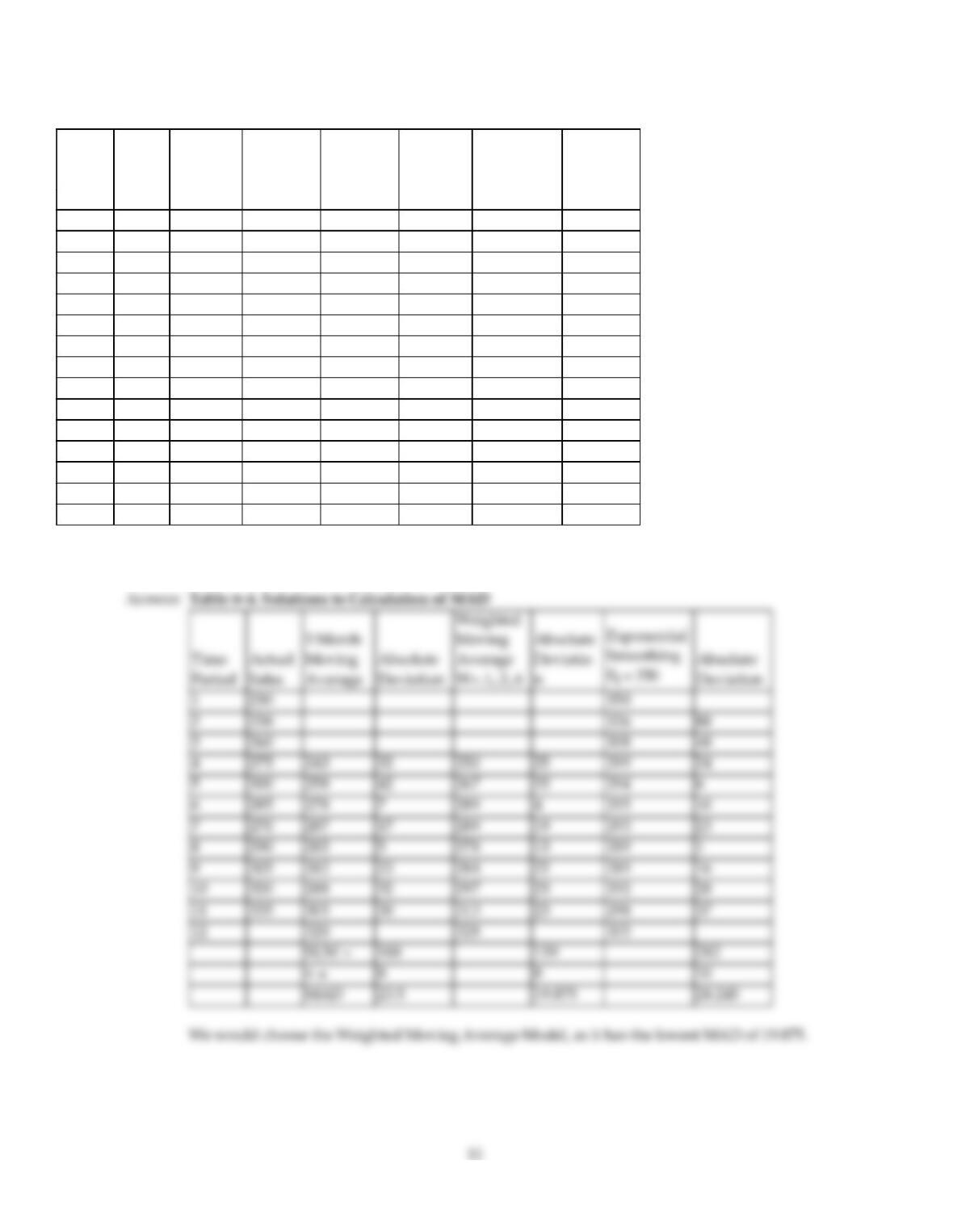
ESSAY. Write your answer in the space provided or on a separate sheet of paper.
Table 6–3. Calculation of MAD
Time
Period Actual
Sales
3 Month
Moving
Average Absolute
Deviation
Weighted
Moving
Average
W=.1,.3,.6 Absolute
Deviation
Exponential
Smoothing
Ft= 350 Absolute
Deviation
1230 350
2238 326
3260 308
4275 243 250 299
5300 258 267 294
6285 278 289 295
7270 287 289 293
8290 285 278 289
9305 282 284 289
10 320 288 297 292
11 335 305 313 298
12 320 328 305
SUM =
n=
MAD
73)
Refer to Table 6–3. Calculate MAD for all forecasting models. The model you would use for your forecast, based
on MAD is ________.