Larson_Calculus_10e ch06sec03
MULTIPLE CHOICE
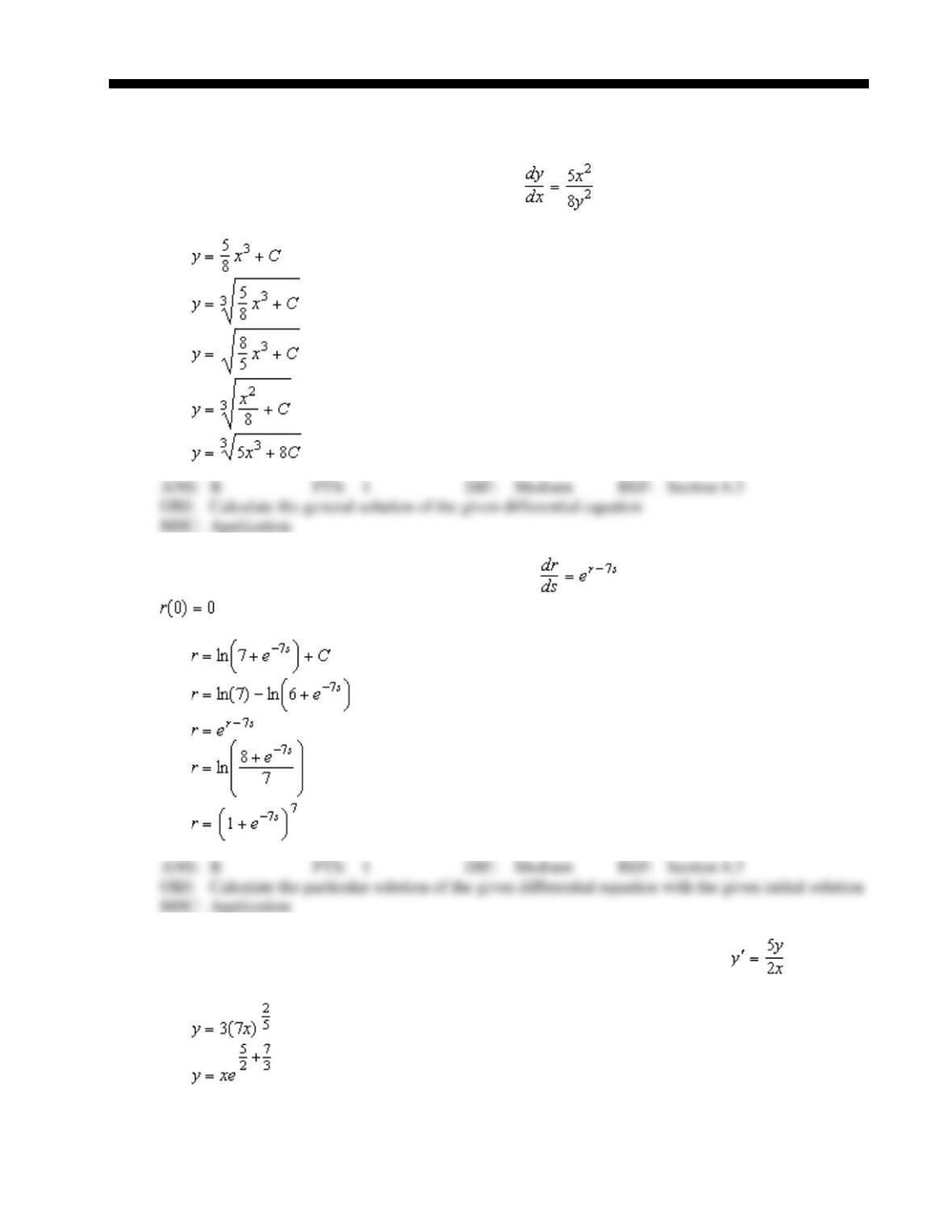
1. Find the general solution of the differential equation .
a.
b.
c.
d.
e.
2. Find the particular solution of the differential equation that satisfies the initial condition
.
a.
b.
c.
d.
e.
3. Find an equation of the graph that passes through the point (7, 3) and has the slope .
a.
b.
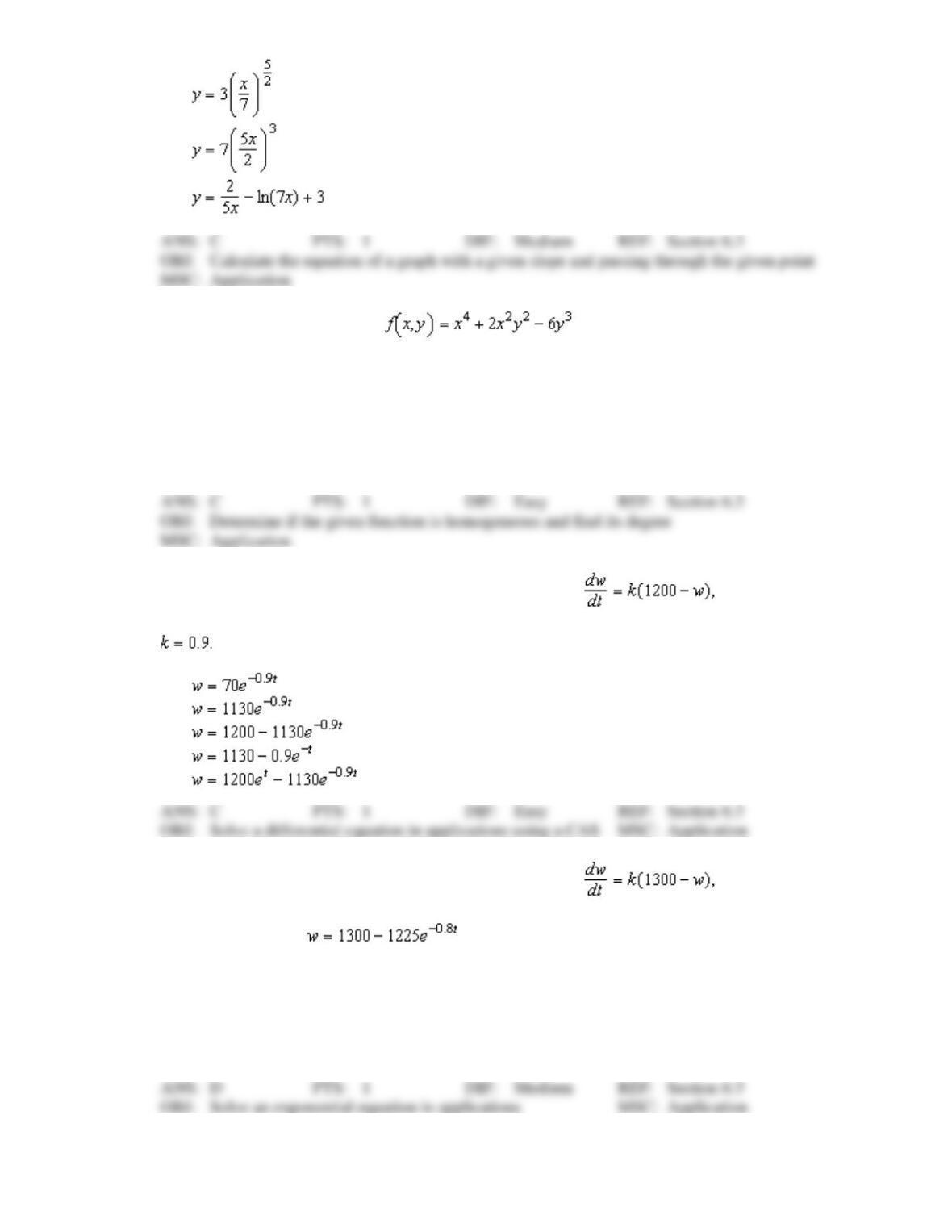
c.
d.
e.
4. Determine whether the function is homogeneous and determine its degree
if it is.
a.
homogeneous, the degree is 4
b.
homogeneous, the degree is 5
c.
not homogeneous
d.
homogeneous, the degree is 3
e.
homogeneous, the degree is 2
5. A calf that weighs 70 pounds at birth gains weight at the rate where w is weight in
pounds and t is time in years. Use a computer algebra system to solve the differential equation for
a.
b.
c.
d.
e.
6. A calf that weighs 75 pounds at birth gains weight at the rate where w is weight in
pounds and t is time in years. If the animal is sold when its weight reaches 750 pounds, find the time of
sale using the model . Round your answer to two decimal places.
a.
8.17 years
b.
2.88 years
c.
0.92 year
d.
1 year
e.
0.32 year
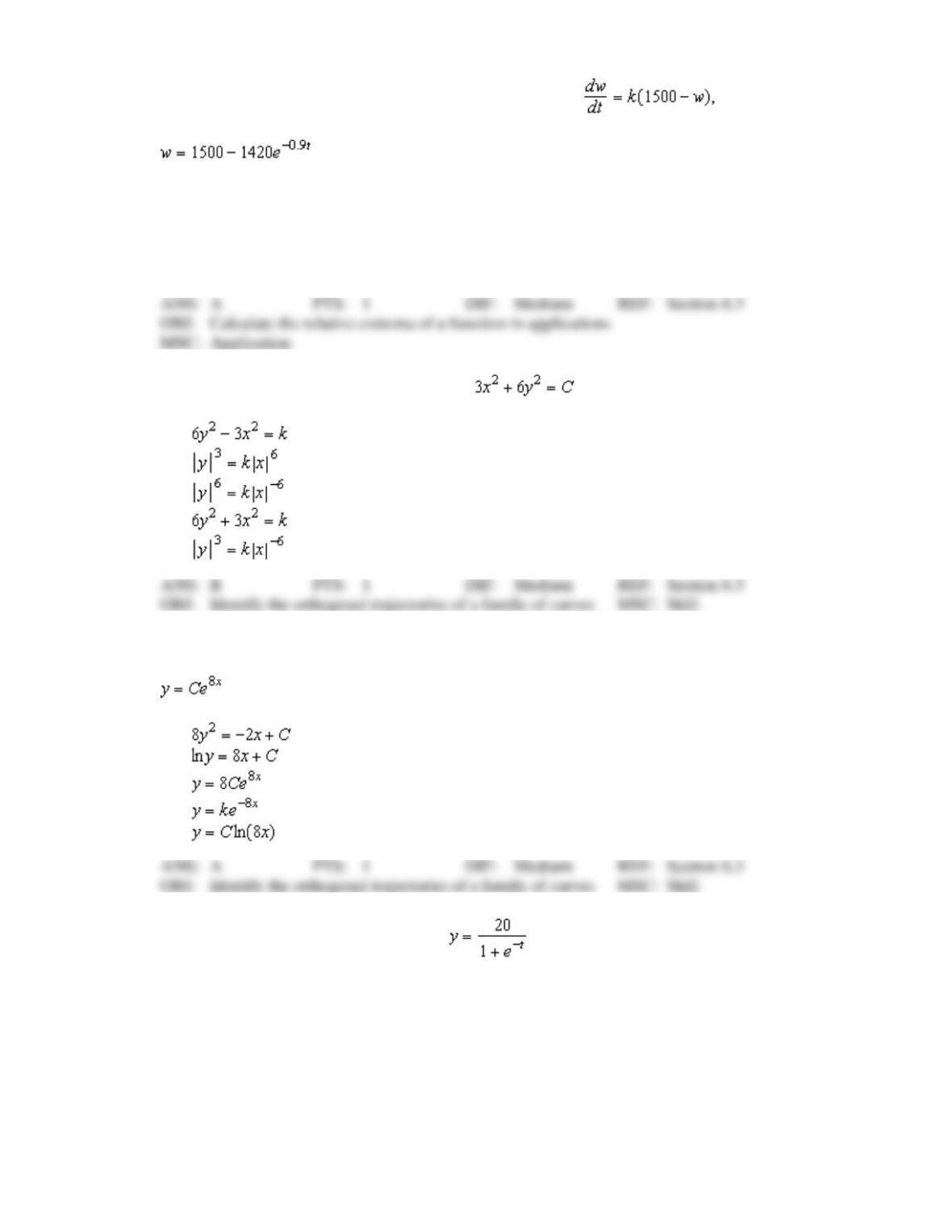
7. A calf that weighs 80 pounds at birth gains weight at the rate where w is weight in
pounds and t is time in years. What is the maximum weight of the animal if one uses the model
?
a.
1500 lb
b.
880 lb
c.
1420 lb
d.
1580 lb
e.
2300 lb
8. Find the orthogonal trajectories of the family .
a.
b.
c.
d.
e.
9. Find the orthogonal trajectories of the family
.
a.
b.
c.
d.
e.
10. Identify the graph of the logistic function .
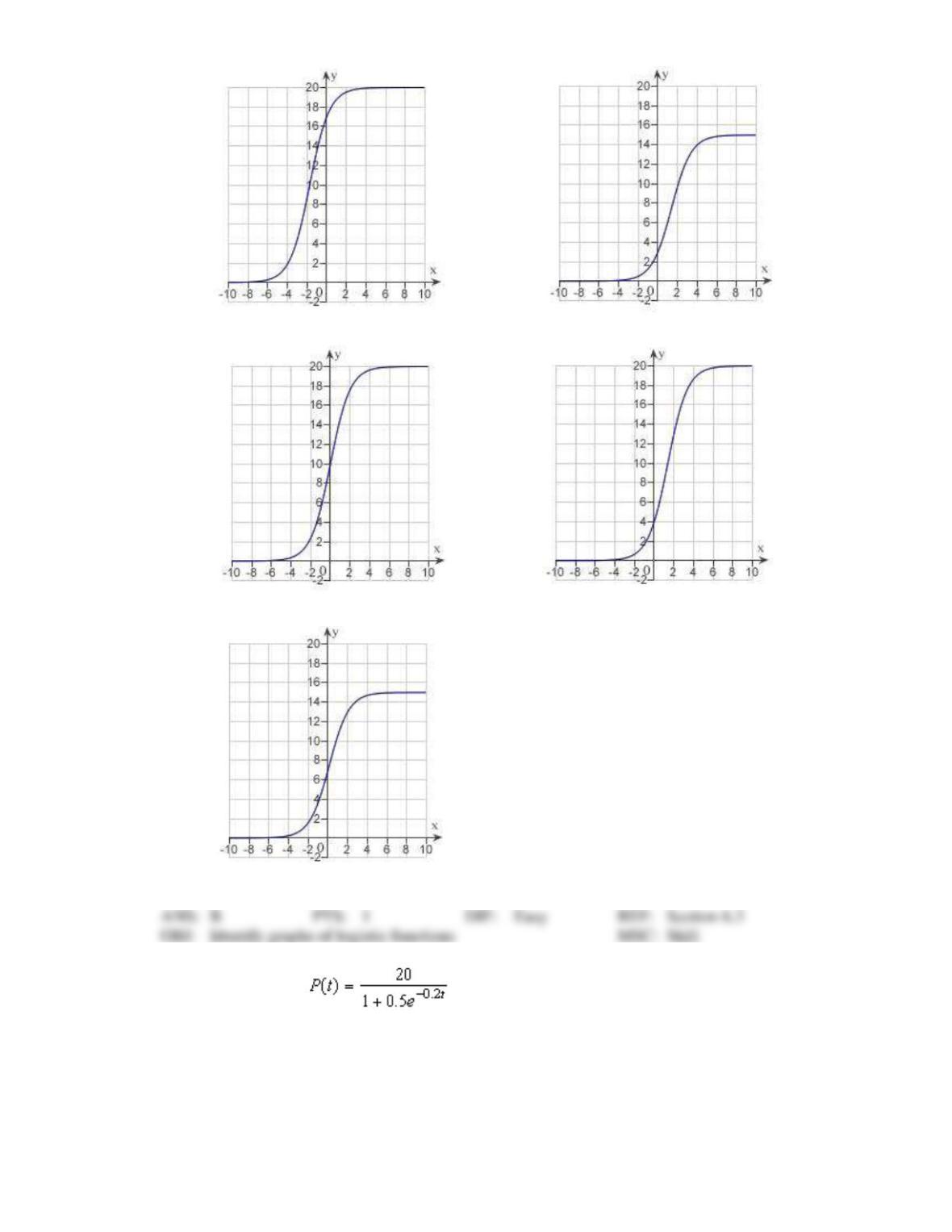
a.
d.
b.
e.
c.
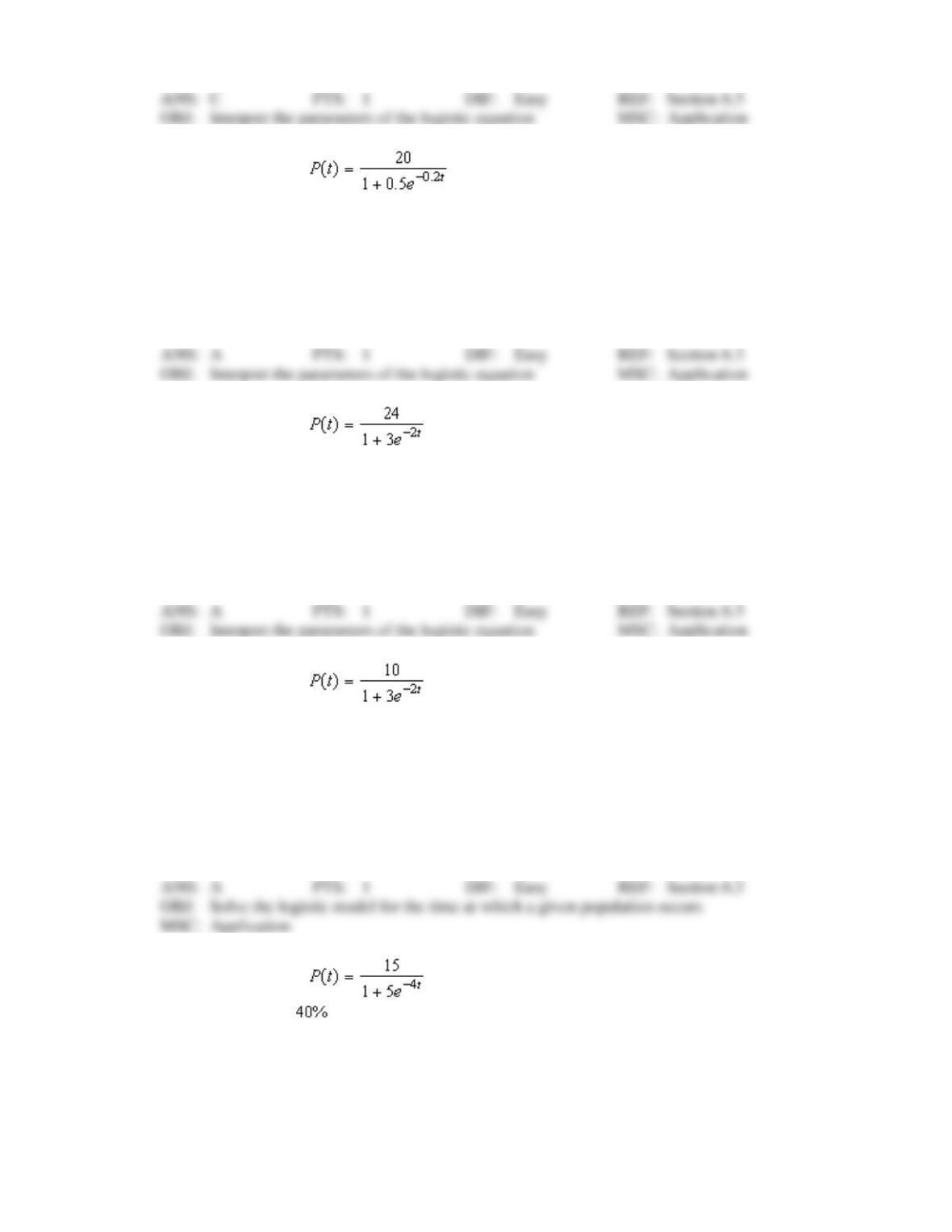
11. The logistic function models the growth of a population. Identify the value of k.
a.
1.7
b.
2.2
c.
0.2
d.
20
e.
0.5
12. The logistic function models the growth of a population. Identify the maximum
carrying capacity.
a.
20
b.
1.7
c.
0.5
d.
0.2
e.
2.2
13. The logistic function models the growth of a population. Identify the initial
population.
a.
6
b.
8
c.
3
d.
24
e.
2
14. The logistic function models the growth of a population. Determine when the
population reaches one-half of the maximum carrying capacity. Round your answer to three decimal
places.
a.
0.549
b.
3.333
c.
1.151
d.
5.000
e.
1.000
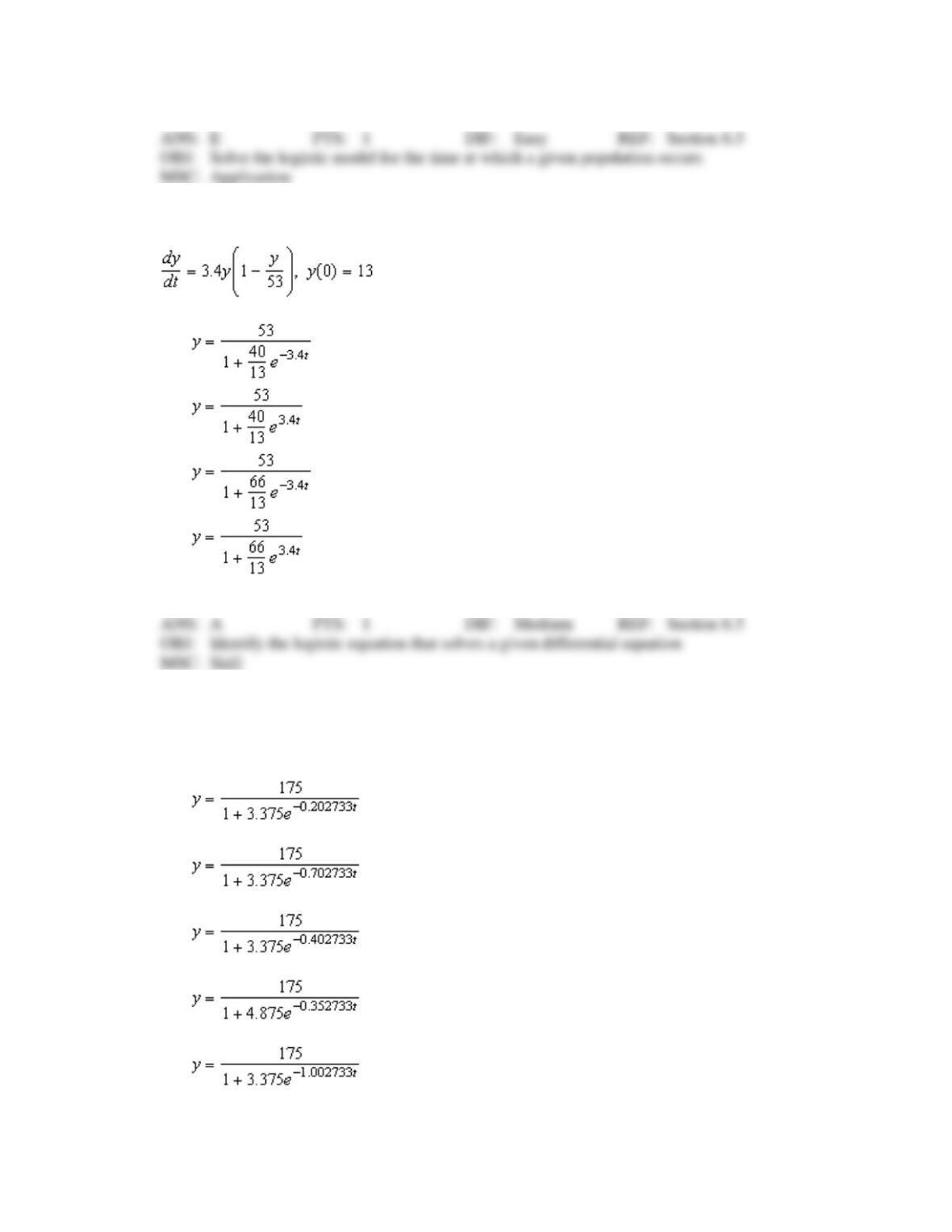
15. The logistic function models the growth of a population. Determine when the
population reaches of the maximum carrying capacity. Round your answer to three decimal
places.
a.
4.317
b.
3.000
c.
0.474
d.
0.677
e.
0.301
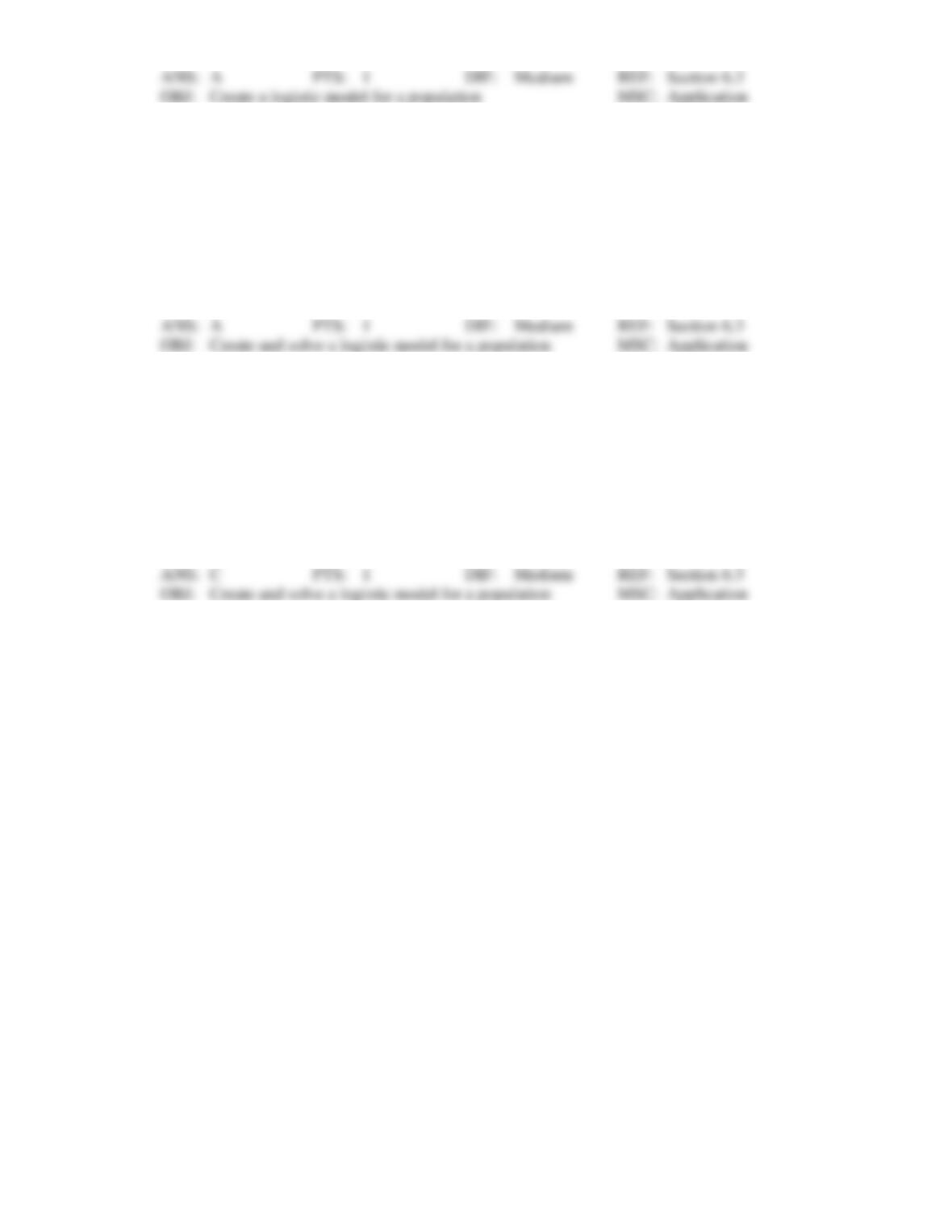
16. Find the logistic equation that satisfies the following differential equation and initial condition.
a.
b.
c.
d.
e.
none of the above
17. A conservation organization releases 40 coyotes into a preserve. After 4 years, there are 70 coyotes
in the preserve. The preserve has a carrying capacity of 175. Write a logistic function that
models the population of coyotes in the preserve.
a.
b.
c.
d.
e.
18. A conservation organization releases 50 foxes into a preserve. After 5 years, there are 85 foxes in the
preserve. The preserve has a carrying capacity of 225. Determine the population after 10 years.
Discard any fractional part of your answer.
a.
126
b.
118
c.
139
d.
131
e.
205
19. A conservation organization releases 30 panthers into a preserve. After 3 years, there are 50 panthers
in the preserve. The preserve has a carrying capacity of 150. Determine the time it takes for the
population to reach 110.
a.
13.139 years
b.
8.994 years
c.
10.378 years
d.
7.811 years
e.
12.003 years