Ch. 6 Exponential and Logarithmic Functions
6.1 Composite Functions
1 Form a Composite Function
MULTIPLE CHOICE. Choose the one alternative that best completes the statement or answers the question.
Evaluate the expression using the values given in the table.
1) (f∘g)(4)
x 1 7 10 12
f(x) –2 10 3 15
x –5
–2 1 4
g(x) 1 –7 7 10
A) 3 B) 10 C) 7 D) Undefined
2) (g∘f)(1)
x 1 4 9 12
f(x) –3 9 1 12
x –5
–3 1 3
g(x) 1 –8 4 9
A) –8B)4 C)
–3D)9
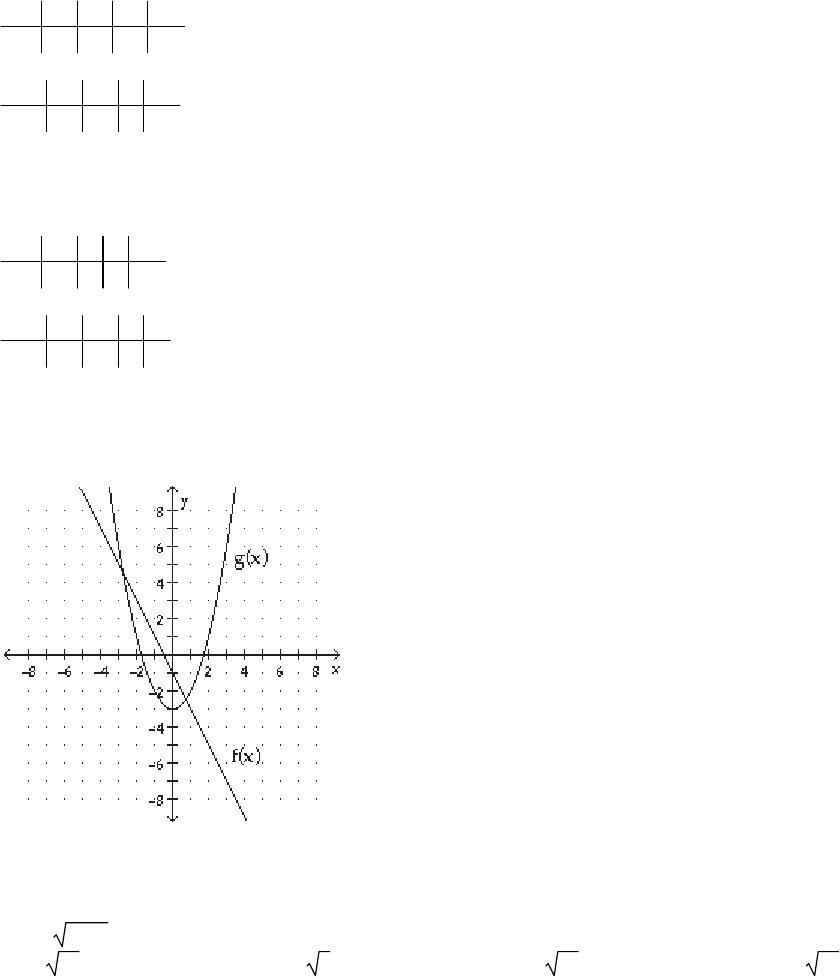
Evaluate the expression using the graphs of y =f(x) and y =g(x).
3) Evaluate (fg)(–2).
A) 3 B) 4 C) –3D)0
For the given functions f and g, find the requested composite function value.
4) f(x) = x
+ 4, g(x) = 2x; Find (f ∘ g)(3).
A) 10 B) 2 7 C) 14 D) 2 14
5) f(x) = 4x + 2, g(x) = 4x2 + 5; Find (g ∘ g)(4).
A) 19,049 B) 278 C) 1301 D) 74
Page 1

6) f(x) = 4x + 4, g(x) = 2x2 + 3; Find (f ∘ f)(0).
A) 20 B) 21 C) 16 D) 35
7) f(x) = 18x2 – 3x , g(x) = 7x – 3; Find (f ∘ g)(11).
A) 98,346 B) 15,012 C) 83,334 D) 158,730
8) f(x) = 4x + 7
,
g(x) = –1
/
x; Find (g ∘f)(3).
A) – 1
19 B) 17
3C) – 19
3D) 56
3
9) f(x) = x – 6
x, g(x) = x2 + 9; Find (g ∘ f)(–2).
A) 25 B) 13 C) 145
16 D) 7
13
10) f(x) = 4x + 2, g(x) = 2x2 + 1; Find (g ∘ f)(2).
A) 201 B) 42 C) 163 D) 38
11) f(x) = 18x2 – 4x, g(x) = 14x – 7; Find (f ∘ g)(2).
A) 7854 B) 889 C) 6965 D) 1344
12) f(t) = t
4 + 6t2 + 9, g(t) = t + 3
3; Find (f ∘ g)(3).
A) 7 B) 5 C) 49 D) 24
For the given functions f and g, find the requested composite function.
13) f(x) = 7x + 11
,
g(x) = 5x – 1; Find (f ∘g)(x).
A) 35x + 4 B) 35x +18 C) 35x +10 D) 35x +54
14) f(x) = –4x + 8
,
g(x) = 5x + 7; Find (g ∘f)(x).
A) –20x + 47 B) –20x +36 C) 20x +47 D) –20x –33
15) f(x) = 6
x – 3 , g(x) = 5
7x; Find (f ∘ g)(x).
A) 42x
5 – 21x B) 5x –15
42x C) 42x
5 + 21x D) 6x
5 – 21x
16) f(x) = x – 7
2, g(x) = 2x + 7; Find (g ∘ f)(x).
A) x B) 2x +7C)x
+14 D) x – 7
2
17) f(x) = 6
x – 3 , g(x) = 5
6x; Find (f ∘ g)(x).
A) 36x
5 – 18x B) 5x –15
36x C) 36x
5 + 18x D) 6x
5 – 18x
Page 2
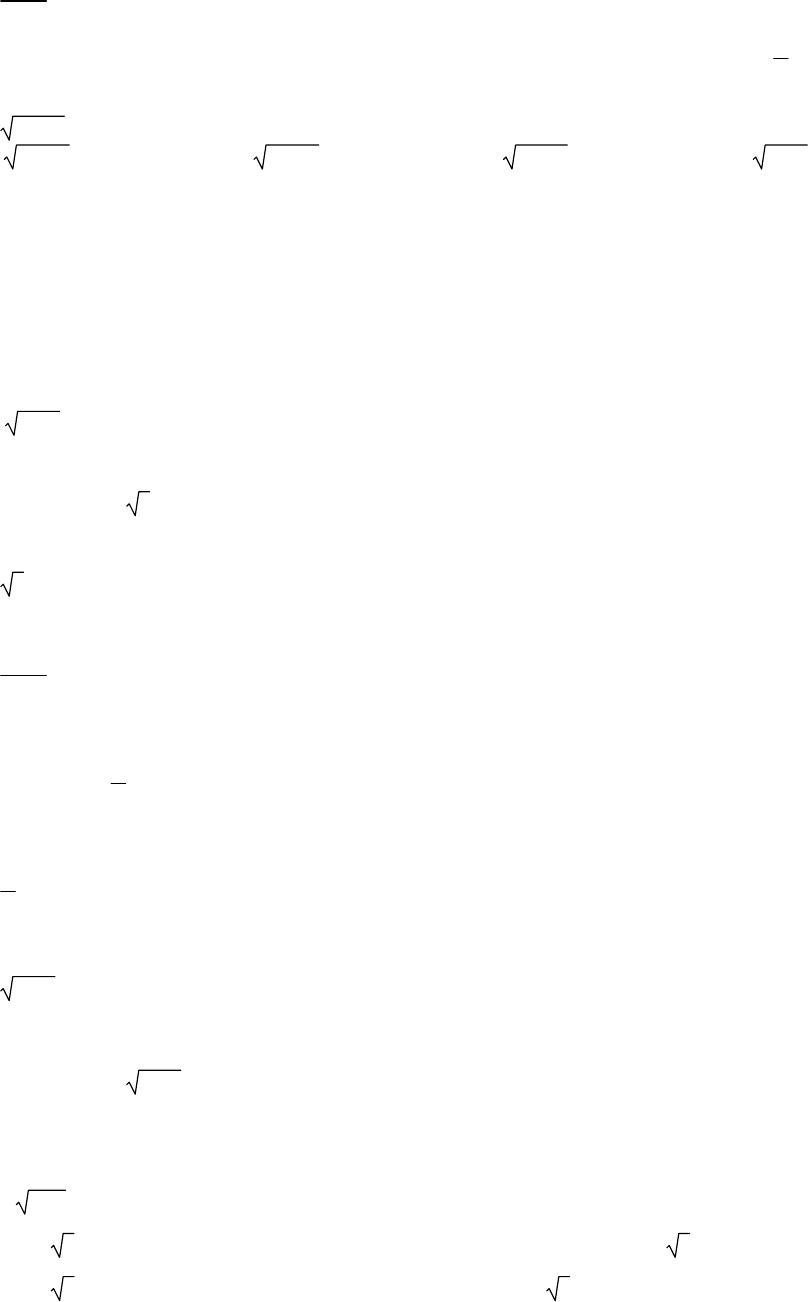
18) f(x) = x – 8
7, g(x) = 7x + 8; Find (g ∘ f)(x).
A) x B) 7x +48 C) x +16 D) x – 8
7
19) f(x) = x
+ 10, g(x) = 8x – 14; Find (f ∘ g)(x).
A) 2 2x – 1 B) 2 2x + 1 C) 8 x + 10 – 14 D) 8 x – 4
20) f(x) = 4x2 + 2x + 3, g(x) = 2x – 4; Find (g ∘ f)(x).
A) 8x2 + 4x + 2B)8x
2 + 4x + 10 C) 4x2 + 4x + 2D)4x
2 + 2x – 1
21) f(x) = x2 – 5, g(x) = x2 – 8; Find (f ∘ g)(x).
A) x4 – 16x2 + 59 B) x4 – 10x2 + 17 C) x4 + 59 D) x4 + 17
Decide whether the composite functions, f ∘ g and g ∘f, are equal to x.
22) f(x) = 5x – 8 , g(x) = x5 + 8
A) Yes, yes B) No, no C) No, yes D) Yes, no
23) f(x) = x2 + 4 , g(x) = x
– 4
A) No, no B) No, yes C) Yes, no D) Yes, yes
24) f(x) = x
, g(x) = x2
A) Yes, yes B) No, no C) No, yes D) Yes, no
25) f(x) = x + 6
3, g(x) = 3x – 6
A) Yes, yes B) No, no C) Yes, no D) No, yes
26) f(x) = 4x, g(x) = x
4
A) Yes, yes B) No, no C) Yes, no D) No, yes
27) f(x) = 1
x, g(x) = x
A) No, no B) No, yes C) Yes, no D) Yes, yes
28) f(x) = x
+ 1 , g(x) = x2
A) No, no B) No, yes C) Yes, no D) Yes, yes
29) f(x) = x3 + 6, g(x) = 3x – 6
A) Yes, yes B) No, no C) No, yes D) Yes, no
Find functions f and g so that f ∘ g = H.
30) H(x) = 3x +1
A) f(x) = 3x ; g(x) = x + 1 B) f(x) = x + 1 ; g(x) = 3x
C) f(x) = 3x ; g(x) = 1 D) f(x) = x ; g(x) = x + 1
Page 3
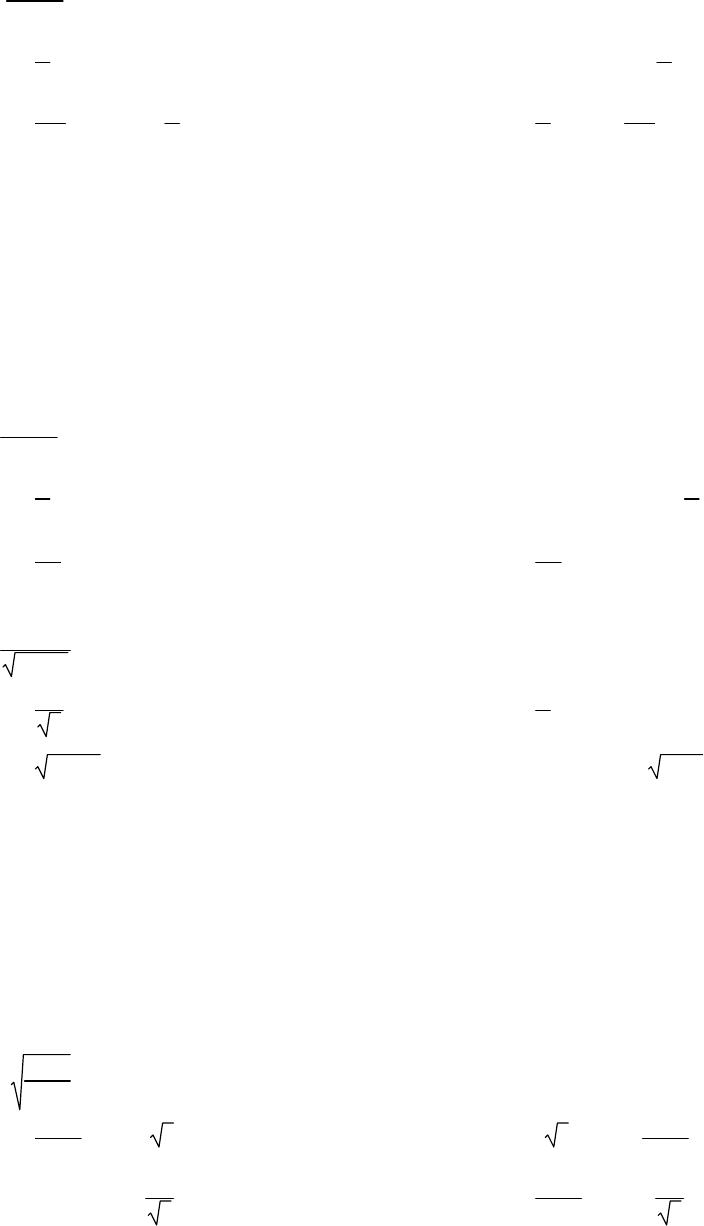
31) H(x) = 1
x2 – 9
A) f(x) = 1
x, g(x) = x2 – 9 B) f(x) = x2 – 9; g(x) = 1
x
C) f(x) = 1
x2 – 9; g(x) = 1
xD) f(x) = 1
x; g(x) = 1
x2 – 9
32) H(x) = ∣4x + 10∣
A) f(x) = ∣x∣; g(x)
=4x + 10 B) f(x) = –∣x∣; g(x)
= 4x + 10
C) f(x) = ∣–x∣; g(x)
=4x – 10 D) f(x) =x; g(x)
= 4x + 10
33) H(x) = (5 – 2x3)2
A) f(x) = x2 ; g(x) = 5 – 2x3B) f(x) = 5 – 2x3 ; g(x) = x2
C) f(x) = (5 – 2x)3 ; g(x) = x2D) f(x) = x3 ; g(x) = (5 – 2x)2
34) H(x) = 1
x2 – 5
A) f(x) = 1
x; g(x)
= x2 – 5 B) f(x) = x2 – 5; g(x) = 1
x
C) f(x) = 1
x2; g(x)
= – 1/5 D) f(x) = 1
x2; g(x)
= x – 5
35) H(x) = 9
2x + 5
A) f(x) = 9
x; g(x)
= 2x + 5 B) f(x) = 9
x; g(x)
= 2x + 5
C) f(x) = 2x
+ 5; g(x)
= 9 D) f(x) = 9; g(x) = 2
+ 5
36) H(x) = |4 – 3x2|
A) f(x) = |x|; g(x) = 4 – 3x2B) f(x) = 4 – 3x2 ; g(x) = |x|
C) f(x) = 4 – 3|x|; g(x) = x2D) f(x) = x2 ; g(x) = 4 – 3|x|
37) H(x) = ∣7x + 8∣
A) f(x) = ∣x∣; g(x)
=7x + 8 B) f(x) = –∣x∣; g(x)
= 7x + 8
C) f(x) = ∣–x∣; g(x)
=7x – 8 D) f(x) =x; g(x)
= 7x + 8
38) H(x) = 1
x – 9
A) f(x) = 1
x – 9 ; g(x) = x B) g(x) = x ; f(x) = 1
x – 9
C) f(x) = x – 9; g(x) = 1
xD) f(x) = 1
x – 9 ; g(x) = 1
x
Page 4
Solve the problem.
39) The population P of a predator mammal depends upon the number x of a smaller animal that is its
primary food source. The population s of the smaller animal depends upon the amount a of a certain plant
that is its primary food source. If P(x) = 3x2 + 4 and s(a) = 2a + 4, what is the relationship between the
predator mammal and the plant food source?
A) P(s(a)) = 12a2 + 48a + 52 B) P(s(a)) = 4a2 + 16a + 20
C) P(s(a)) = 12a2 + 24a + 52 D) P(s(a)) =6a +8
40) An oil well off the Gulf Coast is leaking, with the leak spreading oil over the surface of the gulf as a circle.
At any time t, in minutes, after the beginning of the leak, the radius of the oil slick on the surface is
r(t) = 4t ft. Find the area A of the oil slick as a function of time.
A) A(r(t)) = 16πt2B) A(r(t)) = 4πt2C) A(r(t)) = 16t2D) A(r(t)) =16πt
41) An airline charter service charges a fare per person of $200 plus $30 for each unsold seat. The airplane
holds 100 passengers. Let x represent the number of unsold seats and write an expression for the total
revenue R for a charter flight.
A) R(x) = (100 – x)(200 + 30x) or 20,000 + 2800x – 30x2
B) R(x) = 100(200 + 30x) or 20,000 +3000x
C) R(x) = (100 – x)(200 + 30x) or 20,000 + 3000x – 30x2
D) R(x) = x(200 + 30x) or 200x + 30x2
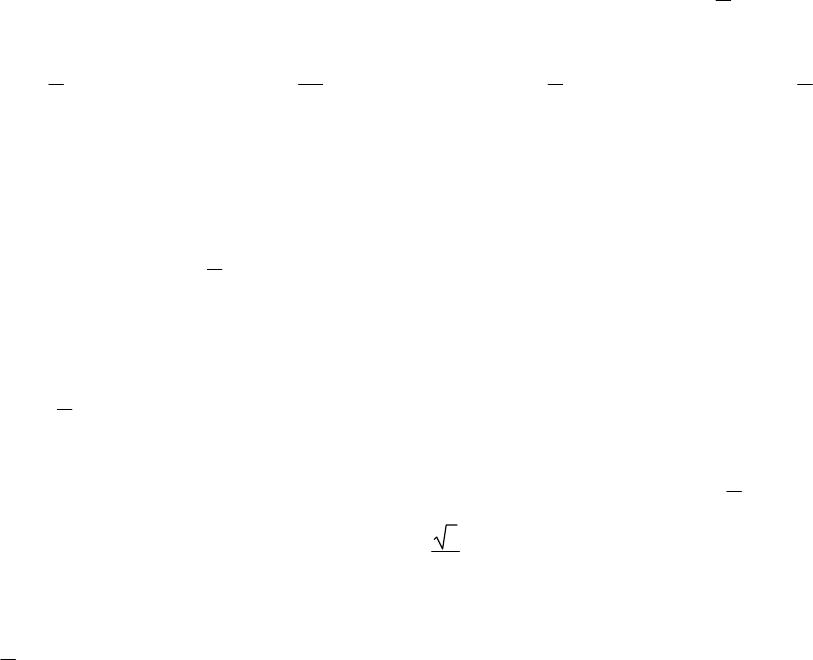
42) The surface area of a balloon is given by S(r) = 4πr2, where r is the radius of the balloon. If the radius is
increasing with time t, as the balloon is being blown up, according to the formula r(t) = 3
4t3, t ≥ 0, find the
surface area S as a function of the time t.
A) S(r(t)) = 9
4
πt6B) S(r(t)) = 9
16
πt6C) S(r(t)) = 9
4
πt3D) S(r(t)) = 9
4
πt9
SHORT ANSWER. Write the word or phrase that best completes each statement or answers the question.
43) The surface area S (in square inches) of a cylindrical pipe with length 12 inches is given by S(r) = 2πr2 + 24
πr, where r is the radius of the piston (in inches). If the radius is increasing with time t (in minutes)
according to the formula r(t) = 1
6t2, t ≥ 0, find the surface area S of the pipe as a function of the time t.
44) The volume V (in cubic inches) of a cylindrical pipe with length 12 inches is given by V(r) = 12πr2, where r
is the radius of the piston (in inches). If the radius is increasing with time t (in minutes) according to the
formula r(t) = 1
6t2, t ≥ 0, find the volume V of the pipe as a function of the time t.
45) The price p of a certain product and the quantity sold x obey the demand equation p = – 2
3x + 200, 0 ≤ x ≤
300. Suppose that the cost C of producing x units is C = x
20 + 800. Assuming that all items produced are
sold, find the cost C as a function of the price p.
46) If f(x) = 1
2x2 + 4 and g(x) = 2x – a, find a so that the graph of f ∘ g crosses the y–axis at 36.
Page 5
2 Find the Domain of a Composite Function
MULTIPLE CHOICE. Choose the one alternative that best completes the statement or answers the question.
Find the domain of the composite function f ∘g.
1) f(x) = 5x + 30; g(x) = x + 10
A) {x x is any real number} B) {x x
≠–16}
C) {x x
≠ 16} D) {x x
≠–10
,
x ≠–6}
2) f(x) = 10
x + 10; g(x) = x + 6
A) {x x
≠ –16} B) {x x
≠–10}
C) {x x
≠ –10
,
x ≠ –6} D) {x x is any real number}
3) f(x) = x + 3; g(x) = 1
x + 4
A) {x x
≠ –4} B) {x x
≠–7}
C) {x x
≠ –4
,
x ≠ –3} D) {x x is any real number}
4) f(x) = –9
x – 9 ; g(x) = –45
x
A) {x x
≠ 0, x ≠ –5} B) {x x
≠0, x ≠9}
C) {x x
≠ 0, x ≠ 9
,
x ≠ –5} D) {x x is any real number}
5) f(x) = 48
x; g(x) = 9
x – 6
A) {x x
≠ 6} B) {x x
≠6
,
x ≠0}
C) {x x
≠ 0, x ≠ 6
,
x ≠ 8} D) {x x is any real number}
6) f(x) = x
x + 7 ; g(x) = 14
x + 4
A) {x x
≠ –4
,
x ≠ –6} B) {x x
≠–4
,
x ≠–7}
C) {x x
≠ 0, x ≠ –4
,
x ≠ –6} D) {x x is any real number}
7) f(x) = x; g(x) = 3x + 18
A) {x x
≥ –6} B) {x x
≥0}
C) {x x
≤ –6 or x ≥ 0} D) {x x is any real number}
8) f(x) = 6x + 12; g(x) = x
A) {x x
≥ 0} B) {x x
≥–2}
C) {x x
≤ –2 or x ≥ 0} D) {x x is any real number}
9) f(x) = x
– 3; g(x) = 3
x – 10
A) {x 10
<
x ≤ 11} B) {x x
≥3
,
x ≠10}
C) {x x
≠ 10
,
x ≠ 3} D) {x x is any real number}
10) f(x) = 1
x – 9 ; g(x) = x
– 1
A) {x x
≥ 1
,
x ≠ 82} B) {x x
≥1
,
x ≠9}
C) {x x
≥ 1
,
x ≠ 9
,
x ≠ 82} D) {x x is any real number}
Page 6
11) f(x) = 2
– x; g(x) = 2x
– 1
A) x| – 1
2 ≤ x ≤ 3
2B) all real numbers C) {x| x ≥2} D) {x | x ≤2}
SHORT ANSWER. Write the word or phrase that best completes each statement or answers the question.
Solve the problem.
12) If f(x) = x2 and g(x) = –1 + 5x, find (f ∘g)(x) and find the domain of (f ∘ g)(x).
6.2 One–to–One Functions; Inverse Functions
1 Determine Whether a Function Is One–to–One
MULTIPLE CHOICE. Choose the one alternative that best completes the statement or answers the question.
Determine whether the function is one–to–one.
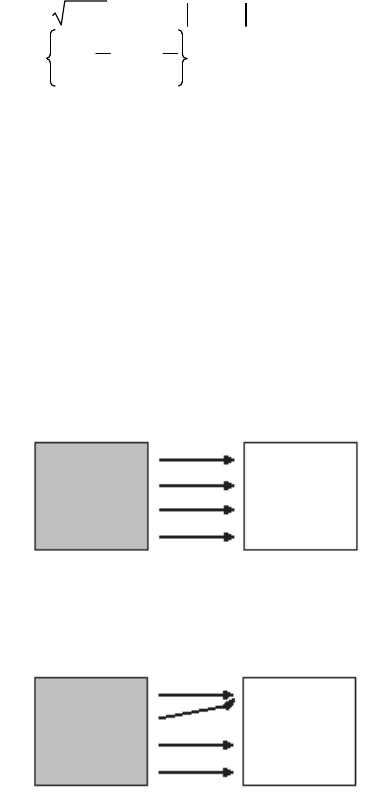
1)
Domain Range
10 years
15 years
20 years
30 years
$1000
$4000
$8000
$13,000
A) One–to–one B) Not one–to–one
2)
Domain Range
15 years
20 years
25 years
35 years
$1000
$8000
$12,000
A) One–to–one B) Not one–to–one
Indicate whether the function is one–to–one.
3) {(18
,
–13), (–2
,
19), (–8
,
–8)}
A) Yes B) No
4) {(–15
,
6), (–17
,
6), (7
,
10)}
A) Yes B) No
5) {(1
,
8), (2
,
8), (3
,
–5), (4
,
–1)}
A) Yes B) No
6) {(6
,
–2), (12
,
–1), (10
,
0), (8
,
1)}
A) Yes B) No
7) {(–5
,
–8), (8
,
5), (1
,
6), (–1
,
–6)}
A) Yes B) No
Page 7
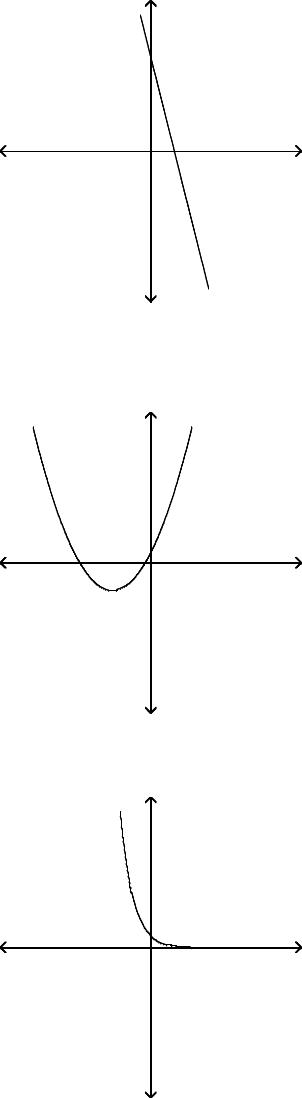
Use the horizontal line test to determine whether the function is one–to–one.
8)
x
y
x
y
A) Yes B) No
9)
x
y
x
y
A) Yes B) No
10)
x
y
x
y
A) Yes B) No
Page 8
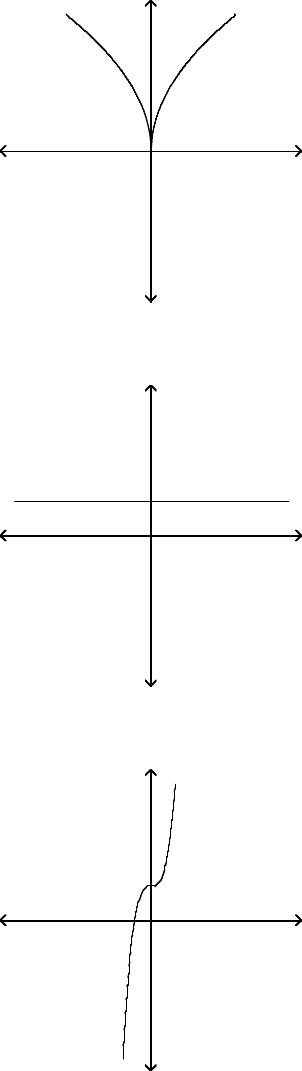
11)
x
y
x
y
A) Yes B) No
12)
x
y
x
y
A) Yes B) No
13)
x
y
x
y
A) Yes B) No
Page 9
2 Determine the Inverse of a Function Defined by a Map or a Set of Ordered Pairs
MULTIPLE CHOICE. Choose the one alternative that best completes the statement or answers the question.
Find the inverse of the function and state its domain and range .
1)
Time at Job Bonus
5 years
10 years
15 years
25 years
$1000
$6000
$8000
$15,000
A)
Bonus Time at Job
$1000
$6000
$8000
$15,000
5 years
10 years
15 years
25 years
D: {1000, 6000, 8000, 15,000}
R: {5, 10, 15, 25}
B)
Bonus Time at Job
$1000
$6000
$8000
$15,000
5 years
10 years
15 years
25 years
D: {5, 10, 15, 25}
R: 1000 6000, 8000, 15,000}
C)
Bonus Time at Job
$1000
$6000
$8000
$15,000
5 years
10 years
15 years
25 years
D: {1000, 15,000}
R: {5, 25}
D)
Bonus Time at Job
$1000
$6000
$8000
$15,000
5 years
10 years
15 years
25 years
D: {1000}
R: {5}
Page 10
2)
Age Group Ticket Price
Child
Adult
Student
Senior
$5.00
$9.00
$7.00
$6.50
A)
Ticket Price Age Group
$5.00
$9.00
$7.00
$6.50
Child
Adult
Student
Senior
D: {5.00, 9.00, 7.00, 6.50}
R: {Child, Adult, Student, Senior}
B)
Ticket Price Age Group
$5.00
$9.00
$7.00
$6.50
Child
Adult
Student
Senior
D: {Child, Adult, Student, Senior}
R: {5.00, 9.00, 7.00, 6.50}
C)
Ticket Price Age Group
$5.00
$9.00
$7.00
$6.50
Child
Adult
Student
Senior
D: {5.00, 6.50}
R: {Child, Senior}
D)
Ticket Price Age Group
$5.00
$9.00
$7.00
$6.50
Child
Adult
Student
Senior
D: {6.50}
R: {Senior}
3) {(1
,
–8), (–1
,
–7), (–3
,
–6), (–5
,
–5)}
A) {(–8
,
1), (–7
,
–1), (–6
,
–3), (–5
,
–5)}; D ={–8
,
–7
,
–6
,
–5 }; R ={1
,
–1
,
–3
,
–5}
B) 1, – 1
8, –1, – 1
7, –3, – 1
6, –5, – 1
5; D = { 1, –1, –3, –5}, R = – 1
8,– 1
7, – 1
6, – 1
5
C) {(–7
,
–8), (–8
,
–3), (1
,
–1), (–7
,
–6)}; D ={(–7
,
–8
,
1}; R ={(–8
,
–3–1
,
–6}
D) {(–7
,
–8), (–5
,
–3), (1
,
–3), (–7
,
–6)}; D ={–7
,
–5
,
1}; R ={–8
,
–3
,
–6}
4) {(3
,
–7), (7
,
–3), (–4
,
3), (4
,
–3)}
A) {(–7
,
3), (–3
,
7), (3
,
–4), (–3
,
4)} D ={–7
,
–3
,
3
,
–3}; R ={3
,
7
,
–4
,
4}
B) 3, – 1
7, 7,
– 1
3, –4, 1
3, 4,
– 1
3 D = { 3, 7, –4, 4}, R = – 1
7, – 1
3, 1
3, – 1
3
C) {(–3
,
–4), (–4
,
7), (–7
,
3), (3
,
4)}; D ={–3
,
–4
,
–7
,
3}; R ={–4
,
7
,
3
,
4}
D) {(–3
,
–4), (–3
,
7), (–7
,
7), (3
,
4)}; D ={(–3
,
–3
,
–7
,
3}; R ={–4
,
7
,
4}
5) {(–3, 4), (–1, 5), (0, 2), (2, 6), (5, 7)}
A) {(4, –3), (5, –1), (2, 0), (6, 2), (7, 5)} D ={2, 4, 5, 6, 7}; R ={–3, –1, 0, 2, 5}
B) {(3, 4), (1, 5), (0, 2), (–2, 6), (–5, 7)}; D ={3, 1, 0, –2, –5}; R ={2, 4, 5, 6, 7}
C) {(–3, –4), (–1, –5), (0, –2), (2, –6), (5, –7)}; D ={–3, –1, 0, 2, 5}; R ={–7, –6, –5, –4, –2}
D) {(3, –4), (1, –5), (0, –2), (–2, –6), (–5, –7)}; D ={3, 1, 0, –2, –5}; R ={–7, –6, –5, –4, –2}
Page 11
3 Obtain the Graph of the Inverse Function from the Graph of the Function
MULTIPLE CHOICE. Choose the one alternative that best completes the statement or answers the question.
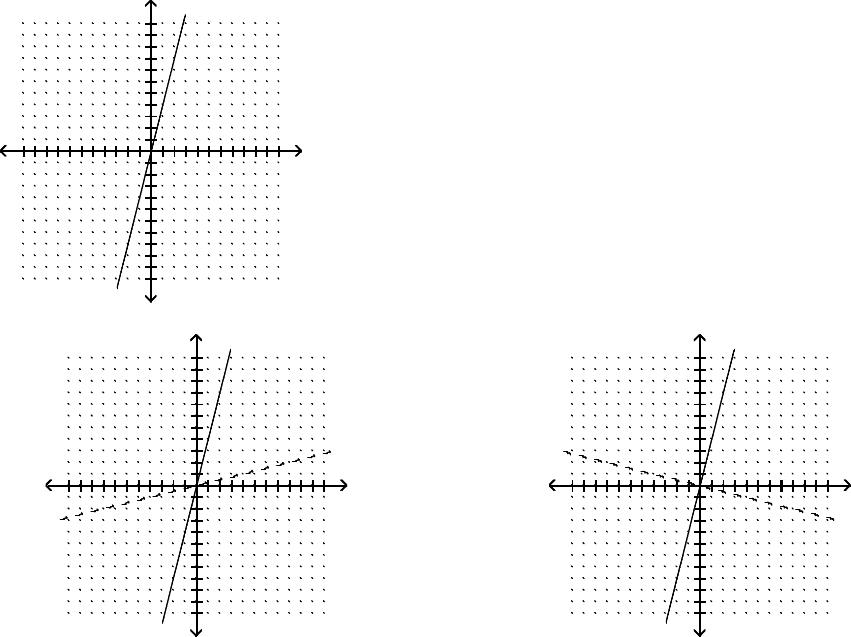
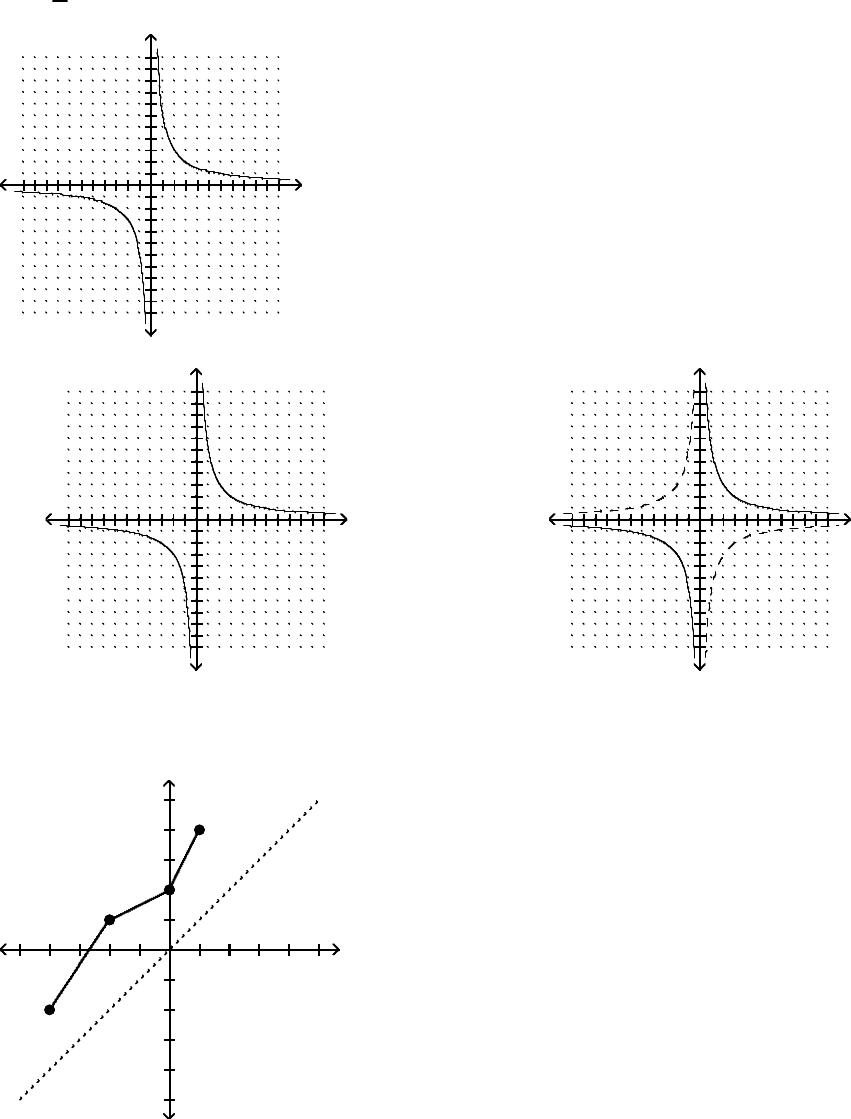
The graph of a one–to–one function f is given. Draw the graph of the inverse function f–1 as a dashed line or curve.
1) f(x) = 4x
x
-10 -5 5 10
y
10
5
-5
-10
x
-10 -5 5 10
y
10
5
-5
-10
A)
x
-10 -5 5 10
y
10
5
-5
-10
x
-10 -5 5 10
y
10
5
-5
-10
B)
x
-10 -5 5 10
y
10
5
-5
-10
x
-10 -5 5 10
y
10
5
-5
-10
Page 12
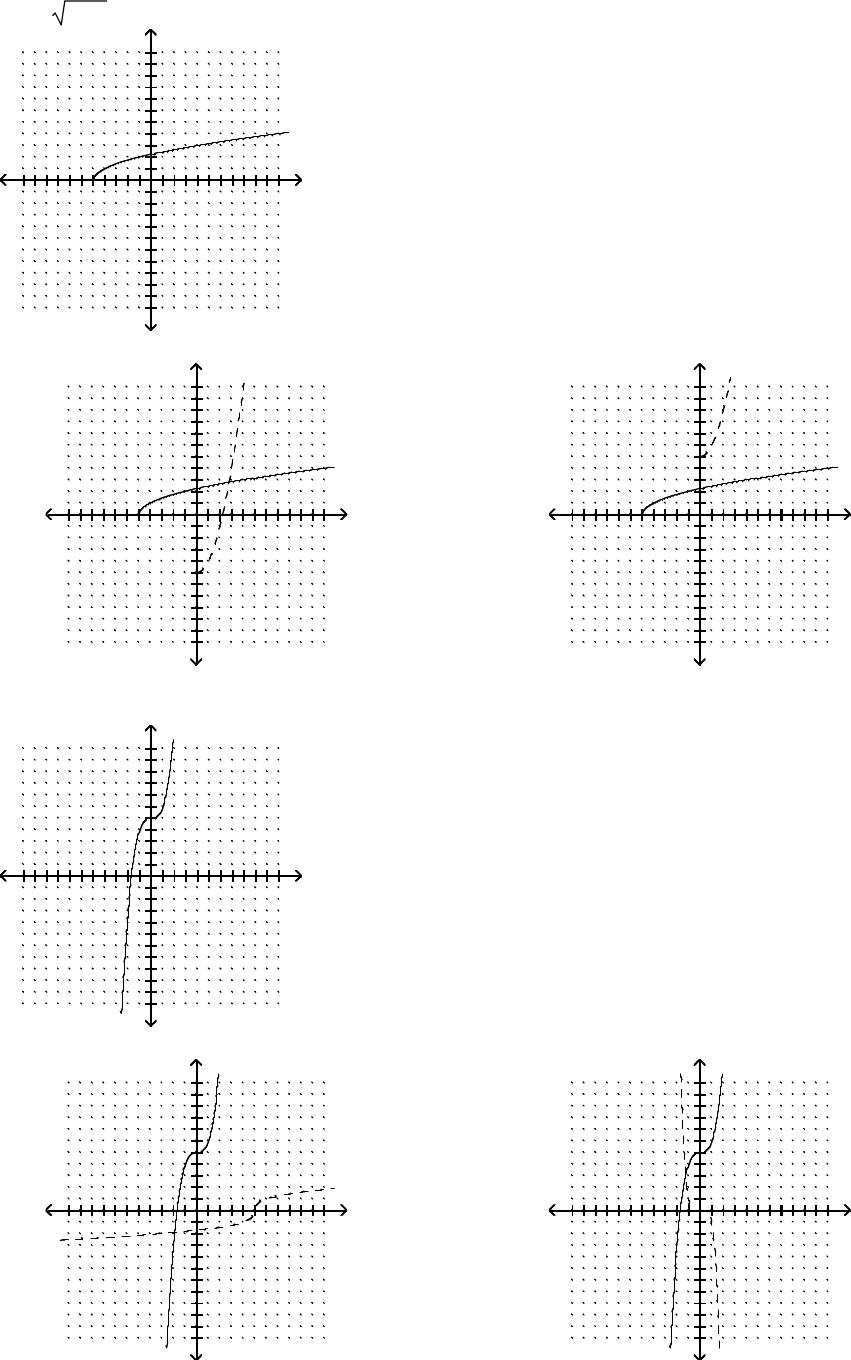
2) f(x) = x
+ 5
x
-10 -5 5 10
y
10
5
-5
-10
x
-10 -5 5 10
y
10
5
-5
-10
A)
x
-10 -5 5 10
y
10
5
-5
-10
x
-10 -5 5 10
y
10
5
-5
-10
B)
x
-10 -5 5 10
y
10
5
-5
-10
x
-10 -5 5 10
y
10
5
-5
-10
3) f(x) = x3 + 5
x
-10 -5 5 10
y
10
5
-5
-10
x
-10 -5 5 10
y
10
5
-5
-10
A)
x
-10 -5 5 10
y
10
5
-5
-10
x
-10 -5 5 10
y
10
5
-5
-10
B)
x
-10 -5 5 10
y
10
5
-5
-10
x
-10 -5 5 10
y
10
5
-5
-10
Page 13
4) f(x) = 6
x
x
-10 -5 5 10
y
10
5
-5
-10
x
-10 -5 5 10
y
10
5
-5
-10
A) Function is its own inverse
x
-10 -5 5 10
y
10
5
-5
-10
x
-10 -5 5 10
y
10
5
-5
-10
B)
x
-10 -5 5 10
y
10
5
-5
-10
x
-10 -5 5 10
y
10
5
-5
-10
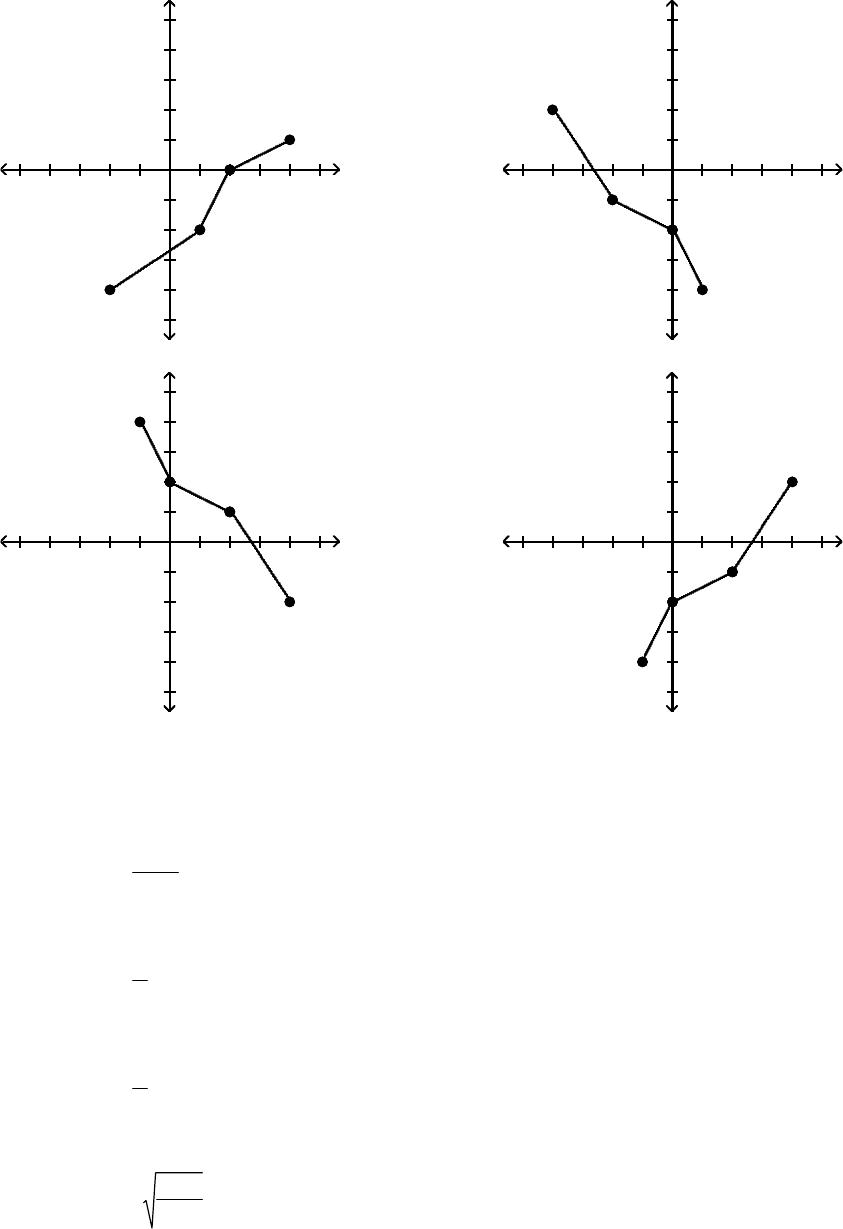
Use the graph of the given one–to–one function to sketch the graph of the inverse function. For convenience, the
graph of y = x is also given.
5)
x
–5–4–3–2–1 12345
y
5
4
3
2
1
-1
-2
-3
-4
-5
(-4, –2)
(-2, 1)
(0, 2)
(1, 4)
x
–5–4–3–2–1 12345
y
5
4
3
2
1
-1
-2
-3
-4
-5
(-4, –2)
(-2, 1)
(0, 2)
(1, 4)
Page 14
A)
x
-5 -4 -3 -2 -1 1 2 3 4 5
y
5
4
3
2
1
-1
-2
-3
-4
-5
(-2, –4)
(1, –2)
(2, 0)
(4, 1)
x
-5 -4 -3 -2 -1 1 2 3 4 5
y
5
4
3
2
1
-1
-2
-3
-4
-5
(-2, –4)
(1, –2)
(2, 0)
(4, 1)
B)
x
-5 -4 -3 -2 -1 1 2 3 4 5
y
5
4
3
2
1
-1
-2
-3
-4
-5
(-4, 2)
(-2, –1)
(0, –2)
(1, –4)
x
-5 -4 -3 -2 -1 1 2 3 4 5
y
5
4
3
2
1
-1
-2
-3
-4
-5
(-4, 2)
(-2, –1)
(0, –2)
(1, –4)
C)
x
-5 -4 -3 -2 -1 1 2 3 4 5
y
5
4
3
2
1
-1
-2
-3
-4
-5
(4, –2)
(2, 1)
(0, 2)
(-1, 4)
x
-5 -4 -3 -2 -1 1 2 3 4 5
y
5
4
3
2
1
-1
-2
-3
-4
-5
(4, –2)
(2, 1)
(0, 2)
(-1, 4)
D)
x
-5 -4 -3 -2 -1 1 2 3 4 5
y
5
4
3
2
1
-1
-2
-3
-4
-5
(4, 2)
(2, –1)
(0, –2)
(-1, –4)
x
-5 -4 -3 -2 -1 1 2 3 4 5
y
5
4
3
2
1
-1
-2
-3
-4
-5
(4, 2)
(2, –1)
(0, –2)
(-1, –4)
4 Find the Inverse of a Function Defined by an Equation
MULTIPLE CHOICE. Choose the one alternative that best completes the statement or answers the question.
Decide whether or not the functions are inverses of each other.
1) f(x) = 5x – 3, g(x) = x + 5
3
A) No B) Yes
2) f(x) = 2x + 4, g(x) = 1
2x – 2
A) Yes B) No
3) f(x) = 9x – 9, g(x) = 1
9x + 1
A) Yes B) No
4) f(x) = 9x2 + 6, g(x) = x – 6
9
A) Yes; Exclude the interval (–∞
,
6) B) Yes; No values need to be excluded.
C) Yes; Exclude the interval (–∞
,
9) D) No
Page 15
5) f(x) = (x – 3)2, x ≥ 3; g(x) = x + 3
A) Yes B) No
6) f(x) = (x – 3)2, x ≥ 3; g(x) = x
+ 3
A) No B) Yes
7) f(x) = 3
x + 2 , g(x) = 2x + 3
x
A) No B) Yes C) Yes; Exclude the value {–2}
8) f(x) = 8 + x
x, g(x) = 8
x – 1
A) Yes B) No
9) f(x) = x
+ 5, domain [–5, ∞); g(x) = x2 + 5, domain (–∞, ∞)
A) No B) Yes
10) f(x) = x3 – 9, g(x) = 3x + 9
A) Yes B) No
The function f is one–to–one. Find its inverse.
11) f(x) = 4x
A) f–1(x) = x
4B) f–1(x) = 4
xC) f–1(x) = –4x D) f–1(x) = 4x
12) f(x) = 4x + 2
A) f–1(x) = x – 2
4B) f–1(x) = x +2
4C) f(x) = x –2
4D) f–1(x) = – x +4
2
13) f(x) = 8x – 2
A) f–1(x) = x + 2
8B) f–1(x) = x
8 – 2C)f
–1(x) = x –2
8D) f–1(x) = x
8 + 2
14) f(x) = 8
x
A) f–1(x) = 8
xB) f–1(x) = x
8C) f–1(x) = –8x D) f–1(x) = 8x
15) f(x) = x2 – 1, x ≥ 0
A) f–1(x) = x
+ 1, x ≥ –1B)f
–1(x) = x
– 1, x ≥ 1
C) f–1(x) = x
+ 1, x ≥ 0D) f
–1(x) = x + 1, x < 0
16) f(x) = 2x2 – 7, x ≥ 0
A) f–1(x) = x + 7
2B) f–1(x) = – x + 7
2C) f–1(x) = 2
x + 7 D) f–1(x) = 2
x + 7
17) f(x) = x3 + 1
A) f–1(x) = 3x – 1 B) f–1(x) = 3x + 1 C) f–1(x) = 3x – 1D)f
–1(x) = 3x + 1
Page 16
18) f(x) = 5x + 7
6
A) f–1(x) = 6x – 7
5B) f–1(x) = 6x +7
5C) f–1(x) = 6
5x – 7 D) f–1(x) = 6
5x + 7
19) f(x) = 4
7x + 5
A) f–1(x) = 4 – 5x
7x B) f–1(x) = 4–5y
7y C) f–1(x) = 7x +5
4D) f–1(x) = 5x –4
7x
20) f(x) = 6
x + 7
A) f–1(x) = –7x + 6
xB) f–1(x) = 7 + 6x2
xC) f–1(x) = 7+6x
xD) f–1(x) = x
7 + 6x
21) f(x) = (x + 8)3
A) f–1(x) = 3x – 8B)f
–1(x) = 3x + 8C)f
–1(x) = x – 8D)f
–1(x) = 3x – 512
22) f(x) = (x + 2)3 – 8.
A) f–1(x) = 3x + 8 – 2B)f
–1(x) = 3x – 2 + 8
C) f–1(x) = 3x + 6 D) f–1(x) = 3x + 10
23) f(x) = x
+ 7
A) f–1(x) = x2 – 7, x ≥ 0B)f
–1(x) = x2 + 7, x ≥ 0
C) f–1(x) = x
– 7 D) f–1(x) = (x + 7)2
24) f(x) =3x – 2
A) f–1(x) = x3 + 2B)f
–1(x) = 1
x3 + 2
C) f–1(x) = x + 2D)f
–1(x) = x3 + 4
25) f(x) = 7x + 6
7x + 5
A) f–1(x) = –5x + 6
7x – 7 B) f–1(x) = 7x +7
7x + 5 C) f–1(x) = 7x –7
–5x + 6 D) f–1(x) = 7x +6
7x + 5
Page 17
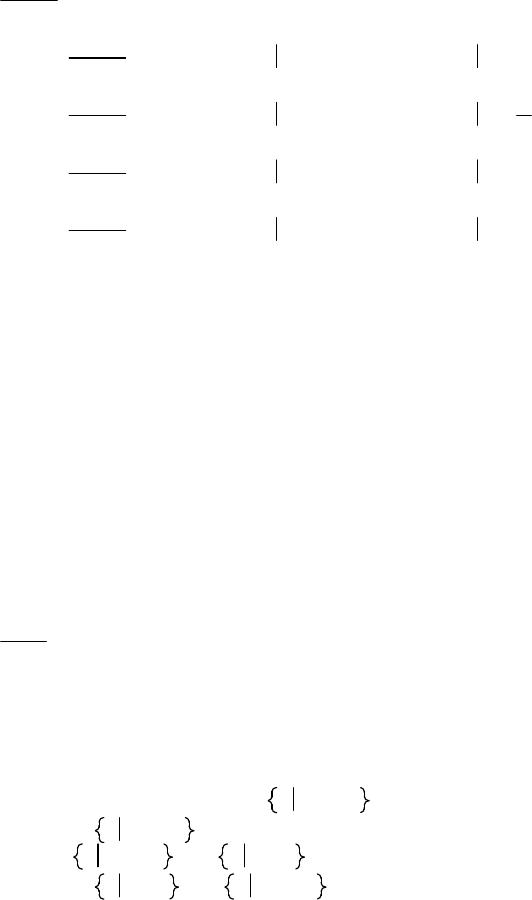
Find the inverse function of f. State the domain and range of f.
26) f(x) = 3x – 2
x + 5
A) f–1(x) = 5x + 2
3 – x ; domain of f: {x x ≠ –5}; range of f: {y y ≠ 3}
B) f–1(x) = x + 5
3x – 2; domain of f: {x x ≠ –5}; range of f: {y y ≠ 2
3}
C) f–1(x) = 5x + 2
3 + x ; domain of f: {x x ≠ –5}; range of f: {y y ≠ – 3}
D) f–1(x) = 3x + 2
x – 5 ; domain of f: {x x ≠ –5}; range of f: {y y ≠ 5}
Determine i) the domain of the function, ii) the range of the function, iii) the domain of the inverse, and iv) the
range of the inverse.
27) f(x) = –8x – 9
A) f(x): D is all real numbers
,
R is all real numbers;
f–1(x): D is all real numbers, R is all real numbers
B) f(x): D is all real numbers
,
R = {y|y > –9};
f–1(x): D is all real numbers, R = {y|y < –9}
C) f(x): D = {x|x > –8}
,
R is all real numbers;
f–1(x): D = {x|x < –8}, R is all real numbers
D) f(x): D = {x|x > –8}
,
R = {y|y > –9};
f–1(x): D = {x|x < –8}, R = {y|y < –9}
28) f(x) = 5
x – 1
A) f(x): D = {x|x ≠ 1}
,
R = {y ≠ 0};
f–1(x): D = {x|x ≠ 0}, R = {y|y ≠ 1}
B) f(x): D is all real numbers
,
R is all real numbers;
f–1(x): D is all real numbers, R is all real numbers
C) f(x): D is all real numbers
,
R = y y ≠–5 ;
f–1(x): D = x x ≠ – 5 , R is all real numbers
D) f(x): D = x x ≠ – 5
,
R = y y ≠1 ;
f–1(x): D = x x ≠ 1 , R = y y ≠ – 5
Page 18

29) f(x) = 3
2x – 1
A) f(x): D = x x ≠ 1
2, R = y y ≠ 0 ;
f–1(x): D = x x ≠ 0 , R = y y ≠ 1
2
B) f(x): D is all real numbers
,
R is all real numbers;
f–1(x): D is all real numbers, R is all real numbers
C) f(x): D = x x ≠ 3
2, R = y y ≠ – 3 ;
f–1(x): D = x x ≠ – 3 , R = y y ≠ 3
2
D) f(x): D = x x ≠ – 1
2, R = y y ≠ 1 ;
f–1(x): D = x x ≠ 1 , R = y y ≠ – 1
2
30) f(x) = 3x
+ 4
A) f(x): D = x x ≥ – 4
3, R = y y ≥ 0 ;
f–1(x): D = x x ≥ 0 , R = y y ≥ – 4
3
B) f(x): D = x x ≥ – 4
3, R is all real numbers;
f–1(x): D is all real numbers, R = y y ≥ – 4
3
C) f(x): D = x x ≥ – 4
3, R = y y ≥ 0 ;
f–1(x): D is all real numbers, R = y y ≥ – 4
3
D) f(x): D =x x ≥ 0
,
R = y y ≥0 ;
f–1(x): D = x x ≥ 0 , R = y y ≥ – 4
3
31) f(x) = 3
– 2x
A) f(x): D = x x ≤ 3
2, R = y y ≥ 0 ;
f–1(x): D = x x ≥ 0 , R = y y ≤ 3
2
B) f(x): D = x x ≤ 3
2, R is all real numbers;
f–1(x): D is all real numbers, R = y y ≤ 3
2
C) f(x): D = x x ≤ 3
2, R = y y ≤ 0 ;
f–1(x): D is all real numbers, R = y y ≤ 3
2
D) f(x): D =x x ≥ 0
,
R = y y ≥0 ;
f–1(x): D = x x ≥ 0 , R = y y ≥ 3
2
SHORT ANSWER. Write the word or phrase that best completes each statement or answers the question.
Solve the problem.
32) The profit P for selling x items is given by the equation P(x) =2x –500. Express the sales amount x as a
function of the profit P.
33) The function f(x) = |x|– 5 is not one–to–one.
(a) Find a suitable restriction on the domain of f so that the new function that results is one–to–one.
(b) Find the inverse of f.
Page 19
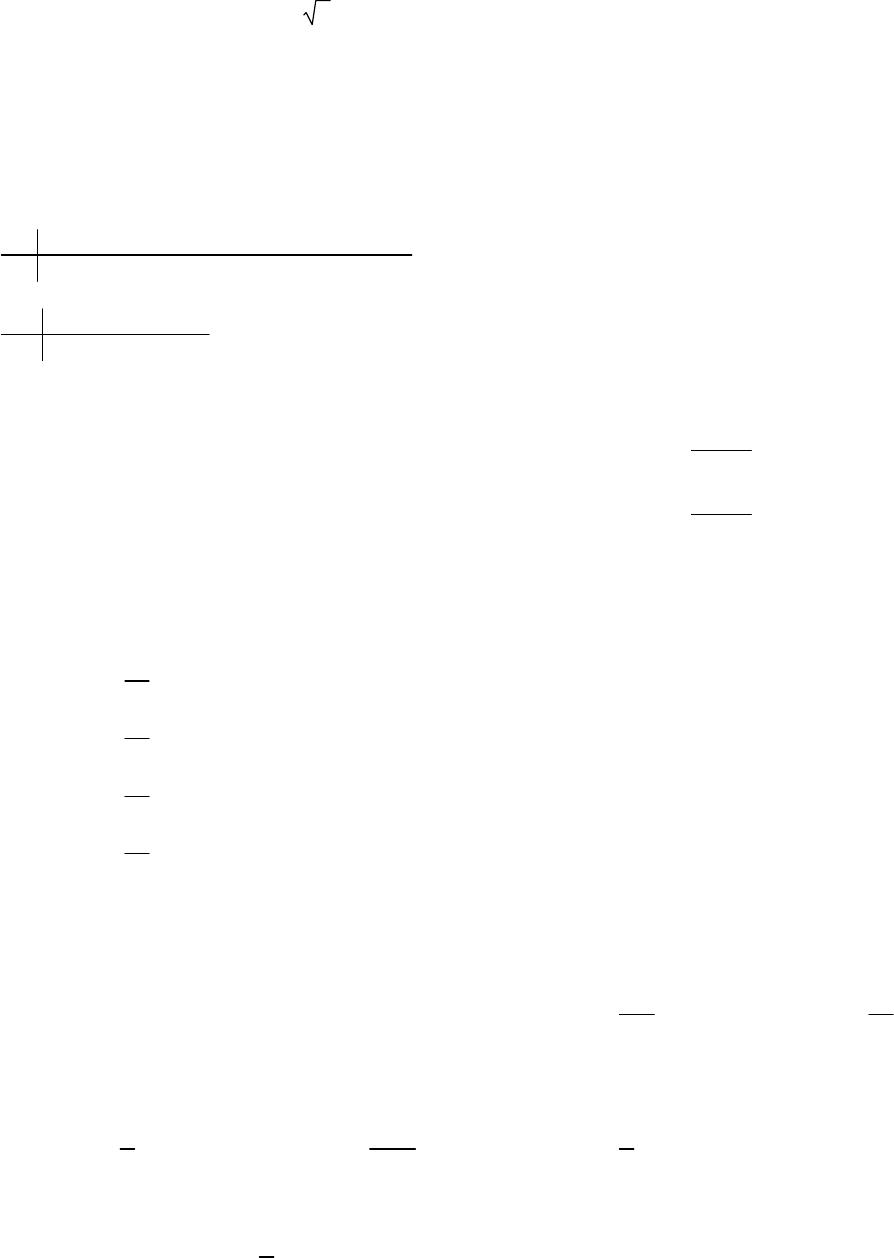
34) The weight W of a bird’s brain (in ounces) is related to the volume V of the bird’s skull (in cubic ounces)
through the function W(V) = 3.473V + 1.16.
(a) Express the skull volume V as a function of brain weight W.
(b) Predict the skull volume of a bird whose brain weighs 5 oz.
MULTIPLE CHOICE. Choose the one alternative that best completes the statement or answers the question.
35) The accompanying tables represent a function f that converts seconds to hours and a function g that
converts hours to days.
x 86,400 172,800 259,200 345,600 432,000
f(x) 24 48 72 96 120
x 24 48 72 96 120
g(x) 1 2 3 4 5
Express (f –1∘g –1)(x) symbolically.
A) (f –1∘g –1)(x) = 86,400x B) (f –1∘g –1)(x) = x
86,400
C) (f –1∘g –1)(x) = 86,400x2D) (f –1∘g –1)(x) = x2
86,400
36) To remodel a bathroom, a contractor charges $25 per hour plus material costs, which amount to $3800.
Therefore, the total cost to remodel the bathroom is given by f(x) = 25x + 3800 where x is the number of
hours the contractor works. Find a formula for f –1(x). What does f –1(x) compute?
A) f –1(x) = x
25 – 152; This computes the number of hours worked if the total cost is x dollars.
B) f –1(x) = x
25 – 152; This computes the total cost if the contractor works x hours.
C) f –1(x) = x
25 – 3800; This computes the number of hours worked if the total cost is x dollars.
D) f –1(x) = x
25 – 3800; This computes the total cost if the contractor works x hours.
Find a formula for the inverse of the function described below.
37) A size 8 dress in Country C is size 46 in Country D. A function that converts dress sizes in Country C to
those in Country D is f(x) = x + 38.
A) f–1(x) = x – 38 B) f–1(x) = x + 38 C) f–1(x) = x
–38 D) f–1(x) = x
38
38) A size 10 dress in Country C is size 36 in Country D. A function that converts dress sizes in Country C to
those in Country D is f(x) = 2(x + 8).
A) f–1(x) = x
2 – 8B)f
–1(x) = x –8
2C) f–1(x) = x
2 + 8D)f
–1(x) = x – 8
39) A size 40 dress in Country C is size 0 in Country D. A function that converts dress sizes in Country C to
those in Country D is f(x) = x
2 – 20.
A) f–1(x) = 2(x + 20) B) f–1(x) = 2(x – 20) C) f–1(x) = 2x + 20 D) f–1(x) = x + 20
Page 20

40) 32° Fahrenheit = 0° Celsius. A function that converts temperatures in Celsius to those in Fahrenheit is
f(x) = 9
5x + 32 .
A) f–1(x) = 5
9(x – 32) B) f–1(x) = 9
5x + 32 C) f–1(x) = 5
9(x + 32) D) f–1(x) = x + 32
41) An organization determines that the cost per person of chartering a bus is given by the formula
C(x) = 150 + 6x
x,
where x is the number of people in the group and C(x) is in dollars.
A) C–1(x) = 150
x – 6 B) C–1(x) = 150
x + 6 C) C–1(x) = 150 +x
6D) C–1(x) = 6
x – 150
6.3 Exponential Functions
1 Evaluate Exponential Functions
MULTIPLE CHOICE. Choose the one alternative that best completes the statement or answers the question.
Approximate the value using a calculator. Express answer rounded to three decimal places.
1) 33.3
A) 37.541 B) 35.937 C) 9.900 D) 27.000
2) 4.53.61
A) 228.085 B) 322.688 C) 16.245 D) 869.874
3) 4.6293.847
A) 363.186 B) 511.129 C) 17.808 D) 1203.761
4) 3.2π
A) 38.635 B) 38.983 C) 10.053 D) 36.462
5) 2 3
A) 3.322 B) 3.464 C) 3.000 D) 4.000
Determine whether the given function is exponential or not. If it is exponential, identify the value of the base a.
6)
x H(x)
–12
0 6
1 10
2 14
3 18
A) Exponential; a = 2 B) Exponential; a = 4
C) Exponential; a = 6 D) Not exponential
Page 21
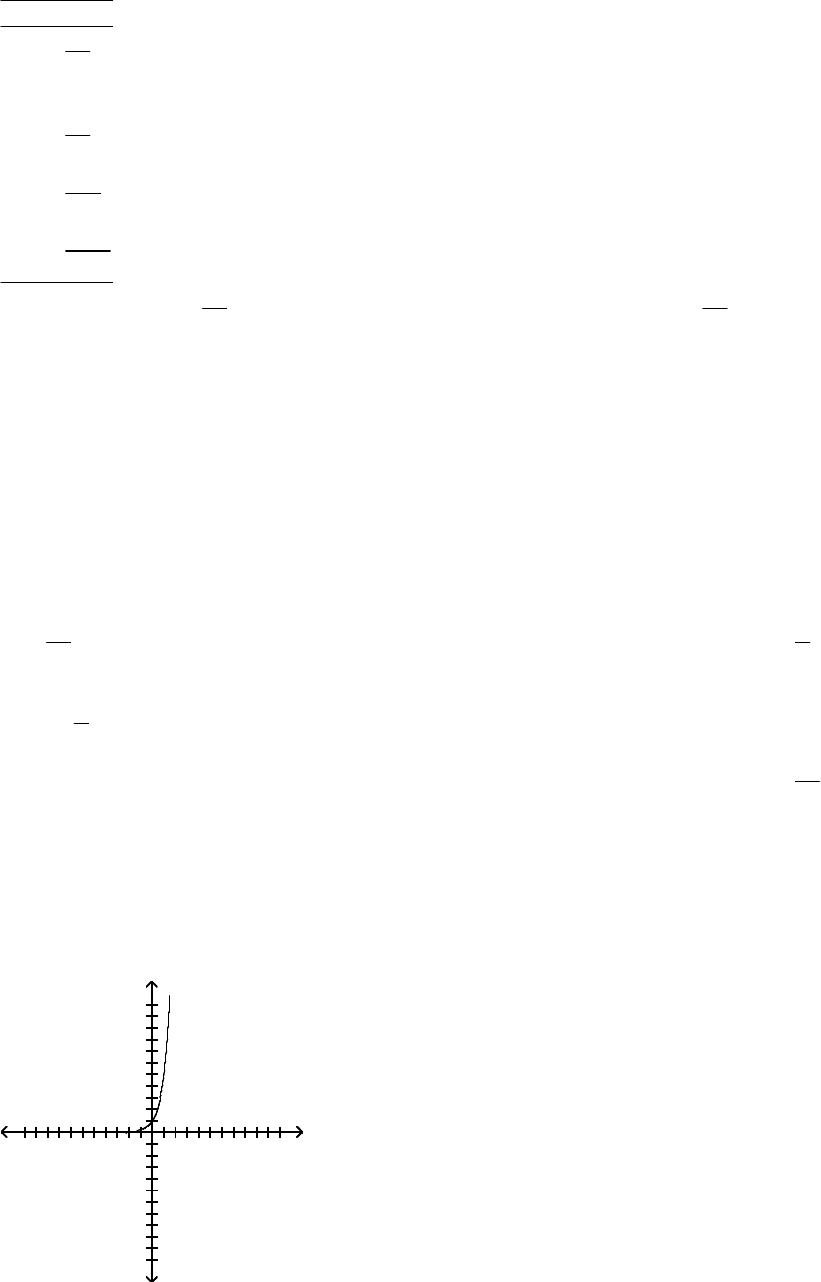
7)
x H(x)
–110
7
0 1
1 7
10
2 49
100
3 343
1000
A) Exponential; a = 7
10 B) Exponential; a = 10
7
C) Exponential; a = 7 D) Not exponential
Solve the problem.
8) The function f(x) = 800(0.5)x
/
80 models the amount in pounds of a particular radioactive material stored in
a concrete vault, where x is the number of years since the material was put into the vault. Find the amount
of radioactive material in the vault after 190 years. Round to the nearest whole number.
A) 154 lb B) 598 lb C) 950 lb D) 168 lb
9) If 3x = 3,what does 3–3x equal?
A) 1
27 B) 27 C) –27 D) 1
9
10) If 2–x = 1
5, what does 4x equal?
A) 25 B) –25 C) 5 D) 1
25
2 Graph Exponential Functions
MULTIPLE CHOICE. Choose the one alternative that best completes the statement or answers the question.
The graph of an exponential function is given. Match the graph to one of the following functions.
1)
x
-10 -5 5 10
y
10
5
-5
-10
x
-10 -5 5 10
y
10
5
-5
-10
A) f(x) = 5xB) f(x) = 5x +2C) f(x) = 5x + 2 D) f(x) = 5x – 2
Page 22
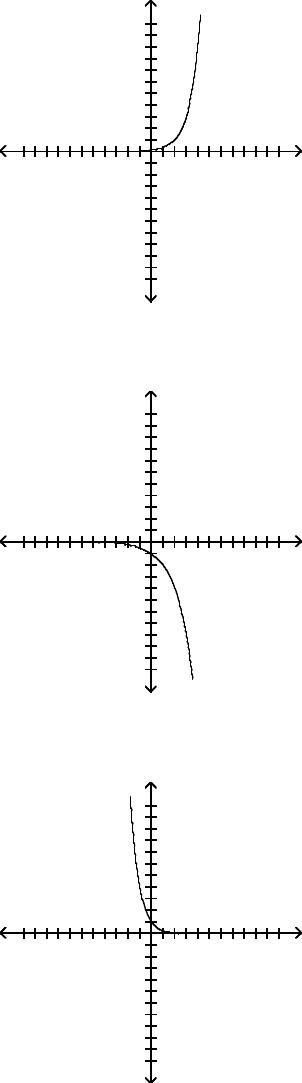
2)
x
-10 -5 5 10
y
10
5
-5
-10
x
-10 -5 5 10
y
10
5
-5
-10
A) f(x) = 3x – 2 B) f(x) = 3xC) f(x) = 3x – 2 D) f(x) = 3x + 2
3)
x
-10 -5 5 10
y
10
5
-5
-10
x
-10 -5 5 10
y
10
5
-5
-10
A) f(x) = –2xB) f(x) = 2xC) f(x) = 2–xD) f(x) = –2–x
4)
x
-10 -5 5 10
y
10
5
-5
-10
x
-10 -5 5 10
y
10
5
-5
-10
A) f(x) = 4–xB) f(x) = 4xC) f(x) = –4xD) f(x) = –4–x
Page 23
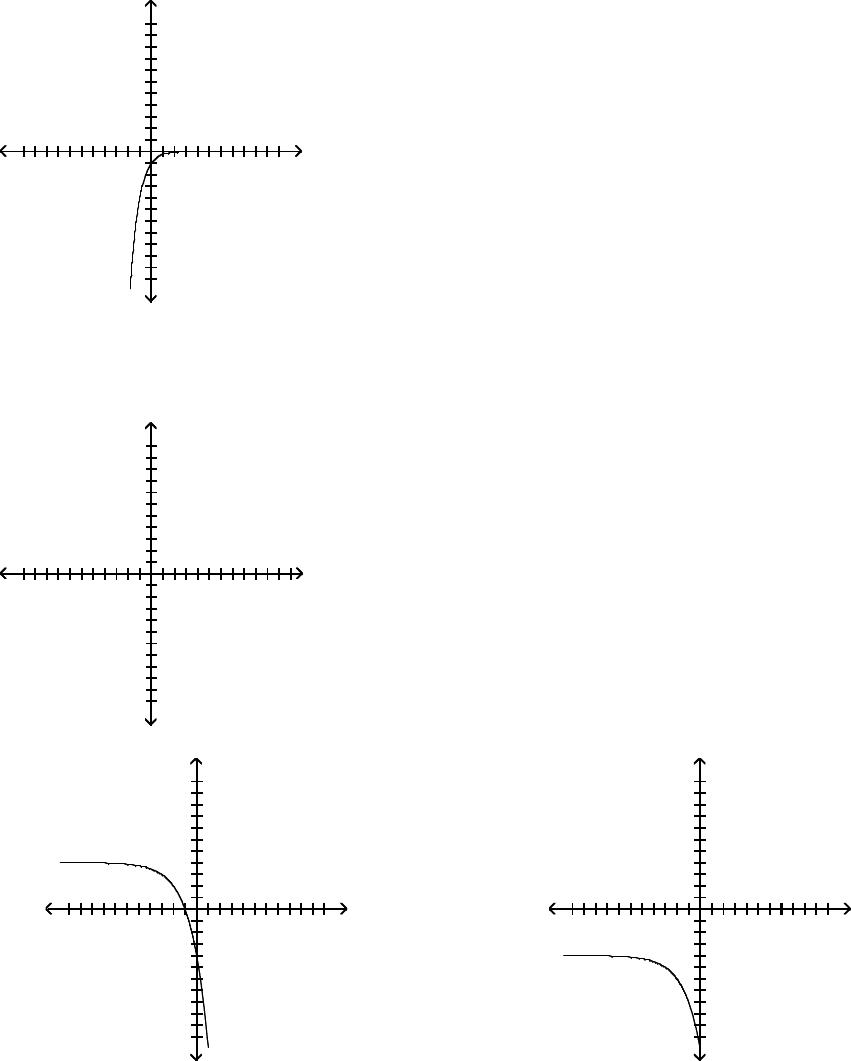
5)
x
-10 -5 5 10
y
10
5
-5
-10
x
-10 -5 5 10
y
10
5
-5
-10
A) f(x) = –4–xB) f(x) = 4xC) f(x) = –4xD) f(x) = 4–x
Use transformations to graph the function. Determine the domain, range, and horizontal asymptote of the function.
6) f(x) = –2x+3 + 4
x
-10 -5 5 10
y
10
5
-5
-10
x
-10 -5 5 10
y
10
5
-5
-10
A)
x
-10 -5 5 10
y
10
5
-5
-10
x
-10 -5 5 10
y
10
5
-5
-10
domain of f: (–∞, ∞); range of f: (–∞, 4);
horizontal asymptote: y = 4
B)
x
-10 -5 5 10
y
10
5
-5
-10
x
-10 -5 5 10
y
10
5
-5
-10
domain of f: (–∞, ∞); range of f: (–∞, –4);
horizontal asymptote: y = –4
Page 24
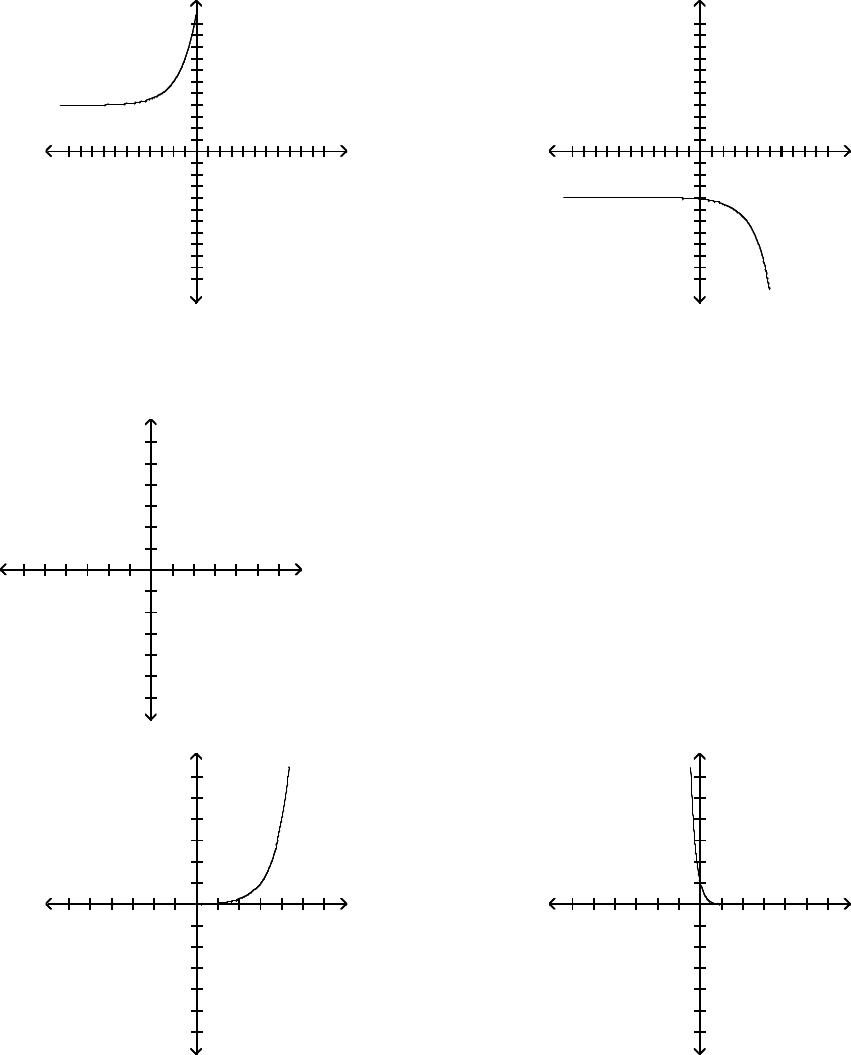
C)
x
-10 -5 5 10
y
10
5
-5
-10
x
-10 -5 5 10
y
10
5
-5
-10
domain of f: (–∞, ∞); range of f: (–4, ∞);
horizontal asymptote: y = 4
D)
x
-10 -5 5 10
y
10
5
-5
-10
x
-10 -5 5 10
y
10
5
-5
-10
domain of f: (–∞, ∞); range of f: (–∞, –4);
horizontal asymptote: y = –4
7) f(x) = 4(x – 3)
x
-6 6
y
6
-6
x
-6 6
y
6
-6
A)
x
-6 6
y
6
-6
x
-6 6
y
6
-6
domain of f: (–∞, ∞); range of f:(0, ∞)
horizontal asymptote: y = 0
B)
x
-6 6
y
6
-6
x
-6 6
y
6
-6
domain of f: (–∞, ∞); range of f:(0, ∞)
horizontal asymptote: y = 0
Page 25
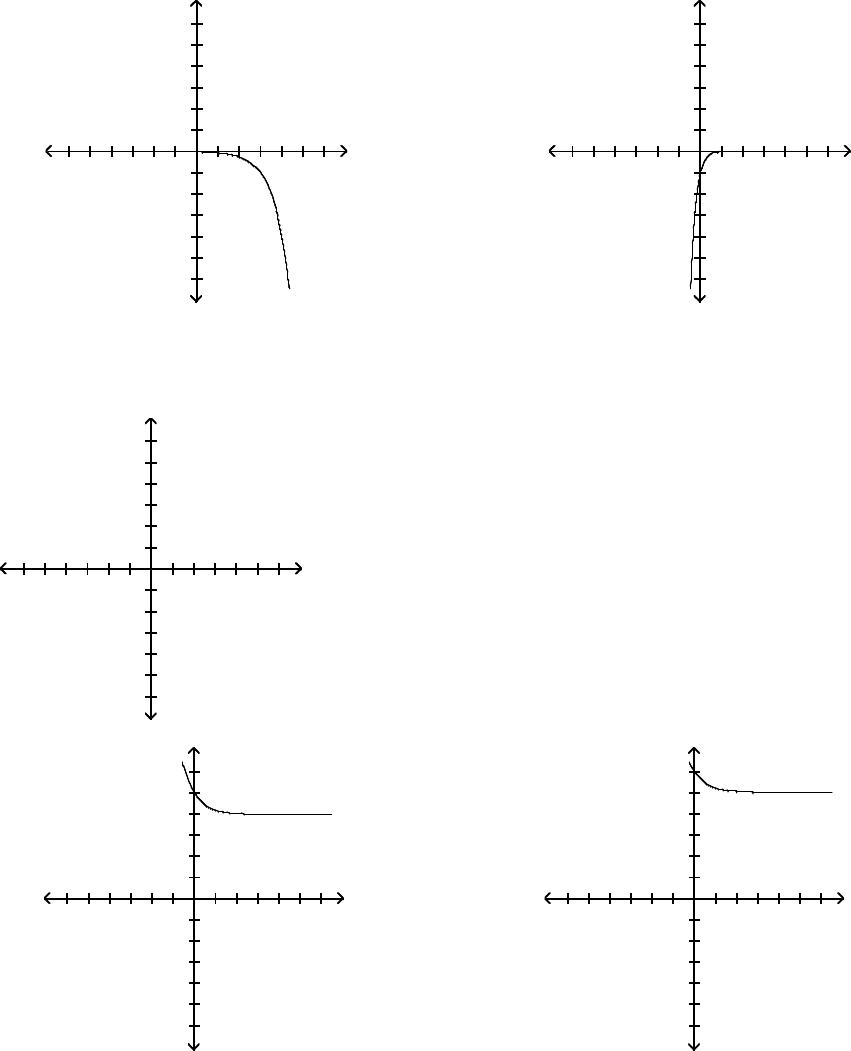
C)
x
-6 6
y
6
-6
x
-6 6
y
6
-6
domain of f: (–∞, ∞); range of f:(–∞, 0)
horizontal asymptote: y = 0
D)
x
-6 6
y
6
-6
x
-6 6
y
6
-6
domain of f: (–∞, ∞); range of f:(–∞, 0)
horizontal asymptote: y = 0
8) f(x) = 5–x + 4
x
-6 -4 -2 2 4 6
y
6
4
2
-2
-4
-6
x
-6 -4 -2 2 4 6
y
6
4
2
-2
-4
-6
A)
x
-6 -4 -2 2 4 6
y
6
4
2
-2
-4
-6
x
-6 -4 -2 2 4 6
y
6
4
2
-2
-4
-6
domain of f: (–∞, ∞); range of f:(4, ∞)
horizontal asymptote: y = 4
B)
x
-6 -4 -2 2 4 6
y
6
4
2
-2
-4
-6
x
-6 -4 -2 2 4 6
y
6
4
2
-2
-4
-6
domain of f: (–∞, ∞); range of f:(5, ∞)
horizontal asymptote: y = 5
Page 26
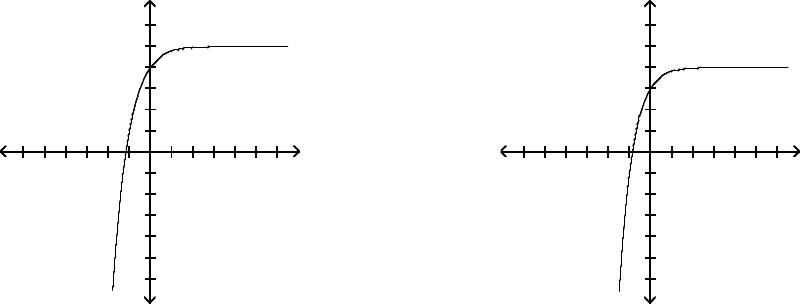
C)
x
-6 -4 -2 2 4 6
y
6
4
2
-2
-4
-6
x
-6 -4 -2 2 4 6
y
6
4
2
-2
-4
-6
domain of f: (–∞, ∞); range of f:(5, ∞)
horizontal asymptote: y = 5
D)
x
-6 -4 -2 2 4 6
y
6
4
2
-2
-4
-6
x
-6 -4 -2 2 4 6
y
6
4
2
-2
-4
-6
domain of f: (–∞, ∞); range of f:(4, ∞)
horizontal asymptote: y = 4
Page 27
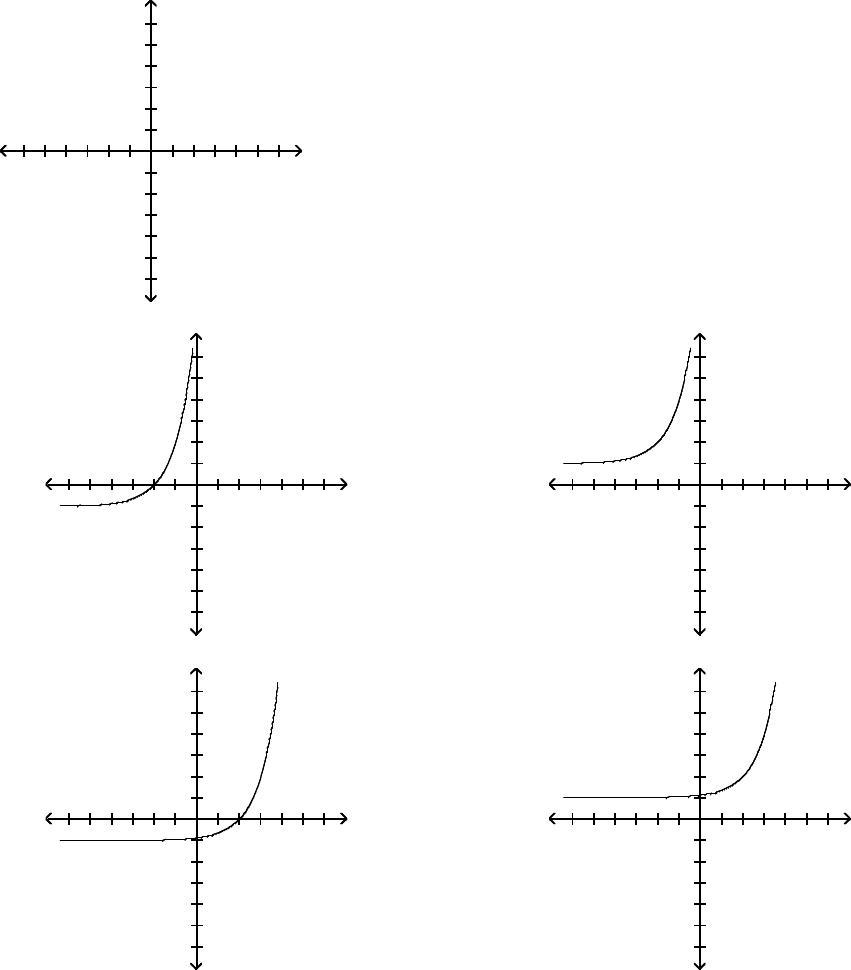
Graph the function.
9) f(x) = 3(x + 2) – 1
x
-6 -4 -2 2 4 6
y
6
4
2
-2
-4
-6
x
-6 -4 -2 2 4 6
y
6
4
2
-2
-4
-6
A)
x
-6 -4 -2 2 4 6
y
6
4
2
-2
-4
-6
x
-6 -4 -2 2 4 6
y
6
4
2
-2
-4
-6
B)
x
-6 -4 -2 2 4 6
y
6
4
2
-2
-4
-6
x
-6 -4 -2 2 4 6
y
6
4
2
-2
-4
-6
C)
x
-6 -4 -2 2 4 6
y
6
4
2
-2
-4
-6
x
-6 -4 -2 2 4 6
y
6
4
2
-2
-4
-6
D)
x
-6 -4 -2 2 4 6
y
6
4
2
-2
-4
-6
x
-6 -4 -2 2 4 6
y
6
4
2
-2
-4
-6
Page 28
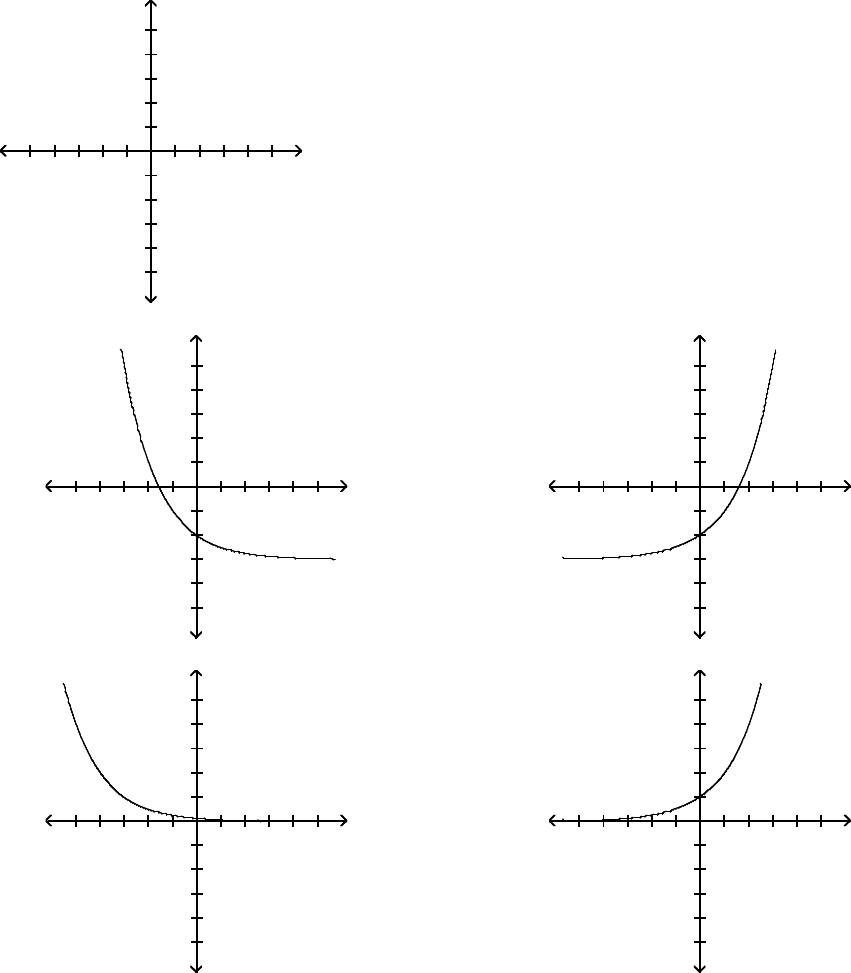
10) f(x) = 2– x – 3
x
-5 -4 -3 -2 -1 1 2 3 4 5
y
5
4
3
2
1
-1
-2
-3
-4
-5
x
-5 -4 -3 -2 -1 1 2 3 4 5
y
5
4
3
2
1
-1
-2
-3
-4
-5
A)
x
-5 -4 -3 -2 -1 1 2 3 4 5
y
5
4
3
2
1
-1
-2
-3
-4
-5
x
-5 -4 -3 -2 -1 1 2 3 4 5
y
5
4
3
2
1
-1
-2
-3
-4
-5
B)
x
-5 -4 -3 -2 -1 1 2 3 4 5
y
5
4
3
2
1
-1
-2
-3
-4
-5
x
-5 -4 -3 -2 -1 1 2 3 4 5
y
5
4
3
2
1
-1
-2
-3
-4
-5
C)
x
-5 -4 -3 -2 -1 1 2 3 4 5
y
5
4
3
2
1
-1
-2
-3
-4
-5
x
-5 -4 -3 -2 -1 1 2 3 4 5
y
5
4
3
2
1
-1
-2
-3
-4
-5
D)
x
-5 -4 -3 -2 -1 1 2 3 4 5
y
5
4
3
2
1
-1
-2
-3
-4
-5
x
-5 -4 -3 -2 -1 1 2 3 4 5
y
5
4
3
2
1
-1
-2
-3
-4
-5
Page 29
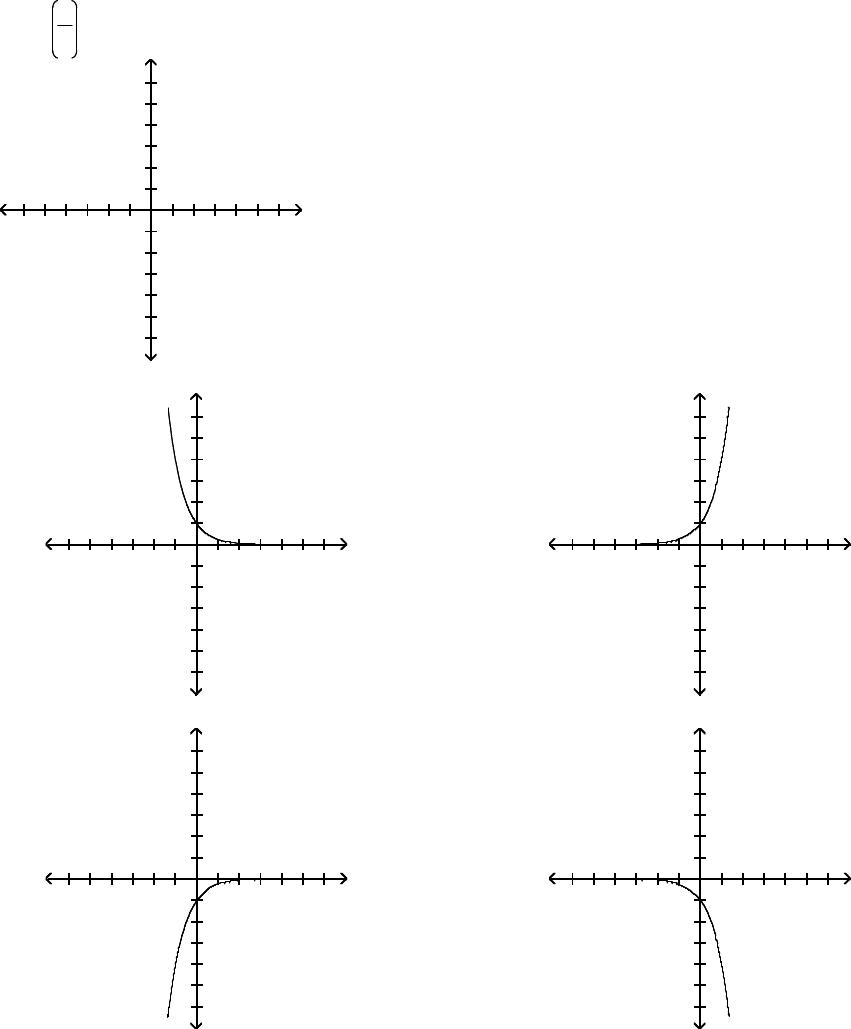
11) f(x) = 1
4
x
x
-6 -4 -2 2 4 6
y
6
4
2
-2
-4
-6
x
-6 -4 -2 2 4 6
y
6
4
2
-2
-4
-6
A)
x
-6 -4 -2 2 4 6
y
6
4
2
-2
-4
-6
x
-6 -4 -2 2 4 6
y
6
4
2
-2
-4
-6
B)
x
-6 -4 -2 2 4 6
y
6
4
2
-2
-4
-6
x
-6 -4 -2 2 4 6
y
6
4
2
-2
-4
-6
C)
x
-6 -4 -2 2 4 6
y
6
4
2
-2
-4
-6
x
-6 -4 -2 2 4 6
y
6
4
2
-2
-4
-6
D)
x
-6 -4 -2 2 4 6
y
6
4
2
-2
-4
-6
x
-6 -4 -2 2 4 6
y
6
4
2
-2
-4
-6
Page 30
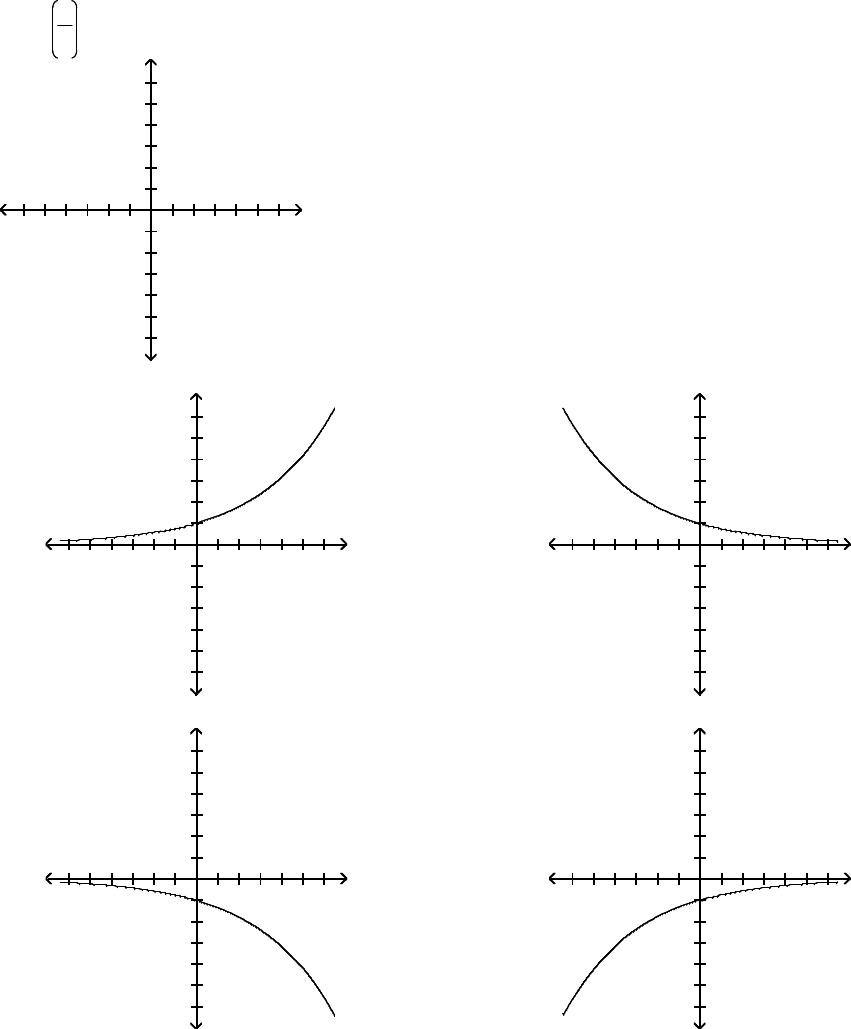
12) f(x) = 4
3
x
x
-6 -4 -2 2 4 6
y
6
4
2
-2
-4
-6
x
-6 -4 -2 2 4 6
y
6
4
2
-2
-4
-6
A)
x
-6 -4 -2 2 4 6
y
6
4
2
-2
-4
-6
x
-6 -4 -2 2 4 6
y
6
4
2
-2
-4
-6
B)
x
-6 -4 -2 2 4 6
y
6
4
2
-2
-4
-6
x
-6 -4 -2 2 4 6
y
6
4
2
-2
-4
-6
C)
x
-6 -4 -2 2 4 6
y
6
4
2
-2
-4
-6
x
-6 -4 -2 2 4 6
y
6
4
2
-2
-4
-6
D)
x
-6 -4 -2 2 4 6
y
6
4
2
-2
-4
-6
x
-6 -4 -2 2 4 6
y
6
4
2
-2
-4
-6
Page 31
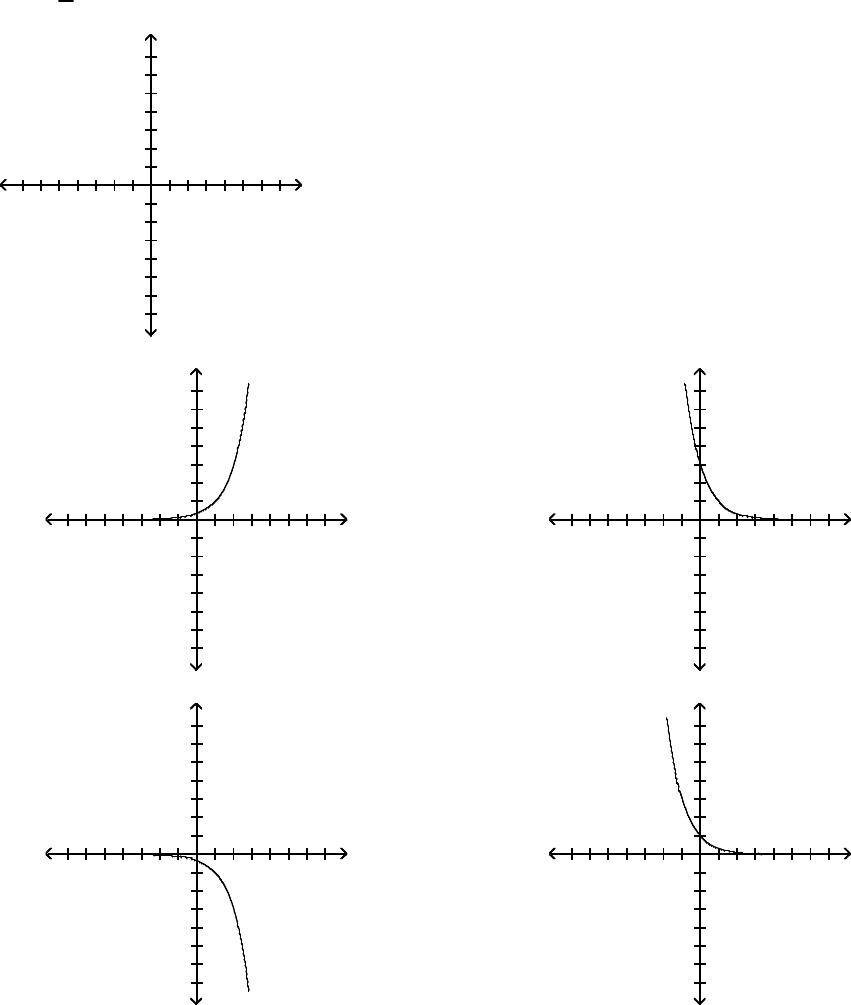
13) f(x) = 1
3 · 3x.
x
-6 -4 -2 2 4 6
y
6
4
2
-2
-4
-6
x
-6 -4 -2 2 4 6
y
6
4
2
-2
-4
-6
A)
x
-6 -4 -2 2 4 6
y
6
4
2
-2
-4
-6
x
-6 -4 -2 2 4 6
y
6
4
2
-2
-4
-6
B)
x
-6 -4 -2 2 4 6
y
6
4
2
-2
-4
-6
x
-6 -4 -2 2 4 6
y
6
4
2
-2
-4
-6
C)
x
-6 -4 -2 2 4 6
y
6
4
2
-2
-4
-6
x
-6 -4 -2 2 4 6
y
6
4
2
-2
-4
-6
D)
x
-6 -4 -2 2 4 6
y
6
4
2
-2
-4
-6
x
-6 -4 -2 2 4 6
y
6
4
2
-2
-4
-6
Page 32
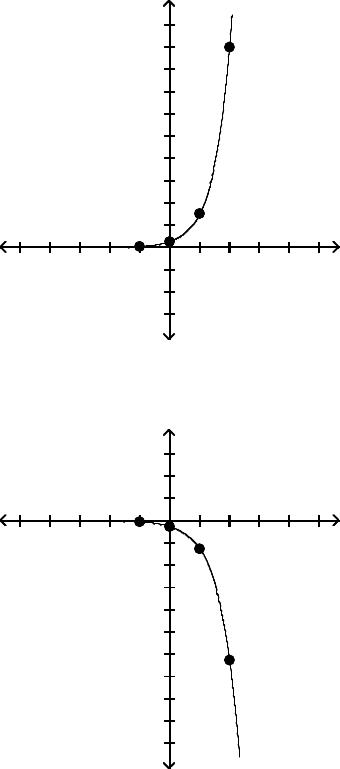
Determine the exponential function whose graph is given.
14)
x
–5–4–3–2–1 12345
y
40
32
24
16
8
-8
x
–5–4–3–2–1 12345
y
40
32
24
16
8
-8
A) f(x) = 6xB) f(x) = –6xC) f(x) = 6–xD) f(x) = –6–x
15)
x
–5–4–3–2–1 12345
y
8
-8
-16
-24
-32
-40
x
–5–4–3–2–1 12345
y
8
-8
-16
-24
-32
-40
A) f(x) = –5xB) f(x) = 5xC) f(x) = –5–xD) f(x) = 5–x
3 Define the Number e
MULTIPLE CHOICE. Choose the one alternative that best completes the statement or answers the question.
Approximate the value using a calculator. Express answer rounded to three decimal places.
1) e1.29
A) 3.633 B) 1.998 C) 3.507 D) 15.154
2) e–2.3
A) 0.100 B) –6.252 C) –0.100 D) 0.400
3) 2e
A) 6.581 B) 5.437 C) 7.389 D) 4.718
4) πe
A) 22.459 B) 8.540 C) 23.141 D) 5.860
Page 33
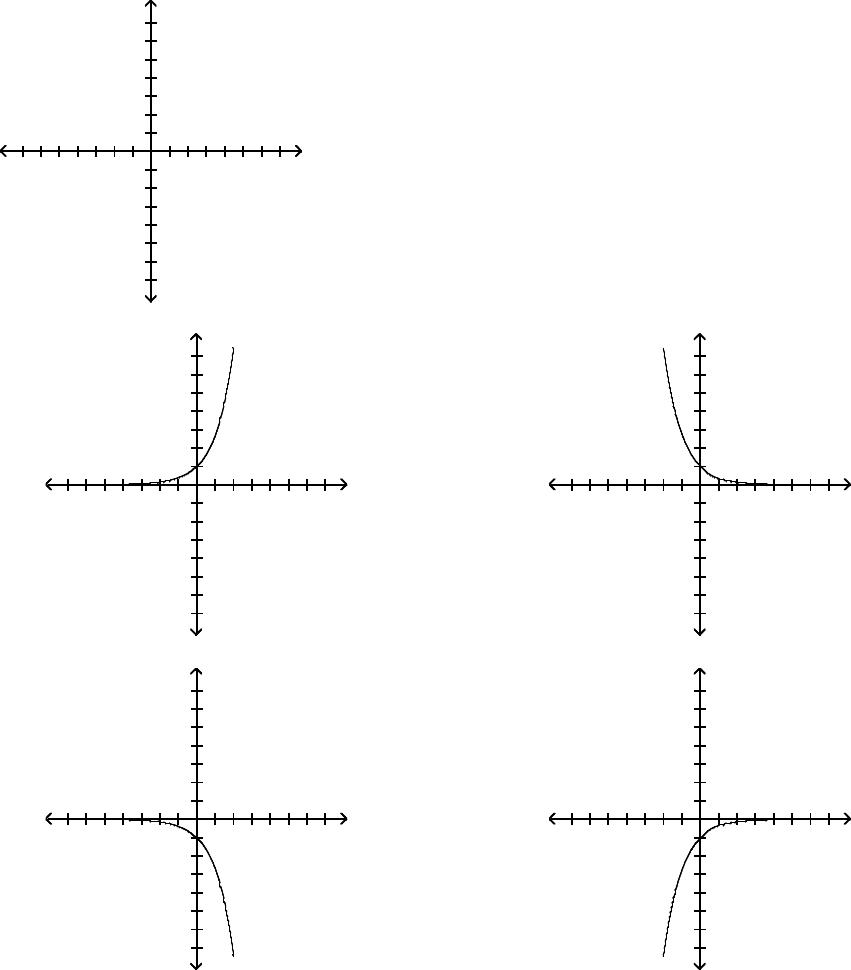
5) eπ
A) 23.141 B) 5.860 C) 22.459 D) 8.540
Graph the function.
6) f(x) = ex
x
-6 -4 -2 2 4 6
y
6
4
2
-2
-4
-6
x
-6 -4 -2 2 4 6
y
6
4
2
-2
-4
-6
A)
x
-6 -4 -2 2 4 6
y
6
4
2
-2
-4
-6
x
-6 -4 -2 2 4 6
y
6
4
2
-2
-4
-6
B)
x
-6 -4 -2 2 4 6
y
6
4
2
-2
-4
-6
x
-6 -4 -2 2 4 6
y
6
4
2
-2
-4
-6
C)
x
-6 -4 -2 2 4 6
y
6
4
2
-2
-4
-6
x
-6 -4 -2 2 4 6
y
6
4
2
-2
-4
-6
D)
x
-6 -4 -2 2 4 6
y
6
4
2
-2
-4
-6
x
-6 -4 -2 2 4 6
y
6
4
2
-2
-4
-6
Page 34
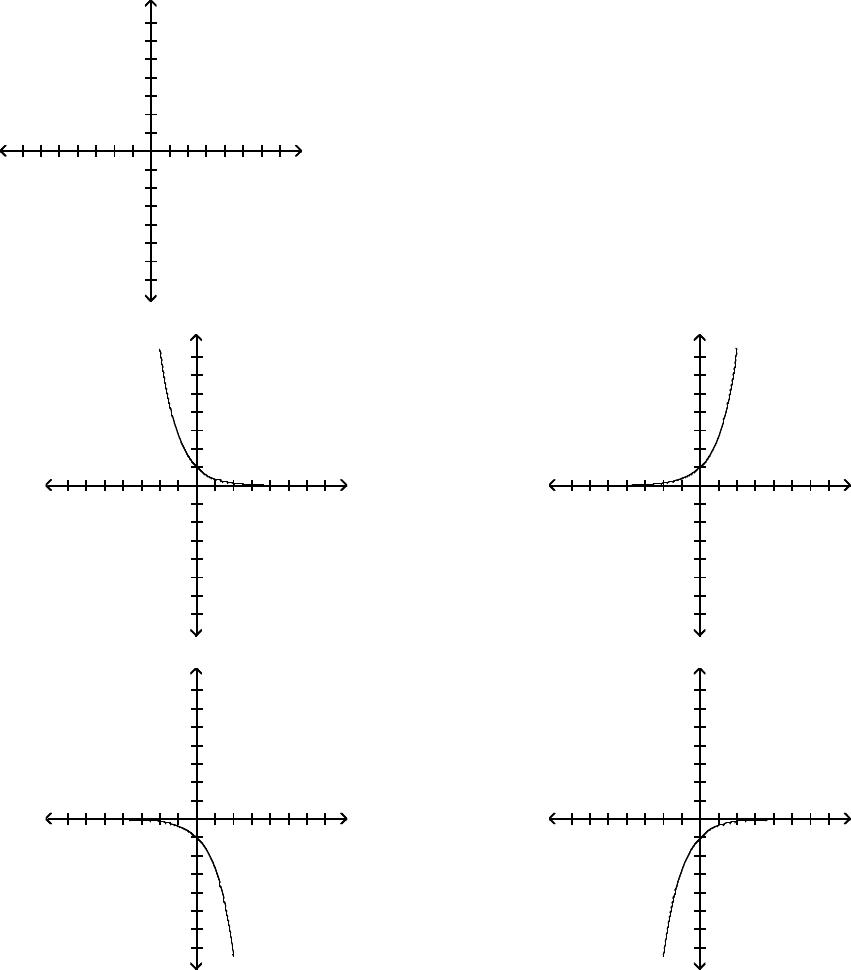
7) f(x) = e–x
x
-6 -4 -2 2 4 6
y
6
4
2
-2
-4
-6
x
-6 -4 -2 2 4 6
y
6
4
2
-2
-4
-6
A)
x
-6 -4 -2 2 4 6
y
6
4
2
-2
-4
-6
x
-6 -4 -2 2 4 6
y
6
4
2
-2
-4
-6
B)
x
-6 -4 -2 2 4 6
y
6
4
2
-2
-4
-6
x
-6 -4 -2 2 4 6
y
6
4
2
-2
-4
-6
C)
x
-6 -4 -2 2 4 6
y
6
4
2
-2
-4
-6
x
-6 -4 -2 2 4 6
y
6
4
2
-2
-4
-6
D)
x
-6 -4 -2 2 4 6
y
6
4
2
-2
-4
-6
x
-6 -4 -2 2 4 6
y
6
4
2
-2
-4
-6
Page 35
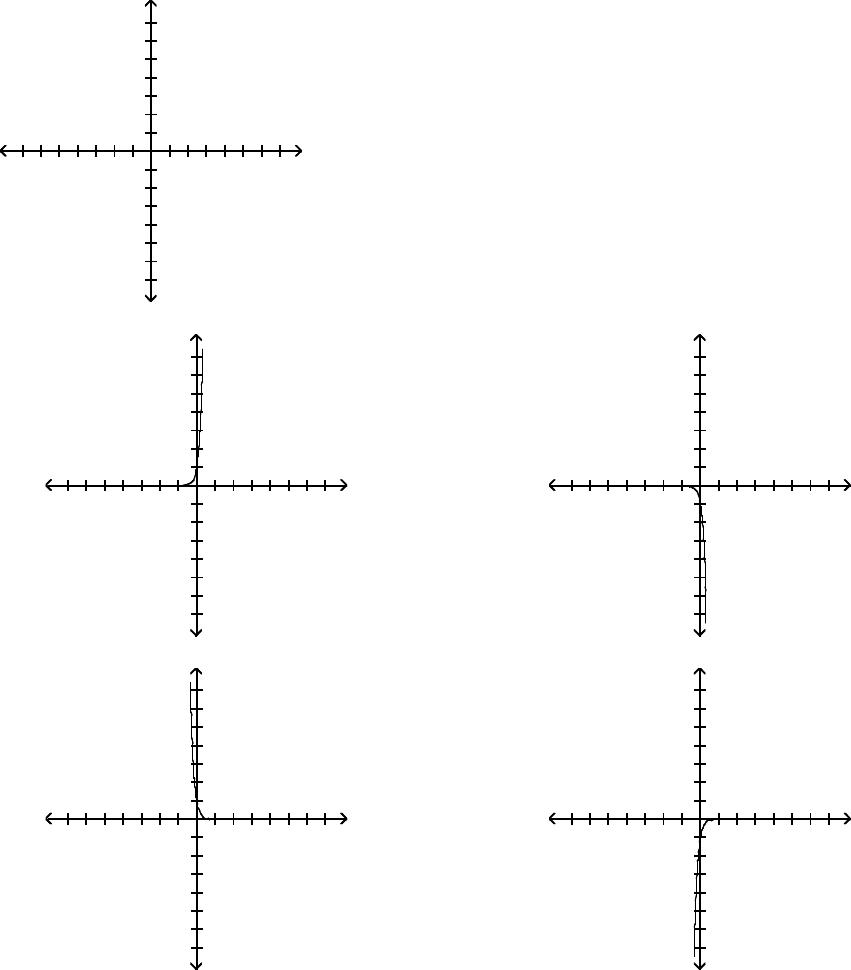
8) f(x) = e6x
x
-6 -4 -2 2 4 6
y
6
4
2
-2
-4
-6
x
-6 -4 -2 2 4 6
y
6
4
2
-2
-4
-6
A)
x
-6 -4 -2 2 4 6
y
6
4
2
-2
-4
-6
x
-6 -4 -2 2 4 6
y
6
4
2
-2
-4
-6
B)
x
-6 -4 -2 2 4 6
y
6
4
2
-2
-4
-6
x
-6 -4 -2 2 4 6
y
6
4
2
-2
-4
-6
C)
x
-6 -4 -2 2 4 6
y
6
4
2
-2
-4
-6
x
-6 -4 -2 2 4 6
y
6
4
2
-2
-4
-6
D)
x
-6 -4 -2 2 4 6
y
6
4
2
-2
-4
-6
x
-6 -4 -2 2 4 6
y
6
4
2
-2
-4
-6
Page 36
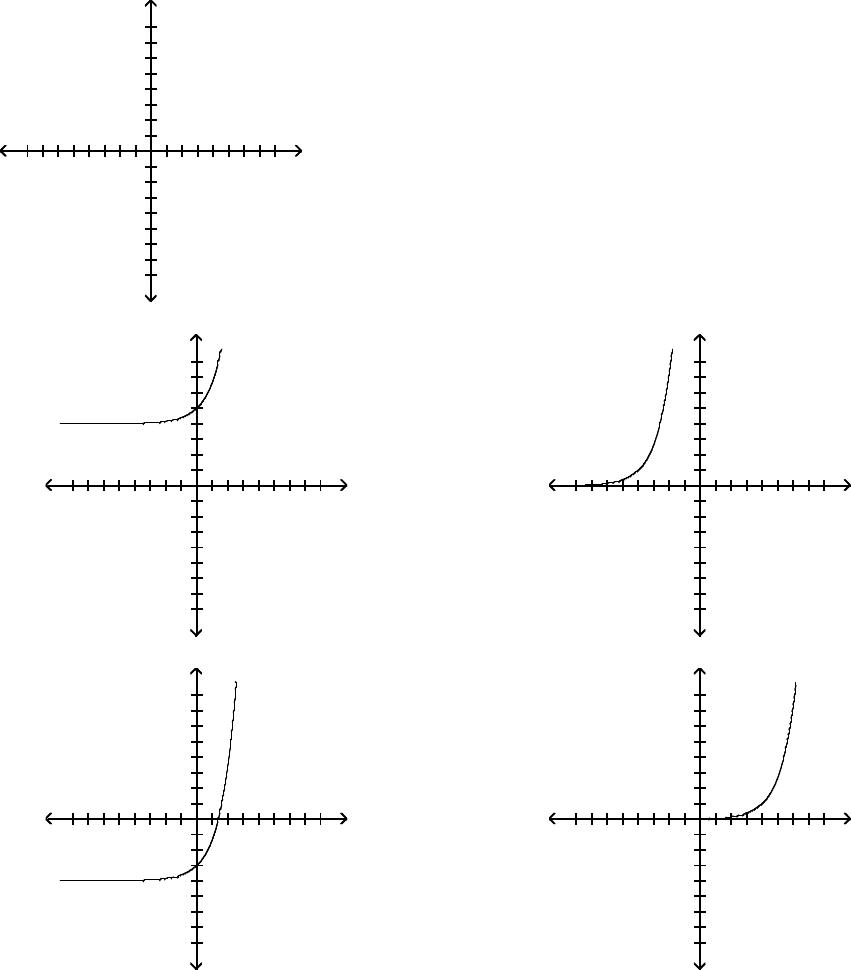
9) f(x) = ex + 4
x
–8–6–4–2 2468
y
8
6
4
2
-2
-4
-6
-8
x
–8–6–4–2 2468
y
8
6
4
2
-2
-4
-6
-8
A)
x
–8–6–4–2 2468
y
8
6
4
2
-2
-4
-6
-8
x
–8–6–4–2 2468
y
8
6
4
2
-2
-4
-6
-8
B)
x
–8–6–4–2 2468
y
8
6
4
2
-2
-4
-6
-8
x
–8–6–4–2 2468
y
8
6
4
2
-2
-4
-6
-8
C)
x
–8–6–4–2 2468
y
8
6
4
2
-2
-4
-6
-8
x
–8–6–4–2 2468
y
8
6
4
2
-2
-4
-6
-8
D)
x
–8–6–4–2 2468
y
8
6
4
2
-2
-4
-6
-8
x
–8–6–4–2 2468
y
8
6
4
2
-2
-4
-6
-8
Page 37
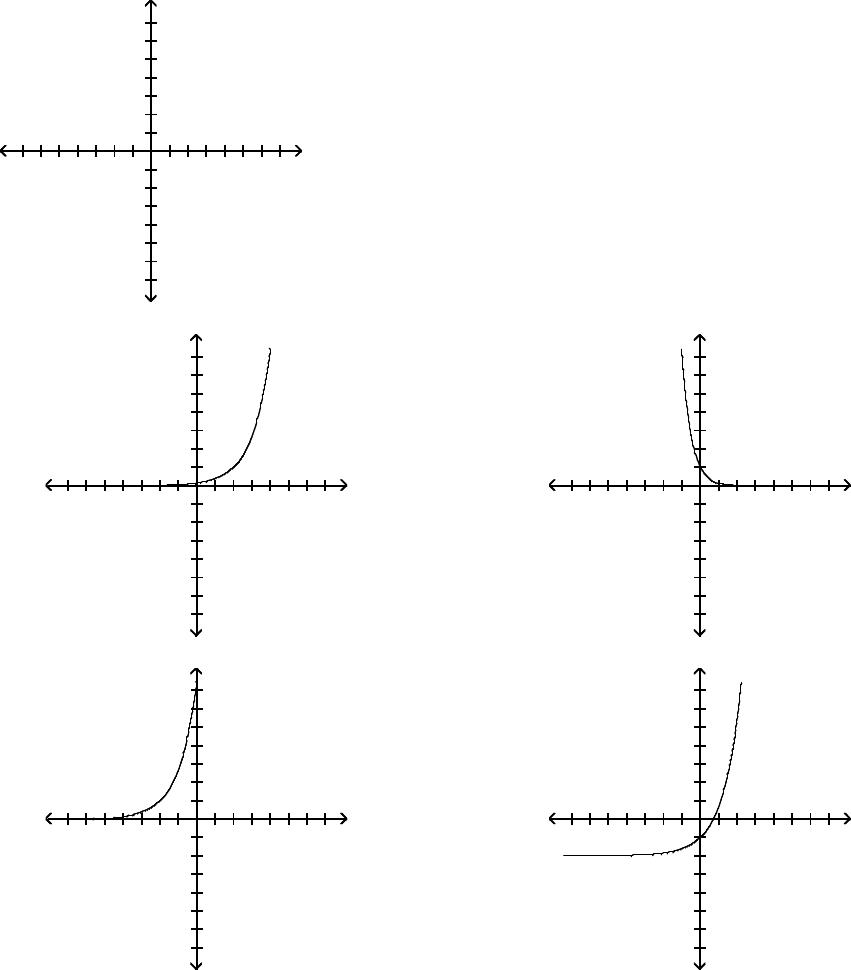
10) f(x) = ex – 2
x
-6 -4 -2 2 4 6
y
6
4
2
-2
-4
-6
x
-6 -4 -2 2 4 6
y
6
4
2
-2
-4
-6
A)
x
-6 -4 -2 2 4 6
y
6
4
2
-2
-4
-6
x
-6 -4 -2 2 4 6
y
6
4
2
-2
-4
-6
B)
x
-6 -4 -2 2 4 6
y
6
4
2
-2
-4
-6
x
-6 -4 -2 2 4 6
y
6
4
2
-2
-4
-6
C)
x
-6 -4 -2 2 4 6
y
6
4
2
-2
-4
-6
x
-6 -4 -2 2 4 6
y
6
4
2
-2
-4
-6
D)
x
-6 -4 -2 2 4 6
y
6
4
2
-2
-4
-6
x
-6 -4 -2 2 4 6
y
6
4
2
-2
-4
-6
Page 38
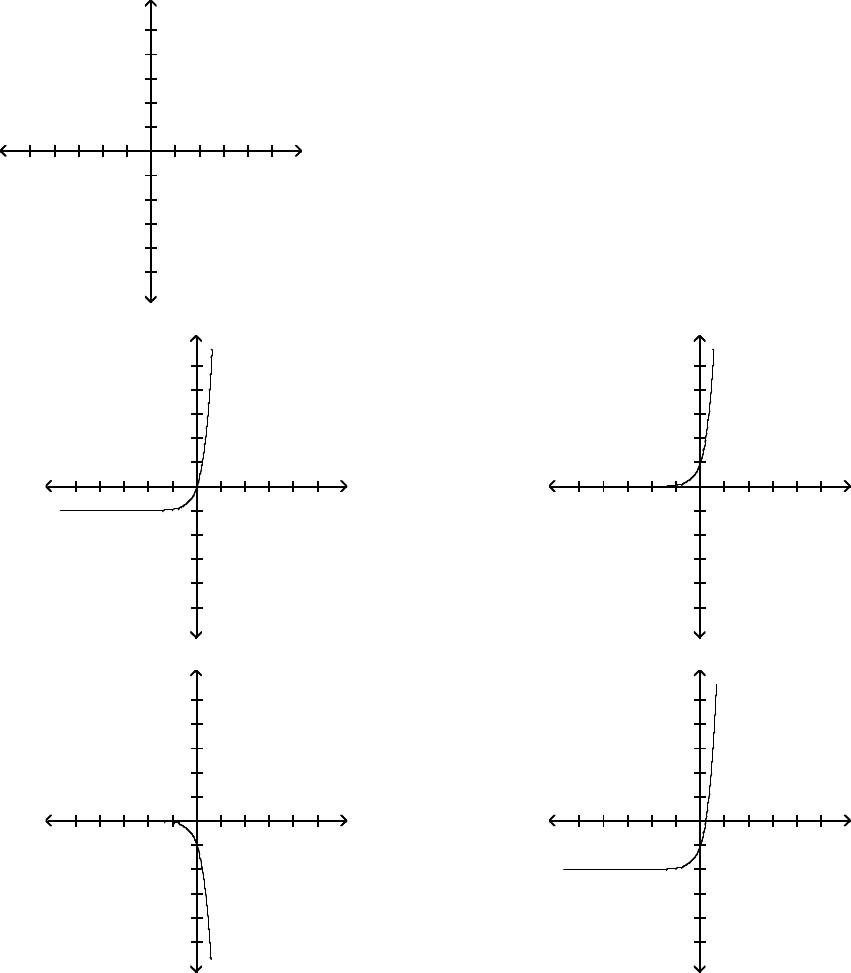
11) f(x) = e3x – 1
x
-5 -4 -3 -2 -1 1 2 3 4 5
y
5
4
3
2
1
-1
-2
-3
-4
-5
x
-5 -4 -3 -2 -1 1 2 3 4 5
y
5
4
3
2
1
-1
-2
-3
-4
-5
A)
x
-5 -4 -3 -2 -1 1 2 3 4 5
y
5
4
3
2
1
-1
-2
-3
-4
-5
x
-5 -4 -3 -2 -1 1 2 3 4 5
y
5
4
3
2
1
-1
-2
-3
-4
-5
B)
x
-5 -4 -3 -2 -1 1 2 3 4 5
y
5
4
3
2
1
-1
-2
-3
-4
-5
x
-5 -4 -3 -2 -1 1 2 3 4 5
y
5
4
3
2
1
-1
-2
-3
-4
-5
C)
x
-5 -4 -3 -2 -1 1 2 3 4 5
y
5
4
3
2
1
-1
-2
-3
-4
-5
x
-5 -4 -3 -2 -1 1 2 3 4 5
y
5
4
3
2
1
-1
-2
-3
-4
-5
D)
x
-5 -4 -3 -2 -1 1 2 3 4 5
y
5
4
3
2
1
-1
-2
-3
-4
-5
x
-5 -4 -3 -2 -1 1 2 3 4 5
y
5
4
3
2
1
-1
-2
-3
-4
-5
Page 39
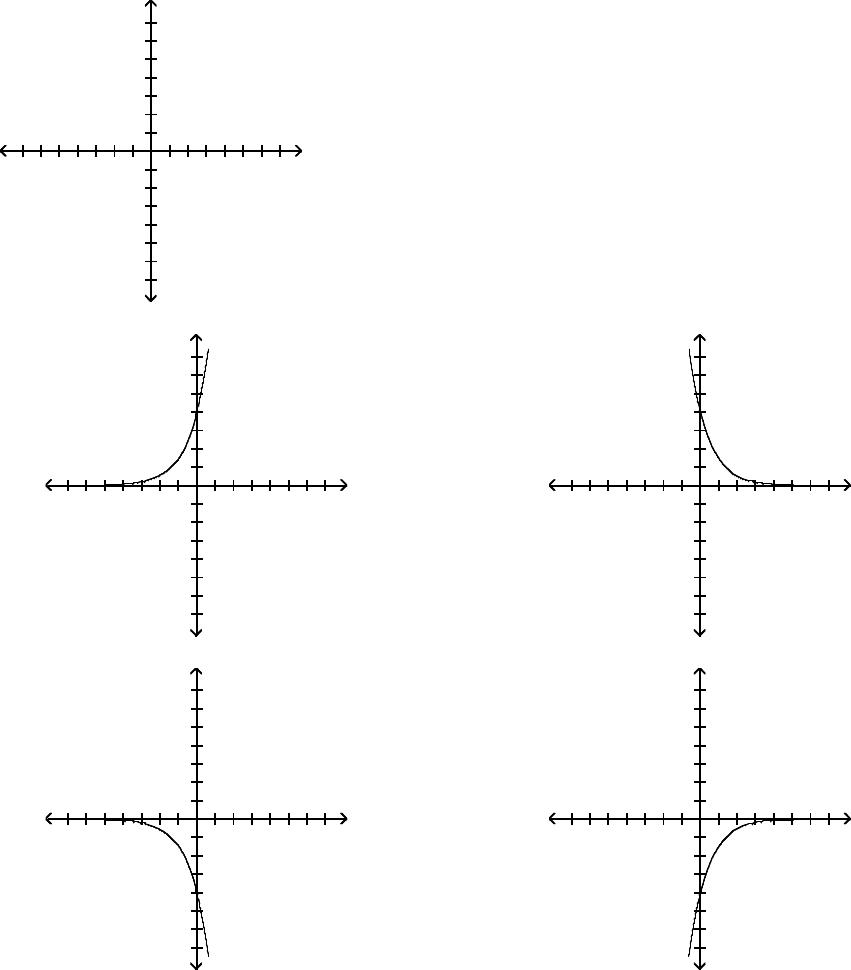
12) f(x) = 4ex
x
-6 -4 -2 2 4 6
y
6
4
2
-2
-4
-6
x
-6 -4 -2 2 4 6
y
6
4
2
-2
-4
-6
A)
x
-6 -4 -2 2 4 6
y
6
4
2
-2
-4
-6
x
-6 -4 -2 2 4 6
y
6
4
2
-2
-4
-6
B)
x
-6 -4 -2 2 4 6
y
6
4
2
-2
-4
-6
x
-6 -4 -2 2 4 6
y
6
4
2
-2
-4
-6
C)
x
-6 -4 -2 2 4 6
y
6
4
2
-2
-4
-6
x
-6 -4 -2 2 4 6
y
6
4
2
-2
-4
-6
D)
x
-6 -4 -2 2 4 6
y
6
4
2
-2
-4
-6
x
-6 -4 -2 2 4 6
y
6
4
2
-2
-4
-6
Page 40
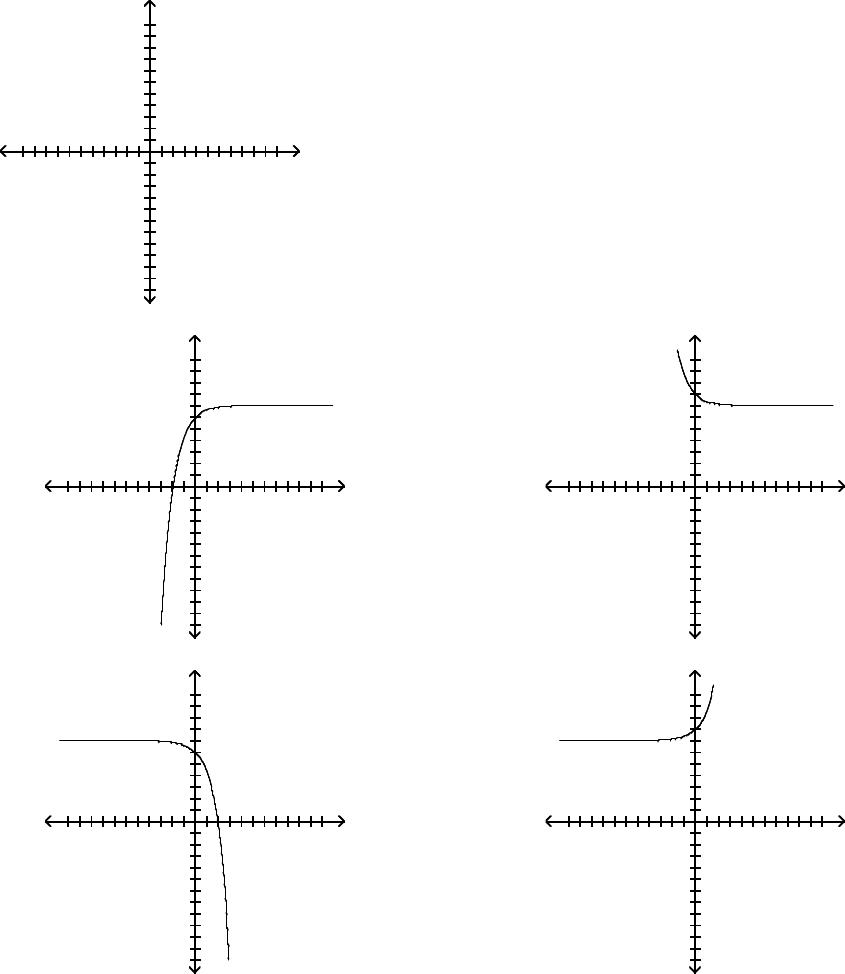
13) f(x) = 7 – e–x
x
-10 -5 5 10
y
10
5
-5
-10
x
-10 -5 5 10
y
10
5
-5
-10
A)
x
-10 -5 5 10
y
10
5
-5
-10
x
-10 -5 5 10
y
10
5
-5
-10
B)
x
-10 -5 5 10
y
10
5
-5
-10
x
-10 -5 5 10
y
10
5
-5
-10
C)
x
-10 -5 5 10
y
10
5
-5
-10
x
-10 -5 5 10
y
10
5
-5
-10
D)
x
-10 -5 5 10
y
10
5
-5
-10
x
-10 -5 5 10
y
10
5
-5
-10
Solve the problem.
14) The function D(h) = 7e–0.4h can be used to determine the milligrams D of a certain drug in a patient’s
bloodstream h hours after the drug has been given. How many milligrams (to two decimals) will be
present after 11 hours?
A) 0.09 mg B) 570.16 mg C) 4.33 mg D) 0.67 mg
15) The formula P = 14.7e–0.21x gives the average atmospheric pressure, P, in pounds per square inch, at an
altitude x, in miles above sea level. Find the average atmospheric pressure for an altitude of 2.3 miles.
Round your answer to the nearest tenth.
A) 9.1 lb/in.2B) 7.8 lb/in.2C) 11.0 lb/in.2D) 8.4 lb/in.2
Page 41
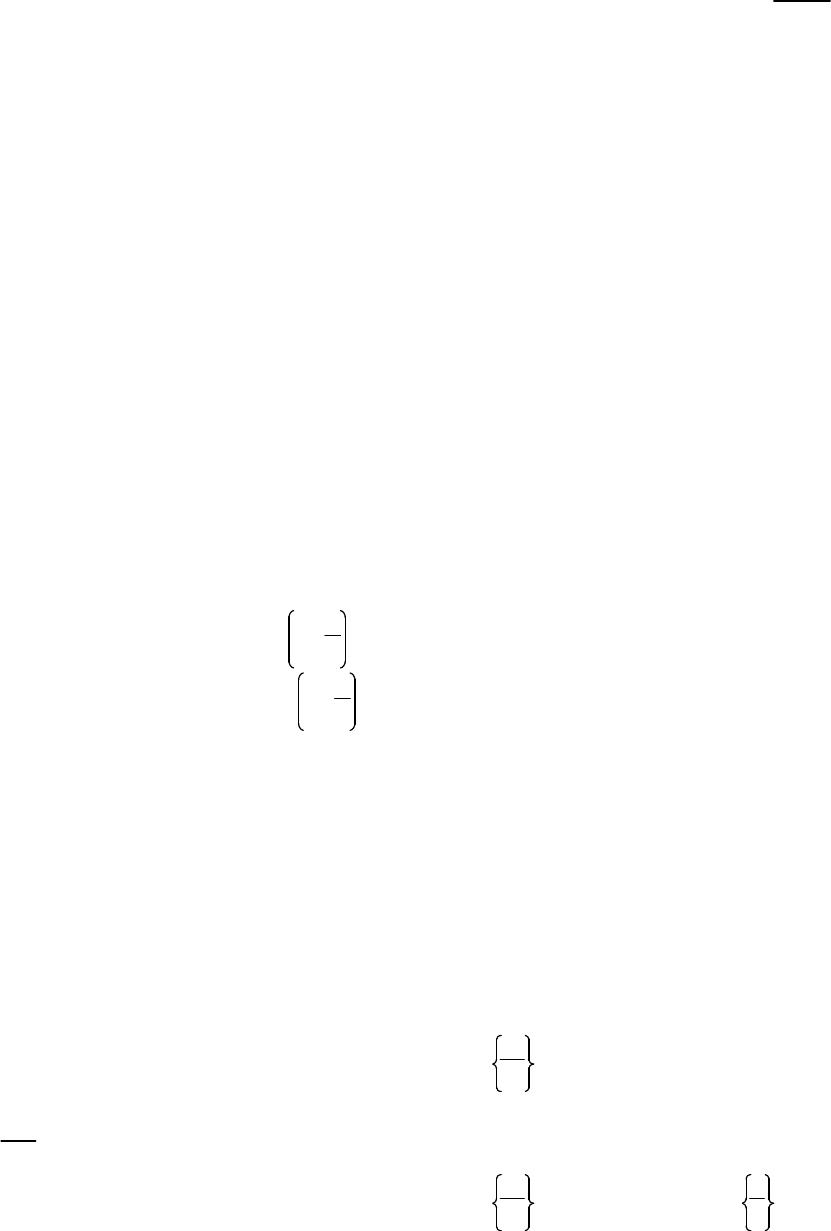
16) A grocery store normally sells 6 jars of caviar per week. Use the Poisson Distribution P(x) = 6xe–6
x! to find
the probability (to three decimals) of selling 3 jars in a week. (x! = x · (x – 1) · (x – 2) · . . . · (3)(2)(1)).
A) 0.089 B) 0.268 C) 0.178 D) 0.059
SHORT ANSWER. Write the word or phrase that best completes each statement or answers the question.
17) A rumor is spread at an elementary school with 1200 students according to the model
N = 1200(1 – e–0.16d) where N is the number of students who have heard the rumor and d is the number
of days that have elapsed since the rumor began. How many students will have heard the rumor after 5
days?
18) Instruments on a satellite measure the amount of power generated by the satellite’s power supply. The
time t and the power P can be modeled by the function P = 50e–t/300, where t is in days and P is in watts.
How much power will be available after 378 days? Round to the nearest hundredth.
19) A cancer patient undergoing chemotherapy is injected with a particular drug. The functio
n
D(h) = 4e–0.35h gives the number of milligrams D of this drug that is in the patient’s bloodstream h hours
after the drug has been administered. How many milligrams of the drug were injected? To the nearest
milligram, how much of the drug will be present after 2 hours?
MULTIPLE CHOICE. Choose the one alternative that best completes the statement or answers the question.
20) Define the number e.
A) The number that the expression, 1 + 1
n
n, approaches as n → ∞.
B) The number defined by e = lim
n→∞ 1 + 1
n
n in Calculus.
C) The number approximately equal to 2.72.
D) All of these.
4 Solve Exponential Equations
MULTIPLE CHOICE. Choose the one alternative that best completes the statement or answers the question.
Solve the equation.
1) 21 + 2x = 32
A) {2} B) {16} C) {4} D) {–2}
2) 18x = 1
A) {0} B) {1} C) 1
18 D) ∅
3) 5–x = 1
125
A) {3} B) {–3} C) 1
25 D) 1
3
Page 42
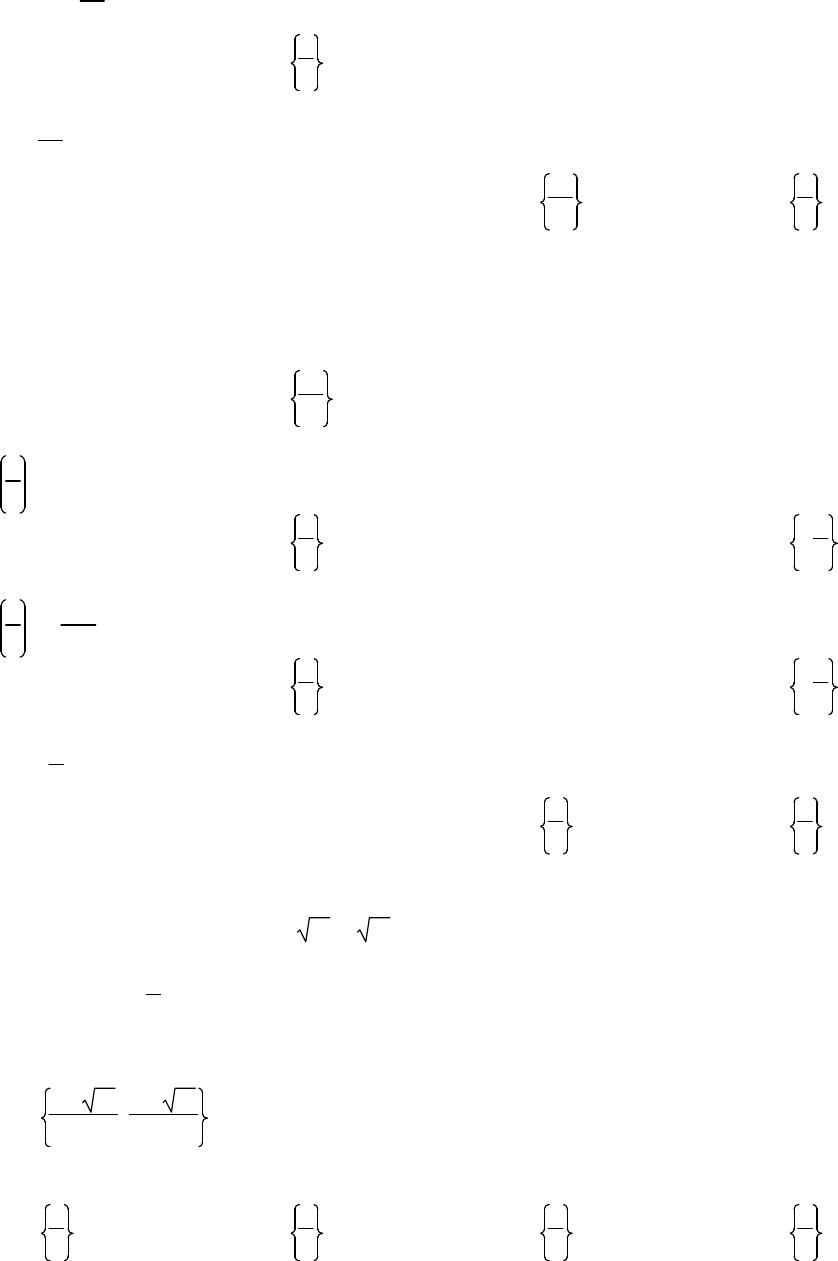
4) 36 – 3x = 1
27
A) {3} B) 1
9C) {9} D) {–3}
5) 4x = 1
64
A) {–3} B) {3} C) 1
16 D) 1
3
6) 3x = 81
A) {4} B) {27} C) {5} D) {3}
7) 4(3x – 5 ) = 256
A) {3} B) 1
64 C) {128} D) {–3}
8) 1
4
x = 16
A) {–2} B) 1
2C) {2} D) – 1
2
9) 9
8
x = 512
729
A) {–3} B) 1
3C) {3} D) – 1
3
10) 2–x = 1
8
A) {3} B) {–3} C) 1
4D) 1
3
11) 2x2 – 3= 64
A) {3, –3} B) { 35, – 35} C) {3} D) {6}
12) 92x · 27(3 – x) = 1
9
A) {–11} B) {–8}
C) 9 + 87
6, 9 – 87
6D) {10}
13) 32x = 16
A) 4
5B) 5
4C) 1
5D) 1
4
14) 2(10 – 2x) = 16
A) {3} B) {4} C) {2} D) {–3}
Page 43
15) 83x – 3 = 325x
A) – 9
16 B) – 16
9C) 9
16 D) 16
9
16) 8x – 1 = 44x
A) – 3
5B) – 1
5C) –1 D) – 1
3
17) 64
27
x + 1= 3
4
x – 1
A) – 1
2B) 1
2C) –1 D) – 1
4
18) 1
3
3x + 5 = 9x – 1
A) – 3
5B) – 4
5C) 7
3D) – 1
19) (ex)x · e6 = e5x
A) {2
,
3} B) {–2
,
–3} C) {2} D) {3}
20) e3x – 1 = (e4)–x
A) 1
7B) – 1 C) 5
4D) {0}
21) ex – 1 = 1
e6
x + 1
A) – 5
7B) – 7
5C) 2
7D) – 2
5
Solve the problem.
22) The rabbit population in a forest area grows at the rate of 6% monthly. If there are 290 rabbits in
J
uly
,
find
how many rabbits (rounded to the nearest whole number) should be expected by next July. Use
y = 290(2.7)0.06t
A) 593 B) 564 C) 606 D) 580
23) Four bacteria are placed in a petri dish. The population will triple every day. The formula for the number
of bacteria in the dish on day t is
N(t) = 4(3)t
where t is the number of days after the four bacteria are placed in the dish. How many bacteria are in the
dish six days after the four bacteria are placed in the dish?
A) 2916 B) 72 C) 864 D) 13
24) The bacteria in a 8–liter container double every 4 minutes. After 48 minutes the container is full. How long
did it take to fill a quarter of the container?
A) 40 min B) 12 min C) 36 min D) 24 min
Page 44

25) The number of books in a small library increases according to the function B = 7700e0.04t, where t is
measured in years. How many books will the library have after 5 years?
A) 9405 B) 5382 C) 12,393 D) 12,204
26) A city has been growing at a rate of 0.5% annually. If there are currently 2,242,000 residents in the city,
how many (to the nearest ten–thousand) would be living in this city five years from now? Use
y = 2,242,000(2.7)0.005t.
A) 2,300,000 B) 150,000 C) 6,050,000 D) 2,330,000
27) The amount of a radioactive substance present, in grams, at time t in months is given by the formula
y = 6000(3)–0.3t. Find the number of grams present in 3 years. If necessary, round to three decimal places.
A) 0.042 B) 2232.246 C) 0.004 D) 223.225
28) Find the amount in a savings account at the end of 10 years if the amount originally deposited is $3000 and
the interest rate is 5% compounded semiannually.
Use: A = P1 + r
n
ntwhere:
A = final amount
P = $3000 (the initial deposit)
r = 5% = 0.05 (the annual rate of interest)
n = 2 (the number of times interest is compounded each year)
t = 10 (the duration of the deposit in years)
A) $4915.85 B) $5407.43 C) $61,500.00 D) $3840.25
29) Daryl borrows $5000 at a rate of 9.5% compounded quarterly. Find how much Daryl owes at the end of 5
years.
Use: A = P1 + r
n
ntwhere:
A = final amount
P = $5000 (the amount borrowed)
r = 9.5% = 0.095 (the annual rate of interest)
n = 4 (the number of times interest is compounded each year)
t = 5 (the duration of the loan in years)
A) $7995.55 B) $8795.10 C) $102,375.00 D) $5622.63
30) Suppose that f(x) = 4x. What is f(3)? What point is on the graph of f?
A) 64; (3
,
64) B) 64; (3
,
4) C) 81; (3
,
81) D) 81; (4
,
81)
31) Suppose that f(x) = 5x. If f(x) = 1
625 , what is x?
A) –4 B) 4 C) 5 D) –5
32) Suppose that f(x) = 5x + 6. What is f(5)? What point is on the graph of f?
A) 3131; (5
,
3131) B) 3125; (5
,
3125) C) 3125; (6
,
3125) D) 3131; (5
,
3125)
33) Suppose that f(x) = 5x + 9. If f(x) = 15,634, what is x?
A) 6 B) –6C)9 D)
–9
Page 45
6.4 Logarithmic Functions
1 Change Exponential Statements to Logarithmic Statements & Logarithmic Statements to Exponential Statements
MULTIPLE CHOICE. Choose the one alternative that best completes the statement or answers the question.
Change the exponential expression to an equivalent expression involving a logarithm.
1) 63 = 216
A) log 6216 = 3 B) log 216 6=3 C) log 3216 =6 D) log 63=216
2) 3–3 = 1
27
A) log 31
27 = –3 B) log 1/27 3= –3 C) log –31
27 = 3 D) log 3–3 = 1
27
3) 32 = x
A) log 3x = 2 B) log x3=2 C) log 2x =3 D) log 32=x
4) 161
/
4 = 2
A) log 16 2 = 1
4B) log 216 = 1
4C) log 42
log 116 = 16 D) log 116 = 1
4
5) 9x = 81
A) log 981 = x B) log x81 =9 C) log 81 9=x D) log 81 x =9
6) ex = 25
A) ln 25 = x B) log25 x =e C) ln x =25 D) logxe =25
Change the logarithmic expression to an equivalent expression involving an exponent.
7) log 1/3 27 = –3
A) 1
3
–3 = 27 B) 1
3
3 = 27 C) (–3)1
/
3 = 27 D) 271
/
3 = 3
8) log 41
16 = –2
A) 4–2 = 1
16 B) 24 = 1
16 C) 416 = 2D)
1
16
2 = 4
9) log 39 = 2
A) 32 = 9B)2
3 = 9C)3
9 = 2D)9
2 = 3
10) log 2x = 3
A) 23 = xB)3
2 = xC)2
x = 3D)x
3 = 2
11) log b16 = 4
A) b4 = 16 B) 4b = 16 C) 164 = bD)16
b = 4
Page 46

12) log 232 = x
A) 2x = 32 B) x2 = 32 C) 32x = 2D)32
2 = x
13) logb 49 = 2
3
A) b2/3= 49 B) 492/3 = bC)
2
3
b = 49 D) b3/2 = 49
14) ln x = 6
A) e6 = xB)e
x = 6C)6
e = xD)x
6 = e
15) ln 1
e5 = –5
A) e–5 = 1
e5B) 1
e5
e = –5C)
1
e5
–5 = eD)
–5e = 1
e5
2 Evaluate Logarithmic Expressions
MULTIPLE CHOICE. Choose the one alternative that best completes the statement or answers the question.
Find the exact value of the logarithmic expression.
1) log5 625
A) 4 B) 625 C) 20 D) 5
2) log8 1
64
A) –2 B) 2 C) 8 D) –8
3) log7 1
343
A) –3 B) 3 C) 49 D) –49
4) log4 1
64
A) –3B)3 C)
1
3D) – 1
3
5) log 51
A) 0 B) 5 C) 1
5D) 1
6) log1/3 27
A) –3B)3 C)
1
3D) – 1
3
7) log 44
A) 1
2B) 4 C) 1
4D) 1
Page 47

8) log 10 10,000
A) 4 B) 40 C) 1
10000 D) –4
9) ln 1
A) 0 B) 1 C) e D) –1
10) ln e
A) 1 B) 0 C) e D) –1
11) ln e12
A) 12 B) e C) 1
12 D) 1
Use a calculator to evaluate the expression. Round your answer to three decimal places
12) log 3
8
A) –0.426 B) –0.981 C) –2.348 D) 0.426
13)
ln 5
4
0.15
A) 1.488 B) –2.120 C) –0.118 D) 2.120
14) log 7 + log 9
ln 3 – ln 9
A) –1.638 B) 0.099 C) –3.771 D) 0.546
15) e log 50 + ln 4
log 2 + ln 20
A) 1.821 B) 0.980 C) 0.936 D) –2.228
Solve the problem.
16) The pH of a chemical solution is given by the formula pH = –log10[H+], where [H+] is the concentration of
hydrogen ions in moles per liter. Find the pH if [H+] = 3.4 × 10⁻⁶. Round to the nearest hundredth.
A) 5.47 B) 6.53 C) 6.47 D) 5.53
17) The long jump record, in feet, at a particular school can be modeled by f(x) =20.4 + 2.1 ln(x +1) where x is
the number of years since records began to be kept at the school. What is the record for the long jump
11 years after record started being kept? Round your answer to the nearest tenth.
A) 25.6 ft B) 25.4 ft C) 25.2 ft D) 22.5 ft
18) The function f(x) = 1 + 1.4 ln(x + 1) models the average number of free–throws a basketball player can
make consecutively during practice as a function of time, where x is the number of consecutive days the
basketball player has practiced for two hours. After 16 days of practice, what is the average number of
consecutive free throws the basketball player makes?
A) 5 consecutive free throws B) 6 consecutive free throws
C) 8 consecutive free throws D) 9 consecutive free throws
Page 48
19) The number of young adults dying of a certain disease (in thousands) since 2010 is modeled by
y = 17.3 + 10.06(ln x), where x represents the number of years after 2010. Use this model to predict the
number of deaths among young adults in 2017. Round to the nearest hundred.
A) 36,900 men B) 37,000 men C) 25,800 men D) 26,000 men
20) Find a so that the graph of f(x) = logax contains the point (16
,
3). Give an exact answer.
A) 316 B) 16 3 C) 3
16 D) 16
3
3 Determine the Domain of a Logarithmic Function
MULTIPLE CHOICE. Choose the one alternative that best completes the statement or answers the question.
Find the domain of the function.
1) f(x) = log(x + 10)
A) (–10
,
∞)B)(10
,
∞) C) (0, ∞) D) (1, ∞)
2) f(x) = ln(4 – x)
A) (–∞
,
4) B) (4
,
∞)C)(
–∞
,
–4) D) (–4
,
∞)
3) f(x) = log8(49 – x2)
A) (–7
,
7) B) [–7
,
7] C) (–∞
,
–7) ∪(7
,
∞)D)(
–49
,
49)
4) f(x) = log10 x + 2
x – 8
A) (–∞
,
–2) ∪ (8
,
∞)B)(
–2
,
8) C) (8
,
∞)D)(
–∞
,
–2)
5) f(x) = ln 1
x + 9
A) (–9
,
∞)B)(9
,
∞) C) (0, ∞) D) (1, ∞)
6) f(x) = 5 – ln(7x)
A) (0, ∞)B)(
–5
,
7) C) (7
,
∞)D)(
–∞
,
5) ∪(7
,
∞)
7) f(x) = ln x
A) (0, ∞) B) (1, ∞)C)(
–∞
,
1) D) (–∞
,
0)
Page 49
4 Graph Logarithmic Functions
MULTIPLE CHOICE. Choose the one alternative that best completes the statement or answers the question.
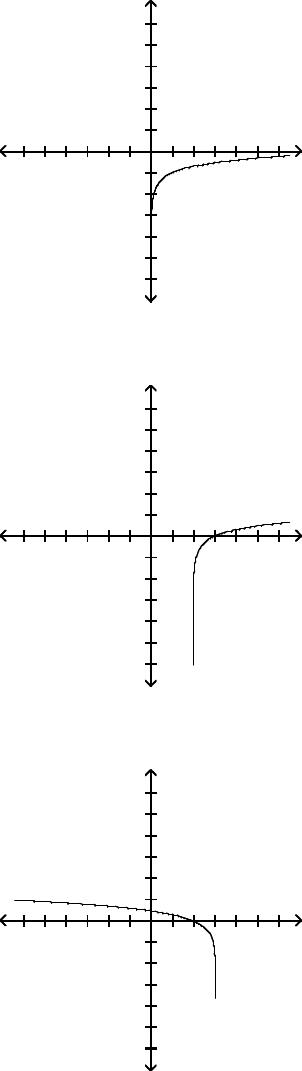
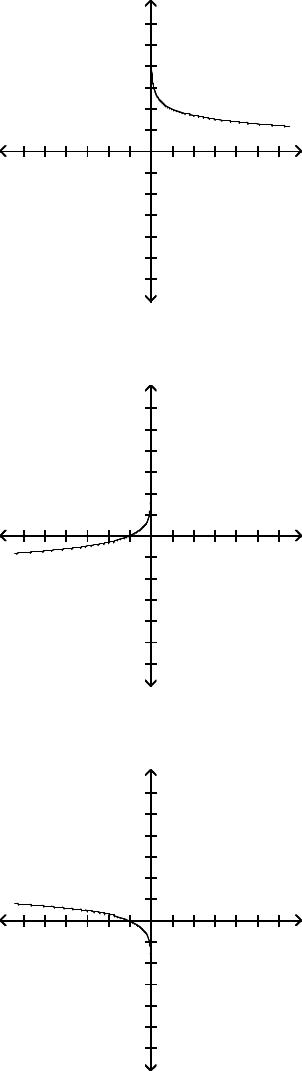
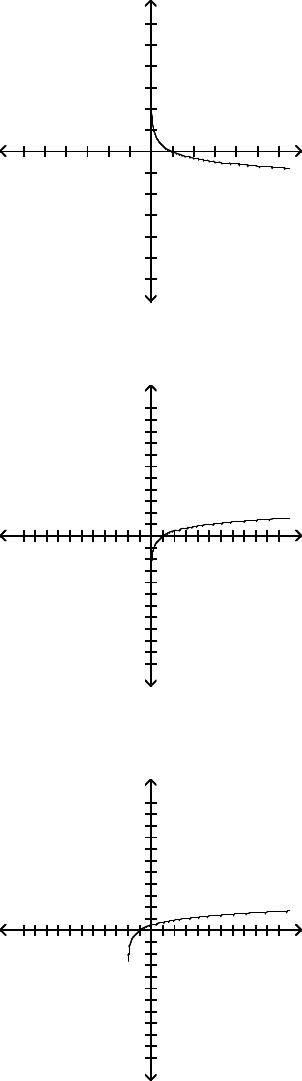
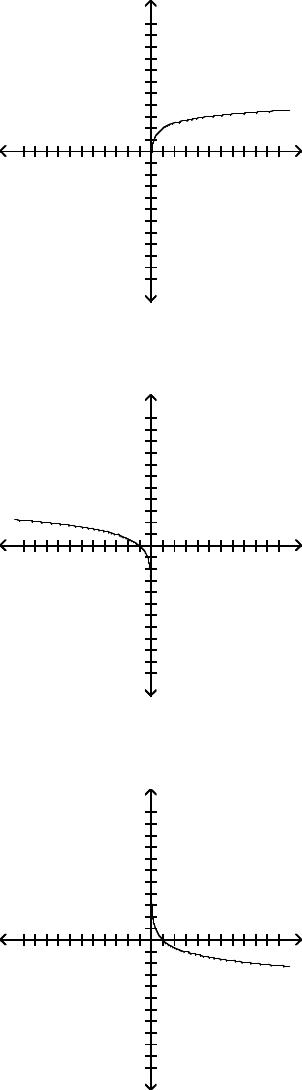
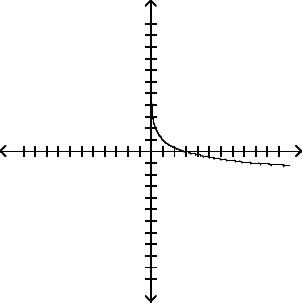
The graph of a logarithmic function is shown. Select the function which matches the graph.
1)
x
-5 5
y
5
-5
x
-5 5
y
5
-5
A) y = log x – 1B)y = 1 –log x C) y =log(1 –x) D) y =log(x –1)
2)
x
-5 5
y
5
-5
x
-5 5
y
5
-5
A) y = log(x – 2) B) y = 2 –log x C) y =log(2 –x) D) y =log x –2
3)
x
-5 5
y
5
-5
x
-5 5
y
5
-5
A) y = log(3 – x) B) y = 3 –log x C) y =log(x –3) D) y =log x –3
Page 50
4)
x
-5 5
y
5
-5
x
-5 5
y
5
-5
A) y = 2 – log x B) y = log(x –2) C) y =log(2 –x) D) y =log x –2
5)
x
-5 5
y
5
-5
x
-5 5
y
5
-5
A) y = –log(–x) B) y = log(–x) C) y = –log x D) y =log x
6)
x
-5 5
y
5
-5
x
-5 5
y
5
-5
A) y = log(–x) B) y = –log(–x) C) y = –log x D) y =log x
Page 51
7)
x
-5 5
y
5
-5
x
-5 5
y
5
-5
A) y = –log x B) y = log(–x) C) y = –log(–x) D) y =log x
8)
x
-10 -5 5 10
y
10
5
-5
-10
x
-10 -5 5 10
y
10
5
-5
-10
A) y = log 5xB)y
= log5(x +2) C) y =log 5(x –2) D) y =log 5x +2
9)
x
-10 -5 5 10
y
10
5
-5
-10
x
-10 -5 5 10
y
10
5
-5
-10
A) y = log 5(x + 2) B) y = log 5xC)y
=log 5(x –2) D) y =log 5x +2
Page 52
10)
x
-10 -5 5 10
y
10
5
-5
-10
x
-10 -5 5 10
y
10
5
-5
-10
A) y = log 5x + 2B)y = log 5xC)y
=log 5(x –2) D) y =log 5(x +2)
11)
x
-10 -5 5 10
y
10
5
-5
-10
x
-10 -5 5 10
y
10
5
-5
-10
A) y = log 3(–x) B) y = –log 3xC)y
=1 –log 3xD)y
=log 3x
12)
x
-10 -5 5 10
y
10
5
-5
-10
x
-10 -5 5 10
y
10
5
-5
-10
A) y = –log 3xB)y
= log3(–x) C) y =1 –log 3xD)y
=log 3x
Page 53
13)
x
-10 -5 5 10
y
10
5
-5
-10
x
-10 -5 5 10
y
10
5
-5
-10
A) y = 1 – log 3xB)y
= log3(–x) C) y = – log 3xD)y
=log 3x
Page 54
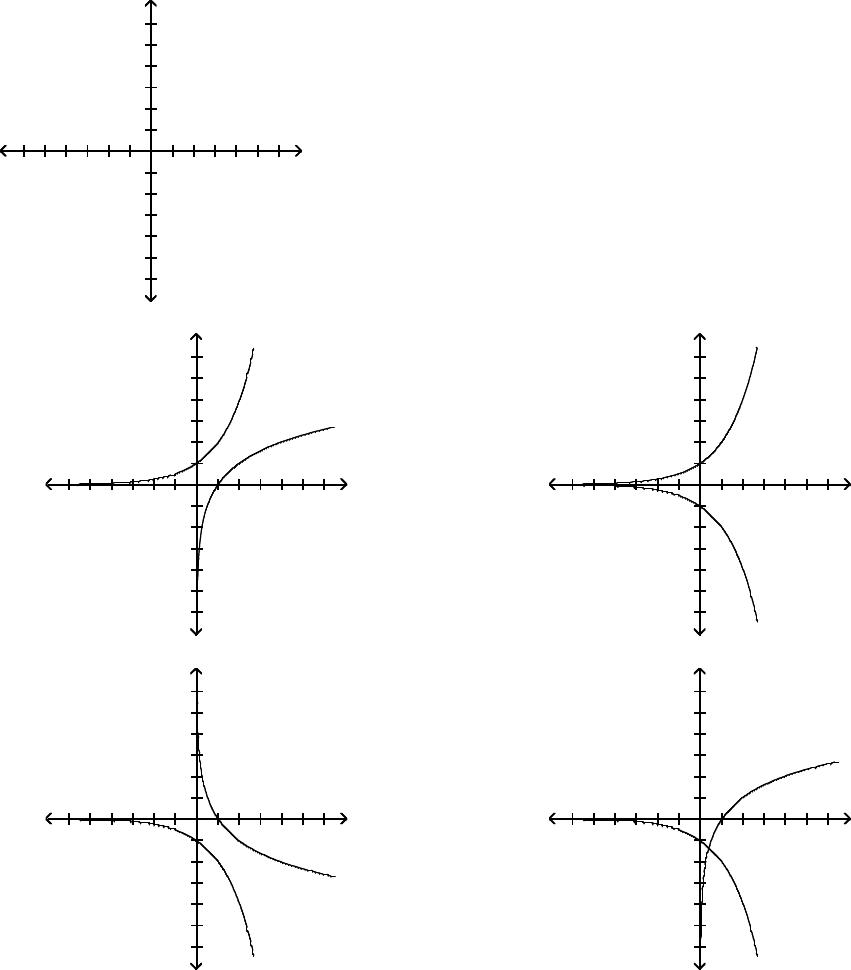
Graph the function and its inverse on the same Cartesian plane.
14) f(x) = log2 x
x
-5 5
y
5
-5
x
-5 5
y
5
-5
A)
x
-5 5
y
5
-5
x
-5 5
y
5
-5
B)
x
-5 5
y
5
-5
x
-5 5
y
5
-5
C)
x
-5 5
y
5
-5
x
-5 5
y
5
-5
D)
x
-5 5
y
5
-5
x
-5 5
y
5
-5
Page 55
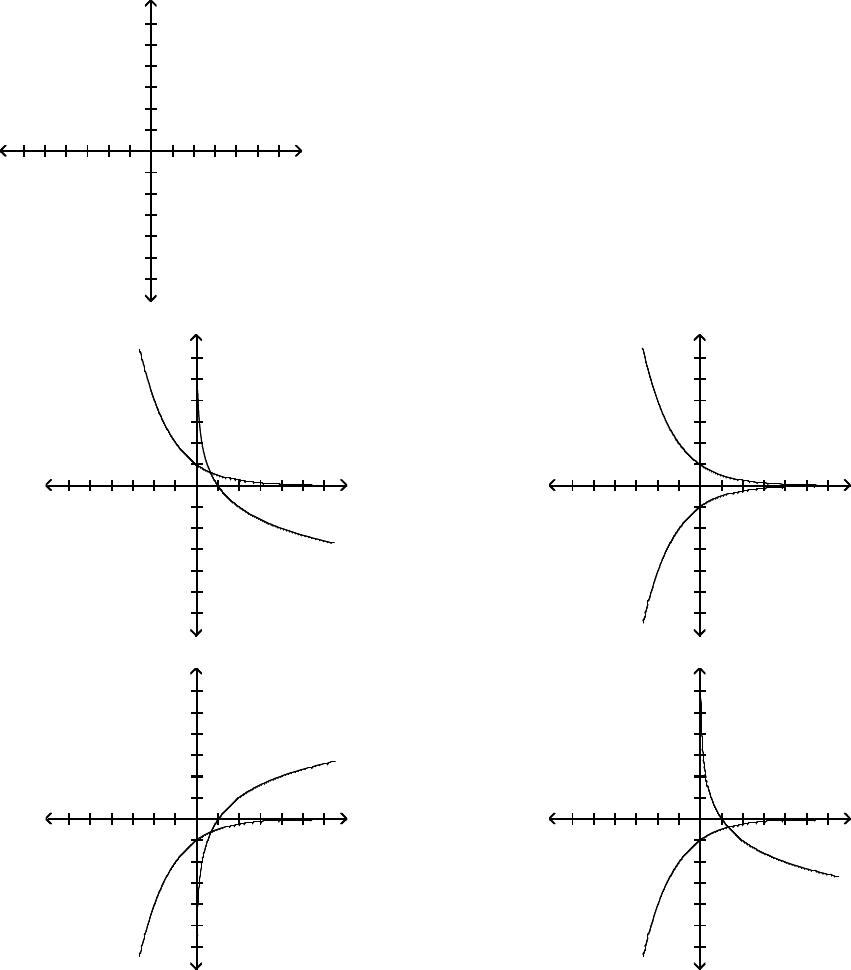
15) f(x) = log1/2 x
x
-5 5
y
5
-5
x
-5 5
y
5
-5
A)
x
-5 5
y
5
-5
x
-5 5
y
5
-5
B)
x
-5 5
y
5
-5
x
-5 5
y
5
-5
C)
x
-5 5
y
5
-5
x
-5 5
y
5
-5
D)
x
-5 5
y
5
-5
x
-5 5
y
5
-5
Page 56
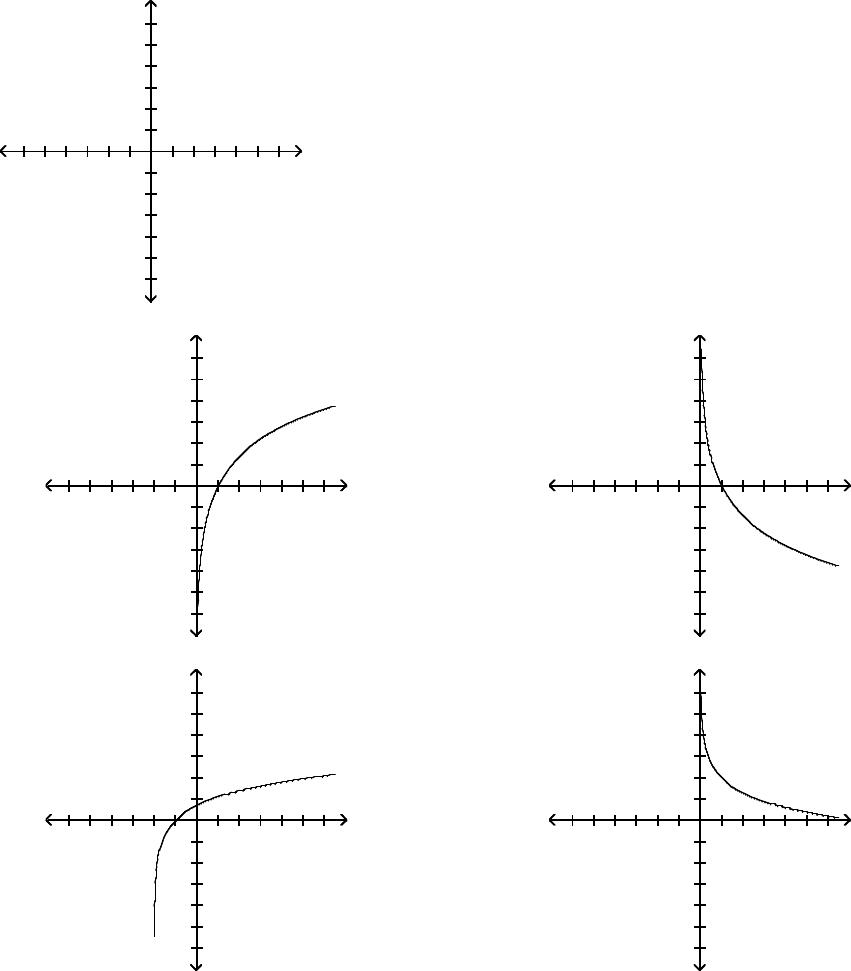
Graph the function.
16) f(x) = 2 ln x
x
-5 5
y
5
-5
x
-5 5
y
5
-5
A)
x
-5 5
y
5
-5
x
-5 5
y
5
-5
B)
x
-5 5
y
5
-5
x
-5 5
y
5
-5
C)
x
-5 5
y
5
-5
x
-5 5
y
5
-5
D)
x
-5 5
y
5
-5
x
-5 5
y
5
-5
Page 57
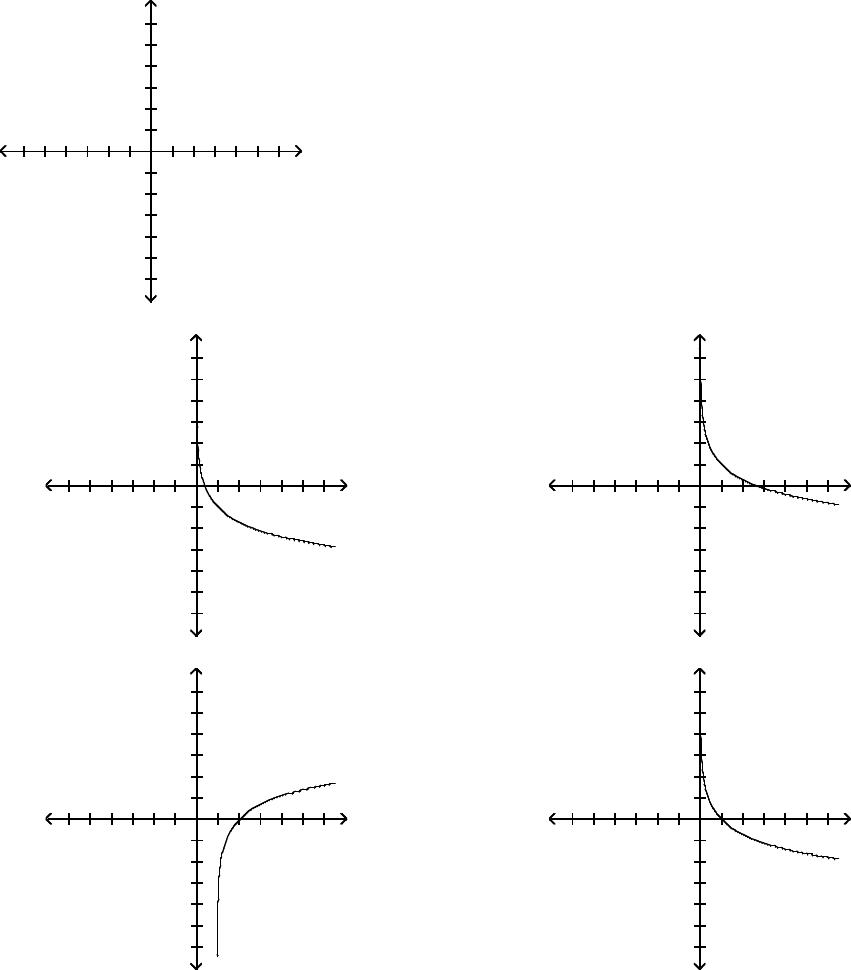
17) f(x) = –1 – ln x
x
-5 5
y
5
-5
x
-5 5
y
5
-5
A)
x
-5 5
y
5
-5
x
-5 5
y
5
-5
B)
x
-5 5
y
5
-5
x
-5 5
y
5
-5
C)
x
-5 5
y
5
-5
x
-5 5
y
5
-5
D)
x
-5 5
y
5
-5
x
-5 5
y
5
-5
Page 58
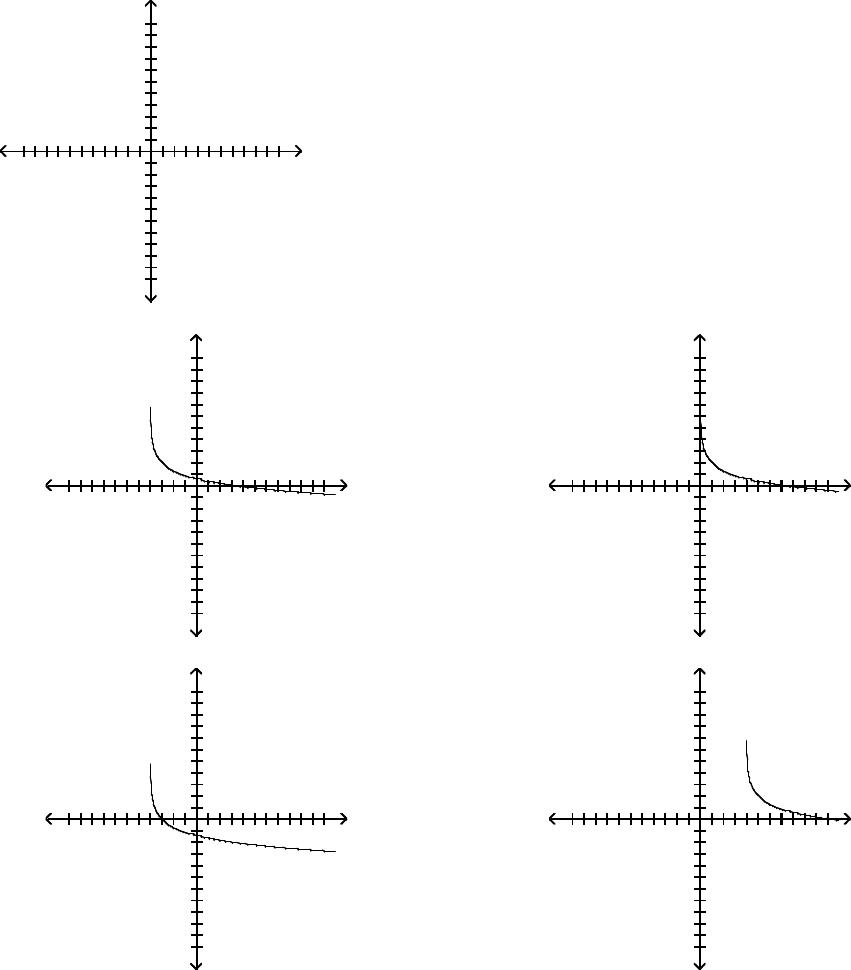
18) f(x) = 2 – ln(x + 4)
x
-10 -5 5 10
y
10
5
-5
-10
x
-10 -5 5 10
y
10
5
-5
-10
A)
x
-10 -5 5 10
y
10
5
-5
-10
x
-10 -5 5 10
y
10
5
-5
-10
B)
x
-10 -5 5 10
y
10
5
-5
-10
x
-10 -5 5 10
y
10
5
-5
-10
C)
x
-10 -5 5 10
y
10
5
-5
-10
x
-10 -5 5 10
y
10
5
-5
-10
D)
x
-10 -5 5 10
y
10
5
-5
-10
x
-10 -5 5 10
y
10
5
-5
-10
Page 59
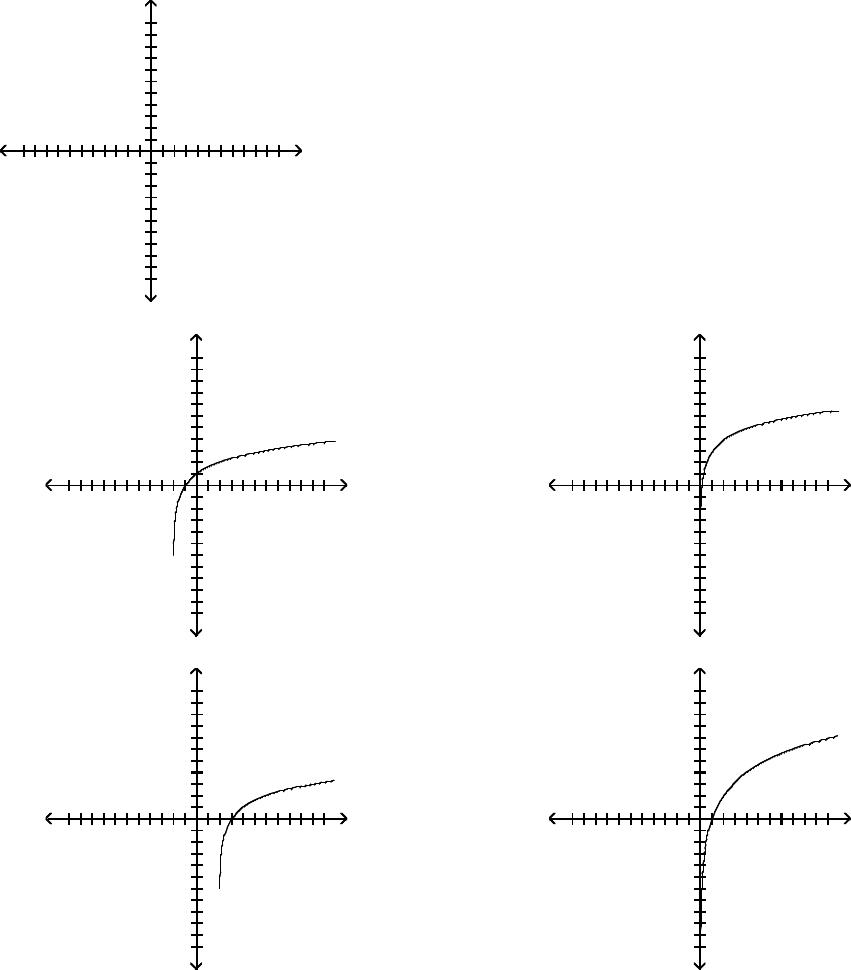
19) f(x) = log2(x + 2)
x
-10 -5 5 10
y
10
5
-5
-10
x
-10 -5 5 10
y
10
5
-5
-10
A)
x
-10 -5 5 10
y
10
5
-5
-10
x
-10 -5 5 10
y
10
5
-5
-10
B)
x
-10 -5 5 10
y
10
5
-5
-10
x
-10 -5 5 10
y
10
5
-5
-10
C)
x
-10 -5 5 10
y
10
5
-5
-10
x
-10 -5 5 10
y
10
5
-5
-10
D)
x
-10 -5 5 10
y
10
5
-5
-10
x
-10 -5 5 10
y
10
5
-5
-10
Page 60
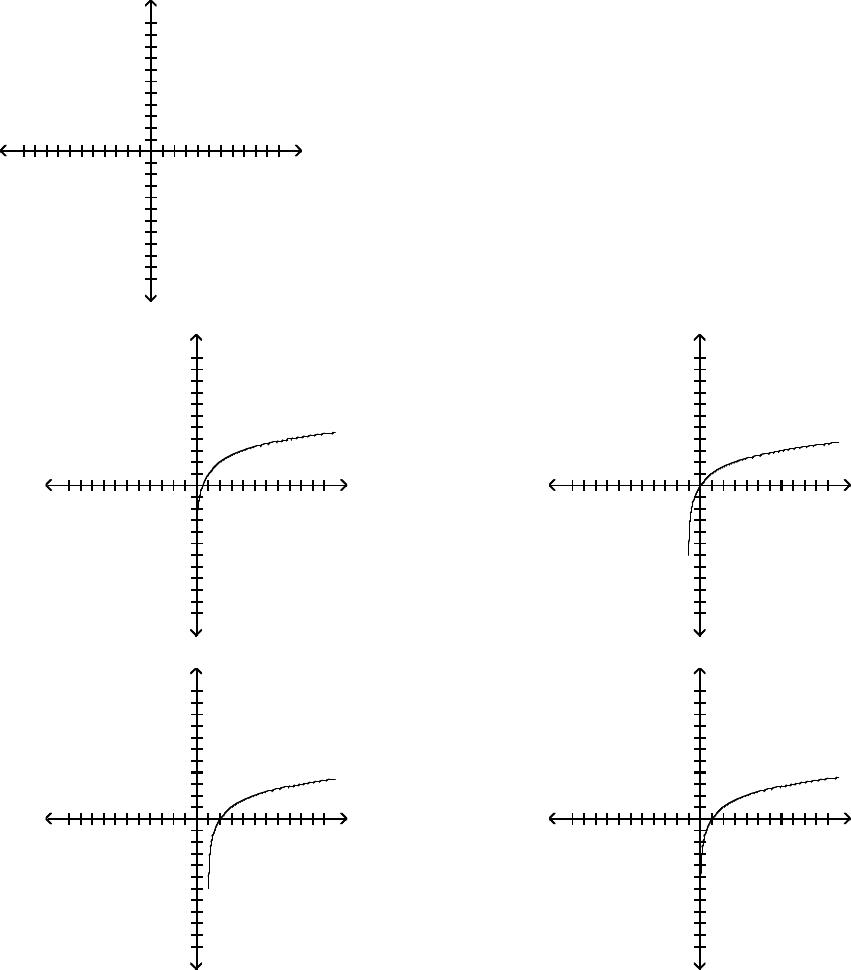
20) f(x) = 1 + log2x
x
-10 -5 5 10
y
10
5
-5
-10
x
-10 -5 5 10
y
10
5
-5
-10
A)
x
-10 -5 5 10
y
10
5
-5
-10
x
-10 -5 5 10
y
10
5
-5
-10
B)
x
-10 -5 5 10
y
10
5
-5
-10
x
-10 -5 5 10
y
10
5
-5
-10
C)
x
-10 -5 5 10
y
10
5
-5
-10
x
-10 -5 5 10
y
10
5
-5
-10
D)
x
-10 -5 5 10
y
10
5
-5
-10
x
-10 -5 5 10
y
10
5
-5
-10
Page 61
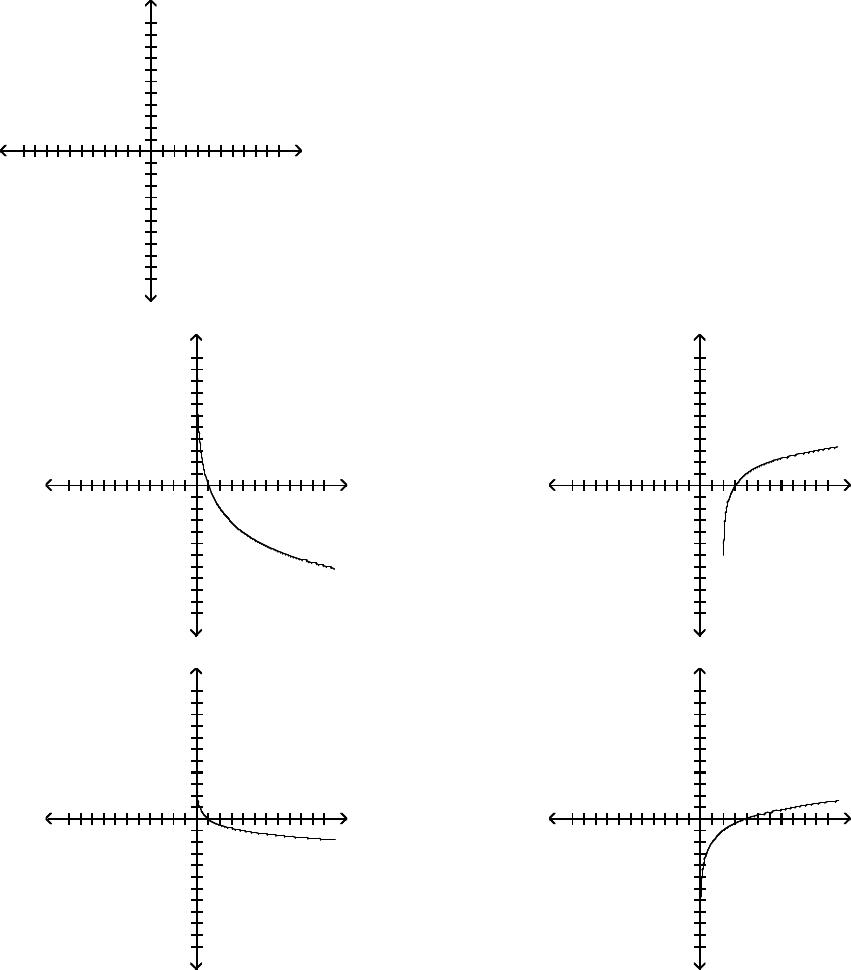
21) f(x) = –2 log 2x
x
-10 -5 5 10
y
10
5
-5
-10
x
-10 -5 5 10
y
10
5
-5
-10
A)
x
-10 -5 5 10
y
10
5
-5
-10
x
-10 -5 5 10
y
10
5
-5
-10
B)
x
-10 -5 5 10
y
10
5
-5
-10
x
-10 -5 5 10
y
10
5
-5
-10
C)
x
-10 -5 5 10
y
10
5
-5
-10
x
-10 -5 5 10
y
10
5
-5
-10
D)
x
-10 -5 5 10
y
10
5
-5
-10
x
-10 -5 5 10
y
10
5
-5
-10
Page 62
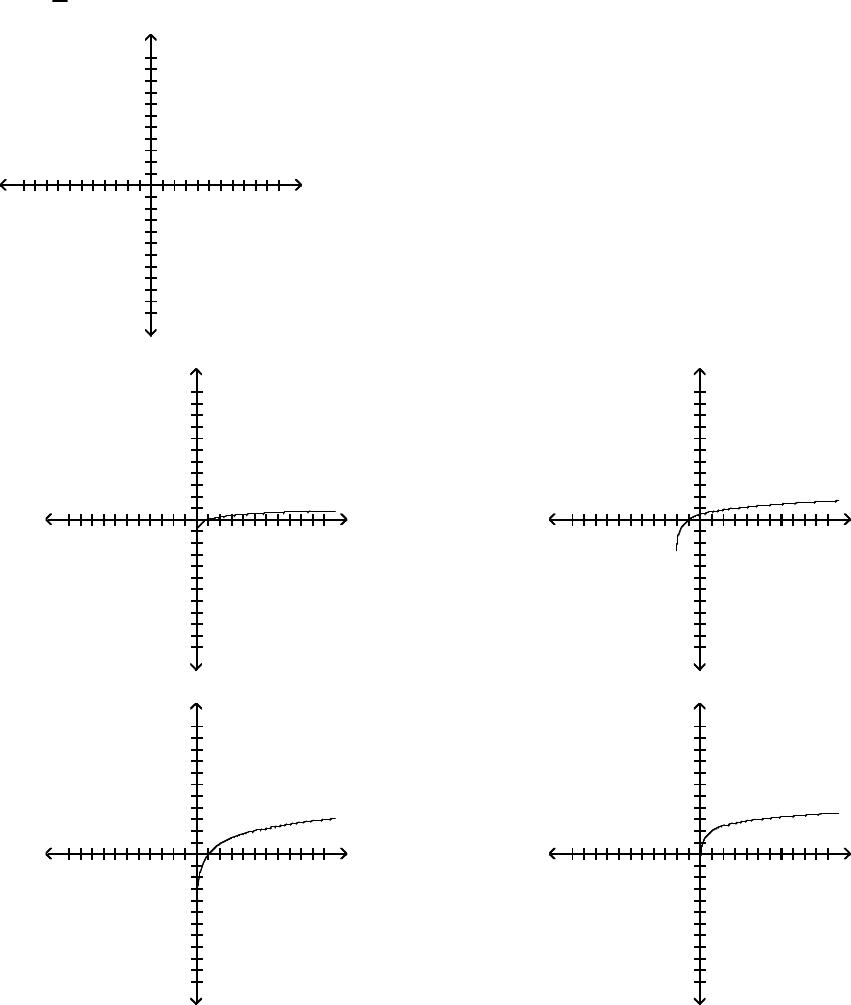
22) f(x) = 1
2log 5x
x
-10 -5 5 10
y
10
5
-5
-10
x
-10 -5 5 10
y
10
5
-5
-10
A)
x
-10 -5 5 10
y
10
5
-5
-10
x
-10 -5 5 10
y
10
5
-5
-10
B)
x
-10 -5 5 10
y
10
5
-5
-10
x
-10 -5 5 10
y
10
5
-5
-10
C)
x
-10 -5 5 10
y
10
5
-5
-10
x
-10 -5 5 10
y
10
5
-5
-10
D)
x
-10 -5 5 10
y
10
5
-5
-10
x
-10 -5 5 10
y
10
5
-5
-10
5 Solve Logarithmic Equations
MULTIPLE CHOICE. Choose the one alternative that best completes the statement or answers the question.
Solve the equation.
1) log 2x = 3
A) {8} B) {6} C) {5} D) {9}
2) log 327 = x
A) {3} B) {81} C) {9} D) {30}
Page 63
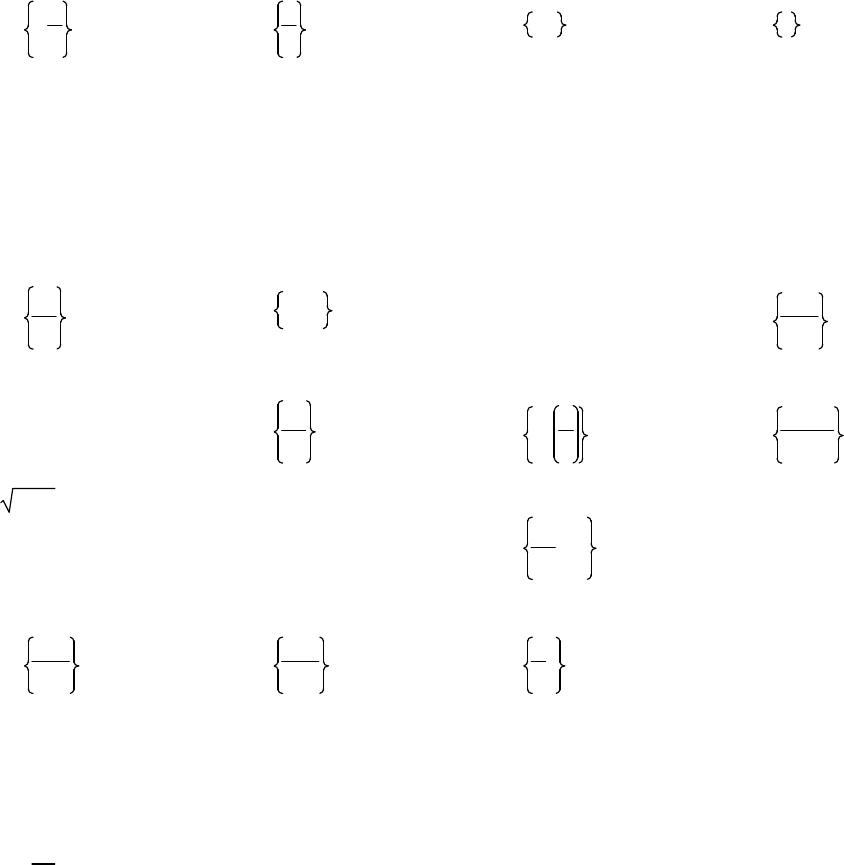
3) log9 x2 = 4
A) {81
,
–81} B) {6
,
–6} C) {512} D) {6561}
4) log 4(x – 1) = 3
A) {65} B) {63} C) {82} D) {80}
5) log 4(x + 2) = –1
A) – 7
4B) 9
4C) –7 D) 9
6) log9 (x2 – 8x) = 1
A) {9
,
–1} B) {–9
,
1} C) {9} D) {1}
7) log6 (x2 – x) = 1
A) {–2
,
3} B) {2
,
3} C) {1, 6} D) {–2
,
–3}
8) 2 ln 7x = 12
A) e6
7B) e 6
/
7C) {e6}D)
6
ln 7
9) 6 + 5 ln x = 9
A) {e 3
/
5}B)
e3
5C) ln 3
5D) 3
5 ln 1
10) ln x
+ 5 = 5
A) {e10 – 5} B) {e10 + 5} C) e5
2 + 5 D) {e5 – 5}
11) e3x = 8
A) ln 8
3B) ln 3
8C) 8
3e D) {3 ln 8}
12) e x + 6 = 3
A) {ln 3 – 6} B) {e3 + 6} C) {e18} D) {ln 9}
The loudness L(x), measured in decibels, of a sound of intensity x, measured in watts per square meter, is defined
as L(x) = 10log ( x
I0), where I0 = 10–12 watt per square meter is the least intense sound that a human ear can detect.
Determine the loudness, in decibels, of the sound.
13) A particular Boeing 747 jetliner produces noise at a loudness level of 113 decibels. Find the intensity leve
l
(round to the nearest hundredth) in watt per square meter for this noise.
A) 0.20 watt per square meter B) 0.10 watt per square meter
C) 0.40 watt per square meter D) 0.80 watt per square meter
14) At a recent Phish rock concert, sound intensity reached a level of 0.50 watt per square meter. To the neares
t
whole number, calculate the loudness of this sound in decibels.
A) 117 decibels B) 123 decibels C) 107 decibels D) 112 decibels
Page 64

15) At a rock concert by The Who, the music registered a loudness level of 120 decibels. The human threshold
of pain due to sound averages 130 decibels. Compute the ratio of the intensities associated with these two
loudness level to determine by how much the intensity of a sound that crosses the human threshold of
pain exceeds that of this particular rock concert.
A) The intensity of a sound that crosses the human threshold of pain is 10 times as intense as this rock
concert.
B) The intensity of a sound that crosses the human threshold of pain is 100 times as intense as this rock
concert.
C) The intensity of a sound that crosses the human threshold of pain is 1000 times as intense as this rock
concert.
D) The intensity of a sound that crosses the human threshold of pain is 0.1 times as intense as this rock
concert.
16) You have two friends, Jim and Amy. Jim always yells when he speaks, and Amy always whispers. The
loudness of Jim’s voice is 120 decibels, and the loudness of Amy’s voice is 20 decibels. Determine how
many times as intense Jim’s voice is as compared at Amy’s.
A) Jim’s voice is 1010 times as intense as Amy’s. B) Jim’s voice is 100.1 times as intense as Amy’s.
C)
J
im’s voice is 100 times as intense as Amy’s. D)
J
im’s voice is 1000 times as intense as Amy’s.
The Richter scale converts seismographic readings into numbers for measuring the magnitude of an earthquake
according to this function M(x) = log x
x0, where x0 = 10–3.
17) What is the magnitude of an earthquake whose seismographic reading is 7.5 millimeters at a distance o
f
100 kilometers from its epicenter? Round the answer to the nearest tenth.
A) 3.9 B) 2.9 C) 2.6 D) 875.1
18) What is the magnitude of an earthquake whose seismographic reading is 7.6 millimeters at a distance o
f
100 kilometers from its epicenter?Round the answer to four decimal places.
A) 3.8808 B) 0.38808 C) 2.0281 D) 0.20281
19) What is the magnitude of an earthquake whose seismographic reading is 0.94 millimeters at a distance o
f
100 kilometers from its epicenter? Round the answer to four decimal places.
A) 2.9731 B) 0.9731 C) –0.0269 D) –3.0269
20) Find the magnitude (to one decimal place) of an earthquake whose seismographic reading is 2000
millimeters at a distance of 100 kilometers from its epicenter. Round the answer to the nearest tenth.
A) 6.3 B) 6.4 C) 7.3 D) 5.9
21) Two earthquakes differ by 0.1 when measured on the Richter scale. How would the seismographic
readings differ at a distance of 100 kilometers from the epicenter?
A) The earthquake of greater magnitude has a seismographic reading that is 100.1 ≈ 1.26 times that of the
lesser earthquake.
B) The earthquake of greater magnitude has a seismographic reading that is 100.01 ≈ 1.02 times that of
the lesser earthquake.
C) The earthquake of greater magnitude has a seismographic reading that is 10 times that of the lesser
earthquake.
D) The earthquake of greater magnitude has a seismographic reading that is 100 times that of the lesser
earthquake.
Page 65

Solve the problem.
22) The formula D = 7e–0.04h can be used to find the number of milligrams D of a certain drug in a patient’s
bloodstream h hours after the drug has been given. When the number of milligrams reaches 2, the drug is
to be given again. What is the time between injections?
A) 31.32 hr B) 34.1 hr C) 48.65 hr D) 17.33 hr
23) Between 7:00 AM and 8:00 AM, trains arrive at a subway station at a rate of 5 trains per hour (0.08 trains
per minute). The following formula from statistics can be used to determine the probability that a train
will arrive within t minutes of 7:00 AM.
F(t) = 1 – e–0.08t
Determine how many minutes are needed for the probability to reach 80%.
A) 20.12 min B) 2.19 min C) 9.46 min D) 13.96 min
24) pH = –log10[H+] Find the [H+] if the pH = 7.4.
A) 3.98 × 10⁻⁸B) 3.98 × 10⁻⁷C) 2.51 × 10⁻⁷D) 2.51 × 10⁻⁸
25) pH = –log10[H+] Find the pH if the [H+] = 5.8 × 10⁻³.
A) 2.24 B) 3.76 C) 3.24 D) 2.76
6.5 Properties of Logarithms
1 Work with the Properties of Logarithms
MULTIPLE CHOICE. Choose the one alternative that best completes the statement or answers the question.
Use the properties of logarithms to find the exact value of the expression. Do not use a calculator.
1) log5 510
A) 10 B) 50 C) 5 D) 1
2) ln e22
A) 2 2 B) e C) 8 D) 64
3) ln e3
A) 3 B) e C) 9 D) 81
4) log320 20 + log320 16
A) 1 B) 320 C) 20 D) 16
5) log9 27 – log9 3
A) 1 B) 9 C) 27 D) 3
6) log4 24 – log4 6
A) 1 B) 4 C) 6 D) 24
7) log2 22 · log22 8
A) 3 B) 2 C) 22 D) 8
8) eln 5
A) 5 B) e5C) 4 D) ln 5
Page 66
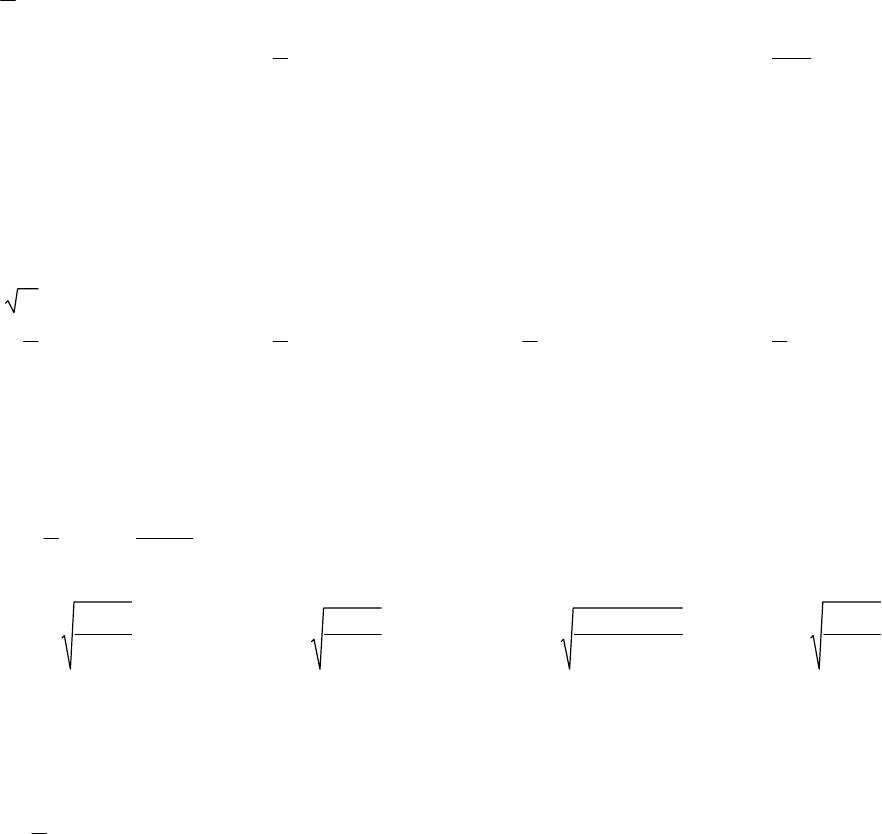
9) 10log 36 – log 6
A) 6 B) 36 C) 1,000,000 D) log 30
10) eloge2 9
A) 3 B) 9 C) e3D) e9
Suppose that ln 2 = a and ln 5 = b. Use properties of logarithms to write each logarithm in terms of a and b.
11) ln 10
A) a + bB)ab C)a –b D) ln a +ln b
12) ln 5
2
A) b – aB)
a
bC) a +bD)
ln a
ln b
13) ln 64
A) 6a B) a6C) ab D) 12a
14) ln 20
A) 2a + bB)a + b C) 4b D) 2a +2b
15) ln 720
A) 1
7(2a + b) B) 2
7(a + b) C) 2
7(a – b) D) 1
7(a2 + b)
Express y as a function of x. The constant C is a positive number.
16) ln y = ln 4x + ln C
A) y = 4Cx B) y = 4x +CC)y
=x +4C D) y = (4x)C
17) 3ln y = 1
3ln x – ln x2 – 1
x4/3 + ln C
A) y =
3Cx5/3
x2 – 1
B) y = 3Cx
x2 – 1
C) y = 3C
x1/3(x2 – 1)
D) y =
3Cx1/3
x2 – 1
2 Write a Logarithmic Expression as a Sum or Difference of Logarithms
MULTIPLE CHOICE. Choose the one alternative that best completes the statement or answers the question.
Write as the sum and/or difference of logarithms. Express powers as factors.
1) log 57
2
A) log 57 – log 52 B) log 52–log 57 C) log 57+log 57 D) log 57÷log 52
Page 67
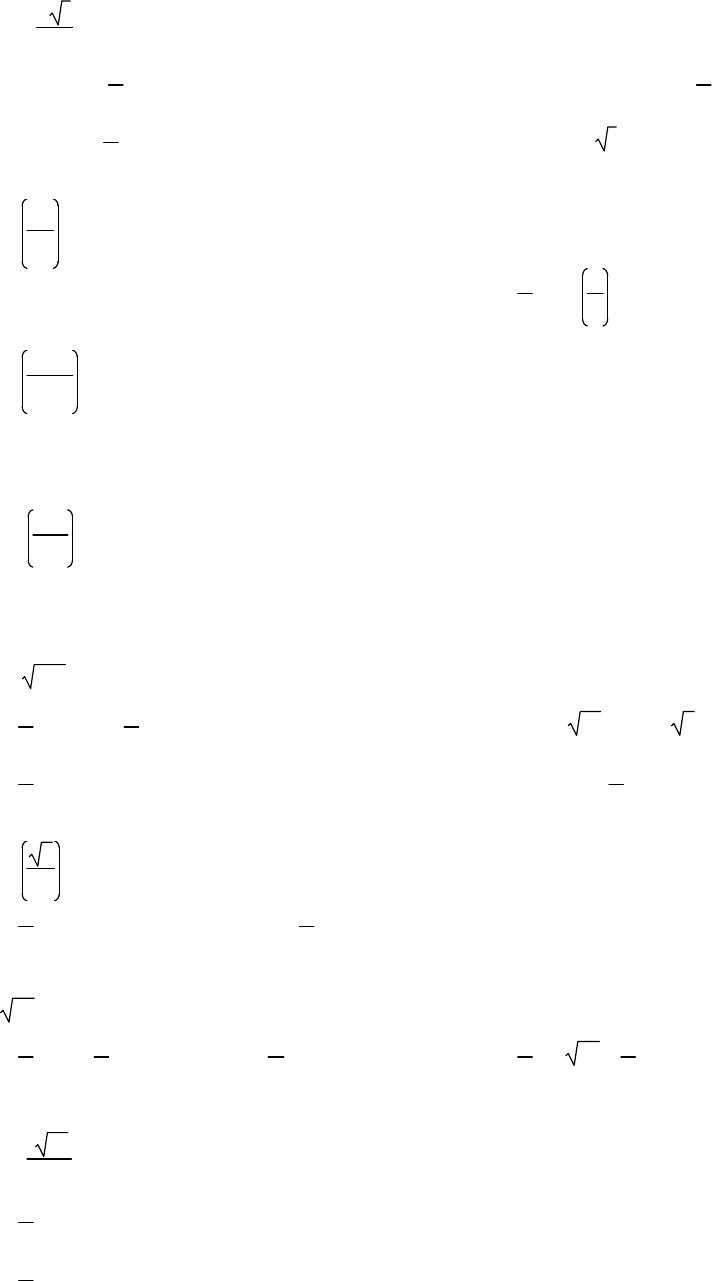
2) log 17 4r
s
A) log 17 4 + 1
2 log 17 r – log 17 s B) log 17 s – log 17 4 – 1
2 log 17 r
C) log 17 4 · 1
2 log 17 m ÷ log 17 s D) log 17 (4 r) – log 17 s
3) log 4x4
y8
A) 4 log 4x – 8 log 4y B) 4 log 4x +8 log 4yC)
1
2log 4x
yD) 8 log 4y –4 log 4x
4) log 3x + 5
x3
A) log 3(x + 5) – 3 log 3x B) log 3(x +5) +3 log 3x
C) 3 log 3x –log 3(x + 5) D) log 3(x +5) –log 3x
5) log w13x
2
A) log w13 +log wx – log w2 B) log w11x
C) log w13x –log w2 D) log w13 +log wx + log w2
6) log 610x
A) 1
2log 610 + 1
2log 6x B) log 610 + log 6x
C) 1
2log 610x D) log 610 + 1
2log 6x
7) log 2x
8
A) 1
2log 2x – 3B)6 – 1
2 log 2x C) log 2x –3D)
– 3 log 2x
8) ln 3ey
A) 1
3 ln y + 1
3B) y
3C) 1
3 ln 3ey + 1
3D) 3 ln y +3
9) log 7
217
n2m
A) 1
2 log 717 – 2 log 7n – log 7m B) 2 log 717 –2 log7n – log72
C) 1
2 log 717 – 2 log 7n – 2 log 7m D) log 717 –log 7n – log7m
Page 68
10) log 3mn
17
A) 1
2log 3m + 1
2log 3n – 1
2log 317 B) 1
2log 3m + 1
2log 3n – log317
C) 1
2log 3mn – 1
2log 317 D) 1
2log 3m · 1
2log 3n ÷ 1
2log 317
11) log 5
2m 9n
k2
A) 1
2log 5m + 1
9log 5n – 2log 5kB)
1
2log 5m · 1
9log 5n ÷ 2 log 5k
C) 2
5log 5m + 9
5log 5n – 2
5log 5k D) 2 log 5m+9 log 5n – 2log 5k
SHORT ANSWER. Write the word or phrase that best completes each statement or answers the question.
12) logb3x
5y8
z2
MULTIPLE CHOICE. Choose the one alternative that best completes the statement or answers the question.
13) log 1
– 1
x3
A) log x3 – log 1 – 3 log x B) log 1 –3 log 1 –3 log x
C) log(x – 1) + log(x2 + x + 1) – 3 log x D) log(x – 1) + log(x2 + 1) – 3 log x
14) ln (x + 4)(x – 3)
(x – 5)4
2
/
3,x
> 3
A) 2
3ln (x + 4) + 2
3ln (x – 3) – 8
3ln (x – 5) B) 2
3ln (x2 + 7x – 12) – 8
3ln (x – 5)
C) 2ln (x + 4) – 3ln (x – 3) – 8
3ln (x – 5) D) ln (x +4) + ln (x – 3) + ln 2 – 8ln (x –5) –ln 3
15) ln (5x) 71 + 4x
(x – 8)5 ,x > 8
A) ln 5 + ln x + 1
7ln (1 + 4x) – 5ln (x – 8) B) ln 5 +ln x –7ln (1 + 4x) – 5ln (x –8)
C) ln 5 + ln x + 1
7ln (1 + 4x) – ln 5 – ln (x – 8) D) 5ln x + 4
7ln (1 + 4x) – 5ln (x – 8)
Page 69
3 Write a Logarithmic Expression as a Single Logarithm
MULTIPLE CHOICE. Choose the one alternative that best completes the statement or answers the question.
Express as a single logarithm.
1) log cx + log cy
A) log cxy B) log cx·log cy C) log c(xy) D) log cx
y
2) 2 log bx – logby
A) log bx2
yB) log bx2 ÷ log by C) log b(x2 – y) D) log b2x
y
3) log a4 + log a(x3 – 2) + log a2
A) log a( 8x3 – 16) B) log a( x3 – 16) C) log a( x3 + 4) D) log a(4x3 – 8)
4) 3 log 6x + 5 log 6(x – 6)
A) log 6x3(x – 6)5B) log 6x(x – 6)15 C) 15 log 6x(x –6) D) log 6x(x –6)
5) 11ln (x – 7) – 2 ln x
A) ln (x – 7)11
x2B) ln x2(x – 7)11 C) ln 11(x –7)
2x D) ln 22x(x –7)
6) 1
2(log6 (x – 9) – log6 x)
A) log6 x – 9
xB) log6 x – 9
2x C) log6 x – 9
xD) log6 x –9
x
7) 5 log4 2 + 1
5 log4 (x – 8) – 1
2 log4 x
A) log4 32 5x – 8
xB) log4 32x –8
10x C) log4 5x – 40
10x D) log4 1
2
x – 8
x
8) ln x2 + 4x – 32
x – 3 – ln x2 + 5x – 24
x + 7 + ln (x2 – 8x + 16), x > 0
A) ln (x – 4)3(x + 7)
(x – 3)2B) ln 3(x –4)(x +7)
2(x – 3) C) ln (x – 4)3
(x – 3)2(x + 7)
D) ln 3(x –4)
2(x – 3)(x + 7)
9) 24 log88x + log8(24x6) – log8 24
A) log8 x9B) log8 x9
/
8C) log8 x14
/
3D) log8 x11
/
6
10) log x + log (x2 – 1) – log 8 – log (x – 1)
A) log x(x + 1)
8B) log x(x –1)
8(x – 1) C) log x(x –1)(x –1)
8D) log 2x +1)
9 – x
Page 70

4 Evaluate Logarithms Whose Base Is Neither 10 Nor e
MULTIPLE CHOICE. Choose the one alternative that best completes the statement or answers the question.
Use the Change–of–Base Formula and a calculator to evaluate the logarithm. Round your answer to three decimal
places.
1) log 979.48
A) 1.991 B) 1.900 C) 0.502 D) 8.831
2) log 30.833
A) –0.166 B) –0.079 C) –6.012 D) 3.601
3) log 3.0 195
A) 4.800 B) 2.290 C) 0.208 D) 65.000
4) log 7.9 7.5
A) 0.975 B) 0.875 C) 1.026 D) 0.949
5) log 3146.3
A) 9.076 B) 4.538 C) 0.239 D) 0.110
Use the Change–of–Base Formula and a calculator to evaluate the logarithm. Round your answer to two decimal
places.
6) log7.3 87
A) 2.25 B) 1.94 C) 0.45 D) 11.92
7) log8.1 4.5
A) 0.72 B) 0.65 C) 1.39 D) 0.56
8) log2/319
A) –7.26 B) –14.52 C) 7.26 D) 8.92
9) log22
194.7
A) 5.07 B) 2.54 C) 0.45 D) 0.20
10) log325
A) 2.93 B) 0.34 C) 3.22 D) 1.10
SHORT ANSWER. Write the word or phrase that best completes each statement or answers the question.
Solve the problem.
11) Find the value of log3 4 · log4 5 · log56 ·log67 ·log78 ·log89.
Page 71
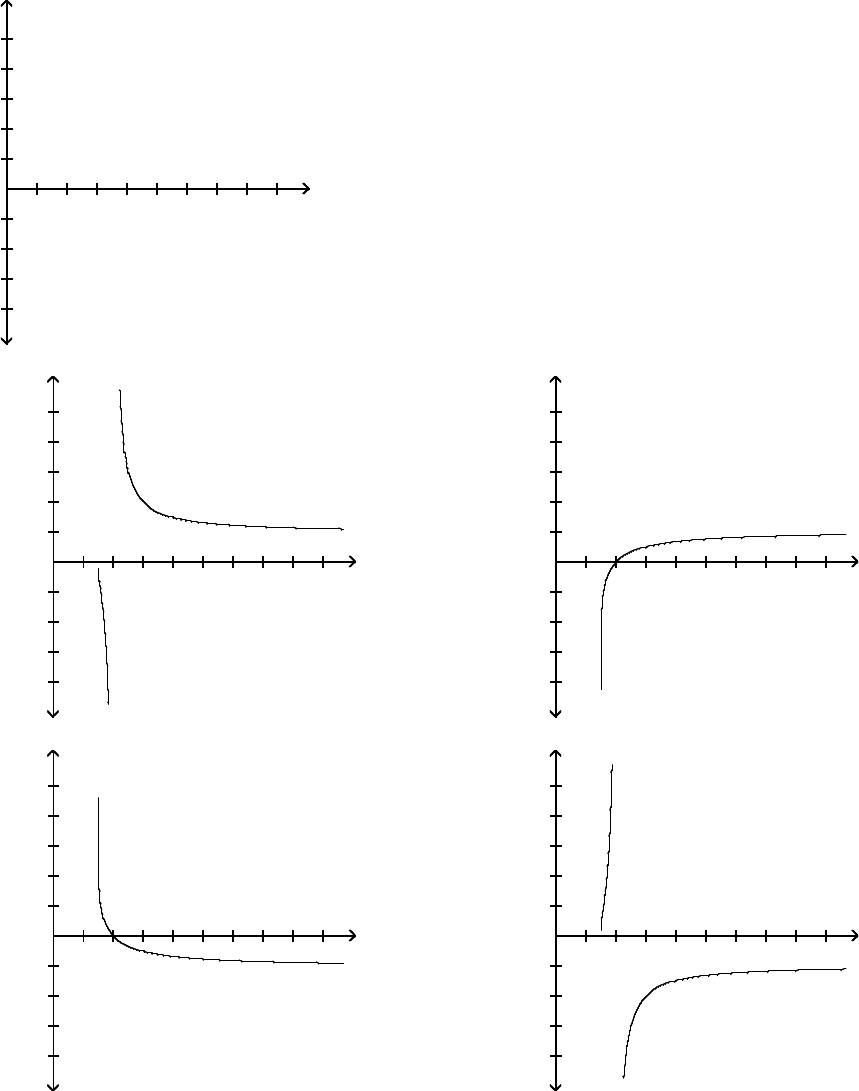
5 Graph Logarithmic Functions Whose Base Is Neither 10 Nor e
MULTIPLE CHOICE. Choose the one alternative that best completes the statement or answers the question.
Graph the function using a graphing utility and the Change–of–Base Formula.
1) y = logx–3(x + 3)
x
2 4 6 8 10 12 14 16 18
y
5
4
3
2
1
-1
-2
-3
-4
x
2 4 6 8 10 12 14 16 18
y
5
4
3
2
1
-1
-2
-3
-4
A)
x
24681012141618
y
5
4
3
2
1
-1
-2
-3
-4
x
24681012141618
y
5
4
3
2
1
-1
-2
-3
-4
B)
x
24681012141618
y
5
4
3
2
1
-1
-2
-3
-4
x
24681012141618
y
5
4
3
2
1
-1
-2
-3
-4
C)
x
24681012141618
y
5
4
3
2
1
-1
-2
-3
-4
x
24681012141618
y
5
4
3
2
1
-1
-2
-3
-4
D)
x
24681012141618
y
5
4
3
2
1
-1
-2
-3
-4
x
24681012141618
y
5
4
3
2
1
-1
-2
-3
-4
Page 72
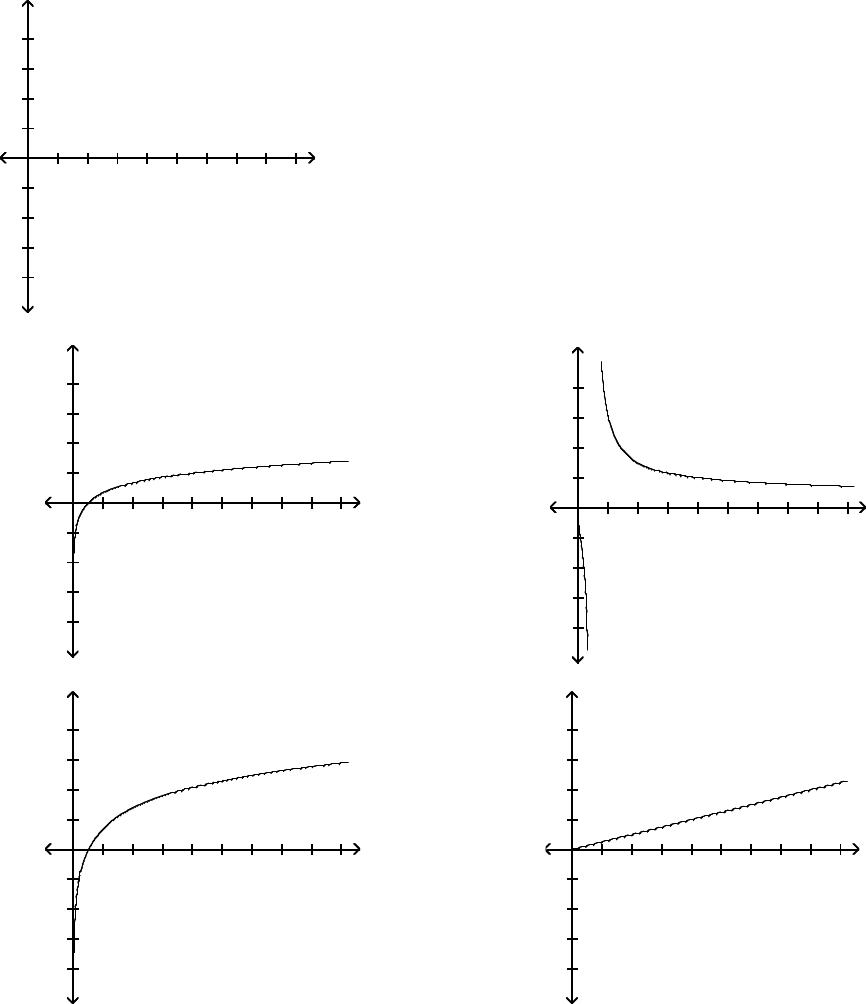
2) y = log8x
x
2 4 6 8 10 12 14 16 18
y
4
3
2
1
-1
-2
-3
-4
x
2 4 6 8 10 12 14 16 18
y
4
3
2
1
-1
-2
-3
-4
A)
x
2 4 6 8 10 12 14 16 18
y
4
3
2
1
-1
-2
-3
-4
x
2 4 6 8 10 12 14 16 18
y
4
3
2
1
-1
-2
-3
-4
B)
x
2 4 6 8 1012141618
y
4
3
2
1
-1
-2
-3
-4
x
2 4 6 8 1012141618
y
4
3
2
1
-1
-2
-3
-4
C)
x
2 4 6 8 10 12 14 16 18
y
4
3
2
1
-1
-2
-3
-4
x
2 4 6 8 10 12 14 16 18
y
4
3
2
1
-1
-2
-3
-4
D)
x
2 4 6 8 10 12 14 16 18
y
4
3
2
1
-1
-2
-3
-4
x
2 4 6 8 10 12 14 16 18
y
4
3
2
1
-1
-2
-3
-4
Page 73
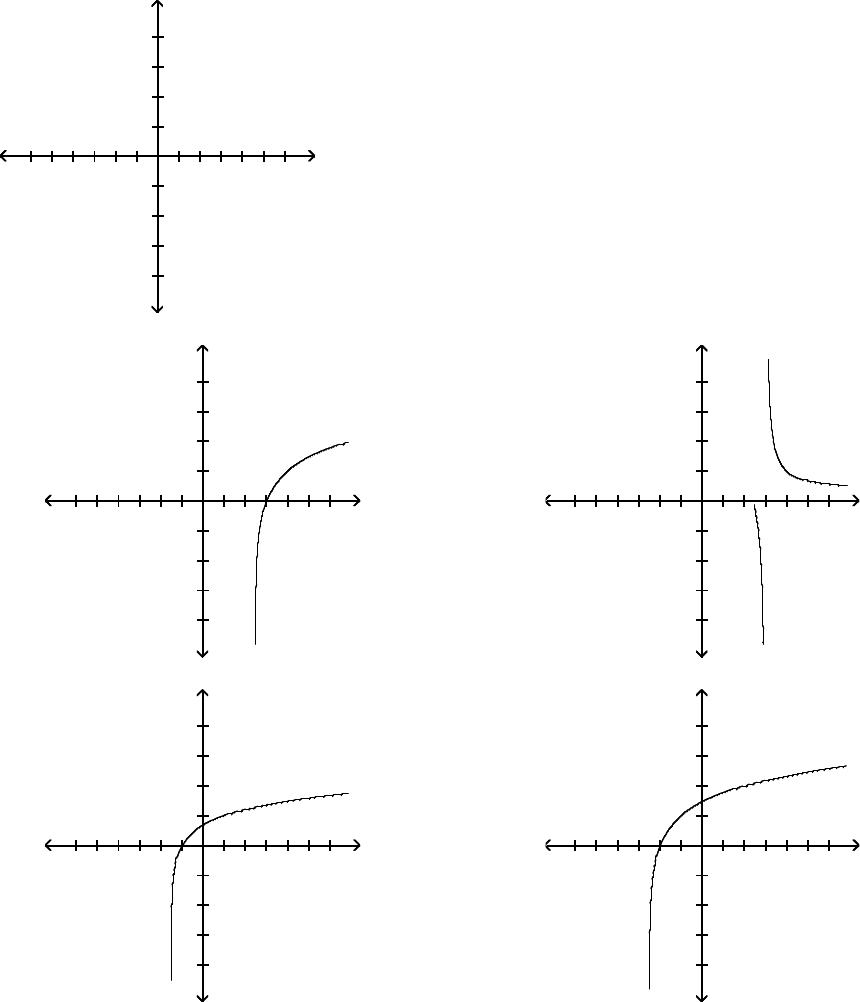
3) y = log3(x – 5)
x
-12-10 -8 -6 -4 -2 2 4 6 8 10 12
y
4
3
2
1
-1
-2
-3
-4
x
-12-10 -8 -6 -4 -2 2 4 6 8 10 12
y
4
3
2
1
-1
-2
-3
-4
A)
x
-12-10 -8 -6 -4 -2 2 4 6 8 10 12
y
4
3
2
1
-1
-2
-3
-4
x
-12-10 -8 -6 -4 -2 2 4 6 8 10 12
y
4
3
2
1
-1
-2
-3
-4
B)
x
-12-10 -8 -6 -4 -2 2 4 6 8 10 12
y
4
3
2
1
-1
-2
-3
-4
x
-12-10 -8 -6 -4 -2 2 4 6 8 10 12
y
4
3
2
1
-1
-2
-3
-4
C)
x
-12-10 -8 -6 -4 -2 2 4 6 8 10 12
y
4
3
2
1
-1
-2
-3
-4
x
-12-10 -8 -6 -4 -2 2 4 6 8 10 12
y
4
3
2
1
-1
-2
-3
-4
D)
x
-12-10 -8 -6 -4 -2 2 4 6 8 10 12
y
4
3
2
1
-1
-2
-3
-4
x
-12-10 -8 -6 -4 -2 2 4 6 8 10 12
y
4
3
2
1
-1
-2
-3
-4
6.6 Logarithmic and Exponential Equations
1 Solve Logarithmic Equations
MULTIPLE CHOICE. Choose the one alternative that best completes the statement or answers the question.
Solve the equation.
1) log 3x = 5
A) {243} B) {15} C) {125} D) {1.46}
2) log 6(x – 2) = 1
A) {8} B) {4} C) {3} D) {–1}
Page 74
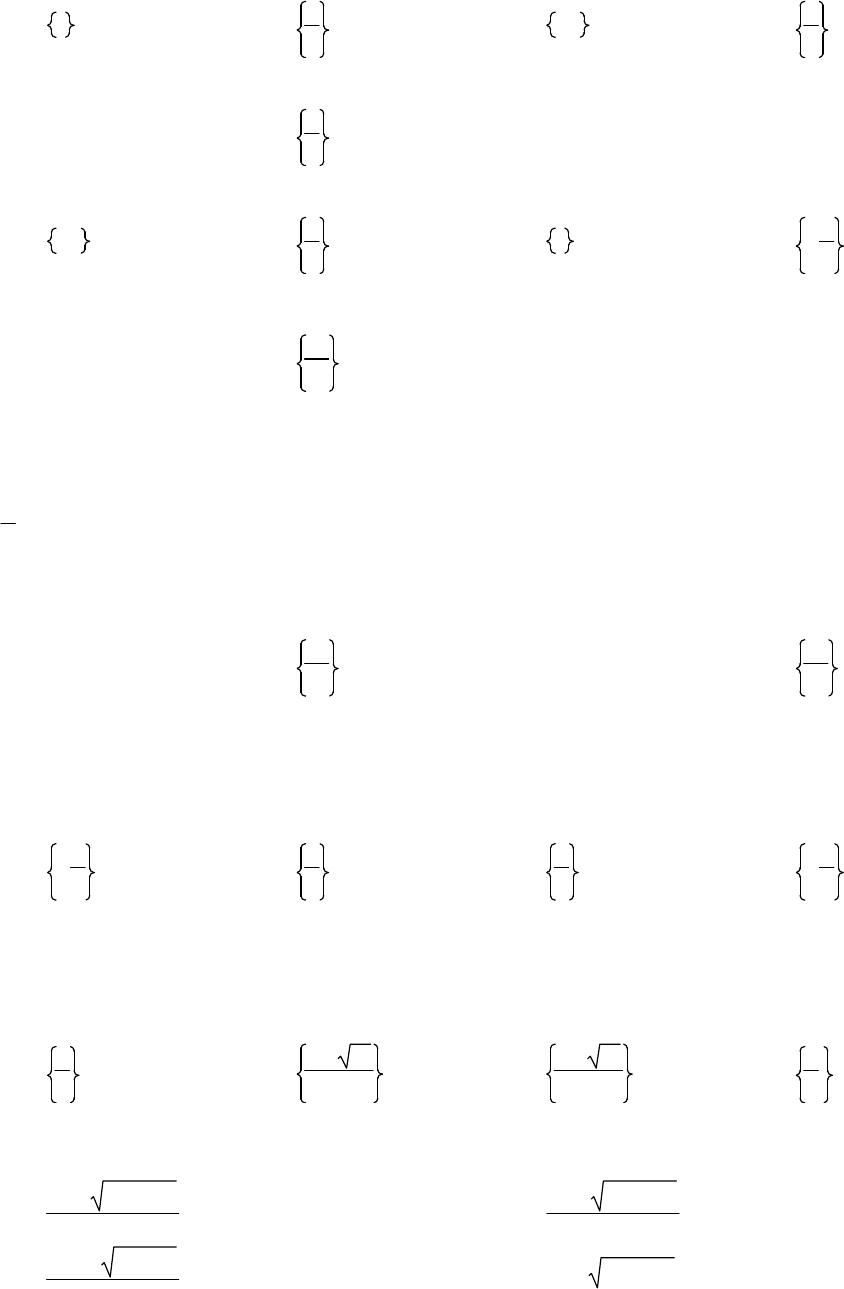
3) log (x + 4) = log (4x – 2)
A) 2 B) 6
5C) –2 D) 2
3
4) log (3 + x) – log (x – 4) = log 2
A) {11} B) 3
2C) {–11} D) ∅
5) log (5x) = log 3 + log (x – 2)
A) – 3 B) 1
4C) 3 D) – 3
4
6) log 7(5x + 4) = log7(5x + 7)
A) {0} B) 11
3C) {3} D) ∅
7) log3 x + log3(x – 24) = 4
A) {27} B) {–3, 27} C) {53} D) ∅
8) 1
3 log 2(x + 6) = log8(3x)
A) {3} B) {3, 0} C) {9} D) ∅
9) log2(3x – 2) – log2(x – 5) = 4
A) {6} B) 38
5C) {18} D) 3
13
10) log 2(x – 5) + log 2(x – 11) = 4
A) {13} B) {13
,
3} C) {3} D) {14}
11) log 3(x + 3) = 1 + log 3(x + 2)
A) – 3
2B) 1
2C) 3
2D) – 1
2
12) log 15 (x – 2) = 1 – log 15 x
A) {5} B) {–5} C) {3} D) {–3}
13) 2 + log3(2x + 5) – log3 x = 4
A) 5
7B) 1 ± 46
9C) 1 + 46
9D) 5
4
Solve the equation. Express irrational answers in exact form and as a decimal rounded to 3 decimal places.
14) ln x + ln (x + 3) = –3
A) –3 + 9
+ 4e–3
2 ≈ 0.017 B) –3 – 9
+ 4e–3
2 ≈ –3.017
C) –3 + 29 + e–3
2 ≈ 1.508 D) –3 + 9
+ 4e–3 ≈ 0.033
Page 75
Solve the problem.
15) f(x) = log4(x + 3) and g(x) = log4(x – 1).
Solve f(x) = 78. What point is on the graph of f?
A) {3}, (3
,
78) B) {3}, (3
,
84) C) {81}, (3
,
78) D) {81}, (3
,
6)
16) f(x) = log6(x + 6) and g(x) = log6(x – 4).
Solve g(x) = 2. What point is on the graph of g?
A) {40}, (40
,
2) B) {2}, (2
,
40) C) {32}, (32
,
2) D) {36}, (36
,
2)
17) f(x) = log2(x + 3) and g(x) = log2(2x –3).
Solve f(x) = g(x).
A) {6}, (6
,
log2(9)) B) {6}, (6
,
log2(6)) C) {6}, (6
,
log2(3)) D) No solution.
18) f(x) = log2(x + 2) and g(x) = log2(x – 2).
Solve f(x) = g(x). Do the graphs of f and g intersect? If so, where?
A) {4}, (4
,
log2(6)) B) {4}, (4
,
log2(4))
C) {4}, (4
,
log2(2)) D) No solution. No intersection.
19) f(x) = log2(x – 1) and g(x) = log2(2x +26).
Solve f(x) + g(x) = 6.
A) {3} B) {8} C) {–3} D) {–8}
20) The function f(x) = 1 + 1.6 ln (x + 1) models the average number of free–throws a basketball player can
make consecutively during practice as a function of time, where x is the number of consecutive days the
basketball player has practiced for two hours. After how many days of practice can the basketball player
make an average of 5 consecutive free throws?
A) 11 days B) 13 days C) 42 days D) 44 days
21) The pH of a solution ranges from 0 to 14. An acid has a pH less than 7. Pure water is neutral and has a pH
of 7. The pH of a solution is given by pH = – log x where x represents the concentration of the hydrogen
ions in the solution in moles per liter. Find the hydrogen ion concentration if the pH = 6.
A) 10–6B) 106C) 1.79 D) 0.17
22) The pH of a solution ranges from 0 to 14. An acid has a pH less than 7. Pure water is neutral and has a pH
of 7. The pH of a solution is given by pH = – log x where x represents the concentration of the hydrogen
ions in the solution in moles per liter. Find the hydrogen ion concentration if the pH = 5.4.
A) 3.98 × 10⁻⁶B) 3.98 × 10⁻⁵C) 2.51 × 10⁻⁵D) 2.51 × 10⁻⁶
2 Solve Exponential Equations
MULTIPLE CHOICE. Choose the one alternative that best completes the statement or answers the question.
Solve the equation.
1) 4x = 256
A) {4} B) {64} C) {5} D) {3}
2) 3(1 + 2x) = 243
A) {2} B) {81} C) {6} D) {–2}
Page 76
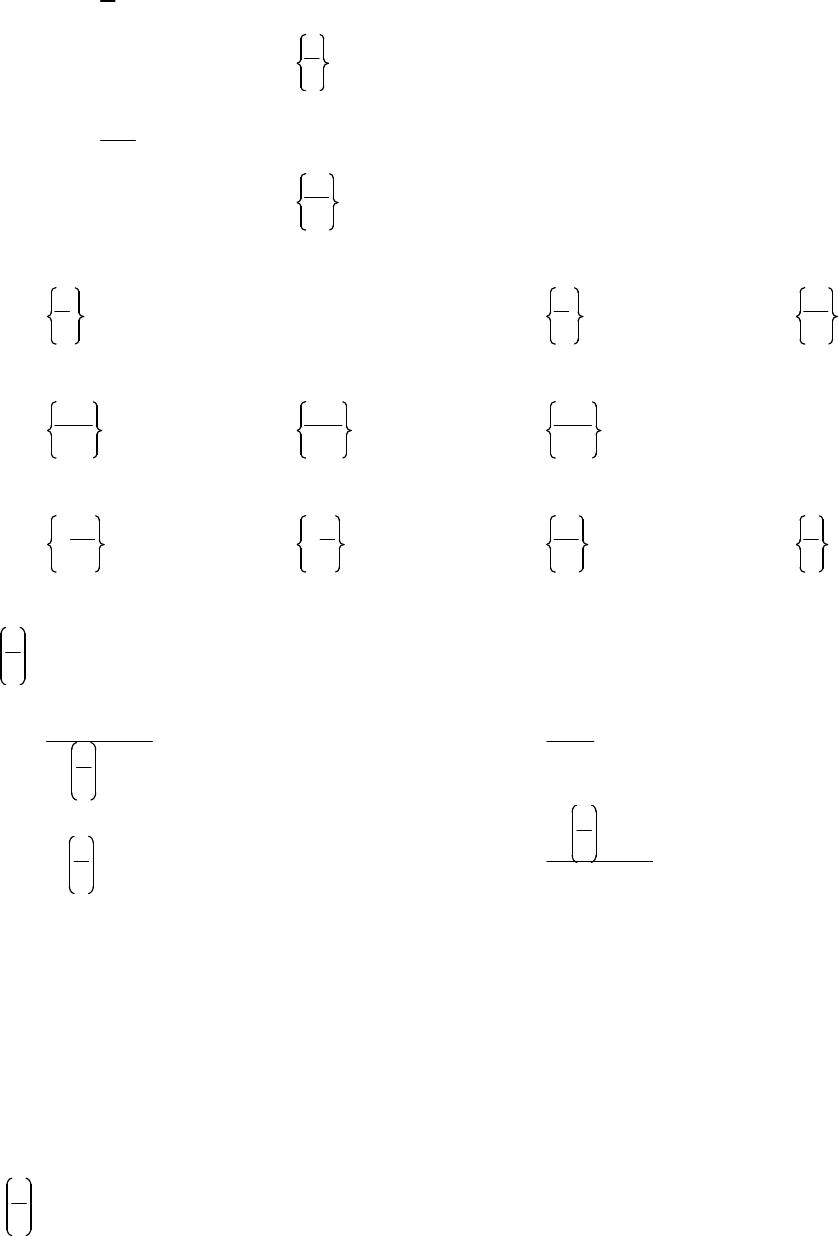
3) 2(7 – 3x) = 1
4
A) {3} B) 1
2C) {1} D) {–3}
4) 4(5 + 3x) = 1
256
A) {–3} B) 1
64 C) {128} D) {3}
5) 3 · 52t – 1 = 75
A) 3
2B) {3} C) 1
2D) 13
10
6) 32x + 3x – 6 = 0
A) ln 2
ln 3 B) ln 3
ln 2 C) ln 2
ln 6 D) {ln 6}
7) 97x + 3 = 27
A) – 3
14 B) – 3
7C) 3
14 D) 3
7
Solve the equation. Express irrational answers in exact form and as a decimal rounded to 3 decimal places.
8) 1
2
x = 91 – x
A) ln 9
ln 1
2 + ln 9
≈ 1.461 B) ln 36
ln 72 ≈ 0.838
C) ln 1
2 – ln 9 ≈ –2.890 D)
ln 1
2 + ln 9
ln 9 ≈ 0.685
Solve the exponential equation. Use a calculator to obtain a decimal approximation, correct to two decimal places,
for the solution.
9) 57x = 2.8
A) {0.09} B) {0.11} C) {4.48} D) {3.39}
10) 4 x + 8 = 7
A) {–6.60} B) {8.71} C) {1.62} D) {–0.66}
11) 1
2
x = 14
A) {–3.81} B) {3.81} C) {–0.26} D) {–7.00}
12) 2(x – 1) = 13
A) {4.70} B) {2.70} C) {7.50} D) {3.91}
Page 77

13) 4(4x – 1) = 11
A) {0.68} B) {0.94} C) {0.18} D) {0.97}
14) e5x = 3
A) {0.22} B) {0.54} C) {1.63} D) {5.49}
15) e x + 4 = 7
A) {–2.05} B) {–1.60} C) {–1.99} D) {2.40}
Solve the problem.
16) If f(x) = 2x + 4 and g(x) = 2–x + 6, find the point of intersection of the graphs of f and g by solving
f(x) = g(x).
A) (1, 32) B) (1, 16) C) (32
,
1) D) (16
,
1)
17) If f(x) = 4x and g(x) = 12, find the point of intersection of the graphs of f and g by solving f(x) = g(x). Give
an exact answer.
A) (log412
,
12) B) (log412
,
0) C) (12
,
12) D) (log412
,
4)
18) Find out how long it takes a $3100 investment to double if it is invested at 7% compounded semiannually.
Round to the nearest tenth of a year. Use the formula A = P1 + r
n
nt.
A) 10.1 yr B) 10.3 yr C) 9.9 yr D) 10.5 yr
19) The formula A = 226e0.022t models the population of a particular city, in thousands, t years after 2011.
When will the population of the city reach 275 thousand?
A) 2020 B) 2021 C) 2019 D) 2022
20) The first recorded population of a particular country was 23 million, and the population was recorded as
32 million 13 years later. The exponential growth function A =23ekt describes the population of this
country t years since the first recording. Use the fact that 13 years later the population increased by 9
million to find k to three decimal places.
A) 0.025 B) 0.169 C) 0.508 D) 0.035
3 Solve Logarithmic and Exponential Equations Using a Graphing Utility
MULTIPLE CHOICE. Choose the one alternative that best completes the statement or answers the question.
Use a graphing calculator to solve the equation. Round your answer to two decimal places.
1) log5 x + log4 x = 4
A) {19.67} B) {1.29} C) {2.11} D) {58.08}
2) log4(x + 2) – log5(x – 1) = 1
A) {2.00} B) {1.75} C) {–0.69} D) {2.05}
3) ex = –x
A) {–0.57} B) {0.57} C) {–1.05} D) {1.05}
4) ex – ln x = 3
A) {1.14} B) {2.17} C) {1.27} D) {0.57}
Page 78
5) ex = x5
A) {1.30} B) {–0.79} C) {2.54} D) {–0.71}
6) ex = x2 – 1
A) {–1.15} B) {0} C) {–0.71} D) {2.54}
7) e3x = x + 3
A) {0.41} B) {0.14} C) {3.41} D) {3.14}
8) ln(2x) = –x + 3
A) {1.75} B) {0.95} C) {4.75} D) {3.95}
6.7 Financial Models
1 Determine the Future Value of a Lump Sum of Money
MULTIPLE CHOICE. Choose the one alternative that best completes the statement or answers the question.
Find the amount that results from the investment.
1) $1,000 invested at 7% compounded annually after a period of 5 years
A) $1402.55 B) $402.55 C) $1310.80 D) $1500.73
2) $1,000 invested at 7% compounded semiannually after a period of 6 years
A) $1511.07 B) $511.07 C) $1500.73 D) $1459.97
3) $14,000 invested at 7% compounded semiannually after a period of 3 years
A) $17,209.57 B) $3209.57 C) $17,150.60 D) $16,627.61
4) $480 invested at 8% compounded quarterly after a period of 6 years
A) $772.05 B) $292.05 C) $761.70 D) $756.91
5) $12,000 invested at 7% compounded quarterly after a period of 4 years
A) $15,839.15 B) $3839.15 C) $15,729.55 D) $15,566.73
Solve the problem.
6) The Feldmans bought their first house for $17
,
000. Over the years they moved three times into bigger and
bigger houses. Now, 40 years later, they are ready to retire and want a smaller house like the first one they
bought. If inflation in property values has averaged 3.9% per year during that time, how much will such a
house cost them now? (Round your answer to the nearest dollar.)
A) $78,536 B) $80,900 C) $3680 D) $3572
7) If Emery has $2200 to invest at 5% per year compounded monthly, how long will it be before he has
$3300? If the compounding is continuous, how long will it be? (Round your answers to three decimal
places.)
A) 8.126 yr, 8.109 yr B) 0.693 yr, 0.676 yr
C) 123.495 yr, 8.509 yr D) 0.097 yr, 0.811 yr
8) Austin invested $12,000 in an account at 11% compounded quarterly. Find the amount in Austin’s account
after a period of 2 years.
A) $14,908.57 B) $2908.57 C) $14,785.20 D) $14,509.55
Page 79

9) How long will it take for $9600 to grow to $29,600 at an interest rate of 12.1% if the interest is compounded
continuously? Round the number of years to the nearest hundredth.
A) 9.31 yr B) 0.93 yr C) 0.09 yr D) 930.59 yr
10) Suppose that $11,000 is invested at an interest rate of 5.7% per year, compounded continuously. What is
the balance after 4 years?
A) $13,816.94 B) $11,627.00 C) $13,508.00 D) $13,916.94
11) Kimberly invested $4000 in her savings account for 6 years. When she withdrew it, she had $4619.54.
Interest was compounded continuously. What was the interest rate on the account? Round to the nearest
tenth of a percent.
A) 2.4% B) 2.5% C) 2.3% D) 2.55%
2 Calculate Effective Rates of Return
MULTIPLE CHOICE. Choose the one alternative that best completes the statement or answers the question.
Find the effective rate of interest.
1) 6% compounded continuously
A) 6.184% B) 6.451% C) 6.089% D) 6.374%
2) 12% compounded monthly
A) 12.683% B) 12.123% C) 12.205% D) 12.905%
3) 6% compounded quarterly
A) 6.136% B) 6.123% C) 6.205% D) 6.905%
Solve the problem.
4) A local bank advertises that it pays interest on savings accounts at the rate of 3% compounded monthly.
Find the effective rate. Round your answer to two decimal places, if necessary.
A) 3.04% B) 3.40% C) 3.44% D) 36%
5) Which of the two rates would yield the larger amount in 1 year: 5.4% compounded monthly or 5.3%
compounded daily?
A) 5.4% compounded monthly
B) 5.3% compounded daily
C) They will yield the same amount.
6) Which of the two rates would yield the larger amount in 1 year: 9% compounded monthly or 9 1
4%
compounded annually?
A) 9% compounded monthly
B) 9 1
4% compounded annually
C) They will yield the same amount.
7) Larry has $2800 to invest and needs $3300 in 10 years. What annual rate of return will he need to get in
order to accomplish his goal? Round your answer to two decimal places, if necessary.
A) 1.66% B) 1.61% C) 2.61% D) 3.61%
Page 80
3 Determine the Present Value of a Lump Sum of Money
MULTIPLE CHOICE. Choose the one alternative that best completes the statement or answers the question.
Find the present value. Round to the nearest cent.
1) To get $5600 after 5 years at 4% compounded annually
A) $4602.79 B) $997.21 C) $4786.90 D) $8219.27
2) To get $10,500 after 7 years at 8% compounded annually
A) $6126.65 B) $4373.35 C) $6616.78 D) $5834.9
3) To get $2000 after 8 years at 8% compounded semiannually
A) $1067.82 B) $932.18 C) $1080.54 D) $1110.53
4) To get $25,000 after 2 years at 6% compounded semiannually
A) $22,212.18 B) $2787.82 C) $22,249.91 D) $22,878.54
5) To get $6500 after 3 years at 4% compounded quarterly
A) $5768.42 B) $731.58 C) $5778.48 D) $5826.10
6) To get $10,000 after 2 years at 9% compounded monthly
A) $8358.31 B) $9142.38 C) $10,938.07 D) $5000.00
Solve the problem. Round to the nearest cent.
7) What principal invested at 8% compounded continuously for 4 years will yield $1190? Round the answer
to two decimal places.
A) $864.12 B) $1638.78 C) $1188.62 D) $627.48
8) What principal invested at 6%, compounded continuously for 3 years, will yield $1500? Round the answer
to two decimal places.
A) $1252.91 B) $651.45 C) $837.25 D) $1522.91
9) How much money needs to be invested now to get $2000 after 4 years at 8% compounded quarterly?
Round to the nearest dollar.
A) $1456.89 B) $583.78 C) $1847.69 D) $1461.38
10) Randy invested his inheritance in an account that paid 6.2% interest, compounded continuously. After 9
years, he found that he now had $57,855.94. What was the original amount of his inheritance?
A) $33,114.00 B) $20,530.68 C) $34,114.00 D) $32,114.00
11) Cindy will require $12,000 in 5 years to return to college to get an MBA degree. How much money should
she ask her parents for now so that, if she invests it at 10% compounded continuously, she will have
enough for school?
A) $7278.37 B) $7451.06 C) $19,784.66 D) $4414.55
12) Tracey bought a diamond ring appraised at $1600 at an antique store. If diamonds have appreciated in
value at an annual rate of 12%, what was the value of the ring 5 years ago?
A) $907.88 B) $878.10 C) $2819.75 D) $481.91
Page 81
4 Determine the Rate of Interest or Time Required to Double a Lump Sum of Money
MULTIPLE CHOICE. Choose the one alternative that best completes the statement or answers the question.
Solve the problem. Round your answer to three decimals.
1) What annual rate of interest is required to double an investment in 9 years?
A) 8.006% B) 4.003% C) 7.702% D) 12.983%
2) What annual rate of interest is required to triple an investment in 8 years?
A) 14.72% B) 7.36% C) 13.733% D) 9.051%
3) How long will it take for an investment to double in value if it earns 8.5% compounded continuously?
A) 8.155 yr B) 8.496 yr C) 4.077 yr D) 12.925 yr
4) How long will it take for an investment to triple in value if it earns 4.5% compounded continuously?
A) 24.414 yr B) 27.652 yr C) 12.207 yr D) 15.403 yr
Solve the problem.
5) How long does it take $1125 to triple if it is invested at 7% interest, compounded quarterly? Round your
answer to the nearest tenth.
A) 15.8 yr B) 15.8 mo C) 18.1 yr D) 18.1 mo
6) How long does it take $1700 to double if it is invested at 5% interest, compounded monthly? Round your
answer to the nearest tenth.
A) 13.9 yr B) 3.9 yr C) 7.9 yr D) 4.8 yr
7) Gillian has $10,000 to invest in a mutual fund. The average annual rate of return for the past five years was
12.25%. Assuming this rate, determine how long it will take for her investment to double.
A) 6 yr B) 12 yr C) 3 yr D) 4 yr
8) Suppose that $11,000 is invested at an interest rate of 5.9% per year, compounded continuously. What is
the doubling time?
A) 11.7 yr B) 2 yr C) 12.7 yr D) 10.7 yr
6.8 Exponential Growth and Decay Models; Newton’s Law; Logistic Growth and Decay Models
1 Find Equations of Populations That Obey the Law of Uninhibited Growth
MULTIPLE CHOICE. Choose the one alternative that best completes the statement or answers the question.
Solve the problem.
1) The size P of a small herbivore population at time t (in years) obeys the function P(t) = 500e0.11t if they
have enough food and the predator population stays constant. After how many years will the population
reach 2000? Round to the nearest hundredth.
A) 12.6 yr B) 66.48 yr C) 21.69 yr D) 24.62 yr
2) Conservationists tagged 120 black–nosed rabbits in a national forest in 2009. In 2010
,
they tagged 240
black–nosed rabbits in the same range. If the rabbit population follows the exponential law, how many
rabbits will be in the range 6 years from 2009?
A) 7680 rabbits B) 15,360 rabbits C) 135 rabbits D) 269 rabbits
Page 82
3) During its first year of operation, 200,000 people visited Rave Amusement Park. Six years later, the
number had grown to 834,000. If the number of visitors to the park obeys the law of uninhibited growth,
find the exponential growth function that models this data.
A) f(t) = 200,000e0.238t B) f(t) = 200,000e0.248t
C) f(t) = 634,000e0.248t D) f(t) = 634,000e0.238t
4) The value of a particular investment follows a pattern of exponential growth. You invested money in a
money market account. The value of your investment t years after your initial investment is given by the
exponential growth model A = 7000e0.059t. How much did you initially invest in the account?
A) $7000.00 B) $7425.43 C) $413.00 D) $3500.00
5) The value of a particular investment follows a pattern of exponential growth. You invested money in a
money market account. The value of your investment t years after your initial investment is given by the
exponential growth model A = 4800e0.06t. By what percentage is the account increasing each year?
A) 6% B) 4.8% C) 0.6% D) 6.7%
6) The value of a particular investment follows a pattern of exponential growth. You invested money in a
money market account. The value of your investment t years after your initial investment is given by the
exponential growth model A = 7400e0.061t. When will the account be worth $10,670?
A) 6 years after the initial investmen
t
B) 7 years after the initial investmen
t
C) 8 years after the initial investmen
t
D) 5 years after the initial investmen
t
SHORT ANSWER. Write the word or phrase that best completes each statement or answers the question.
7) The revenue for a dot.com company is projected to double each year for the first 5 years. If the revenue for
the first year is $2 million, write a function showing the revenue R after x years. What is the revenue for
the fourth year?
8) In a networking marketing plan for a company, each distributor is expected to recruit 3 new distributors.
Jack was the first distributor hired by the company, so he is considered a level 1 distributor. The 3 people
he recruits are considered level 2 distributors. The people recruited by the level 2 distributors are
considered level 3 distributors, and so on. Write a function that models the number of distributors D at
each level L. How many distributors would there be at the fifth level?
9) The bacteria in a container quadruples every day. If there are initially 100 bacteria, write an equation tha
t
models the number of bacteria A after d days. How many bacteria will there be after 1 week?
10) The concentration of alcohol in a person’s blood is measurable. Suppose that the risk R (given as a percent)
of having an accident while driving a car can be modeled by the equation
R = 5ekx
where x is the variable concentration of alcohol in the blood and k is a constant.
Suppose that a concentration of alcohol in the blood of 0.07 results in a 10% risk (R = 10) of an accident.
Find the constant k in the equation.
Using this value of k, what is the risk if the concentration is 0.11?
11) A culture of bacteria obeys the law of uninhibited growth. If 140,000 bacteria are present initially and there
are 609,000 after 6 hours, how long will it take for the population to reach one million?
Page 83
12) The size P of a certain insect population at time t (in days) obeys the function P = 700e0.03t. After how
many days will the population reach 1500?
2 Find Equations of Populations That Obey the Law of Decay
MULTIPLE CHOICE. Choose the one alternative that best completes the statement or answers the question.
Solve the problem.
1) The half–life of silicon–32 is 710 years. If 70 grams is present now, how much will be present in 600 years?
(Round your answer to three decimal places.)
A) 38.968 B) 66.017 C) 0.2 D) 0
2) The half–life of plutonium–234 is 9 hours. If 40 milligrams is present now, how much will be present in 5
days? (Round your answer to three decimal places.)
A) 0.004 B) 27.215 C) 0.85 D) 15.874
3) A fossilized leaf contains 13% of its normal amount of carbon 14. How old is the fossil (to the nearest
year)? Use 5600 years as the half–life of carbon 14.
A) 16,453 B) 20,685 C) 1123 D) 36,015
4) The half–life of a radioactive element is 130 days, but your sample will not be useful to you after 80% of
the radioactive nuclei originally present have disintegrated. About how many days can you use the
sample?
A) 312 B) 297 C) 287 D) 302
SHORT ANSWER. Write the word or phrase that best completes each statement or answers the question.
5) The half–life of carbon–14 is 5700 years. Find the age of a sample in which 8% of the radioactive nuclei
originally present have decayed.
6) The half–life of radium is 1690 years. If 150 grams is present now, how long (to the nearest year) till only
100 grams are present?
7) Assume that the hal
f
–life of Carbon–14 is 5700 years. Find the age (to the nearest year) of a wooden axe in
which the amount of Carbon–14 is 30% of what it originally had.
MULTIPLE CHOICE. Choose the one alternative that best completes the statement or answers the question.
8) Strontium 90 decays at a constant rate of 2.44% per year. Therefore, the equation for the amount P of
strontium 90 after t years is P = P0 e–0.0244t. How long will it take for 15 grams of strontium to decay to 5
grams? Round answer to 2 decimal places.
A) 45.03 years. B) 4.50 years C) 450.25 years D) 40.50 years
SHORT ANSWER. Write the word or phrase that best completes each statement or answers the question.
9) If a single pane of glass obliterates 15% of the light passing through it, then the percent P of light that
passes through n successive panes can be approximated by the equation
P = 100e–0.15n
How many panes are necessary to block at least 50% of the light?
Page 84
10) Bob, the incredible shrinking man, loses half of his height each day after he was exposed to a mysterious
form of cosmic radiation. How many days before he is literally “knee–high to a grasshopper”? Assume that
a grasshopper’s knee is 4 millimeters high and that Bob is 2 meters tall. Round your answer to the nearest
whole day. (1000 millimeters = 1 meter)
11) The formula
D = 8e–0.6h
can be used to find the number of milligrams D of a certain drug that is in a patient’s bloodstream h hours
after the drug has been administered. The drug is to be administered again when the amount in the
bloodstream reaches 4 milligrams. What is the time between injections?
12) Between 8:30 a.m. and 9:30 a.m., cars drive through the Cappuccino Express at a rate of 12 cars per hour
(0.2 per minute). The following formula from probability can be used to determine the probability that a
car will arrive within t minutes of 8:30a.m.
F(t) = 1 – e–0.2t
Determine how many minutes are needed for the probability to reach 0.6.
13) A rumor is spread at an elementary school with 1200 students according to the model
N = 1200(1 – e–0.16d) where N is the number of students who have heard the rumor and d is the number
of days that have elapsed since the rumor began. How many days must elapse for 500 to have heard the
rumor?
MULTIPLE CHOICE. Choose the one alternative that best completes the statement or answers the question.
14) The function A = Aoe–0.00866x models the amount in pounds of a particular radioactive material stored in
a concrete vault, where x is the number of years since the material was put into the vault. If 900 pounds of
the material are initially put into the vault, how many pounds will be left after 30 years?
A) 694 pounds B) 142 pounds C) 169 pounds D) 1200 pounds
15) The function A = Aoe–0.0099x models the amount in pounds of a particular radioactive material stored in
a concrete vault, where x is the number of years since the material was put into the vault. If 500 pounds
of the material are placed in the vault, how much time will need to pass for only 276 pounds to remain?
A) 60 years B) 65 years C) 70 years D) 120 years
16) The amount of a certain drug in the bloodstream is modeled by the function y = y0 e– 0.40t, where y0 is
the amount of the drug injected (in milligrams) and t is the elapsed time (in hours). Suppose that 10
milligrams are injected at 10:00 A.M. If a second injection is to be administered when there is 1 milligram
of the drug present in the bloodstream, approximately when should the next dose be given? Express your
answer to the nearest quarter hour.
A) 3:45 P.M B) 12:30 P.M C) 5:45 P.M D) 5: 30 P.M
Page 85
3 Use Newton’s Law of Cooling
MULTIPLE CHOICE. Choose the one alternative that best completes the statement or answers the question.
Solve the problem.
1) Sandy manages a ceramics shop and uses a 600°F kiln to fire ceramic greenware. After turning off her kiln,
she must wait until its temperature gauge reaches 155°F before opening it and removing the ceramic
pieces. If room temperature is 75°F and the gauge reads 550°F in 10 minutes, how long must she wait
before opening the kiln? Assume the kiln cools according to Newton’s Law of Cooling:
U = T + (Uo – T)ekt.
(Round your answer to the nearest whole minute.)
A) 188 minutes B) –404 minutes C) –262 minutes D) 86 minutes
2) A thermometer reading 87°F is placed inside a cold storage room with a constant temperature of 33°F. If
the thermometer reads 81°F in 11 minutes, how long before it reaches 57°F? Assume the cooling follows
Newton’s Law of Cooling:
U = T + (Uo – T)ekt.
(Round your answer to the nearest whole minute.)
A) 76 minutes B) –22 minutes C) 1 minutes D) 24 minutes
3) A thermometer reading 11°C is brought into a room with a constant temperature of 20°C. If the
thermometer reads 17°C after 5 minutes, what will it read after being in the room for 8 minutes? Assume
the cooling follows Newton’s Law of Cooling:
U = T + (Uo – T)ekt.
(Round your answer to two decimal places.)
A) 18.45°C B) 21.55°C C) 8.05°C D) 20°C
4) A thermometer reading 37°F is brought into a room with a constant temperature of 70°F. If the
thermometer reads 45°F after 3 minutes, what will it read after being in the room for 7 minutes? Assume
the cooling follows Newton’s Law of Cooling:
U = T + (Uo – T)ekt.
(Round your answer to two decimal places.)
A) 52.73°F B) 87.27°F C) 30.95°F D) 65.27°F
5) A cup of coffee is heated to 194° and is then allowed to cool in a room whose air temperature is 72°. After
11 minutes, the temperature of the cup of coffee is 140°. Find the time needed for the coffee to cool to a
temperature of 102°. Assume the cooling follows Newton’s Law of Cooling:
U = T + (Uo – T)ekt.
(Round your answer to one decimal place.)
A) 26.4 minutes B) 29.7 minutes C) 15.1 minutes D) 41.1 minutes
SHORT ANSWER. Write the word or phrase that best completes each statement or answers the question.
6) A thermometer is taken from a room at 71°F to the outdoors where the temperature is 14°F. Determine
what the reading on the thermometer will be after 5 minutes, if the reading drops to 45°F after 1 minute.
Assume the cooling follows Newton’s Law of Cooling:
U = T + (Uo – T)ekt.
(Round your answer to two decimal places.)
Page 86

7) The temperature (in degrees Fahrenheit) of a dead body that has been cooling in a room set at 70° is
measured as 88°. One hour later, the body temperature is 87.5°. How long (to the nearest hour) before the
first measurement was the time of death, assuming that the body temperature of the deceased at the time
of death was 98.6°. Assume the cooling follows Newton’s Law of Cooling:
U = T + (Uo – T)ekt.
8) A fully cooked turkey is taken out of an oven set at 200°C (Celsius) and placed in a sink of chilled water of
temperature 4°C. After 3 minutes, the temperature of the turkey is measured to be 50°C. How long (to the
nearest minute) will it take for the temperature of the turkey to reach 15°C? Assume the cooling follows
Newton’s Law of Cooling:
U = T + (Uo – T)ekt.
(Round your answer to the nearest minute.)
4 Use Logistic Models
MULTIPLE CHOICE. Choose the one alternative that best completes the statement or answers the question.
Solve the problem.
1) The logistic growth model P(t) = 1850
1 + 36e–0.325t represents the population of a bacterium in a culture tube
after t hours. What was the initial amount of bacteria in the population?
A) 50 B) 51 C) 49 D) 55
2) The logistic growth model P(t) = 930
1 + 25.57e–0.346t represents the population of a bacterium in a culture
tube after t hours. When will the amount of bacteria be 720?
A) 12.93 hours B) 8.63 hours C) 7.15 hours D) 2.85 hours
3) The logistic growth model P(t) = 320
1 + 79e–0.167t represents the population of a species introduced into a
new territory after t years. When will the population be 60?
A) 17.38 years B) 16.14 years C) 5.41 years D) 4.16 years
4) The logistic growth model P(t) = 290
1 + 71.5e–0.196t represents the population of a species introduced into a
new territory after t years. What will the population be in 20 years?
A) 120 B) 204 C) 134 D) 290
5) The logistic growth model P(t) = 1
1 + 9e–0.836t represents the proportion of the total market of a new
product as it penetrates the market t years after introduction. When will the product have 80% of the
market?
A) 4.29 years B) 2.36 years C) 5.29 years D) 3.36 years
6) In 1990, the population of a country was estimated at 4 million. For any subsequent year the population,
P(t) (in millions), can be modeled by the equation P(t) = 240
5 + 54.99e–0.0208t, where t is the number of years
since 1990. Estimate the year when the population will be 21 million.
A) approximately the year 2088 B) approximately the year 2041
C) approximately the year 2016 D) approximately the year 2093
Page 87

SHORT ANSWER. Write the word or phrase that best completes each statement or answers the question.
7) In 1992, the population of a country was estimated at 5 million. For any subsequent year, the population,
P(t) (in millions), can be modeled using the equation P(t) = 250
5 + 44.99e–0.0208t, where t is the number of
years since 1992. Determine the year when the population will be 39 million.
MULTIPLE CHOICE. Choose the one alternative that best completes the statement or answers the question.
8) In a town whose population is 3000, a disease creates an epidemic. The number of people, N, infected t
days after the disease has begun is given by the function
N(t) = 3000
1 + 21.2 e – 0.54t. Find the number of infected people after 10 days.
A) 2737 people B) 142 people C) 1000 people D) 2000 people.
9) The logistic growth function f(t) = 600
1 + 6.5e–0.2t describes the population of a species of butterflies t months
after they are introduced to a non–threatening habitat. How many butterflies were initially introduced to
the habitat?
A) 80 butterflies B) 600 butterflies C) 7 butterflies D) 2 butterflies
10) The logistic growth function f(t) = 400
1 + 9.0e–0.24t describes the population of a species of butterflies
t months after they are introduced to a non–threatening habitat. What is the limiting size of the butterfly
population that the habitat will sustain?
A) 400 butterflies B) 40 butterflies C) 9 butterflies D) 800 butterflies
11) The logistic growth function f(t) = 600
1 + 5.7e–0.28t describes the population of a species of butterflies
t months after they are introduced to a non–threatening habitat. How many butterflies are expected in the
habitat after 16 months?
A) 564 butterflies B) 1440 butterflies C) 600 butterflies D) 9600 butterflies
12) The logistic growth function f(t) = 79,000
1 + 1127.6e–1.8t models the number of people who have become ill
with a particular infection t weeks after its initial outbreak in a particular community. How many people
became ill with this infection when the epidemic began?
A) 70 people B) 79,000 people C) 1128 people D) 1129 people
13) The logistic growth function f(t) = 68,000
1 + 1132.3e–1.5t models the number of people who have become ill
with a particular infection t weeks after its initial outbreak in a particular community. How many people
were ill after 6 weeks?
A) 59,663 people B) 68,000 people C) 360 people D) 69,133 people
14) The logistic growth function f(t) = 23,000
1 + 327.6e–1.3t models the number of people who have become ill with
a particular infection t weeks after its initial outbreak in a particular community. What is the limiting size
of the population that becomes ill?
A) 23,000 people B) 46,000 people C) 328 people D) 329 people
Page 88

6.9 Building Exponential, Logarithmic, and Logistic Models from Dat
a
1 Build an Exponential Model from Data
MULTIPLE CHOICE. Choose the one alternative that best completes the statement or answers the question.
Solve the problem.
1) The population (in hundred thousands) for a certain country in ten–year increments is given in the table.
Decade
0
1
2
3
4
Population
251
332
466
629
906
Decade
5
6
7
8
Population
1171
1594
2148
2780
State whether the data can be more accurately modeled using an exponential function or a logarithmic
function. Using a graphing utility, find a model for population (in hundred thousands) as a function of
decades since decade 0. Round values to the nearest hundredth.
A) exponential; y = 252.68 · 1.36xB) exponential; y = 249.37 · 1.36x
C) logarithmic; y = 1066.55 – 163.04 ln(x) D) logarithmic; y = –163.04 + 1066.55 ln(x)
2) A biologist has a bacteria sample. She records the amount of bacteria every week for 8 weeks and finds
that the exponential function of best fit to the data is A = 150 · 1.79t. Express the function of best fit in the
form A = A0ekt. Round values to the nearest hundredth if necessary.
A) A = 150e0.58t B) A = 87.33e0.58t C) A = 0.58e150t D) 87.33e1.79t
3) A life insurance company uses the following rate table for annual premiums for women for term life
insurance. Use a graphing utility to fit the data with an exponential function in the form A = A0ekt. Round
the values to the nearest thousandth. Then, use the function to predict the annual premium, to the nearest
dollar, for a woman 70 years old.
Age 35 40 45 50 55 60 65
Premium $103 $133 $190 $255 $360 $503 $818
A) y = 8.944e0.068x, $1044 B) y = –3644.854 +1023.386 ln x, $773
C) y = 8.944e0.068x, $1467 D) y = –3644.854 +1023.386 ln x, $703
Page 89
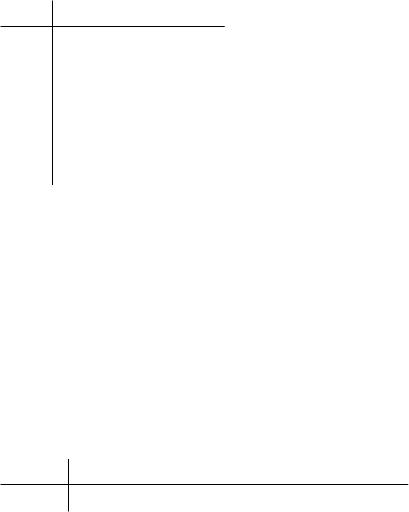
4) A certain magazine reports that the percentage of trading days in which the stock market loses or gains 2%
or more has been increasing over the last six years indicating more volatility in the stock market. Use a
graphing utility to fit an exponential function to the data. Round the values to the nearest thousandth.
Then, use the function to predict the percentage of trading days, to the nearest day, in the seventh year.
Year % of trading days
12
25
38
418
523
649
A) y = 1.278e0.611x, 92 days B) y = 2.354e0.611x, 92 days
C) y = 1.669x1.706, 46 days D) y = 1.849e0.531x, 76 days
5) A nuclear scientist has a sample of 100 mg of a radioactive material which has a half–life in hours. She
monitors the amount of radioactive material over a period of 30 hours and obtains the following data. Use
a graphing utility to fit an exponential function to the data. Round the values to the nearest thousandth.
Then, use the function to predict the amount of material, rounded to the nearest tenth, remaining at 40
hours.
Hours 0 5 10 15 20 25 30
mg 100 68.3 45.2 31.3 21.5 14.6 9.8 .
A) y = 99.671e–0.077x, 4.6 mg B) y = 99.671e–0.077x, 6.7 mg
C) y = 99.671e0.926x, 1.2 mg D) y = 99.671e0.077x, 2168.7 mg
2 Build a Logarithmic Model from Data
MULTIPLE CHOICE. Choose the one alternative that best completes the statement or answers the question.
Solve the problem.
1) Data representing the price and quantity demanded for hand–held electronic organizers were analyzed
every day for 15 days. The logarithmic function of best fit to the data was found to be y = 398 – 73 ln x. Use
this to predict the number of hand–held electronic organizers that would be demanded if the price were
$275. Round to the nearest whole number.
A) 5 electronic organizers B) 7 electronic organizers
C) 6 electronic organizers D) 4 electronic organizers
Page 90
2) The rates of death (in number of deaths per 100,000 population) for 1–4 year olds in a certain country
between 1995–2010 are given below.
Year Rate of Death
1995 91.4
2000 74.5
2005 69.3
2010 61.3
A logarithmic equation that models this data is y = 822.99 – 167.55 ln x where x represents the number of
years since 1915. Use this equation to predict the rate of death for 1–4 year olds in 2020. Round to the
nearest tenth.
A) 43.2 deaths per 100,000 B) 45.7 deaths per 100,000
C) 39.2 deaths per 100,000 D) 50.3 deaths per 100,000
3) The rates of death (in number of deaths per 100,000 population) for 20–24 year olds in a certain country
between 2004–2012 are given below.
Year Rate of Death
2004 134.9
2006 154.7
2008 162.9
2010 174.5
2012 182.2
A logarithmic equation that models this data is y = 76.93 + 42.26 ln x where x represents the number of
years since 2000 and y represents the rate of death in that year. Use this equation to predict the year in
which the rate of death for 20–24 year olds first exceeds 200.
A) 2018 B) 2015 C) 2020 D) 2014
4) After introducing an inhibitor into a culture of luminescent bacteria, a scientist monitors the luminosit
y
produced by the culture. Use a graphing utility to fit a logarithmic function to the data. Round values to
the nearest hundredth. Then, use the function to predict the luminosity, to the nearest hundredth, after 20
hours.
Time, hrs 234581015
Luminosity 77.4 60.8 54.5 45.8 30.0 24.3 10.5
A) y = 98.75 – 32.66 ln x; 0.91 B) y =112.97 –45.97 ln x; –24.74
C) y = 107.55 – 41 ln x; –15.27 D) y =100.5 –32.7 ln x; 2.54
5) In a Psychology class, the students were tested at the end of the course on a final exam. Then they were
retested with an equivalent test at subsequent time intervals. Their average scores after t months are given
in the table.
Time, t ( in months) 12345
Score, y ( in percentage) 86.2 85.7 85.4 85.2 85.0
Using a graphing utility, fit a logarithmic function y = a + b ln x to the data. Using the function you found,
estimate how long will it take for the test scores to fall below 84%. Express your answer to the nearest
month.
A) 20 months B) 10 months C) 12 months D) 8 months
Page 91

3 Build a Logistic Model from Data
MULTIPLE CHOICE. Choose the one alternative that best completes the statement or answers the question.
Solve the problem.
1) A mechanic is testing the cooling system in a boat engine. He measures the engine’s temperature ove
r
time. Use a graphing utility to build a logistic model from the data. Round value to the nearest hundredth.
Based on the model, what is the carrying capacity of the cooling system?
Time, min 5 10 15 20 25
Temperature, °F 100 180 270 300 305
A) y = 314.79
1 + 7.86e–0.25x ; 314.79°F B) y = 314.79
1 + 7.86e–1.22x ; 314.79°F
C) y = 311.63
1 + 8.1e–0.25x ; 311.63°F D) y = 306.53
1 + 7.92e–0.25x ; 306.53°F
2) Use the data in the table to build a logistic model for the population of the city t years after 1940. Round
values to the nearest thousandth.
Year Population (in millions)
1940 0.8
1950 1.0
1960 1.3
1970 1.7
1980 2.0
1990 2.5
2000 3.0
2010 3.6
A) y = 9.053
1 + 10.279e–0.027t B) y = 10.279
1 + 9.053e–0.027t
C) y = 11.679
1 + 13.251e–0.012t D) y = 8.731
1 + 7.663e–0.036t
Page 92
Ch. 6 Exponential and Logarithmic Functions
Answer Key
6.1 Composite Functions
1 Form a Composite Function
Page 93
2 Find the Domain of a Composite Function
6.2 One–to–One Functions; Inverse Functions
1 Determine Whether a Function Is One–to–One
2 Determine the Inverse of a Function Defined by a Map or a Set of Ordered Pairs
3 Obtain the Graph of the Inverse Function from the Graph of the Function
4 Find the Inverse of a Function Defined by an Equation
Page 94
6.3 Exponential Functions
1 Evaluate Exponential Functions
Page 95
2 Graph Exponential Functions
3 Define the Number e
4 Solve Exponential Equations
Page 96

6.4 Logarithmic Functions
1 Change Exponential Statements to Logarithmic Statements & Logarithmic Statements to Exponential Statements
2 Evaluate Logarithmic Expressions
Page 97

3 Determine the Domain of a Logarithmic Function
4 Graph Logarithmic Functions
5 Solve Logarithmic Equations
Page 98
6.5 Properties of Logarithms
1 Work with the Properties of Logarithms
2 Write a Logarithmic Expression as a Sum or Difference of Logarithms
3 Write a Logarithmic Expression as a Single Logarithm
Page 99
4 Evaluate Logarithms Whose Base Is Neither 10 Nor e
5 Graph Logarithmic Functions Whose Base Is Neither 10 Nor e
6.6 Logarithmic and Exponential Equations
1 Solve Logarithmic Equations
2 Solve Exponential Equations
Page 100
3 Solve Logarithmic and Exponential Equations Using a Graphing Utility
6.7 Financial Models
1 Determine the Future Value of a Lump Sum of Money
2 Calculate Effective Rates of Return
3 Determine the Present Value of a Lump Sum of Money
Page 101
4 Determine the Rate of Interest or Time Required to Double a Lump Sum of Money
6.8 Exponential Growth and Decay Models; Newton’s Law; Logistic Growth and Decay Models
1 Find Equations of Populations That Obey the Law of Uninhibited Growth
2 Find Equations of Populations That Obey the Law of Decay
3 Use Newton’s Law of Cooling
Page 102
4 Use Logistic Models
6.9 Building Exponential, Logarithmic, and Logistic Models from Dat
a
1 Build an Exponential Model from Data
2 Build a Logarithmic Model from Data
3 Build a Logistic Model from Data
Page 103