94.
Which of the following statements is incorrect?
95.
All of the following are secondary market transactions EXCEPT:
96.
Which of the following is NOT correct with respect to derivative securities?
97.
Which of the following is NOT correct with respect to financial institutions?
98.
All of the following are factors that influence interest rates for individual securities
EXCEPT:
99.
The real interest rate is:
100.
All of the following special provisions benefit security holders EXCEPT:
101.
An example of an illiquid asset is:
102.
All of the following are common shapes for the yield curve EXCEPT:
103.
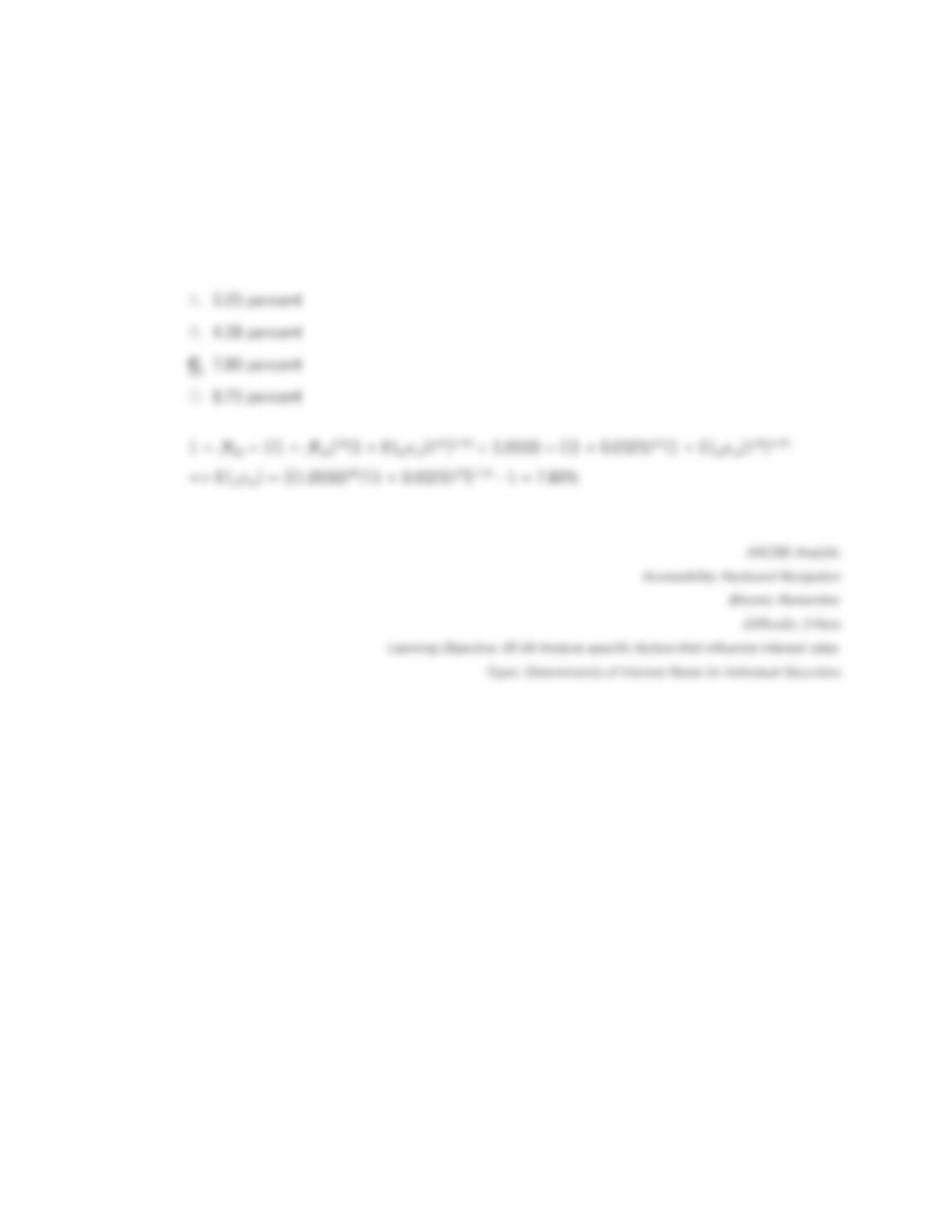
Determinants of Interest Rates for Individual Securities
The Wall Street Journal
reports
that the current rate on five-year Treasury bonds is 2.85 percent and on 10-year Treasury
bonds is 4.35 percent. Assume that the maturity risk premium is zero. Calculate the
expected rate on a five-year Treasury bond purchased five years from today, E(5
r
5).
104.
Determinants of Interest Rates for Individual Securities
The Wall Street Journal
reports
that the current rate on 10-year Treasury bonds is 3.25 percent and on 20-year Treasury
bonds is 5.50 percent. Assume that the maturity risk premium is zero. Calculate the
expected rate on a 10-year Treasury bond purchased ten years from today, E(10
r
10).
Essay Questions
105.
What is a derivative security and what determines its value?
106.
What shape does the term structure usually take? Why?
107.
What does the “term structure of interest rates” mean?
108.
Why is it useful to calculate forward rates?
109.
George Washington wants to invest in one of two corporate bonds issued by separate
firms. One bond yields 7 percent with a 10-year maturity; the other offers a 10 percent
yield with a nine-year maturity. George thinks the nine-year bond is the better deal since
the rate is higher. Is this necessarily so? Explain what factors George should consider
before making a choice.
110.
How do Financial Intermediaries (FIs) act as asset transformers?
111.
Who are some of the participants in the shadow banking system?
112.
Explain how the shadow banking system works.
113.
Classify the following transactions as taking place in the primary or secondary markets:
a. A company issues new common stock.
b. A company issues common stock in an IPO.
c. A shareholder sells preferred stock out of its marketable securities portfolio.
d. A mutual fund buys previously issued bonds.
e. An insurance company sells another company’s common stock.
f. A company buys another company’s stock from a mutual fund.
114.
Classify the following financial instruments as money market securities or capital market
securities:
a. Common stock
b. Corporate bonds
c. Mortgages
d. U.S. Treasury bills
e. U.S. Treasury notes
f. U.S. Treasury bonds
g. State and government bonds