
96)
What is a calling orientation, and how does it impact employee motivation?
Electro Logic
Electro Logic (EL) is a small R&D firm located in a midwestern college town adjacent to a major university. Its primary
mission is to perform basic research on, and development of, a new technology called “Very Fast, Very Accurate” (VFVA).
Founded four years ago by Steve Morgan, an electrical engineering professor and inventor of the technology, EL is primarily
funded by government contracts, although it plans to market VFVA technology and devices to nongovernmental
organizations within the year.
The government is very interested in VFVA, as it will enhance radar technology, robotics, and a number of other
important defense applications. EL recently received the largest small–business contract ever awarded by the government to
research and develop this or any other technology. Phase I of the contract has just been completed, and the government has
agreed to Phase II contracting as well.
The organizational chart of EL is shown in Figure 6.
Current membership is 75, with roughly 88 percent in engineering. Heads of staff are supposedly appointed based on
their knowledge of VFVA technology and their ability to manage people. In practice, the president of EL hand picks these
people based on what some might call arbitrary guidelines: Most of the staff leaders were or are the president’s graduate
students. There is no predetermined time frame for advancement up the hierarchy. Raises are, however, directly related to
performance appraisal evaluations.
Working directly with the engineers are the technicians. These people generally have a high school degree, although
some also have college degrees. They are trained on the job, although some have gone through a local community college’s
program on microtechnology fabrication. The technicians perform the mundane tasks of the engineering department:
running tests, building circuit boards, manufacturing VFVA chips, and so on. Most are full–time hourly employees.
The administrative staff is composed of the staff head (with an MBA from a major university), accountants, personnel
director, graphic artists, purchasing agent, project controller, technical writers/editors, and secretaries. Most of the people in
the administrative staff are women. All are hourly employees except the staff head, personnel director, and project controller.
The graphic artists and technical writer/editor are part–time employees.
The facilities staff is composed of the staff head and maintenance personnel. EL is housed in three different buildings,
and the primary responsibility of the facilities staff is to ensure that the facilities of each building are in good working order.
Additionally, the facilities staff is often called upon to remodel parts of the buildings as the staff continues to grow.
EL anticipates a major recruiting campaign to enhance the overall staff. In particular, it is looking for more technicians
and engineers. Prior to this recruiting campaign, however, the president of EL hired an outside consultant to assess employee
needs as well as the morale and overall effectiveness of the firm. The consultant has been observing EL for about three weeks
and has written up some notes of her impressions and observations of the company.
Consultant’s Notes from Observations of Electro Logic
Facilities: Electro Logic (EL) is housed in three different buildings. Two are converted houses, and one is an old school
building. Senior managers and engineers are in the school, and others are scattered between the houses.
Meetings: Weekly staff meetings in the main building are held to discuss objectives and to formulate and review
milestone charts.
Social interaction: A core group of employees interact frequently on a social basis, for example, sports teams, parties. The
administration staff celebrate birthdays at work. The president occasionally attends.
Work allocation: Engineers request various tasks from the support staff, which consists of technicians and administrative
unit personnel. There is obviously some discretion used by the staff in assigning priorities to the work requests, based on
rapport and desirability of the work.
Turnover: The highest turnover is among administrative personnel and technicians. Exit interviews with engineers
indicate they leave because of the company’s crisis–management style, better opportunities for career advancement and
security in larger organizations, and overall frustration with EL’s “pecking order.” Engineers with the most responsibility and
58
authority tend to leave.
Salary and benefits: In general, wages at EL are marginal by national and local standards. A small group of scientists and
engineers do make substantial salaries and have a very attractive benefits package, including stock options. Salaries and
benefits for new engineers tend to be linked to the perceived level of their expertise.
Offices and facilities: Only EL’s president, vice–president, and chief financial officer have their own offices. Engineers are
grouped together in “pods” by project assignment. There is very little privacy in these work areas, and the noise from the
shared printer is distracting. The head of administration shares a pod with the personnel director, facilities head, and the
project controller. One to three secretaries per building are located in or near the reception areas. The large building has an
employee lounge with three vending machines. There is also a coffee and tea station. The smaller buildings have only a
soft–drink machine in the reception area.
Consultant’s Interviews with Employees
After making these observations, the consultant requested interviews with a cross–section of the staff for the purpose of
developing a survey to be taken of all employees. Presented below are excerpts from those interviews.
Pat Klausen, Senior Member of the Technical Staff
CONSULTANT: What is it about Electro Logic (EL) that gives you the most satisfaction?
PAT: I really enjoy the work. I mean, I’ve always liked to do research, and working on VFVA is an incredible opportunity.
Just getting to work with Steve (EL’s president and VFVA’s inventor) again is exciting. I was his graduate student about six
years ago, you know. He really likes to work closely with his peopleperhaps sometimes too closely. There have been times
when I could have done with a little less supervision.
CONSULTANT: What’s the least satisfying aspect of your work?
PAT: Probably the fact that I’m never quite sure that we’ll be funded next month, given the defense budget problems and the
tentativeness of our research. I’ve got a family to consider, and this place isn’t the most stable in terms of its financial
situation. Maybe it’ll change once we get more into commercial production. Who knows?
CONSULTANT: You’ve offered some general positives and negatives about EL. Can you be more specific about day–to–day
dealings? What’s good and bad about working here on a daily basis?
PAT: You’re sure this isn‘t going to get back to anyone? Okay. Well, in general I’m not satisfied with the fact that too often we
end up changing horses in the middle of the stream, if you know what I mean. In the past seven months, three of my
engineers and four of my techs have been pulled off my project and put onto projects whose deadlines were nearer than
mine. Now I’m faced with a deadline, and I’m supposed to be getting more staff. But I’ll have to spend so much time briefing
them that it might make more sense for me to just finish the project myself. On the other hand, Steve keeps telling me that we
have to be concerned with EL’s overall goals, not just our individual concernsyou know, we have to be “team players,”
“good members of the family.” It’s kind of hard to deal with that, though, when deadlines are bearing down and you know
your butt’s on the line, team player or not. But if you go along with this kind of stuff and don’t complain, the higher–ups treat
you well. Still, it seems to me there’s got to be a better way to manage these projects.
CONSULTANT: What are the positive aspects of your daily work?
PAT: Well, the people here are all great to work with. They know their stuff or can learn quickly. I tend to be a social person
and I really like socializing with these people. We play softball and basketball together and do happy hours and stuff. I like
that. I’ve got some good friends here, which helps get my work orders filled quickly, if you know what I mean.
Bob Christensen, Member of the Technical Staff
CONSULTANT: You said earlier that Steve was your advisor for your MS. So you’ve known him a long time.
BOB: Yes, that’s right. I’ve known Professor MorganStevefor about eight years. I had him for a few undergraduate classes;
then, of course, he was my advisor for my two–year master’s program, and now I’ve worked at Electro Logic (EL) for two
years.
CONSULTANT: It seems as if you enjoy working with Steve.
BOB: Oh, yeah. But I really don‘t get to work directly with him anymore. I‘ll see him at meetings and such, but that’s about it.
CONSULTANT: So he’s not your immediate supervisor?
BOB: No, but for the amount of time I spend with my supervisor, Steve might as well be. My boss and I meet maybe once
every three weeks for about an hour to see if all is well. And that’s it. The rest of the time, I’m on my own. I used to talk to
Steve when I had questions, but he’s gotten so busy now that it’s hard to see himyou need to make an appointment a few
days in advance.
CONSULTANT: Do you think your supervisor treats all his staff this way?
59
BOB: To be honest, I have heard some complaints. In fact, about six months ago, the situation was so bad, some other people
and I had a meeting with him. He promised that he would be more available to us and was, for about a month. Then we got
involved in a new proposal, so he made himself scarce again. So nothing’s really changed. We’re coming up on finalizing the
proposal now, and it’s important that I see him, ask him questions. The last few drafts I‘ve submitted to him, he‘s returned,
rewritten in his own way, and with no explanation of the changes. Sometimes I think he treats me like somebody who doesn’t
know anything, as if I had no training whatsoever. I realize his neck is on the line with this project, but sometimes it seems
that he uses being busy to avoid talking to me.
Chris Chen, Research Scientist
CONSULTANT: What kind of characteristics should a person have if he/she wants to work as a research scientist at Electro
Logic (EL)?
CHRIS: Well, certainly technical knowledge is important. When I’ve interviewed recent college grads for entry–level
positions, I am always concerned with their GPA. I like to see straight–A averages, if possible. But for experienced research
scientists, technical knowledge shows up in their publication records, mostly. So I’ll read their papers. I also think a research
scientist has to be highly self–motivated, not look to others for praise and such. Particularly here. If you want someone to tell
you you’ve done a good job, you’ll be waiting a long time. It’s not clear to me that research scientists really get the support we
need from the rest of the staff here. Work orders are often lost or put off for one reason or another. Senior members seem to
get more techs than scientists do, and they certainly get more attention from Steve. The rumor is that these guys also get
higher raises than the scientists; allegedly, this is to keep pay at an equitable rateyou know, they’re supposedly more
valuable to the company. Of course, everybody knows that most of the senior members are Steve’s old graduate students,
and so he takes care of them really well. One of the things that really galls me is that I need to keep up my publication record
to maintain my career options. But publishing is frowned on because it takes time away from your work. I’ve even been told
that my work can’t be published because of proprietary rights or that the defense department considers the information
classified. However, if somebody important is working with me and needs the publication, then it’s full steam ahead.
CONSULTANT: You sound pretty disgruntled with your work.
CHRIS: It’s not my work so much. I’m really very happy doing this workit’s cutting–edge, after all. The problem is that I’m
never quite sure where the work is going. I do my part of a project, and unless I go out of my way to talk to other people, I
never find out the final results of the total project. That’s just something you learn to live with around herebeing part of a
system that’s not particularly open.
Meg Conroy, Assistant to the Head of Administration
CONSULTANT: You’ve only been here a short time, is that correct?
MEG: That’s rightjust a little over a year.
CONSULTANT: Why did you take the job?
MEG: Well, I was in my last semester of college and was looking for a job, like most college seniors. My fiancé at the time
now he‘s my husbandwas already working for Electro Logic (EL) and found out that there was an opening. So I applied.
CONSULTANT: So you were a business major in school?
MEG: Oh, no. I was a history major.
CONSULTANT: Do you like your job?
MEG: It has a lot to offer. I get paid pretty well for what I’m doing. And I’m learning a lot. I just wish the company would let
me take some classes in administration, like accounting. The auditors ask some pretty tough questions. Steve says we should
hire that expertise, but I’d still be responsible for supervising the people.
CONSULTANT: Is there any particular aspect about your job that you really find satisfying?
MEG: Well, let me think. I guess I like the fact that I get to do a lot of different tasks so that things don’t get so boring. I would
hate to have to do the same thing, day in and day out. A lot of times, I go to the library to do research on different things, and
that’s nice because it gets me out of the office.
CONSULTANT: What don’t you like about your job?
MEG: Well, I often get the feeling that administration isn‘t taken seriously. You know, the engineers could get along without
us quite nicely, or so they seem to think. The whole structure of the department shows that we’re the catch–all department: If
you don’t fit anywhere else, they put you in here. Perhaps some of that is because our department is primarily womenin
fact, I’ve been told that 95 percent of all the female employees are in administration. Sometimes it’s hard to work with the
engineers because they treat you like you don’t know anything, and they always want things to be done their way. Clearly,
the engineers get the money and consideration and yet, well, we do contribute quite a lot to the whole team, as Steve would
say. But words of praise just aren’t as impressive as actions. Sure, we get our birthday parties, but that still seems to be a little
60
patronizing. We rarely get to see what’s going on in the research area. I’ve asked a number of engineers specific questions,
and they just kind of look at me with a blank stare and give me some really simplified answer. It seems to me if you want to
build a family, like the president says, you can’t treat administration like a bad relation.
P. J. Ginelli, Technician
CONSULTANT: I gather you’ve just been through your semiannual performance appraisal. How did it go?
P. J.: Like I expected. No surprises.
CONSULTANT: Do you find these appraisals useful?
P. J.: Sure. I get to find out what he thinks of my work.
CONSULTANT: Is that all?
P. J.: Well, I suppose it‘s a nice opportunity to understand what my supervisor wants. Sometimes he’s not so clear during the
rest of the year. I suppose he’s been given specific goals from higher–ups before he talks with me, so he’s clear and then I’m
clear.
CONSULTANT: Do you like what you’re doing?
P. J.: Oh yeah. The best part is that I’m not at the main building and so I don’t have to put up with the “important” people,
you know? I’ve heard from other techs that those guys can be a real paintrying to be nice and all, but really just being a
bother. I mean, how can you get your stuff done when the president’s looking over your shoulder all the time? On the other
hand, if the president knows your name, I suppose that’s a good thing when it comes to raises and promotions. But my boss
sticks up for his techs; we get a fair deal from him.
CONSULTANT: Do you think you’ll be able to get ahead at Electro Logic (EL)?
P. J.: Get ahead? You mean become an engineer or something? No, and I really don’t want to do that. Everyone around here
keeps pushing me to move up. I’m afraid to tell people how I really feel for fear they‘ll decide I don’t fit into this high–tech
environment. I don’t want to be the “black sheep of the family.” I like where I am, and if the raises keep coming, I’ll keep
liking it. One of my kids is starting college next year, and I need the money to help her out. I get a lot of overtime, particularly
when contract deadlines are near. I suppose the rush toward the end of contracts gives some people big headaches, but for
me, I don’t mind. The work is pretty slow otherwise, and so at least I’m working all the time and then some. But my family
wishes my schedule was more predictable.
CONSULTANT: Do you think you’ll continue working for EL?
P. J.: I’m not sure I want to answer that. Let’s just say that my ratings on the performance appraisal were good, and I expect to
see an improvement in my pay. I’ll stay for that.
Chalida Montgomery, Technician
CONSULTANT: In general, what are your feelings about the work you do for Electro Logic (EL)?
CHALIDA: Well, I feel my work is quite good, but I also feel that I perform rather boring, tedious tasks. From what my
supervisor says, the kinds of things I do are what electrical engineering students do in their last year of classes. I gather their
final project is to make a circuit board, and that’s what I do, day in and day out.
CONSULTANT: What is it that you would like to do?
CHALIDA: Well, it would be nice to be able to offer some input into some of the designs of these boards. I know I don’t have
a Ph.D. or anything, but I do have lots of experience. But because I’m a tech, the engineers don’t really feel I’ve got much to
offereven though I build the boards and can tell from the design which one will do what the designer wants it to do. I also
would like to maybe supervise other technicians in my department. You know, some kind of advancement would be nice. As
it is, lots of techs ask me how to do things, and of course I help, but then they get the credit. Around here, you have to have a
piece of paper that says you’re educated before they let you officially help other people.
61
97)
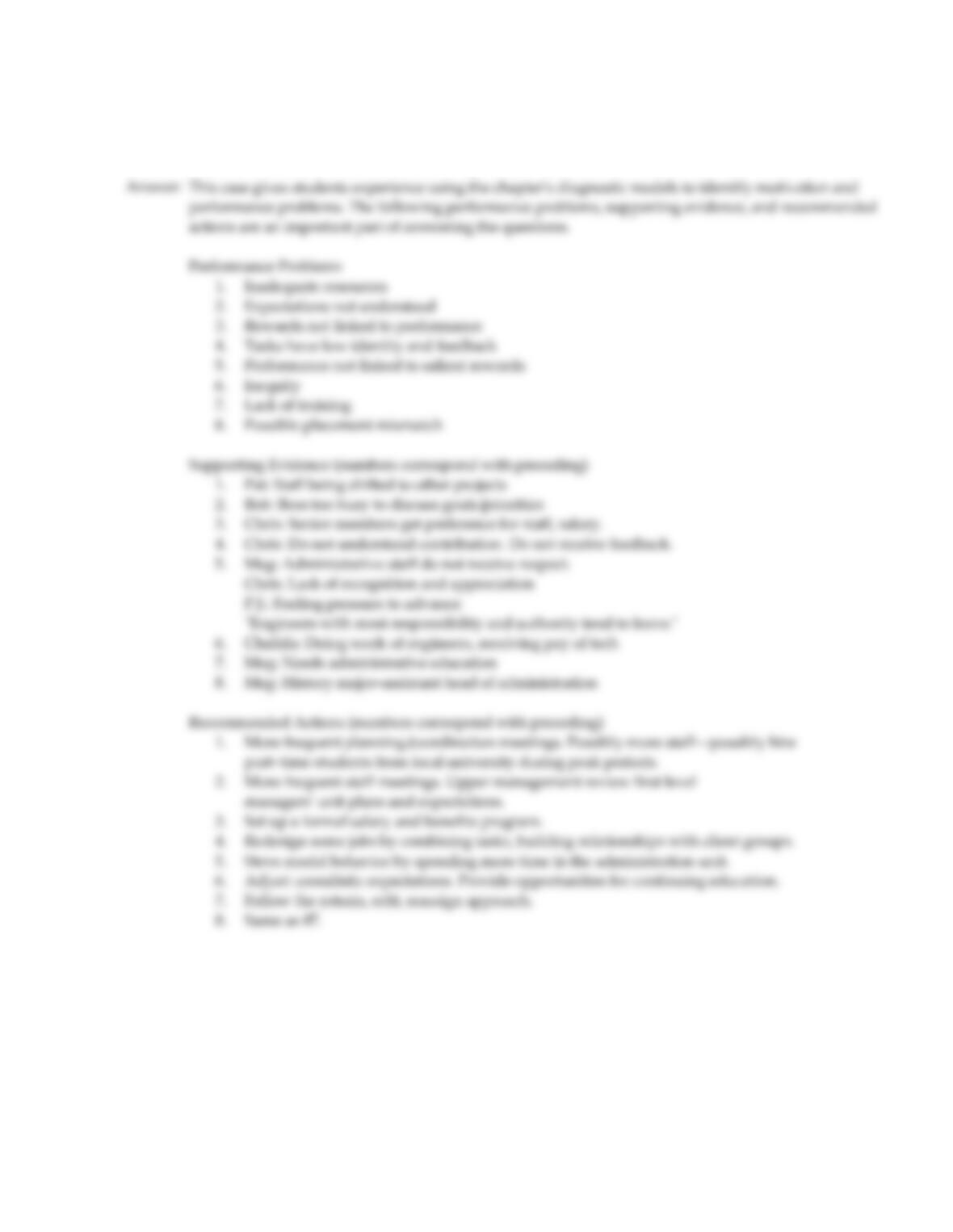
What are the high–priority action items you would include in a consulting report to Steve Morgan, president of
EL? Focus on specific actions that he could initiate that would better use the abilities of the staff and foster a
more motivating work environment.What are the high–priority action items you would include in a consulting
report to Steve Morgan, president of EL? Focus on specific actions that he could initiate that would better use
the abilities of the staff and foster a more motivating work environment.
62
98)
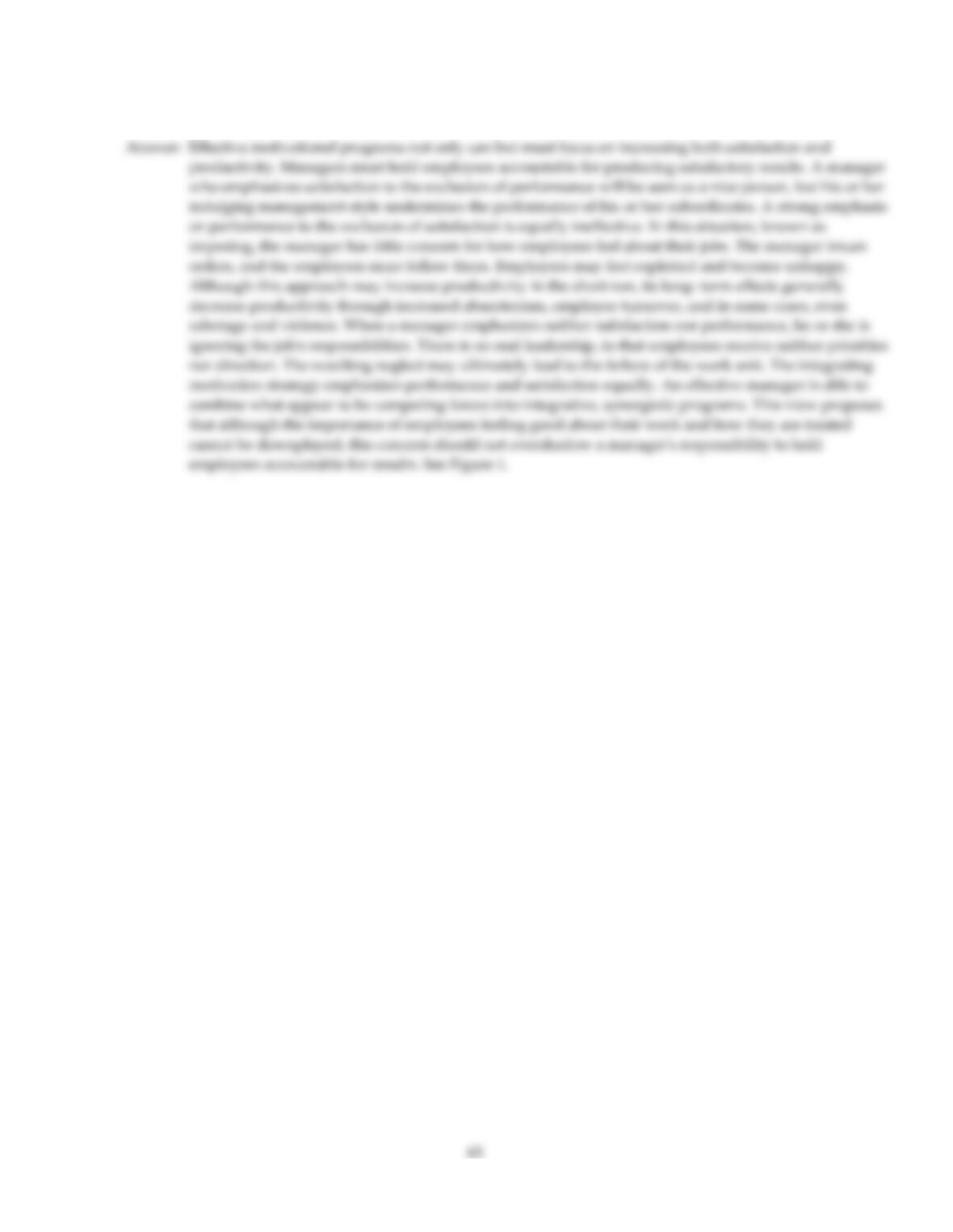
Are concerns about employee morale and company productivity compatible or are they mutually exclusive?
Compare and contrast the types of outcomes that can result from placing a different emphasis on both job
performance and job satisfaction.
Answer Key
Testname: C6
Answer Key
Testname: C6
65
Answer Key
Testname: C6
66
Answer Key
Testname: C6
Answer Key
Testname: C6
Answer Key
Testname: C6
69
Answer Key
Testname: C6
70
Answer Key
Testname: C6
71
Answer Key
Testname: C6
Answer Key
Testname: C6
73
Answer Key
Testname: C6
74