16) Suppose the cross-price elasticity of demand between grapefruit juice and orange juice is
approximately 6. What does this mean?
A) A 1 percent decrease in the price of grapefruit juice leads to a 6 percent increase in orange
juice consumption.
B) A 6 percent increase in the price of grapefruit juice leads to a 1 percent increase in orange
juice consumption.
C) If the price of grapefruit juice rises by $1, 6 more cartons of orange juice will be purchased.
D) The demand for orange juice is 6 times more than the demand for grapefruit juice.
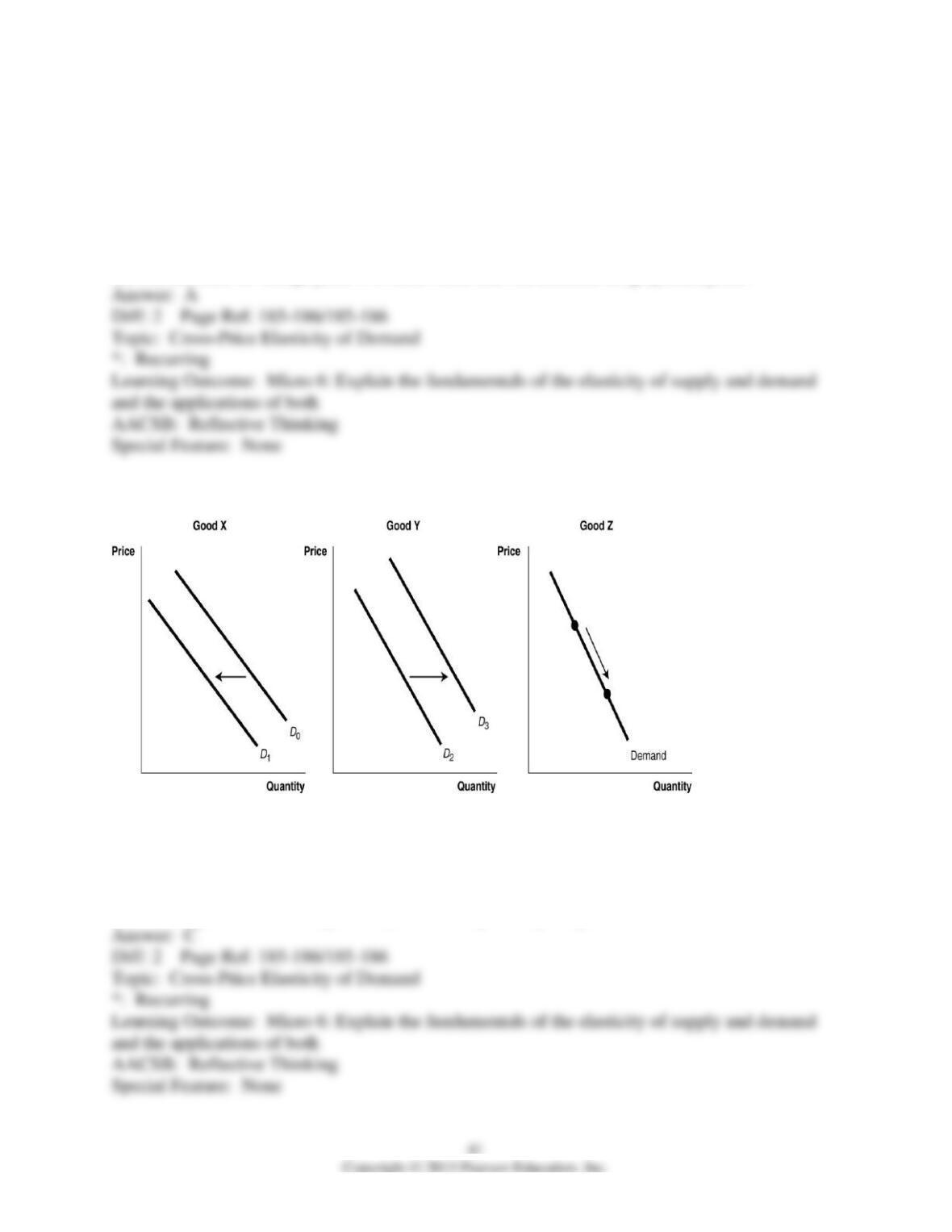
Figure 6-5
17) Refer to Figure 6-5. Identify the two goods which are substitutes.
A) Good X and Good Y
B) Good Y and Good Z
C) Good X and Good Z
D) It is not possible to distinguish any relationship among the goods.
18) Refer to Figure 6-5. Identify the two goods which are complements.
A) Good X and Good Y
B) Good Y and Good Z
C) Good X and Good Z
D) It is not possible to distinguish any relationship among the goods.
19) In September 2006, the Food and Drug Administration recommended that Americans avoid
eating bagged raw spinach in the wake of an outbreak of E. coli bacteria. Following this
recommendation, the food industry looked at alternatives and many turned to arugula. One
Chicago distributor claimed, “The sale of the stuff has gone through the roof.” Based on this
information,
A) arugula is a normal good while raw spinach is an inferior good.
B) the cross-price elasticity between arugula and spinach is negative.
C) the cross-price elasticity between arugula and spinach is positive
D) the price elasticity of arugula is positive while the price elasticity of spinach falls to zero.
20) For people who live near a bus route, a subway station, or a commuter rail line, public
transportation provides a substitute to driving their own cars. So, for these people, the cross-price
elasticity of demand between gasoline and public transportation is
A) positive.
B) negative.
C) zero.
D) infinity.
21) If a firm is in an antitrust court case being accused of monopolizing a product, the firm
would hire an economist to show
A) the cross-price elasticity of demand between the firm’s good and another is negative.
B) the cross-price elasticity of demand between the firm’s good and another is positive.
C) the price elasticity of demand for the firm’s good is highly inelastic.
D) the income elasticity of the firm’s good is inferior.
22) Suppose the California Nurses Union successfully secured a 12 percent increase in the wages
of registered nurses. If a hospital responds by reducing the quantity of registered nurses hired and
increasing the quantity of physician’s assistants hired, what conclusion can you draw?
A) Physician’s assistants are more valuable in terms of their productivity.
B) The price elasticity of demand for registered nurses is negative while the price elasticity of
demand for physician’s assistants is positive.
C) The cross-price elasticity of demand between registered nurses and physician’s assistants is
positive.
D) The cross-price elasticity of demand between registered nurses and physician’s assistants is
negative.
23) If the cross-price elasticity of demand between Breeze Detergent and Faber Detergent is a
relatively large positive number, then it indicates that
A) the two brands are probably made by the same company.
B) the two brands of detergent are close substitutes.
C) consumers have a distinct preference for one brand versus the other.
D) detergents are necessities.
24) The cross-price elasticity of demand between an unlimited texting option and an unlimited
call minutes option offered from a cell phone provider would be
A) positive if subscribers consider the services substitutes for each other.
B) positive if subscribers consider the services complements to each other.
C) negative if subscribers consider the services substitutes for each other.
D) negative no matter if subscribers consider the services substitutes or complements for each
other.
25) Demand for staples such as dairy products and bread is likely to be both income and price
inelastic.
26) In recent years, the prices of new domestically produced cars have been falling. Suppose
consumers respond by reducing their demand for used cars and mass transport services such as
bus travel. This information suggests that the cross-price elasticity between new cars and used
cars, and the cross-price elasticity between new cars and bus travel are negative.
27) In the alcohol industry, both wine and spirits are considered to be substitutes for beer.
28) What factors would make you more sensitive or less sensitive to price when purchasing
gasoline?
29) Suppose a 4 percent increase in income results in a 2 percent decrease in the quantity
demanded of a good. Calculate the income elasticity of demand for the good and determine what
type of good it is.
6.5 Using Elasticity to Analyze the Disappearing Family Farm
1) Which of the following is one reason why the income of small family farms has decreased
over time?
A) Technology has increase farm productivity and market supply.
B) The demand for farm products is price elastic.
C) The demand for farm products is income inelastic.
D) The U.S. population has increased greatly since 1950.
2) Between 1950 and 2011 the number of acres devoted to wheat production in the United States
________ and the price of wheat ________.
A) declined; decreased
B) more than doubled; increased by about 50 percent
C) declined; more than doubled
D) increased; more than doubled
3) The price of wheat has fallen since 1950. Which of the following explains this price decline?
A) The price elasticity of demand is less than 1 (in absolute value) and the income elasticity of
demand for wheat is low.
B) The price elasticity of demand is greater than 1 (in absolute value) and the income elasticity
of demand for wheat is low.
C) The price elasticity of demand is less than 1 (in absolute value) and wheat is an inferior good.
D) The price elasticity of demand is greater than 1 (in absolute value) and the income elasticity
of demand for wheat is greater than 1.
4) The demand for most farm products is relatively inelastic. All else constant, what is the effect
on farm revenues as a result of the introduction of new and better farm equipment which
increases in productivity?
A) Farm revenues increase.
B) Farm revenues decrease.
C) Farm revenues remain constant because consumers will not increase their consumption of
farm products by much.
D) Farm revenues could increase or decrease depending on the cost of this new equipment.
5) Suppose a frost destroys the tomato crop in California but farmers see an increase in their
revenues. Which of the following best explains this?
A) The decrease in supply led to huge price increases.
B) Tomatoes are necessities.
C) The demand for tomatoes is price inelastic.
D) The cross-price elasticity between tomatoes and most other substitute vegetables is very low.
6) Suppose the price of gasoline is $3.50 per gallon, the quantity of gasoline demanded is 150
billion gallons per year, the price elasticity of demand for gasoline is -0.06, and the federal
government decides to increase the excise tax on gasoline by $1.00 per gallon, which increases
the price of gasoline by $0.75 per gallon. What is the new equilibrium quantity of gasoline
demanded after the tax is imposed?
A) 109.72 billion gallons per year
B) 127.25 billion gallons per year
C) 148.27 billion gallons per year
D) 161.61 billion gallons per year
7) Suppose the price of gasoline is $3.50 per gallon, the quantity of gasoline demanded is 150
billion gallons per year, the price elasticity of demand for gasoline is -0.06, and the federal
government decides to increase the excise tax on gasoline by $1.00 per gallon, which increases
the price of gasoline by $0.75 per gallon. How much revenue does the federal government
receive from the tax?
A) $95.44 billion
B) $111.20 billion
C) $148.27 billion
D) $161.61 billion
8) The demand for most farm products is relatively inelastic. A drought that reduces the supply
of farm products will also cause farm revenues to fall.
9) A study of the effects of the minimum wage on employment of low-skilled workers estimated
the price elasticity of demand for low-skilled workers is -0.75. Suppose that the government is
considering raising the minimum wage from $7.25 per hour to $7.75 per hour. Based on this
information, calculate the percentage change in the employment of low skilled workers. Use the
midpoint formula.
10) Suppose the price elasticity of demand for cigarettes is -0.4. The FDA decides to regulate
tobacco production, which increases the price of cigarettes and causes the quantity of cigarettes
demanded to decrease by 25 percent. What is the percentage increase in price which would lead
to the 25 percent decrease in quantity demanded? If the price elasticity was -4, what would be the
percentage increase in price?
6.6 The Price Elasticity of Supply and Its Measurement
1) The price elasticity of an upward-sloping supply curve is always
A) positive.
B) negative.
C) greater than one.
D) impossible to determine.
2) Price elasticity of supply is used to gauge
A) how responsive suppliers are to price changes.
B) how responsive suppliers are to changes in future prices.
C) how responsive suppliers are to a change in demand.
D) how responsive sales are to a change in input prices
3) The price elasticity of supply is equal to
A) the value of the slope of the supply curve.
B) the change in quantity supplied divided by the change in price.
C) the percentage change in price divided by the percentage change in quantity supplied.
D) the percentage change in quantity supplied divided by the percentage change in price.
4) Suppose the value of the price elasticity of supply is 4. What does this mean?
A) A 4 percent increase in the price of the good causes quantity supplied to increase by 1
percent.
B) A 1 percent increase in the price of the good causes the supply curve to shift upward by 4
percent.
C) A 1 percent increase in the price of the good causes quantity supplied to increase by 4
percent.
D) For every $1 increase in price, quantity supplied increases by 4 units.
5) Suppose a 4 percent increase in price results in a 2 percent increase in the quantity supplied of
a good. Calculate the price elasticity of supply and characterize the product.
A) 2; The product is elastic.
B) 0.2; The product is inelastic.
C) 0.5; The product is inelastic.
D) 50%; The product is inelastic.
6) Suppose that the price of a money clip increases from $0.75 to $0.90 and quantity supplied
rises from 8,000 units to 10,000 units. Use the midpoint formula to calculate the price elasticity
of supply.
A) 1.22
B) 1.0
C) 0.82
D) 0.07
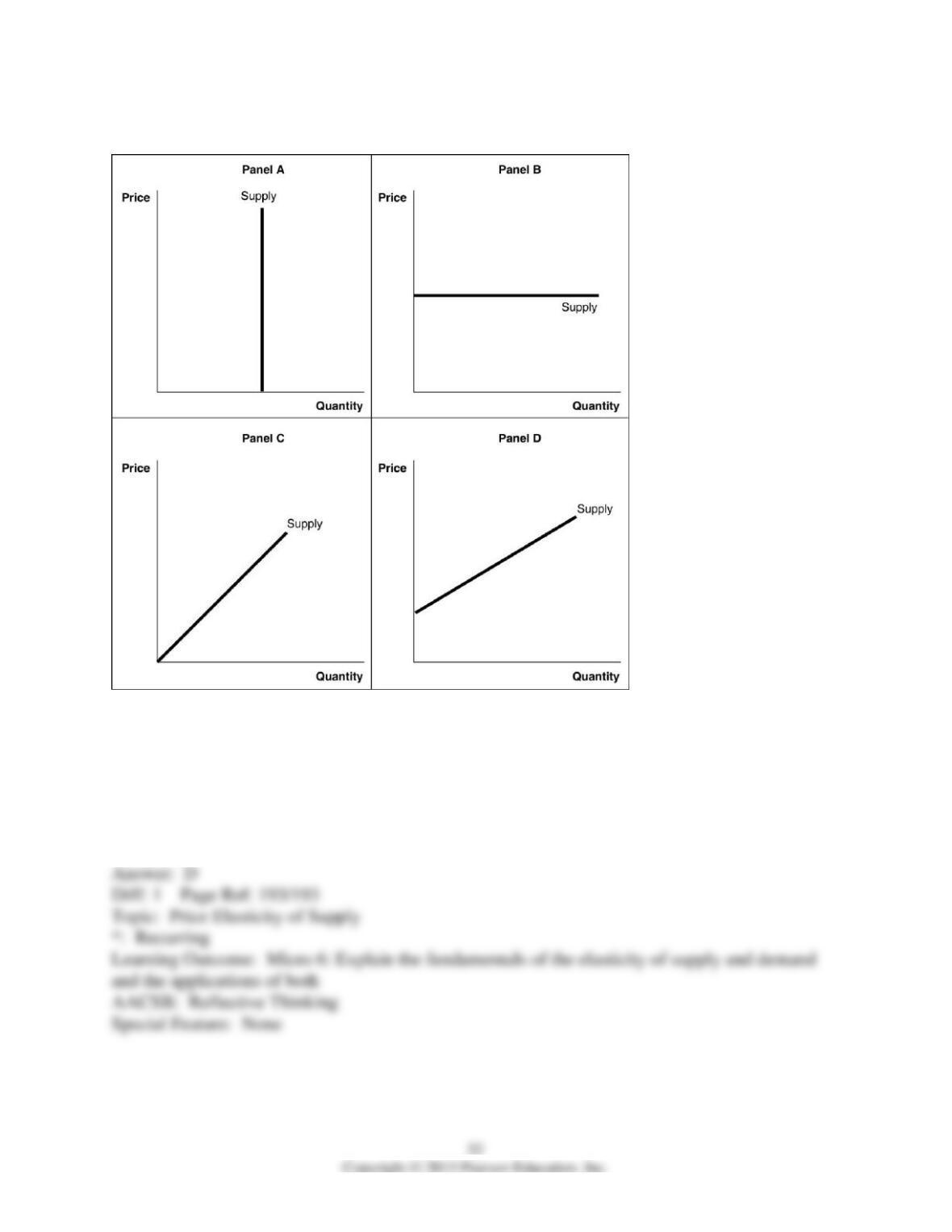
Figure 6-6
7) Refer to Figure 6-6. The supply curve on which price elasticity changes at every point is
shown in
A) Panel A.
B) Panel B.
C) Panel C.
D) Panel D.
8) Refer to Figure 6-6. A perfectly elastic supply curve is shown in
A) Panel A.
B) Panel B.
C) Panel C.
D) Panel D.
9) Refer to Figure 6-6. A perfectly inelastic supply curve is shown in
A) Panel A.
B) Panel B.
C) Panel C.
D) Panel D.
10) Refer to Figure 6-6. A unit-elastic supply curve is shown in
A) Panel A.
B) Panel B.
C) Panel C.
D) Panel D.
11) The price elasticity of the supply of teenage labor services is approximately 1.36. Suppose
the minimum wage rises from $7.25 per hour to $8.75. Using the midpoint formula, calculate the
approximately change in the quantity supplied of teenage labor.
A) 7.3 percent
B) 14.4 percent
C) 25.5 percent
D) There is insufficient information to answer the question.
12) An increase in the demand for green tea raises the price of apples from $16 a pound to $20 a
pound. As a result, quantity supplied increases by 30 percent. Using the midpoint formula,
calculate the value of the price elasticity of supply?
A) 1.35
B) 1.875
C) 2.22
D) 7.5
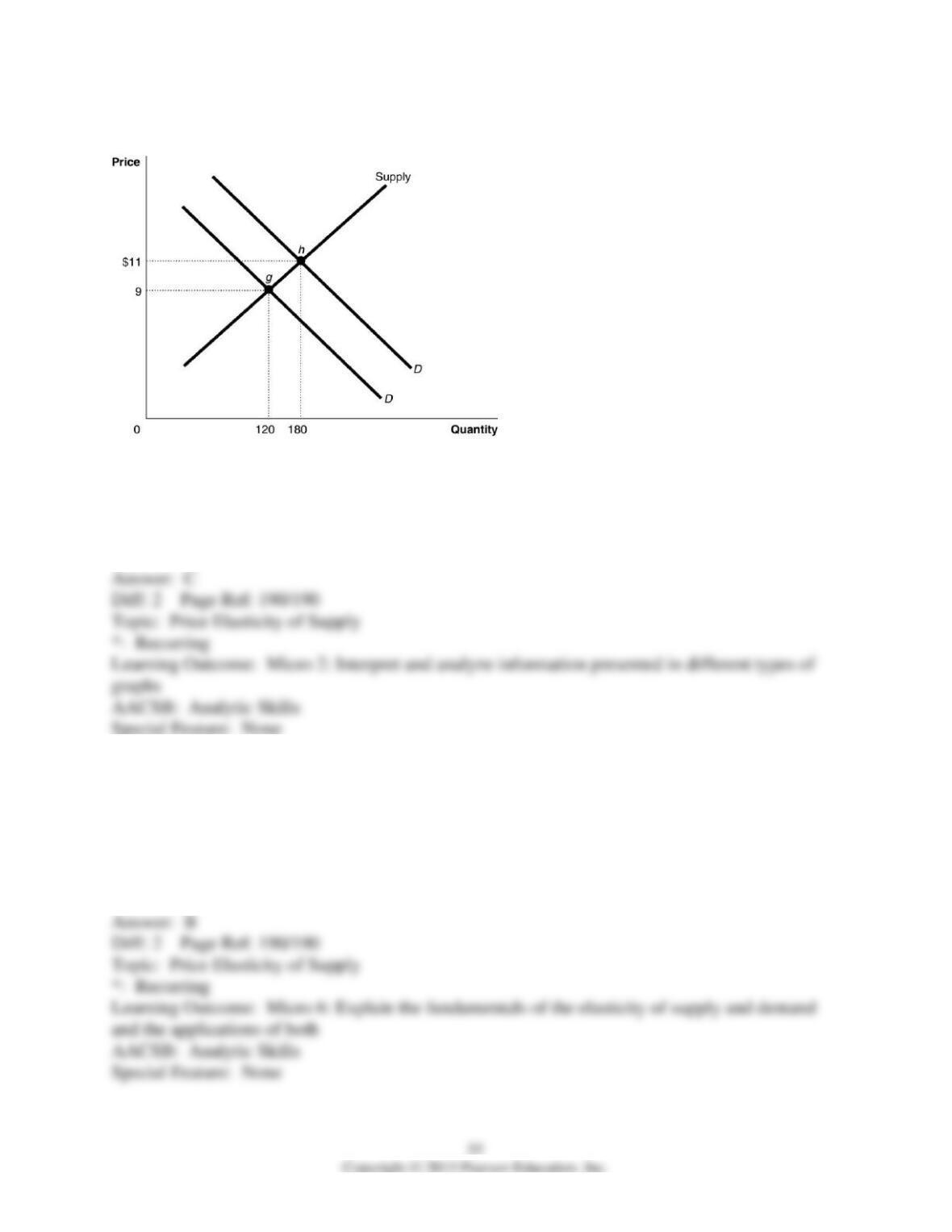
Figure 6-7
13) Refer to Figure 6-7. What is the value of the price elasticity of supply between g and h?
A) 20 percent
B) 0.5
C) 2
D) 0.02
14) The price elasticity of supply for umbrellas is 2. Suppose you’re told that following a price
increase, quantity supplied increased by 30 percent. What was the percentage change in price
that brought this about?
A) 60 percent
B) 15 percent
C) 6.7 percent
D) impossible to determine without additional information
15) If, for a given percentage increase in price, quantity supplied increases by a proportionately
larger percentage, then supply is
A) unit-elastic.
B) perfectly elastic.
C) relatively inelastic.
D) elastic.
16) If firms do not increase their quantity supplied when price changes, then supply is
A) perfectly elastic.
B) perfectly inelastic.
C) relatively inelastic.
D) elastic.
17) If, for a given percentage decrease in price, quantity supplied decreases by a proportionately
smaller percentage, then supply is
A) unit-elastic.
B) perfectly elastic.
C) relatively inelastic.
D) elastic.
18) Bringing oil to the market is a relatively long and costly process. The whole process from
exploration to pumping significant amounts of oil can take years. What does this indicate about
the price elasticity of supply for oil?
A) The elasticity coefficient is likely to be very high and supply is inelastic.
B) The elasticity coefficient is likely to be close to zero and supply is perfectly elastic.
C) The elasticity coefficient is likely to be low and supply is highly inelastic.
D) The elasticity coefficient is likely to be low and supply is highly elastic.
19) Over longer periods of time, increases in oil prices provide firms with incentives to explore
and recover oil. What does this indicate about the long run price elasticity of supply for oil?
A) The elasticity coefficient is likely to be higher in the long run than in the short run.
B) The elasticity coefficient is likely to be lower in the long run than in the short run.
C) The elasticity coefficient approaches 0 in the long run as supplies are depleted.
D) The elasticity coefficient is unstable in the long run because oil supplies may be depleted.
20) Suppose at the going wage rate of $20 per hour, firms can hire as many hours of janitorial
services as it desires. If any firm tries to lower the wage rate to $19, it will not be able to hire any
janitor. What does this indicate about the supply curve for janitorial services?
A) Supply is unit-elastic.
B) Supply is perfectly elastic.
C) Supply is perfectly inelastic.
D) Supply is relatively inelastic.
21) Suppose the demand curve for a product is represented by a typical downward-sloping curve.
Now suppose the demand for this product decreases. Which of the following statements
accurately predicts the resulting decrease in price?
A) The more elastic the supply curve, the greater the price increase.
B) The more elastic the supply curve, the smaller the price decrease.
C) The increase in price is not affected by the elasticity of the supply curve.
D) The decrease in price will always be proportional to the magnitude of the demand shift.
22) The price elasticity of supply is calculated as the change in supply divided by the change in
price.
23) Suppose the supply curve for digital cameras shifts to the right. This will cause a relatively
large decrease in the price of digital cameras if both demand and supply are inelastic.
24) The value of the price elasticity of supply depends primarily on how quickly firms can
acquire inputs to increase quantity supplied when price increases.
25) Explain the economic concept of price elasticity of supply. How is price elasticity of supply
calculated?
26) Suppose the current price of oil is $90 a barrel and the quantity supplied is 800 million
barrels per day. If the price elasticity of supply for oil in the short run is estimated at 0.5, use the
midpoint formula to calculate the percentage change in quantity supplied when the price of oil
rises to $98 a barrel.