147)
A state tax assessed specifically on cigarettes is an example of
147)
A)
a tariff.
B)
a social tax.
C)
a consumption tax.
D)
an excise tax.
148)
The marginal tax rate is
148)
A)
total tax due/total taxable income.
B)
total tax due/change in taxable income.
C)
change in taxes due/change in taxable income.
D)
change in taxes due/total taxable income.
C
149)
Which of the following statements is TRUE of static tax analysis?
149)
A)
A government cannot change it tax revenues by changing the tax rate.
B)
A government receives lower tax revenues by raising the tax rate.
C)
A change in the tax rate can raise or lower tax revenues, depending on other factors.
D)
A government receives higher tax revenues by raising the tax rate.
D
150)
Imposing a tax on sales of a product
150)
A)
has no effect on either the market demand or the market supply curve for the product.
B)
shifts the market demand curve for the product.
C)
shifts the market supply curve for the product.
D)
shifts both the market supply and demand curve for the product.
C
151)
Mr. Smith earns $100,000 per year. Each year he spends $50,000 and saves $50,000. He pays a 5
percent sales tax on all of his spending. Assuming the sales tax is the only tax he pays, his average
tax rate out of his income is
151)
A)
5.0 percent.
B)
2.5 percent.
C)
0 percent.
D)
3.5 percent.
B
D
152)
Retained earnings are
152)
A)
the reason there is double taxation.
B)
the funds held back to pay out dividends.
C)
profits not given out to stockholders.
D)
the funds used to pay corporate taxes.
153)
Ad valorem taxation means
153)
A)
a progressive property tax imposed in some states.
B)
that the tax rate is a percentage of the price paid for a product.
C)
that only the value added by a service provider is taxed.
D)
a negative income tax.
154)
Social Security taxes are regressive because
154)
A)
they apply only to rich people.
B)
they are applied to welfare recipients.
C)
they are not applied to income beyond a certain amount.
D)
they are applied to retired people only.
155)
The government budget constraint implies that
155)
A)
government spending = government borrowing – transfers – taxes and user charges
B)
government borrowings = government spending+ transfers – taxes and user charges.
C)
government borrowings = taxes and user charges + government spending – transfers
D)
government spending = transfers – taxes and user charges – government borrowing.
Quantity Quantity Quantity Supplied
Price Demanded Supplied After Tax
$5 10 40 30
$4 15 35 25
$3 20 30 20
$2 25 25 15
$1 30 20 5
156)
Using the above table, a unit tax of $2 is imposed on the product. How much of the tax is paid by
the producer?
156)
A)
$3
B)
$2
C)
$1
D)
unable to determine
157)
In a progressive income tax system,
157)
A)
the tax rate depends solely on how long an individual has been in the labor force.
B)
the marginal tax rate exceeds the average tax rate.
C)
the average tax rate exceeds the marginal tax rate.
D)
high income earners pay a lower percentage of their income in taxes than do low income
earners.
158)
A tax system that applies a lower marginal tax rate at higher levels of income is
158)
A)
backward.
B)
regressive.
C)
proportional.
D)
progressive.
159)
Another name for a “flat–rate tax” in which the same tax rate applies to all income earners is a
159)
A)
passive tax.
B)
regressive tax.
C)
proportional tax.
D)
progressive tax.
160)
The imposition of a unit excise tax on beer will
160)
A)
increase equilibrium quantity and price in the market.
B)
raise equilibrium quantity and lower equilibrium price in the market.
C)
lower equilibrium price and quantity in the market.
D)
lower equilibrium quantity and raise equilibrium price in the market.
161)
Ultimately, the real burden of paying for Social Security benefits will be paid for by
161)
A)
new federally issued Treasury bills.
B)
a new tax levied on businesses.
C)
Social Security trust fund bonds.
D)
taxes levied on workers.
D
162)
An example of a regressive tax is the
162)
A)
Social Security tax.
B)
corporate income tax.
C)
state inheritance tax.
D)
personal income tax.
A
163)
Which of the following forms of taxation accounts for the largest share of taxes received by state
and local governments?
163)
A)
sales, excise, and gross receipts taxes
B)
property taxes
C)
license and permit fees
D)
personal and corporate income taxes
A
164)
A major criticism of static tax analysis is that it
164)
A)
does not use ad valorem taxes.
B)
assumes that the tax base will not increase.
C)
uses only ad valorem taxes.
D)
ignores the incentive effects created by higher tax rates.
D
D
165)
Under a progressive income tax system, the marginal income tax rate paid by taxpayers
165)
A)
is unrelated to their incomes.
B)
is unchanged as their incomes increase.
C)
rises as their incomes increase.
D)
declines as their incomes increase.
166)
Current concern about Social Security is that
166)
A)
the fund might be depleted before long and might not be there for workers who retire later.
B)
the fund is growing too rapidly and would trigger inflation.
C)
the government is planning to phase out the program.
D)
none of the above
167)
Assume that the government one day decides to tax greens fees at all state golf courses. To the
government‘s dismay, not only was the amount of tax collected small, but there was a 90 percent
decline in golfing. What type of tax analysis did the government apparently rely upon when it
imposed this tax?
167)
A)
transaction cost analysis
B)
ad hoc tax analysis
C)
dynamic tax analysis
D)
static tax analysis
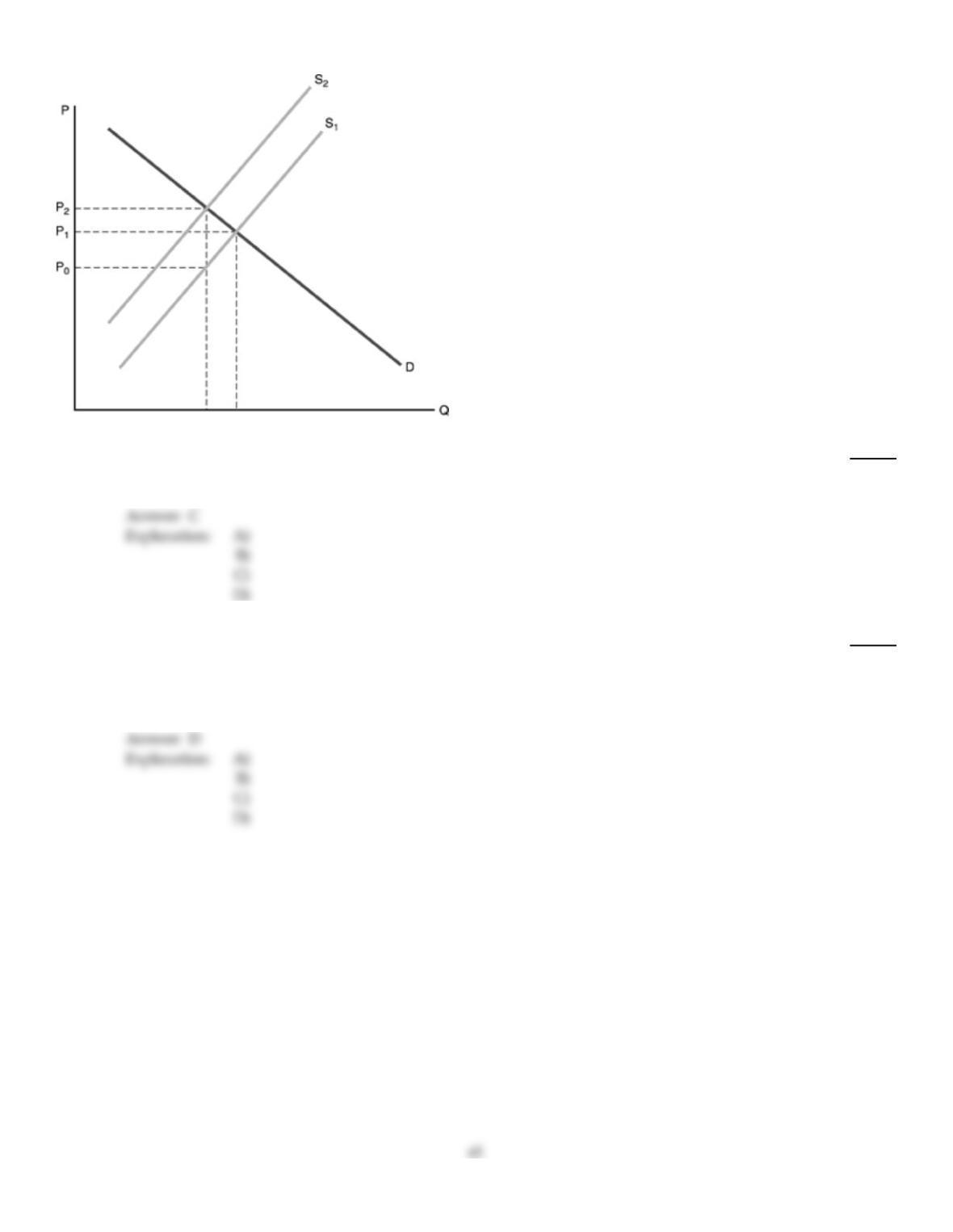
168)
Refer to the above figure. A unit tax has been placed on the good. The producer pays what amount
of the tax?
168)
A)
none of the tax
B)
P2– P0
C)
P1– P0
D)
P2– P1
169)
An excise tax is a tax that is levied on
169)
A)
that part of a person’s income coming from interest payments.
B)
the value of an estate.
C)
the value of a piece of property.
D)
the purchase of a given good or service.
170)
A current concern about Social Security is that
170)
A)
promised benefit payouts are growing more rapidly than likely sources of revenues,
indicating a future inability to keep the system operating.
B)
the payroll taxes used to fund the program are being eliminated as part of an effort to
generate employment increases, thus leaving the program bankrupt.
C)
funds set aside by past generations to pay benefits for future generations are growing too
rapidly and may trigger inflation.
D)
continued political bickering between the president and Congress could lead to an end to any
funding of the program.
171)
Dynamic tax analysis generally predicts
171)
A)
that the higher tax rates lead to higher revenues only to a point at which revenues will begin
to decrease due to a diminishing tax base.
B)
that the higher the tax rate is, the higher the tax revenue will continue to be into the future.
C)
that lower tax rates are always going to lead to decreased tax revenues.
D)
that lower tax rates will always and continuously lead to increased tax revenues.
172)
Corporate profits are
172)
A)
taxed at too low a rate.
B)
taxed three timesonce by the corporate tax system, again by the personal tax system, and
again as capital gains.
C)
taxed only when a stockholder sells his or her shares of stock.
D)
taxed twiceonce by the corporate tax system, and again by personal tax system when they
are paid to stockholders as dividends.
Quantity Quantity Quantity Supplied
Price Demanded Supplied After Tax
$5 10 40 30
$4 15 35 25
$3 20 30 20
$2 25 25 15
$1 30 20 5
173)
Using the above table, a unit tax of $2 is imposed on the product. The equilibrium price of this
product after the tax is imposed is
173)
A)
$3.
B)
$4.
C)
$5.
D)
$2.
174)
The distribution of tax burdens among various groups in society is referred to as
174)
A)
sectioning.
B)
zero–base budgeting.
C)
regressive placement.
D)
tax incidence.
Explanation:
175)
The U.S. Social Security tax is an example of a
175)
A)
regressive tax.
B)
progressive tax.
C)
proportional tax.
D)
premium tax.
Explanation:
176)
State and local governments receive most of their revenue from
176)
A)
sales and excise taxes, revenue from the federal government, and property taxes.
B)
corporate income taxes, property taxes, and personal income taxes.
C)
property taxes, sales and excise taxes, and Social Security contribution.
D)
individual income taxes, social insurance contributions, and property taxes.
Explanation:
Explanation:
177)
Local government expenditures depend on which taxes?
177)
A)
local property, sales, and excise taxes
B)
capital gains taxes
C)
revenues from licenses and permits
D)
Social Security taxes
178)
Eight years ago you purchased an asset for $100,000 that has yielded a nominal capital gain of
$30,000. If you sold the asset today, your inflation–adjusted capital gains would be zero due to
inflation over the last eight years. The capital gains tax is 28 percent. If you sold the asset today
your tax liability would be
178)
A)
zero.
B)
$28,000.
C)
$8,400.
D)
cannot be determined without more information.
179)
The Mayor of Stuckeyville is considering increasing the tax on bowling. He is confident that tax
revenues will increase but recognizes the possibility that they may decrease. The mayor is engaging
in
179)
A)
a policy that will cause the tax base to remain unchanged.
B)
dynamic tax analysis.
C)
static tax analysis.
D)
a policy that will cause the tax base to increase.
180)
If the marginal tax rate is less than the average tax rate, the tax system is
180)
A)
regressive.
B)
proportional.
C)
liberal.
D)
progressive.
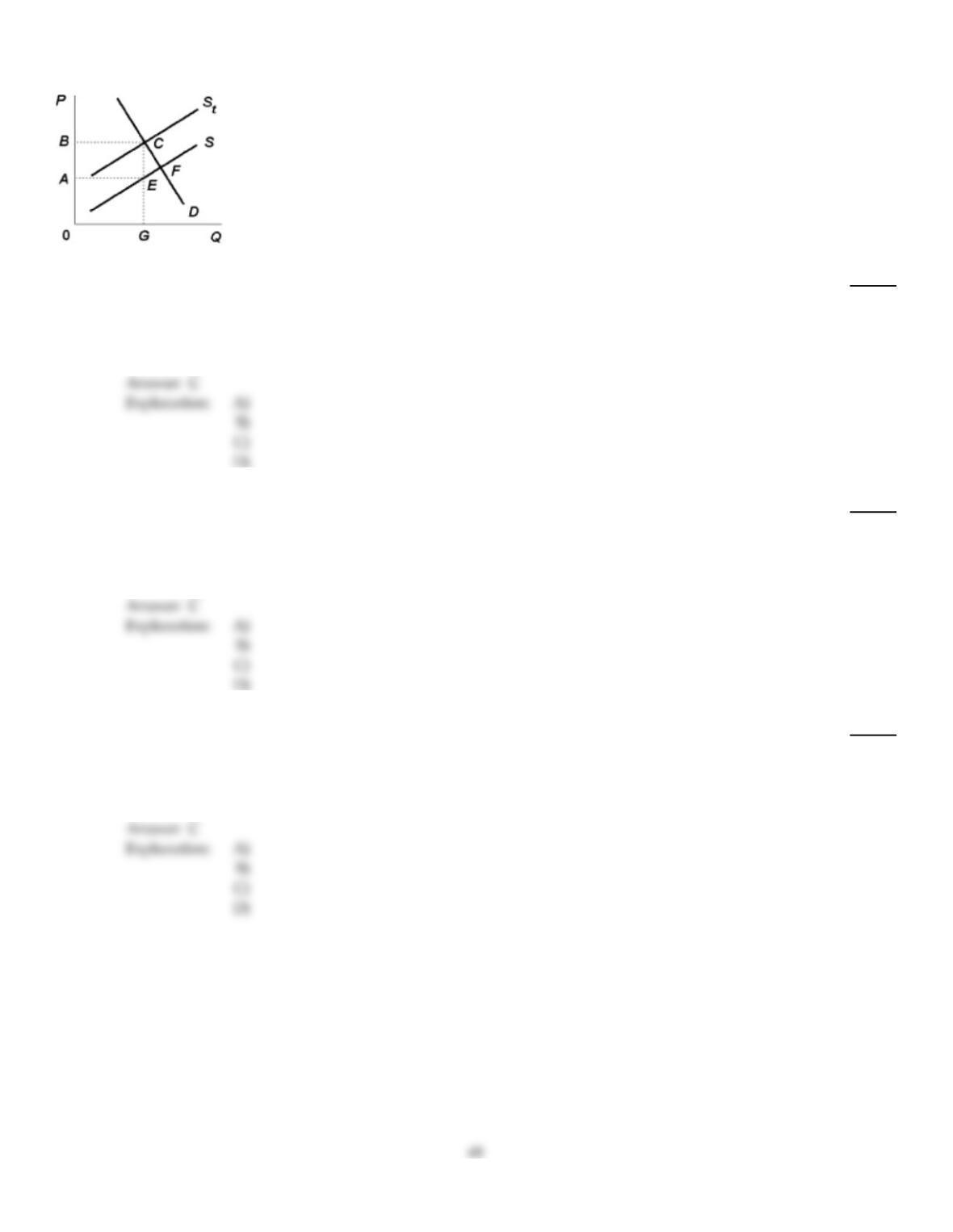
181)
Using the above figure, if the government levies a new unit tax in this market, S represents the
original supply curve, and St represents the after–tax supply curve, then the after–tax price paid by
consumers is the vertical distance from the origin to
181)
A)
point F.
B)
point A.
C)
point B.
D)
somewhere between point B and point A.
182)
The responsibility of paying for the Social Security benefits for currently retired individuals falls on
182)
A)
only working people over 50 years of age.
B)
the retired people themselves.
C)
current and future workers.
D)
no one, since the government prints the money.
C
183)
Which of the following are considered ad valorem taxes?
183)
A)
taxes based on the amount of spending the government will undertake
B)
taxes based on the amount of debt that the government must repay
C)
taxes assessed by charging a rate equal to a percentage of an item’s price
D)
taxes assessed by charging a flat amount per unit purchased
C
C
184)
A local government currently has a tax base of $4 billion and a tax rate of 5 percent. If the tax rate is
increased to 6 percent, the tax base will decrease to $3.5 billion. If the goal is to maximize tax
revenues the tax rate should be
184)
A)
raised to 6 percent.
B)
lowered below 5 percent.
C)
abolished.
D)
kept at 5 percent.
185)
Static tax analysis assumes that
185)
A)
an increase in a tax rate will lead to an increase in the tax base.
B)
an increase in a tax rate will leave the tax base unchanged.
C)
the tax base will always remain unchanged.
D)
an increase in a tax rate may lead to a decrease in the tax base.
B
186)
The marginal income tax rate applies to
186)
A)
all income earned by a family.
B)
the income in the highest tax bracket reached.
C)
the income received by people above the national average.
D)
the income of the highest income U.S. taxpayers.
B
ESSAY. Write your answer in the space provided or on a separate sheet of paper.
187)
What is meant by the term “tax incidence”? What is the tax incidence of the personal income tax? What is the tax
incidence of the corporate income tax?
188)
What are the three sources of funding for the public sector? Can the government rely on all of these sources in
the long run? Explain.
A
189)
Why is the government budget constraint different between the short run and the long run?
190)
Explain how corporate profits are taxed twice.
191)
What is a government’s budget constraint in the long run as opposed to a given time period?
192)
Explain why an increase in the tax rate can result in lower tax revenues.
193)
Suppose the income tax rate is 0 percent on the first $10,000; 10 percent on the next $20,000; 20 percent on the
next $20,000; 30 percent on the next $20,000; and 40 percent on all income above $70,000. Family A has income
of $82,000 while Family B has income of $37,000. What are the marginal tax rates faced by the two families?
194)
Briefly compare the three tax systems based on the relationship between the marginal tax rate and the average
tax rate as income rises.
195)
A government is thinking about increasing the sales tax rate. Should it use static or dynamic tax analysis?
Explain why one approach is better than the other.
196)
Explain why it is that how much consumers pay for an excise tax depends on how responsive they are to a
given change in market price.
197)
“Only in a progressive tax system does the amount of taxes increase as income increases.” Do you agree or
disagree? Explain.
198)
Suppose Jill has earned more income this year as compared to what she did last year. Her income tax has also
increased. Does it necessarily mean that the income tax system is progressive? Explain.
199)
According to dynamic tax analysis, will continuing to push up the tax lead to steady increases in tax revenues?
Why?
200)
Suppose the income tax rate schedule is 0 percent on the first $10,000; 10 percent on the next $20,000; 20 percent
on the next $20,000; 30 percent on the next $20,000; and 40 percent on any income over $70,000. Family A earns
$32,000 a year and Family B earns $70,000 a year. Both families each receive a ten percent raise. What is the
marginal tax rate of each and what is the extra tax paid by each after the raise?
201)
In what way is corporate income subject to double taxation?
Answer Key
Testname: C6
53
Answer Key
Testname: C6
Answer Key
Testname: C6
Answer Key
Testname: C6
56
Answer Key
Testname: C6