Solve the problem.
136)
In a race, Car A starts 1 mile behind Car B. Car A is traveling at 55 miles per hour, while Car B is
traveling at 40 miles per hour. How long will it take for Car A to overtake Car B?
136)
A)
4 minutes
B)
22
3 minutes
C)
1
15 minute
D)
16 minutes
Find the function value.
137)
f(x) =x – 8
3x ; f(4)
137)
A)
– 1
B)
–4
3
C)
1
3
D)
–1
3
Use synthetic division to show that the number given to the right of the equation is a solution of the equation, then solve
the polynomial equation.
138)
2x3+ 7x2– 5x – 4 = 0; –4
138)
A)
The remainder is zero; 1
2, 1, –4
B)
The remainder is zero; –1
2, –1, –4
C)
The remainder is zero; 1
2, –1, –4
D)
The remainder is zero; –1
2, 1, –4
Find the least common denominator of the rational expressions.
139)
5
y2–1, 2y
y2+2y +1, and 5y
2y2+3y +1
139)
A)
(y –1)(y +1)(y +1)(2y + 1)
B)
(y –1)(y –1)(y +1)(2y + 1)
C)
(y –1)(y +1)(2y + 1)
D)
(y –1)(y +1)

140)
1
6x and –6
x2+ 6x
140)
A)
6x2+ 6
B)
6x2– 6
C)
6x(x + 6)
D)
6x + 6
If y varies directly as x, find the direct variation equation for the situation.
141)
y =0.6 when x =1.2
141)
A)
y =2x
B)
y = x – 0.6
C)
y =0.5x
D)
y =0.6x
Solve.
142)
While traveling at a constant speed in a car, the centrifugal acceleration passengers feel while the
car is turning is inversely proportional to the radius of the turn. If the passengers feel an
acceleration of 8 feet per second per second when the radius of the turn is 100 feet, find the
acceleration the passengers feel when the radius of the turn is 400 feet.
142)
A)
5 feet per second per second
B)
4 feet per second per second
C)
2 feet per second per second
D)
3 feet per second per second
143)
The pressure of a gas varies jointly as the amount of the gas (measured in moles) and the
temperature and inversely as the volume of the gas. If the pressure is 1080 kPa (kiloPascals) when
the number of moles is 8, the temperature is 300° Kelvin, and the volume is 960 cc, find the
pressure when the number of moles is 7, the temperature is 280° K, and the volume is 840 cc.
143)
A)
2016
B)
1008
C)
1872
D)
1080
Divide as indicated.
144)
2x2
3÷x3
24
144)
A)
x
16
B)
16x2
x3
C)
16
x
D)
48x2
3x3
Perform the indicated operations. Simplify the result, if possible.
145)
y –5
y2–16
+y –5
16 –y2
145)
A)
2y –10
(y +4)(y –4)
B)
–10
(y +4)(y –4)
C)
2y
(y +4)(y –4)
D)
0
Solve the problem.
146)
A cleaning company has monthly fixed costs of $13,000 for its facilities and it costs $70 per house
for each house that it cleans. How many houses must the company clean each month to have an
average cost per house of $120?
146)
A)
260 houses
B)
186 houses
C)
261 houses
D)
140 houses
Find the variation equation for the variation statement.
147)
y varies directly as the square of x; y = – 1 when x =3
147)
A)
y = – 1
9x2
B)
y = – 1x
C)
y = – 1x2
D)
y = – 1
9x2

Perform the indicated operations. Simplify the result, if possible.
148)
x
x2– 25
+5
x + 5 –6
x
148)
A)
25(x + 6)
x(x + 5)(x – 5)
B)
25(x – 6)
(x + 5)(x – 5)
C)
–25(x – 6)
x(x + 5)(x – 5)
D)
6x2– 25x + 150
x(x + 5)(x – 5)
D)
Perform the indicated operations. Simplify where possible.
149)
x
x +6+4
x –6
149)
A)
x +4
2x
B)
x2+2x –24
(x +6)(x –6)
C)
x2–2x +24
(x +6)(x –6)
D)
x2–10x +24
(x +6)(x +6)
D)
150)
7x
x + 1 +8
x – 1 –14
x2– 1
150)
A)
7x –6
x + 1
B)
x + 1
x – 1
C)
7x
x – 1
D)
7x –6
x – 1
D)
Solve the equation for the specified variable.
151)
P =A
1 + rt for t
151)
A)
t = P – rA
B)
t =A – P
Pr
C)
t =P – A
1 + r
D)
t =P – 1
Ar
D)
Solve the problem.
152)
Mark and Rachel both work for Smith Landscaping Company. Mark can finish a planting job in 5
hours, while it takes Rachel 2 hours to finish the same job. If Mark and Rachel will work together
on the job, and the cost of labor is $35 per hour, what should the labor estimate be? (Round to the
nearest cent, if necessary.)
152)
A)
$50.00
B)
$100.00
C)
$122.50
D)
$24.50
Find the function value.
153)
f(x) =x2– 7
x3– 8x; f(–3)
153)
A)
– 3
B)
–2
35
C)
–2
27
D)
–2
3
Perform the indicated operations. Simplify the result, if possible.
154)
5x
x + 1 +6
x – 1 –10
x2– 1
154)
A)
x + 1
x – 1
B)
5x –4
x + 1
C)
5x
x – 1
D)
5x –4
x – 1
Multiply as indicated.
155)
2x2
5·25
x3
155)
A)
x
10
B)
10
x
C)
10x2
x3
D)
50x2
5x3

Perform the indicated operations. Simplify the result, if possible.
156)
2
x+9
x – 7
156)
A)
11x – 14
x(7– x)
B)
14x – 11
x(x – 7)
C)
11x – 14
x(x – 7)
D)
14x – 11
x(7– x)
Write an equation to describe the variation. Use k for the constant of proportionality.
157)
s varies directly as the square of t and inversely as the cube of u.
157)
A)
s+t2–u3= k
B)
s=ku3
t2
C)
s=kt2
u3
D)
st2u3= k
C
Solve.
158)
While traveling in a car, the centrifugal force a passenger experiences as the car drives in a circle
varies jointly as the mass of the passenger and the square of the speed of the car. If the a passenger
experiences a force of 176.4 newtons when the car is moving at a speed of 70 kilometers per hour
and the passenger has a mass of 40 kilograms, find the force a passenger experiences when the car
is moving at 60 kilometers per hour and the passenger has a mass of 80 kilograms.
158)
A)
324 newtons
B)
230.4 newtons
C)
288 newtons
D)
259.2 newtons
D
159)
For a resistor in a direct current circuit that does not vary its resistance, the power that a resistor
must dissipate is directly proportional to the square of the voltage across the resistor. The resistor
must dissipate 1
16 watt of power when the voltage across the resistor is 12 volts. Find the power
that the resistor must dissipate when the voltage across it is 36 volts.
159)
A)
3
4 watt
B)
9 watts
C)
9
16 watt
D)
3
16 watt
C
C
Write an equation to describe the variation. Use k for the constant of proportionality.
160)
r varies directly as b
160)
A)
b= kr
B)
b=k
r
C)
r=k
b
D)
r= kb
Find the variation equation for the variation statement.
161)
y varies inversely as the square of x; y =5 when x =4
161)
A)
y =80
x2
B)
y =x2
80
C)
y =x
80
D)
y =80
x
A
Provide an appropriate response.
162)
An airport limo service charges riders a fixed charge of $15 plus $3.00 per mile.
a. Write a cost function, C, of riding in a limo for x miles.
b. Write the average cost function, C, riding in a limo for x miles.
c. How many miles must a rider go to have an average cost per mile of $4.00?
162)
A)
a. C(x) =15 +3x;
b. C(x) =15 +3x
x
c. 15 mi
B)
a. C(x) =15 +3x
b. C(x) =15 +3x
x
c. 3 mi
C)
a. C(x) =3+15x
b. C(x) =3+15x
x
c. 50 mi
D)
a. C(x) =3+15x
b. C(x) =3+15x
x
c. 18 mi
A
Multiply as indicated.
163)
x3+ 1
x3–x2+ x
·6x
–66x –66
163)
A)
–x3+ 1
11(x + 1)
B)
–1
11
C)
x + 1
11(–x – 1)
D)
–x2+ 1
11
B
D

If y varies inversely as x, find the inverse variation equation for the situation.
164)
y =0.8 when x =0.4
164)
A)
y =3.125
x
B)
y =3.125x
C)
y =0.32
x
D)
y =2x
Add. Simplify the result, if possible.
165)
9
8x2+3
8x2
165)
A)
2
3x2
B)
3
C)
3
4x4
D)
3
2x2
Solve the equation for the specified variable.
166)
1
a+1
b= c for b
166)
A)
b =1
c– a
B)
b =1
ac
C)
b =a
ac – 1
D)
b = ac –1
a
Write an equation to describe the variation. Use k for the constant of proportionality.
167)
w varies directly as x and inversely as y.
167)
A)
wxy = k
B)
w=kx
y
C)
w+x–y= k
D)
w=ky
x

Simplify the complex fraction.
168)
m–1+ z–1
m–1– z–1
168)
A)
z + m
m
B)
z + m
z – m
C)
z + m
z
D)
z – m
z
Provide an appropriate response.
169)
If the voltage, V, in an electric circuit is held constant, the current, I, is inversely proportional to the
resistance, R. If the current is 300 milliamperes when the resistance is 4 ohms, find the current
when the resistance is 20 ohms.
169)
A)
60 milliamperes
B)
240 milliamperes
C)
1495 milliamperes
D)
1500 milliamperes
Simplify the rational expression. If the rational expression cannot be simplified, so state.
170)
4x + 2
20x2+ 18x + 4
170)
A)
Cannot be simplified
B)
1
5x + 2
C)
4x
5x + 2
D)
4x + 5
5x + 18
Find the domain of the rational function.
171)
f(x) =x2– 4
x2+ 5x – 24
171)
A)
domain of f: ( , –8) (–8, 3) (3, )
B)
domain of f: ( , 0) (0, )
C)
domain of f: ( , –2) (–2, 2) (2, )
D)
domain of f: ( , –3) (–3, 8) (8, )

Subtract. Simplify the result, if possible.
172)
10
11x–7
11x
172)
A)
11x
3
B)
3
22x
C)
3
11x
D)
3
173)
15
6x2–10
6x2
173)
A)
5
6x2
B)
5
C)
6
5x2
D)
5
6x4
Divide.
174)
(40x6+ 15x4+ 15x2) ÷(5x4)
174)
A)
8x + 3 +3
x2
B)
8x2+ 3 +3
x
C)
8x + 3 +3
x
D)
8x2+ 3 +3
x2
Find the variation equation for the variation statement.
175)
y varies directly as the square of x; y =45 when x =3
175)
A)
y =15x
B)
y =5x2
C)
y =9x
D)
y =45x

Add. Simplify the result, if possible.
176)
4
8x2+6
8x2
176)
A)
5
2x4
B)
5
4x2
C)
4
5x2
D)
5
Solve the problem.
177)
A baker can decorate the day’s cookie supply four times as fast as his new assistant. If they decorate
all the cookies working together in 36 minutes, how long would it take for each of them to decorate
the cookies working individually?
177)
A)
baker: 180 minutes
assistant: 45 minutes
B)
baker: 10 1
4 minutes
assistant: 41 minutes
C)
baker: 45 minutes
assistant: 180 minutes
D)
baker: 180 minutes
assistant: 720 minutes
178)
A boat moves 8 kilometers upstream in the same amount of time it moves 15 kilometers
downstream. If the rate of the current is 6 kilometers per hour, find the rate of the boat in still
water.
178)
A)
19 5
7 kilometers per hour
B)
17 1
7 kilometers per hour
C)
66
7 kilometers per hour
D)
6 kilometers per hour
Use synthetic division to show that the number given to the right of the equation is a solution of the equation, then solve
the polynomial equation.
179)
x3+ 5x2+ 2x – 8 = 0; –2
179)
A)
The remainder is zero; {–1, –4, –2}
B)
The remainder is zero; {–1, 4, –2}
C)
The remainder is zero; {1, 4, –2}
D)
The remainder is zero; {1, –4, –2}
51

Use synthetic division to divide.
180)
(5x3+ 13x2– 11x – 15) ÷ (x + 3)
180)
A)
–5x2– 3x – 5
B)
5x – 2
C)
5
3x2+13
3x –11
3
D)
5x2– 2x – 5
Simplify the complex fraction.
181)
9+3
x
x
4+1
12
181)
A)
36
B)
1
C)
x
36
D)
36
x
Divide as indicated.
182)
(14x5y7– 42x3y4+ 6x2y3) ÷ (7x2y3)
182)
A)
14x3y4– 42xy +6
B)
2x3y4– 6xy +6
7
C)
2x3y4– 6xy4+6
7
D)
2x3y7– 6x2y3+6
7
183)
(–5x5–x3+ 4x2+ 53x – 12) ÷ (x2– 3)
183)
A)
–5x3– 16x + 4 +5x
x2– 3
B)
–5x3– 16x – 4 +5x
x2– 3
C)
–5x3– 16x + 4 +5x – 24
x2– 3
D)
–5x3– 16x + 4 –5x
x2– 3
52

Solve the problem.
184)
A car travels 400 miles on level terrain in the same amount of time it travels 160 miles on
mountainous terrain. If the rate of the car is 30 miles per hour less in the mountains than on level
ground, find its rate in the mountains.
184)
A)
80 mph
B)
50 mph
C)
40 mph
D)
20 mph
Perform the indicated operations. Simplify the result, if possible.
185)
x + 1
x2+ 2x – 15
+5x + 6
x2+ 4x – 21
185)
A)
6x + 7
2x2+ 6x – 36
B)
6x + 7
C)
6x2+ 39x + 37
(x – 3)(x + 5)(x + 7)
D)
6x2+ 39x + 37
(x + 3)(x – 5)(x – 7)
Perform the indicated operations. Simplify where possible.
186)
x + 7
x2+ 13x + 40
+2x – 5
x2+ 7x + 10
186)
A)
3x + 2
2x2+ 20x + 50
B)
3x + 2
C)
3x2+ 20x – 26
(x + 5)(x + 8)(x + 2)
D)
3x2+ 20x – 26
(x – 5)(x – 8)(x – 2)
Divide as indicated.
187)
x2+ 11x + 18
x2+ 12x + 27
÷x2+ 2x
x2+ 8x + 15
187)
A)
x + 5
B)
x + 5
x2+ 3x
C)
x + 5
x
D)
x
x2+ 12x + 27
53
188)
(25x3– 15x2– 8x + 2) ÷ (–5x + 1)
188)
A)
–5x2+ 2
B)
x2– 2x – 2
C)
x2+ 2x + 2
D)
–5x2+ 2x + 2
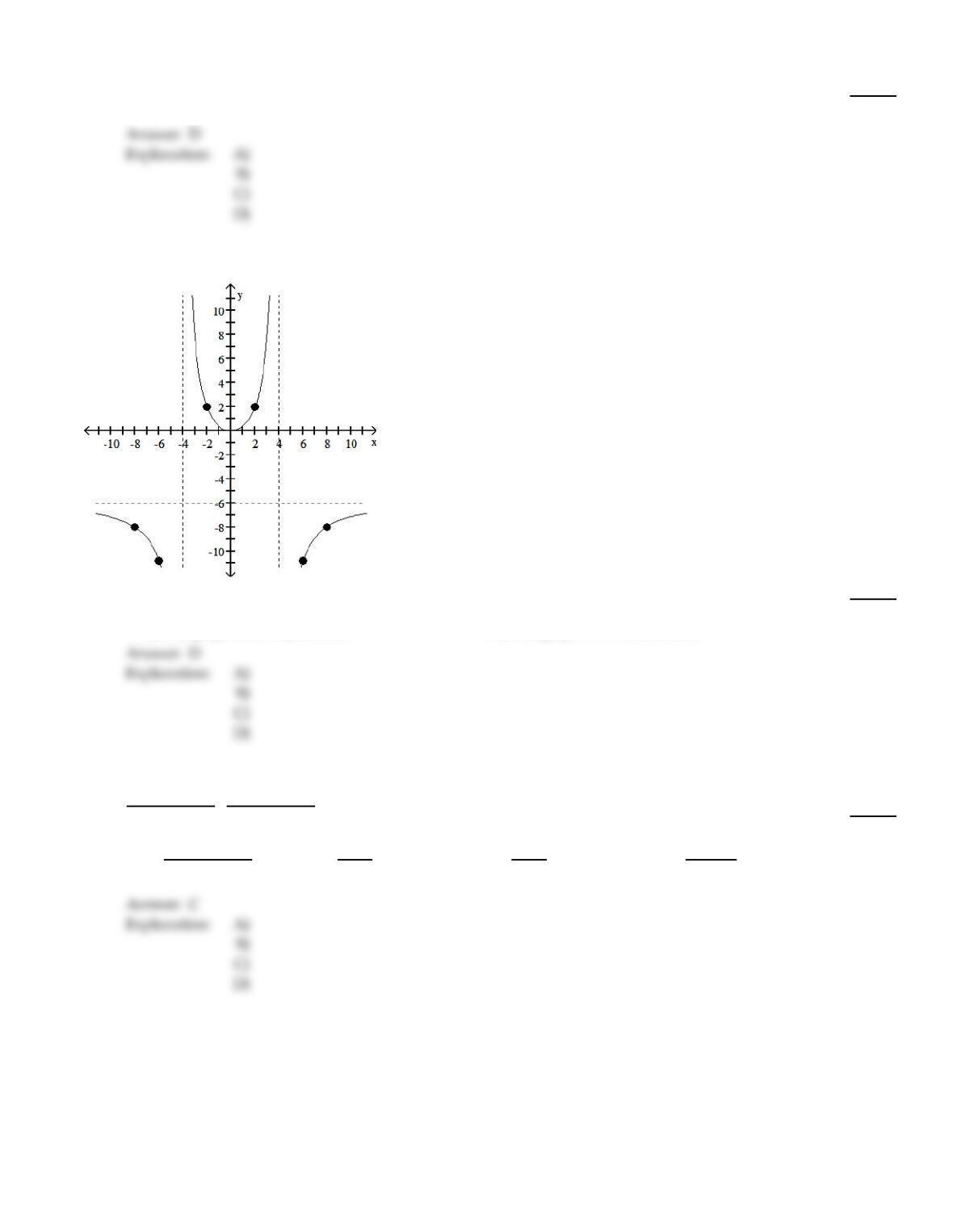
The graph of a rational function, f, is shown in the figure. Use the graph to answer the question.
189)
How can you tell that this is not the graph of a polynomial function?
189)
A)
The value of f(1) is not equal to 1.
B)
The graph is continuous.
C)
The graph is not a parabola.
D)
The graph is not continuous.
Multiply as indicated.
190)
x2+ 13x + 40
x2+ 17x + 72
·x2+ 9x
x2+ 11x + 30
190)
A)
x
x2+ 17x + 72
B)
1
x + 6
C)
x
x + 6
D)
x2+ 9x
x + 6
54

Simplify the complex fraction.
191)
5
3r – 1 – 5
5
3r – 1 + 5
191)
A)
2 – 3r
3r
B)
2 + 3r
3r
C)
3r
2 – 3r
D)
2 – r
r
Divide.
192)
(9x3– 6x2+ 9x + 21) ÷ (3x + 1)
192)
A)
3x2– 3x + 4
B)
3x2– 3x + 4 +17
3x + 1
C)
x2+ 4 +
–3
3x + 1
D)
3x2– 3x + 4 +20
3x + 1
Simplify the rational expression. If the rational expression cannot be simplified, so state.
193)
4x2–9x +2
x –2
193)
A)
Cannot be simplified
B)
4x2–10
C)
1
x –2
D)
4x –1
If y varies directly as x, find the direct variation equation for the situation.
194)
y =3.2 when x =0.8
194)
A)
y =0.8x
B)
y = x +2.4
C)
y =4x
D)
y =0.25x
Simplify the complex fraction.
195)
4+2
x
x
4+1
8
195)
A)
16
x
B)
16
C)
x
16
D)
1
Solve the rational equation.
196)
2y + 3
y=3
2
196)
A)
{0}
B)
{–6}
C)
{6}
D)
{ 2}
Use synthetic division and the Remainder Theorem to find the indicated function value.
197)
f(x) =3x3 – 5x2– 4x + 24; f(–3)
197)
A)
–114
B)
–90
C)
–54
D)
–72
Solve the equation for the specified variable.
198)
A =1
2h(B + b) for b
198)
A)
b=2A +Bh
h
B)
b=A –Bh
h
C)
b=2A –Bh
h
D)
b= 2A –Bh

Provide an appropriate response.
199)
Given f(x) =x4+ 3x3–25x2+15x – 442, use synthetic division and the Remainder Theorem to find
f(5).
199)
A)
8
5
B)
8
C)
–292
D)
–442
Multiply as indicated.
200)
4y
8y +4·14y +7
3
200)
A)
7y
3
B)
7y
12
C)
7
3
D)
y
3
A
Write an equation to describe the variation. Use k for the constant of proportionality.
201)
r varies directly as the square of s and inversely as t.
201)
A)
r=kt
s2
B)
r=ks2
t
C)
r= k +s2–t2
D)
r= ks2t
B
Solve the equation for the specified variable.
202)
P =A
1 + rt for r
202)
A)
r =P – 1
At
B)
r =A – P
Pt
C)
r = P – tA
D)
r =P – A
1 + t
B
B