53) ________ are secured by stock and/or bonds that are owned by the issuer.
A) Mortgage bonds
B) Equipment trust certificates
C) Collateral trust bonds
D) Subordinated debentures
54) ________ have a short maturities, typically one to five years, and which can be renewed for
a similar period at the option of their holders.
A) Floating rate bonds
B) Extendible notes
C) Putable bonds
D) Junk bonds
55) Payment of interest required only when earnings are made available from which to make a
payment is characteristic of a(n) ________.
A) floating rate bond
B) income bond
C) mortgage bond
D) equipment trust certificate
56) A putable bond gives the bondholder ________.
A) the right to sell the bond back to the corporation at a discount
B) the right to sell the bond back to the corporation at a stated premium
C) the right to redeem the bond back to the corporation at the current market value
D) the right to redeem the bond back to the corporation at par
57) A significant portion of the return on a zero coupon bond is in the form of ________.
A) interest and gain in value
B) interest
C) gain in value
D) tax reduction
58) When issuing a(n) ________ the issuer can annually deduct the current year’s interest accrual
without having to actually pay the interest until the bond matures.
A) junk bond
B) zero coupon bond
C) floating rate bond
D) extendible note
59) High-risk, high-yield junk bonds have declined in popularity over time due to ________.
A) the decline in mergers and takeovers, which these bonds were used to finance
B) the declining need of growth capital
C) the stabilizing of interest rates
D) a number of major defaults on these bonds
60) ________ are claims that are not satisfied until those of the creditors holding certain (senior)
debts have been fully satisfied.
A) Convertible debentures
B) Subordinated debentures
C) Mortgage bonds
D) Collateral trust bonds
61) Bonds that can be redeemed at par at the option of their holders either at specific date after
the date of issue and every 1 to 5 years thereafter or when and if the firm takes specified actions
such as being acquired, acquiring another company, or issuing a large amount of additional debt
are called ________.
A) zero coupon bonds
B) junk bonds
C) floating-rate bonds
D) putable bonds
62) The decision to refund a callable bond ________.
A) should be made only if interest rates have increased
B) is a net working capital decision
C) is a capital budgeting decision
D) is an investing decision
63) A foreign bond is issued by a(n) ________.
A) foreign corporation or government and is denominated in the investor’s home currency and
sold in the investor’s home market
B) corporation or government and is denominated in the investor’s foreign currency and sold in
the foreign market
C) international borrower and sold to investors in countries with currencies other than the local
currency
D) international borrower and sold to investors in countries with currencies in which the bond is
denominated
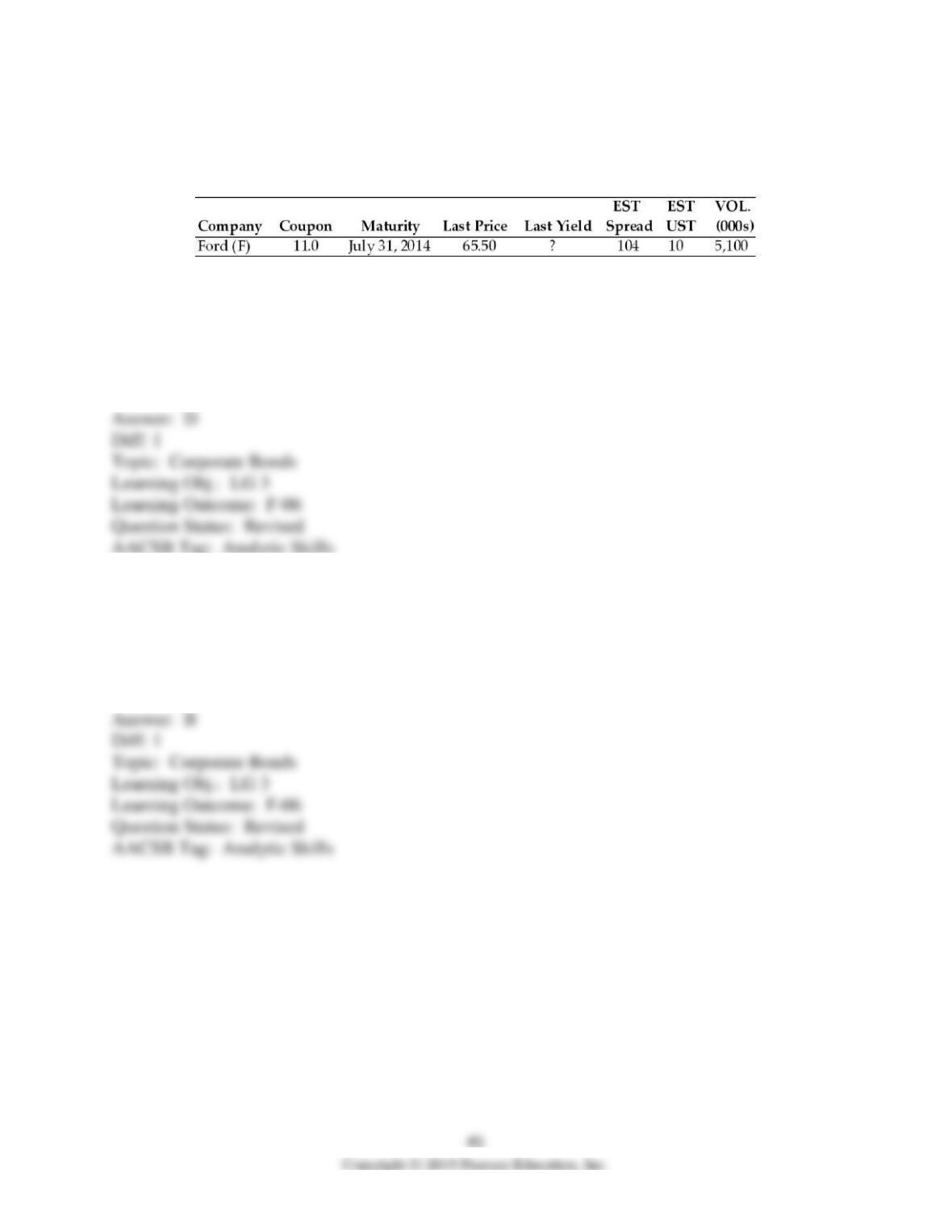
Table 6.1
Assume the below information to answer the following question(s).
64) Based on the table 6.1, on this trading day, the number of Ford bonds which changed hands
was ________.
A) 5,100
B) 51,000
C) 510,000
D) 5,100,000
65) Based on the Table 6.1, assume this bond’s face value is $1,000. What is the bond’s current
market price?
A) $65.00
B) $655.00
C) $650.00
D) $6,550.00
66) Based on the Table 6.1, what is the last yield for this bond?
A) 11.0%
B) 14.2%
C) 16.8%
D) 18.9%
6.4 Understand the key inputs and basic model used in the bond valuation process.
1) Valuation is the process that links risk and return to determine the worth of an asset.
2) The value of an asset depends on the historical cash flow(s) up to the present time.
3) In the valuation process, the higher the risk, the greater is the required return.
4) The level of risk associated with a given cash flow positively affects its value.
5) The value of an asset is determined by discounting the expected cash flows back to its present
value, using an appropriate discount rate.
6) The process that links risk and return in order to determine the worth of an asset is termed
________.
A) securitization
B) valuation
C) discounting
D) compounding
7) The return expected from an asset is fully defined by its ________.
A) risk and cash flow
B) cash flow and timing
C) discount rate
D) beta
8) The key inputs to the valuation process include ________.
A) returns and risk
B) cash flow, cash flow timing, and risk
C) cash flows and discount rate
D) returns, discount rate, and risk
9) Less certain a cash flow, the ________ the risk, and ________ the present value of the cash
flow.
A) lower; higher
B) lower; lower
C) higher; lower
D) higher; higher
10) The value of any asset is the ________.
A) sum of all future cash flows it is expected to provide over the relevant time period
B) sum of the present values of all future cash flows it is expected to provide over the relevant
time period
C) present value of the sum of all future cash flows it is expected to provide over the relevant
time period
D) sum of all compounded future cash flows it is expected to provide over the relevant time
period
11) In the basic valuation model, risk is generally incorporated into the ________.
A) cash flows
B) timing
C) discount rate
D) total value
12) A record collector has agreed to sell her entire collection to a historical museum in three
years at a price of $100,000. The current risk-free rate is 7 percent. At what price should she
value her collection today?
13) A corporate financial analyst must calculate the value of an asset which produces year-end
annual cash flows of $0 the first year, $2,000 the second year, $3,000 the third year, and $2,500
the fourth year. Assuming a discount rate of 15 percent, what is the value of this asset?
14) What is the value of an asset which pays $200 a year for the next 5 years and can be sold for
$1,500 at the end of five years from now? Assume that the opportunity cost is 10 percent.
6.5 Apply the basic valuation model to bonds, and describe the impact of required return and
time to maturity on bond values.
1) The value of a bond that pays semiannual interest is greater than that on an otherwise
equivalent annual coupon interest paying bond.
2) Interest rate risk is the risk that results from the changes in interest rates and thereby impact
the bond value.
3) When the required return is different from the coupon interest rate and is constant until
maturity, the value of the bond will approach its par value as it nears maturity.
4) When a bond’s required return is greater than its coupon interest rate, the bond value will be
less than its par value.
5) A bond with short maturity has less “interest rate risk” than a bond with long maturity when
all other features—coupon interest rate, par value, and interest payment frequency—are the
same.
6) Duration measures the sensitivity of a bond’s prices to changing interest rates.
7) The shorter the amount of time until a bond’s maturity, the more responsive is its market value
to a given change in the required return.
8) Increases in the basic cost of long-term funds or in risk will raise the required return on a
bond.
9) A bond will sell at a premium when its required return rises above its coupon interest rate.
10) The required return on a bond is likely to differ from the stated interest rate for either of two
reasons: 1) economic conditions have changed, causing a shift in the basic cost of long-term
funds, or 2) the firm’s risk has changed.
11) Corporate bonds have a ________.
A) face value of $5,000
B) market price of $1,000
C) specified coupon rate paid annually
D) par value of $1,000
12) Bonds are ________.
A) a series of perpetual short-term debt instruments
B) a form of equity financing that pays interest
C) long-term debt instruments used to raise large sums of money
D) a hybrid form of financing used to raise large sums of money from a diverse group of lenders
13) A type of long-term financing used by both corporations and government entities is
________.
A) common stocks
B) bonds
C) preferred stocks
D) retained earnings
14) The value of a bond is the present value of the ________.
A) dividends and maturity value
B) interest and dividend payments
C) maturity value
D) interest payments and maturity value
15) A firm has an issue of $1,000 par value bonds with a 12 percent stated interest rate
outstanding. The issue pays interest annually and has 10 years remaining to its maturity date. If
bonds of similar risk are currently earning 8 percent, the firm’s bond will sell for ________
today.
A) $1,000
B) $805.20
C) $1,115.50
D) $1,268.40
16) The value of a bond is the present value of its interest payments plus ________.
A) future value of its par value
B) present value of its par value
C) its face value
D) present value of interest payment
17) Danno is trying to decide which of two bonds to buy. Bond H is a 10 percent coupon, 10-
year maturity, $1,000 par, January 1, 2000 issue paying annual interest. Bond F is a 10 percent
coupon, 10-year maturity, $1,000 par, January 1, 2000 issue paying semiannual interest. The
market required return for each bond is 10 percent. When using present value to determine the
prices of the bonds, Danno will find that ________.
A) there is no difference in price
B) the price of F is greater than H
C) the price of H is greater than F
D) he needs more information before determining the prices
18) A firm has an issue of $1,000 par value bonds with a 9 percent stated interest rate
outstanding. The issue pays interest annually and has 20 years remaining to its maturity date. If
bonds of similar risk are currently earning 11 percent, the firm’s bond will sell for ________
today.
A) $1,000
B) $716.67
C) $840.73
D) $1,123.33