Accounting and the Time Value of Money
6 – 39
BRIEF EXERCISES
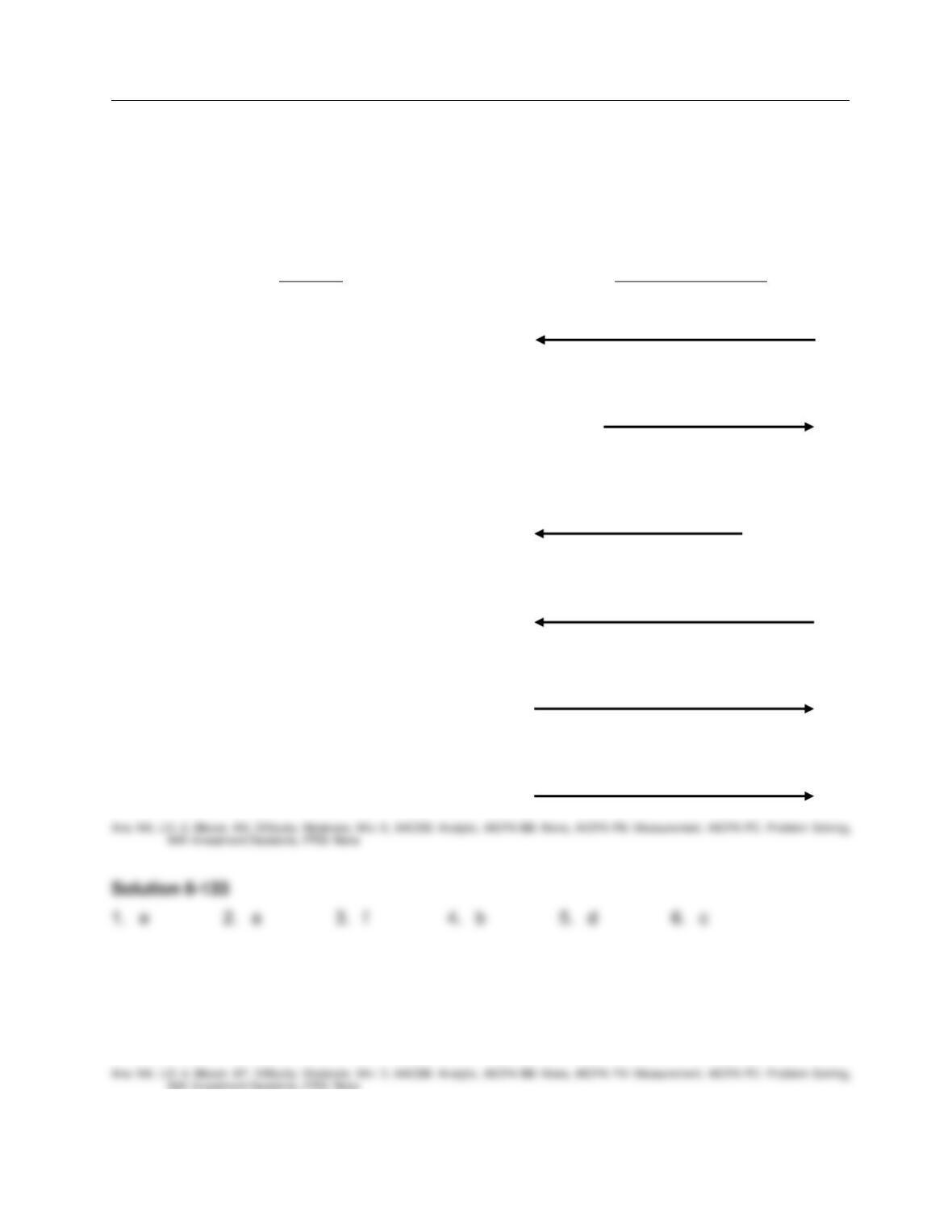
BE. 6–133—Present and future value concepts.
On the right are six diagrams representing six different present and future value concepts stated
on the left. Identify the diagrams with the concepts by writing the identifying letter of the diagram
on the blank line at the left. Assume n = 4 and i = 8%.
Concept Diagram of Concept
_____ 1. Future value of 1. ? $1
a. | | | | |
_____ 2. Present value of 1.
?
_____ 3. Future value of an annuity $1 $1 $1 $1
due of 1. b. |- – – – | | | |
_____ 4. Future value of an ordinary
annuity of 1. ?
$1 $1 $1 $1
_____ 5. Present value of an ordinary c. | | | |- – – – |
annuity of 1.
_____ 6. Present value of an annuity ? $1 $1 $1 $1
due of 1. d. | | | | |
$1 ?
e. | | | | |
$1 $1 $1 $1 ?
f. | | | | |
BE. 6–134—Compute loan payments. (Tables needed.)
On January 2, 2017, Jensen Company borrowed $150,000 from Lyon Country Bank. The terms
of the loan agreement specified 4 equal annual payments at 6% annual interest. Compute the
amount of each of these payments, assuming they begin on December 31, 2017.
Test Bank for Intermediate Accounting, Sixteenth Edition
6 – 40
BE. 6–135—Present value of an investment in equipment. (Tables needed.)
Find the present value of an investment in equipment if it is expected to provide annual savings of
$50,000 for 10 years and to have a resale value of $125,000 at the end of that period. Assume an
interest rate of 9% and that savings are realized at year end.
Accounting and the Time Value of Money
6 – 41
EXERCISES
Ex. 6-136—Future value of an annuity due. (Tables needed.)
If $12,000 is deposited annually starting on January 1, 2017 and it earns 9%, how much will
accumulate by December 31, 2026?
Ex. 6-137—Retirement of debt. (Tables needed.)
Steve Milner borrowed $120,000 on July 1, 2017. This amount plus accrued interest at 8%
compounded semiannually is to be repaid in total on July 1, 2027. To retire this debt, Milner plans
to contribute to a debt retirement fund five equal amounts starting on July 1, 2022 and continuing
for the next four years. The fund is expected to earn 6% per annum.
Instructions
Compute how much must be contributed each year by Steve Milner to provide a fund sufficient to
retire the debt on July 1, 2027?
Test Bank for Intermediate Accounting, Sixteenth Edition
6 – 42
Ex. 6-138—Future value of annuity due. (Tables needed.)
Andrea is 40 years old today and she wishes to accumulate $2,000,000 by her sixty fifth birthday
so she can retire to a beach in Florida. She wishes to accumulate this amount by making equal
deposits on her fortieth through her sixty fourth birthdays. Compute the annual deposit Andrea
must make if the fund will earn 6% interest compounded annually.
Ex. 6-139—Future value of annuity. (Tables needed.)
Linda Ogleby wants to accumulate $40,000 to use for an around the world trip. She plans to
accumulate the desired amount by depositing $5,500 annual-year-end payments into an account
at the National Bank which pays 4% interest, compounded annually.
1. Compute the account balance at the end of the sixth year.
2. Compute the amount of each payment that Linda must make at the end of each of the six
years to accumulate the $40,000.
Ex. 6-140—Future value of annuity. (Tables needed.)
Pearson Corporation having recently issued a $25 million, 10-year bond issue, is required to
make annual year end sinking fund deposits of $1,800,000. The deposits are made on the last
day of each year and yield a return of 5%.
1. Compute the fund balance at the end of the 10 years.
2. Compute the additional annual deposit amount that should have been made at the end of
each of the 10 years to accumulate the $25 million.
Accounting and the Time Value of Money
6 – 43
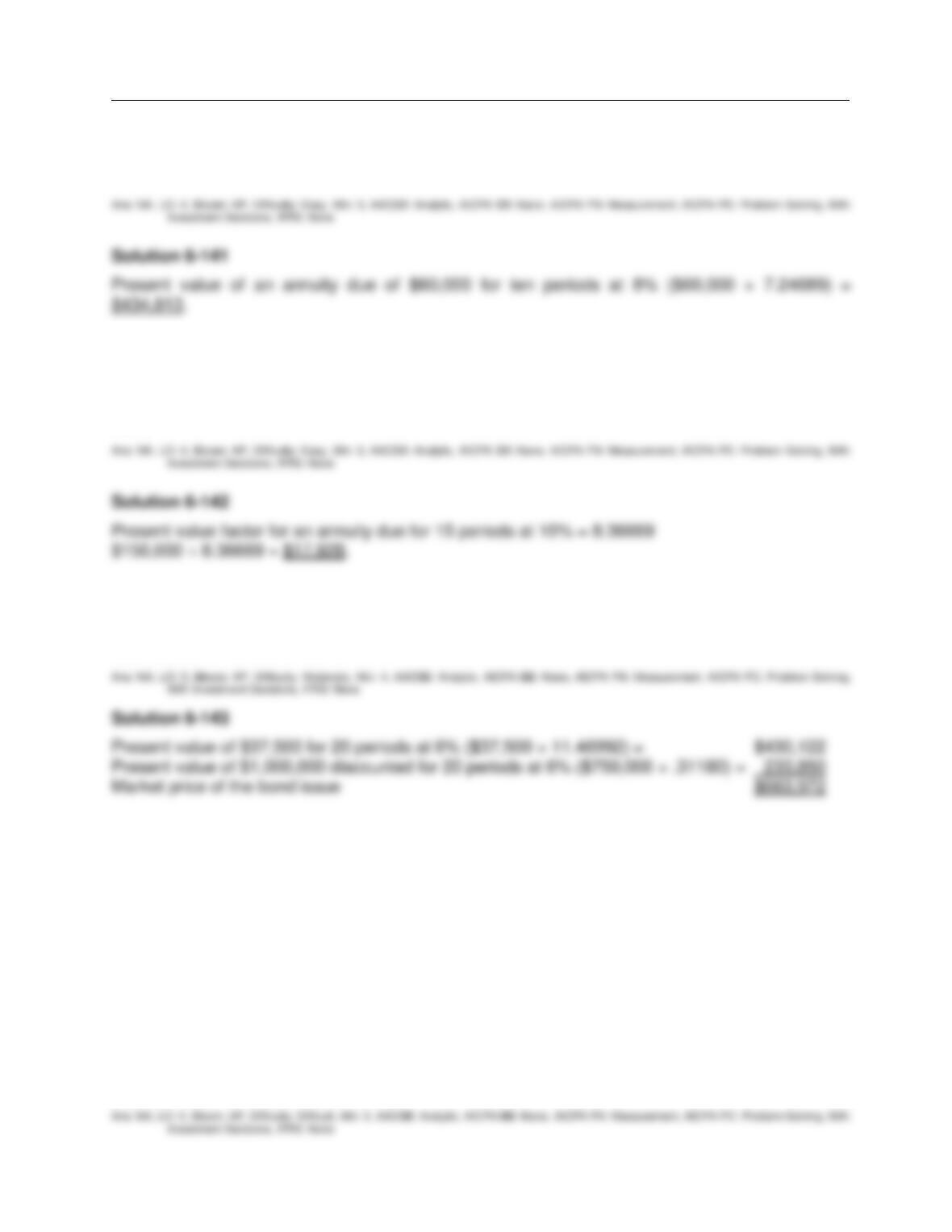
Ex. 6-141—Present value of an annuity due.(Tables needed.)
How much must be invested now to receive $60,000 for ten years if the first $60,000 is received
today and the rate is 8%?
Ex. 6-142—Compute the annual rent. (Tables needed.)
Crone Co. has machinery that cost $150,000. It is to be leased for 15 years with rent received at
the beginning of each year. Crone wants a return of 10%. Compute the amount of the annual
rent.
Ex. 6-143—Calculate market price of a bond. (Tables needed.)
Determine the market price of a $750,000, ten-year, 10% (pays interest semiannually) bond issue
sold to yield an effective rate of 12%.
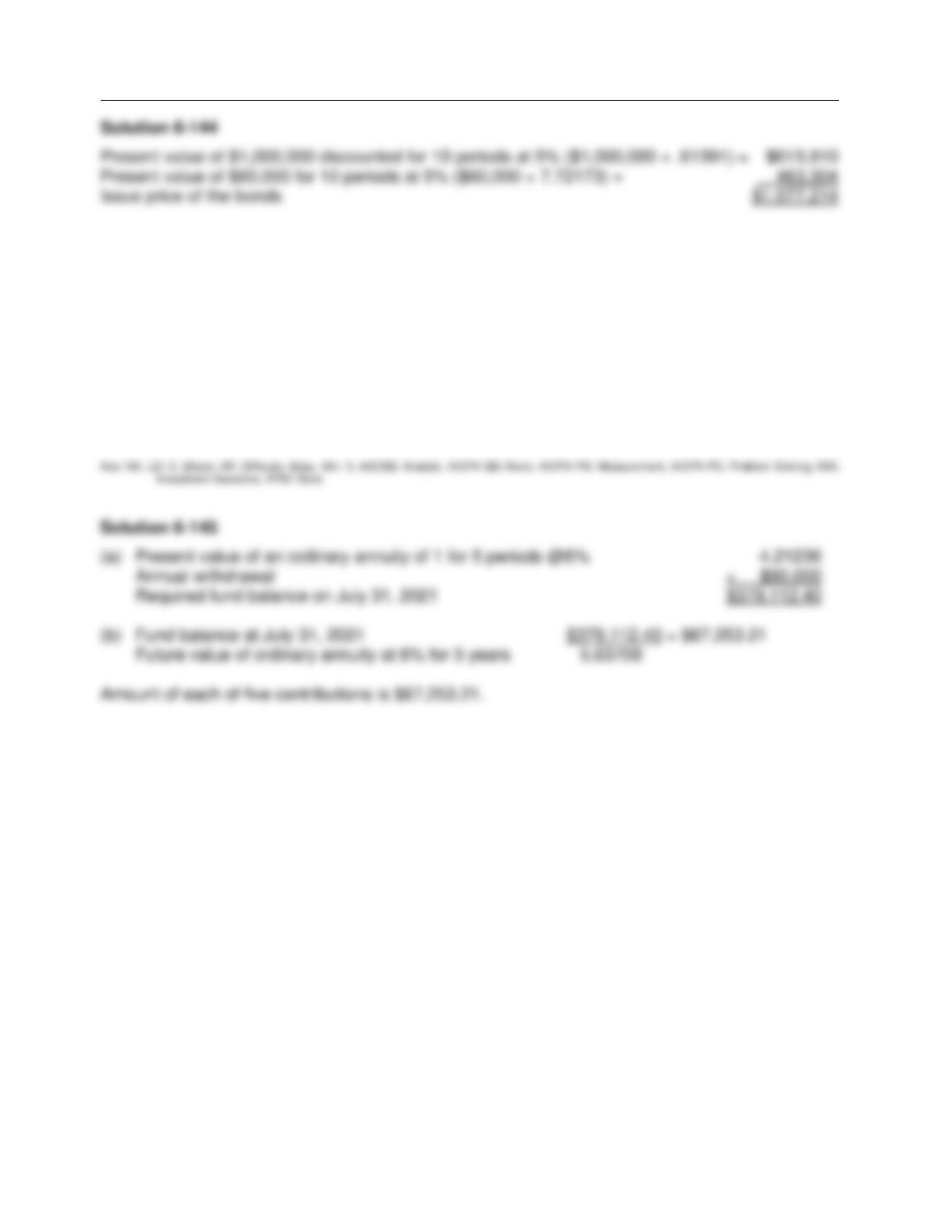
Ex. 6-144—Calculate market price of a bond.
On January 1, 2017 Lance Co. issued five-year bonds with a face value of $700,000 and a stated
interest rate of 12% payable semiannually on July 1 and January 1. The bonds were sold to yield
10%. Present value table factors are:
Present value of 1 for 5 periods at 10% .62092
Present value of 1 for 5 periods at 12% .56743
Present value of 1 for 10 periods at 5% .61391
Present value of 1 for 10 periods at 6% .55839
Present value of an ordinary annuity of 1 for 5 periods at 10% 3.79079
Present value of an ordinary annuity of 1 for 5 periods at 12% 3.60478
Present value of an ordinary annuity of 1 for 10 periods at 5% 7.72173
Present value of an ordinary annuity of 1 for 10 periods at 6% 7.36009
Calculate the issue price of the bonds.
Test Bank for Intermediate Accounting, Sixteenth Edition
6 – 44
Ex. 6-145—Present value and future value computations. (Tables needed.)
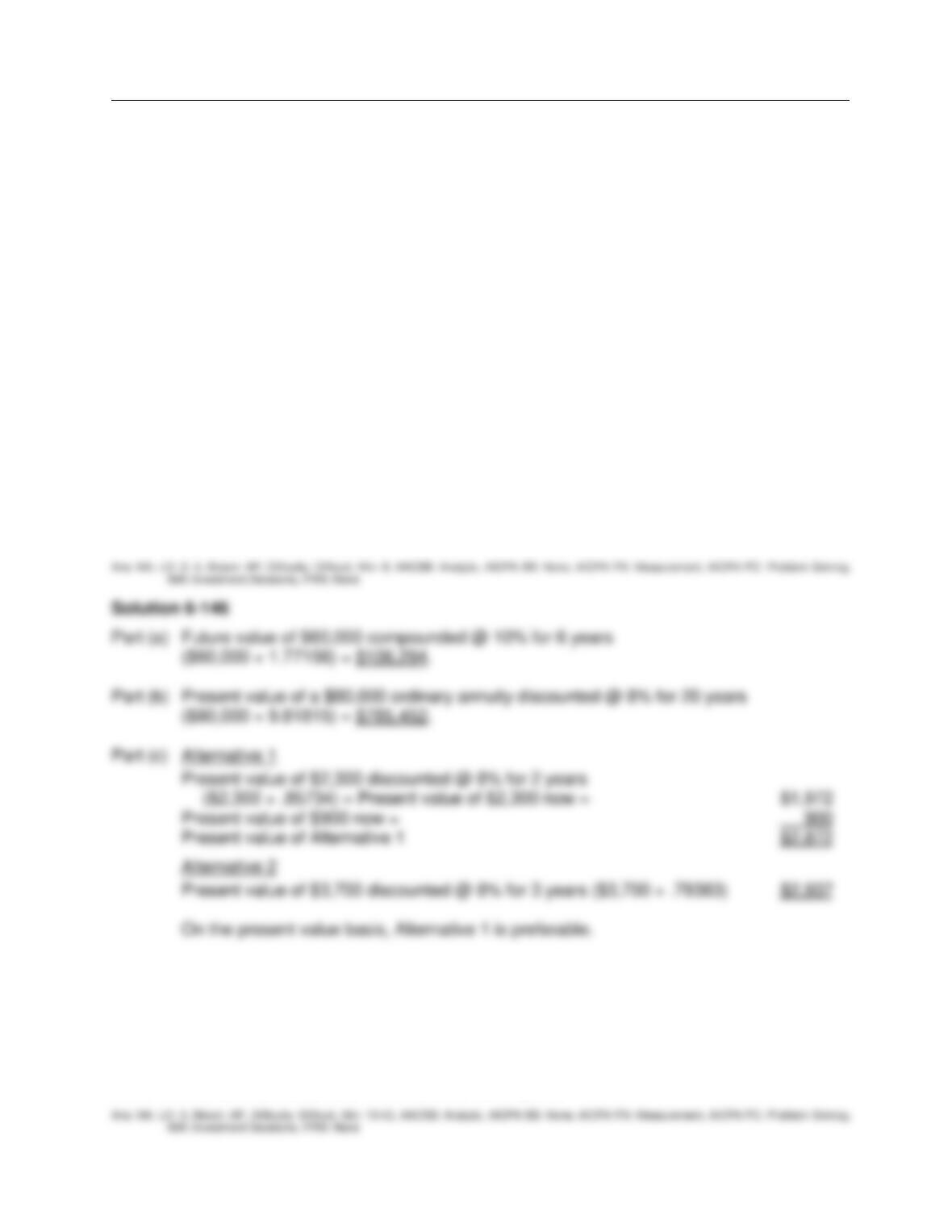
John Rich, an executive VP contemplating retirement on his sixty fifth birthday, decides to create
a fund on a 6% basis that will enable him to withdraw $90,000 per year on July 31, beginning in
2022 and continuing through 2026. To develop this fund, Rich intends to make equal
contributions on July 31 of each of the years 2017–2021.
Instructions
(a) Compute how much the balance of the fund must equal on July 31, 2021, in order for Rich to
satisfy his objective.
(b) Compute the amount of Rich’s contributions to the fund.
Accounting and the Time Value of Money
6 – 45
PROBLEMS
Pr. 6-146—Present value and future value computations.
Part (a) Compute the amount that a $60,000 investment today would accumulate at 10%
(compound interest) by the end of 6 years.
Part (b) Tom wants to retire at the end of this year (2017). His life expectancy is 20 years from
his retirement. Tom has come to you, his CPA, to learn how much he should deposit on
December 31, 2017 to be able to withdraw $80,000 at the end of each year for the next
20 years, assuming the amount on deposit will earn 8% interest annually.
Part (c) Judy Thomas has a $2,800 overdue debt for medical books and supplies at Joe’s
Bookstore. She has only $900 in her checking account and doesn’t want her parents to
know about this debt. Joe’s tells her that she may settle the account in one of two ways
since she can’t pay it all now:
1. Pay $900 now and $2,300 when she completes her residency, two years from today.
2. Pay $3,700 one year after completion of residency, three years from today.
Assuming that the cost of money is the only factor in Judy’s decision and that the cost of
money to her is 8%, which alternative should she choose? Your answer must be
supported with calculations.
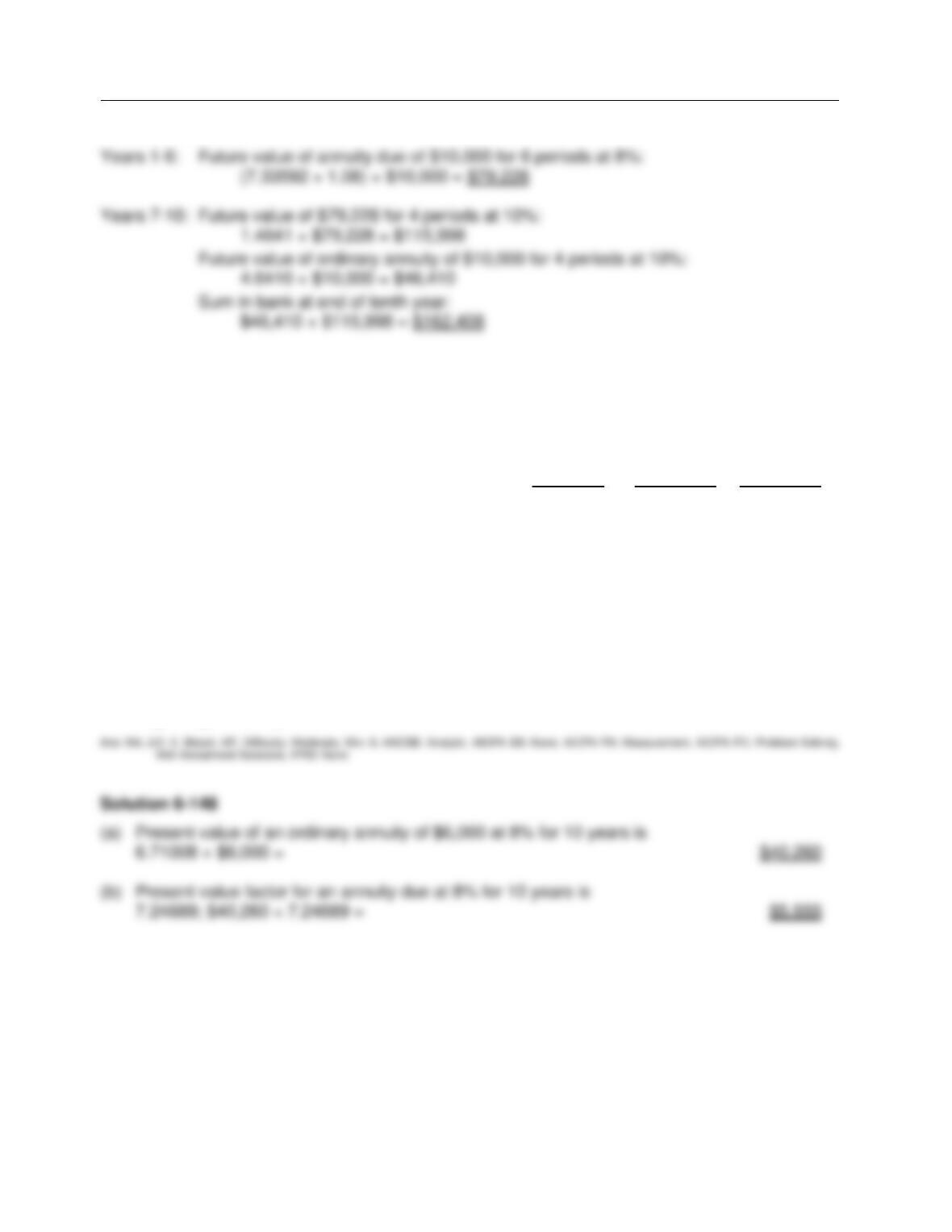
Pr. 6-147—Annuity with change in interest rate.
Jan Green established a savings account for her son’s college education by making annual
deposits of $10,000 at the beginning of each of six years to a savings account paying 8%. At the
end of the sixth year, the account balance was transferred to a bank paying 10%, and annual
deposits of $10,000 were made at the end of each year from the seventh through the tenth years.
What was the account balance at the end of the tenth year?
Test Bank for Intermediate Accounting, Sixteenth Edition
6 – 46
Solution 6-147
Pr. 6-148— Present value of an ordinary annuity and annuity due.
Jill Morris is presently leasing a small business computer from Eller Office Equipment Company.
The lease requires 10 annual payments of $6,000 at the end of each year and provides the lessor
(Eller) with an 8% return on its investment. You may use the following 8% interest factors:
9 Periods 10 Periods 11 Periods
Future Value of 1 1.99900 2.15892 2.33164
Present Value of 1 .50025 .46319 .42888
Future Value of Ordinary Annuity of 1 12.48756 14.48656 16.64549
Present Value of Ordinary Annuity of 1 6.24689 6.71008 7.13896
Present Value of an Annuity Due of 1 6.74664 7.24689 7.71008
Instructions
(a) Assuming the computer has a ten-year life and will have no salvage value at the expiration of
the lease, what was the original cost of the computer to Eller?
(b) What amount would each payment be if the ten annual payments are to be made at the
beginning of each period?
Accounting and the Time Value of Money
6 – 47
Pr. 6-149—Finding the implied interest rate.
Bates Company has entered into two lease agreements. In each case the cash equivalent
purchase price of the asset acquired is known and you wish to find the interest rate which is
applicable to the lease payments.
Instructions
Calculate the implied interest rate for the lease payments.
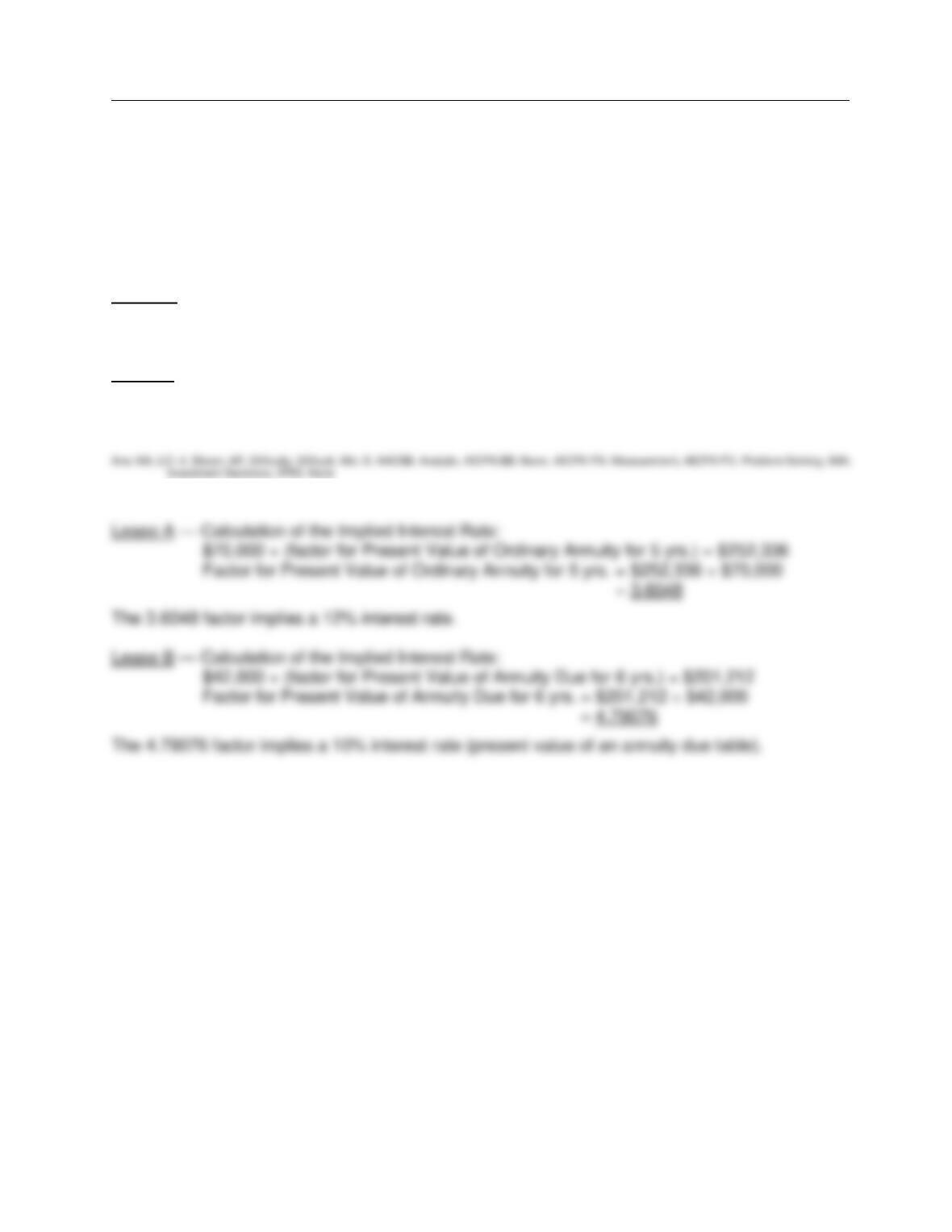
Lease A — Lease A covers office equipment which could be purchased for $252,336. Bates
Company has, however, chosen to lease the equipment for $70,000 per year, payable at the end
of each of the next 5 years.
Lease B — Lease B applies to a machine which can be purchased for $201,212. Bates Company
has chosen to lease the machine for $42,000 per year on a 6-year lease. Payments are due at
the start of each year.
Solution 6-149
Test Bank for Intermediate Accounting, Sixteenth Edition
6 – 48
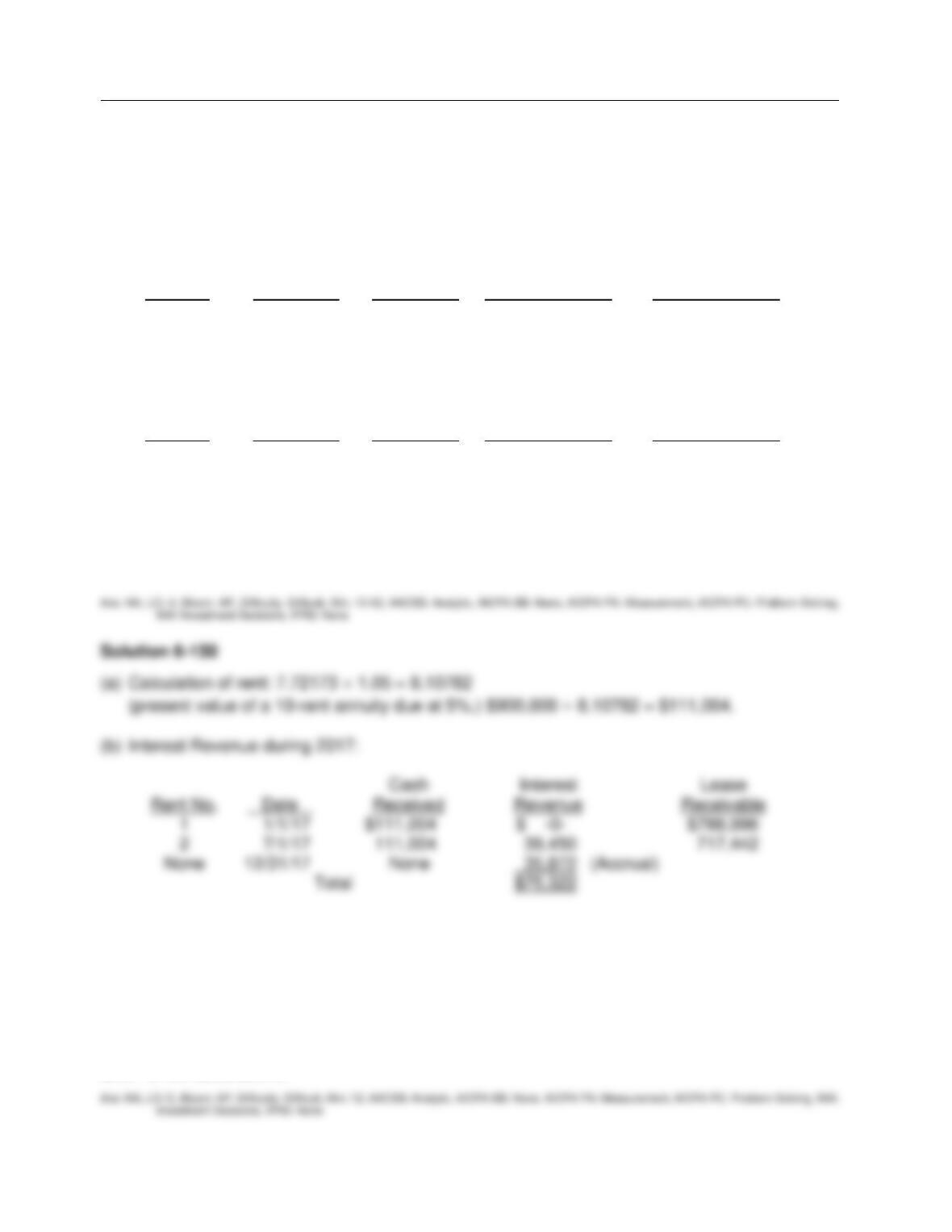
Pr. 6-150—Calculation of unknown rent and interest.
Pine Leasing Company purchased specialized equipment from Wayne Company on December
31, 2016 for $900,000. On the same date, it leased this equipment to Sears Company for 5 years,
the useful life of the equipment. The lease payments begin January 1, 2017 and are made every
6 months until July 1, 2021. Pine Leasing wants to earn 10% annually on its investment.
Various Factors at 10%
Periods Future Present Future Value of an Present Value of an
or Rents Value of $1 Value of $1 Ordinary Annuity Ordinary Annuity
9 2.35795 .42410 13.57948 5.75902
10 2.59374 .38554 15.93742 6.14457
11 2.85312 .35049 18.53117 6.49506
Various Factors at 5%
Periods Future Present Future Value of an Present Value of an
or Rents Value of $1 Value of $1 Ordinary Annuity Ordinary Annuity
9 1.55133 .64461 11.02656 7.10782
10 1.62889 .61391 12.57789 7.72173
11 1.71034 .58468 14.20679 8.30641
Instructions
(a) Calculate the amount of each rent.
(b) How much interest revenue will Pine earn in 2017?
Pr. 6-151—Deferred annuity.
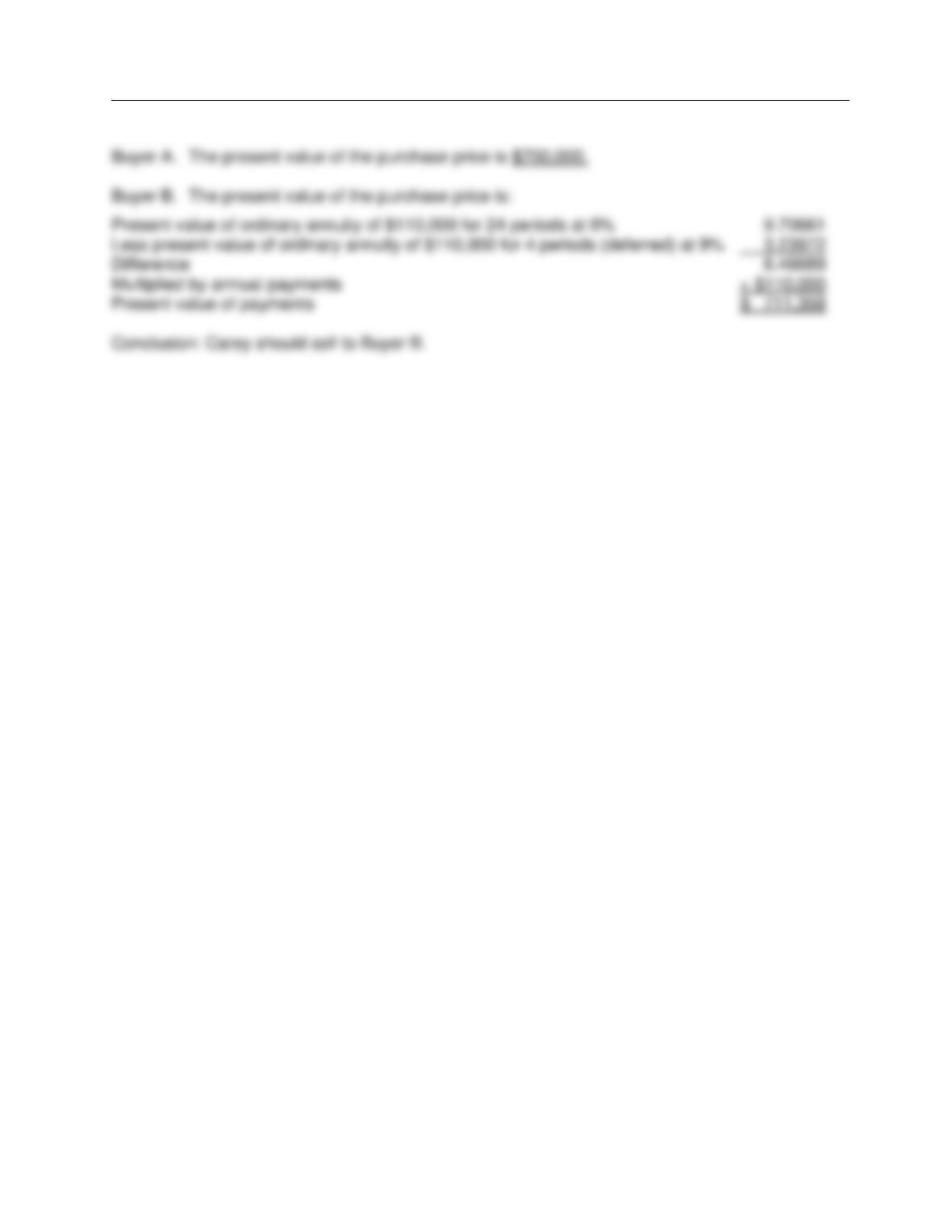
Carey Company owns a plot of land on which buried toxic wastes have been discovered. Since it
will require several years and a considerable sum of money before the property is fully detoxified
and capable of generating revenues, Carey wishes to sell the land now. It has located two
potential buyers: Buyer A, who is willing to pay $700,000 for the land now, and Buyer B, who is
willing to make 20 annual payments of $110,000 each, with the first payment to be made 5 years
from today. Assuming that the appropriate rate of interest is 9%, to whom should Carey sell the
land? Show calculations.
Accounting and the Time Value of Money
6 – 49
Solution 6-151
Test Bank for Intermediate Accounting, Sixteenth Edition
6 – 50
IFRS QUESTIONS
True / False
1. IFRS does not intend to issue detailed guidance on the selection of a discount rate when
the time value of money is required to determine cash flows.
2. Under IAS 37 and the establishment of estimate provisions, discounting is required where
the time value of money is material.
3. Under IFRS, the rate implicit in the lease is generally used to discount minimum lease
payments.
4. Under IFRS, the discount rate should reflect risks for which future cash flow estimates have
been adjusted.
5. Under IFRS, if an estimate is being developed for a large number of items with varied
outcomes, then the expected value method is used.
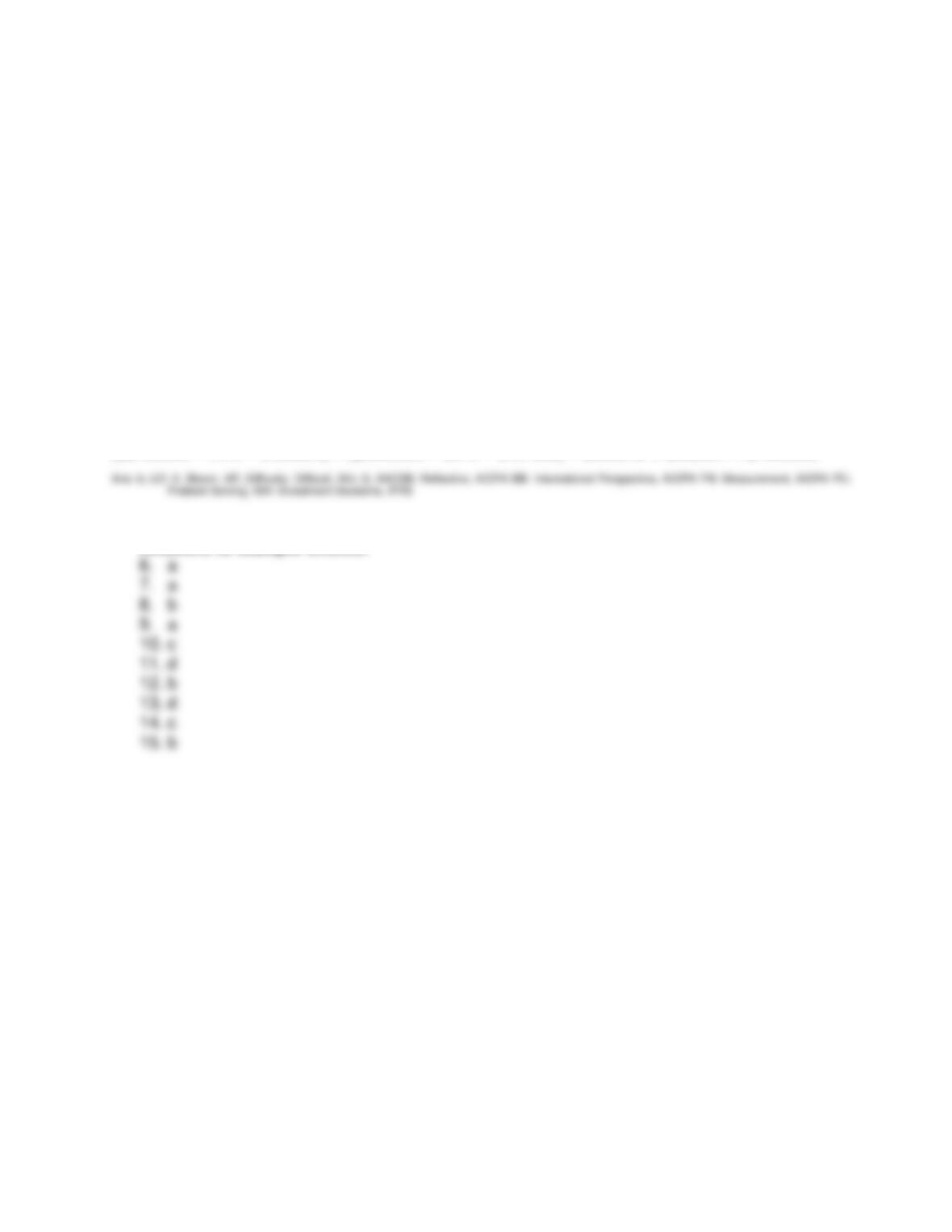
Answers to True / False questions:
Accounting and the Time Value of Money
6 – 51
Multiple Choice Questions:
6. Underwood Company maintains its accounting records using IFRS. The company recently
signed a lease for a new office building, for a lease period of 10 years. Under the lease
agreement, a security deposit of $25,000 is made, with the deposit to be returned at the
expiration of the lease, with interest compounded at 10% per year. What amount will the
company receive at the time the lease expires?
a. $64,844.
b. $50,000.
c. $153,615.
d. $34,639.
Calculation:
Future value of $25,000 @ 10% for 10 years
($25,000 × 2.59374) = $64,844
Use the following information to answer questions 7 & 8.
Martin Industries maintains its accounting records using IFRS. The company purchases
equipment with a price of $400,000. The manufacturer has offered a payment plan that would
allow Martin to make 10 equal annual payments of $49,316, with the first payment due one year
after the purchase.
7. How much total interest will Martin pay on this payment plan?
a. $93,160
b. $49,316
c. $160,000
d. $40,000
Calculation: Total interest = Total payments—amount owed today
$493,160 (10 × $49,316) − $400,000 = $93,160.
8. Martin could borrow $400,000 from its bank to finance the purchase at an annual rate of
6%. Should Martin borrow from the bank or use the manufacturer’s payment plan to pay
for the equipment?
a. Borrow from the bank.
b. Use the manufacturer’s payment plan.
c. The rates for both the bank and manufacturer are the same, so Martin would be
indifferent.
d. There is not enough information to answer this question.
Calculation: Martin should use the manufacturer’s payment plan, since it is about a 4% rate as
compared to the bank‘s 6% rate.
PV − OA10, i% = $400,000 $49,316
= 8.11096; Inspection of the10 period row reveals a rate of about 4%.
Test Bank for Intermediate Accounting, Sixteenth Edition
6 – 52
9. Barton Company, a company who maintains its accounting records using IFRS,
manufactures furniture. Barton sells an order to Save-A Lot Furniture in exchange for a
zero-interest-bearing $90,000 note due from the customer in two years. Since there is no
stated interest rate on the note, the controller uses the current market rate of 8% to derive
the present value. Based on this information and the incorporation of the time value of
money, which of the following would be recorded by Barton to recognize this sale?
a. A debit to Notes Receivable for $77,161.
b. A credit to Sales Revenue for $90,000.
c. A credit to Notes Receivable for $77,161.
d. A debit to Discount on Notes Receivable for $7,200.
Rationale:
Notes Receivable 77,161
Sales Revenue 77,161
$90,000 PV (8%, 2) = $90,000 .85734 = $77,161
10. Moore Industries manufactures exercise equipment. Recently the vice president of
operations of the company has requested construction of a new plant to meet the
increasing demand for the company’s exercise equipment. After a careful evaluation of
the request, the board of directors has decided to raise funds for the new plant by issuing
$3,000,000 of 11% bonds on March 1, 2017, due on March 1, 2032, with interest payable
each March 1 and September 1. At the time of issuance, the market interest rate for
similar financial instruments is 10%. What is the selling price of the bonds?
a. $3,330,000
b. $1,904,664
c. $3,230,594
d. $2,536,454
Calculations:
Formula for the interest payments:
PV − OA = R (PVF − OAn, i)
PV − OA = $165,000 (PVF − OA30, 5%)
PV − OA = $165,000 (15.37245)
PV − OA = $2,536,454
Formula for the principal:
PV = FV (PVFn, i)
PV = $3,000,000 (PVF30, 5%)
PV = $3,000,000 (0.23138)
PV = $694,140
The selling price of the bonds = $2,536,454 + $694,140 = $3,230,594.
Accounting and the Time Value of Money
6 – 53
11. Reegan Company owns a trade name that was purchased in an acquisition of Hamilton
Company. The trade name has a book value of $1,800,000, but according to IFRS, it is
assessed for impairment on an annual basis. To perform this impairment test, Reegan
must estimate the fair value of the trade name. It has developed the following cash flow
estimates related to the trade name based on internal information. Each cash flow
estimate reflects Reegan‘s estimate of annual cash flows over the next 7 years. The trade
name is assumed to have no residual value after the 7 years. (Assume the cash flows
occur at the end of each year.)
Probability Assessment Cash Flow Estimate
30% $240,000
50% 365,000
20% 425,000
Reegan determines that the appropriate discount rate for this estimation is 6%. To the nearest
dollar, what is the estimated fair value of the trade name?
a. $1,800,000
b. $ 339,500
c. $1,030,000
d. $1,895,218
Calculations: This exercise determines the present value of an ordinary annuity of expected cash
flows as a fair value estimate.
Cash Flow Probability Expected
Estimate Assessment = Cash Flow
$240,000 30% $ 72,000
365,000 50% 182,500
425,000 20% 85,000
$339,500 PV Factor,
(n = 7, l = 6%) Present Value
$339,500 5.58238 = $1,895,218
Test Bank for Intermediate Accounting, Sixteenth Edition
6 – 54
12. Jamison Company uses IFRS for its financial reporting. It produces machines that sell
globally. All sales are accompanied by a one-year warranty. At the end of the year, the
company has the following data:
• 3,000 units were sold during the year.
• The trend over the past five years has been that 4% of the machines were defective in
some way and had to be repaired. Of this 4%, half required a full replacement at a cost of
$3,000 per unit and half were able to be repaired at an average cost of $300.
What is the expected value of the warranty cost provision?
a. $360,000
b. $198,000
c. $396,000
d. $180,000
Calculation:
(3,000 4% 50% $3,000) + (3,000 4% 50% $300) = $180,000 + $18,000 = $198,000
13. Maxim Company leased an office under a five-year contract, which has been accounted
for as an operating lease. Faced with the downturn in the economy, the viable company
decided to sub-lease the office. However, they have had no luck with this effort and the
landlord will not allow the lease to be cancelled. The payments are $8,000 per year and
there are four years left on the lease. The company’s most recent interest rate for
financing from a bank is 6%. The risk-free rate on government bonds is 4%. What is the
provision for the lease under IFRS?
a. $29,040
b. $30,096
c. $32,000
d. $27,721
Calculation: PV $8,000 (4 years, 6%) = $8,000 3.46511 = $27,721
14. Dolphin Company leased an office under a six-year contract, which has been accounted
for as an operating lease. Faced with the downturn in the economy, the viable company
decided to sub-lease the office. However, they have had no luck with this effort and the
landlord will not allow the lease to be cancelled. The payments are $15,000 per year and
there are five years left on the lease. The company’s most recent interest rate for
financing from a bank is 9%. The risk-free rate on government bonds is 5%. What is the
provision for the lease under IFRS?
a. $75,000
b. $66,778
c. $58,345
d. $64,942
Calculation: PV $15,000 (5 years, 9%) = $15,000 3.88965 = $58,345
Accounting and the Time Value of Money
6 – 55
15 Techtronics, a technology company that uses IFRS for its financial reporting, has been
found to have polluted the property surrounding its plant. The property is leased for 12
years and Techtronics has agreed that when the lease expires, the pollution will be
remediated before transfer back to its owner. The lease has a renewal option for another
8 years. If this option is exercised, the cleanup will be done at the end of the renewal
period. There is a 70% chance that the lease will not be renewed and the cleanup will cost
$240,000. There is 30% chance that the lease will be renewed and the cleanup costs will
be $500,000 at the end of the 20 years. If you assume that these estimates are derived
from best estimates of likely outcomes and the risk-free rate is 5%, the expected present
value of the cleanup provision is:
a. $318,000
b. $150,083
c. $370,000
d. $302,100
Calculation:
($240,000 70% 0.55684) + ($500,000 30% 0.37689) = $93,549 + $56,534 = $150,083
Answers to Multiple Choice.