
130. Below is an Income Statement and a Statement of Cash Flows for Morgan Corporation for Year 8.
Morgan Corporation
Income Statement
For the Year Ended December 31, Year 8
Sales Revenue
$11,400
Gain on Sale of Equipment
60
Interest Revenue
16
Total Revenues
$11,476
Cost of Goods Sold
(7,070)
Selling and Administrative Expense
(2,240)
Interest Expense
(210)
Income Tax Expense
(752)
Net Income
$ 1,204
Morgan Corporation
Statement of Cash Flows
For the Year Ended December 31, Year 8
Operations
Net Income
$1,204
Depreciation
370
Gain on Sale of Equipment
(60)
Increase in Accounts Receivable
(160)
Increase in Prepayments
(70)
Decrease in Income Tax Payable
(25)
Decrease in Other Current Liabilities
(150)
Decrease in Inventories
140
Increase in Accounts Payable-Merchandise
175
Cash Flow from Operations
$1,424
Investing
Sale of Equipment
$ 310
Acquisition of Property, Plant and Equipment
(610)
Acquisition of Marketable Securities
(1,300)
Cash Flow from Investing
$(1,600)
Financing
Decrease in Short-term Borrowing
$(120)
Increase in Long-term Debt
550
Increase in Common Stock
400
Decrease in Long-term Debt
(200)
Dividends
(390)
Cash Flow from Financing
$ 240
Change in Cash
$ 64
Cash-January 1, Year 8
850
Cash-December 31, Year 8
$ 914
Required:
Respond to each of the following questions.
a.
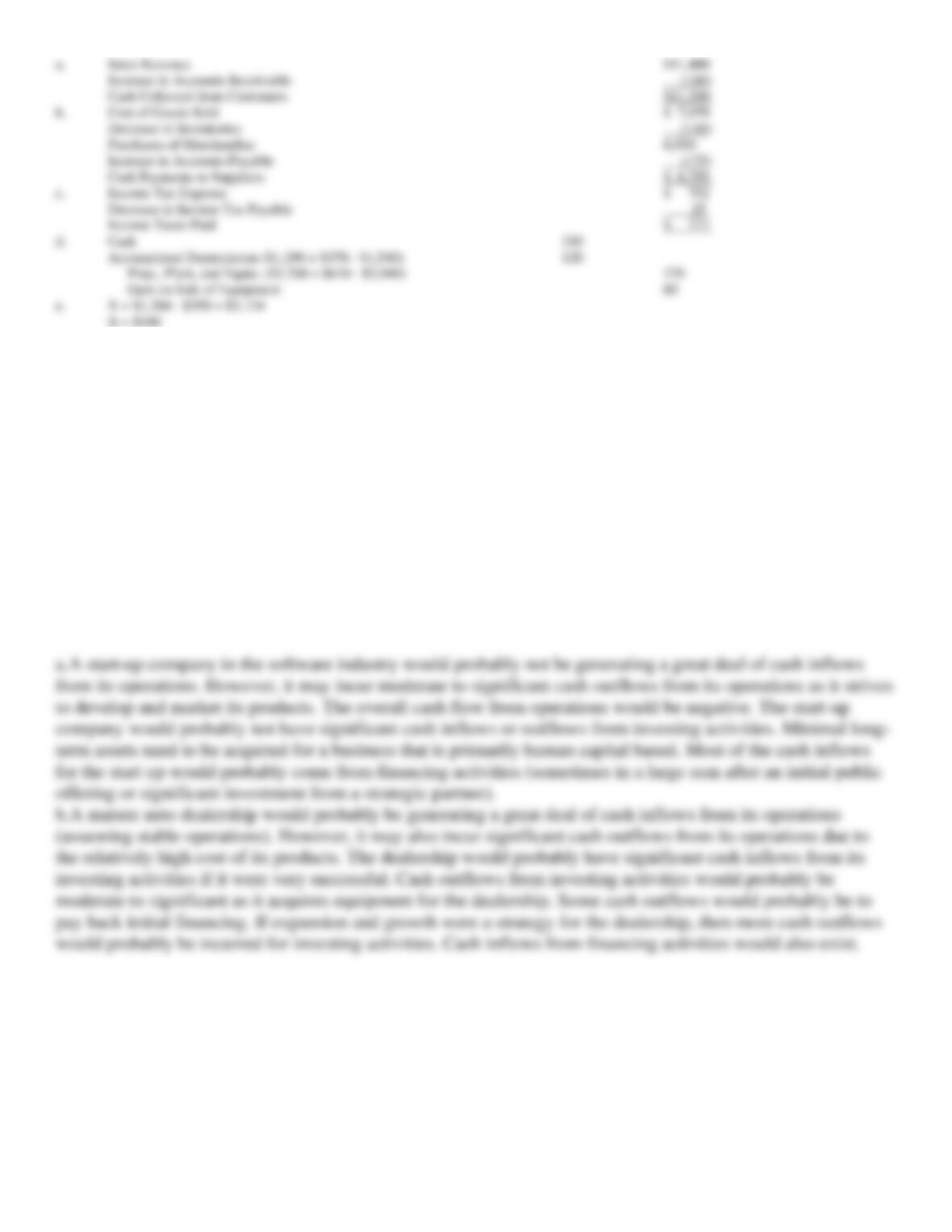
Compute the amount of cash collected from customers during Year 8.
b.
Compute the amount of cash paid to suppliers for merchandise during Year 8.
c.
Compute the amount of income taxes paid to governmental agencies during Year 8.
d.
Property, plant and equipment (at cost) had a balance of $3,700 on January 1, Year 8 and $3,940 on
December 31, Year 8. Accumulated depreciation had a balance of $1,290 on January 1, Year 8 and $1,540 on
December 31, Year 8. Give the journal entry that Morrissey Corporation made in its accounting records
during Year 8 to record the sale of the equipment.
e.
The balance in the retained earnings account on December 31, Year 8 after closing entries was $1,154.
Compute the balance in the retained earnings account on January 1, Year 8.
131. At different points in their existence, companies will have different cash inflow and outflow requirements.
Such differences make intercompany comparisons difficult, even within the same industry.
Required:
a.
Consider a start-up company in the software development industry. What might its operating, investing, and financing cash flows look like
in general? Provide examples where appropriate.
b.
Consider a mature auto dealership. What might its operating, investing, and financing cash flows look like in general? Provide examples
where appropriate.
132. Why is a Statement of Cash Flows needed?
NEED FOR A STATEMENT OF CASH FLOWS
133. How does the statement of cash flows explain the reasons for the change in cash between balance sheet
dates?
THE STATEMENT EXPLAINS THE REASONS FOR THE CHANGE IN CASH BETWEEN BALANCE
SHEET DATES
134. The inflows and outflows of cash during the year appear in the statement of cash flows in one of three
categories: operating, investing, and financing. Explain each category.
THE STATEMENT CLASSIFIES THE REASONS FOR THE CHANGE IN CASH
AS AN OPERATING, OR INVESTING, OR FINANCING ACTIVITY
135. Describe the various presentation formats for the Statement of Cash Flows.
PRESENTATION FORMATS FOR THE STATEMENT OF CASH FLOWS
136. Describe the various sections of the statement of cash flows.
Overview of the Statement of Cash Flows
137. The statement of cash flows provides information that helps the reader in (1) assessing the impact of
operations on liquidity and (2) assessing the relations among cash flows from operating, investing, and
financing activities. Explain.
USING INFORMATION FROM THE STATEMENT
OF CASH FLOWS
138. Cash flows do not always fit unambiguously into only one of the three categories: operating, investing and
financing. Explain.
139. Some analysts focus attention on cash flow from operations, thinking it as important as, or more important
than, net income as a performance measure. Interpreting cash from operations as a measure of operating
performance requires considering cash flows along two dimensions: (1) their timing and (2) their classification
and disclosure in the statement and related notes. Explain.
140. How does the statement of cash flows helps readers understanding?