97. While the indirect method is prevalent in the construction of cash flow statements in the U.S., why might a
firm choose to construct its cash flow statement using the direct method?
98. U.S. GAAP
99. U.S. GAAP
100. Which of the following is the method of reporting amounts of cash received from customers less cash
disbursed to various suppliers, employees, lenders for interest payments, and taxing authorities, allowed by U.S.
GAAP?
101. Which of the following methods, allowed by U.S. GAAP, report(s) the net income for a period adjusted
by revenues converted to cash received from customers and expenses converted to cash disbursed to various
suppliers of goods and services?
102. The method of reporting preferred by U.S. GAAP is/are
103. The direct method of reporting
104. The indirect method of reporting
105. Given the large number of transactions affecting the Cash account during a period, most firms prefer to
prepare the statement of cash flows after they have prepared
106. Which of the following concerning the preparation of the statement of cash flows is correct?
107. One can prepare the statement of cash flows
108. Most firms prefer to prepare the statement of cash flows after they have prepared the income statement and
the balance sheet. The amounts debited to various accounts on the T-account work sheet
109. Most firms prefer to prepare the statement of cash flows after they have prepared the income statement and
the balance sheet. In the preparation of the T-account work sheet, an error
110. The final step in preparing the statement of cash flows is to use the information provided in the master T-
account for _____ to prepare the formal statement.
111. What is the key difference between the direct method and indirect method for preparing the Statement of
Cash Flows?
112. The _____ for preparing the Statement of Cash Flows begins with net income and adjusts that amount for
noncash items.
113. Many analysts focus attention on cash flow from operations, thinking it as important as, or more important
than, net income. A common misconception is that the management has little opportunity to manipulate
transactions affecting the statement of cash flows. The manipulation possibilities arise from
114. Firms have some choice as to when they disburse cash. Firms that delay making payments to suppliers,
employees, and others during the last several days of an accounting period
115. Firms have some choice as to when they disburse cash. A firm may delay making payments to suppliers,
employees, and others during the last several days of an accounting period. When this firm makes the cash
payments during the early part of the next period, cash flow from
116. Firms have some choice as to when they disburse cash. A firm may delay making payments to suppliers,
employees, and others during the last several days of an accounting period and then make the cash payments
during the early part of the next period. The firm
117. Regarding the Statement of Cash Flow, which of the following is not true regarding operations?
118. Firms not experiencing rapid growth can often finance capital expenditures with
119. Rapidly growing firms must often _____ to finance their acquisitions of noncurrent assets.
120. Firms can use free cash flow to
121. A growing firm that delays payments at the end of each period reports larger cash flow from operations
each period than if it had not delayed making the cash payments at the end of each period. Which of the
122. If a statement of cash flow showed that a firm had a small cash loss from operating activities, a large cash
outflow from investing activities, and a large cash inflow from financing activities, you would expect the firm
to be at what stage of development?.
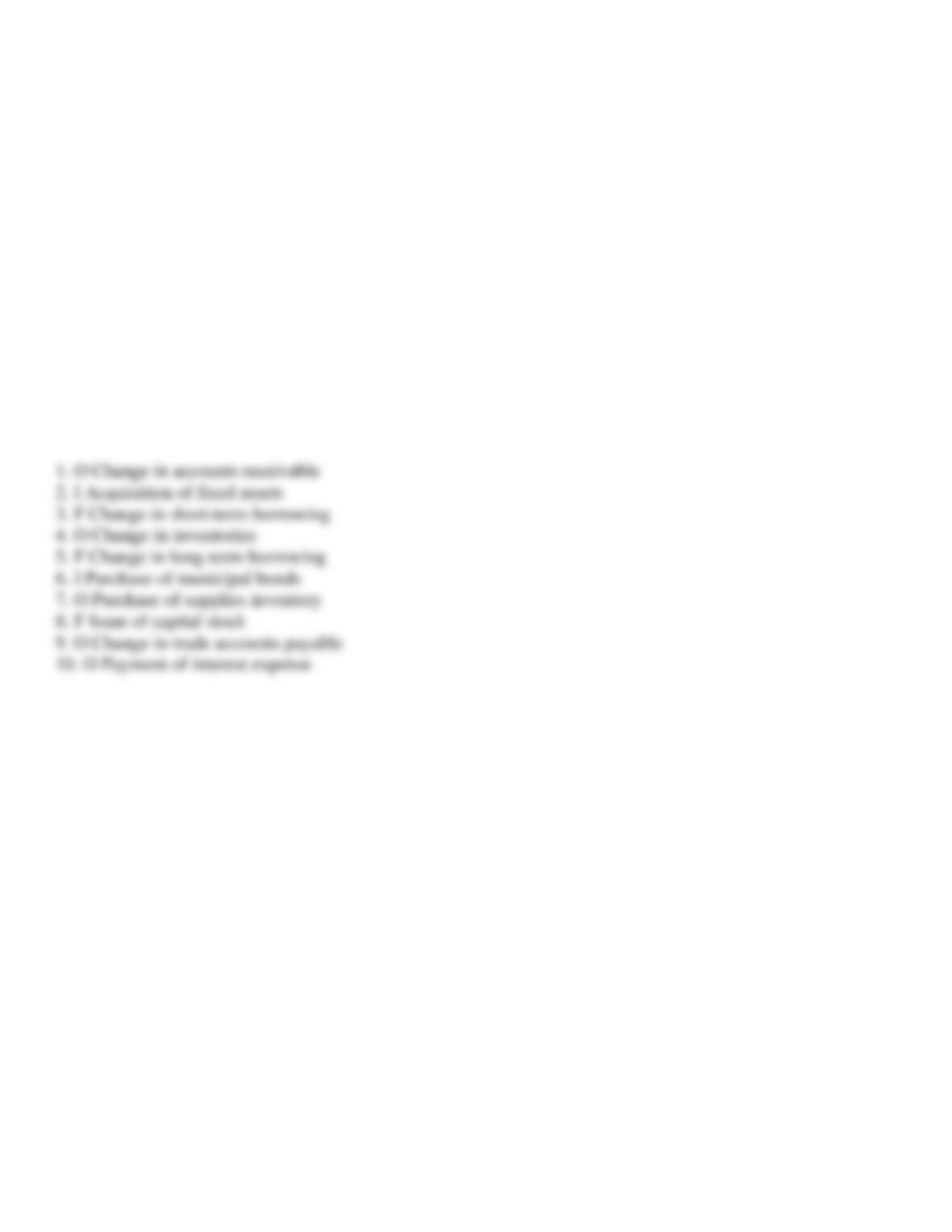
123. For each of the following activities, identify where the activity would be reported on the statement of cash
flows.
O
-Operating
I
-Investing
F
-Financing
1.
Change in accounts receivable
2.
Acquisition of fixed assets
3.
Change in short-term borrowing
4.
Change in inventories
5.
Change in long-term borrowing
6.
Purchase of municipal bonds with the intention of holding the bonds to maturity
7.
Purchase of supplies inventory
8.
Issue of capital stock
9.
Change in trade accounts payable
10.
Payment of interest expense
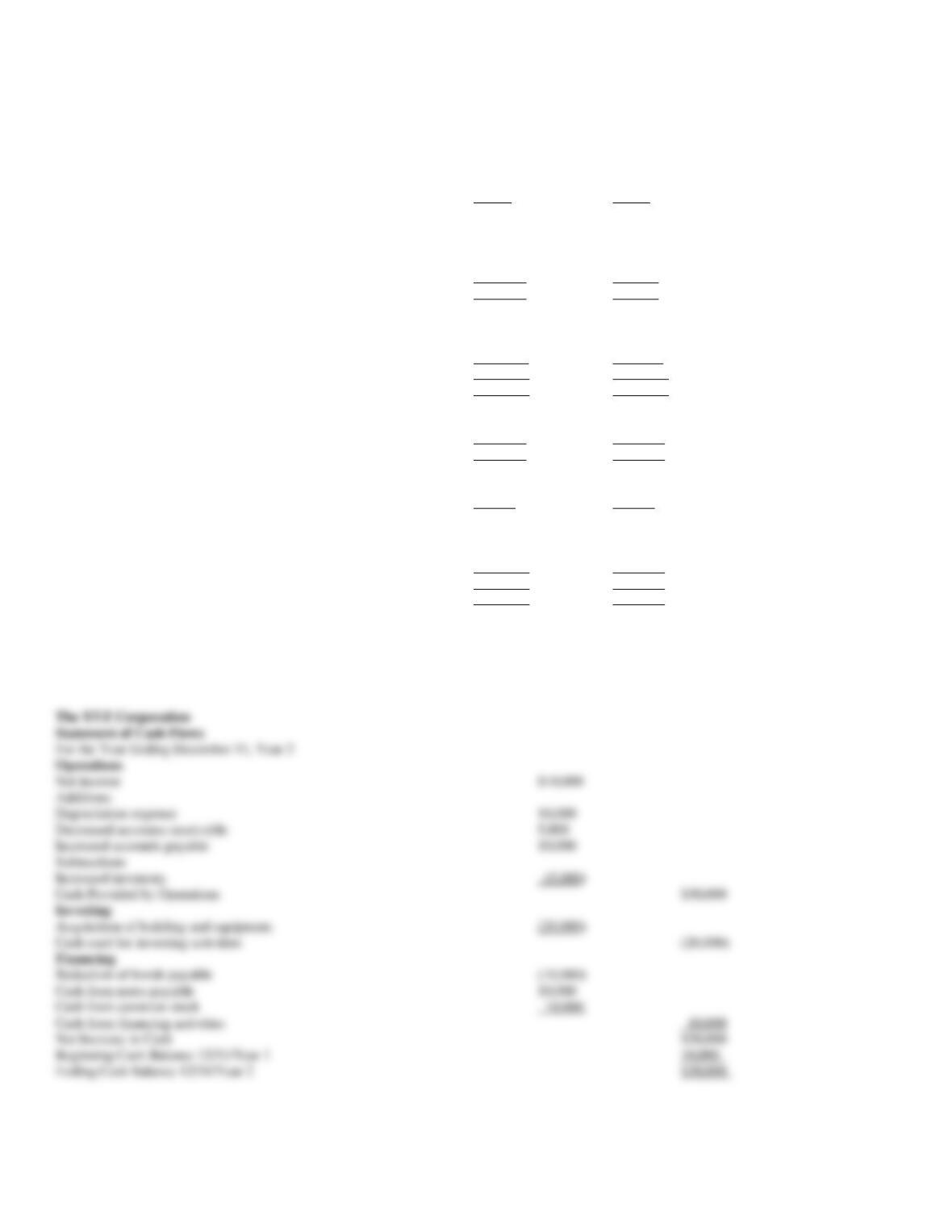
124. Based on the following information, prepare a statement of cash flows for Year 2. Use the indirect method.
The XYZ Corporation
Comparative Balance Sheet
As of December 31, Year 1 and Year 2
December 31,
Year 1
Year 2
Assets
Current assets
Cash
$ 10,000
$30,000
Accounts receivable
20,000
15,000
Inventories
15,000
20,000
Total current assets
45,000
65,000
Property, plant, and equipment
Land
10,000
10,000
Building and equipment
100,000
120,000
Accumulated depreciation
(10,000)
(20,000)
Total property, plant,and equipment
100,000
110,000
Total Assets
$145,000
$175,000
Liabilities and Shareholders’ Equity
Current liabilities
Accounts payable
$ 20,000
$ 30,000
Total current liabilities
20,000
30,000
Noncurrent liabilities
Bonds payable
50,000
40,000
Notes payable
20,000
30,000
Total noncurrent liabilities
70,000
70,000
Shareholders’ equity
Common stock
20,000
30,000
Retained earnings
35,000
45,000
Total shareholders’ equity
55,000
75,000
Total Liabilities and Shareholders’ Equity
$145,000
$175,000
Dividends paid during Year 2 are $0. There were no dispositions of property during the year.
Operations
Net income
$10,000
Additions
Depreciation expense
10,000
Decreased accounts receivable
5,000
Increased accounts payable
10,000
Subtractions
Increased inventory
(5,000)
Cash Provided by Operations
$30,000
Acquisition of building and equipment
(20,000)
Cash used for investing activities
(20,000)
Financing
Reduction of bonds payable
(10,000)
Cash from notes payable
10,000
Cash from common stock
10,000
Cash from financing activities
10,000
Net Increase in Cash
$20,000
Beginning Cash Balance 12/31/Year 1
10,000
125. In the first month of operations (April Year 1) of the QuickClean Company, a service business, the
following events occurred.
a.
Issued stock for $100,000; 20,000 shares with a $1 par value.
b.
Purchased equipment with a useful life of ten years for $12,000.
c.
Purchased a building with a useful life of 20 years for $24,000.
d.
Bought office supplies for $2,400. Supplies are expected to last one year.
e.
Paid salaries of $10,000.
f.
Borrowed $15,000 from bank on last day of the month. 12% interest rate payable in 90 days.
g.
Sold services for $20,000 on account.
h.
Collected $15,000 of receivables.
i.
Recorded expense accruals of $4,000 at end of month.
Required:
Prepare a balance sheet and statement of cash flow using the indirect method for the first month of operations.
Current assets
Cash
$81,600
Accounts receivable
5,000
Supplies inventory
2,200
Total current assets
88,800
Property, plant and equipment
Property, plant and equipment
36,000
Accumulated depreciation
(200)
Total property, plant, and equipment
35,800
Total assets
$124,600
Current liabilities
Accrued expenses
$ 4,000
Noncurrent liabilities
Note payable
15,000
Total liabilities
$ 19,000
Shareholders’ equity
Common stock, $1 par
20,000
Additional paid-in capital
80,000
Retained earnings
5,600
Total shareholders’ equity
105,600
Total Liabilities and Shareholders’ Equity
$124,600
126. For each of the following independent cases, solve for the unknown factor.
CASE 1
CASE 2
CASE 3
Cost of goods sold
$25,000
$20,000
C
Inventory, beginning
8,000
80,000
$ 25,000
Inventory, ending
3,000
B
60,000
Accounts payable, beginning
6,000
8,000
15,000
Accounts payable, ending
5,000
8,000
2,000
Cash payments to suppliers
A
44,000
123,000
Operations
Net income
$ 5,600
Additions
Depreciation expense
Increased accrued expense
4,000
Subtractions
Increased accounts receivable
(5,000)
Increase in supplies inventory
(2,200)
Cash from operations
$ 2,600
Investing
Acquisition of property, plant, and equipment
(36,000)
Cash used for investing activities
(36,000)
Financing
Cash from note payable
15,000
Cash from common stock
100,000
Cash from financing activities
115,000
Net increase in cash
$ 81,600
127. Given the following information, prepare the cash flows from operations section of the statement of cash
flows using the indirect method.
The Wayne Corporation
Income Statement
For the Year Ending December 31, Year 2
Sales
$500,000
Expenses:
Cost of goods sold
$150,000
Depreciation expense
15,000
Salary expense
35,000
200,000
Net income
$300,000
Additional Information:
Accounts receivable
$ 6,000
Decrease
Merchandise inventory
12,000
Increase
Accounts payable
900
Increase
Salaries payable
600
Decrease
The Wayne Corporation
Statement of Cash Flows
Net income
$300,000
Additions
Depreciation expense
15,000
Decreased accounts receivable
6,000
Increased accounts payable
900
Subtractions
Increased inventory
(12,000)
Decreased salaries payable
(600)
Cash flow from operating activities
$309,300
128. Given the following information, indicate the cash flow amounts in the blanks provided. (Note that the
ABCCompany uses a just-in-time inventory system and there is no beginning or ending inventory).
ABC Company
Income Statement
For the Year Ended December 31, Year 2
Cash Flow
Sales revenue, 75% on credit
$200,000
$__________
Accounts receivable balance
December 31, Year 1, $50,000
December 31, Year 2, $60,000
Cost of good sold, 100% on credit
$ 60,000
$__________
Accounts payable balance
December 31, Year 1, $15,000
December 31, Year 2, $12,000
Expenses:
Salaries and Wages
$ 26,000
$__________
Accrued wages payable balance
December 31, Year 1, $1,500
December 31, Year 2, $1,600
Depreciation expense
$ 2,500
$__________
Rent expense
$ 1,500
$__________
No accruals
Income tax expense
$ 5,500
$__________
Taxes payable balance
December 31, Year 1, $1,000
December 31, Year 2, $2,000
Total expenses
$ 35,500
Net income
$104,500
Cash flow from operating activities
$
Income Statement
Cash Flow
Sales revenue, 75% on credit
$200,000
$190,000
Accounts receivable balance
December 31, Year 1, $50,000
December 31, Year 2, $60,000
Cost of good sold, 100% on credit
60,000
(63,000)
Accounts payable balance
December 31, Year 1, $15,000
December 31, Year 2, $12,000
Expenses:
Salaries and Wages
26,000
(25,900)
Accrued wages payable balance
December 31, Year 1, $1,500
December 31, Year 2, $1,600
Depreciation expense
2,500
0
Rent expense
1,500
(1,500)
No accruals
Income tax expense
$ 5,500
$ (4,500)
Taxes payable balance
Total expenses
$ 35,500
Net income
$104,500
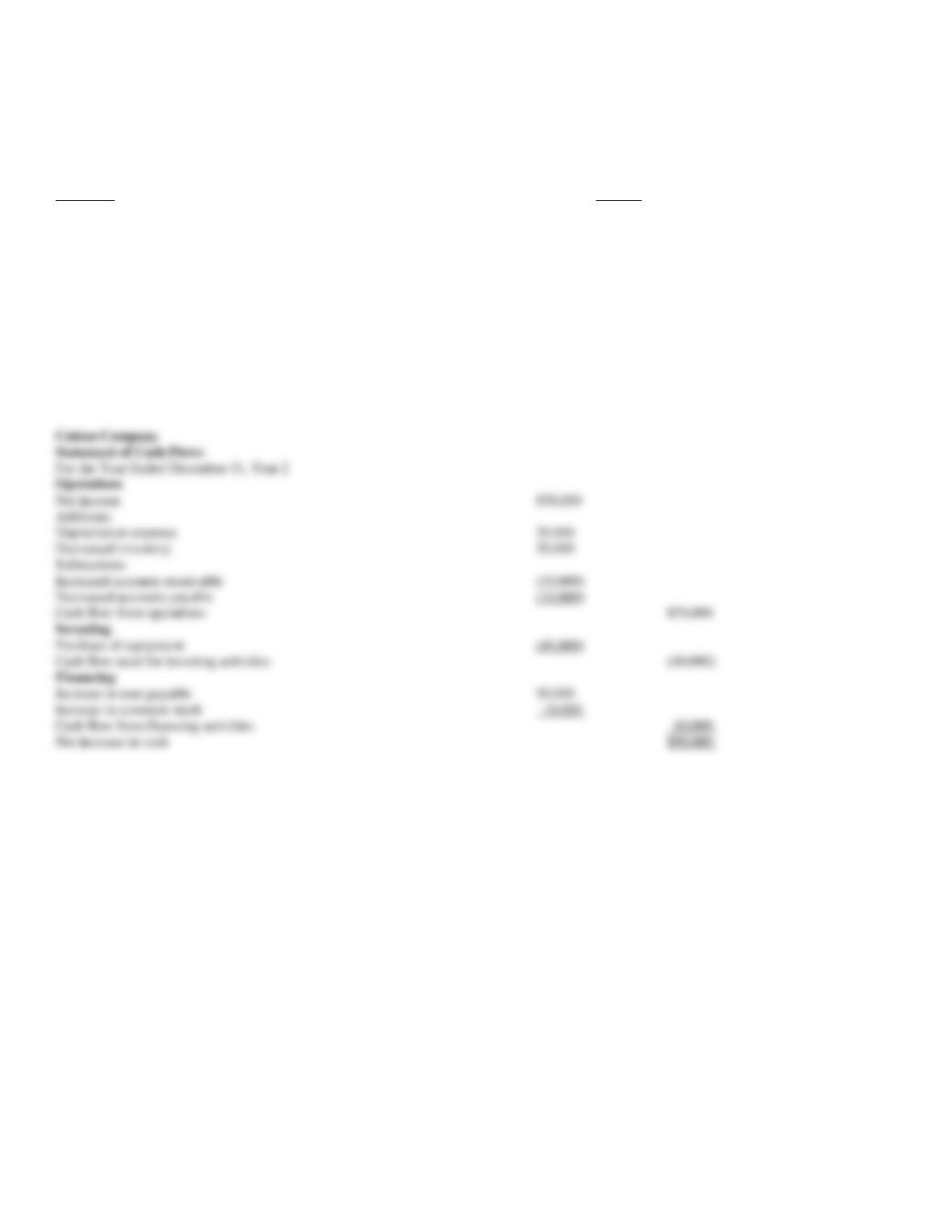
129. Given the following changes in the balance sheet for Year 2 of the Cotton Company, prepare a statement
of cash flows using the indirect method.
Change In
DR(CR)
Cash
90,000
Accounts receivable
10,000
Inventory
(20,000)
Accounts payable
10,000
Notes payable
(50,000)
Equipment
40,000
Accumulated depreciation
(20,000)
Retained earnings
(50,000)
Common stock
(10,000)
No dividends were paid during the year and no equipment was sold during the year.
Net income
$50,000
Additions
Depreciation expense
20,000
Decreased inventory
20,000
Subtractions
Increased accounts receivable
(10,000)
Decreased accounts payable
(10,000)
Cash flow from operations
$70,000
Cash flow used for investing activities
(40,000)
Increase in note payable
50,000
Increase in common stock
10,000
Cash flow from financing activities
60,000
Net increase in cash
$90,000