78) Which one of the following contains 35% carbon by mass?
A) C2H2
B) CH4
C) CH3F
D) CO2
79) Which of the following statements is false concerning the formula of a compound?
A) The empirical formula is the simplest whole numbered ratio of atoms in a compound.
B) The molecular formula is the true ratio of atoms in a compound.
C) The molecular formula and empirical formula can be identical.
D) The number of atoms in a molecular formula is always greater than the number of atoms in an
empirical formula.
80) What is the empirical formula for ethyl fluoride if the compound contains 49.97% carbon,
10.51% hydrogen, and 39.52% fluorine by mass?
A) C2H5F
B) C4H10F2
C) C4H10F4
D) C25F2
81) What is the empirical formula for perfluoropropane if the compound contains 81% fluorine
and 19% carbon by mass?
A) CF3
B) C2F8
C) C3F8
D) C19F81
82) What is the empirical formula of a substance that contains 2.64 g of C, 0.444 g of H, and
3.52 g of O?
A) CH2O
B) C2H4O2
C) C2H4O3
D) C3H4O4
83) Which one of the following is not an empirical formula?
A) CHO
B) CH2O
C) C2H4O
D) C2H4O2
84) Which one of the following is an empirical formula?
A) C2F6
B) H2SO4
C) N2H4
D) P4O10
85) A compound responsible for the odor of garlic has a molecular weight of 146 g/mol. A
0.650 g sample of the compound contains 0.321 g of carbon, 0.044 g of hydrogen, and 0.285 g of
sulfur. What is the molecular formula of the compound?
A) CH5S
B) C3H5S
C) C3H15S3
D) C6H10S2
86) Which statement about elemental analysis by combustion is not correct?
A) Carbon is determined from the amount of CO2 formed.
B) Hydrogen is determined from the amount of H2O formed.
C) Oxygen is determined from the amount of H2O formed.
D) Only carbon and hydrogen can be determined directly from CO2 and H2O.
87) In the combustion analysis of an unknown compound containing only carbon, hydrogen, and
oxygen, the grams of oxygen are found from the grams of
A) CO2 only.
B) H2O only.
C) CO2 and H2O only.
D) CO2, H2O and unknown compound.
88) Combustion analysis of an unknown compound containing only carbon and hydrogen
produced 4.554 g of CO2 and 2.322 g of H2O. What is the empirical formula of the compound?
A) CH2
B) C2H5
C) C4H10
D) C5H2
89) Combustion analysis of 2.400 g of an unknown compound containing carbon, hydrogen, and
oxygen produced 4.171 g of CO2 and 2.268 g of H2O. What is the empirical formula of the
compound?
A) C2H5O
B) C2H5O2
C) C2H10O3
D) C3H8O2
90) Combustion analysis of a 0.675 g sample of an unknown compound that contains only
carbon, hydrogen, and oxygen gives 0.627 g of CO2 and 1.534 g of H2O. The molecular mass
of the unknown is
A) C3H6O.
B) C6H12O2.
C) C9H18O3.
D) unable to be determined from this data.
91) Isoeugenol is the compound which gives the characteristic odor to nutmeg and contains
carbon, hydrogen, and oxygen. If a 0.500 g sample of isoeugenol is combusted it gives 1.341 g of
CO2 and 0.329 g of H2O. Isoeugenol has a molecular weight of 164 g/mol. What is the
molecular formula of isoeugenol?
A) C2HO
B) C5H6O
C) C8H4O4
D) C10H12O2
92) Molecular mass can be determined by
A) combustion analysis.
B) mass spectrometry.
C) titration.
D) weighing with an analytical balance.
93) Which of the following statements about mass spectrometry is false?
A) Mass spectrometry can be used to determine the molecular weight of a compound.
B) The curvature of the path in a magnetic field is determined by the mass of the ion.
C) The paths of heavier ions are deflected more strongly than the paths of lighter ions.
D) The sample is changed into positively charged ions.
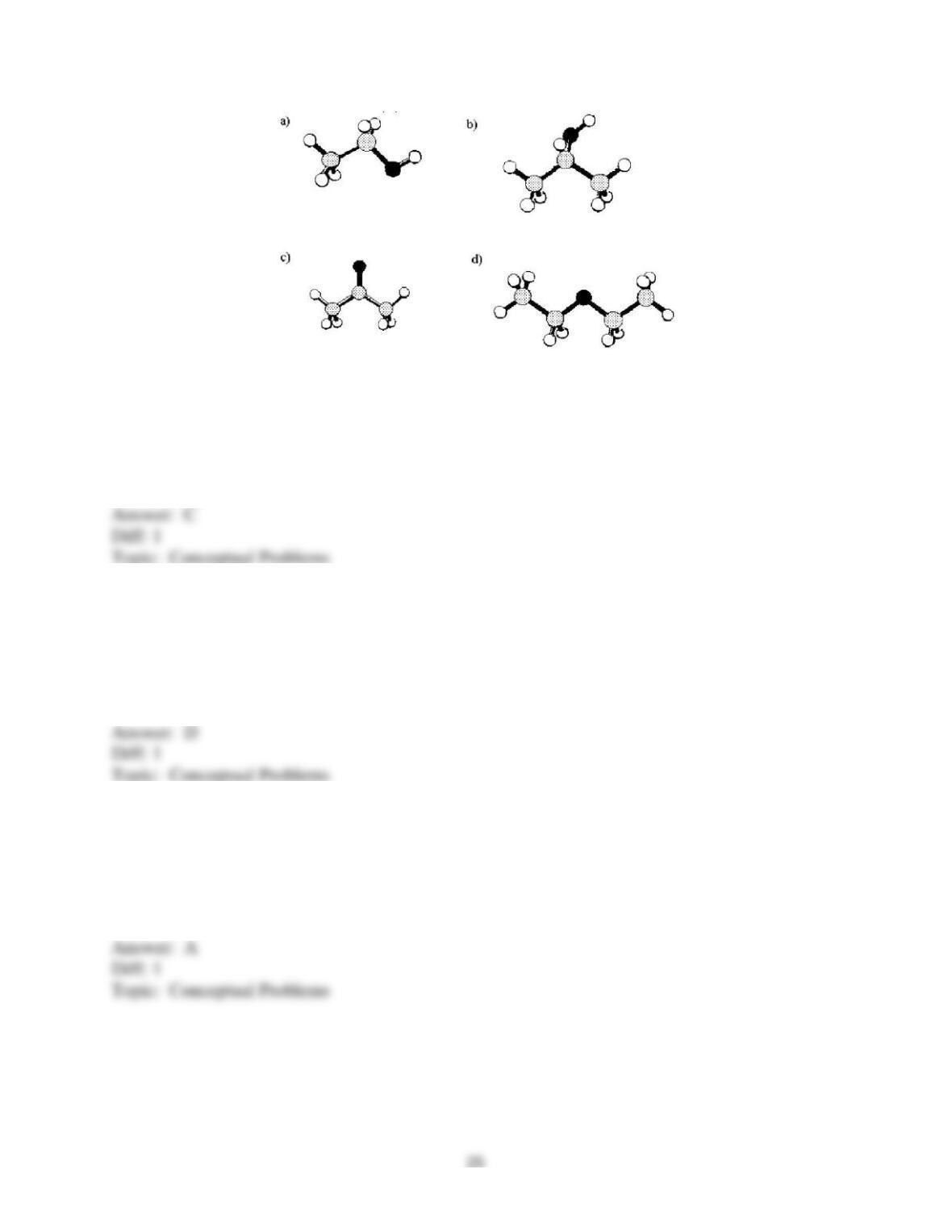
94) Acetone has the formula C3H6O. Which ball and stick model shown above represents
acetone? [gray spheres = C, black spheres = O, unshaded spheres = H]
A) model a)
B) model b)
C) model c)
D) model d)
95) Diethyl ether has the molecular formula C4H10O. Which ball and stick model shown above
represents diethyl ether? [gray spheres = C, black spheres = O, unshaded spheres = H]
A) model a)
B) model b)
C) model c)
D) model d)
96) Ethanol has the molecular formula C2H6O. Which ball and stick model shown above
represents ethanol? [gray spheres = C, black spheres = O, unshaded spheres = H]
A) model a)
B) model b)
C) model c)
D) model d)
97) 2-Propanol has the molecular formula C3H8O. Which ball and stick model shown above
represents 2-propanol? [gray spheres = C, black spheres = O, unshaded spheres = H]
A) model a)
B) model b)
C) model c)
D) model d)
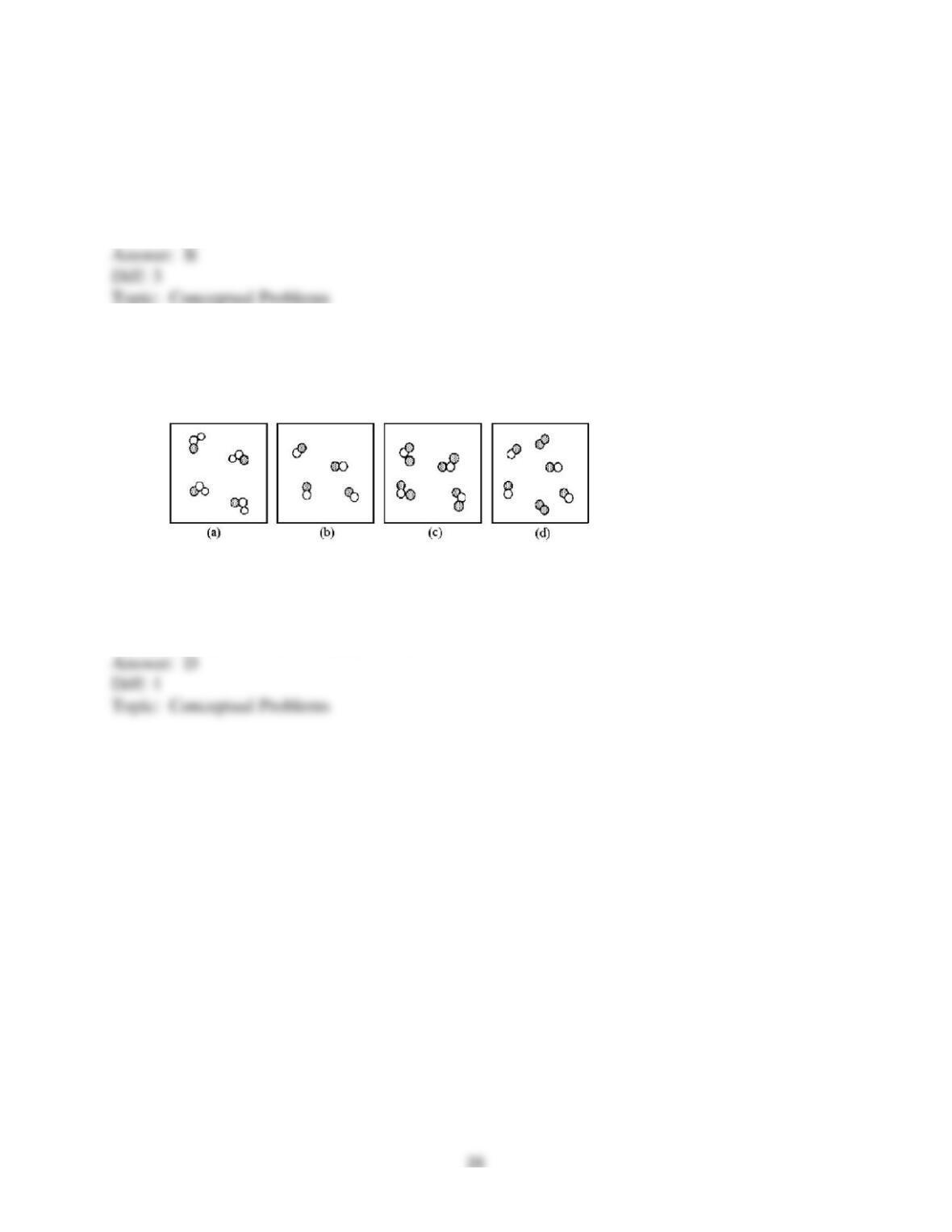
98) If unshaded spheres represent nitrogen atoms and shaded spheres represent oxygen atoms,
which box represents reactants and which represents products for the reaction 2 NO2(g) → 2
NO(g) + O2(g)?
A) box (a) reactants and box (b) products
B) box (a) reactants and box (d) products
C) box (c) reactants and box (b) products
D) box (c) reactants and box (d) products
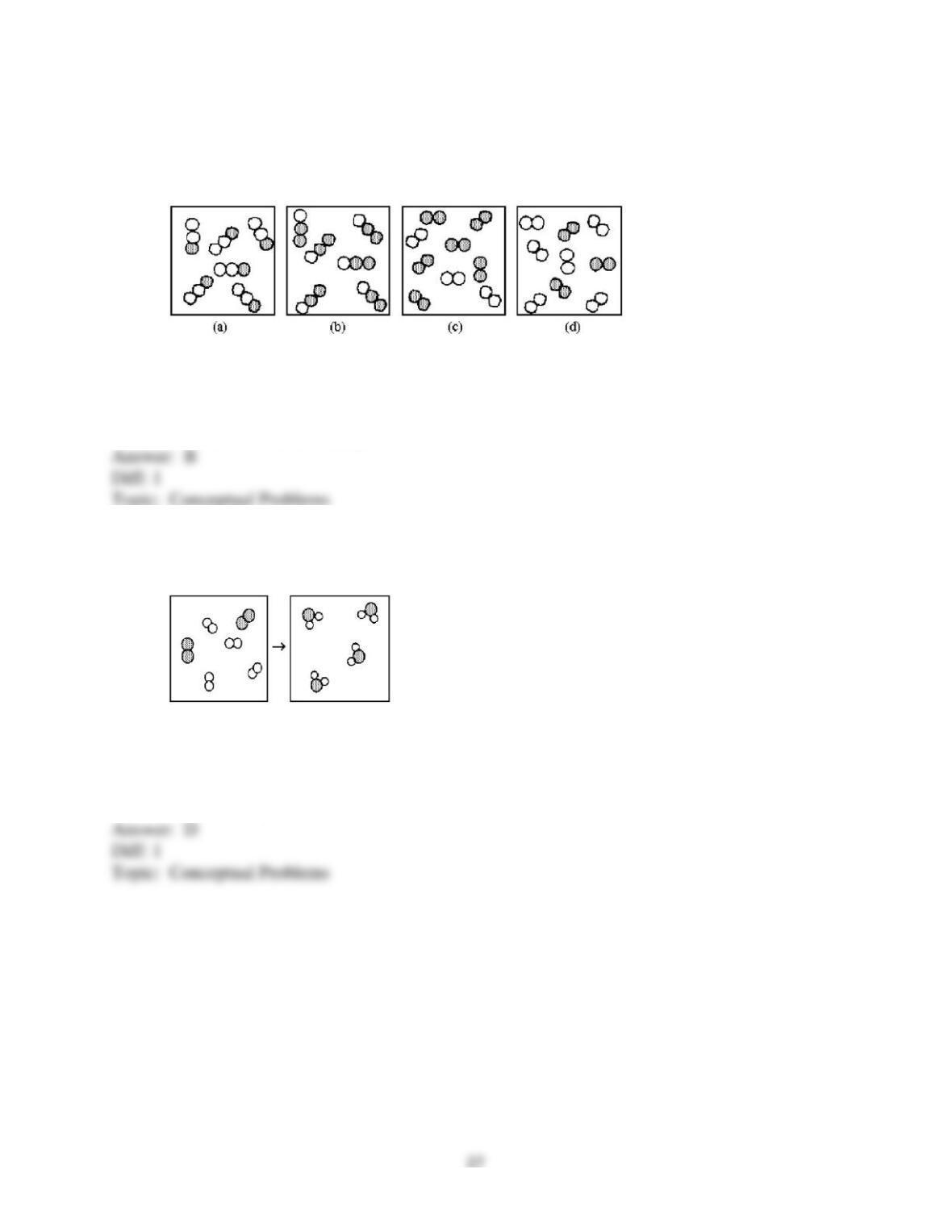
99) 3If unshaded spheres represent nitrogen atoms and shaded spheres represent oxygen atoms,
which box represents reactants and which represents products for the reaction 2 N2O(g) → 2
N2(g) + O2(g)?
A) box (a) reactants and box (c) products
B) box (a) reactants and box (d) products
C) box (b) reactants and box (c) products
D) box (b) reactants and box (d) products
100) What is the balanced chemical equation for the reaction of element A (unshaded spheres)
with element B (shaded spheres) as represented below?
A) A + B → AB
B) 4A + 2B → 4AB
C) A2 + B2 → A2B
D) 2A2 + B2 → 2A2B
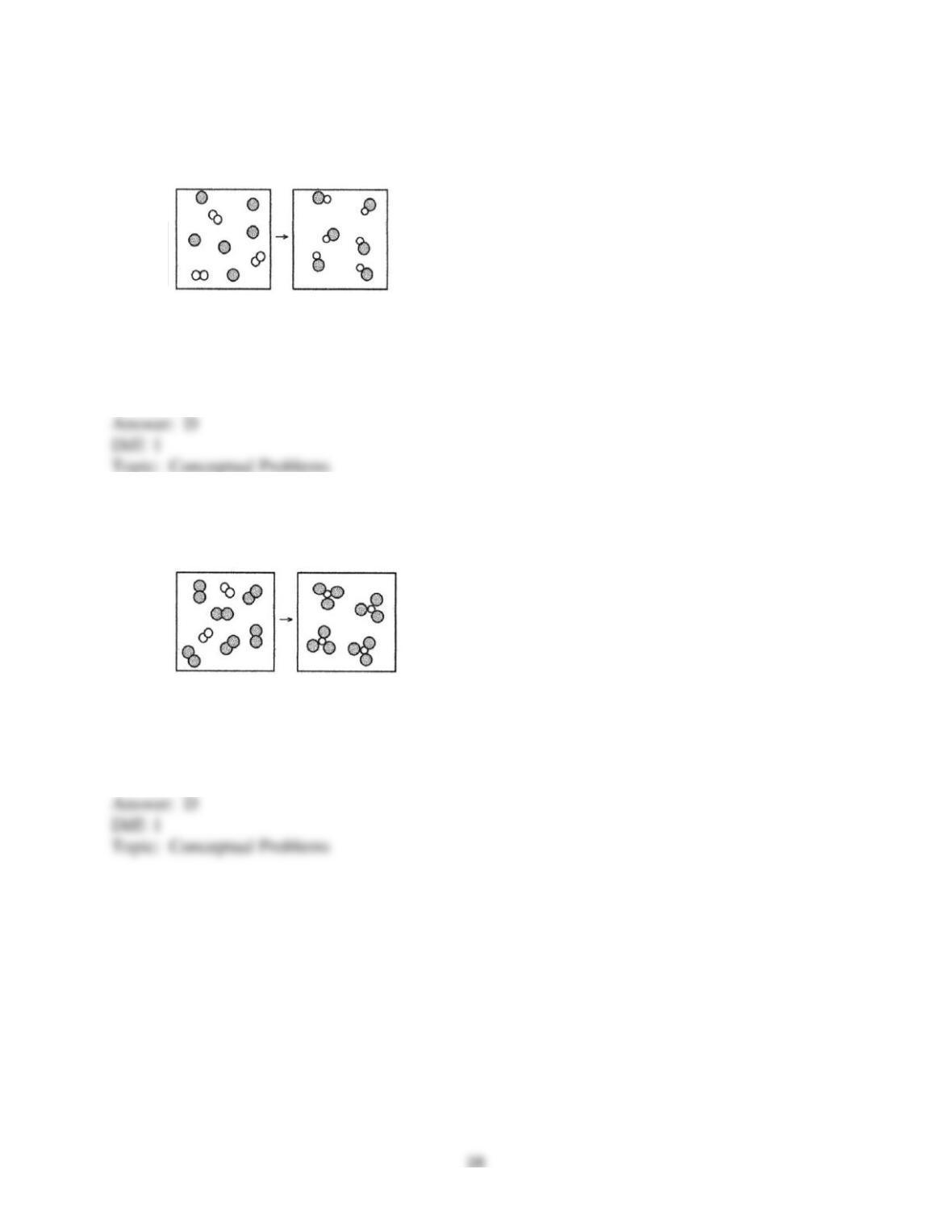
101) What is the balanced chemical equation for the reaction of element A (unshaded spheres)
with element B (shaded spheres) as represented below?
A) A + B → AB
B) A + 3B → 3AB
C) A2 + B → AB
D) A2 + 2B → 2AB
102) What is the balanced chemical equation for the reaction of element A (unshaded spheres)
with element B (shaded spheres) as represented below?
A) A + B → AB
B) A + 3B → 2AB
C) A2 + B2 → AB3
D) A2 + 3B2 → 2AB3
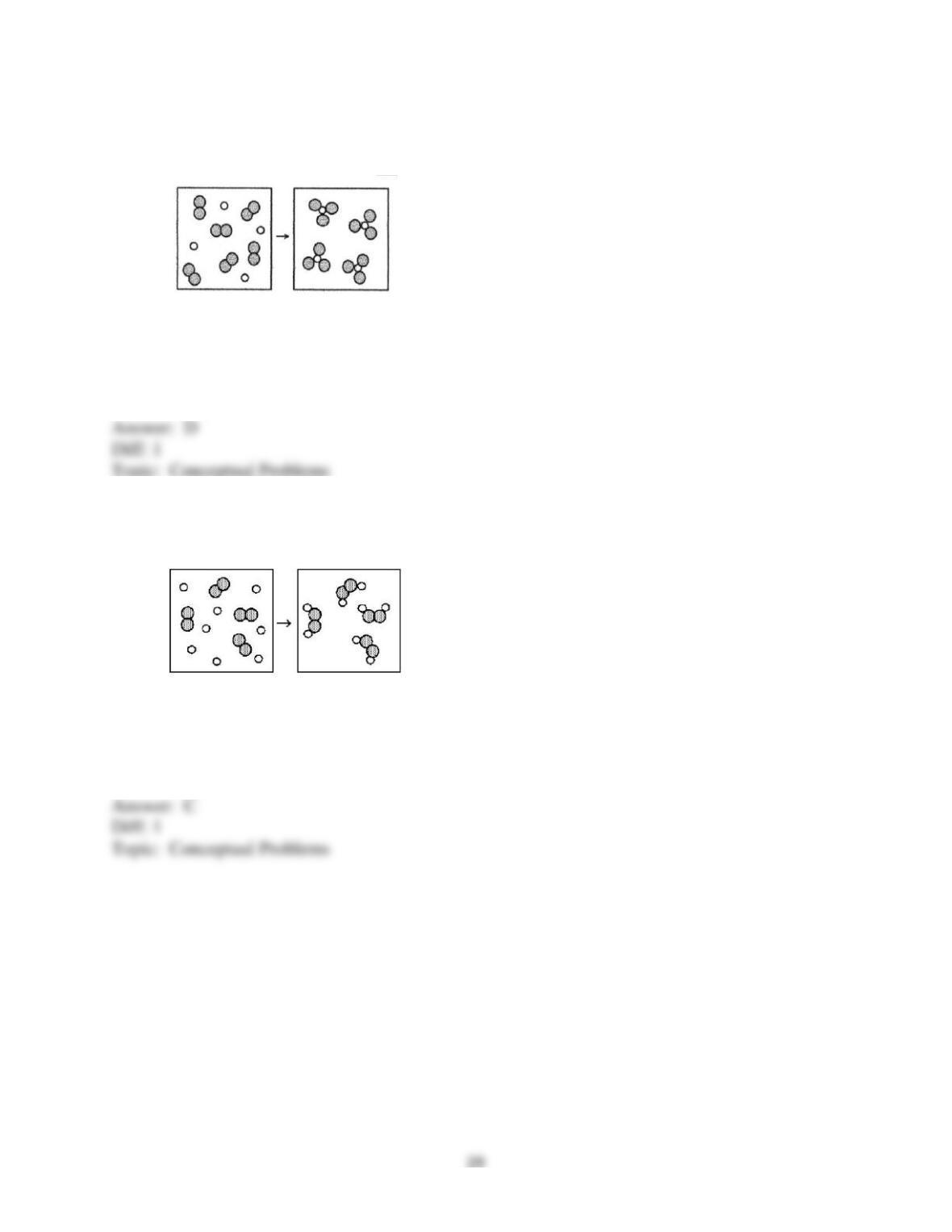
103) What is the balanced chemical equation for the reaction of element A (unshaded spheres)
with element B (shaded spheres) as represented below?
A) A + B → AB
B) 2A + 3B → 2AB
C) A + B2 → AB3
D) 2A + 3B2 → 2AB3
104) Reaction of A (unshaded spheres) with B2 (shaded spheres) is shown schematically in the
following diagram. Which equation best describes the stoichiometry of the reaction?
A) A2 + 2 B → A2B2
B) 8 A + 4 B2 → 4 A2B2
C) 2 A + B2 → A2B2
D) 4 A + 4 B2 → 4 A2B2
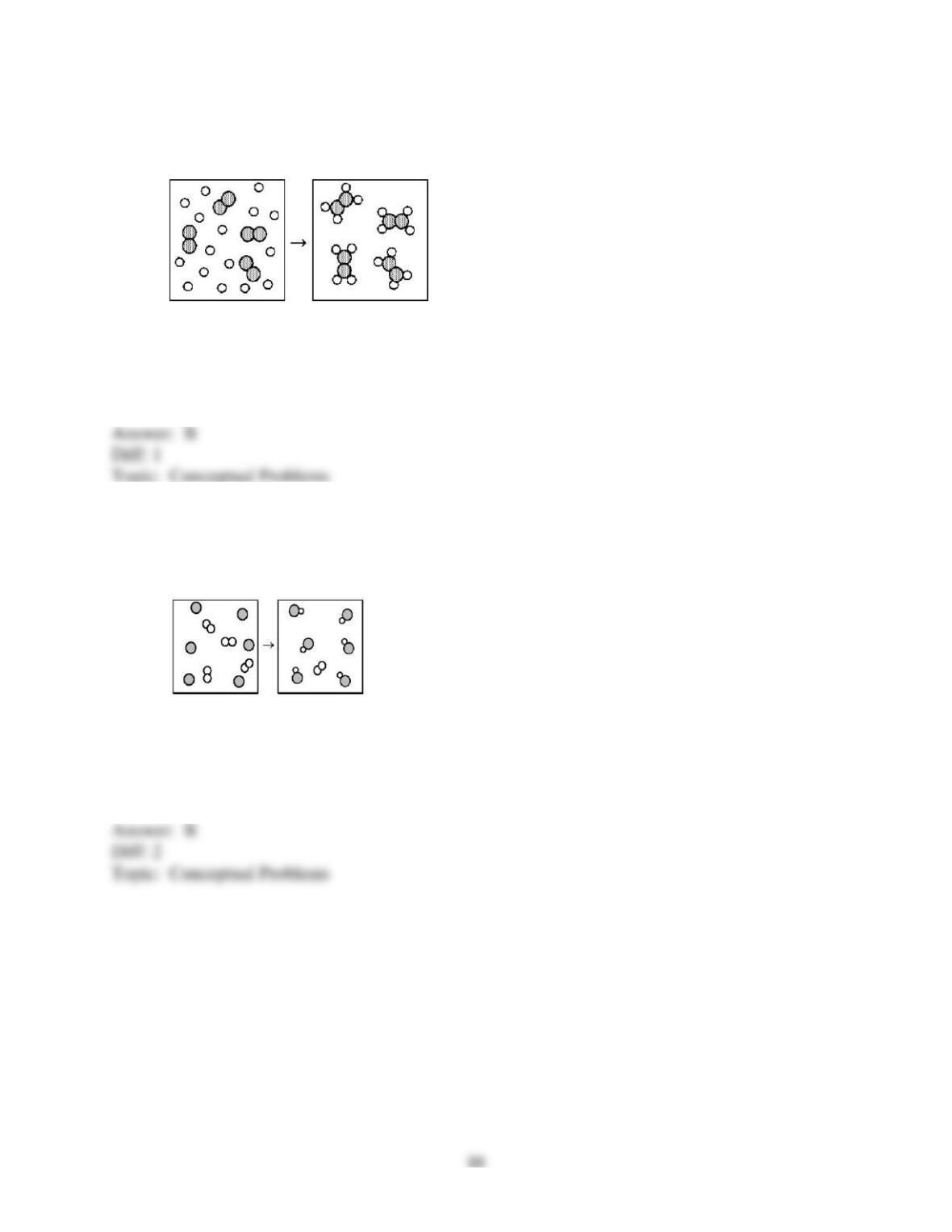
105) Reaction of A (unshaded spheres) with B2 (shaded spheres) is shown schematically in the
following diagram. Which equation best describes the stoichiometry of the reaction?
A) 4 A + B2 → 8 A2B
B) 4 A + B2 → A4B2
C) 16 A + 4 B2 → 8 A2B
D) 16 A + 4 B2 → 4 A4B2
106) The following diagram represents the reaction of A2 (unshaded spheres) with B (shaded
spheres). What is the balanced chemical equation for this reaction, and what is the limiting
reactant?
A) A2 + 2B → 2AB; A2 is the limiting reactant.
B) A2 + 2B → 2AB; B is the limiting reactant.
C) 4A2 + 6B → 6AB; A2 is the limiting reactant.
D) 4A2 + 6B → 6AB; B is the limiting reactant.
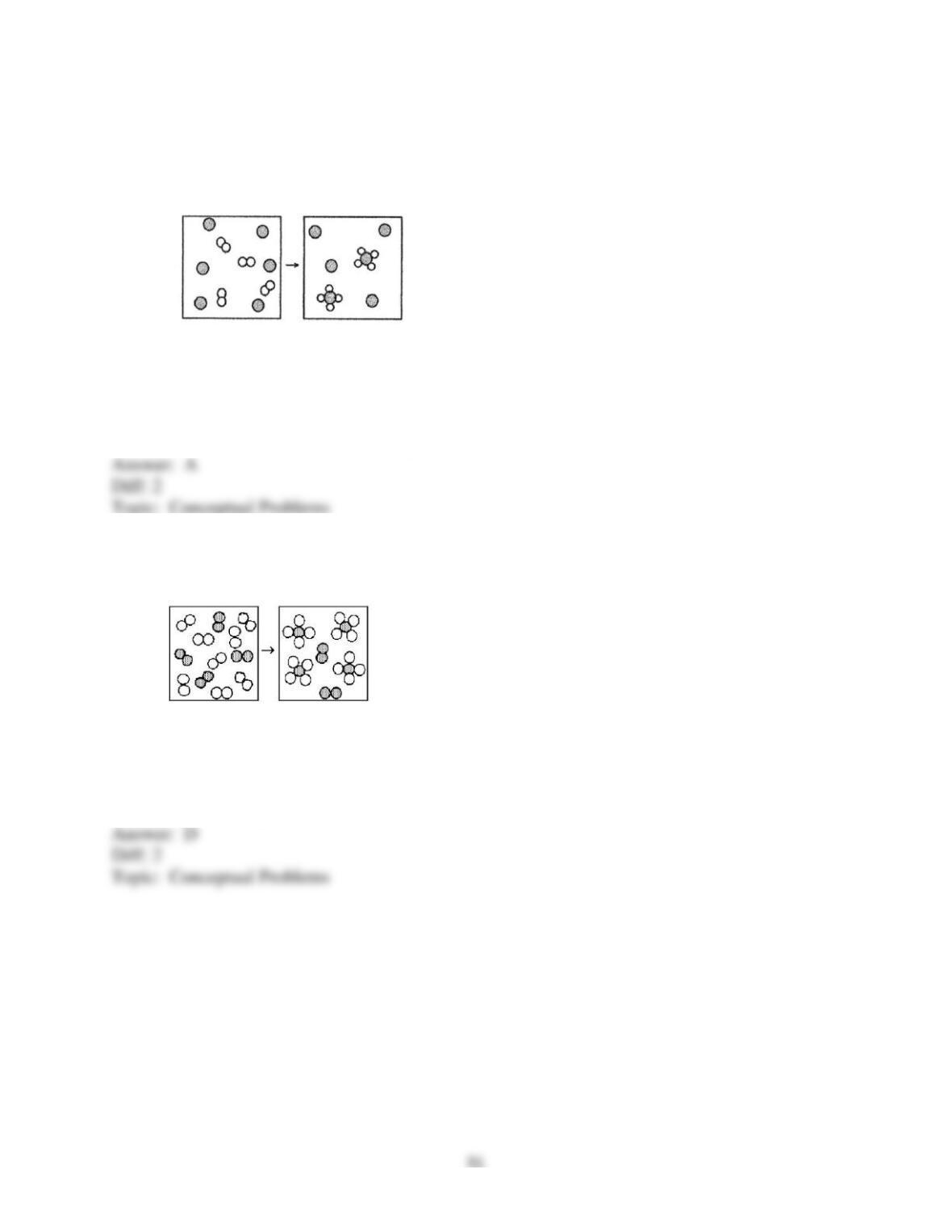
107) The following diagram represents the reaction of A2 (unshaded spheres) with B (shaded
spheres). What is the balanced chemical equation for this reaction, and what is the limiting
reactant?
A) 2A2 + B → A4B; A2 is the limiting reactant.
B) 2A2 + B → A4B; B is the limiting reactant.
C) 4A2 + 6B → 2A4B; A2 is the limiting reactant.
D) 4A2 + 6B → 2A4B; B is the limiting reactant.
108) The following diagrams represent the reaction of A2 (shaded spheres) with B2 (unshaded
spheres). Identify the limiting reactant and a balanced equation for the reaction.
A) A2 is the limiting reactant; A + 4 B → AB4.
B) A2 is the limiting reactant; A2 + 4 B2 → 2 AB4.
C) B2 is the limiting reactant; A + 4 B → AB4.
D) B2 is the limiting reactant; A2 + 4 B2 → 2 AB4.
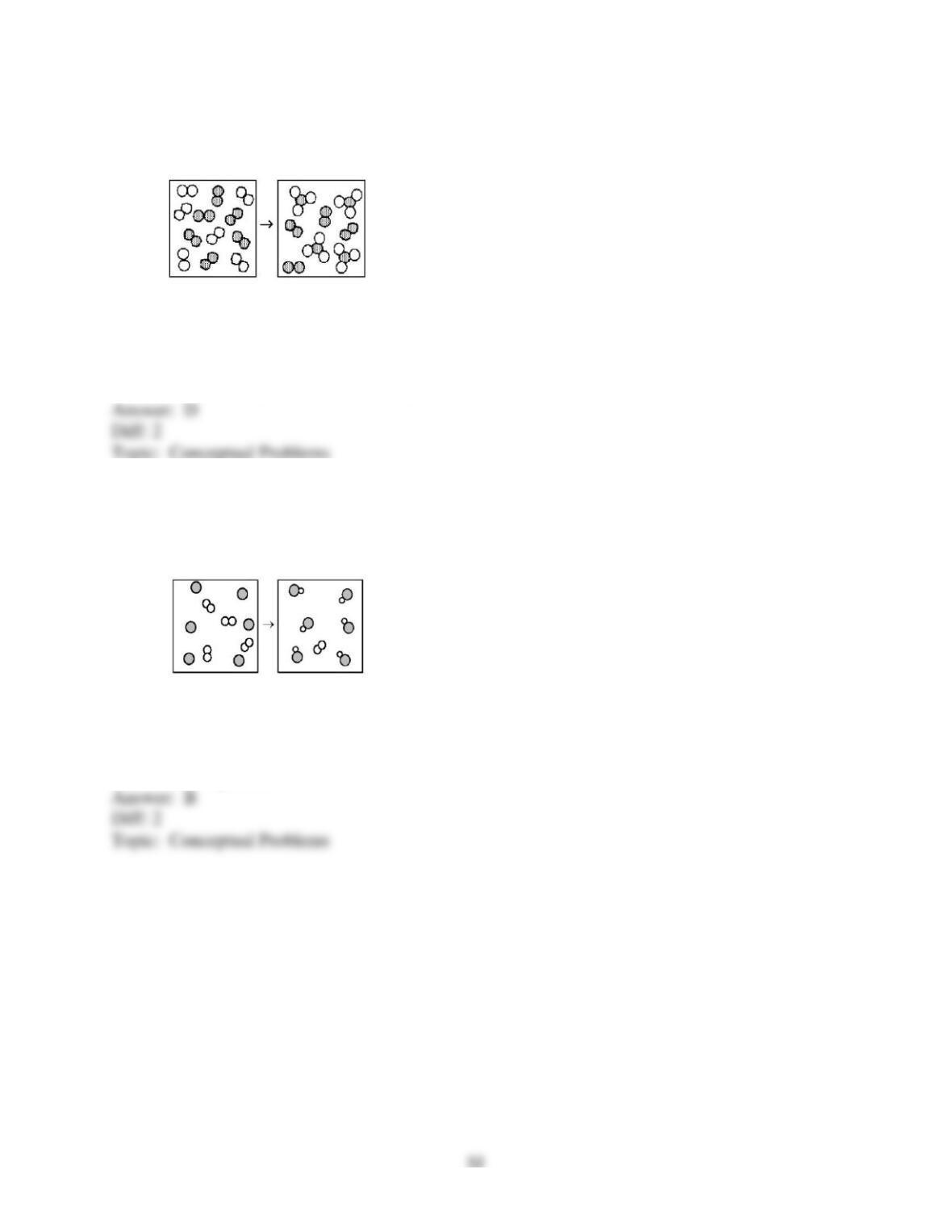
109) The following diagrams represent the reaction of A2 (shaded spheres) with B2 (unshaded
spheres). Identify the limiting reactant and a balanced equation for the reaction.
A) A2 is the limiting reactant; A + 3 B → AB3.
B) A2 is the limiting reactant; A2 + 3 B2 → 2 AB3.
C) B2 is the limiting reactant; A + 3 B → AB3.
D) B2 is the limiting reactant; A2 + 3 B2 → 2 AB3.
110) The following diagram represents the reaction of A2 (unshaded spheres) with B (shaded
spheres). How many moles of product can be produced from the reaction of 1.0 mol of A2 and
1.0 mol of B?
A) 0.5 mol of product
B) 1.0 mol of product
C) 3.0 mol of product
D) 6.0 mol of product
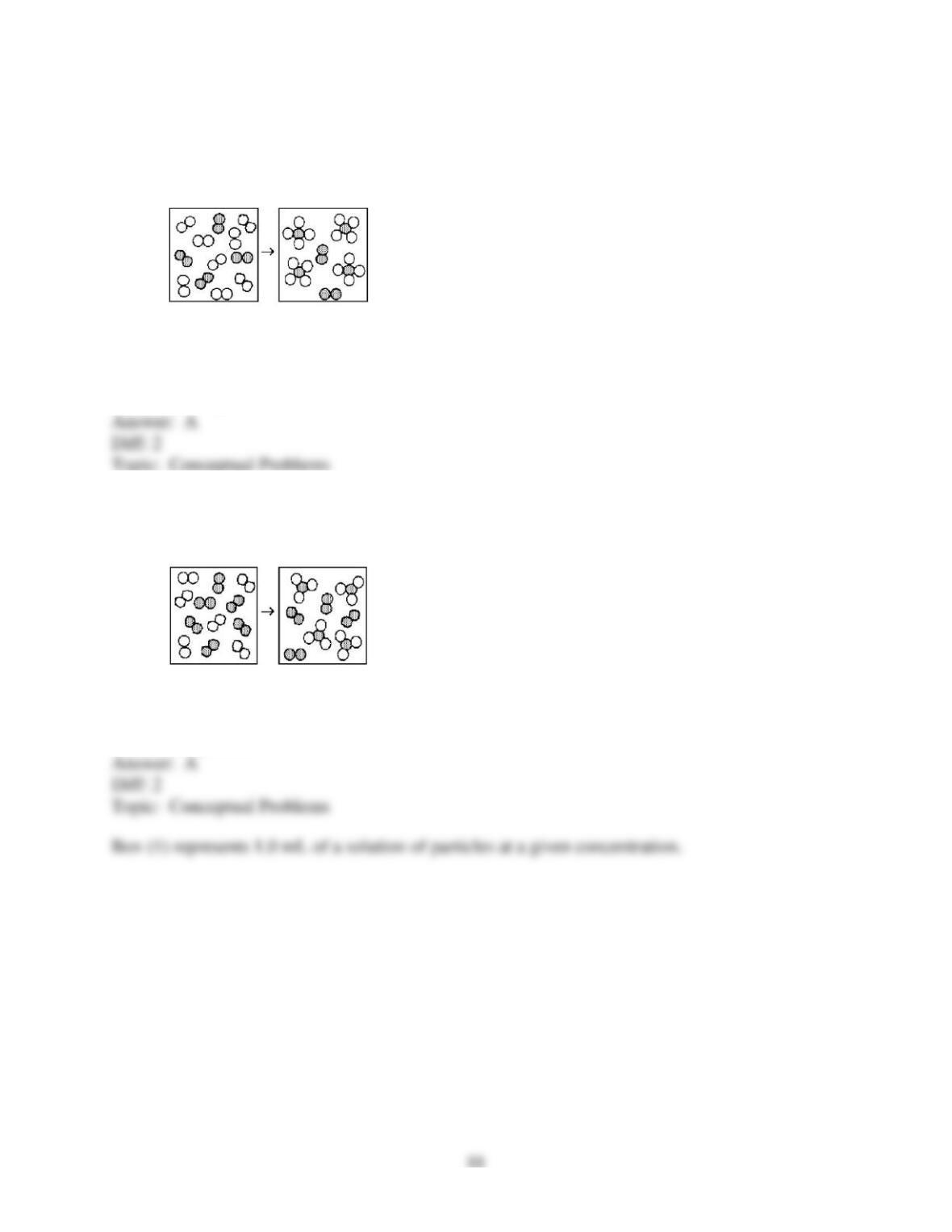
111) The following diagram represents the reaction of A2 (unshaded spheres) with B2 (shaded
spheres). How many moles of product can be produced from the reaction of 1.0 mol of A2 and
1.0 mol of B2?
A) 0.5 mol of product
B) 1.0 mol of product
C) 2.0 mol of product
D) 4.0 mol of product
112) The following diagrams represent the reaction of A2 (shaded spheres) with B2 (unshaded
spheres). How many moles of product can be made from 1.0 mol of A2 and 1.0 mol of B2?
A) 0.67 mol product
B) 1.0 mol product
C) 2.0 mol product
D) 3.0 mol product
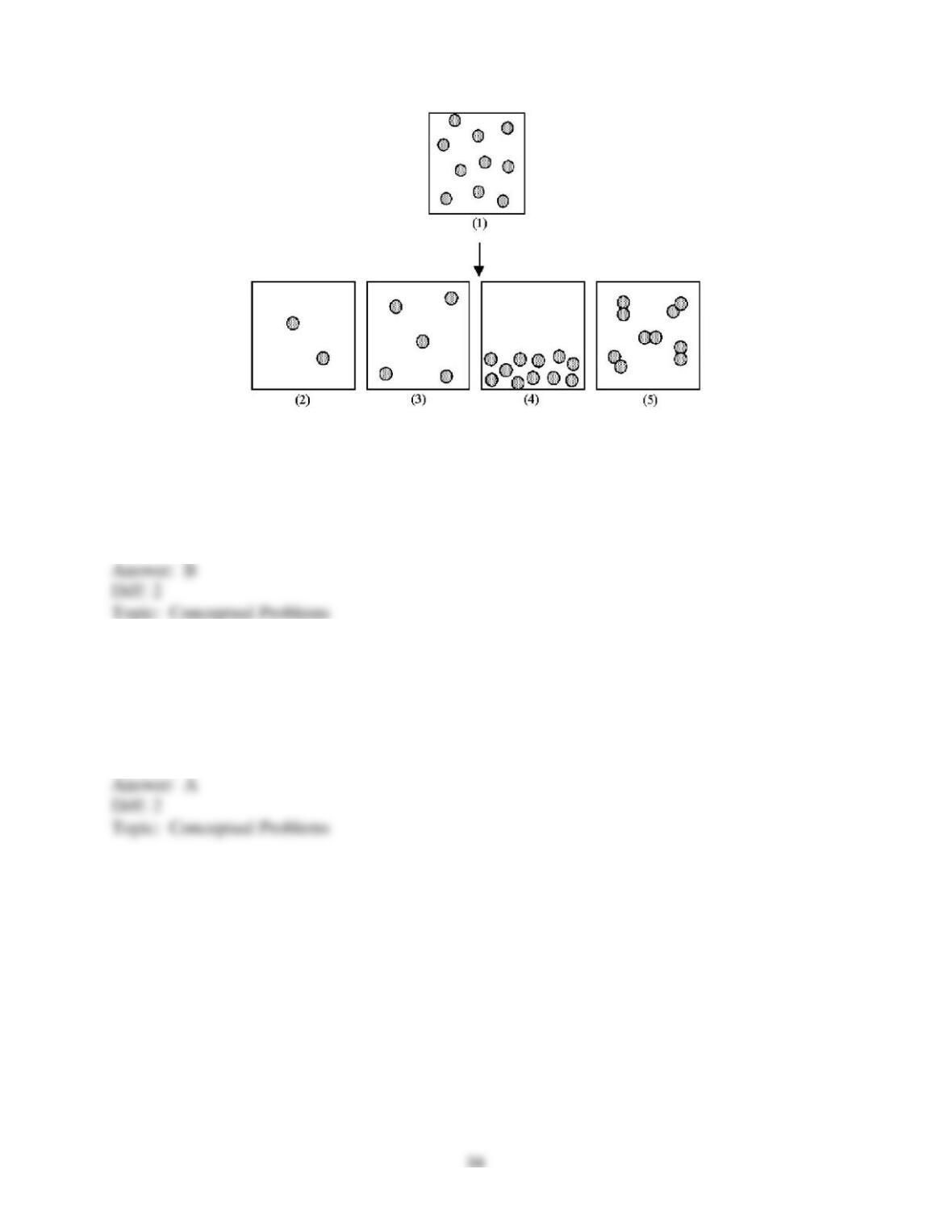
113) Which of the boxes (2)-(5) represents 1.0 mL of the solution that results after (1) has been
diluted by adding enough solvent to make 2.0 mL of solution?
A) box (2)
B) box (3)
C) box (4)
D) box (5)
114) Which of the boxes (2)-(5) represents 1.0 mL of the solution that results after (1) has been
diluted by adding enough solvent to make 5.0 mL of solution?
A) box (2)
B) box (3)
C) box (4)
D) box (5)
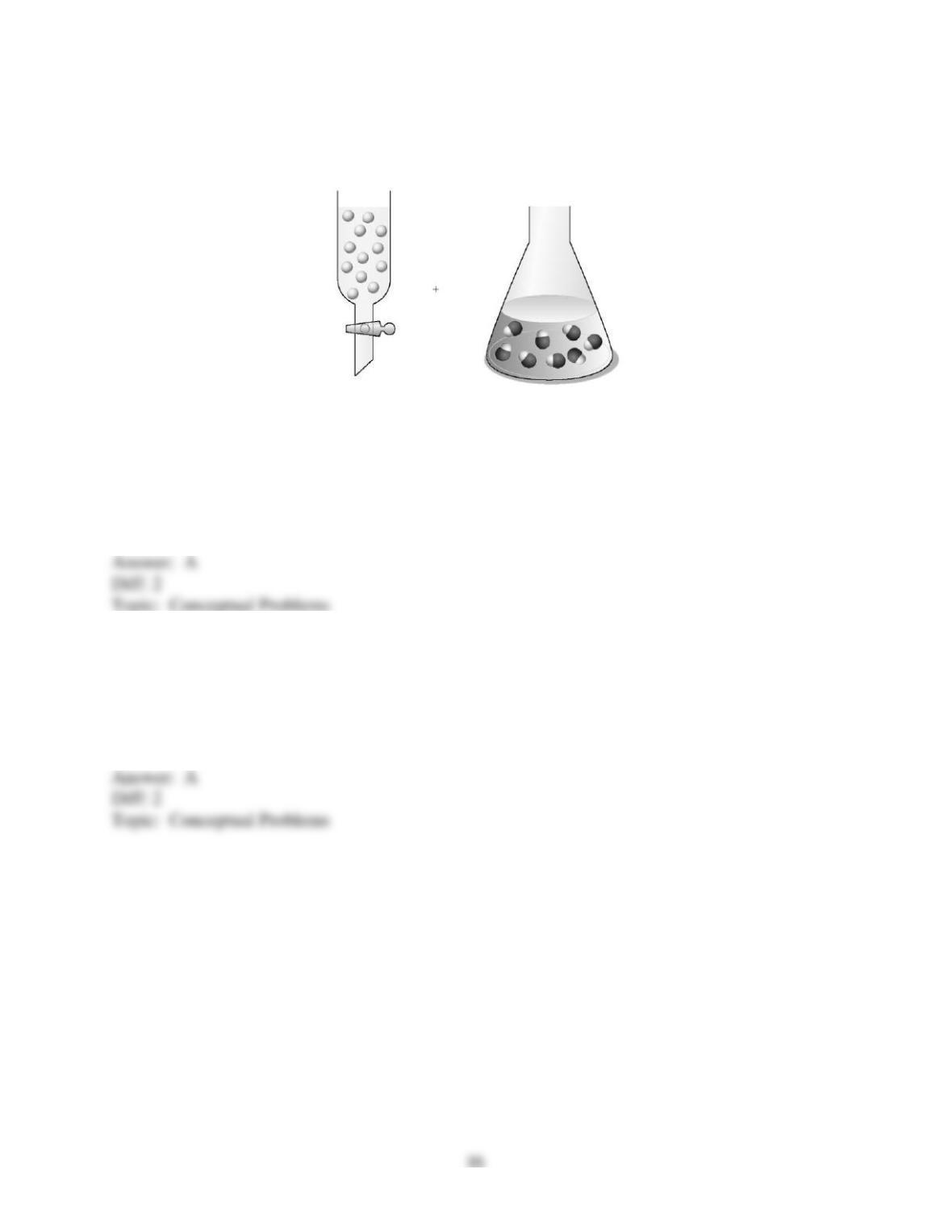
Assume that the unshaded spheres in the buret represent H+ ions, the shaded spheres in the flask
represent OH– ions, and you are carrying out a titration of the base with the acid.
115) If the volumes in the buret and the flask are identical and the concentration of the acid in
the buret is 0.250 M, what is the concentration of the base in the flask?
A) 0.167 M
B) 0.250 M
C) 0.375 M
D) 0.667 M
116) If the volumes in the buret and the flask are identical and the concentration of the acid in
the buret is 0.500 M, what is the concentration of the base in the flask?
A) 0.333 M
B) 0.500 M
C) 0.667 M
D) 0.750 M
36
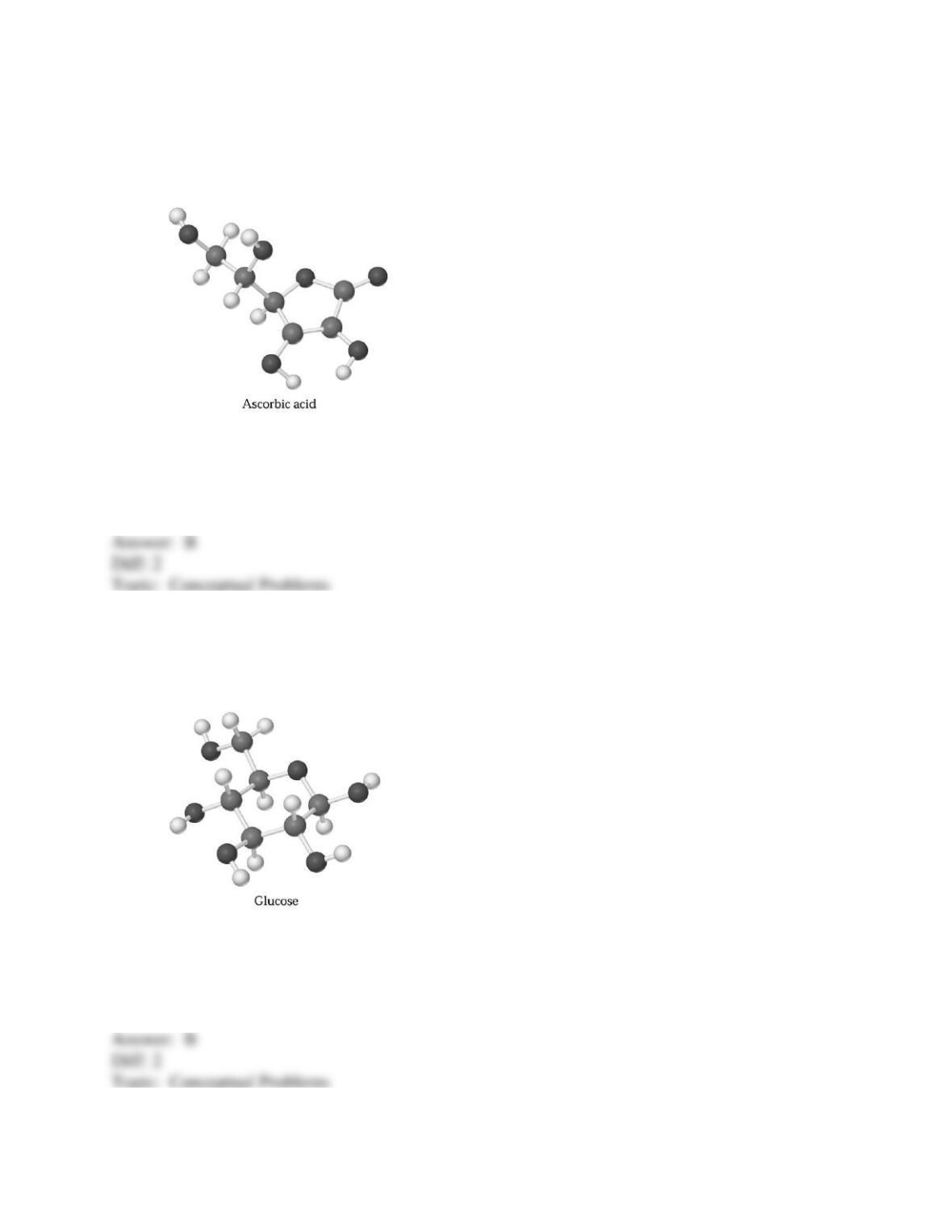
117) Ascorbic acid, C6H806, can be represented by the molecular model shown below. If 1.00
mol of ascorbic acid is submitted to combustion analysis, how many moles of CO2 and how
many moles of H2O would be formed?
A) 3.00 mol CO2 and 2.00 mol H2O
B) 6.00 mol CO2 and 4.00 mol H2O
C) 6.00 mol CO2 and 8.00 mol H2O
D) 12.0 mol CO2 and 10.0 mol H2O
118) Glucose, C6H1206, can be represented by the molecular model shown below. If 1.00 mol
of glucose is submitted to combustion analysis, how many moles of CO2 and how many moles
of H2O would be formed?
A) 1.00 mol CO2 and 2.00 mol H2O
B) 6.00 mol CO2 and 6.00 mol H2O
C) 6.00 mol CO2 and 12.0 mol H2O
D) 12.0 mol CO2 and 12.0 mol H2O
119) A hydrocarbon of unknown formula CxHy was submitted to combustion analysis with the
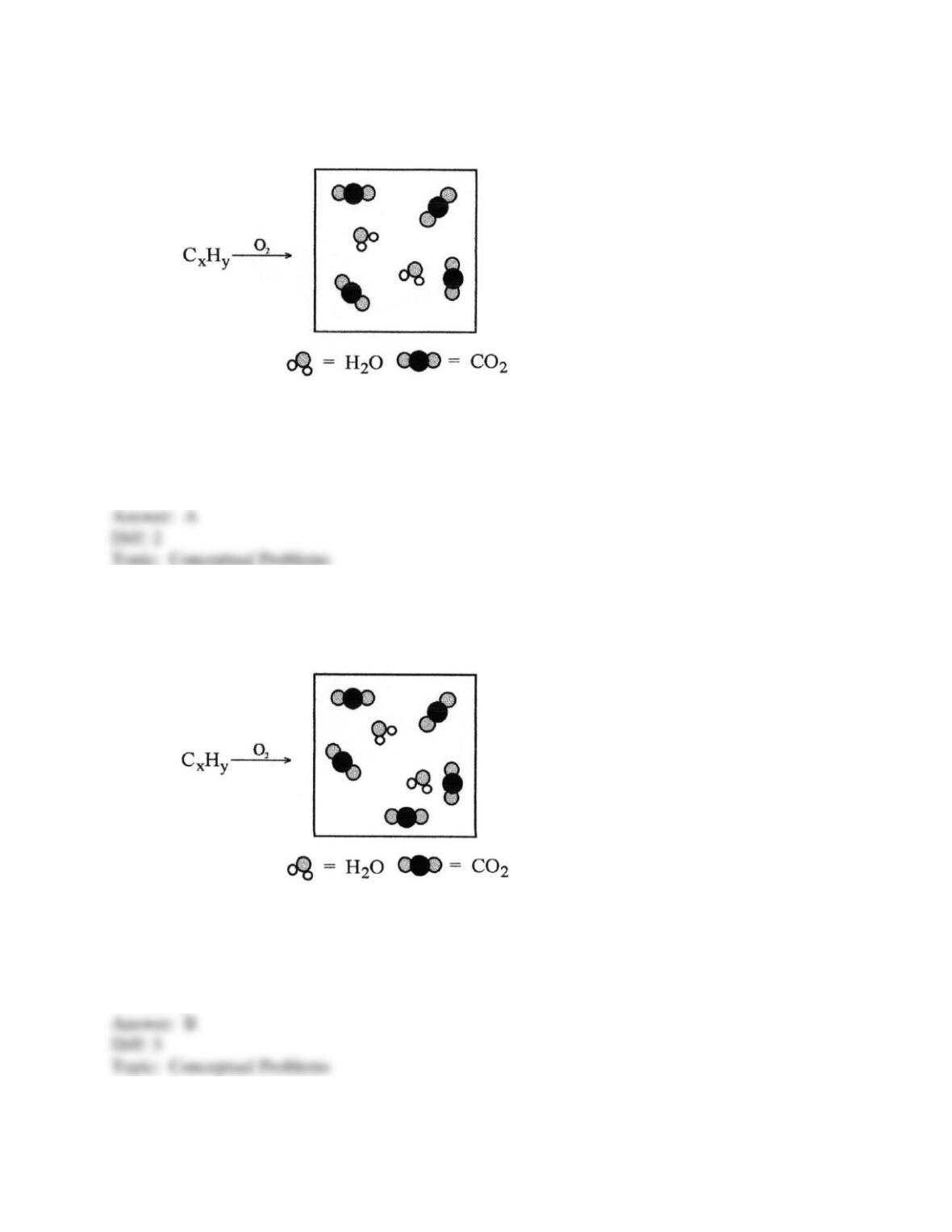
37
following results. What is the empirical formula of the hydrocarbon?
A) CH
B) C2H
C) C2H4
D) C4H4
120) A hydrocarbon of unknown formula CxHy was submitted to combustion analysis with the
following results. What is the empirical formula of the hydrocarbon?
A) C5H2
B) C5H4
C) C10H4
D) C10H8
6.2 Algorithmic Questions
1) What is the stoichiometric coefficient for oxygen when the following equation is balanced
using the lowest, whole-number coefficients?
________ C2H6O (l) + ________ O2(g) → ________ CO2(g) + ________ H2O(l)
A) 9
B) 7
C) 5
D) 3
2) Aluminum metal reacts with aqueous iron(II) chloride to form aqueous aluminum chloride
and iron metal. What is the stoichiometric coefficient for aluminum when the chemical equation
is balanced using the lowest, whole-number stoichiometric coefficients?
A) 1
B) 2
C) 3
D) 4
3) Calcium phosphate reacts with sulfuric acid to form calcium sulfate and phosphoric acid.
What is the coefficient for sulfuric acid when the equation is balanced using the lowest, whole-
numbered coefficients?
A) 1
B) 2
C) 3
D) none of these