28) If the firm is incurring losses in the short run, then which of the following is true?
A) P < ATC
B) P > ATC
C) P > MC
D) MC > ATC
29) If a profit-maximizing firm in a perfectly competitive market is currently producing the
output where (price – average variable cost) < average fixed cost, the firm is
A) making a positive economic profit.
B) making a zero economic profit.
C) suffering an economic loss.
D) none of the above
30) If a profit-maximizing firm in a perfectly competitive market is currently producing the
output where (price – average variable cost) = average fixed cost, the firm is
A) making a positive economic profit.
B) making a zero economic profit.
C) suffering an economic loss.
D) none of the above
31) If your firm is producing a good at a level where marginal revenue equals marginal cost, and
price is greater than average total cost, your firm
A) should shut down and suffer a loss equal to your fixed costs.
B) is earning an economic profit greater than zero.
C) should decrease output.
D) should increase output
32) If the price a firm charges in a perfectly competitive industry is greater than average total
cost
A) the firm is earning an economic profit equal to zero.
B) the firm is earning an economic profit greater than zero.
C) the firm is earning an economic profit less than zero.
D) it is not possible to determine anything about profits.
33) If the price a firm charges in a perfectly competitive industry is less than average total cost
A) the firm is earning positive economic profit.
B) the firm is earning zero economic profit.
C) the firm is earning negative economic profit.
D) it is not possible to determine anything about profits.
34) In a perfectly competitive market, if price is greater than average total cost at the level of
output where marginal cost equals marginal revenue
A) the firm must be in long-run equilibrium.
B) the firm is earning an economic profit greater than zero.
C) the firm is earning an economic profit less than zero.
D) We cannot determine whether the firm is earning positive or negative profits.
35) In a perfectly competitive market, if price is less than average total cost, but greater than
average variable cost at the level of output where marginal cost equals marginal revenue
A) the firm is earning positive economic profit.
B) the firm is earning negative economic profit.
C) the firm should shut down.
D) We cannot determine whether the firm is earning positive or negative profits.
36) If a competitive firm is in short-run equilibrium, then
A) marginal revenue is equal to marginal cost.
B) price is greater than marginal cost.
C) price is equal to average variable cost.
D) price is greater than marginal revenue.
37) In short-run equilibrium for a competitive firm
A) price will not equal marginal revenue.
B) marginal revenue will be greater than marginal cost.
C) price will equal marginal cost.
D) price will be greater than marginal cost.
38) In short-run equilibrium for a competitive firm economic profits
A) will be positive.
B) will be negative.
C) will be zero.
D) may be positive, negative, or zero.
39) If a perfectly competitive firm charges a price that is equal to its average total cost
A) the firm is earning an economic profit equal to zero.
B) the firm is earning an economic profit greater than zero.
C) the firm is earning an economic profit less than zero.
D) It is not possible to determine anything about the firm’s profits.
40) If the market demand increases for a good sold in a perfectly competitive market, individual
firms in the market
A) will be able to charge a higher price for their product.
B) will need to lower price in order to remain competitive.
C) will not be able to change their price.
D) will begin earning economic losses.
41) In long-run equilibrium for a competitive firm economic profits
A) will be positive.
B) will be negative
C) will be zero.
D) may be positive, negative, or zero.
Recall the Application about the break-even price for growing switchgrass, a perennial
grass that is native to the U.S. plains states and is used to create biofuel, to answer the
following question(s).
42) Recall the Application. If the minimum of average total cost for switchgrass farmers is $55
per ton and the minimum of average variable costs is $40 per ton, then at a price of $35 per ton
in the short-run the switchgrass farmer will
A) shut down, that is bring no switchgrass to market.
B) operate losing money.
C) make a zero economic profit.
D) make a positive economic profit.
43) Recall the Application. If the minimum of average total cost for switchgrass farmers is $55
per ton and the minimum of average variable costs is $40 per ton, then at a price of $50 per ton
in the short-run the switchgrass farmer will
A) shut down, that is bring no switchgrass to market.
B) operate losing money.
C) make a zero economic profit.
D) make a positive economic profit.
44) Recall the Application. If the minimum of average variable cost for switchgrass farmers is
$40 per ton and the current price is $35 per ton, in the long-run the switchgrass farmer will
A) exit the industry.
B) operate losing money.
C) make a positive economic profit.
D) make a zero economic profit.
45) A perfectly competitive firm that is maximizing profit produces the quantity of output at
which price equals marginal cost.
46) Suppose that the market price of sugar is 25 cents per pound and a farmer’s marginal cost of
producing sugar is 28 cents per pound. The farmer should increase her sugar production.
47) For a perfectly competitive firm, price always equals marginal revenue.
48) For a perfectly competitive firm, price always equals marginal cost.
49) A perfectly competitive firm maximizes profit where marginal revenue or price equals
marginal cost.
50) If marginal revenue is $10 and marginal costs is $8, the firm should increase its output.
51) If marginal revenue is $8 and marginal costs is $10, the firm should increase its output.
52) In the short run, a firm that is incurring losses would always better off it keeps producing.
53) What is marginal revenue?
1) Which of the following is true about a perfectly competitive firm in the long run and in the
short run?
A) The supply curve in the short run is usually steeper than the supply curve in the long run.
B) The supply curve in the short run is usually flatter than the supply curve in the long run.
C) The demand curve in the short run is usually steeper than the marginal cost curve in the long
run.
D) The supply curve in the short run is usually steeper than the average total cost curve in the
long run.
2) A firm will not shut down in the short run as long as at the point where MR = MC
A) P > AVC.
B) P > ATC.
C) P > MC.
D) P > AFC.
3) A firm will not shut down in the long-run as long as the firms revenue
A) is larger than the firm’s variable cost.
B) is greater than the firm’s marginal cost.
C) is greater than the fixed cost.
D) is less than the total cost.
4) If in the short-run the firm incurs zero marginal cost, then the firm will
A) never shut down.
B) shut down if the price is greater than the average variable cost.
C) shut down if the price is less than the average total cost.
D) shut down if the marginal cost equals the marginal revenue.
5) If average total cost > average variable cost > price, a profit maximizing firm in a perfectly
competitive market should
A) continue to produce its current output level.
B) shut down in the short run.
C) increase its output level to minimize its loss.
D) none of the above
6) A firm will not shut down in the short run as long as price exceeds
A) average fixed cost at the level of output where marginal revenue equals marginal cost.
B) average variable cost at the level of output where marginal revenue equals marginal cost.
C) marginal cost at the level of output where marginal revenue equals marginal cost.
D) total revenue at the level of output where marginal revenue equals marginal cost.
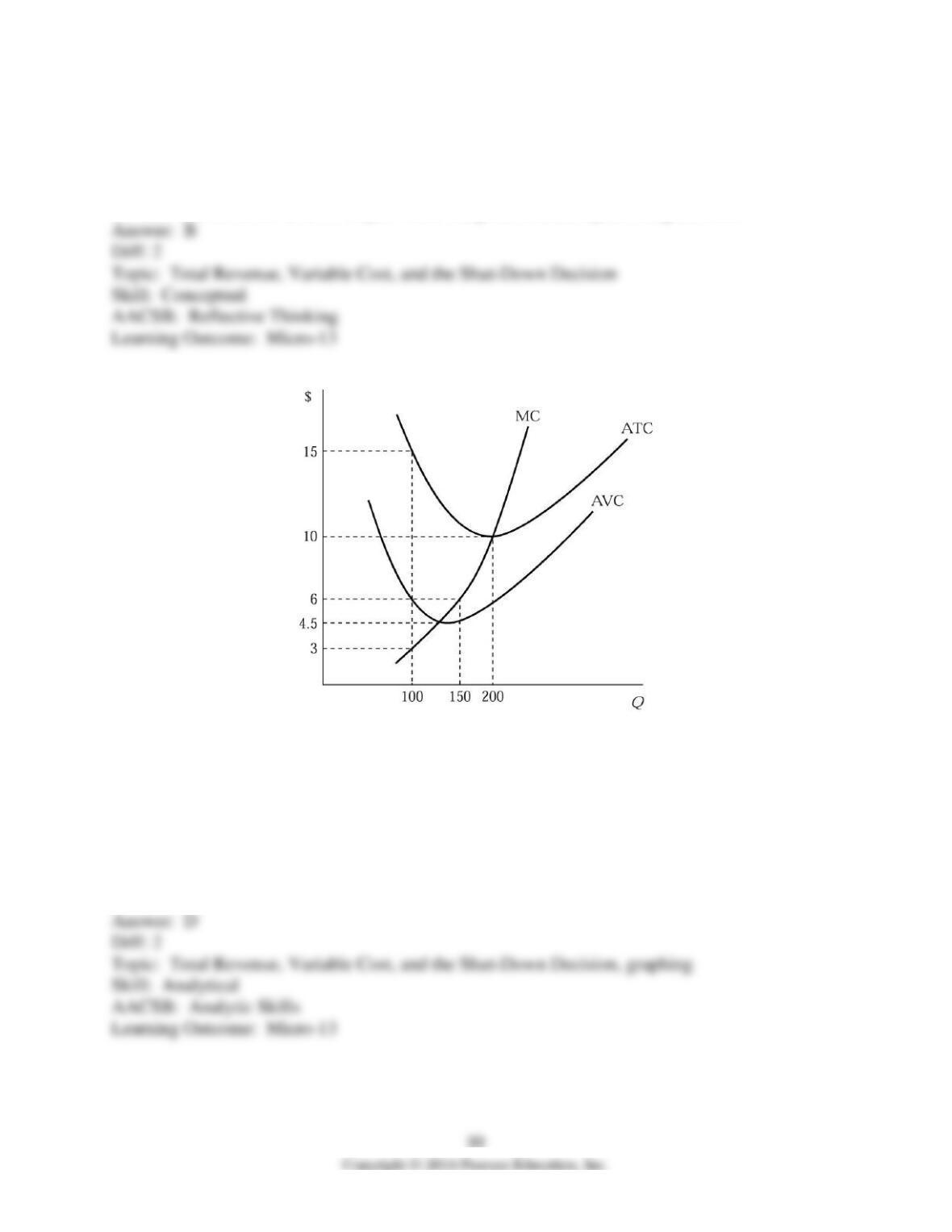
Figure 6.3
7) Figure 6.3 shows the cost structure of a firm in a perfectly competitive market. If the market
price is $3 and the firm produces the output where MR = MC, its profit is
A) -$300.
B) -$600.
C) -$900.
D) -$1,200.
8) Figure 6.3 shows the cost structure of a firm in a perfectly competitive market. If the market
price is $3 and the firm shuts down in the short run, its profit is
A) -$300.
B) -$600.
C) -$900.
D) -$1,200.
9) Figure 6.3 shows the cost structure of a firm in a perfectly competitive market. If the market
price is $3 and the firm is currently producing 100 units. If the firm produces zero unit in the
short run, it will reduce its economic loss by
A) $300.
B) $600.
C) $900.
D) $1,200.
10) Figure 6.3 shows the cost structure of a firm in a perfectly competitive market. The price at
which the firm is just as well off either operating or shutting down is
A) $3.
B) $4.5.
C) $6.
D) $10.
11) Figure 6.3 shows the cost structure of a firm in a perfectly competitive market. The firm will
stay in the market in the long run only if the market price is greater than or equal to
A) $4.5.
B) $6.
C) $10.
D) $15.
12) Figure 6.3 shows the cost structure of a firm in a perfectly competitive market. If the market
price is $6, then the firm will
A) be better off producing 150 units than shutting down.
B) be better off exiting the market and using the resources for other production activities.
C) be better off shutting down in the short run and waiting until the market price rises above $10.
D) none of the above
Output (Q)
Total Fixed Cost
Total Variable Cost
0
20
0
1
20
5
2
20
7
3
20
10
4
20
15
5
20
21
Table 6.1
13) Table 6.1 shows the cost structure of a firm in a perfectly competitive market. If the market
price is $3,
A) the firm suffers a loss and is better off shutting down.
B) the firm suffers a loss but is better off producing the output level where MR = MC.
C) the market price is greater than the minimum average variable cost.
D) none of the above
14) Table 6.1 shows the cost structure of a firm in a perfectly competitive market. If the market
price is $5,
A) the firm suffers a loss but is better off producing at the output where MR = MC.
B) the firm suffers a loss and is better off shutting down.
C) the market price is lower than its marginal cost at the profit maximizing output level.
D) the market price is lower than the average variable cost at the profit maximizing output level.
15) In the short run, the firm should shut down when
A) price is equal to the average total cost of production.
B) price is less than the minimum of the average variable cost of production.
C) price is equal to the minimum of the marginal cost of production.
D) price is equal to the minimum of the average total cost of production.
16) You are hired by Jimbo’s Potato Farm to determine when Jimbo should shut down and
produce no potatoes in the short run. Jimbo sells his potatoes in a perfectly competitive market.
You tell Jimbo to shut down if
A) total cost is less than total revenue when marginal revenue equals marginal cost.
B) price is less than average variable cost when marginal revenue equals marginal cost.
C) price is less than average total cost when marginal revenue equals marginal cost.
D) marginal revenue is less than marginal cost.
17) Suppose Tim’s Cowboy boot factory produces in a perfectly competitive market. Suppose the
average total cost of cowboy boots is $65, the average variable cost of cowboy boots is $60, and
the price of cowboy boots is $62. If the firm is producing the level of output where marginal cost
equals price, then in the short run the firm
A) should shut down.
B) should continue to produce since total revenue exceeds total variable cost.
C) is earning a positive economic profit.
D) can increase profit by increasing output.
18) Suppose Robin’s Clock Works produces in a perfectly competitive market. Suppose the
average total cost of clocks is $95, the average variable cost of clocks is $90, and the price of
clocks is $85. If the firm is producing the level of output where marginal cost equals price, then
in the short run the firm
A) should shut down.
B) should continue to produce since total revenue exceeds total variable cost.
C) is earning a positive economic profit.
D) can increase profit by increasing output.
19) If your firm is producing a good at a level where marginal revenue equals marginal cost, and
price is less than average variable cost, then in the short run your firm should
A) shut down and suffer a loss equal to your fixed costs.
B) continue to produce, but increase output.
C) continue to produce the same amount.
D) continue to produce, but decrease output.
20) If your firm is producing a good at a level where marginal revenue equals marginal cost, and
price is between average variable cost and average total cost, then in the short run your firm
should
A) shut down and suffer a loss equal to your fixed costs.
B) continue to produce, but increase output.
C) continue to produce at the same level of output.
D) continue to produce, but decrease output.
21) A perfectly competitive firm is producing a good at a level where P = $30 and MC = $30.
The firm will continue to produce in the short run as long as
A) AVC is less than $30.
B) AFC is less than $30.
C) price does not increase.
D) ATC is greater than $30.
22) A perfectly competitive firm is producing a good at a level where P = $90 and MC = $90.
The firm will continue to produce as long as
A) AVC is less than $90.
B) AFC is less than $90.
C) price does not increase.
D) ATC is greater than $90.
23) If price is less than average variable cost at a level of output where marginal revenue is equal
to marginal cost, then in the short run the firm
A) should shut down.
B) should produce the level of output where marginal revenue equals marginal cost.
C) should gather more data to determine whether to shut down.
D) will produce only if they can decrease their fixed costs.
24) Suppose your firm is operating in a perfectly competitive market, and that the minimum
average variable cost of producing your good is $13. If the price of the good is $15, your firm
should
A) supply the amount of the good where the marginal cost of production is equal to $15.
B) not produce anything since the price is above the minimum of average variable cost.
C) not consider price when determining the amount to sell.
D) not do any of the above.
25) Suppose your firm is operating in a perfectly competitive market, and that the minimum
average variable cost of producing your good is $30. If the price of the good is $32, your firm
should
A) not produce anything since the price is above the minimum of average variable cost.
B) not consider price when determining the amount to sell.
C) supply the amount of the good where the marginal cost of production is equal to $32.
D) supply the amount of the good where the marginal cost of production is $30.
26) If a firm has already paid or has agreed to pay for something we call it
A) a fixed cost.
B) a spent cost.
C) a sunk cost.
D) a lost cost.
27) In the short run, a firm considers its fixed cost as a(n)
A) sunk cost.
B) variable cost.
C) implicit cost.
D) marginal cost.
Recall the Application about the shutdown price for zinc to answer the following
question(s).
28) Recall the Application. If the cost of mining zinc varies from one mine to another, the
shutdown price for mining zinc
A) can also vary for each mine.
B) must remain uniform for all zinc mines.
C) will only vary in the long run.
D) cannot exist without uniform costs.
29) Recall the Application. If the selling price of zinc falls below the shutdown price for half of
the world’s zinc mines, the output produced from these mines will
A) decrease by 50%.
B) still remain constant.
C) increase by 50%.
D) fall to zero.
30) A firm should shut down in the short-run if it s revenue is smaller than its variable costs.
31) Firms earning negative profits in the short run should always shut down.
32) A firm with total revenue of $500, total cost of $700, and variable cost of $400 should
continue to operate its production facility.
33) Perfectly competitive firms always produce the quantity that minimizes average total cost in
the short run.
34) In the short run a manufacturing firm’s production equipment is a sunk cost.
35) Why does it make sense for unprofitable firms to stay in business?
36) Suppose that a firm maximizes its profits by producing a quantity of 20 units. The market
price is $5. The firm’s variable costs are $70 and its fixed costs are $40. What should the firm do
in the short run? In the long run?
37) Explain why a firm’s shut-down decision does not incorporate the fixed costs of the
production facility.