64)
Assume a family that earns $30,000 pays $3500 in income taxes, while a family that earns $40,000
pays $3200 in income taxes. In this situation, the income tax system is
64)
A)
regressive.
B)
proportional.
C)
progressive.
D)
one of the above but we cannot tell which one without more information.
65)
A 2 percent tax is going to be applied to a $100,000 tax base. What can be said about the revenue
collected assuming dynamic tax analysis?
65)
A)
The total revenue will be zero.
B)
The total revenue will be between $0 and $2,000.
C)
The total revenue will be $2,000.
D)
There is not enough information to determine what revenues will equal.
66)
The largest source of receipts for the federal government is
66)
A)
Social Security taxes.
B)
capital gains taxes.
C)
corporate income taxes.
D)
personal income taxes.
67)
In what type of analysis could an increase in the tax rate lead to a decrease in tax revenues?
67)
A)
Excise taxation
B)
Static tax analysis
C)
Ad valorem taxation
D)
Dynamic tax analysis
68)
Eight years ago you purchased an asset for $100,000 that has yielded a nominal capital gain of
$30,000. If you sold the asset today, your inflation–adjusted capital gains would be zero due to
inflation over the last eight years. The capital gains tax is 28 percent. If you sold the asset today
your tax liability would be
68)
A)
zero.
B)
$28,000.
C)
$8,400.
D)
cannot be determined without more information.
69)
A major criticism of static tax analysis is that it
69)
A)
ignores the incentive effects created by higher tax rates.
B)
assumes that the tax base will not increase.
C)
does not use ad valorem taxes.
D)
uses only ad valorem taxes.
70)
Suppose the income tax rate is 0 percent on the first $10,000; 10 percent on the next $20,000; 20
percent on the next $20,000; 30 percent on the next $20,000; and 40 percent on all income above
$70,000. Family A has income of $100,000 while Family B has income of $40,000. The marginal tax
rates faced by the two families are
70)
A)
30 percent on A and 20 percent on B.
B)
40 percent on A and 10 percent on B.
C)
30 percent on A and 30 percent on B.
D)
40 percent on A and 20 percent on B.
71)
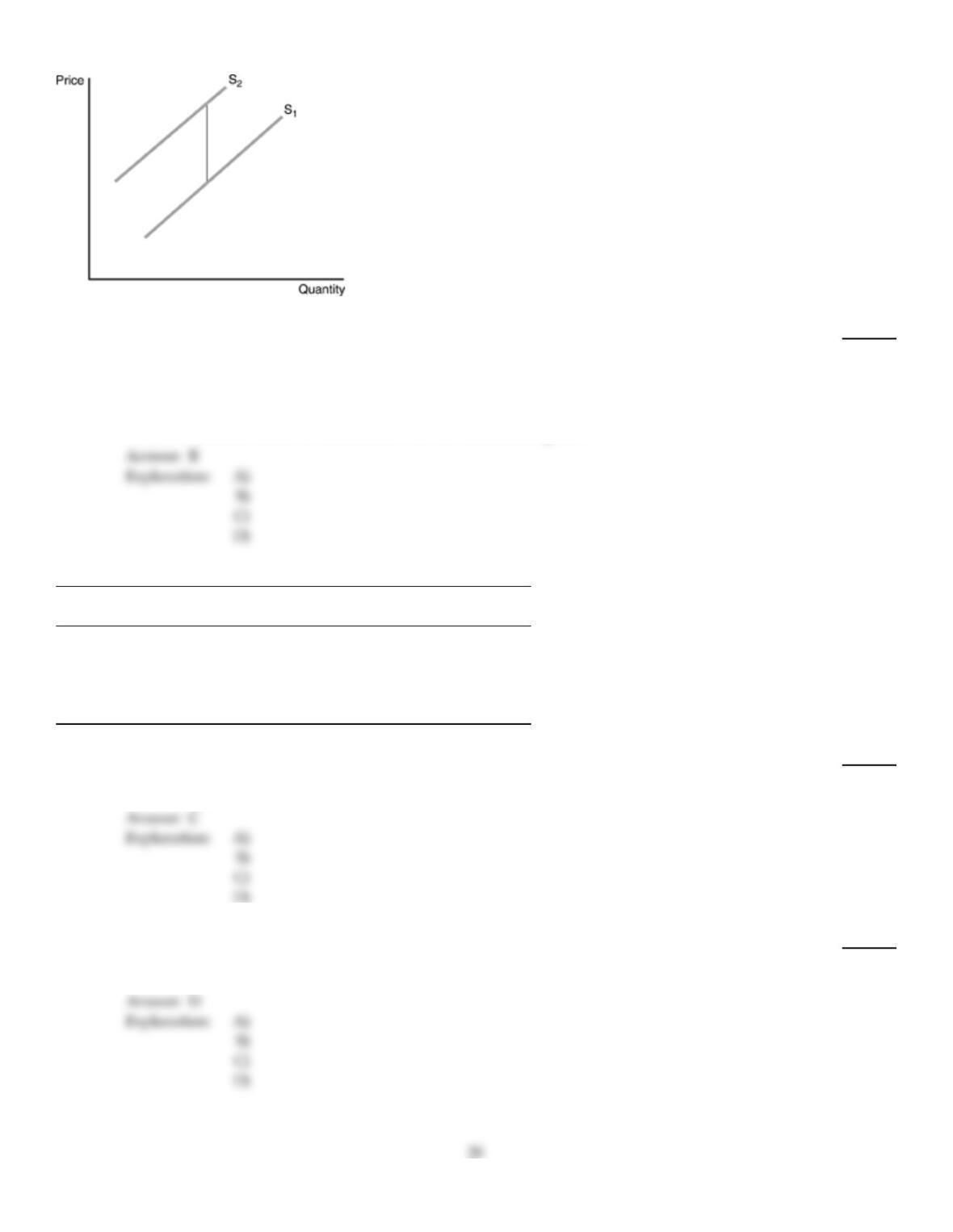
Refer to the above figure. A unit tax of $.30 has been placed on the good. Which of the following
statements is true about the vertical distance between S1 and S2?
71)
A)
The distance is less than $0.30.
B)
The distance is $0.30.
C)
The distance is more than $0.30.
D)
The distance cannot be determined with the information given.
Quantity Quantity Quantity Supplied
Price Demanded Supplied After Tax
$5 10 40 30
$4 15 35 25
$3 20 30 20
$2 25 25 15
$1 30 20 5
72)
The demand and supply of a product is given in the above table. A unit tax of $2 is imposed on the
product. The equilibrium quantity for this product after the tax is imposed is equal to
72)
A)
30 units.
B)
15 units.
C)
20 units.
D)
25 units.
73)
Social Security taxes are paid by
73)
A)
employees only.
B)
neither employers nor employees.
C)
employers only.
D)
both employers and employees.
74)
The sum of public spending on goods and services and transfer payments during a given period
cannot exceed tax revenues plus borrowed funds. This is the statement for
74)
A)
the government budget constraint.
B)
a sales tax.
C)
an excise tax.
D)
ad valorem taxation.
75)
Ad valorem taxation means
75)
A)
a progressive property tax imposed in some states.
B)
that the tax rate is a percentage of the price paid for a product.
C)
that only the value added by a service provider is taxed.
D)
a negative income tax.
76)
A state tax assessed specifically on cigarettes is an example of
76)
A)
a social tax.
B)
a tariff.
C)
a consumption tax.
D)
an excise tax.
77)
A unit tax of $0.50 has been levied on a good. The equilibrium price of the good will most likely
77)
A)
remain unchanged.
B)
increase by an amount less than $0.50.
C)
decrease by $0.50.
D)
increase by $0.50.
78)
A tax system in which the average and marginal tax rates are the same for every level of taxable
income and every change in income is an example of
78)
A)
regressive taxation.
B)
proportional taxation.
C)
premium taxation.
D)
progressive taxation.
79)
The government budget constraint implies that
79)
A)
government borrowings = taxes and user charges + government spending – transfers
B)
government borrowings = government spending+ transfers – taxes and user charges.
C)
government spending = government borrowing – transfers – taxes and user charges
D)
government spending = transfers – taxes and user charges – government borrowing.
80)
Which of the following statements is FALSE about the issues faced by the government when
contemplating a tax?
80)
A)
Consideration must be given to how tax rates relate to the amount actually received.
B)
Consideration must be given to the amount of funds the government will be receiving from
the transfer payments paid by the public to the government.
C)
Consideration must be given to how taxes influence market prices.
D)
Consideration must be given to how taxes influence equilibrium quantity.
81)
Another name for a “flat–rate tax” in which the same tax rate applies to all income earners is a
81)
A)
regressive tax.
B)
progressive tax.
C)
proportional tax.
D)
passive tax.
82)
The imposition of a new excise tax will
82)
A)
increase equilibrium price and increase equilibrium quantity.
B)
decrease equilibrium price and increase equilibrium quantity.
C)
increase equilibrium price and decrease equilibrium quantity.
D)
decrease equilibrium price and decrease equilibrium quantity.
83)
Assume that the government one day decides to tax greens fees at all state golf courses. To the
government‘s dismay, not only was the amount of tax collected small, but there was a 90 percent
decline in golfing. What type of tax analysis did the government apparently rely upon when it
imposed this tax?
83)
A)
ad hoc tax analysis
B)
static tax analysis
C)
dynamic tax analysis
D)
transaction cost analysis
84)
Which of the following statements about excise taxes is TRUE?
84)
A)
The producer will increase the price of the good by the amount of the excise tax.
B)
Both the consumer and producer pay part of the excise tax.
C)
Consumers will refuse to pay excise taxes forcing the producers to pay it.
D)
The equilibrium price will increase and the equilibrium quantity will remain unchanged.
B
85)
For all earnings subject to Social Security taxes, what is the current Social Security tax rate?
85)
A)
2.9%
B)
6.2%
C)
0.8%
D)
9.1%
B
86)
A ad valorem sales tax can be thought of as
86)
A)
a revenue source for county governments only.
B)
not part of the tax base.
C)
a proportional tax.
D)
none of the above.
C
B
87)
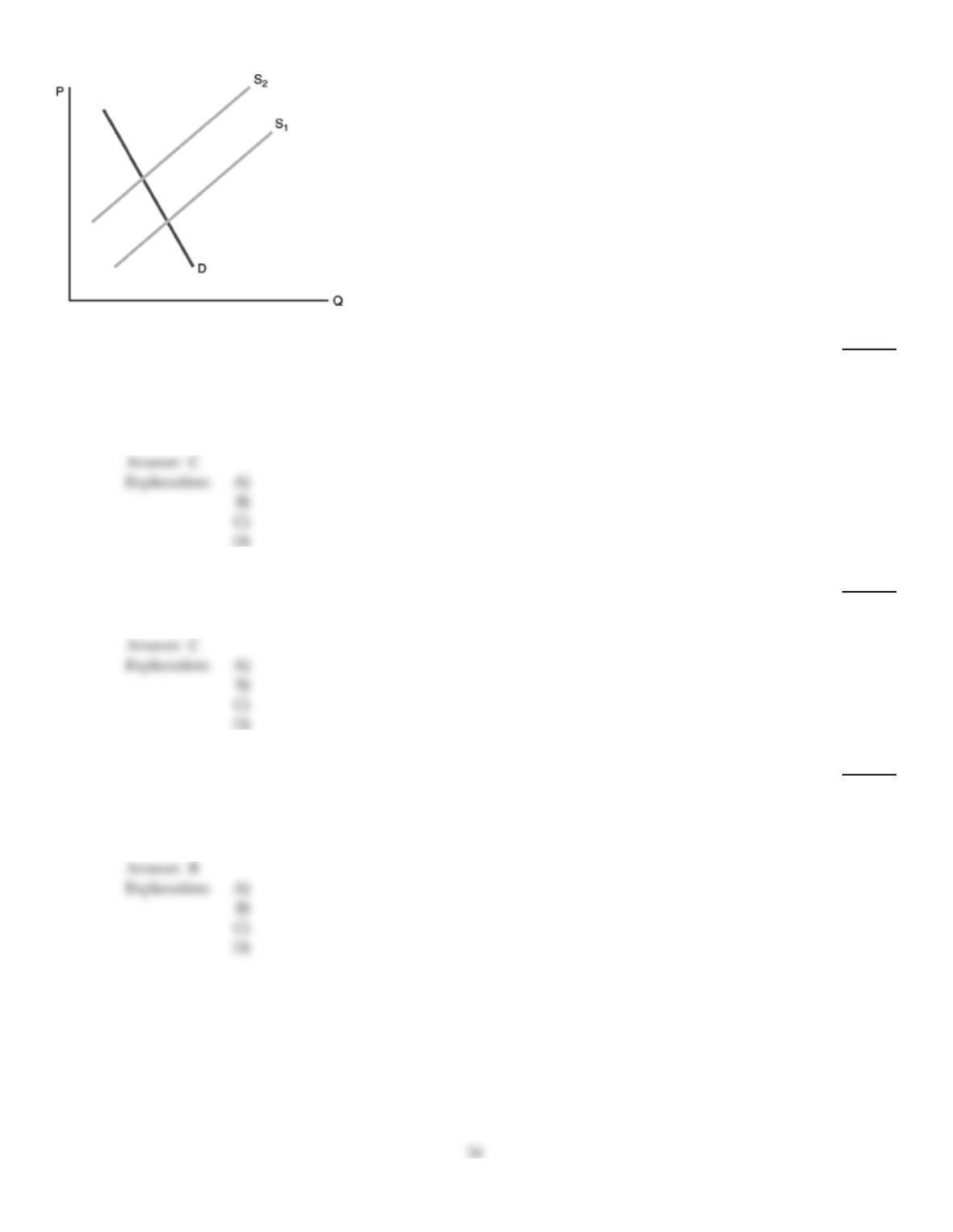
Refer to the above figure. An excise tax of $0.50 was imposed on this good. From the figure we can
see that the
87)
A)
amount of the tax collected is less than $0.50.
B)
producer will bear most of the tax.
C)
consumer will bear most of the tax.
D)
consumer and producer will share the tax.
88)
A typical capital gain is experienced by
88)
A)
all shareholders in the United States.
B)
only rich people.
C)
selling stock or a mutual fund.
D)
only investment bankers.
C
89)
Tax incidence refers to
89)
A)
determining the marginal tax rate applied to any increase in income.
B)
the distribution of tax burdens among groups, or who really pays a tax.
C)
determining who sends the taxes into the government.
D)
the tendency of some people to avoid paying taxes at all.
B
C
90)
A 2 percent tax is going to be applied to a $100,000 tax base. What can be said about the revenue
collected assuming static tax analysis?
90)
A)
The total revenue will be zero.
B)
The total revenue will be between $0 and $2,000.
C)
The total revenue will be $2,000.
D)
There is not enough information to determine what revenues will equal.
91)
Which of the following is subject to double taxation?
91)
A)
dividends and retained earnings
B)
income earned by people in the lowest tax bracket
C)
income earned by government employees
D)
Social Security income
92)
Which of the following is TRUE about the effects of an excise tax if consumers are totally
unresponsive to price changes?
92)
A)
Producers pay all of the excise tax.
B)
Consumers and producers share the excise tax equally.
C)
Neither consumers nor producers pay the excise tax.
D)
Consumers pay all of the excise tax.
93)
Suppose the tax rate on the first $10,000 income is 0 percent; 10 percent on the next $20,000; 20
percent on the next $20,000; 30 percent on the next $30,000; and 40 percent on any income over
$80,000. Family A has income of $40,000 and Family B has income of $100,000. What is the marginal
and average tax rate for each family?
93)
A)
Family A: marginal10 percent; average10 percent; Family B: marginal30 percent; average
30 percent.
B)
Family A: marginal20 percent; average10 percent; Family B: marginal40 percent; average
23 percent.
C)
Family A: marginal20 percent; average15 percent; Family B: marginal40 percent; average
20 percent.
D)
Family A: marginal20 percent; average20 percent; Family B: marginal40 percent; average
40 percent.
94)
Which of the following is an argument that the incidence of corporate taxation falls entirely on
consumers?
94)
A)
Corporations always evade taxes so that consumers ultimately bear the tax burdens as
taxpayers.
B)
Most taxes on consumers are collected by corporations through sales taxes.
C)
Corporations pass their tax burdens on to consumers because consumers ultimately work for
the corporations.
D)
Corporations pass their tax burdens on to consumers by charging higher prices equal to the
amount of the tax.
95)
Assume a family that earns $20,000 pays $1500 in income taxes, while a family that earns $40,000
pays $3500 in income taxes. In this situation, the income tax system is
95)
A)
proportional.
B)
progressive.
C)
regressive.
D)
one of the above but we cannot tell which one without more information.
96)
Dynamic tax analysis is an economic evaluation of tax rate changes
96)
A)
by the National Tax Institute in Burlington, Massachusetts.
B)
by the tax institutes established by a consortium of business schools.
C)
based on the assumption that tax base declines if tax rates continuously increase.
D)
by various state governments.
97)
The Social Security program is financed directly from
97)
A)
poll taxes.
B)
sales taxes on goods with inelastic demand.
C)
payroll taxes.
D)
voluntary contributions by the elderly.
98)
In a progressive income tax system,
98)
A)
the average tax rate exceeds the marginal tax rate.
B)
high income earners pay a lower percentage of their income in taxes than do low income
earners.
C)
the tax rate depends solely on how long an individual has been in the labor force.
D)
the marginal tax rate exceeds the average tax rate.
Quantity Quantity Quantity Supplied
Price Demanded Supplied After Tax
$5 10 40 30
$4 15 35 25
$3 20 30 20
$2 25 25 15
$1 30 20 5
99)
Using the above table, a unit tax of $2 is imposed on the product. How much of the tax is paid by
the producer?
99)
A)
$1.
B)
$3.
C)
$2.
D)
unable to determine.
100)
A tax levied on the purchase of a specific good or service is
100)
A)
a purchase tax.
B)
a consumption tax.
C)
a value tax.
D)
an excise tax.
SHORT ANSWER. Write the word or phrase that best completes each statement or answers the question.
101)
What is meant by the term “tax incidence”? What is the tax incidence of the personal
income tax? What is the tax incidence of the corporate income tax?
101)
102)
What is a government’s budget constraint in the long run as opposed to a given time
period?
102)
103)
What are the three sources of funding for the public sector? Can the government rely on all
of these sources in the long run? Explain.
103)
104)
Explain why an increase in the tax rate can result in lower tax revenues.
104)
105)
A government is thinking about increasing the sales tax rate. Should it use static or
dynamic tax analysis? Explain why one approach is better than the other.
105)
106)
Explain how corporate profits are taxed twice.
106)
107)
Suppose the income tax rate is 0 percent on the first $10,000; 10 percent on the next $20,000;
20 percent on the next $20,000; 30 percent on the next $20,000; and 40 percent on all income
above $70,000. Family A has income of $82,000 while Family B has income of $37,000.
What are the marginal tax rates faced by the two families?
107)
108)
Suppose Jill has earned more income this year as compared to what she did last year. Her
income tax has also increased. Does it necessarily mean that the income tax system is
progressive? Explain.
108)
109)
Explain why it is that how much consumers pay for an excise tax depends on how
responsive they are to a given change in market price.
109)
110)
Briefly compare the three tax systems based on the relationship between the marginal tax
rate and the average tax rate as income rises.
110)
111)
Using supply and demand analysis, graphically show what an excise tax does to
equilibrium price and quantity. On your graph show the part of the tax paid by the
consumer and the part paid by the producer.
111)
112)
According to dynamic tax analysis, will continuing to push up the tax lead to steady
increases in tax revenues? Why?
112)
113)
Why is the government budget constraint different between the short run and the long
run?
113)
114)
Suppose the income tax rate schedule is 0 percent on the first $10,000; 10 percent on the
next $20,000; 20 percent on the next $20,000; 30 percent on the next $20,000; and 40 percent
on any income over $70,000. Family A earns $32,000 a year and Family B earns $70,000 a
year. Both families each receive a ten percent raise. What is the marginal tax rate of each
and what is the extra tax paid by each after the raise?
114)
115)
In what way is corporate income subject to double taxation?
115)
116)
“Only in a progressive tax system does the amount of taxes increase as income increases.”
Do you agree or disagree? Explain.
116)
Answer Key
Testname: C6
Answer Key
Testname: C6
Answer Key
Testname: C6
33