29) What is the gravitational force acting on a 59-kg person due to another 59-kg person standing
2.0 m away? We can model each person as a small sphere. (G = 6.67 × 10⁻¹¹ N ∙ m2/kg2)
A) 5.8 × 10⁻⁸ N
B) 8.5 × 10³ N
C) 1.2 × 10⁻⁷ N
D) 9.8 × 10⁻¹⁰ N
E) 2.0 × 10⁻⁹ N
30) What is the magnitude of the gravitational force that two small 7.00-kg balls exert on each
other when they are 35.0 cm apart? (G = 6.67 × 10⁻¹¹ N ∙ m2/kg2)
31) Two identical tiny balls of highly compressed matter are 1.50 m apart. When released in an
orbiting space station, they accelerate toward each other at 2.00 cm/s2. What is the mass of each
of them? (G = 6.67 × 10⁻¹¹ N ∙ m2/kg2)
32) As a 70-kg person stands at the seashore gazing at the tides (which are caused by the Moon),
how large is the gravitational force on that person due to the Moon? The mass of the Moon is
7.35 × 10²² kg, the distance to the Moon is 3.82 × 10⁸ m, and G = 6.67 × 10⁻¹¹ N ∙ m2/kg2.
A) 0.24 N
B) 0.024 N
C) 0.0024 N
D) 0.00024 N
33) A very dense 1500-kg point mass (A) and a dense 1200-kg point mass (B) are held in place
1.00 m apart on a frictionless table. A third point mass is placed between the other two at a point
that is 20.0 cm from B along the line connecting A and B. When the third mass is suddenly
released, find the magnitude and direction (toward A or toward B) of its initial acceleration. (G =
6.67 × 10⁻¹¹ N ∙ m2/kg2)
34) When a spacecraft is launched from the earth toward the sun, at what distance from the earth
will the gravitational forces due to the sun and the earth cancel?
Earth’s mass is 5.97 × 1024 kg, the sun’s mass is 1.99 × 1030 kg, and the Earth-sun distance is
1.5 × 10¹¹ m.
A) 1.3 × 10⁸ m
B) 2.6 × 10⁸ m
C) 1.3 × 10¹⁰ m
D) 2.6 × 10¹⁰ m
35)
Mass
Radius
Orbital radius
Orbital period
Moon A
4.0 × 10²⁰ kg
unknown
2.0 × 10⁸ m
4.0 × 10⁶ s
Moon B
1.5 × 10²⁰ kg
2.0 × 10⁵ m
3.0 × 10⁸ m
unknown
Mithra is an unknown planet that has two moons, A and B, in circular orbits around it. The table
summarizes the hypothetical data about these moons. What is the magnitude of the maximum
gravitational force that Moon A exerts on Moon B? (G = 6.67 × 10⁻¹¹ N ∙ m2/kg2)
A) 1.6 × 10¹³ N
B) 4.4 × 10¹³ N
C) 1.0 × 10¹⁴ N
D) 2.0 × 10¹⁴ N
E) 4.0 × 10¹⁴ N
36) At their closest approach, Venus and Earth are 4.20 × 10¹⁰ m apart. The mass of Venus is
4.87 × 1024 kg, the mass of Earth is 5.97 × 1024 kg, and G = 6.67 × 10⁻¹¹ N ∙ m2/kg2. What is
the magnitude of the gravitational force exerted by Venus on Earth at that point?
A) 1.10 × 10¹⁸ N
B) 4.62 × 1028 N
C) 5.43 × 1026 N
D) 6.30 × 10²⁰ N
E) 1.72 × 10¹⁹ N
37) A spaceship with a mass of 2.8 × 10⁶ kg is traveling toward two spherical asteroids, each
with a mass of 5.0 × 10¹⁶ kg, that are 40 km apart center-to-center. Its path is perpendicular to
the line joining the asteroids and is aimed at the midpoint of that line. What is the net
gravitational force exerted by the asteroids on the spaceship when the spaceship is 30 km away
from that midpoint? (G = 6.67 × 10⁻¹¹ N ∙ m2/kg2)
A) 12,000 N
B) 8,000 N
C) 16,000 N
D) 6,200 N
E) 18,000 N
38) Three identical 50-kg balls are held at the corners of an equilateral triangle, 30 cm on each
side. If one of the balls is released, what is the magnitude of its initial acceleration if the only
forces acting on it are the gravitational forces due to the other two masses? (G = 6.67 × 10⁻¹¹ N ∙
m2/kg2)
A) 3.7 × 10⁻⁸ m/s2
B) 2.5 × 10⁻⁸ m/s2
C) 1.9 × 10⁻⁸ m/s2
D) 4.2 × 10⁻⁸ m/s2
E) 6.4 × 10⁻⁸ m/s2
39) What is the distance from the center of the Moon to the point between Earth and the Moon
where the gravitational pulls of Earth and Moon are equal? The mass of Earth is 5.97 × 1024 kg,
the mass of the Moon is 7.35 × 10²² kg, the center-to-center distance between Earth and the
Moon is 3.84 × 10⁸ m, and G = 6.67 × 10⁻¹¹ N ∙ m2/kg2.
A) 3.45 × 10⁸ m
B) 3.84 × 10⁷ m
C) 4.69 × 10⁶ m
D) 3.83 × 10⁶ m
E) 4.69 × 10⁷ m
40) From what height above the surface of the earth should an object be dropped to initially
experience an acceleration of 0.54g? (G = 6.67 × 10⁻¹¹ N ∙ m2/kg2, Mearth = 5.97 × 1024 kg,
Rearth = 6.38 × 10⁶ m)
A) 2300 km
B) 1700 km
C) 5400 km
D) 2900 km
41) At a given point above Earth’s surface, the acceleration due to gravity is equal to
What is the altitude of this point above Earth’s surface? (G = 6.67 × 10⁻¹¹ N ∙ m2/kg2, Mearth =
5.97 × 1024 kg, Rearth = 6.38 × 10⁶ m)
A) 770 km
B) 970 km
C) 1500 km
D) 2000 km
E) 2400 km
42) In another solar system, a planet has an airless moon Zygo that is 4.0 × 10⁵ m in diameter.
Experiments reveal that a freely falling object at the surface of Zygo accelerates at 0.20 m/s2.
What is the mass of Zygo? (G = 6.67 × 10⁻¹¹ N ∙ m2/kg2)
A) 2.4 × 10¹⁹ kg
B) 4.8 × 10¹⁹ kg
C) 1.2 × 10²⁰ kg
D) 2.4 × 10²⁰ kg
E) 4.8 × 10²⁰ kg
43)
Mass
Radius
Orbital radius
Orbital period
Moon A
4.0 × 10²⁰ kg
unknown
2.0 × 10⁸ m
4.0 × 10⁶ s
Moon B
1.5 × 10²⁰ kg
2.0 × 10⁵ m
3.0 × 10⁸ m
unknown
Mithra is an unknown planet that has two airless moons, A and B, in circular orbits around it.
The table summarizes the hypothetical data about these moons. If you dropped a laser at the
surface of Moon B, at what rate would it accelerate toward the ground? (G = 6.67 × 10⁻¹¹ N ∙
m2/kg2)
A) 0.10 m/s2
B) 0.15 m/s2
C) 0.20 m/s2
D) 0.25 m/s2
E) 0.30 m/s2
44) Planet Z-34 has a mass equal to one-third that of Earth and a radius equal to one-third that of
Earth. With g representing, as usual, the acceleration due to gravity at the surface of Earth, the
acceleration due to gravity at the surface of Z-34 is
A) g/3.
B) 3g.
C) 6g.
D) g/9.
E) 9g.
45) What would be the weight of a 59.1-kg astronaut on a planet twice as massive as Earth and
having twice Earth’s radius?
A) 580 N
B) 290 N
C) 1160 N
D) 118 N
E) 1200 N
46) What would be the weight of a 59.1-kg astronaut on a planet with the same density as Earth
and having twice Earth’s radius?
A) 580 N
B) 290 N
C) 1160 N
D) 2320 N
E) 1200 N
47) The mass of the Moon is 7.4 × 10²² kg, its radius is 1.74 × 10³ km, and it has no
atmosphere. What is the acceleration due to gravity at the surface of the Moon? (G = 6.67 × 10–
11 N ∙ m2/kg2)
A) 2.8 × 10⁶ m/s2
B) 9.8 m/s2
C) 4.9 m/s2
D) 1.6 m/s2
E) 0.80 m/s2
48) An astronaut goes out for a “space-walk” at a distance above the earth equal to the radius of
the earth. What is her acceleration due to gravity at that point?
A) zero
B) g
C) g/2
D) g/4
E) g/
49) The radius of the earth is R. At what distance above the earth’s surface will the acceleration
of gravity be 4.9 m/s2?
A) 0.41 R
B) 0.50 R
C) 1.00 R
D) 1.41 R
E) 0.25 R
50) The mass of Pluto is 1.31 × 10²² kg and its radius is 1.15 × 10⁶ m. What is the acceleration
of a freely-falling object at the surface of Pluto if it has no atmosphere? (G = 6.67 × 10⁻¹¹ N ∙
m2/kg2)
A) 0.661 m/s2
B) 9.81 m/s2
C) 1.62 m/s2
D) 3.72 m/s2
E) 0.140 m/s2
51) An astronaut drops a marble on the surface of the airless Planet Z-49 and observes that it
takes 1.02 s for the marble to fall 2.00 m starting from rest. She also knows that the radius of Z-
49 is 3.39 × 10⁶ m. From this information, what will she determine for the mass of Z-49? (G =
6.67 × 10⁻¹¹ N ∙ m2/kg2)
A) 3.30 × kg.
B) 6.62 × kg.
C) 4.62 × kg.
D) 8.09 × kg.
E) 9.95 × kg.
52) At a distance of 14,000 km from the center of Planet Z-99, the acceleration due to gravity is
32 m/s2. What is the acceleration due to gravity at a point 28,000 km from the center of this
planet?
A) 8.0 m/s2
B) 16 m/s2
C) 128 m/s2
D) 4.0 m/s2
E) 2.0 m/s2
53) An object weighs 432 N on the surface of the earth. The earth has radius R. If the object is
raised to a height of 3R above the earth’s surface, what is its weight?
A) 108 N
B) 48.0 N
C) 27.0 N
D) 305 N
E) 144 N
54) By how many newtons does the weight of a 100-kg person decrease when he goes from sea
level to mountain top at an altitude of 5000 m? The mean radius of the earth is 6.38 × 10⁶ m.
A) 0.60 N
B) 1.5 N
C) 2.6 N
D) 3.6 N
E) 9.8 N
55) The earth has radius R. A satellite of mass 100 kg is in orbit at an altitude of 3R above the
earth’s surface. What is the satellite’s weight at the altitude of its orbit?
A) 61 N
B) 110 N
C) 9000 N
D) 16,000 N
56) A spherically symmetric planet has four times the earth’s mass and twice its radius. If a jar
of peanut butter weighs 12 N on the surface of the Earth, how much would it weigh on the
surface of this planet?
A) 3.0 N
B) 6.0 N
C) 12 N
D) 24 N
E) 36 N
57) A 2.10-kg hammer is transported to the Moon. The radius of the Moon is 1.74 × 10⁶ m, its
mass is 7.35 × 10²² kg, and G = 6.67 × 10⁻¹¹ N ∙ m2/kg2. How much does the hammer weigh
on Earth and on the Moon?
58) A satellite orbits the Earth once every 6.0 hours in a circle. What are the magnitude and
direction of the acceleration of the satellite? (G = 6.67 × 10⁻¹¹ N ∙ m2/kg2, Mearth = 5.97 ×
1024 kg)
59) Suppose NASA wants a satellite to revolve around Earth 5 times a day. What should be the
radius of its orbit if we neglect the presence of the Moon? (G = 6.67 × 10⁻¹¹ N ∙ m2/kg2, Mearth
= 5.97 × 1024 kg)
A) 1.44 × 10⁷ m
B) 0.69 × 10⁷ m
C) 7.22 × 10⁷ m
D) 2.11 × 10⁷ m
60) The captain of a spaceship orbiting planet X discovers that to remain in orbit at from
the planet’s center, she needs to maintain a speed of What is the mass of planet X? (G =
6.67 × 10⁻¹¹ N ∙ m2/kg2)
A) 2.8 × 10¹⁹ kg
B) 4.2 × 10¹⁷ kg
C) 2.8 × 10¹⁶ kg
D) 4.2 × 10¹⁴ kg
61) Find the orbital speed of an ice cube in the rings of Saturn. The mass of Saturn is 5.68 x 1026
kg, and use an orbital radius of 1.00 x 10⁵ km. (G = 6.67 × 10⁻¹¹ N ∙ m2/kg2)
A) 19.5 km/s
B) 27.5 km/s
C) 13.8 km/s
62) You are the science officer on a visit to a distant solar system. Prior to landing on a planet
you measure its diameter to be 1.8 × 10⁷ m. You have previously determined that the planet
orbits 2.9 × 10¹¹ m from its star with a period of 402 earth days. Once on the surface you find
that the acceleration due to gravity is 19.5 m/s2. What are the masses of (a) the planet and (b) the
star? (G = 6.67 × 10⁻¹¹ N ∙ m2/kg2)
A) (a) 2.4 kg × kg, (b) 1.2 kg × kg
B) (a) 4.3 kg × kg, (b) 1.2 kg × kg
C) (a) 2.4 kg × kg, (b) 7.1 kg × kg
D) (a) 4.3 kg × kg, (b) 7.1 kg × kg
63) A satellite that is in a circular orbit 230 km above the surface of the planet Zeeman-474 has
an orbital period of 89 min. The radius of Zeeman-474 is 6.38 × 10⁶ m. What is the mass of this
planet? (G = 6.67 × 10⁻¹¹ N ∙ m2/kg2)
A) 5.0 × 1024 kg
B) 5.5 × 1024 kg
C) 6.0 × 1024 kg
D) 6.5 × 1024 kg
64) Asteroid Ida was photographed by the Galileo spacecraft in 1993, and the photograph
revealed that the asteroid has a small moon, which has been named Dactyl. From the dimensions
of Ida and its general features, one can estimate the mass of Ida to be 4.5 × 10¹⁶ kg, and the
distance between Dactyl and Ida is approximately 90 km. Assuming a circular orbit, what would
be the orbital speed of Dactyl? (G = 6.67 × 10⁻¹¹ N ∙ m2/kg2)
A) 5.8 m/s
B) 11 m/s
C) 2.3 m/s
D) 2.9 m/s
E) 30 m/s
65) In another solar system, a planet has a moon that is 4.0 × 10⁵ m in diameter. Measurements
reveal that this moon takes 3.0 x 10⁵ s to make each orbit of diameter 1.8 × 10⁸ m. What is the
mass of the planet? (G = 6.67 × 10⁻¹¹ N ∙ m2/kg2)
A) 1.2 × 1024 kg
B) 1.7 × 1024 kg
C) 2.4 × 1024 kg
D) 3.4 × 1024 kg
E) 4.8 × 1024 kg
66)
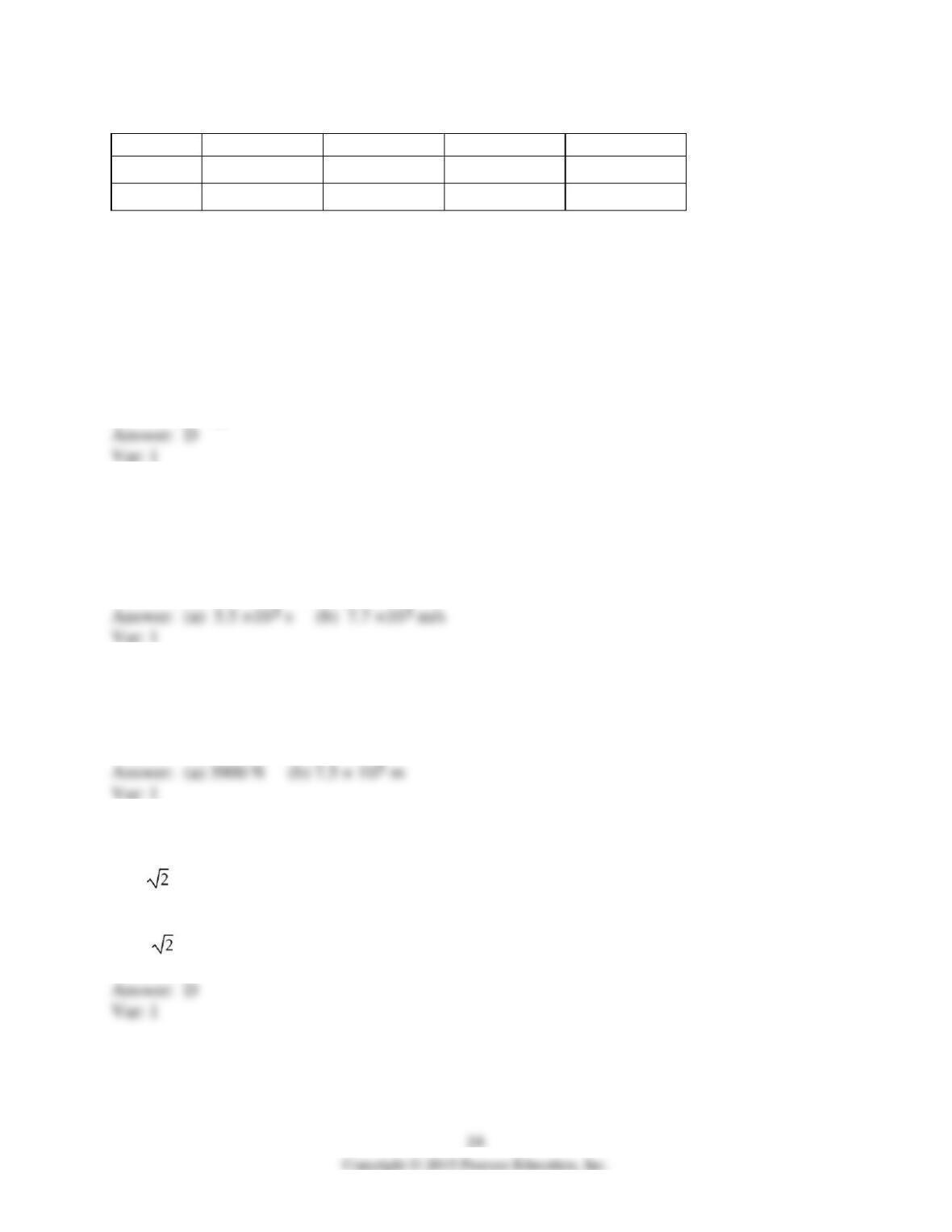
Mass
Radius
Orbital radius
Orbital period
Moon A
4.0 × 10²⁰ kg
unknown
2.0 × 10⁸ m
4.0 × 10⁶ s
Moon B
1.5 × 10²⁰ kg
2.0 × 10⁵ m
3.0 × 10⁸ m
unknown
Mithra is an unknown planet that has two moons, A and B, in circular orbits around it. The table
summarizes the hypothetical data about these moons. What is the mass of Mithra? (G = 6.67 ×
10-11 N ∙ m2/kg2)
A) 1 × 10²² kg
B) 3 × 10²² kg
C) 1 × 10²³ kg
D) 3 × 10²³ kg
E) 1 × 1024 kg
67) The International Space Station is orbiting at an altitude of about 370 km above the earth’s
surface. The mass of the earth is 5.97 × 1024 kg, the radius of the earth is 6.38 × 10⁶ m, and G =
6.67 × 10⁻¹¹ N ∙ m2/kg2. Assume a circular orbit.
(a) What is the period of the International Space Station’s orbit?
(b) What is the speed of the International Space Station in its orbit?
68) A satellite of mass 500 kg orbits the earth with a period of 6,000 s. The earth has a mass of
5.97 × 1024 kg, a radius of 6.38 × 10⁶ m, and G = 6.67 × 10⁻¹¹ N ∙ m2/kg2.
(a) Calculate the magnitude of the earth’s gravitational force on the satellite.
(b) Determine the altitude of the satellite above the earth’s surface.
69) A satellite having orbital speed V orbits a planet of mass M. If the planet had half as much
mass, the orbital speed of the satellite at the same distance from the center would be
A) V.
B) 2V.
C) V.
D) V/.
E) V/2.
70) A satellite of mass M takes time T to orbit a planet. If the satellite had twice as much mass,
the time for it to orbit the planet at the same altitude would be
A) 4T.
B) 2T.
C) T.
D) T/2.
E) T/4.
71) A large telescope of mass 8410 kg is in a circular orbit around the earth, making one
revolution every 927 minutes. What is the magnitude of the gravitational force exerted on the
satellite by the earth? (G = 6.67 × 10⁻¹¹ N ∙ m2/kg2, Mearth = 6.0 × 1024 kg)
72) Europa, a satellite of Jupiter, has an orbital diameter of 1.34 × 10⁹ m and a period of 3.55
days. What is the mass of Jupiter? (G = 6.67 × 10⁻¹¹ N ∙ m2/kg2)
A) 1.53 × 1027 kg
B) 1.65 × 1027 kg
C) 1.07 × 1027 kg
D) 1.89 × 1027 kg
E) 3.08 × 1027 kg
73) The innermost satellite of Jupiter orbits the planet with a radius of 422 × 103 km and a
period of 1.77 days. What is the mass of Jupiter? (G = 6.67 × 10⁻¹¹ N ∙ m2/kg2)
A) 1.33 × 1027 kg
B) 1.50 × 1027 kg
C) 1.72 × 1027 kg
D) 1.89 × 1027 kg
E) 3.08 × 1027 kg