9) According to an article in the Wall Street Journal, unlike airlines, even elite hotels don’t have
sophisticated systems that can react quickly to changes in demand. Even if they could, many
hoteliers say people don’t respond that much to lower rates. “We‘ve tested this, cutting our rates
by $50 [per night], and we didn’t see an appreciable response in occupancy,” says Jim
Schultenover, a vice president for Ritz-Carlton.
Source: Jesse Drucker, “In Times of Belt-Tightening, We Seek Reasonable Rates,” Wall Street
Journal, April 6, 2001.
Based on the information above, the demand for hotel rooms is
A) elastic.
B) unit-elastic.
C) inelastic.
D) perfectly elastic.
10) According to a study of the price elasticities of products sold in supermarkets, the price
elasticity of demand for toothpaste is estimated at -0.45. Which of the following could explain
why the price elasticity of demand for toothpaste is so low?
A) The toothpaste industry is highly competitive.
B) Toothpaste is relatively inexpensive.
C) Toothpaste is heavily endorsed by dentists.
D) There are few close substitutes for toothpaste.
11) If the price of steel increases drastically, the quantity of steel demanded by the building
industry will fall significantly over the long run because
A) buyers of steel are more sensitive to a price change if they have more time to adjust to the
price change.
B) buyers of steel are less sensitive to a price change if they have more time to adjust to the price
change
C) sales revenue in the building industry will fall sharply.
D) profits will fall by a greater amount in the long run than in the short run.
12) With the increased usage of cell phone services, what has happened to the price elasticity of
demand for land-line telephone services?
A) It has become more price inelastic.
B) It has become more price elastic.
C) It has become more income elastic.
D) The absolute value of the price elasticity coefficient has probably gone down.
13) Which of the following would result in a higher absolute value of the price elasticity of
demand for a product?
A) A wide variety of substitutes are available for the good.
B) The time period under consideration is short.
C) The good is a necessity.
D) The expenditure on the good is small relative to one’s budget.
14) As high gasoline prices persisted into the first part of 2011, consumers began driving less
and using public transportation more. Over time, this caused the demand curve for gasoline to
become ________ and the quantity of gasoline demanded to ________.
A) more elastic, rise
B) more elastic; fall
C) less elastic; rise
D) less elastic; fall
15) If the market for a product is broadly defined, then
A) the good has many complements.
B) there are few substitutes for the product and the demand for the product is relatively inelastic.
C) there are many substitutes for the product and the demand for the product is relatively elastic.
D) the expenditure on the good is likely to make up a large share of one’s budget.
16) Rank these three items in terms of the elasticity of the demand for them at any given price,
from most elastic to least elastic: hot beverages, coffee and Peets’ Coffee.
A) hot beverages, coffee, Peets’ Coffee
B) Peets’ Coffee, coffee, hot beverages
C) coffee, Peets’ Coffee, hot beverages
D) coffee, hot beverages, Peets’ Coffee
17) Necessities tend to have more inelastic demands than luxuries.
18) When there are few substitutes available for a good, demand tends to be relatively inelastic.
19) If the market for a product is narrowly defined, then there are likely to be many substitutes
for the product and the demand for the product is relatively elastic.
20) List the five key determinants of price elasticity of demand and explain how each
determinant indicates if demand tends to be elastic or inelastic.
21) For each pair of items below determine which product would have the higher price elasticity
of demand (in absolute value).
a. Insulin for a diabetic or aspirin for someone suffering a headache.
b. A new Whirlpool 27 cu.ft. side-by-side refrigerator or electricity to power your all-electric
home.
c. A can of Red Bull or soft drinks in general.
6.3 The Relationship between Price Elasticity of Demand and Total Revenue
1) Total revenue equals
A) price per unit times quantity sold.
B) price per unit times quantity supplied.
C) price per unit times change in quantity sold.
D) change in price per unit times quantity sold.
2) When demand is elastic, a fall in price causes total revenue to rise because
A) when price falls, quantity sold increases so total revenue automatically rises.
B) the increase in quantity sold is large enough to offset the lower price.
C) the percentage increase in quantity demanded is less than the percentage fall in price.
D) the demand curve shifts.
3) When demand is unit-elastic, a change in price causes total revenue to stay the same because
A) the percentage change in quantity demanded exactly offsets the percentage change in price.
B) buyers are buying the same quantity.
C) total revenue never changes with price changes.
D) the change in profit is offset by the change in production cost.
4) If a firm lowered the price of the product it sells and found that total revenue did not change,
then the demand for its product is
A) perfectly inelastic.
B) perfectly elastic.
C) unit-elastic.
D) relatively elastic.
5) If a firm wanted to know whether the demand for its product was elastic, unit-elastic, or
inelastic, then the firm could
A) survey competitors and ask them what they think demand elasticity is for the product.
B) talk to its customers.
C) change price a little bit and observe what happens to total revenue.
D) not do anything as there is no way to find an elasticity value.
6) A service station owner in Staten Island, New York, was worried that raising the price of
gasoline would cause the quantity demanded to fall by so much that he would be in a worse
situation than if he did not raise the price. If raising the price of gasoline would cause the owner
to receive less total revenue from the sale of gasoline, the demand for gasoline is
A) elastic.
B) inelastic.
C) unit elastic.
D) perfectly inelastic.
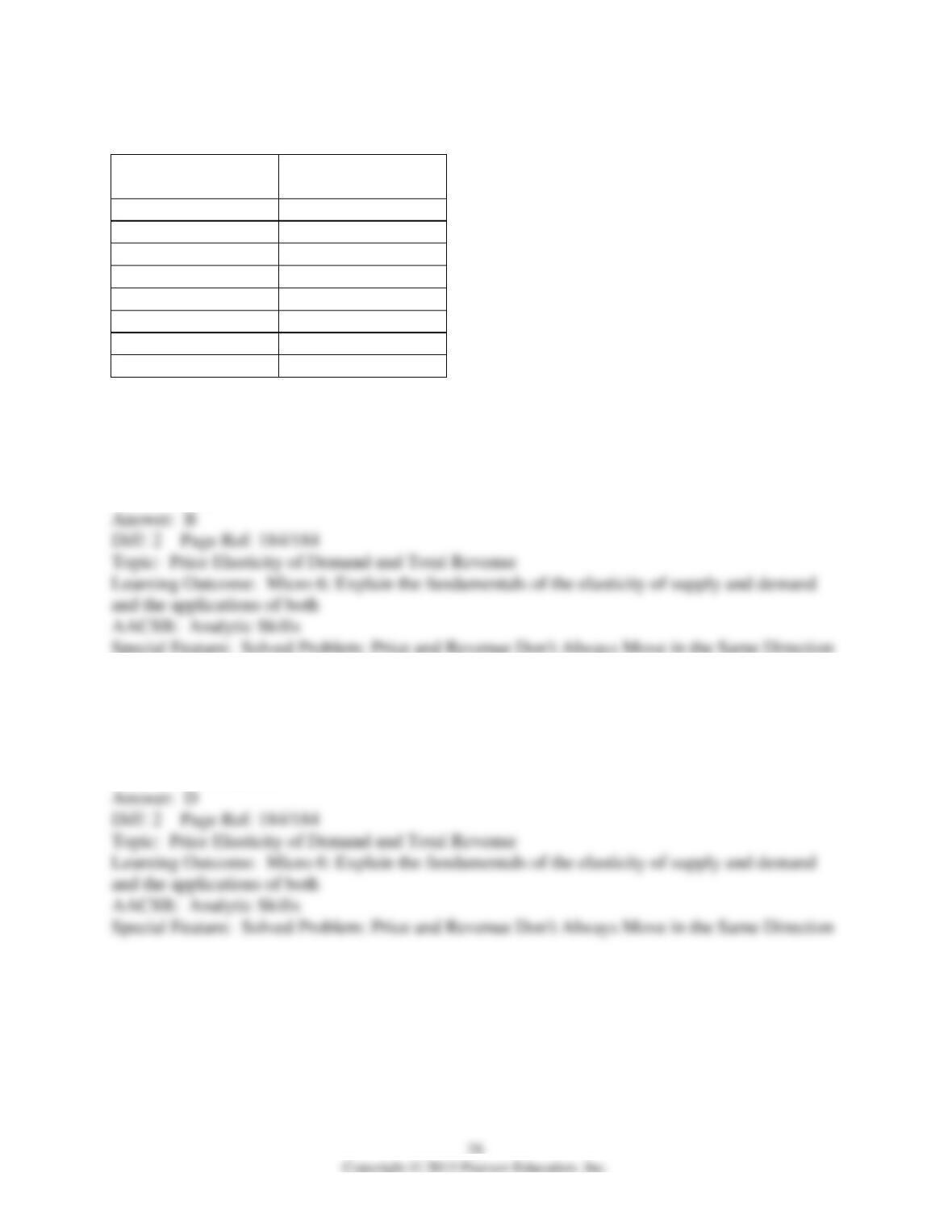
Table 6-1
Price per Pound
(dollars)
Quantity of Cheese
Demanded (pounds)
$16
3
14
4
12
5
10
6
8
7
6
8
4
9
2
10
7) Refer to Table 6-1. Over what range of prices is the demand elastic?
A) over the entire range of prices
B) between $14 and $16
C) between $8 and $16
D) between $2 and $8
8) Refer to Table 6-1. Over what range of prices is the demand inelastic?
A) over the entire range of prices
B) between $12 and $16
C) between $8 and $16
D) between $2 and $8
9) Consider a demand curve that has a constant elasticity value of 0. What happens to quantity
demanded and total revenue when price increases?
A) The quantity demanded and total revenue remain the same.
B) The quantity demanded does not change but total revenue increases.
C) The quantity demanded and total revenue fall to zero.
D) The quantity demanded does not change but total revenue decreases.
10) If the price elasticity of demand for canned soup is estimated at -1.62. What happens to sales
revenue if the price of canned soup rises?
A) It falls by 162 percent.
B) It rises by 1.62 percent.
C) It falls.
D) It rises.
11) Suppose a decrease in the supply of bottled water results in a decrease in revenue. This
indicates that
A) the demand for bottled water is inelastic in the price range considered.
B) the demand for bottled water is elastic in the price range considered.
C) the supply of bottled water is inelastic in the price range considered.
D) the supply of bottled water is elastic in the price range considered.
12) Suppose a decrease in the supply of wheat results in an increase in revenue. This indicates
that
A) the decrease in quantity sold is proportionately larger than the resulting change in price.
B) the resulting increase in price is proportionately greater than decrease in quantity sold.
C) the demand curve for wheat must be vertical.
D) the supply curve for wheat must be vertical.
13) Suppose the demand for milk is relatively inelastic. What happens to sales revenue if the
government imposes a price floor above the free market equilibrium price in the market for
milk?
A) Sales revenue falls.
B) Sales revenue rises.
C) Sales revenue remains unchanged.
D) It cannot be determined without information on prices.
14) Suppose the absolute value of the price elasticity of demand for meals at Fortune Buffet
House is ∞. What happens to sales revenue if the restaurant increases its price by 5 percent?
A) Sales revenue falls by less than 5 percent.
B) Sales revenue remains unchanged.
C) Sales revenue falls by 100 percent.
D) It cannot be determined without information on prices.
15) Apple introduced the iPhone to the market in June 2007. Within two months, it had become
clear that the price elasticity of demand for iPhones was
A) significantly higher than had been expected.
B) very close to original estimates.
C) significantly lower than had been expected.
D) essentially unit elastic.
Table 6-2
The publisher of a magazine gives his staff the following information:
Current price
$2.00 per issue
Current sales
150,000 copies per month
Current revenue
$300,000 per month
Current total costs
$450,000 per month
He tells the staff, “Our costs are currently $150,000 more than our revenues each month. I
propose to eliminate this problem by raising the price of the magazine to $3.00 per issue. This
will result in our revenue being exactly equal to our cost.”
16) Refer to Table 6-2. Which of the following statements is correct?
A) The publisher’s analysis is correct only if the demand is perfectly elastic.
B) The publisher’s analysis is correct only if the demand is elastic.
C) The publisher’s analysis is correct only if the demand is perfectly inelastic.
D) The publisher’s analysis is correct only if the demand is unit-elastic.
17) An article in the Wall Street Journal noted the following: Instead of relying on a full-coach,
round-trip unrestricted fare of about $2,000 between Cleveland and Los Angeles …Continental
[Airlines] since June has offered a $716 unrestricted fare in that market …. Through October, the
test resulted in about the same revenue that Continental thinks it would have collected with its
higher fare.
Source: Scott McCartney, “Airlines Try Cutting Business Fares, Find They Don’t Lose Revenue,”
Wall Street Journal, November 22, 2002.
What is the absolute value of the price elasticity of demand on this airline route?
A) 0
B) less than 1
C) greater than 1
D) approximately 1
18) If a firm’s goal is to maximize revenue, it will price its product to correspond to the unit–
elastic segment of its demand curve.
19) When Audrina raised the price of her home made cookies, her total revenue increased. This
suggests that the demand for Audrina’s cookies is elastic.
20) Firms estimate the price elasticity of demand for new products by conducting market
experiments in which firms try different prices and observe the resulting change in quantity
demanded.
21) Explain the relationship between price elasticity of demand and total revenue.
22) Suppose that at a price of $55, 100 units were sold while at a price of $33, 153 units were
sold. Without calculating the price elasticity value, can you determine whether demand is elastic,
unit-elastic, or inelastic? Explain your answer.
23) The Mass Rapid Transit (MRT) System in Hong Kong has been running significant losses.
Transport Ministry officials have argued over whether to raise fares to combat the losses. One
argument against a fare increase is that it will aggravate traffic congestion on the streets during
peak commuter hours. Suppose that the current fare is $4 and the government is considering
raising it to $6. Officials estimate that this reduces the number of rides purchased from 10,000 to
8,000 per day.
a. What is the estimated elasticity of demand for MRT rides?
b. What does this elasticity of demand suggest to you about what will happen to total revenue
earned by the transit system?
c. Last year, the MRT system incurred a loss of $50,000 per day. Do you think the fare increase
will resolve the deficit problem as well as Ministry officials anticipate? Explain.
6.4 Other Demand Elasticities
1) Income elasticity measures
A) how a good’s quantity demanded responds to change in the goods price.
B) how a good’s quantity demanded responds to change in the price of another good.
C) how a good’s quantity demanded responds to change in buyers’ incomes.
D) how a good’s quantity demanded responds to producers’ incomes.
2) Calculate the income elasticity if an 8 percent increase in income leads to a 4 percent increase
in quantity demanded for organic produce.
A) -0.66
B) 0.5
C) 1.5
D) 2
3) Studies show that the income elasticity of demand for wine is approximately five. What does
this mean?
A) A one percent decrease in the price of wine leads to a five percent increase in wine
consumption.
B) A one percent increase in income leads to a five percent increase in wine consumption.
C) A five percent increase in income leads to a one percent increase in wine consumption.
D) Wine is a relatively elastic good.
4) Which of the following items is likely to have the highest income elasticity of demand?
A) a bus ride
B) a meal at Taco Bell
C) a vacation home in the Swiss Alps
D) a tank of gasoline
5) If you expect the economy is going to boom and average income in the economy will rise in
the foreseeable future, the type of firm that would be able to increase its sales if your
expectations are met is
A) one that sells an inferior good.
B) one that sells a necessity good.
C) one that sells a luxury good.
D) one that sells a price inelastic good.
6) Last year, Sefton purchased 60 pounds of potatoes to feed his family of five when his
household income was $30,000. This year, his household income fell to $20,000 and Sefton
purchased 80 pounds of potatoes. All else constant, Sefton’s income elasticity of demand for
potatoes is
A) negative, so Sefton considers potatoes to be an inferior good.
B) positive, so Sefton considers potatoes to be an inferior good.
C) positive, so Sefton considers potatoes to be a normal good and a necessity.
D) negative, so Sefton considers potatoes to be a normal good.
7) According to a study of the U.S. demand for alcoholic beverages, the price elasticity of
demand for beer is -0.23. Which of the following could explain why the price elasticity of
demand for beer is low?
A) Beer is an inferior alcoholic beverage.
B) More and more people are switching to wine and cocktails rather than beer.
C) The price of beer is relatively low and for many people it is a habit forming product.
D) There are only a few major suppliers of beer.
8) Economists estimated that the price elasticity of beer is -0.23 and the income elasticity of beer
is -0.09. This means that
A) an increase in the price of beer will increase the quantity demanded of beer and beer is a
normal good.
B) an increase in the price of beer will lead to an increase in revenue for beer sellers and beer is
an inferior good.
C) a decrease in the price of beer will lead to an increase in revenue for beer sellers and beer is
an inferior good.
D) an increase in the price of beer will lead to a decrease in the quantity demanded of beer and
beer is a necessity.
9) Using cross-sectional data from the two Housing Assistance Supply Experiment (HASE)
sites—Brown County, Wisconsin, and St. Joseph County, Indiana, John Mulford of Rand
Research estimates that the long-run “permanent” income elasticity of housing expenditures to be
0.45 for owners. Using this information, what is likely to happen to housing expenditures if the
government increases income transfers to recipients in HASE sites?
A) Housing expenditures will increase significantly.
B) Housing expenditures in HASE sites significantly will fall as recipients moved out of these
areas to higher-income areas.
C) Housing expenditures will increase, but not significantly.
D) Housing expenditures will decrease by a small amount.
10) Linesha, a college student working part-time receives a wage increase. An avid movie buff,
she increased her purchases of Blu-ray discs and reduced her purchases of DVDs. Based on this
information,
A) DVDs and Blu-ray discs are substitutes.
B) Blu-ray discs are normal goods and DVDs are inferior goods.
C) DVDs and Blu-ray discs are normal goods.
D) the cross-price elasticity between DVDs and Blu-ray discs is negative.
11) Cross-price elasticity of demand is calculated as the
A) percentage change in quantity demanded divided by percentage change in price of a good.
B) percentage change in quantity demanded of one good divided by percentage change in price
of a different good.
C) percentage change in quantity sold divided by percentage change in buyers’ incomes.
D) percentage change in quantity supplied divided by percentage change in price of a good.
12) If the cross-price elasticity of demand for computers and software is negative, this means the
two goods are
A) substitutes.
B) complements.
C) inferior.
D) normal.
13) Suppose Tinsel Town Videos lowers the price of its movie club membership by 10 percent
and as a result, CineArts Videos experienced a 16 percent decline in its movie club membership.
What is the value of the cross-price elasticity between the two movie club memberships?
A) -1.6
B) -0.625
C) 0.625
D) 1.6
14) Consider the following pairs of items:
a. shampoo and conditioner
b. iPhones and earbuds
c. a laptop computer and a desktop computer
d. beef and pork
e. air-travel and weed killer
Which of the pairs listed will have a negative cross-price elasticity?
A) a and b only
B) c and d only
C) e only
D) a, b, and c only
15) Consider the following pairs of items:
a. shampoo and conditioner
b. iPhones and earbuds
c. a laptop computer and a desktop computer
d. beef and pork
e. air-travel and weed killer
Which of the pairs listed will have cross-price elasticity of zero?
A) a and b only
B) c only since most people cannot do without computers
C) e only
D) none of the pairs listed