77. Figure 6-3.
Hamilton Company manufactures engines. Hamilton produces all the parts necessary for its engines except for
one electronic component, which is purchased from two local suppliers: Traynor, Inc. and Bello Company. Both
suppliers are reliable and rarely deliver late; however, Traynor sells the component for $10.00 per unit and
Bello sells the same component for $8.95. Hamilton purchases 70 percent of its components from Bello,
because of the lower price. The total annual demand is 75,000 units.
I. Activity Data
Activity Cost
Inspecting components (sampling only)
$190,000
Reworking products (due to failed component)
$2,254,000
Warranty work (due to failed component)
$1,723,000
II. Supplier Data
Traynor, Inc.
Bello Company
Units Purchase Price
$10.00
$8.95
Units Purchased
22,500
52,500
Sampling Hours
50
2,450
Rework hours
135
3,625
Warranty hours
475
6,000
Refer to Figure 6.3. Suppose that Hamilton loses $2,500,000 in sales per year because of its reputation for defective units attributable to failed
components. Using warranty hours, assign the proportional cost of lost sales to Bello Company. Then determine what effect this would have on the
cost per component.
78. A manual process takes 18 minutes of direct labor time and six pounds of material to produce a product.
Automating the process requires 12 minutes of machine time and 5 pounds of material. The cost per labor hour
is $9, the cost per machine hour is $7, and the cost per pound of materials is $11.
Find the non-value added cost for the above situation.
79. Using the original design, a machine requires 12 hours of setup time. By redesigning the machine, the setup
time is reduced by 25 percent. The cost per setup hour is $225. Calculate the reduction in nonvalue-added cost
per setup.
80. A product currently requires 4 moves. By changing the plant layout, the number of moves can be reduced to
zero. The cost per move is $70. Calculate the reduction in nonvalue-added cost of the moving activity.
81. Inspection time for a plant is 10,000 hours per year. The cost of inspection consists of salaries of four
inspectors, totaling $60,000. Inspection also used supplies costing $3 per inspection hour. The company has a
close to zero defect state and has eliminated the need for any inspection activity. Calculate the nonvalue-added
cost of inspection per year.
82. Each unit of a product requires four components. The average number of components is 4.25 due to
component failure. Purchasing higher quality components can reduce the average number of components to four
per unit. The cost per component is $350. Calculate the reduction in failure costs per unit due to purchasing
higher quality components.
83. A plant produces 75 different electronic products. Each product requires an average of six components that
are purchased externally. By redesigning the products, it is possible to produce the 75 products so that they all
have three components in common. This will reduce the demand for purchasing, receiving, and paying bills.
Estimated savings from the reduced demand are $1,200,000 per year.
Calculate the nonvalue-added cost of purchasing, receiving and paying bills.

84. A factory produces 124,000 televisions per quarter. A total of 8,000 production hours are used within the
factory per quarter. Calculate the cycle time in minutes.
85. Figure 6-4.
Honeydew Company produces two products, a high end laptop computer under the label Bunsen Laptops, and
an inexpensive desktop computer under the label Beaker Computers. The two products use two overhead
activities, with the following costs:
Setting up equipment
$ 2,000
Machining
12,000
The controller has collected the expected annual prime costs for each product, the machine hours, the setup hours, and the expected production.
Bunsen
Beaker
Direct Labor
$20,000
$5,000
Direct Materials
15,000
4,000
Units
2,000
2,000
Machine hours
750
1,500
Setup hours
50
50
Refer to Figure 6-4. Calculate Beaker’s consumption ratio for setup hours.
86. Figure 6-4.
Honeydew Company produces two products, a high end laptop computer under the label Bunsen Laptops, and
an inexpensive desktop computer under the label Beaker Computers. The two products use two overhead
activities, with the following costs:
Setting up equipment
$ 2,000
Machining
12,000
The controller has collected the expected annual prime costs for each product, the machine hours, the setup hours, and the expected production.
Bunsen
Beaker
Direct Labor
$20,000
$5,000
Direct Materials
15,000
4,000
Units
2,000
2,000
Machine hours
750
1,500
Setup hours
50
50
Refer to Figure 6-4. Calculate the overhead cost per unit for Bunsen Laptops, using a plantwide rate based on direct labor costs.
87. Figure 6-4.
Honeydew Company produces two products, a high end laptop computer under the label Bunsen Laptops, and
an inexpensive desktop computer under the label Beaker Computers. The two products use two overhead
activities, with the following costs:
Setting up equipment
$ 2,000
Machining
12,000
Bunsen
Beaker
Direct Labor
$20,000
$5,000
Direct Materials
15,000
4,000
Units
2,000
2,000
Machine hours
750
1,500
Setup hours
50
50
88. Figure 6-5.
Rizzo Manufacturing produces two types of cameras: 35mm and digital. The cameras are produced using one
continuous process. Four activities have been identified: machining, setups, receiving, and packing. Resource
drivers have been used to assign costs to each activity. The overhead activities, their costs, and the other related
data are as follows:
Product
Machine Hours
Setups
Receiving Orders
Packing Orders
35mm
10,000
100
200
400
Digital
10,000
250
800
2,000
Costs
$60,000
$40,000
$8,000
$24,000
Refer to Figure 6-5. Calculate the total overhead assigned to the 35mm cameras using only machine hours to calculate a plantwide rate.
89. Figure 6-5.
Rizzo Manufacturing produces two types of cameras: 35mm and digital. The cameras are produced using one
continuous process. Four activities have been identified: machining, setups, receiving, and packing. Resource
drivers have been used to assign costs to each activity. The overhead activities, their costs, and the other related
data are as follows:
Product
Machine Hours
Setups
Receiving Orders
Packing Orders
35mm
10,000
100
200
400
Digital
10,000
250
800
2,000
Costs
$60,000
$40,000
$8,000
$24,000
Refer to Figure 6-5. Calculate a consumption ratio for setups on the digital cameras.
90. Figure 6-5.
Rizzo Manufacturing produces two types of cameras: 35mm and digital. The cameras are produced using one
continuous process. Four activities have been identified: machining, setups, receiving, and packing. Resource
drivers have been used to assign costs to each activity. The overhead activities, their costs, and the other related
data are as follows:
Product
Machine Hours
Setups
Receiving Orders
Packing Orders
35mm
10,000
100
200
400
Digital
10,000
250
800
2,000
Costs
$60,000
$40,000
$8,000
$24,000
Refer to Figure 6-5. Using an activity rate for receiving based on receiving orders, assign receiving costs to the 35mm camera.
91. Figure 6-5.
Rizzo Manufacturing produces two types of cameras: 35mm and digital. The cameras are produced using one
continuous process. Four activities have been identified: machining, setups, receiving, and packing. Resource
drivers have been used to assign costs to each activity. The overhead activities, their costs, and the other related
data are as follows:
Product
Machine Hours
Setups
Receiving Orders
Packing Orders
35mm
10,000
100
200
400
Digital
10,000
250
800
2,000
Costs
$60,000
$40,000
$8,000
$24,000
Refer to Figure 6-5. Calculate an activity rate for packing based on packing orders.
92. A factory produces 124,000 televisions per quarter. A total of 8,000 production hours are used within the
factory per quarter. Compute the velocity in units per hour.
93. Match each item with the correct statement below.
1. Factors that measure the consumption of resources
2. System that emphasizes direct tracing and driver
3. Financial and nonfinancial information items that
4. Activities that are performed each time a unit is
Activity-based costing
5. Factors that measure the consumption of activities
94. Match each item with the correct statement below.
with perfect efficiency.
1
2. Costs necessary to perform value-added activities
3. The number of times an activity is performed.
activity output
measure
3
output.
5
4. Resources consumed by the activity in producing its
perform the activities?”
2
5. Process that answers the question “How many people
95. Match each item with the correct statement below.
are caused by competing strategies.
1
1. Involves choosing among different sets of activities that
activity
activity sharing
2
2. Increases the efficiency of necessary activities by using
delivered to finished goods inventory.
3
3. The length of time it takes to produce a unit of output
from the time raw materials are received until the good is
5
5. Activities necessary to remain in business
4
4. Cost assignment method used for a cost of a resource that
value-added
96. Gerard Company makes a product using two departments – Department 1 and Department 2. Information on
these departments is as follows:
Department 1
Department 2
Direct labor hours
10,000
90,000
Machine hours
40,000
10,000
Overhead cost
$240,000
$180,000
a) Calculate the department overhead rate for each department. Use machine hours as the base in Department 1 and direct labor hours as the base in
Department 2.
b) A job has prime cost of $270. It uses 10 machine hours in Department 1 and 15 direct labor hours in Department 2. Calculate the total product cost
for the job.
Prime cost
$270
Dept. 1 overhead cost ($6 ´ 10)
Dept. 2 overhead cost ($2 ´ 15)
1. Result or product of an activity.
4
97. Figure 6-6.
Xander Company produces televisions. One of its plants produces two versions of televisions: a basic model
and a premium model. At the beginning of the year, the following data were prepared for the plant:
Basic Model
Premium Model
Expected Quantity
20,000
10,000
Selling Cost
$90
$200
Prime Costs
$40
$80
Machine Hours
2,500
2,500
Number of requisitions
500
1,500
Maintenance hours
2,000
6,000
Number of setups
8
32
Additionally, the following overhead activity costs are reported:
Maintaining equipment
$220,000
Setting up equipment
$112,000
Purchasing materials
$87,000
Total
$419,000
Xander uses activity-based costing to calculate product cost.
Refer to Figure 6-6.
a) What is the activity rate for maintaining equipment based on maintenance hours?
b) What is the activity rate for setting up equipment based on number of setups?
c) What is the activity rate for purchasing materials based on number of requisitions?
d) What is the unit cost of the basic model (rounded to the nearest cent)?
e) What is the unit cost of the premium model (rounded to the nearest cent)?
Basic
Prime Costs
$40.00
Maintenance
($27.50 ´ 2,000)/20,000
2.75
Setups
($2,800 ´ 8)/20,000
1.12
Purchasing
($43.50 ´ 500)/20,000
1.09
Unit cost of basic
$44.96
Premium
Prime Costs
$80.00
Maintenance
($27.50 ´ 6,000)/10,000
16.50
Setups
($2,800 ´ 32)/10,000
8.96
Purchasing
($43.50 ´ 1,500)/10,000
6.53
Unit cost of basic
$111.99
98. Figure 6-6.
Xander Company produces televisions. One of its plants produces two versions of televisions: a basic model
and a premium model. At the beginning of the year, the following data were prepared for the plant:
Basic Model
Premium Model
Expected Quantity
20,000
10,000
Selling Cost
$90
$200
Prime Costs
$40
$80
Machine Hours
2,500
2,500
Number of requisitions
500
1,500
Maintenance hours
2,000
6,000
Number of setups
8
32
Additionally, the following overhead activity costs are reported:
Maintaining equipment
$220,000
Setting up equipment
$112,000
Purchasing materials
$87,000
Total
$419,000
Xander uses activity-based costing to calculate product cost.
Refer to Figure 6-6.
A. What is the plantwide overhead rate based on machine hours?
B. Assuming a plantwide overhead rate, what is the unit cost of the basic model?
C. Assuming a plantwide overhead rate, what is the unit cost of the premium model?
99. Flynn Company has a JIT system in place. Each manufacturing cell is dedicated to the production of a
single product or major subassembly. One cell, dedicated to the production of guitar pickups, has four
operations: machining, finishing, assembly, and qualifying (testing).
For the coming year, the pickup cell has the following budgeted costs and cell time (both at theoretical
capacity):
Cell time:
8,000 hours
Theoretical output:
60,000 pickups
During the year, the following actual results were obtained:
Actual cell time:
8,000 hours
Actual output:
50,000 pickups
Prime cost
$40.00
Applied overhead
($83.80 ´ 2,500)/20,000
10.48
Total unit cost
$50.48
Prime cost
$ 80.00
Applied overhead
($83.80 ´ 2,500)/10,000
20.95
Total unit cost
$100.95
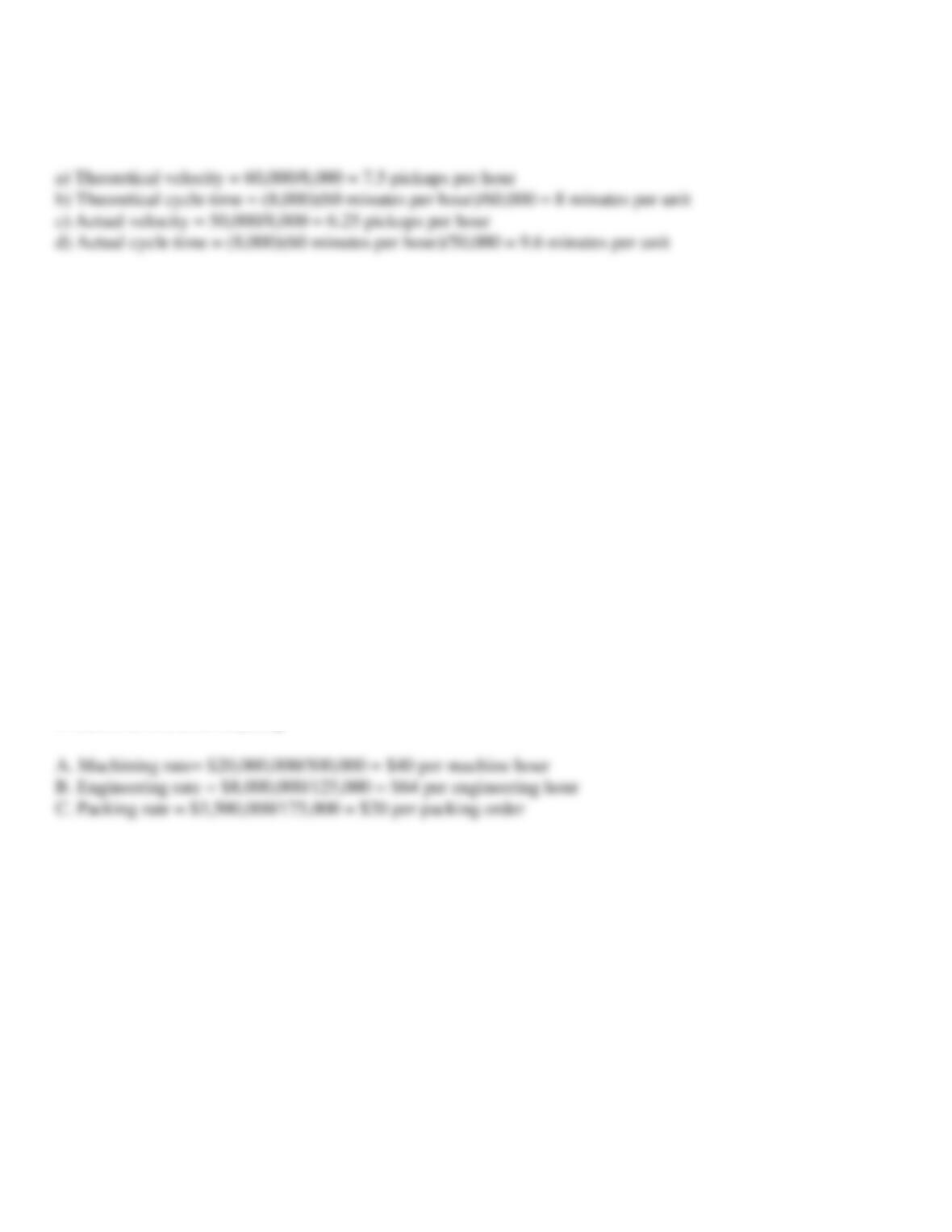
a) Compute the theoretical velocity for the cell per hour.
b) Compute the theoretical cycle time in minutes.
c) Compute the actual velocity for the cell per hour.
d) Compute the actual cycle time in minutes.
100. Figure 6-7.
Armstrong Company produces a variety of bicycles. One of its plants produces two bicycles: a mountain model
and a racing model. At the beginning of the year, the following data were prepared for this plant:
Mountain
Racing
Quantity
250,000
125,000
Selling Price
$1,200
$1,000
Unit Prime Cost
$400
$500
In addition, the following information was provided so that overhead costs could be assigned to each product:
Activity Name
Activity Driver
Activity Cost
Racing
Mountain
Machining
Machine hours
$20,000,000
250,000
250,000
Engineering
Engineering hours
$8,000,000
75,000
50,000
Packing
Packing orders
$3,500,000
50,000
125,000
Refer to Figure 6-7.
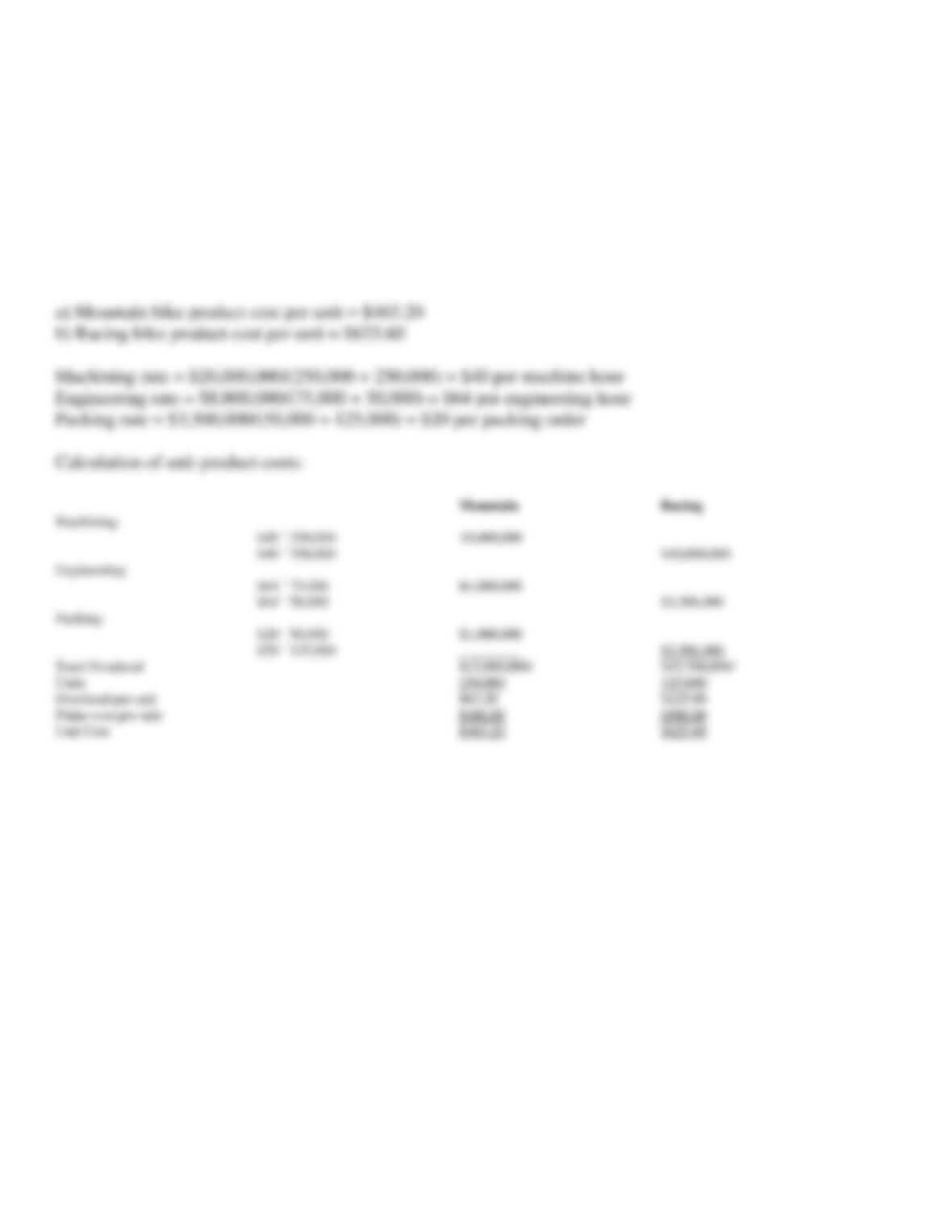
A. Calculate the activity rate for machining.
B. Calculate the activity rate for engineering.
C. Calculate the activity rate for packing.
101. Figure 6-7.
Armstrong Company produces a variety of bicycles. One of its plants produces two bicycles: a mountain model
and a racing model. At the beginning of the year, the following data were prepared for this plant:
Mountain
Racing
Quantity
250,000
125,000
Selling Price
$1,200
$1,000
Unit Prime Cost
$400
$500
In addition, the following information was provided so that overhead costs could be assigned to each product:
Activity Name
Activity Driver
Activity Cost
Racing
Mountain
Machining
Machine hours
$20,000,000
250,000
250,000
Engineering
Engineering hours
$8,000,000
75,000
50,000
Packing
Packing orders
$3,500,000
50,000
125,000
Refer to Figure 6-7. Armstrong Company uses activity-based costing to calculate product costs.
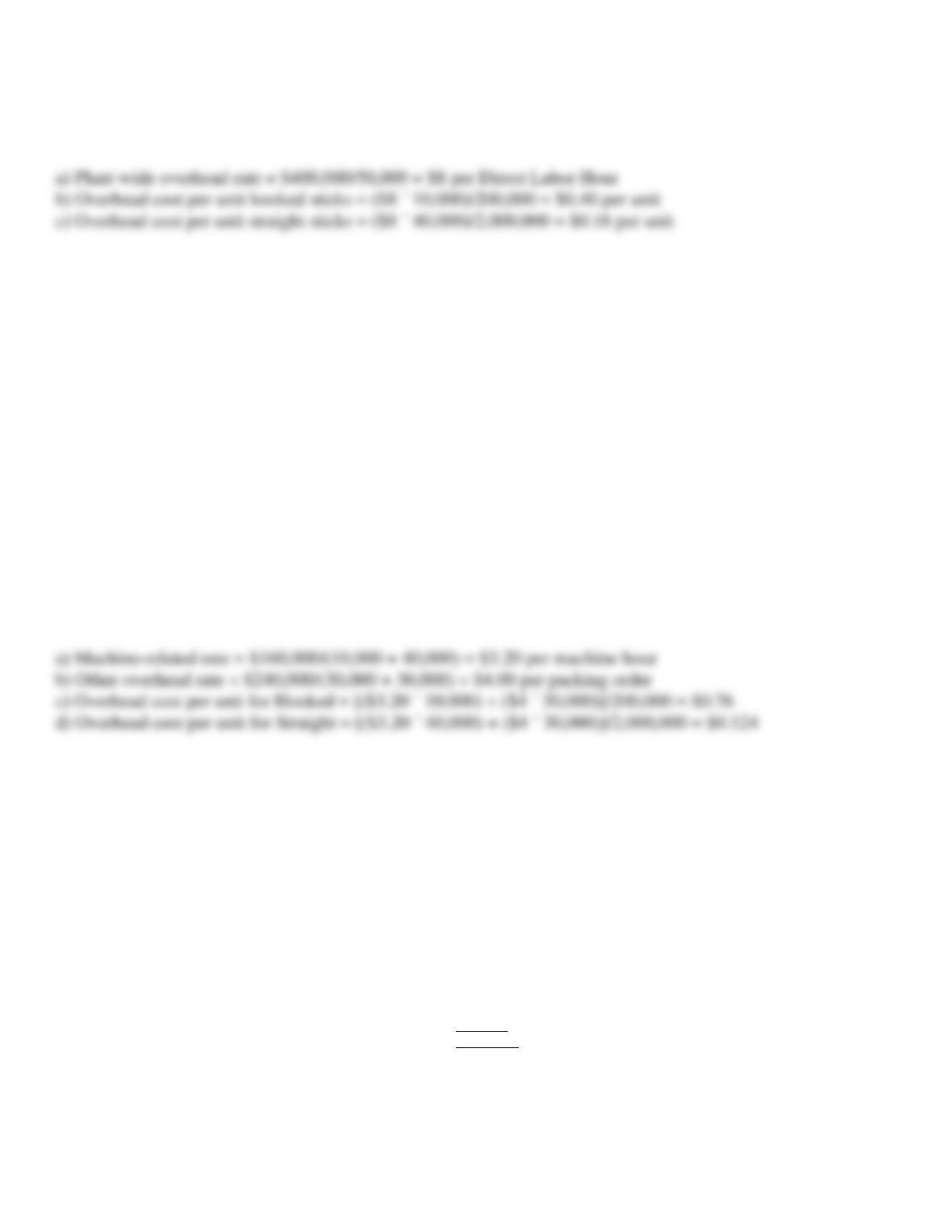
a) Calculate the per unit product cost for a mountain bike.
b) Calculate the per unit product cost for a racing bike.
102. Randy Company produces candy sticks (hooked and straight). Both products pass through two producing
departments. The hooked stick’s production is much more labor-intensive than the straight stick. The straight
stick is also more popular. The following data have been gathered for the two products:
Product Data
Hooked
Straight
Units produced per year
200,000
2,000,000
Direct labor hours
10,000
40,000
Machine hours
10,000
40,000
Mountain
Racing
Machining:
$40 ´ 250,000
10,000,000
$40 ´ 250,000
$10,000,000
Engineering:
$64 ´ 75,000
$4,800,000
$64 ´ 50,000
$3,200,000
Packing:
$20 ´ 50,000
$1,000,000
$20 ´ 125,000
$2,500,000
Total Overhead
$15,800,000/
$15,700,000/
Units
250,000
125,000
Overhead per unit
$63.20
$125.60
Prime cost per unit
$400.00
$500.00
Unit Cost
$463.20
$625.60
Total overhead costs equal $400,000. Randy applies overhead based on direct labor hours.
a) Calculate the plantwide overhead rate based on direct labor hours.
b) Using the plantwide overhead rate, calculate the overhead cost per unit for hooked sticks.
c) Using the plantwide overhead rate, calculate the overhead cost per unit for straight sticks.
103. Randy Company produces candy sticks (hooked and straight). Both products pass through two producing
departments. The hooked sticks’s production is much more labor-intensive than the straight sticks. The straight
stick is also more popular. The following data have been gathered for the two products:
Product Data
Hooked
Straight
Units produced per year
200,000
2,000,000
Machine hours
10,000
40,000
Packing orders
30,000
30,000
Randy has decided to used activity-based costing and has developed two types of activities, machine related (based on machine hours), and other
overhead (based on packing orders). Machine-related costs equal $160,000. Other overhead costs equal $240,000.
a) Calculate the activity rate for machine-related costs based on machine hours.
b) Calculate the activity rate for other overhead costs based on packing orders.
c) Using the two activity rates, calculate the overhead cost per unit for hooked sticks. (Carry out computations to three decimal places.)
d) Using the two activity rates, calculate the overhead cost per unit for straight sticks. (Carry out computations to three decimal places.)
104. Figure 6-8.
Sallisaw Savings & Loan has requested an analysis of checking account profitability by customer type.
Customers are categorized according to size of their account: low balances, medium balances, and high
balances. The activities associated with the three different customer categories and their associated annual costs
are as follows:
Opening and closing statements
$100,000
Issuing monthly statements
$150,000
Processing transactions
$1,025,000
Customer inquiries
$200,000
Providing ATM services
$560,000
Total cost
$2,035,000
Additional data concerning the usage of the activities by the various customers are also provided:
Account Balance
Low
Medium
High
Number of accounts opened/closed
7,500
1,500
1,000
Number of statements issued
225,000
50,000
25,000
Processing transactions
9,000,000
1,000,000
250,000
Number of telephone minutes
500,000
300,000
200,000
Number of ATM transactions
675,000
100,000
25,000
Number of checking accounts
19,000
4,000
2,000
Refer to Figure 6-8.
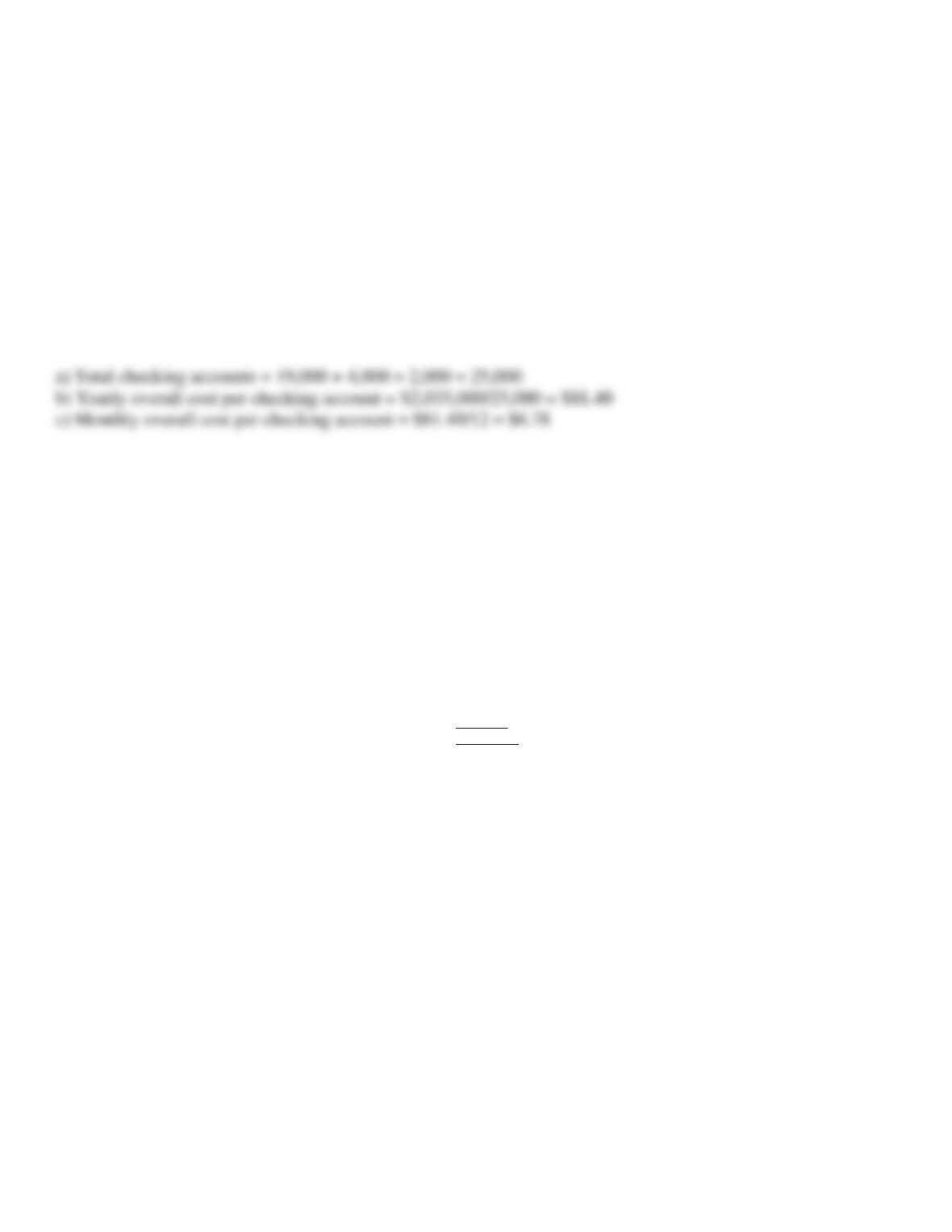
a) Calculate the total number of checking accounts.
b) Calculate the yearly overall cost per checking account.
c) Calculate the monthly overall cost per checking account.
105. Figure 6-8.
Sallisaw Savings & Loan has requested an analysis of checking account profitability by customer type.
Customers are categorized according to size of their account: low balances, medium balances, and high
balances. The activities associated with the three different customer categories and their associated annual costs
are as follows:
Opening and closing statements
$100,000
Issuing monthly statements
$150,000
Processing transactions
$1,025,000
Customer inquiries
$200,000
Providing ATM services
$560,000
Total cost
$2,035,000
Additional data concerning the usage of the activities by the various customers are also provided:
Account Balance
Low
Medium
High
Number of accounts opened/closed
7,500
1,500
1,000
Number of statements issued
225,000
50,000
25,000
Processing transactions
9,000,000
1,000,000
250,000
Number of telephone minutes
500,000
300,000
200,000
Number of ATM transactions
675,000
100,000
25,000
Number of checking accounts
19,000
4,000
2,000
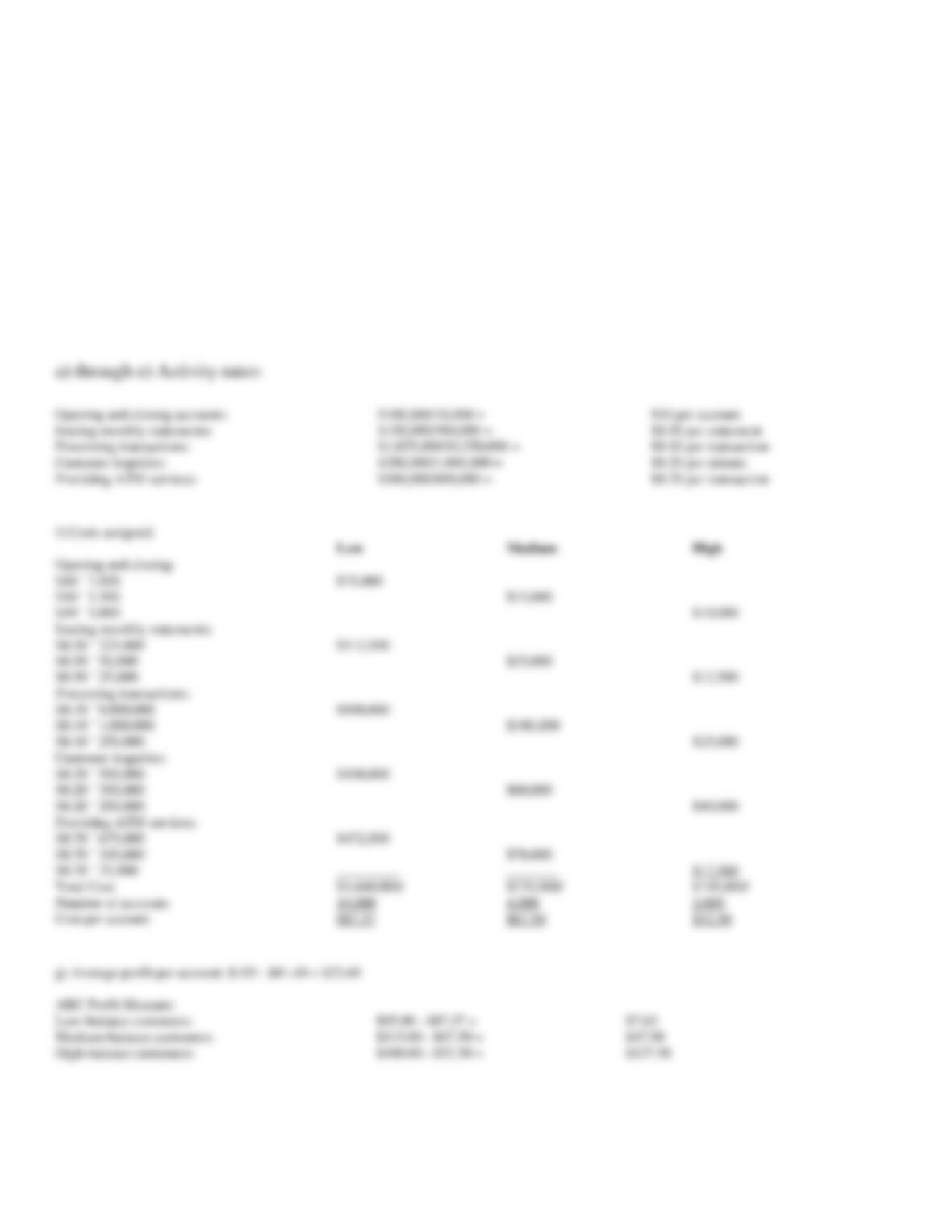
Refer to Figure 6-8:
Sallisaw uses an activity-based costing system. The activity rate for opening and closing statements is based on the number of accounts opened and
closed. The activity rate for issuing monthly statements is based on the number of statements issued. The activity rate for processing transactions is
based on the number of transactions processed. The activity rate for customer inquiries is based on the number of telephone minutes. The rate for
ATM services is based on the number of ATM transactions.
a) Calculate the activity rate for opening and closing accounts.
b) Calculate the activity rate for issuing monthly statements.
c) Calculate the activity rate for processing transactions.
d) Calculate the activity rate for customer inquiries.
e) Calculate the activity rate for providing ATM services.
f) Calculate the cost per account by customer category using the five activity rates.
g) Sallisaw Savings & Loan offers free checking to all its customers. Overall, the interest revenues average $105 per account; however, the interest
revenues earned per account by category are $95, $115, and $180 from the low, medium and high balance accounts, respectively. Calculate the
overall average profit per account. Then calculate the average profit per account for each of the three customer categories.
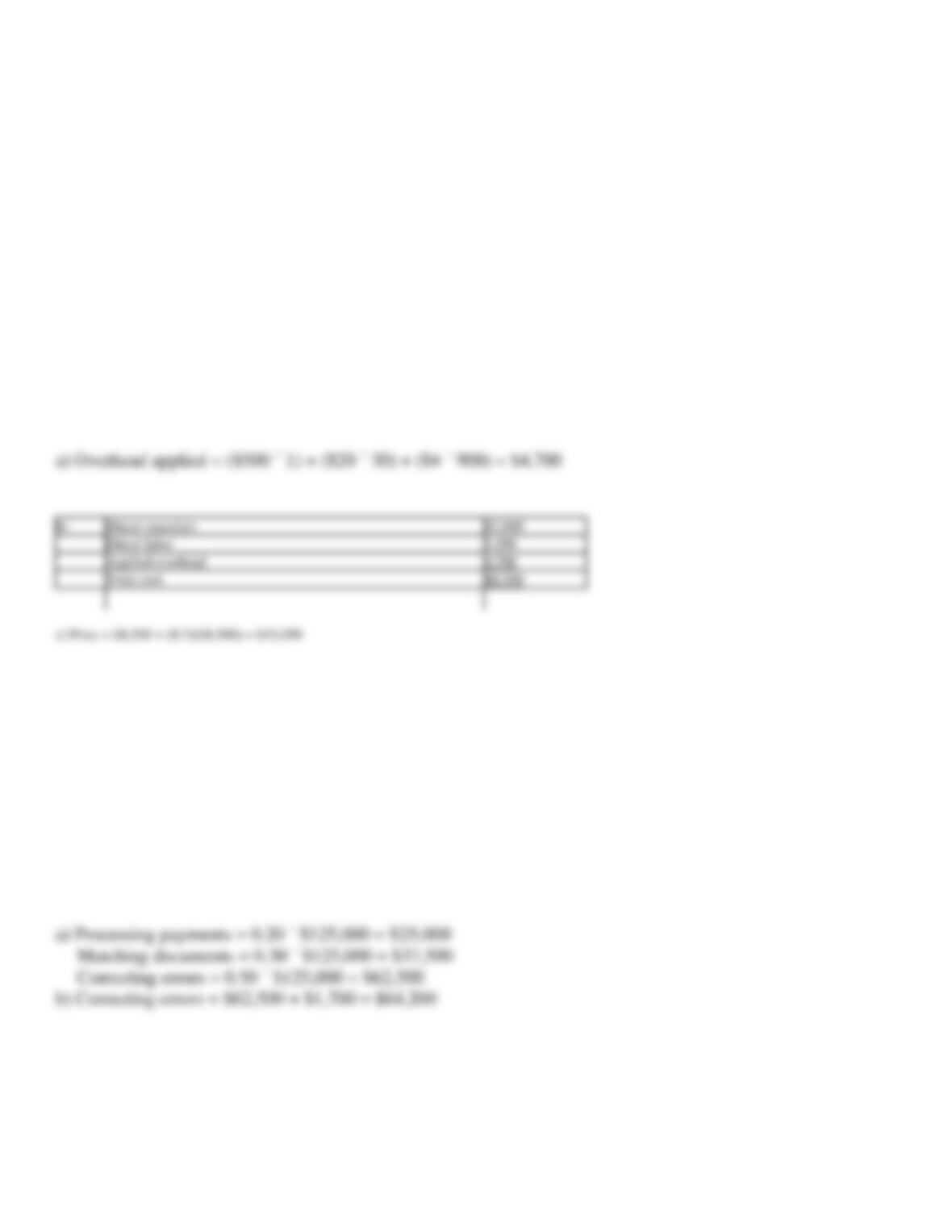
106. Thompson Company uses activity-based costing to figure product cost. Three activities have been
determined and rate calculated.
Setting up equipment = $500 per setup
Moving goods = $20 per move
Machining = $4 per machine hour
Thompson provided the following data from the job order cost sheet for Job #345
Direct materials
$2,000
Direct labor
1,800
Setups
1
Moves
30
Machine hours
900
a) Calculate the overhead applied to Job #345.
b) Calculate the total cost of Job #345.
c) If price is calculated by applying a 30 % markup on cost, what is the price for Job #345?
107. Assume that the accounts payable department of a company has 5 clerks; each one is paid $25,000 per year
($125,000 total clerical salaries). On average, the clerks spend:
20% of time on processing payments
30% of time matching invoices, receiving documents, and billing statement
50% of time correcting errors in the various documents
In addition, long distance telephone costs of $1,700 are directly traced to the activity “correcting errors.”
a) Assign the clerical salary cost to each of the three activities.
b) What is the total cost of the “correcting errors” activity?
b)
Direct materials
$2,000
Direct labor
1,800
Applied overhead
4,700
Total cost
$8,500
108. Assume that the accounts payable department of a company has 10 clerks; each one is paid $25,000 per
year ($250,000 total clerical salaries). Six of the clerks spend the following percentages of time on the three
activities:
20% of time on processing payments
30% of time matching invoices, receiving documents, and billing statement
50% of time correcting errors in the various documents
One clerk, the head clerk, spends 50% of her time on administrative duties, and the remainder on error
correction. The remaining three clerks spend 30% of their time on processing payments and the remaining 70%
of their time on matching documents.
Long distance telephone costs of $1,700 are directly traced to the activity “correcting errors.”
a) Assign the clerical salary cost to each of the three activities, and to administration.
b) What is the total cost of the “correcting errors” activity?
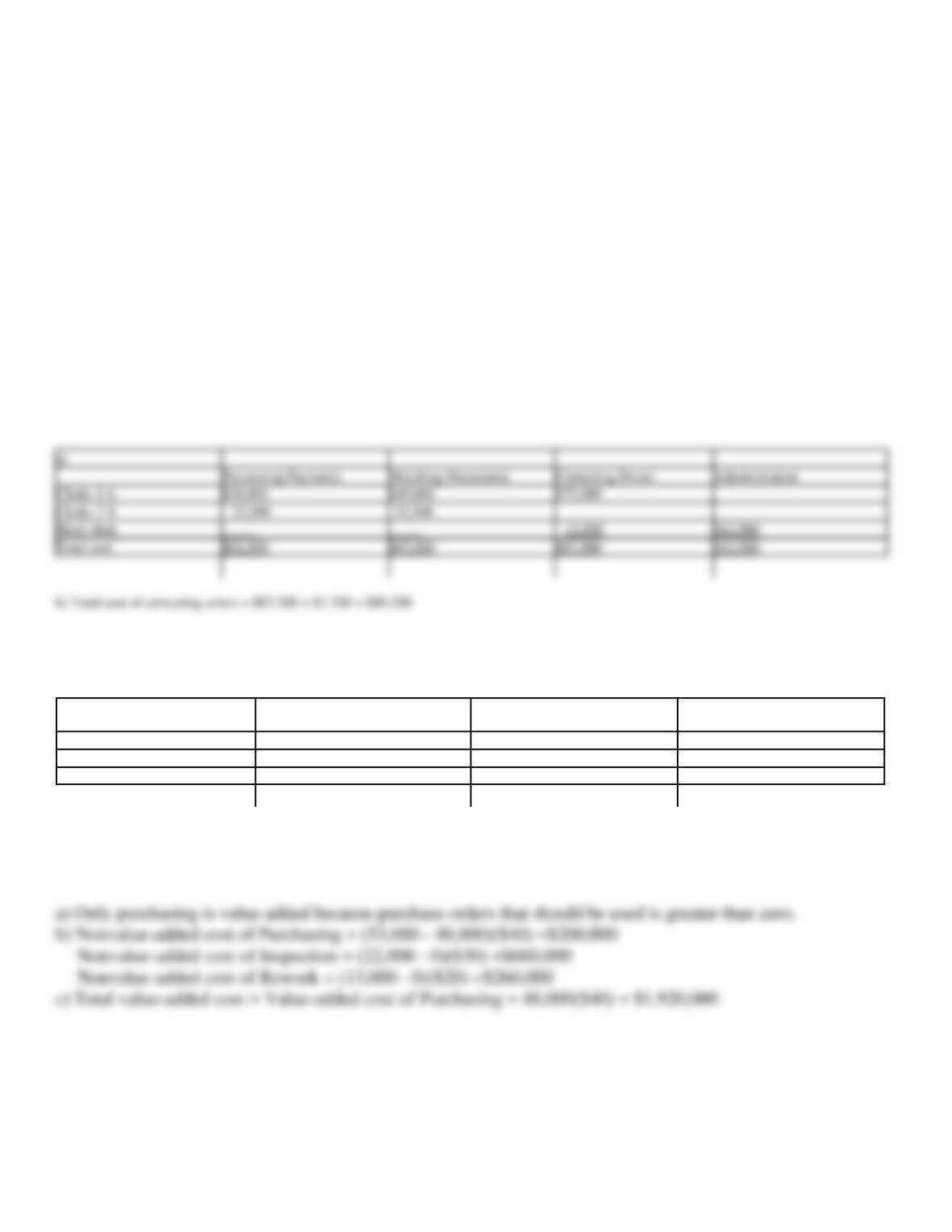
109. Consider the following information on activities:
Activity (driver)
Amount of Driver That Should be
Used
Actual Amount Used
Cost per unit of driver
Purchasing (purchase orders)
48,000
53,000
$40
Inspection (inspection hours)
0
22,000
$30
Rework (labor hours)
0
13,000
$20
a) Which of the three activities, if any, is value added?
b) What is the nonvalue-added cost of each activity?
c) What is the total value-added cost of the activities?
Processing Payments
Matching Documents
Correcting Errors
Administration
Clerks 1-6
$30,000
$45,000
$75,000
Clerks 7-9
22,500
52,500
Head clerk
12,500
$12,500
Total cost
$52,500
$97,500
$87,500
$12,500
110. Develop a set of at least five interview questions that could be used in the construction of an activity
dictionary. Also explain why you would ask each question, i.e., what information you hope to acquire and how
it would apply to the activity dictionary.
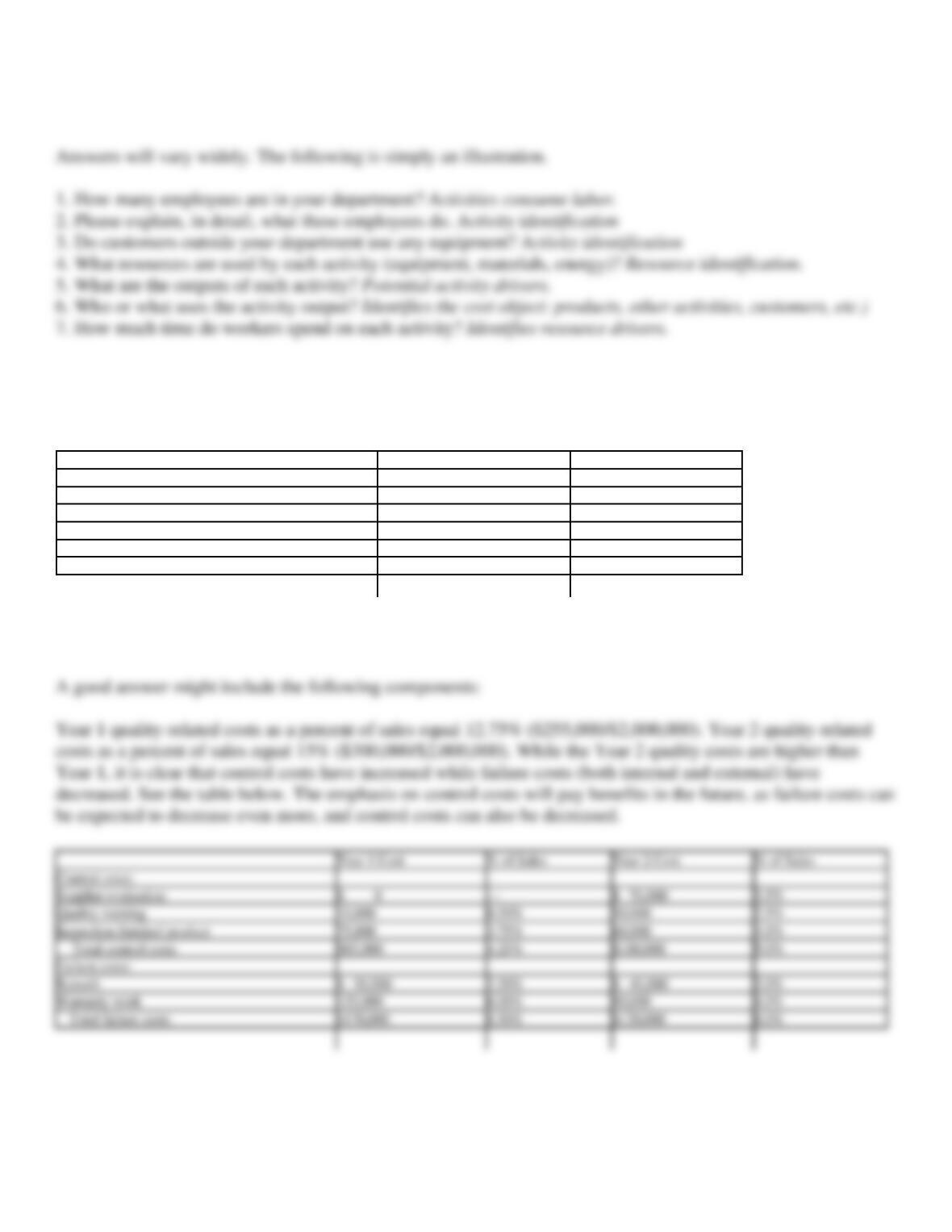
111. A company has developed a list of quality-related costs as follows:
Year 1
Year 2
Supplier evaluation
$ 0
$ 70,000
Quality training
10,000
50,000
Inspection of finished product
75,000
60,000
Rework
50,000
40,000
Warranty work
120,000
80,000
Sales
$2,000,000
$2,000,000
The company’s controller is pleased with the Year 2 results and commented that the company is now on its way toward total quality. Is the controller
right? Explain.
Year 1 Cost
% of Sales
Year 2 Cost
% of Sales
Control costs:
Supplier evaluation
$ 0
$ 70,000
3.5%
Quality training
10,000
0.50%
50,000
2.5%
Inspection finished product
75,000
3.75%
60,000
3.0%
Total control costs
$85,000
4.25%
$180,000
9.0%
Failure costs:
Rework
$ 50,000
2.50%
$ 40,000
2.0%
Warranty work
120,000
6.00%
80,000
4.0%
Total failure costs
$170,000
8.50%
$120,000
6.0%