6-18 Test Bank – Chapter 6 – The Current Asset Classification, Cash, and Accounts Receivable
52. The following information was taken from the unadjusted trial balance and aging schedule of
Diane Company on December 31, 2017. All sales are on account.
Accounts and related balances at December 31, 2017 before adjustment:
Debit
Credit
Accounts receivable
$46,000
Allowance for doubtful accounts
$ 680
Sales (all on account)
500,000
Sales returns
3,000
Aging Schedule of Accounts Receivable:
Age
Amount
% Uncollectible
0-30 days
$14,000
5%
30-60 days
20,000
8%
Over 60 days
12,000
12%
If Diane Company estimates bad debts as 6% of net credit sales, what is the amount of bad debt
expense to be reported on the income statement for the period ending December 31, 2017?
a. $27,019
b. $29,820
c. $30,000
d. $29,779
53. On December 1, 2017, Sedona Trading Co. sold goods to a German company for 25,000
German marks (25,000 DM) to be collected on January 12, 2018. The exchange rates on
December 1 and December 31, 2017 are US$0.75 = 1 DM and US$.90 = 1 DM, respectively.
What is Sedona’s sales revenue in U.S. dollars?
a. $18,750
b. $22,500
c. $3,750
d. $41,250
Test Bank – Chapter 6 – The Current Asset Classification, Cash, and Accounts Receivable 6-19
54. On December 1, 2017, Sedona Trading Co. sold goods to a German company for 25,000
German marks (25,000 DM) to be collected on January 12, 2018. The exchange rates on
December 1 and December 31, 2017 are US$0.75 = 1 DM and US$.90 = 1 DM, respectively.
What is Sedona’s exchange gain or loss for 2017?
a.$22,500 Exchange Gain
b. $3,750 Exchange Loss
c. $3,750 Exchange Gain
d. $18,750 Exchange Loss
MATCHING QUESTIONS
1. For each item listed in 1 through 5 below, place the letter of the best description selected from a
through e in the space provided. You may use each letter more than once or not at all.
Descriptions
a. (Accounts receivable∕sales) x 365
b. Amount of Accounts Receivable to be collected
c. Proper matching achieved
d. Used to reduce risk
e. Cash-purchase-sale-cash
____ 1. Operating cycle
____ 2. Net realizable value
____ 3. Allowance method
____ 4. Collection period
____ 5. Hedging
6-20 Test Bank – Chapter 6 – The Current Asset Classification, Cash, and Accounts Receivable
2. For each item numbered 1 through 5 below, identify the letter of the best description by selecting
from items a through e below. You may use each letter more than once or not at all.
Descriptions
a. Intention is to convert into cash within one year
b. Current assets/current liabilities
c. Current assets – current liabilities
d. Must pay within one year
e. (Cash + marketable securities + accounts receivable) divided by current liabilities
____ 1. Current liabilities
____ 2. Current assets
____ 3. Quick ratio
____ 4. Working capital
____ 5. Current ratio
3. For each item listed in 1 through 5, place the letter (a through e) of the best description in the
space provided. You may use each letter more than once or not at all.
Descriptions
a. Occurs when a customer brings back merchandise for a refund
b. Uses multiple bad debt rates
c. Decreases accounts receivable
d. Deduction, other than returns, to compute net realizable value
e. Estimated cash value
f. Arises from normal credit sales transactions with customers
____ 1. Sales returns
____ 2. Accounts receivable
____ 3. Cash discounts
____ 4. Net realizable value
____ 5. Aging schedule
Test Bank – Chapter 6 – The Current Asset Classification, Cash, and Accounts Receivable 6-21
SHORT PROBLEMS
1. At the beginning of 2017, Flagstaff Corp.’s allowance for doubtful accounts is $10,000. During
2017, $7,000 was written off as uncollectible. At December 31, the company used an aging
schedule of accounts receivable and determined that $8,000 of the accounts receivable would
probably be uncollectible. Calculate bad debt expense to be reported on Flagstaff’s 2017 income
statement.
2. Before adjusting entries, Dormont Corp’s accounts receivable and allowance for doubtful
accounts are $800,000 and $7,000 (credit balance), respectively. Using an aging schedule of
accounts receivable, it is determined that $44,000 of the accounts receivable would probably be
uncollectible. Calculate the net realizable value of Dormont’s receivables at year end.
Use the information that follows concerning the current assets and current liabilities of Ryan Company at
December 31, 2017, to answer problems 3 through 8. Each problem is independent of the others.
Current Assets
Cash
$1,700
Accounts Receivable
$2,900
Less Allowance
(70)
2,830
Inventory
2,270
Prepaid expenses
300
Total
$7,100
Current Liabilities
Accounts payable
$4,000
Wages payable
300
Taxes payable
200
Rent payable
800
Notes payable
1,000
Total
$6,300
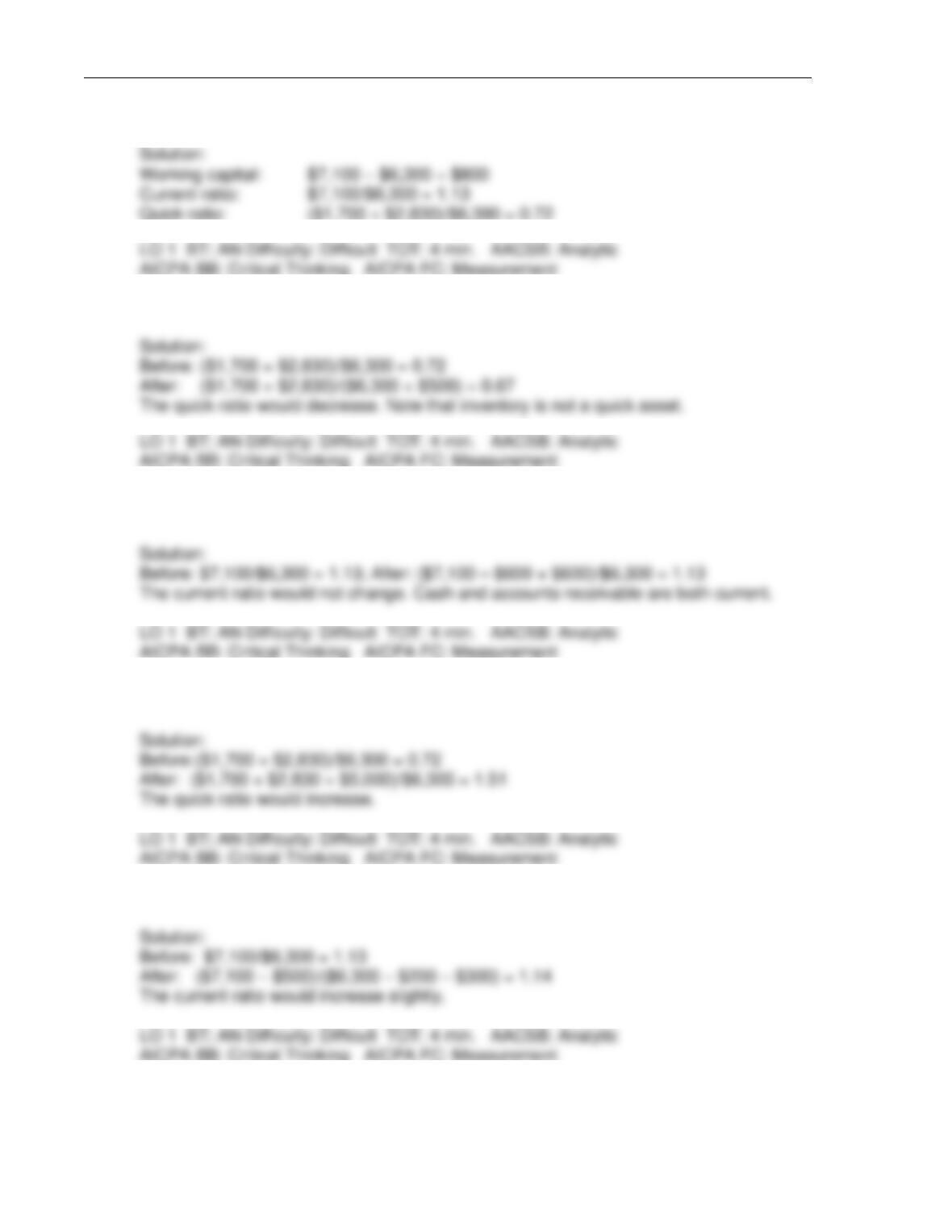
3. How would the current ratio be affected if Ryan collects some accounts receivable and then uses
$4,000 cash to pay off the accounts payable?
6-22 Test Bank – Chapter 6 – The Current Asset Classification, Cash, and Accounts Receivable
4. Calculate Ryan’s working capital, current ratio, and quick ratio at December 31, 2017.
5. How would the quick ratio be affected if Ryan purchased $500 of inventory on account?
6. How would the current ratio be affected if Ryan collects $600 from customers for amounts owed?
7. What would the quick ratio be if Ryan sold all of its inventory for $5,000 cash?
8. How would the current ratio be affected if Ryan paid off its wages and taxes?
Test Bank – Chapter 6 – The Current Asset Classification, Cash, and Accounts Receivable 6-23
9. Brocton Inc. sells to customers only on credit. For the year ended December 31, 2017, the
following information is provided:
Sales revenue
$550,000
Accounts receivable, 1/01/17
240,000
Allowance for doubtful accounts, 12/31/17 (before adjustment for bad debts)
600
Collections during 2017
580,000
Accounts written off as uncollectible during 2017
14,000
Sales returns
6,000
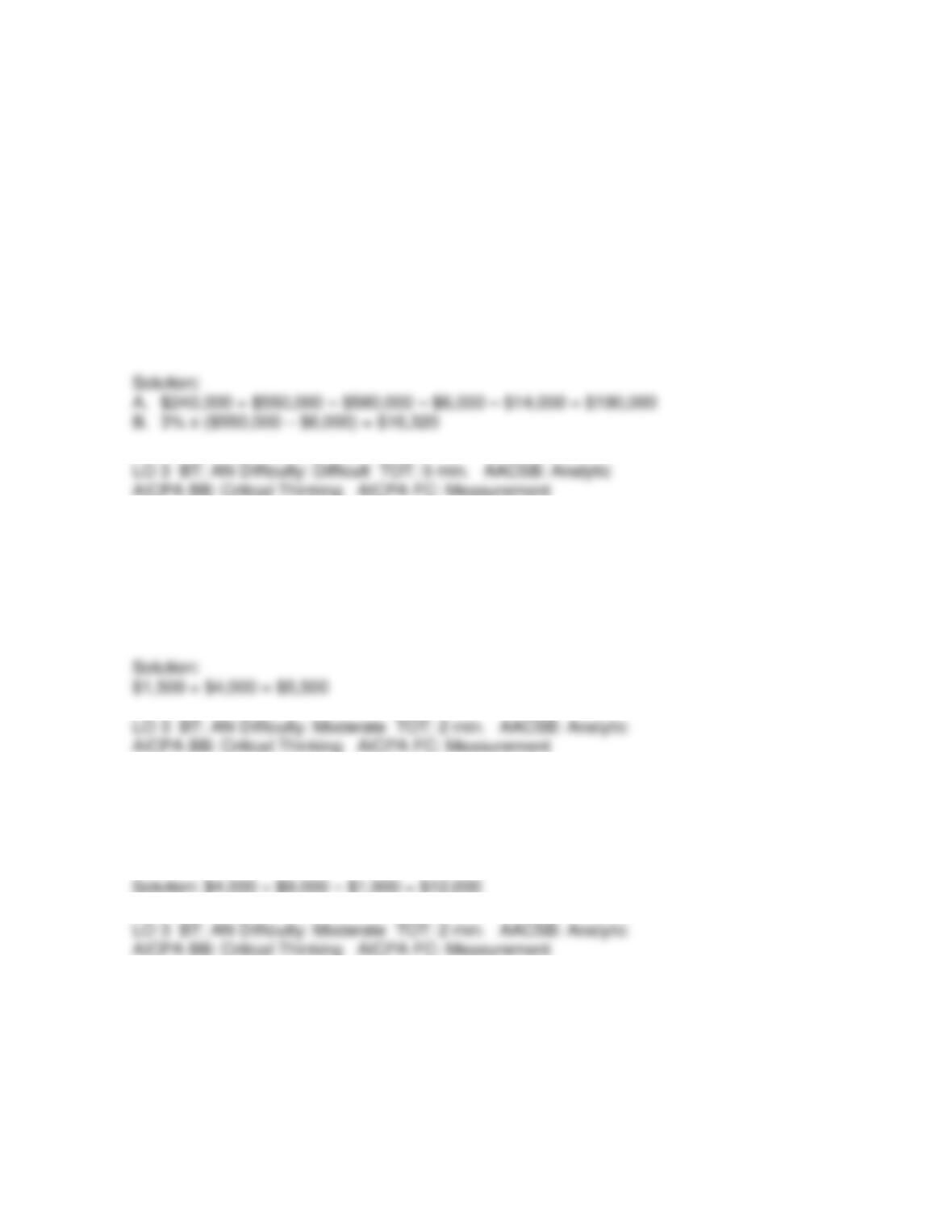
A. Determine the balance of the Accounts Receivable account at December 31, 2017.
B. If Brocton estimates bad debts at 3% of net credit sales, how much is bad debt expense?
10. Before adjusting entries, Martin’s accounts receivable and allowance for doubtful accounts are
$65,000 and $1,500 (debit balance), respectively. Using an aging schedule of accounts
receivable, it is determined that $4,000 of the accounts receivable would probably be
uncollectible. Calculate bad debt expense to be reported on Martin’s current year’s income
statement.
11. The balances of the allowance for doubtful accounts on the balance sheets dated December 31
of 2017 and 2016 were $1,000 and $4,000, respectively. During 2017, bad debt expense was
$9,000. What is the amount of accounts receivable that were written off as uncollectible during
2017?
6-24 Test Bank – Chapter 6 – The Current Asset Classification, Cash, and Accounts Receivable
12. The following information is provided for Garland Inc. Answer the questions that follow.
Balance Sheet
2017
2016
Cash and cash equivalents
$98,000
$114,000
Accounts Receivables, less allowance for doubtful
accounts of $3,000 (2017) and $1,800 (2016)
165,000
132,000
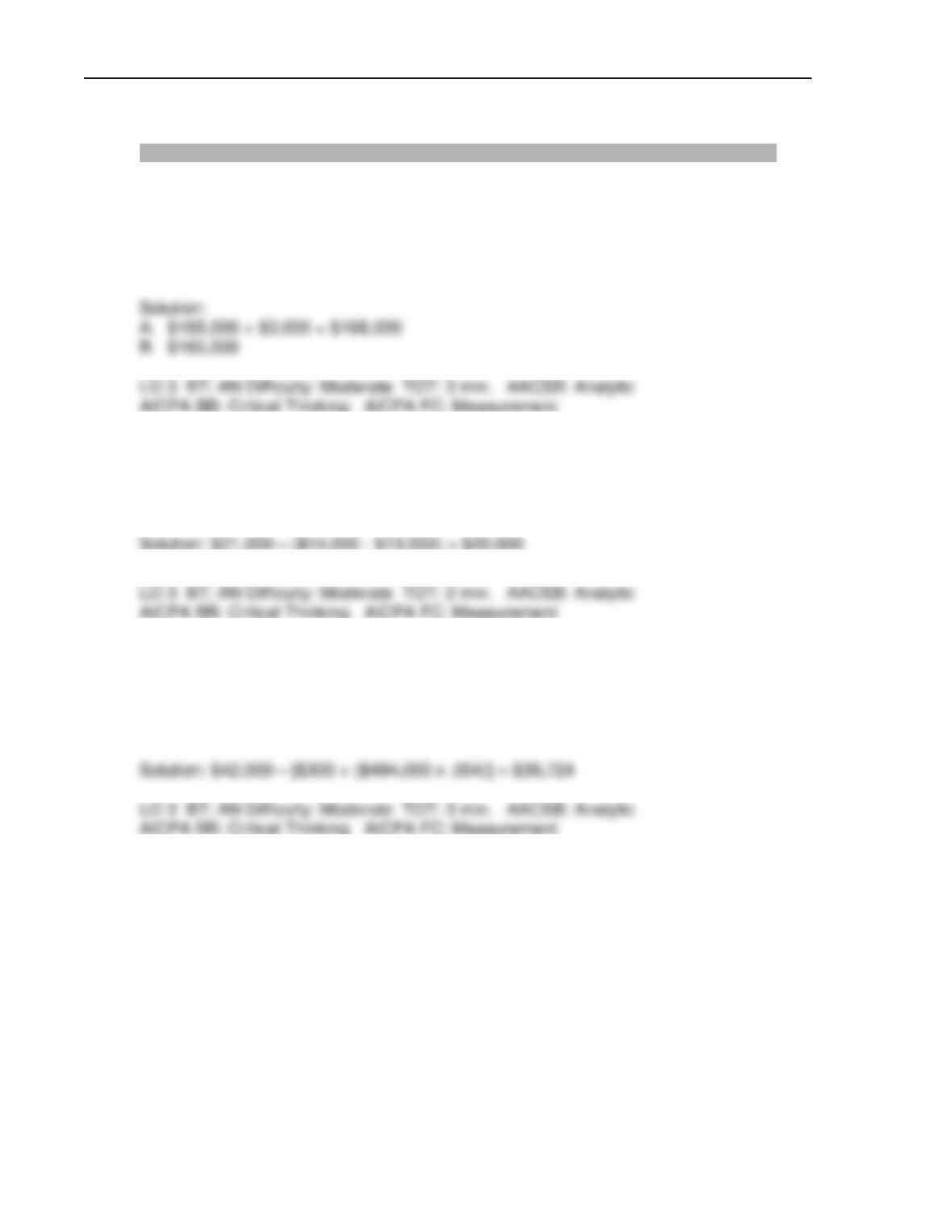
A. How much is the balance in the Accounts Receivable account at December 31, 2017?
B. What is the amount of the Net Realizable Value of the receivables at December 31, 2017?
13. The balances of the allowance for doubtful accounts on the balance sheets dated December 31
of 2017 and 2016 were $21,000 and $14,000, respectively. During 2017, $13,000 of accounts
receivable were written off as uncollectible. How much bad debt expense is recognized during
2017?
14. Before adjusting entries, Clark’s accounts receivable and allowance for doubtful accounts are
$42,000 and $300 (credit balance), respectively. Clark determined that 0.4% of net sales would
probably be uncollectible. Sales during the year were $500,000 and sales returns amounted to
$6,000. Calculate the net realizable value of accounts receivable on Clark’s balance sheet at
year-end.
Test Bank – Chapter 6 – The Current Asset Classification, Cash, and Accounts Receivable 6-25
15. Use the information that follows taken from the unadjusted trial balance and aging schedule of
Behrend Company on December 31, 2017 to answer the questions below. All sales are on account.
Accounts and related balances at December 31, 2017 before adjustment:
Debit
Credit
Accounts receivable
$47,000
Allowance for doubtful accounts
$ 420
Sales (all on account)
400,000
Sales returns
2,000
Aging Schedule of Accounts Receivable:
Age
Amount
% Uncollectible
0-30 days
$15,000
2%
30–60 days
18,000
7%
Over 60 days
14,000
13%
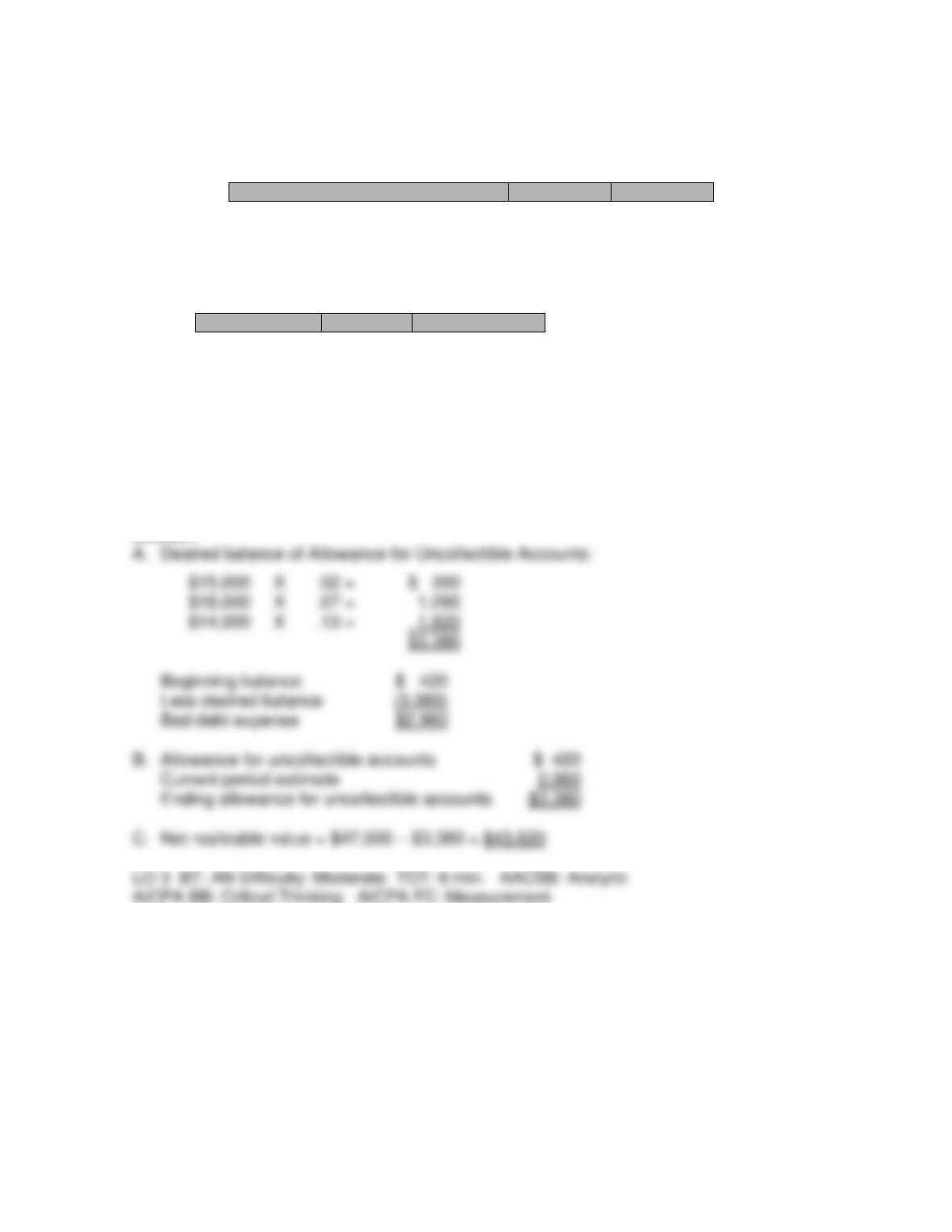
If Behrend uses the aging schedule of accounts receivable to determine bad debts, determine the
following:
A. Bad debt expense for the year ending December 31, 2017
B. Allowance for Doubtful Accounts balance at December 31, 2017
C. Net realizable value of accounts receivable on the 2017 financial statements
Solution:
6-26 Test Bank – Chapter 6 – The Current Asset Classification, Cash, and Accounts Receivable
Use the information that follows from the financial statements of Pines Company at December 31, 2017,
to answer questions 16 through 20 that follow.
Accounts payable
$ 2,000
Accounts receivable
3,000
Capital stock
8,000
Cash
5,000
Inventory
19,000
Land
24,000
Notes payable (short-term)
5,000
Cost of goods sold
12,000
Retained earnings
21,000
Sales revenue
20,000
16. Calculate total current assets for Pines Company at December 31, 2017.
17. Calculate total current liabilities for Pines Company at December 31, 2017.
18. Calculate total working capital for Pines Company at December 31, 2017.
19. Calculate the current ratio for Pines Company at December 31, 2017.
20. Calculate the quick ratio for Pines Company at December 31, 2017.
Test Bank – Chapter 6 – The Current Asset Classification, Cash, and Accounts Receivable 6-27
21. On December 1, 2017, Casio Trading Co. sold goods to a German company for 20,000 German
marks (20,000 DM) to be collected on January 12, 2018. The exchange rates on December 1
and December 31, 2017 are US$0.50 = 1 DM and US$.60 = 1 DM, respectively. Calculate
Casio’s revenue in U.S. dollars and its exchange gain or loss for 2017.
22. On December 11, 2017, Bisbee Co. purchased capsules from a Canadian company for 10,000
Canadian dollars (10,000 C$) to be paid on January 2, 2018. The exchange rates on December
11 and December 31, 2017 are US$0.79 = 1C$ and US$0.82 = 1C$, respectively. What is the
cost of the capsules in U.S. dollars and the 2017 exchange loss?
23. On December 1, 2017, Mason Company delivered a shipment of goods to a Swiss customer for
a price of 150,000 euros. If on that date 1.3 U.S. dollars could be exchanged for 1 euro, what
entry would Mason record in equivalent U.S. dollars?
24. The following are partial balance sheets for Pedro Co, dated December 31:
2016
2017
Accounts receivable
$55,000
$68,000
Allowance for doubtful accounts
(5,000)
(11,000)
Net realizable value
$50,000
$57,000
During 2017, $4,000 of accounts receivable were written off as uncollectible. Calculate the
amount of bad debt expense recognized on Pedro’s 2017 income statement.
6-28 Test Bank – Chapter 6 – The Current Asset Classification, Cash, and Accounts Receivable
25. Paxton’s aging schedule of its accounts receivable on December 31 follows:
Account Age
Balance
Non-collection Likelihood
1-30 days
$100,000
3%
31-90 days
70,000
7%
Over 90 days
40,000
10%
The balance in Paxton’s allowance for doubtful accounts immediately prior to December 31
adjusting entries is $700 credit. Determine bad debt expense and the net realizable value of the
December 31 accounts receivable.
26. On 12/31/16, Phoebe Company’s balance sheet revealed a $7,000 balance in its allowance for
doubtful accounts. During 2017, $2,000 of accounts were written off and $500 of accounts
receivable previously written off were collected. On 12/31/17, bad debt expense was estimated
to be 5% on net credit sales, which were $400,000. Calculate the balance in the allowance for
doubtful accounts on 12/31/17.
Test Bank – Chapter 6 – The Current Asset Classification, Cash, and Accounts Receivable 6-29
SHORT ESSAY QUESTIONS
1. Briefly describe hedging.
2. The Porsha Bank has provided its auditor with the following selected financial data for 2017:
Cash
$ 7,000
Loans receivable—current
$21,000
Allowance for doubtful accounts
(3,000)
18,000
Total current assets
$25,000
Loans receivable—long-term
$36,000
Allowance for doubtful accounts
(4,000)
$32,000
Current liabilities
$19,000
2017 net income
$30,000
In reviewing the loans outstanding, the auditors were troubled by the fact that the collectability of
some loans to Brazil was questionable. In fact, Porsha Bank has been making new loans to
Brazil so that they can pay the interest on the loans already outstanding. The economic situation
of Brazil has forced the auditors to insist that Porsha Bank increase its allowance for its current
loans to $9,000 and for its non-current loans to $16,000. Porsha Bank decided to adhere to their
auditors’ suggestions.
Indicate the effects of adopting the auditor’s allowance requirements on Porsha Bank’s current
ratio and 2017 net income.
6-30 Test Bank – Chapter 6 – The Current Asset Classification, Cash, and Accounts Receivable
3. Why might an operating cycle of one company differ from an operating cycle of another
company?
4. What accounting requirements brought significant opposition from the banking industry?
5. Identify the limitations of current asset classification.
Solution:
Test Bank – Chapter 6 – The Current Asset Classification, Cash, and Accounts Receivable 6-31
6. A company has a significant debit or credit accumulation in the preadjustment balance of
allowance for doubtful accounts over several periods.
Required:
(1) What would this indicate?
(2) How can users detect the source of this problem?
Solution:
7. Preston Bank has $50 million of loans outstanding on December 31 of the current year, in which
it recorded net income of $770,000. Preston did not provide for any uncollectible loans because
all of its loans are collateralized by real estate. That is, if the loans were to default, Preston would
obtain the title to the real estate for which the loans were made. However, during the audit of
Preston’s financial statements, the auditing company determined that $5 million of the
outstanding loans would probably be dishonored (uncollectible). Because during the last three
years real estate values have deteriorated, they also investigated the real estate that backed
these collateralized loans. The market value of that real estate is negligible.
Recalculate Preston’s loans receivable on December 31 and current net income to an amount
that would be acceptable to the auditors.
Solution:
6-32 Test Bank – Chapter 6 – The Current Asset Classification, Cash, and Accounts Receivable
8. What effect does ‘window dressing’ have on the solvency of a company?
Test Bank – Chapter 6 – The Current Asset Classification, Cash, and Accounts Receivable 6-33
9. The following is a partial balance sheet for Quenton Company dated December 31, 2017:
Current assets
Cash
$20,000
Accounts receivable
$45,000
Allowance for doubtful accounts
(3,000)
Net realizable value
42,000
Inventory
33,000
Total current assets
$95,000
Current liabilities
$65,000
During 2017, $4,000 of accounts receivable were written off as uncollectible and bad debt
expense (based on an aging schedule) recognized on Quenton’s 2017 income statement was
$8,000. However, the president of the company believes that $2,500 of these receivables were
written off too soon. She believes that there is a good chance that they will be collected next
year. There is some historical evidence to back the president’s position.
A partial explanation for her position is that Quenton has a debt covenant requiring it to maintain
a current ratio of 1.5. The president believes that by reversing the write-off of $2,500 of accounts
receivable, the current assets will be $97,500 and the current ratio will be 1.5. However, the chief
financial officer states that a better approach to getting the current ratio to 1.5 is to pay off some
accounts payable. If the company paid $5,000 of accounts payable, the current ratio would
become the minimum 1.5 required by the debt covenant.
Comment, with numerical illustration, on the president’s and chief financial officer’s positions.
6-34 Test Bank – Chapter 6 – The Current Asset Classification, Cash, and Accounts Receivable
10. Why is too much cash undesirable?
11. Why is the timing of recording a receivable important?
Solution: