6.5-17) Assume Puppy Haven, Inc., uses the allowance method for bad debts. Puppy Haven wrote off the
$825 account of Dogs R’ Us, Inc., on February 19, 20X9. On October 8, 20X9, Puppy Haven, Inc., received a
check for $825 from Dogs R’ Us, Inc. Which of the following is the journal entry that Puppy Haven, Inc.,
will make on October 8, 20X9?
A) Bad Debts Expense 825
Accounts Receivable 825
B) Cash 825
Bad Debts Expense 825
C) Accounts Receivable 825
Allowance for Uncollectible Accounts 825
Cash 825
Accounts Receivable 825
D) Cash 825
Accounts Receivable 825
E) No journal entry is required on October 8, 20X9.
6.5-18) Assume Park Company uses the allowance method for bad debts. Park Company wrote off the
$75 account of Amanda Day on May 6, 20X9. On November 12, 20X9, Park Company received a check for
$75 from Amanda Day. What is the journal entry that Park will make on November 12, 20X9?
A) Cash 75
Accounts Receivable 75
B) Cash 75
Bad Debts Expense 75
C)Accounts Receivable 75
Bad Debts Expense 75
Cash 75
Accounts Receivable 75
D)Allowance for Uncollectible Account 75
Bad Debts Expense 75
Cash 75
Accounts Receivable 75
E) Accounts Receivable 75
Allowance for Uncollectible Accounts 75
Cash 75
Accounts Receivable 75
6.5-19) Park N’ Fly recovered a bad debt from Walsh Rent A Car in October 20X9 in the amount of $200
that was previously written off by Park N’ Fly in November 20X8. Park N’ Fly utilizes the percentage of
sales method to estimate bad debts. To adjust bad debt expense and the allowance for uncollectible
accounts for 20X8, Park N’ Fly must make which journal entry?
A) Bad debt expense 200
Allowance for uncollectible accounts 200
B) Allowance for uncollectible accounts 200
Bad debt expense 200
C) Bad debt expense 200
Accounts receivable 200
D) Accounts receivable 200
Allowance for uncollectible accounts 200
E) There is no journal entry required for the previous year’s accounts.
6.5-20) When an organization sells on credit, it is essentially reducing the risk that a portion of the
accounts receivable balance will never be collected.
6.5-21) The allowance method has two basic elements: (1) an estimate of the amount of accounts
receivable that will ultimately be uncollectible and (2) a contra account that contains the estimate and is
deducted from the accounts receivable.
6.5-22) A contra asset account is created under the allowance method because of the inability to write
down a specific customer‘s account at the time bad debts expense is recognized.
6.5-23) The accounts used in the journal entry for the write–off of accounts receivable is the same whether
a firm uses the percentage of sales, percentage of accounts receivable, or the aging method to estimate
bad debts expense.
6.5-24) In the aging of accounts receivable method, one would expect the bad debts percentages to
increase as the age of the accounts receivable increases.
6.5-25) When bad debts recoveries occur, the write–off should be reversed and the collection handled as a
normal receipt on account.
6.5-26) The specific write–off method assumes all sales are fully collectible until proved otherwise.
6.5-27) Accountants generally do not use the specific write–off method because it violates the matching
principle.
6.5-28) The Allowance for Uncollectible Accounts may have a debit balance before the adjusting entry is
prepared.
6.5-29) An aging schedule reveals $6,500 of uncollectible accounts. The Allowance for Uncollectible
Accounts currently has a credit balance of $250. The adjusting entry amount should be $6,250.
6.5-30) An aging schedule reveals $6,500 of uncollectible accounts. The Allowance for Uncollectible
Accounts account currently has a debit balance of $250. The adjusting entry amount should be $6,750.
6.5-31) McGarr Company has determined that 2% of $50,000 credit sales are uncollectible. The Allowance
for Uncollectible Accounts currently has a credit balance of $250. The adjusting entry amount should be
$1,000.
6.5-32) Kaskey Company has determined that 2% of $50,000 credit sales are uncollectible. The Allowance
for Uncollectible Accounts currently has a debit balance of $250. The adjusting entry should be prepared
for $1,250.
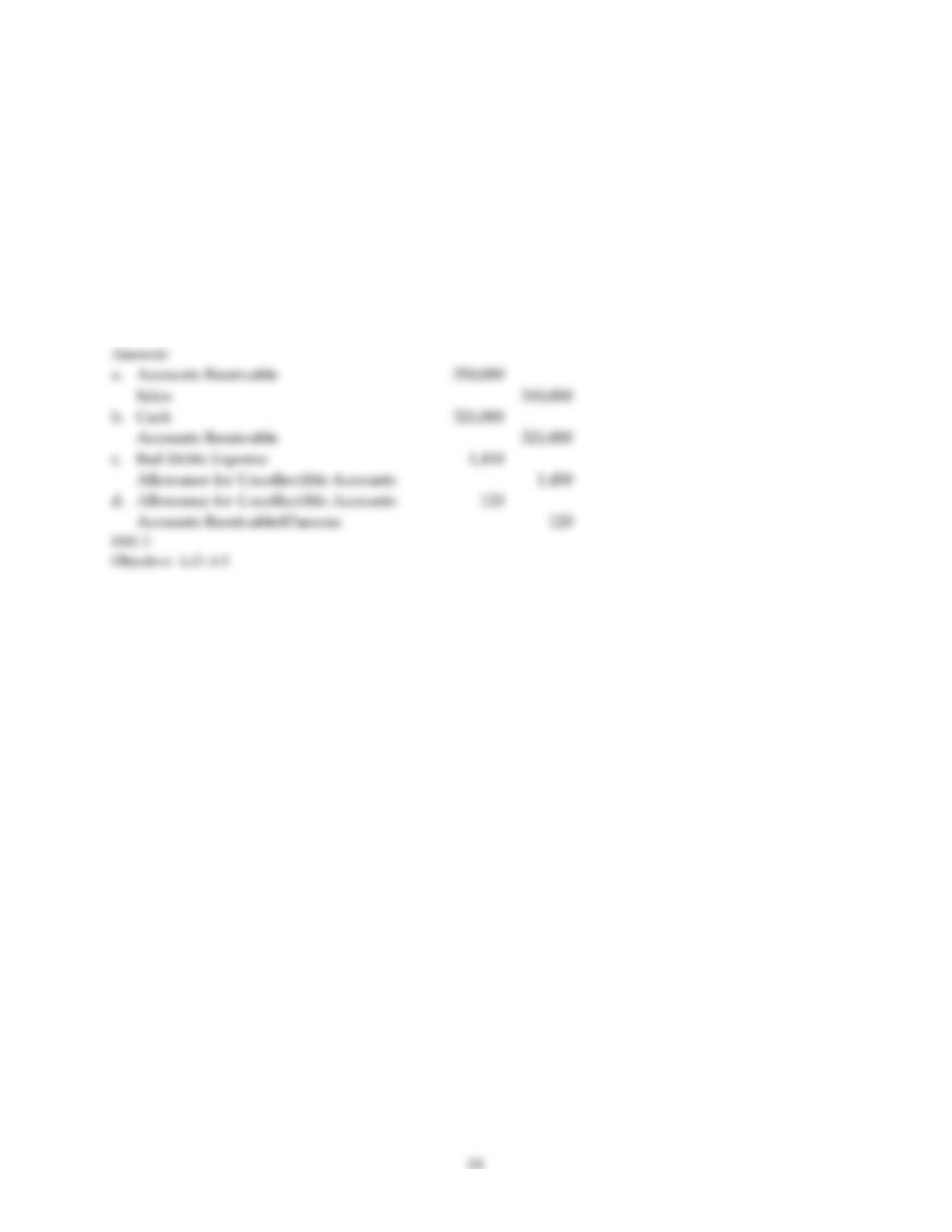
6.5-33) In its first year of operations, 20X9, Nordman Concrete, Inc., had credit sales of $350,000 to 120
different customers. Of this amount, Mr. Piper purchased $400 and Mr. Parsons purchased $180 on
account. During the year, cash collections of $321,000 were made, of which Mr. Piper paid $360 and Mr.
Parsons paid $60. At the end of 20X9, bad debts expense was estimated to be 5% of ending accounts
receivable. On February 23, 2X10, the balance in Mr. Parsons’ account was written off as uncollectible.
Prepare the appropriate journal entry on the books of Nordman Concrete for
a. the $350,000 in credit sales.
b. the collection of $321,000 from credit customers.
c. the estimation of bad debts expense.
d. the write–off of Mr. Parsons’ account.
6.5-34) Donelson Company has the following information available as of December 31, 20X9:
Total
Accounts 1–30 31–60 61–90 Over 90
Receivable Days Days Days Days
$60,000 $46,500 $7,400 $3,700 $2,400
Total credit sales for the year ended December 31, 20X9, were $825,000.
The balance in the Allowance for Uncollectible Accounts at December 31, 20X9, is a $500 debit.
The estimated bad debts percentages are as follows:
as a percentage of credit sales 1%
as a percentage of ending accounts receivable 10%
as a percentage of aging accounts receivable:
1–30 days 3%
31–60 days 15%
61–90 days 35%
Over 90 days 75%
Given the previous information, prepare the journal entry on December 31, 20X9, to estimate bad debts
under the allowance method using the
a. percentage of credit sales method.
b. percentage of ending accounts receivable method.
c. aging of accounts receivable method.
6.5-35) Denim Table Company has many accounts receivable. Denim Table Company’s balance sheet as of
December 31, 20X9, showed Accounts Receivable of $36,000 and an Allowance for Uncollectible Accounts
of $3,400 credit. In early 2X10, write–offs of customer accounts of $2,800 were made. In late 2X10, a
customer named Jeremy, whose $1,000 debt had been written off earlier, won a $1 million promotion cash
prize. He immediately remitted $1,000 to Denim Table Company.
Prepare the journal entries for the
a. $2,800 write–off in early 2X10.
b. receipt from Jeremy in late 2X10.
Learning Objective 6.6 Questions
Table 6–4
Consider the following information:
Cash sales $ 50,000
Credit sales 450,000
Beginning Cash 10,000
Ending Cash 14,000
Beginning Retained Earnings 35,000
Ending Retained Earnings 48,000
Beginning Accounts Receivable 30,000
Ending Accounts Receivable 40,000
Net Income 58,000
6.6-1) Referring to Table 6–4, determine the accounts receivable turnover.
A) 1.20
B) 2.92
C) 11.43
D) 12.86
E) 14.29
6.6-2) Referring to Table 6–4 and assuming a 365–day year, determine the days to collect accounts
receivable.
A) 304.2 days
B) 125.0 days
C) 31.9 days
D) 30.4 days
E) 28.4 days
6.6-3) All else equal, the lower the accounts receivable turnover ratio and the higher the days to collect
accounts receivable, the better.
6.6-4) The accounts receivable turnover ratio indicates how rapidly customers pay their bills.
6.6-5) The days to collect accounts receivable is calculated by dividing credit sales by the average
accounts receivable.
6.6-6) Teal Scissor Company reports the following information for the years ended December 31, 20X9
and 2X10:
2X10 20X9
Sales $ 980,000 $820,000
Accounts Receivable 75,000 65,000
Sales consisted of 80% credit sales and 20% cash sales during 20X9 and 2X10.
From the information given previously for Teal Scissor Company, determine the
a. accounts receivable turnover for 2X10.
b. days to collect accounts receivable for 2X10.
Learning Objective 6.7 Questions
6.7-1) Good accounting controls
A) include all methods and procedures that facilitate management’s planning and control of operations.
B) help maximize efficiency and minimize waste, unintentional errors, and fraud.
C) include procedures for granting credit to customers.
D) are not concerned with safeguarding assets.
E) All of the above statements are true concerning accounting controls.
6.7-2) All except which of the following statements concerning controls are appropriate?
A) Administrative controls consider the organization plan.
B) Accounting controls include procedures that facilitate management’s planning and control of
operations.
C) Accounting controls include the methods and procedures for authorizing transactions and
safeguarding assets.
D) Accounting controls are present to ensure the accuracy of the financial records.
E) Accounting controls minimize waste, errors, and fraud within an organization.
6.7-3) The internal accounting control that provides reasonable assurance that all authorized transactions
are recorded in the correct amounts, periods, and accounts is
A) authorization.
B) recording.
C) safeguarding.
D) reconciliation.
E) valuation.
6.7-4) Which of the following internal accounting control objectives relate to establishing the system of
accountability and are aimed at the prevention of errors and irregularities?
1. Authorization
2. Promoting operating efficiency
3. Reconciliation
4. Recording
5. Safeguarding
6. Valuation
A) 3 and 4
B) 4 and 5
C) 1, 3, and 4
D) 1, 4, and 5
E) 2, 3, and 5
6.7-5) Which of the following statements describes the Sarbanes–Oxley required attributes of a
management report?
A) A management report usually states that management is responsible for all audited and unaudited
information in the annual report, including a statement on the adequacy of internal controls.
B) A management report includes information with respect to management’s compensation, including the
salaries and bonuses received by the top executives of the company.
C) A management report lists the executives of the company and states what changes have been made in
management personnel since the prior period and why those changes were made.
D) A management report states how well or poorly the company performed during the most recent
period.
E) A management report states the acquisitions and divestitures that a company has made during the
current period.
6.7-6) Which of the following is not a typical attribute of an audit committee?
A) Audit committees typically meet at least twice a year.
B) Internal and external auditors report only to the audit committee and to no member of management.
C) Audit committees are comprised solely of outside board members.
D) Audit committees act as a liaison among the full board, internal auditors, external auditors, and
management.
E) Audit committees gather information directly from internal and external auditors.
6.7-7) Which of the following items from the checklist of internal control is most important?
A) Proper authorization
B) Separation of duties
C) Honest, reliable personnel
D) Adequate documents
E) Physical safeguards
6.7-8) All except which of the following statements are attributes of the principle of having reliable
personnel with clear responsibilities?
A) Employee theft causes larger losses to companies than shoplifting.
B) Responsibility for results should be traced to the individual level.
C) Appropriate overseeing and appraisal of employees is necessary.
D) Incompetent or dishonest individuals cannot undermine a strong internal control system.
E) Employers who use low–cost talent may find such a policy expensive in the long–run, due to fraud and
poor productivity.
6.7-9) The primary goal of the separation of duties is
A) to provide greater training to employees by allowing them to work on different tasks.
B) to make sure that one person, acting alone, cannot defraud the company.
C) to ensure that no one in management accumulates too much organizational power and control.
D) to provide clear promotion tracks within one’s discipline.
E) to provide a work environment where no one person is overloaded with work or does so many things
that he or she becomes indispensable to the company.
6.7-10) A policy stating that the board of directors must approve all expenditures for capital assets in
excess of $35,000 is an example of
A) specific authorization.
B) general authorization.
C) adequate documentation.
D) proper procedures.
E) an independent check.
6.7-11) A policy that forces clerks to make change by pricing items at $1.99, $2.99, and $3.99 rather than at
$2, $3, and $4 is an example of
A) adequate documentation.
B) general authorization.
C) specific authorization.
D) proper procedures.
E) an independent check.
6.7-12) A policy that requires organizations to use procedures manuals to specify the flow of documents
and provide information and instructions to facilitate adequate record–keeping is an example of
A) adequate documentation.
B) general authorization.
C) specific authorization.
D) proper procedures.
E) an independent check.
6.7-13) Rotation of duties has all except which of the following attributes?
A) Rotation of duties is not necessary if a company is bonded.
B) At least two employees know how to do each job.
C) It discourages employees from engaging in fraudulent activities.
D) Employees can exchange duties and thus can become familiar with more aspects of a company’s
operations.
E) It reduces the likelihood of major problems in the event that an employee leaves the company.
6.7-14) Internal auditors
A) are company employees.
B) help design the company’s control systems.
C) assess the degree of management’s compliance with the existing control system.
D) are an example of an independent check.
E) All of the above are true statements.
6.7-15) Which of the following tasks is not commonly performed by an external auditor?
A) External auditors examine transactions, but the number examined is dependent on the strength or
weakness of the internal control system.
B) External auditors evaluate the system of internal controls.
C) External auditors test whether the internal control system is being followed.
D) External auditors assume responsibility for the total accuracy of the financial statements.
E) External auditors inspect a sample of the transactions that are entered into the records of a company.
6.7-16) A policy of routinely paying the invoice amount without checking supporting documentation
except on a random sampling basis is an example of
A) cost–benefit analysis.
B) adequate documentation.
C) physical safeguards.
D) an independent check.
E) separation of duties.
6.7-17) Audit reports
A) state that management is responsible for all audited and unaudited information in the annual report.
B) include a description of the composition and duties of the audit committee.
C) include a description of the duties of the independent auditor.
D) include a statement on the adequacy of the company’s system of internal controls.
E) All of the above are true statements.
6.7-18) Internal accounting controls include administrative, financial statement, and accounting controls.
6.7-19) Accounting controls include the methods and procedures for authorizing transactions,
safeguarding assets, and ensuring the accuracy of the financial records.
6.7-20) Since auditors provide an opinion as to the fairness of the financial statements, auditors have the
primary responsibility for the preparation of the company’s financial statements.
6.7-21) Audit committees perform the internal audits of a company.
6.7-22) The most important element of internal control is reliable personnel with clear responsibilities.
6.7-23) Separation of duties will prevent collusion.
6.7-24) A main goal of the separation of duties is to make sure that one person, acting alone, cannot
defraud the company.
6.7-25) The aim of the internal control that calls for adequate documentation is the immediate, complete,
and tamper–proof recording of all transactions.
6.7-26) Top executives, branch managers, and individuals who handle cash and inventories should be
discouraged from taking vacations, as errors most frequently occur when other employees try to fill in.
6.7-27) State the key features included in an audit report.
6.7-28) Name four internal controls specific to the cash account.
6.7-29) Wells, Inc., manufactures lawn mowers. Materials are purchased by the purchasing agent from
information sent to him by the line manager. The line manager details how much to purchase as well as
whom to purchase the materials from. When materials arrive at the factory, they are sent immediately to
the stockroom without warehouse personnel checking on quantity or quality of the goods. Invoices are
received by the accounts payable department, which compares the invoice to the purchase order. If the
documents agree, payment is generated in the accounts payable department and sent to the vendor.
Propose improvements in the internal control procedures for Wells, Inc.
6.7-30) Describe a typical audit committee and discuss its primary responsibility.
Learning Objective 6.8 Questions
6.8-1) The following represent common reconciling items within a bank reconciliation:
1. Bank service charges
2. Deposits in transit
3. Outstanding checks
Which of the above items will be an adjustment to the balance per books?
A) 1 only
B) 2 only
C) 3 only
D) 1 and 2
E) 2 and 3
6.8-2) A bank overdraft
A) is typical on a bank reconciliation.
B) represents a customer‘s overpayment.
C) is an occasional courtesy from a bank allowing an account balance to be temporarily negative.
D) happens only of a company’s year end.
E) is the amount of money a company keeps as a compensating balance.
6.8-3) The bank reconciliation is
A) only required when a company suspects fraud.
B) supplied as a bank courtesy.
C) needed because the IRS requires it for cash–basis companies.
D) an important part of internal control.
E) usually reported in a company footnote.
6.8-4) Novak Industries had a check returned to it labeled “NSF.” What journal entry should Novak
Industries make to recognize the $200 NSF check?
A) Accounts receivable 200
Service charges 200
B) Bad debt expense 200
Accounts receivable 200
C) Accounts receivable 200
Bad debt expense 200
D) Allowance for uncollectible accounts 200
Accounts receivable 200
E) Accounts receivable 200
Allowance for uncollectible accounts 200
6.8-5) Deposits in transit are added to the balance per books when preparing a bank reconciliation.
6.8-6) Outstanding checks should be added to the balance per bank when preparing a bank reconciliation.
6.8-7) Bank service charges not recorded on the books should be added to the balance per books when
preparing a bank reconciliation.
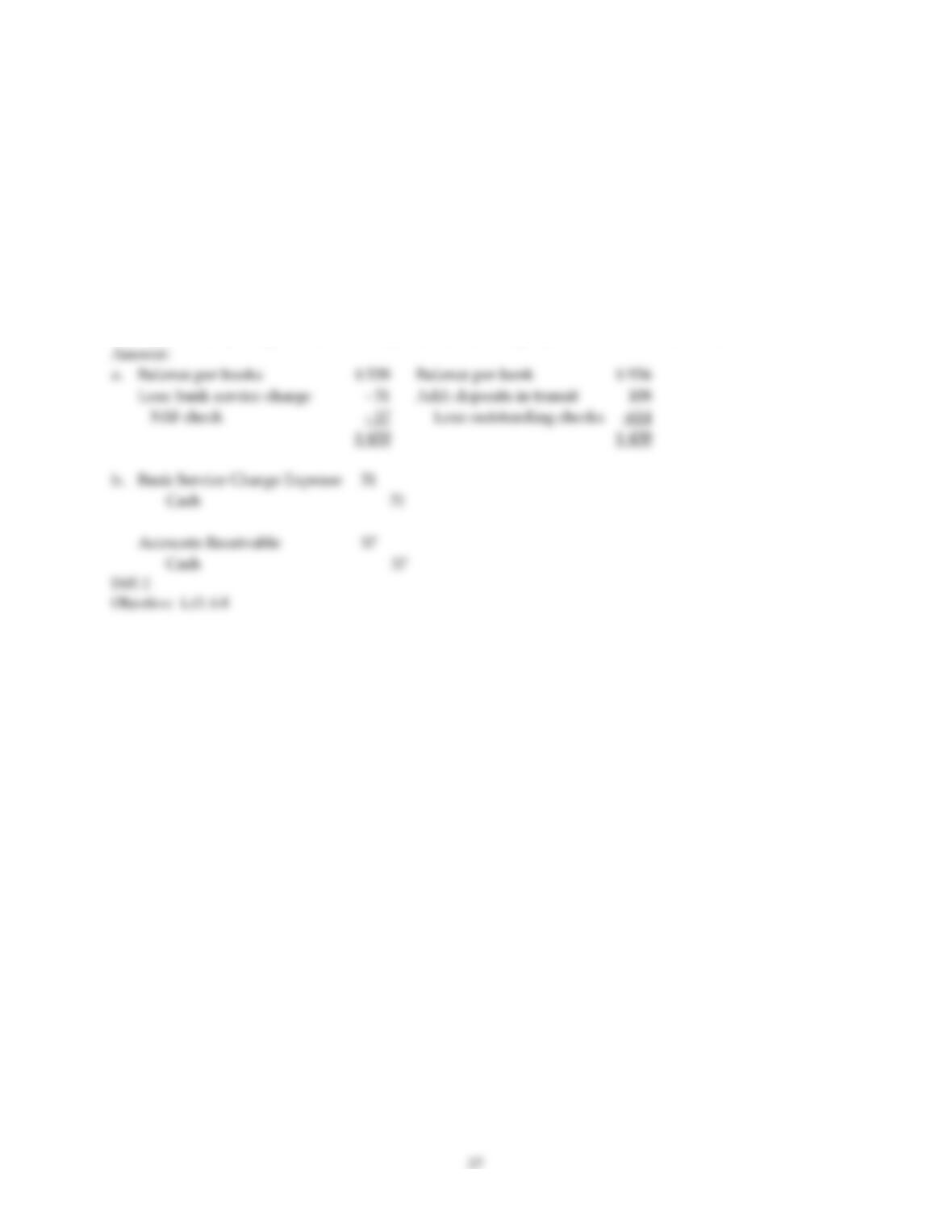
6.8-8) The following information is associated with the bank reconciliation of Fish Tackle Company as of
October 31, 20X4:
Balance per bank $ 956
Balance per books 538
Bank service charge 31
Deposits in transit 108
NSF check from a credit customer 57
Outstanding checks 614
a. Prepare a bank reconciliation for Fish Tackle Company dated October 31, 20X4.
b. Prepare the adjusting entries needed by Fish Tackle Company as a result of the bank reconciliation.

38
6.8-9) Corbin Catering prepares monthly bank reconciliations of its checking account balance. The bank
statement received by Corbin Catering for February 20X9 follows:
Corbin Catering First Fifth Bank
54 Windsong Drive PO Box 22
BANK STATEMENT DATE OF STATEMENT: February 28, 20X9
Credit Debit
Balance, February 1, 20X9 $ 29,500
Interest earned 100
Service charge 40
Account collected on behalf of Corbin 1,600
Checks:
#310 120
#312 260
#313 180
#314 215
#316 80
#317 110
Deposits:
February 15, 20X9 5,000
Ending Balance $ 35,195
Corbin Catering’s books disclosed the following additional information:
Checking account balance, February 1, 20X9 $ 29,500
Checks written:
#310 120
#311 40
#312 260
#313 180
#314 215
#315 200
#316 80
#317 110
Deposits:
February 15, 20X9 5,000
February 28, 20X9 2,500
Ending balance $ 35,795
Required:
Prepare a bank reconciliation for Corbin Catering at February 28, 20X9.
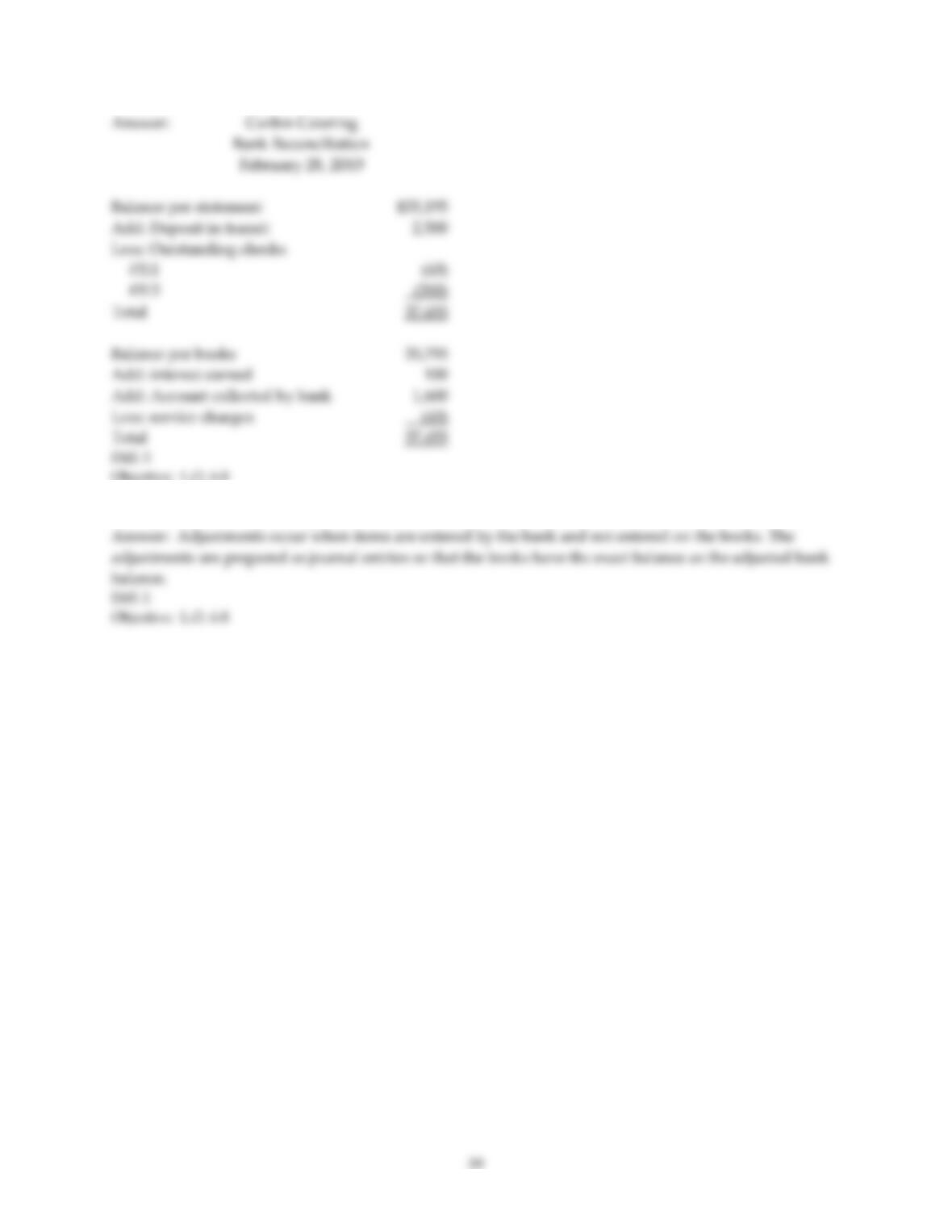
6.8-10) When and why are adjustments made to the books after the reconciliation of the bank account?