77)
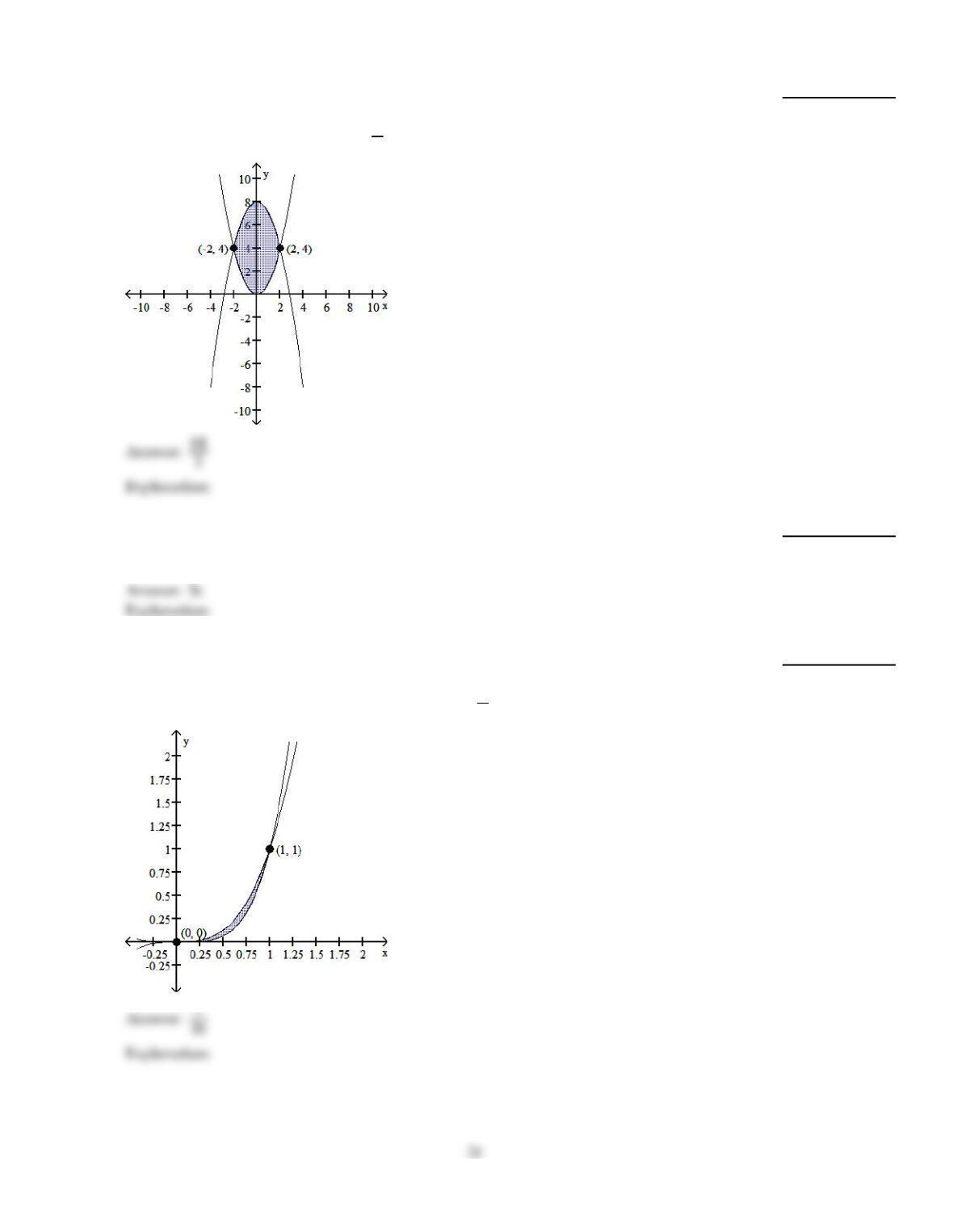
This is a sketch of the region between the two curves f(x) =x2, g(x) = 8 –x2. Compute this
area.
Enter just a reduced fraction of form a
b.
77)
78)
Use a Riemann sum to approximate the area under the graph of
f(x) = c, –2 x 3, n = 6. Use the left endpoints of the interval.
Enter an unlabeled answer.
78)
79)
This is a sketch of the region between the two curves f(x) =x3, g(x) =x4. Compute this
area.
Enter your answer as just a reduced fraction of form a
b.
79)
80)
Find: –3(ex/2 + 1) dx
Enter your terms in the same order in which they appear in the integral with each term in
standard power function form; any fractions reduced form a
b.
80)
81)
Determine the average value of g(x) =xover the interval from x = 0 to x = 4.
Enter a reduced fraction of form a
b.
81)
82)
Determine the average value of f(x) = x –x2 over the interval from x = 0 to x = 1.
Enter a reduced fraction of form a
b.
82)
83)
Determine the average value of f(x) =ex over the interval from x= 1 to x = 4.
Enter your answer in the form a(eb± e)
83)
84)
Use a Riemann sum to approximate the area under the graph of f(x) = x, 0 x 5, n = 10.
Use the right endpoints.
Enter just a real number to two decimal places.
84)
Calculate.
85)
100,000
–100,000
x3 dx
Enter just an integer.
85)
86)
Determine the area under the curve y =1
x from x = 1 to x = e.
Enter just an integer.
86)
87)
Given f(x) =x2+ x +1 on the interval 0 x 4 and with n = 5, compute the Riemann sum (a)
using the left endpoints; (b) using the right endpoints; and (c) using the midpoints of the
subintervals. Enter your answer as just a, b, c all integers separated by commas.
Enter the numbers in the order that answers (a), (b), (c) but do not label. Round to the
nearest whole number.
87)
Answer:
26, 42, 33
Explanation:
Calculate.
88)
2
1
1
x2– 3 dx
Enter just a reduced fraction of form a
b.
88)
89)
2
1
5x dx
Enter your answer as a reduced fraction of form a
b.
89)
Answer:
Explanation:
Find all antiderivatives of the function.
90)
f(x) =x15
Enter your answer as a polynomial in x in standard form.
90)
Answer:
Explanation:
Calculate.
91)
2
0
(x3+3x2+ x + 1) dx
Enter just an integer.
91)
Answer:
Explanation:
92)
For the Riemann sum, [(3.5)4+ 7(3.5) +(4)4+ 7(4) +(4.5)4+ 7(4.5) +(5)4+ 7(5)](0.5); a = 3,
find n, b, and f(x).
Enter your answer as just n, b, f(x) (2 integers in that order separated by commas and
followed by a polynomial in x).
92)
Answer:
23
Answer:
Explanation:
93)
Determine the area under the curve y = 4x + 4 from x = 2 to x = 3.
Enter an integer.
93)
94)
Given f(x) =ex+ x; 0 x 2, n = 6, set up a Riemann sum to approximate the area under the
graph of f(x) on the given interval. Use the left endpoints. Is the following the correct sum?
Enter “yes” or “no”.
1
31 +e1/3 +1
3+e2/3 +2
3+ (e + 1) +e4/3 +4
3+e5/3 +5
3
94)
Explanation:
95)
Given f(x) = ln(x + 1); 0 x 1, n = 3, set up a Riemann sum to approximate the area
under the graph of f(x) on the given interval. Use the midpoints. Is the following the
correct answer?
Enter “yes” or “no”.
ln 7
6+ ln 3
2+ ln 11
6
95)
Explanation:
96)
Find: 1 +x2
x2dx
Enter terms in the order in which they appear in standard power function forms with any
constant at the right end.
96)
Explanation:
97)
Find all functions f(x) with the following property: f'(x) =x5+ 2x3–3x2+ 6.
Enter your answer as a polynomial in x in standard form with any fractional coefficients or
powers reduced of form a
b.
97)
Explanation:
98)
Given f(x) =x3– 1 on the interval 1 x 5 and with n = 4, compute the Riemann sum (a)
using the left endpoints; (b) using the right endpoints; and (c) using the midpoints of the
subintervals. Enter your answer as just a, b, c all integers separated by commas.
Enter the numbers in the order that answers (a), (b), (c) but do not label.
98)
Explanation:
Explanation:
MULTIPLE CHOICE. Choose the one alternative that best completes the statement or answers the question.
Evaluate.
99)
0
–4
1
2x3dx
99)
A)
32
B)
– 128
C)
128
D)
– 32
100)
9
0
4 x dx
100)
A)
162
B)
108
C)
18
D)
72
Solve the problem.
101)
An object’s acceleration at time t is given by v'(t) =14t, and its initial velocity v(0) is 25. Find the
velocity function v(t).
101)
A)
v(t) =7t2+25
B)
v(t) =14t2+25
C)
v(t) =7t2+25t
D)
v(t) =25t2+14
102)
Suppose that f and g are continuous and that
10
6
f(x) dx = – 2 and
10
6
g(x) dx =9.
Find
10
6
f(x) –5g(x) dx .
102)
A)
–47
B)
43
C)
–11
D)
–55
103)
What is the consumers’ surplus for the demand curve p = 5 –x
20 at the sales level x = 60?
103)
A)
320 –1
20 ln 60
B)
291
C)
90
D)
200 – 20 ln 60
E)
none of these
Calculate.
104)
–1
–2
(x2–2x–3+ 3) dx
104)
A)
–89
12
B)
–151
12
C)
73
12
D)
–49
12
E)
none of these
26
105)
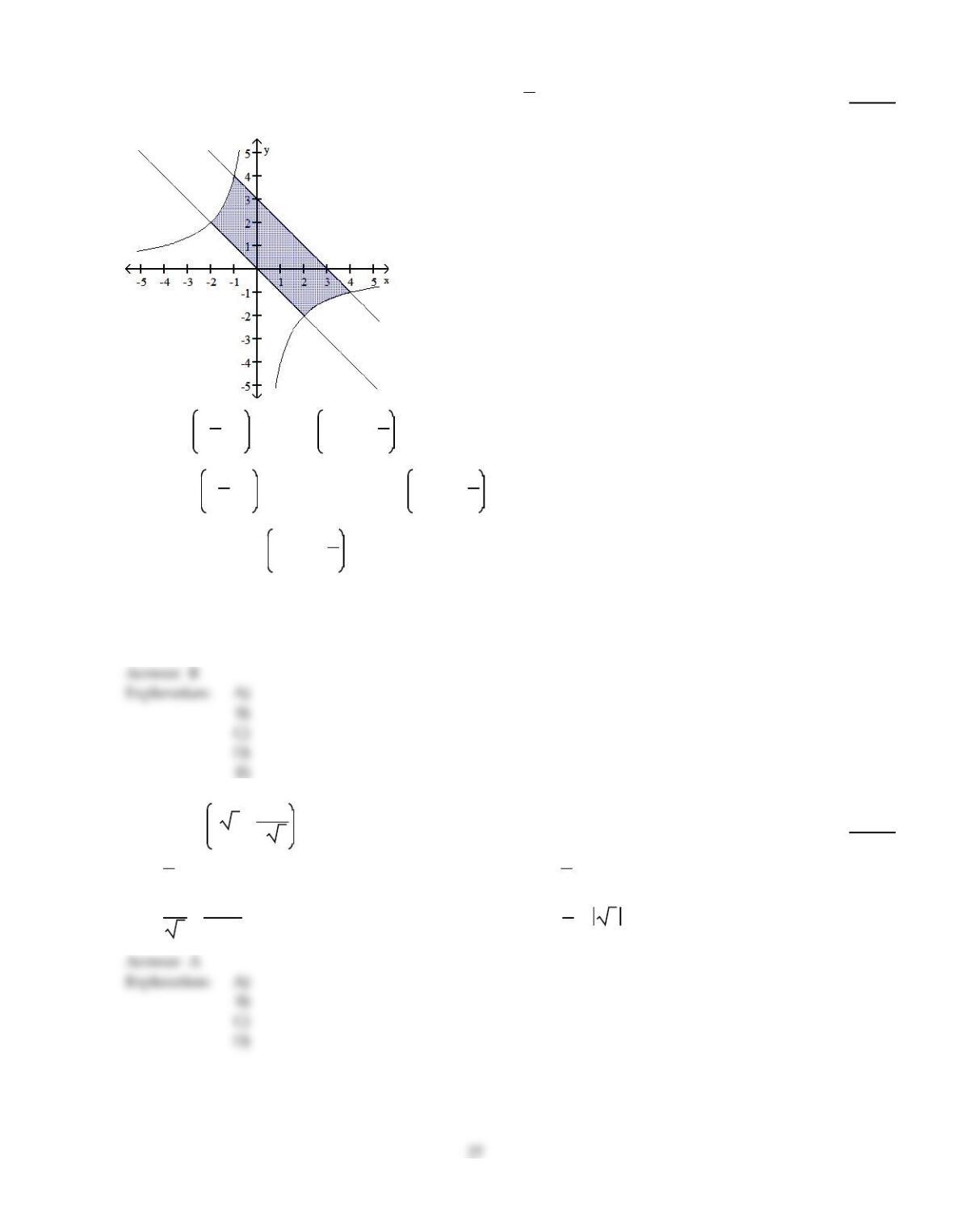
In the figure below, the region enclosed by the curves y = – 4
x , y = – x, and y = – x + 3 is shown. Set
up an integral or sum of integrals to find the area of the shaded region. (Do not calculate the area.)
105)
A)
0
–2
–4
x+ x dx +
2
0
–x + 3 +4
x dx
B)
–1
–2
–4
x+ x dx +
2
–1
3 dx +
4
2
–x + 3 +4
x dx
C)
2
–2
3 dx +
4
2
–x + 3 –4
x dx
D)
4
–2
3 dx
E)
none of these
106)
Find: 4 x –1
2 x dx
106)
A)
8
3x3/2 –x1/2 + C
B)
2x3/2 +1
4x1/2 + C
C)
2
x
+1
4x3/2 + C
D)
6x3/2 –1
2 ln x+ C
107)
Set up an integral or sum of integrals and then find the area bounded by y =x2+ 3 and y = – 5x – 3.
107)
A)
3
2
[(x2+ 3) – (–5x – 3)] dx =149
6
B)
–2
–3
[(x2+ 3) – (–5x – 3)] dx = – 1
6
C)
–2
–3
[(–5x – 3) – (x2+ 3)] dx =1
6
D)
3
2
[(–5x – 3) – (x2+ 3)] dx = – 149
6
E)
none of these
Solve the problem.
108)
In a certain memory experiment, subject A is able to memorize words at a rate given by
m’(t) = – 0.006t2+ 0.2t (words per minute).
In the same memory experiment, subject B is able to memorize at the rate given by
M'(t) = – 0.003t2+ 0.2t (words per minute).
How many more words does subject B memorize from t = 0 to t =19 (during the first 19 minutes)?
Round to the nearest word.
108)
A)
7 words
B)
29 words
C)
43 words
D)
21 words
Find the value of k that makes the antidifferentiation formula true.
109)
x–7 dx = kx–6+ C
109)
A)
6
B)
–1
6
C)
–6
D)
1
6
Refer to the graph to answer the question.
28
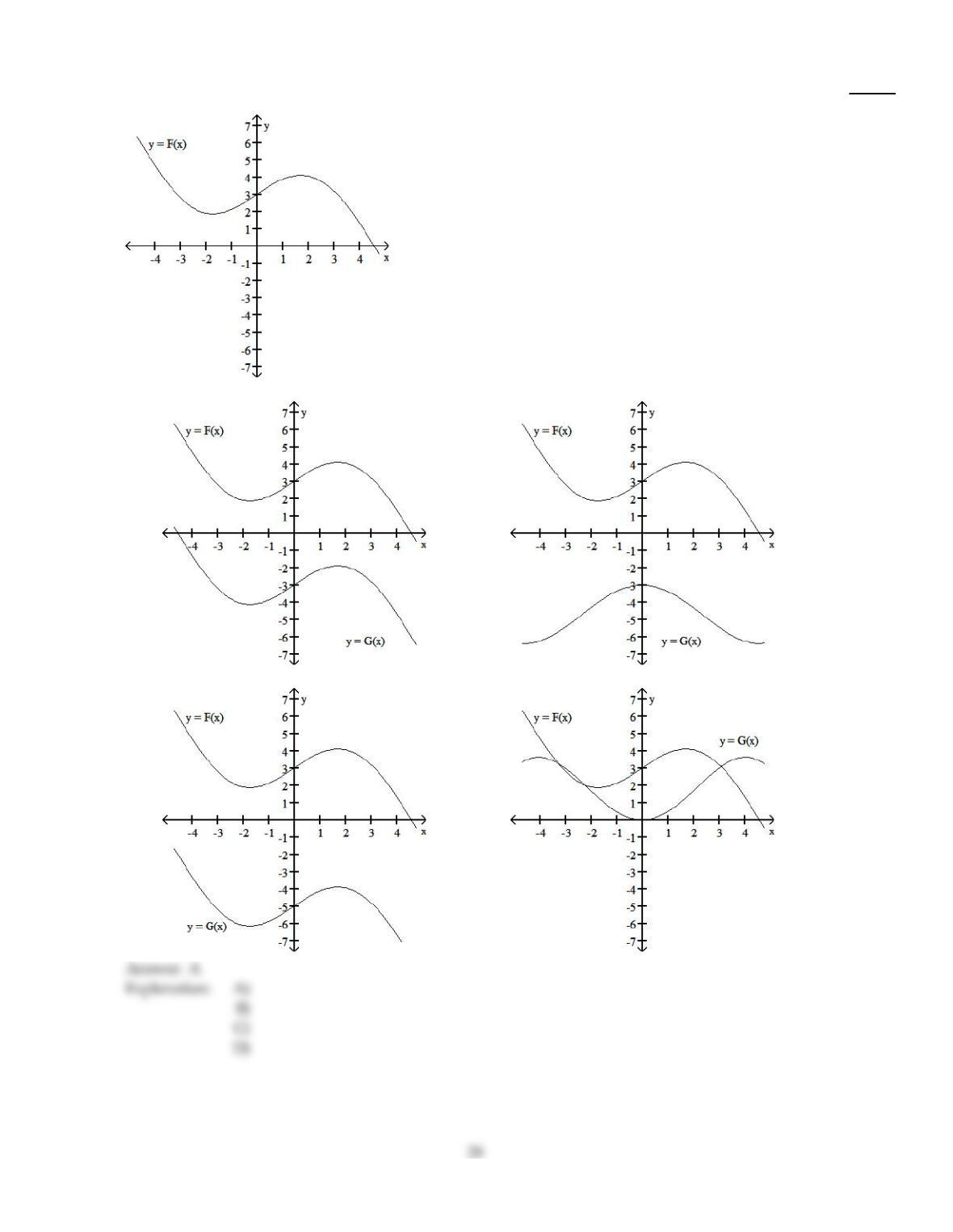
110)
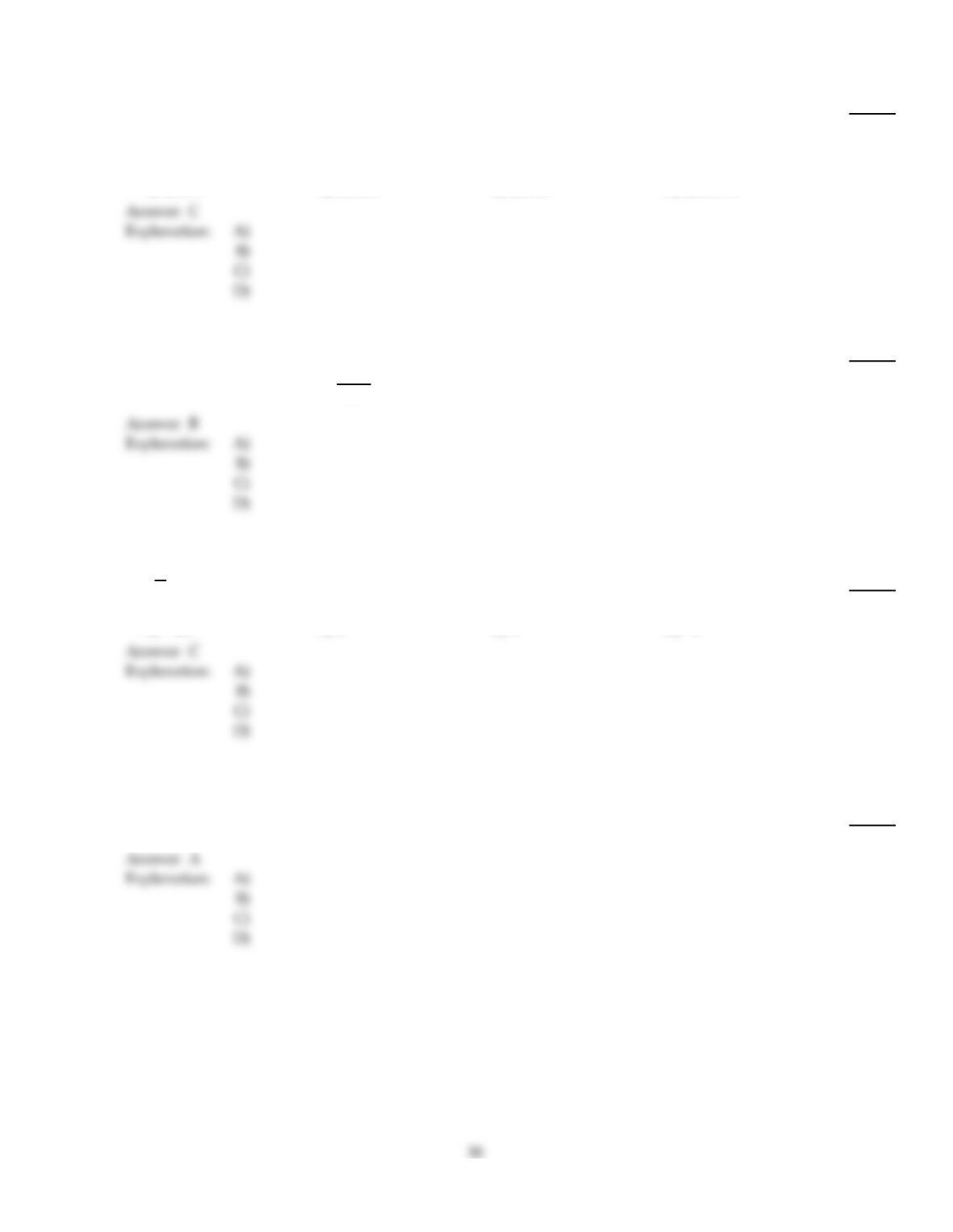
The graph below shows the function F(x). On the same coordinate system, draw the graph of the
function G(x) having the properties G(0) = – 3 and G(x) =F(x) for all x.
110)
A)
B)
C)
D)
Solve the problem.
111)
A kitchen remodeling company determines that the marginal cost, in dollars per foot, of installing x
feet of kitchen countertop is given by
C'(x) = 7x–1/3.
Find the cost of installing an extra 12 feet of countertop after 30 feet have already been ordered.
111)
A)
$50.99
B)
$55.04
C)
$25.49
D)
$253.74
Find the volume generated by revolving about the x–axis the region bounded by the following graph.
112)
y =x2, x = 0, x =6
112)
A)
72
B)
7776
5
C)
1944
D)
324
Evaluate.
113)
e
1
4
xdx
113)
A)
–2e2
B)
0
C)
4
D)
–4
Use a Riemann sum to approximate the area under the graph of f(x) on the given interval, with selected points as
specified.
114)
f(x) =x2, x =3 to x =7, n = 4; use midpoints of subintervals
114)
A)
105
B)
126
C)
86
D)
117
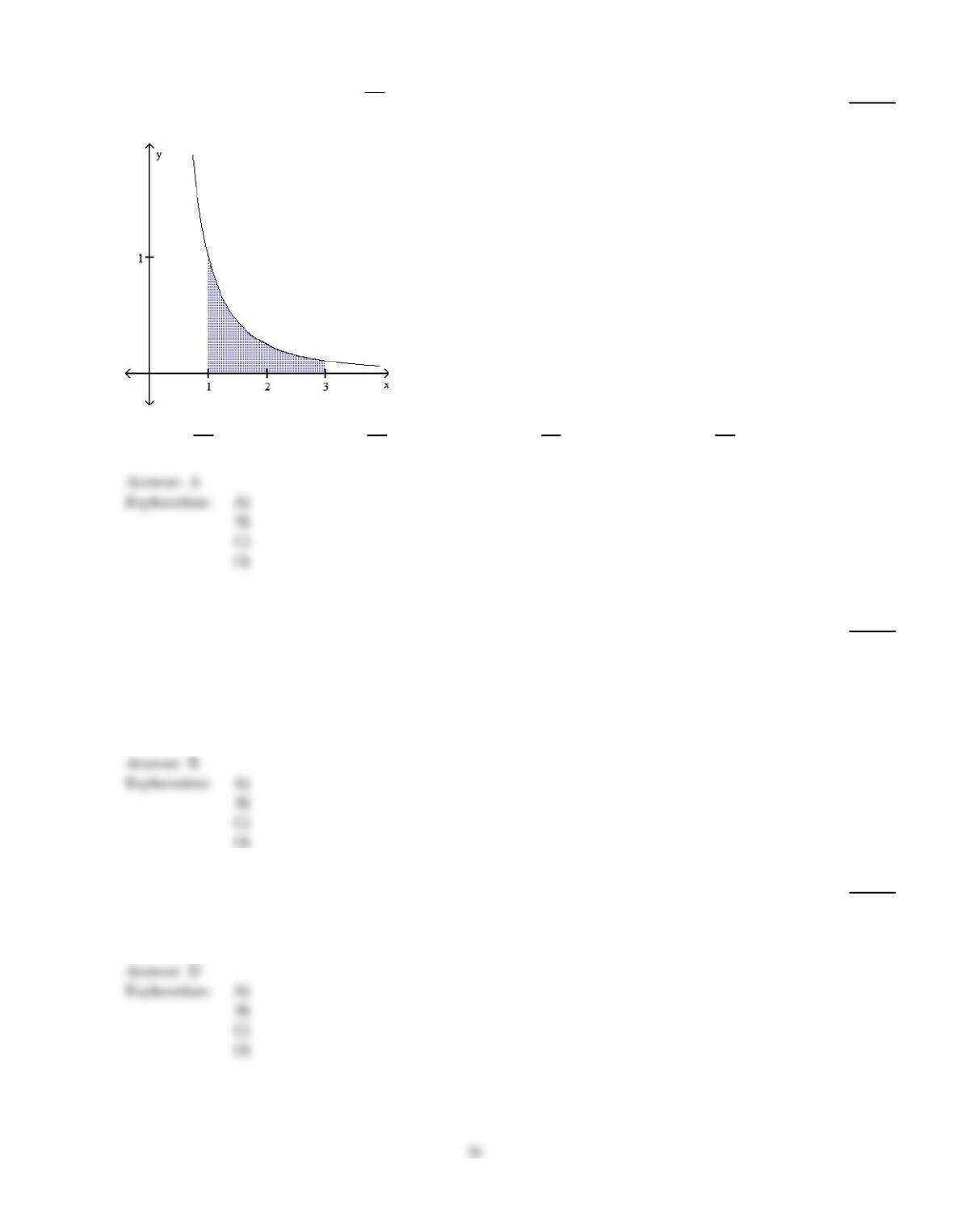
115)
Given the graph of the function y =1
x2, set up the definite integral that gives the area of the shaded
region.
115)
A)
3
1
1
x2dx
B)
2
0
1
x2dx
C)
1
0
1
x2dx
D)
3
0
1
x2dx
Solve the problem.
116)
The velocity of particle A, t seconds after its release is given by
va(t) =9.8t –0.6t2 meters per second. The velocity of particle B, t seconds after its release is given by
vb(t) =12.5t –0.4t2 meters per second. If velocity is measured in meters per second, how much
farther does particle B travel than particle A during the first ten seconds (from t = 0 to t = 10)?
Round to the nearest meter.
116)
A)
470 m
B)
202 m
C)
4 m
D)
335 m
117)
A manufacturer determined that its marginal cost per unit produced is given by the function
C'(x) = 0.0006x2– 0.4x +76.
Find the total cost of producing the 301st unit through the 400th unit.
117)
A)
$1000
B)
$8400
C)
$4700
D)
$990.02
Find f such that the given conditions are satisfied.
118)
f'(x) =x2–7x +5, f(0) =8
118)
A)
f(x) =1
3x3–8x2+5x +8
B)
f(x) =1
3x3–8x2+5x + 1
C)
f(x) =1
3x3–7
2x2+5x + 1
D)
f(x) =1
3x3–7
2x2+5x +8
119)
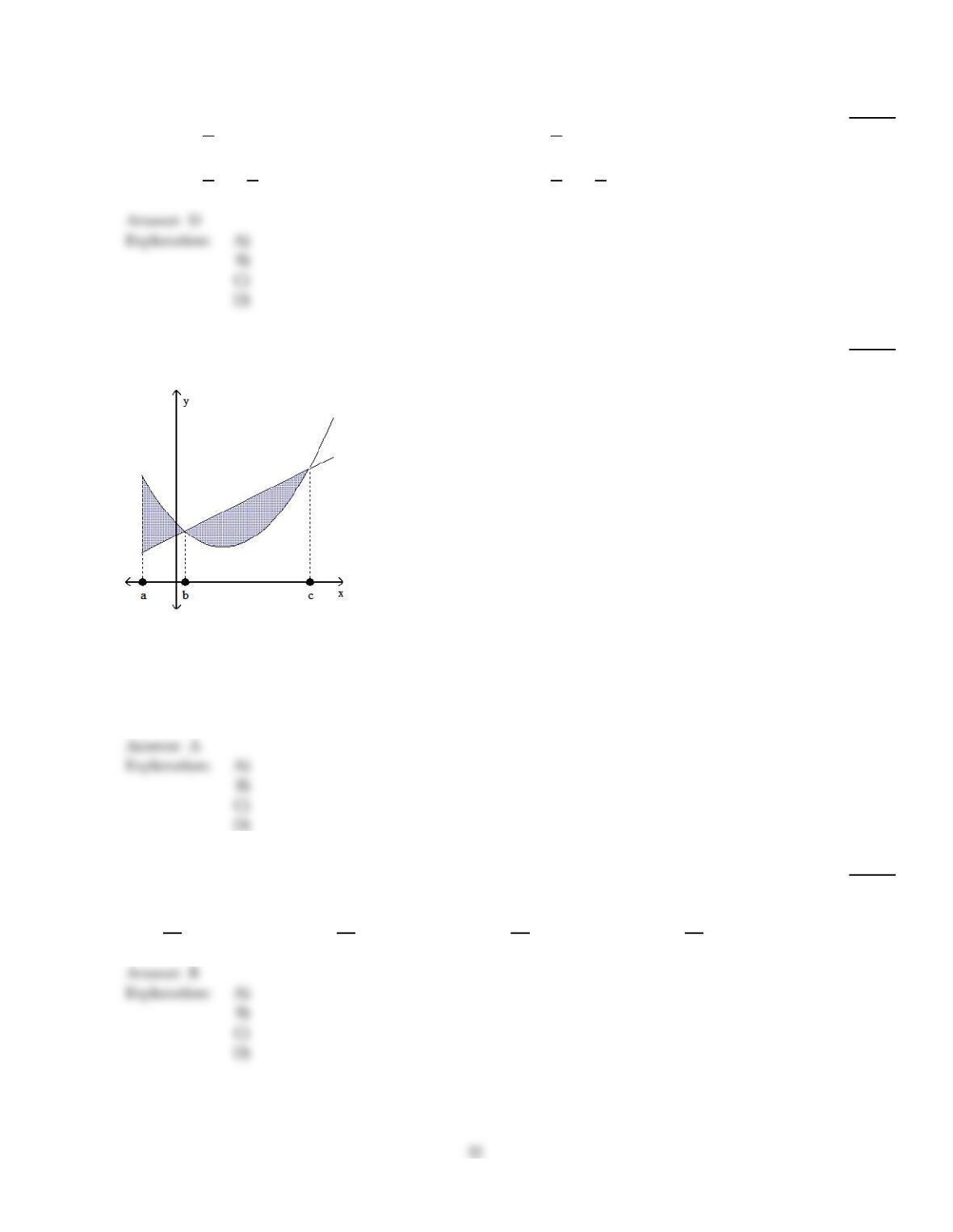
Set up a definite integral or sum of definite integrals that represent the indicated shaded areas over
the interval [a, c].
y = g(x)
y = f(x)
119)
A)
b
a
[g(x) – f(x)] dx +
c
b
[f(x) – g(x)] dx
B)
a
b
[f(x) – g(x)] dx +
c
b
[g(x) – f(x)] dx
C)
c
a
[f(x) – g(x)] dx
D)
b
a
[f(x) – g(x)] dx +
c
b
[g(x) – f(x)] dx
120)
Use a Riemann sum to approximate the area under the graph of f(x) on the given interval. Use the
left endpoints.
f(x) =3x – 4; 2 x 5, n = 6
120)
A)
51
4=12.75
B)
69
4=17.25
C)
63
4=15.75
D)
87
4=21.75
121)
Find the producers’ surplus for the supply curve p = 4 +1
2x at x = 144.
121)
A)
$724
B)
$392
C)
$1152
D)
$288
122)
What is the area under the curve y =x3+ x from x = 1 to x = 2?
122)
A)
21
2
B)
21
4
C)
6
4
D)
61
4
E)
none of these
Find the volume generated by revolving about the x–axis the region bounded by the following graph.
123)
y =x, x = 0, x =8
123)
A)
32
B)
64
3
C)
4
D)
8
Use a Riemann sum to approximate the area under the graph of f(x) on the given interval, with selected points as
specified.
124)
f(x) =e–x+3 from x = – 2 to x =2, n = 4; use right endpoints
round the answer to two decimal places
124)
A)
23.48
B)
12.54
C)
16.22
D)
18.96
33