55. Which of the following statements regarding service companies and activity-based costing (ABC) is true?
56. Activity-based costing (ABC):
57. Which of the following items might cause activity-based costing (ABC) to be more difficult to implement in
a service company than in a manufacturing company?
58. Which of the following types of costs would service-oriented companies be more likely to have
proportionately more of than manufacturing companies?
59. Which of the following is not a benefit of activity-based costing (ABC)?
60. Which of the following is false regarding activity-based costing (ABC)?
61. Which of the following types of companies would be most likely to benefit from activity-based costing?
62. Which of the following would be a likely disadvantage of activity-based costing (ABC)?
63. Which of the following is a likely advantage in activity-based costing (ABC)?
64. Which of the following is true regarding activity-based costing (ABC)?
65. In ____ costing system, product costs are accumulated directly in cost of goods sold.
66. Which of the following statements is false regarding “backflush” costing?
67. Barrow Manufacturing produces made-to-order backyard pools. During the year, Barrow accepted a
customer order that required direct materials costing $2,500. If Barrow uses backflush costing, which account
should be increased when the materials are purchased?
68. All of the following statements about service department costs are true except:
69. Companies allocate service department costs to other departments for all of the following reasons except:
70. Which of the following would be classified as a service department?

71. Danville Manufacturing
The Danville Manufacturing Company has two service departments and two producing departments. The
following data are available for 2006.
Service
Service
Producing
Producing
Dept. 1
Dept. 2
1
2
Department Costs
$12,000
$8,000
$60,000
$70,000
Number of Transactions
6,000
4,000
6,000
14,000
Square Feet Occupied
2,000
1,000
4,000
6,000
The costs of service departments 1 and 2 are allocated on the basis of number of transactions and square feet occupied, respectively.
Refer to the Danville Manufacturing information above. Assuming that Danville Manufacturing Company allocates service department 1 costs first,
the amount of service department 1 costs allocated to service department 2 under the step-down method would be:
72. Danville Manufacturing
The Danville Manufacturing Company has two service departments and two producing departments. The
following data are available for 2006.
Service
Service
Producing
Producing
Dept. 1
Dept. 2
1
2
Department Costs
$12,000
$8,000
$60,000
$70,000
Number of Transactions
6,000
4,000
6,000
14,000
Square Feet Occupied
2,000
1,000
4,000
6,000
The costs of service departments 1 and 2 are allocated on the basis of number of transactions and square feet occupied, respectively.
Refer to the Danville Manufacturing information above. Assuming that Danville Manufacturing Company allocates service department 1 costs first,
the amount of service department 2 costs allocated to producing 1 under the step-down method would be:
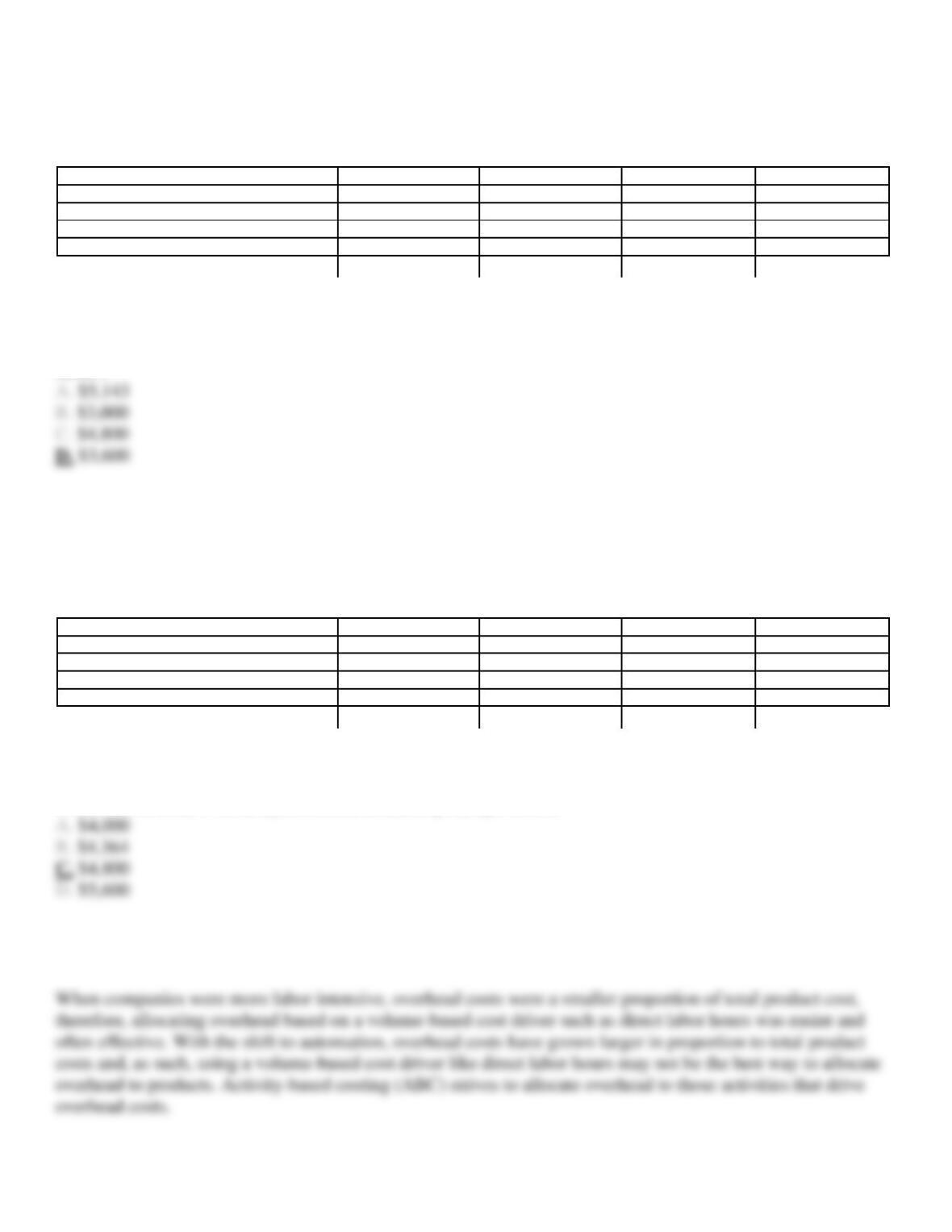
73. Danville Manufacturing
The Danville Manufacturing Company has two service departments and two producing departments. The
following data are available for 2006.
Service
Service
Producing
Producing
Dept. 1
Dept. 2
1
2
Department Costs
$12,000
$8,000
$60,000
$70,000
Number of Transactions
6,000
4,000
6,000
14,000
Square Feet Occupied
2,000
1,000
4,000
6,000
The costs of service departments 1 and 2 are allocated on the basis of number of transactions and square feet occupied, respectively.
Refer to the Danville Manufacturing information above. Assuming that Danville Manufacturing Company uses the direct method of allocating
service costs, the amount of service department 1 costs allocated to producing 1 would be: (If necessary, round your answer to the nearest whole
number.)
74. Danville Manufacturing
The Danville Manufacturing Company has two service departments and two producing departments. The
following data are available for 2006.
Service
Service
Producing
Producing
Dept. 1
Dept. 2
1
2
Department Costs
$12,000
$8,000
$60,000
$70,000
Number of Transactions
6,000
4,000
6,000
14,000
Square Feet Occupied
2,000
1,000
4,000
6,000
The costs of service departments 1 and 2 are allocated on the basis of number of transactions and square feet occupied, respectively.
Refer to the Danville Manufacturing information above. Assuming that Danville Manufacturing Company uses the direct method of allocating
service costs, the amount of service department 2 costs allocated to producing 2 would be:
75. Discuss how the shift from labor intensive manufacturing to automation has affected product costing.
76. Identify and define each of the four general types of cost classifications used with activity-based costing
(ABC).
77. Give two examples for each of the four types of cost classifications.
Unit-level:
1.
2.
Batch-level:
1.
2.
Product-level:
1.
2.
Facility-level:
1.
2.
Unit-level:
1. supplies for factory
2. utilities for factory machinery
3. depreciation on factory machinery
4. repairs and maintenance on factory machinery
Batch-level:
1. salaries related to purchasing/receiving
2. quality control costs
3. salaries related to moving material
4. depreciation of setup equipment
Product-level:
1. salaries of engineers
2. product development (testing) costs
3. depreciation of engineering equipment
4. quality control costs
Facility-level:
1. depreciation of factory building or rent
2. factory insurance, taxes, etc.
3. salary of plant manager
4. employee training
78. Classify each of the following costs as unit-level (U), batch-level (B), product-level (P), or facility-level (F).
factory supplies
factory insurance
product development costs
depreciation of factory equipment
depreciation of set-up equipment
utilities costs for factory machinery
salaries of product engineers
salary of plant manager
repairs of factory machinery
factory rent
79. What is meant by the term “activity” in activity-based costing (ABC)? How are costs allocated in ABC?
80. For each of the following activities, identify one potential cost driver.
a.
repair and maintenance of factory equipment
b.
supplies for factory
c.
purchasing
d.
quality control inspections
e.
machine setups
potential cost driver:
a.
repair and maintenance of factory equipment
machine hours, labor hours, number
of units
b.
supplies for factory
machine hours, number of units
c.
purchasing
number of purchase orders, number
d.
quality control inspections
number of inspections, inspection hours
e.
machine setups
number of setups
factory supplies
U
factory insurance
F
product development costs
P
depreciation of factory equipment
U
depreciation of set-up equipment
B
utilities costs for factory machinery
U
salaries of product engineers
P
salary of plant manager
F
repairs of factory machinery
U
factory rent
F
81. Define “cross subsidies” and tell what kind of product costing system is likely to have them. What happens
to cross subsidies in activity-based costing (ABC)?
82. When comparing traditional product costing and activity-based costing (ABC), which kind(s) of costs are
allocated to products in a similar manner and which kind(s) are allocated to products in a different manner?
Explain your answers.
83. Can activity-based costing (ABC) be used by service companies? If so, is the implementation of an ABC
system in a service company different than that of a manufacturing company?
84. What are the benefits and limitations of activity-based costing (ABC) systems?
85. When is it appropriate to use “backflush” costing? Explain how backflush costing differs from traditional
product costing. What are some of its advantages and disadvantages?
86. List three reasons why service department costs should be allocated to production and explain the difference
between the direct method and the step-down method of allocating service costs.
Reasons why companies allocate service department costs to production include the following:
87. Ken’s Carpets sells carpet for both residential and business use. To better estimate costs, the company
recently adopted an activity-based costing system. Last year, the company incurred $300,000 in overhead costs.
Based on an intense study of their company, the following activities, allocation bases, and percentages of
overhead costs were determined:
Activity
Allocation Base
Proportion of Overhead Cost
Purchasing
Number of purchase orders
25%
Materials processing
Number of square feet
50%
Sales
Number of sales orders
25%
The number of activities for residential and business is as follows:
Residential
Business
Number of purchase orders
700
500
Number of square feet
4,000,000
2,000,000
Number of sales orders
400
100
Required:
A.
Calculate the total overhead that should be allocated to each of the three activities.
B.
Calculate the overhead rates for each of the three activities.
C.
If a particular residential job requires 4 purchase orders and 1 sales order for total of 1,500 square feet of carpet, how much overhead
should be allocated to the job?
A.
Purchasing:
$300,000 ´ 25% = $ 75,000
Materials processing:
$300,000 ´ 50% = $150,000
Sales:
$300,000 ´ 25% = $ 75,000
B.
Purchasing:
$75,000 ¸ 1,200 = $62.50 per purchase order
Materials processing:
$150,000 ¸ 6,000,000 = $.025 per square foot
Sales:
$75,000 ¸ 500 = $150 per sales order
C.
Purchasing:
$62.50 ´ 4 = $250.00
Materials processing:
$.025 ´ 1,500 = 37.50
Sales:
$150 ´ 1 = 150.00
Overhead allocated to job
$437.50
88. Mountaineer Tents manufactures and sells heavy and light duty tents to various outdoor retailers. To better
estimate costs, the company recently adopted an activity-based costing system. Last year, the company incurred
$900,000 in overhead costs. Based on an intense study of their company, the following activities, allocation
bases, and percentages of overhead costs were determined:
Activity
Allocation Base
Proportion of Overhead Cost
Purchasing
Number of purchase orders
55%
Inspections
Number of inspections
20%
Sales
Number of sales orders
25%
The number of activities for heavy and light duty tents is as follows:
Heavy-duty
Light-duty
Number of purchase orders
5,000
4,000
Number of inspections
3,000
1,000
Number of sales orders
800
400
Required:
A.
Calculate the total overhead that should be allocated to each of the three activities.
B.
Calculate the overhead rates for each of the three activities.
C.
If a single sales order requires 10 purchase orders and 30 inspections to fill, how much overhead should be applied to the order?
A.
Purchasing:
$900,000 ´ 55% = $495,000
Inspecting:
$900,000 ´ 20% = $180,000
Sales:
$900,000 ´ 25% = $225,000
B.
Purchasing:
$495,000 ¸ 9,000 = $55 per purchase order
Inspecting:
$180,000 ¸ 4,000 = $45 per inspection
Sales:
$225,000 ¸ 1,200 = $187.50 per sales order
C.
Purchasing:
$55 ´ 10 = $ 550.00
Inspecting:
$45 ´ 30 = 1,350.00
Sales:
$187.50 ´ 1 = 187.50
Overhead allocated to job
$2,087.50
89. The following overhead cost information is available for Millennium Inc. for 2006:
Activity
Allocation Base
Overhead Cost
Purchasing
Number of purchase orders
$300,000
Machine setups
Number of setups
150,000
Quality control
Number of inspections
50,000
During the year, 4,000 purchase orders were issued; 8,000 machine setups were performed; and 2,000 inspections were conducted.
Required:
A.
Calculate the overhead rates for each of the three activities.
B.
If a particular job requires 10 purchase orders, 6 setups, and 5 inspections to fill, how much overhead should be applied to the job?
Purchasing:
$300,000 ¸ 4,000 = $75.00 per purchase order
Machine setups:
$150,000 ¸ 8,000 = $18.75 per setup
Quality control:
$ 50,000 ¸ 2,000 = $25.00 per inspection
Purchasing:
Machine setups:
$18.75 ´ 6 = 112.50
Quality control:
$25.00 ´ 5 = 125.00
Overhead allocated to job
$987.50
90. The following overhead cost information is available for Lowman Inc. for 2006:
Activity
Allocation Base
Overhead Cost
Purchasing
Number of purchase orders
$200,000
Machine setups
Number of setups
80,000
Quality control
Number of inspections
60,000
During the year, 2,000 purchase orders were issued; 500 machine setups were performed; and 1,500 inspections were conducted.
Required:
A.
Calculate the overhead rates for each of the three activities.
B.
If a particular job requires 8 purchase orders, 3 setups, and 4 inspections to fill, how much overhead should be applied to the job?
Overhead allocated to job
$1,440
91. Thurman Brothers Construction manufactures and installs standard and custom-made cabinetry for
residential homes. Last year, the company incurred $600,000 in overhead costs when a total of 10,000 direct
labor hours were incurred. After implementing activity-based costing (ABC), the company’s accountant
identified the following related information:
Proportion of
Activity
Allocation Base
Overhead Cost
Material delivery and handling
Number of deliveries
30%
Inspections
Number of inspections
25%
Supervision
Hours of supervisor time
20%
Purchasing
Number of purchase orders
25%
The number of activities for standard and custom-made cabinets is as follows:
Standard
Custom-made
Number of deliveries
500
700
Number of inspections
600
400
Hours of supervisor time
1,000
2,000
Number of purchase orders
800
400
During the past year, Thurman accepted a customer order for a set of custom-made cabinets that would require the following:
Direct labor hours
45
Number of deliveries
4
Number of inspections
5
Hours of supervisor time
2
Number of purchase orders
4
Required:
A.
How much overhead would be applied to the job if traditional costing using direct labor hours as the cost driver were used?
B.
Using activity-based costing (ABC), what would be the overhead rate for each of the four activities?
C.
Using activity-based costing (ABC), what would be the total overhead applied to the above job?
D.
Compare the overhead applied using traditional costing to ABC costing and remark on the difference. Which one do you think is more
accurate?
B.
Material delivery and handling:
($600,000 ´ 30%) ¸ 1,200 = $150 per delivery
Inspections:
($600,000 ´ 25%) ¸ 1,000 = $150 per inspection
Supervision:
($600,000 ´ 20%) ¸ 3,000 = $ 40 per supervisor hour
Purchasing:
($600,000 ´ 25%) ¸ 1,200 = $125 per purchase order
C.
Material delivery and handling:
$150 ´ 4 = $ 600
Inspections:
$150 ´ 5 = 750
Total overhead allocated using ABC
$1,930